


 Скачать презентацию H 2 E — Cost Savings Through Red
194f24e9fb1c4d93bc4dfabd3a14834c.ppt
- Количество слайдов: 20
 H 2 E -- Cost Savings Through Red Bag Reduction Janet Brown, Medical Waste Manager Beth Israel, New York, NY - February 2003
 REALITY NO SPACE - NO TIME - NO MONEY
 Awards • 2002 AHA/EPA H 2 E Partners for Change Award • 2001 US EPA Region 2 Environmental Quality Award • 1999 Health Care Without Harm’s Honors for Contribution to a Mercury-free Environment • 1999 - AHA/EPA Waste Minimization Work Group • 1998 Health Care Without Harm Environmental Health Award • 1998 Citizens’ Environmental Coalition’s Activist Award
 Commitment to Environmental Management -- Why bother? n. Saves Money n n n n Ethical Responsibility Public Health Impact Environmental Impact Liability/Regulatory Compliance Safety/Employee Engagement Press Coverage/Awards Patient Satisfaction Corporate Identity
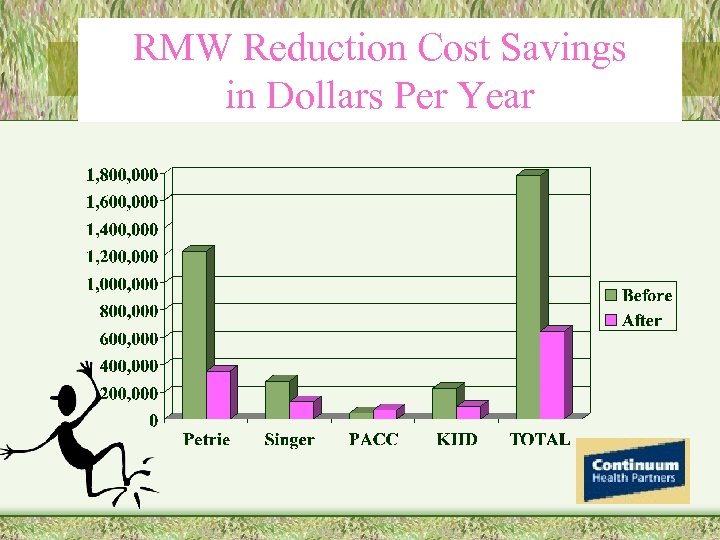 RMW Reduction Cost Savings in Dollars Per Year
 Environmental Impact • The EPA has reported that medical waste incinerators are major sources for both mercury and dioxin in the environment. • Health Care facilities generate double the amount of plastics than other municipal institutions.
 Liability/Regulatory Compliance • • Occupational exposure Perception -- Fear of hospital waste Cradle to grave responsibility Implications of Fresh Kills Landfill closure and export of waste to other states. • JCAHO, OSHA, EPA, DEC and DOH. • Negative press.
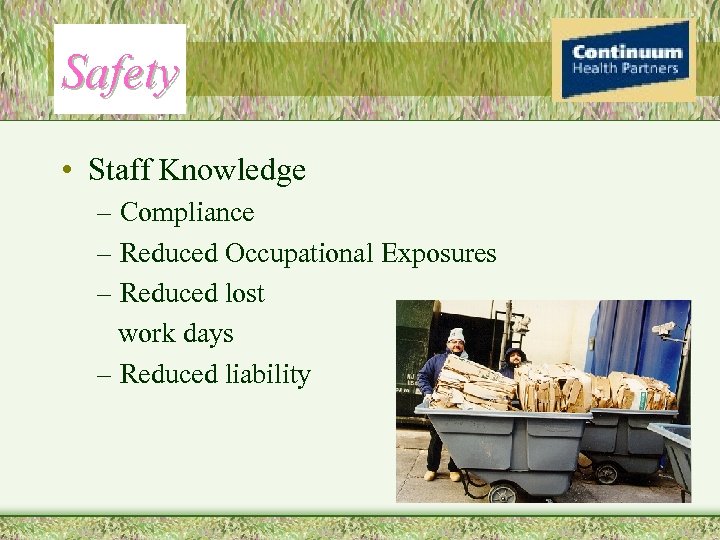 Safety • Staff Knowledge – Compliance – Reduced Occupational Exposures – Reduced lost work days – Reduced liability
 Employee Engagement • Environmental commitment is everyone’s responsibility. • % incentive for proper segregation and waste prevention initiatives. • Development of corporate identity. • Employee’s are part of the solution and feel positive that their work is appreciated. • Safe environment shows we care.
 Why Reduce Red Bags First? • Red Bag Waste is at least 5 x more expensive than NRMW. • No other waste management program will save as much as RMW reduction. • Savings in RMW reduction will pave way to future programs. • RMW reduction can justify more costly programs
 Red Bag Reduction Plan • Calculate Potential Cost Savings* • Present to Administration • Shared Savings Program • Designate a Waste Manager • Cement Administrative Support • Define RMW through Infection Control Committee • Define Pathological and Cytotoxic Drug Waste. • Facility Survey • Standardization • Signage • Education • Monitoring • Maintenance • Reporting * See Laura Brannen’s cost savings calculation aid attached.
 Common Obstacles • Fear of Waste • No Time to Segregate! • Poor Signage • Red bagging IV bags • Overfilled Red Bag • Poor Placement of Waste Containers • Foley Bags/diapers • Housekeeping commingling waste • Isolation Waste
 Red Bag Waste removal is five times more expensive than regular waste What Goes in the Red Bag Anyway? YES RED BAG ME • • • Blood, products of blood, anything caked, soaked or dripping in blood. Suction Canisters containing any fluid. Cultures and stocks of infectious agents Pathological waste, placenta Items saturated with the following fluids as defined by OSHA: vaginal fluid, semen, pleural fluid, cerebrospinal fluid, synovial fluid, pericardial fluid and amniotic fluid in addition to any fluid visibly contaminated with blood. Waste from patients isolated with highly communicable diseases as per CDC. NO - USE REGULAR GARBAGE • • • Blood-tainted waste IV bags and their tubing Urine, vomit, feces, diapers Nonbloody gloves Items tainted (versus soaked) with the fluids listed. Nonbloody drapes, packaging, personal protective equipment Questions? Call Waste Manager at 420 -2442
 And Don’t Forget. . . • Change bag ordering to reflect usage. • Spot check both red and clear bags! • Walk those floors! • Keep on Educating! • Reward Success! • Be patient…. • Pat yourself on the back. • Maintain program and start planning your next program recycling, bulbs, mercury phase out. . .
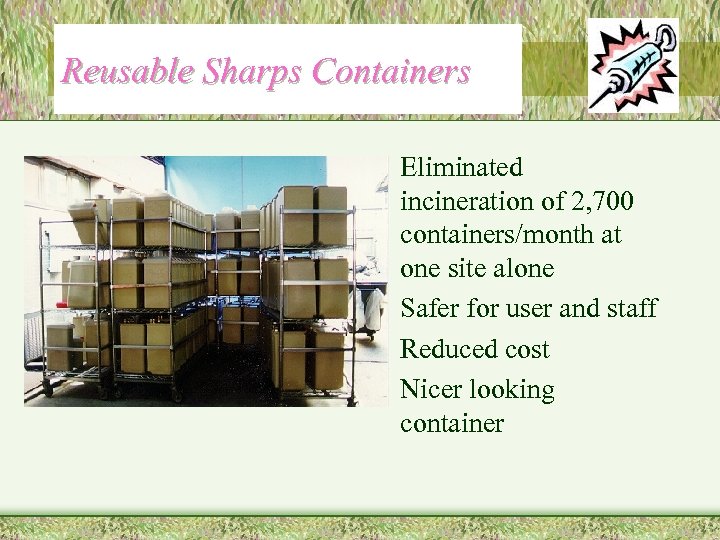 Reusable Sharps Containers • Eliminated incineration of 2, 700 containers/month at one site alone • Safer for user and staff • Reduced cost • Nicer looking container
 Disposable vs. Reusable Sharps Containers Disposable • Nurses were responsible for changing containers • Containers often overfilled. • Containers often removed without being closed properly. • Disposable filled containers were stored in the soiled utility rooms • Too many employees handling sharps containers. • Beth Israel incinerated approximately 2, 700 disposable sharps containers per month at one site alone! Reusable • Vendor offered a full-service sharps management service. • One dedicated person for handling sharps. • Much fewer incidents of overfilled containers. • Nicer looking container • Reduced needle sticks associated with waste • Elimination of 2, 700 containers per month! • Reduced liability • Positive feedback from staff.
 Successful Programs • • • Simplicity Economically Viable Communication Support Employee Incentive
 Taking our commitment to the next level • Environmental commitment should be maintained like any other service line. • Corporate and executive-wide support would generate a stronger community-wide commitment. • Commitment to an environmental agenda throughout Continuum has to mean more than having a waste manager.
 Next Level • Implement an Environmental Management System • Environmental leadership Committee • Environmentally Preferable Purchasing • Energy Conservation • Mercury phase-out • Expanded and increased recycling • Green cleaning • Green building • Surplus sharing
 Janet Brown Beth Israel Medical Center 212/420 -2442 jhbrown@bethisraelny. org