 Скачать презентацию GWC 2018 — WORD EMBEDDING Multilingual Word Net
4ac8c38e1010082e93b3ab7526efdbdc.ppt
- Количество слайдов: 30



GWC 2018 - WORD EMBEDDING Multilingual Word. Net sense Ranking using nearest context Authors: Umamaheswari and Francis Bond School of Humanities, LMS, NTU, Singapore.
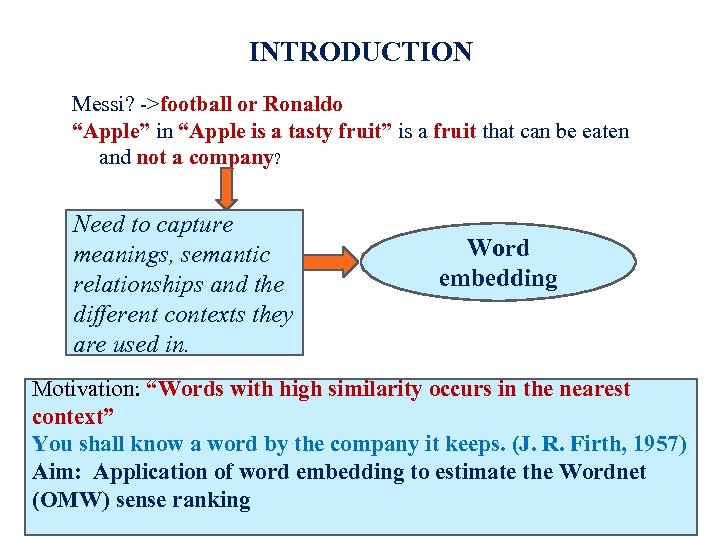
INTRODUCTION Messi? ->football or Ronaldo “Apple” in “Apple is a tasty fruit” is a fruit that can be eaten and not a company? Need to capture meanings, semantic relationships and the different contexts they are used in. Word embedding Motivation: “Words with high similarity occurs in the nearest context” You shall know a word by the company it keeps. (J. R. Firth, 1957) Aim: Application of word embedding to estimate the Wordnet (OMW) sense ranking
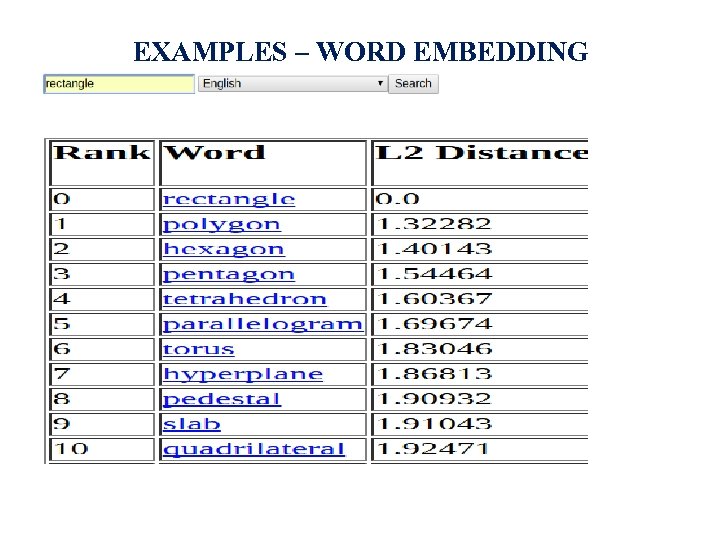
EXAMPLES – WORD EMBEDDING
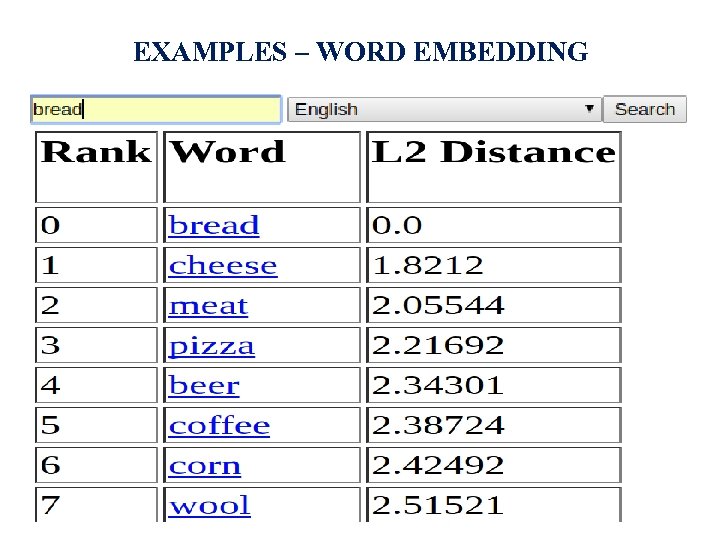
EXAMPLES – WORD EMBEDDING

I decorated this house in
I decorated this house in red
I decorated this house in blue

I decorated this house in June
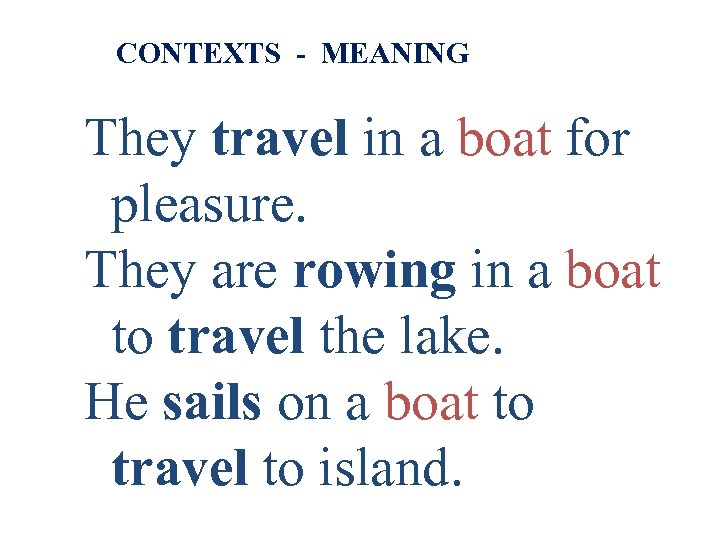
CONTEXTS - MEANING They travel in a boat for pleasure. They are rowing in a boat to travel the lake. He sails on a boat to travel to island.
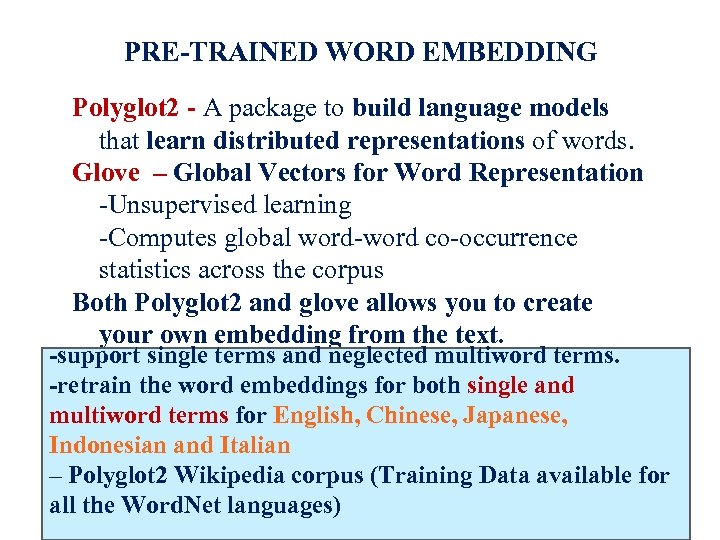
PRE-TRAINED WORD EMBEDDING Polyglot 2 - A package to build language models that learn distributed representations of words. Glove – Global Vectors for Word Representation -Unsupervised learning -Computes global word-word co-occurrence statistics across the corpus Both Polyglot 2 and glove allows you to create your own embedding from the text. -support single terms and neglected multiword terms. -retrain the word embeddings for both single and multiword terms for English, Chinese, Japanese, Indonesian and Italian – Polyglot 2 Wikipedia corpus (Training Data available for 10 all the Word. Net languages)
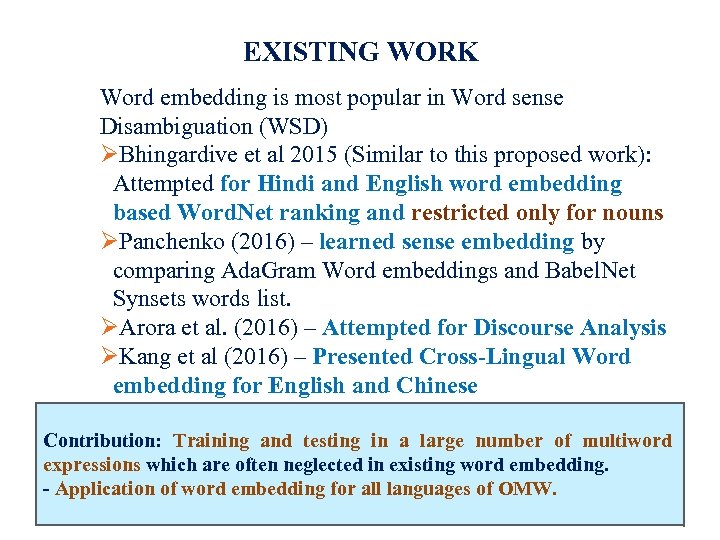
EXISTING WORK Word embedding is most popular in Word sense Disambiguation (WSD) Bhingardive et al 2015 (Similar to this proposed work): Attempted for Hindi and English word embedding based Word. Net ranking and restricted only for nouns Panchenko (2016) – learned sense embedding by comparing Ada. Gram Word embeddings and Babel. Net Synsets words list. Arora et al. (2016) – Attempted for Discourse Analysis Kang et al (2016) – Presented Cross-Lingual Word embedding for English and Chinese Contribution: Training and testing in a large number of multiword expressions which are often neglected in existing word embedding. - Application of word embedding for all languages of OMW. 11
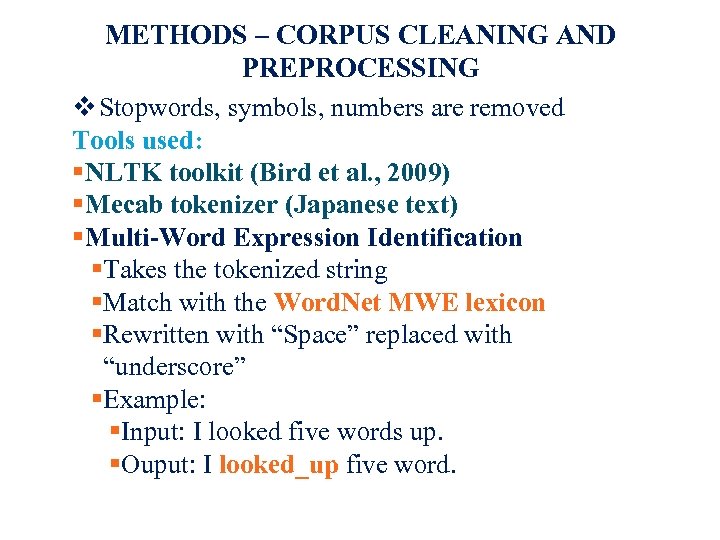
METHODS – CORPUS CLEANING AND PREPROCESSING Stopwords, symbols, numbers are removed Tools used: NLTK toolkit (Bird et al. , 2009) Mecab tokenizer (Japanese text) Multi-Word Expression Identification Takes the tokenized string Match with the Word. Net MWE lexicon Rewritten with “Space” replaced with “underscore” Example: Input: I looked five words up. Ouput: I looked_up five word. 12
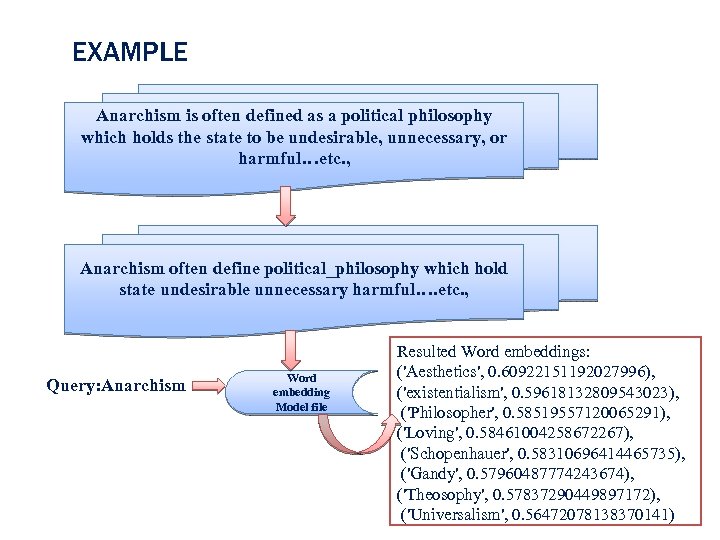
EXAMPLE Anarchism is often defined as a political philosophy which holds the state to be undesirable, unnecessary, or harmful…etc. , Anarchism often define political_philosophy which hold state undesirable unnecessary harmful…. etc. , Query: Anarchism Word embedding Model file Resulted Word embeddings: ('Aesthetics', 0. 60922151192027996), ('existentialism', 0. 59618132809543023), ('Philosopher', 0. 58519557120065291), ('Loving', 0. 58461004258672267), ('Schopenhauer', 0. 58310696414465735), ('Gandy', 0. 57960487774243674), ('Theosophy', 0. 57837290449897172), ('Universalism', 0. 56472078138370141)13
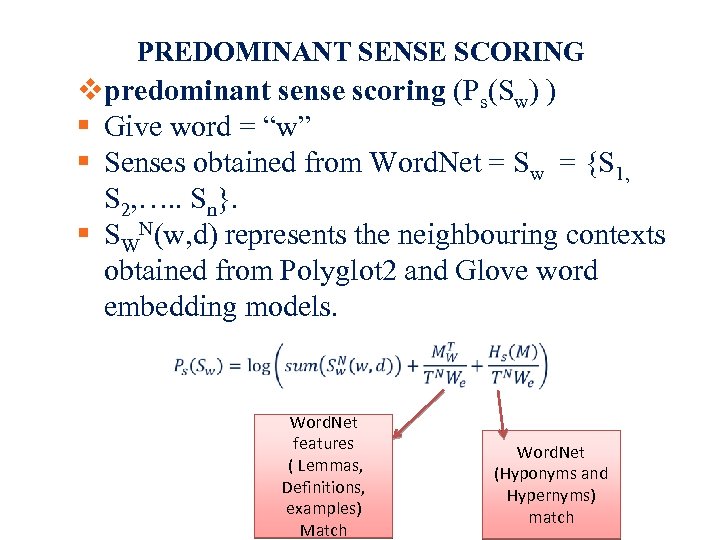
PREDOMINANT SENSE SCORING predominant sense scoring (Ps(Sw) ) Give word = “w” Senses obtained from Word. Net = Sw = {S 1, S 2, …. . Sn}. SWN(w, d) represents the neighbouring contexts obtained from Polyglot 2 and Glove word embedding models. Word. Net features ( Lemmas, Definitions, examples) Match Word. Net (Hyponyms and Hypernyms) match 14
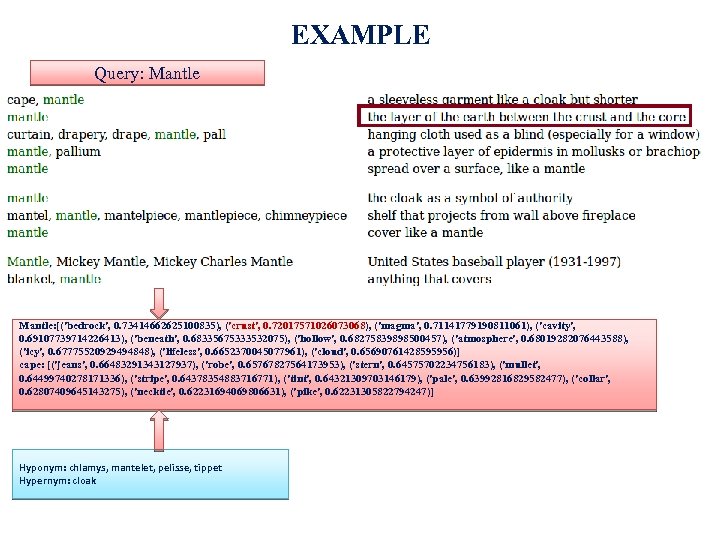
EXAMPLE Query: Mantle: [('bedrock', 0. 73414662625100835), ('crust', 0. 72017571026073068), ('magma', 0. 71141779190811061), ('cavity', 0. 69107739714226413), ('beneath', 0. 68335675333532075), ('hollow', 0. 68275839898500457), ('atmosphere', 0. 68019282076443588), ('icy', 0. 67775520929494848), ('lifeless', 0. 6652370045077961), ('cloud', 0. 65690761428595956)] cape: [('jeans', 0. 66483291343127937), ('robe', 0. 65767827564173953), ('stern', 0. 64575702234756183), ('mullet', 0. 64499740278171336), ('stripe', 0. 64378354883716771), ('tint', 0. 64321309703146179), ('pale', 0. 63992816829582477), ('collar', 0. 62807409645143275), ('necktie', 0. 62231694069806631), ('pike', 0. 62231305822794247)] Hyponym: chlamys, mantelet, pelisse, tippet Hypernym: cloak 15
RESULTS 16
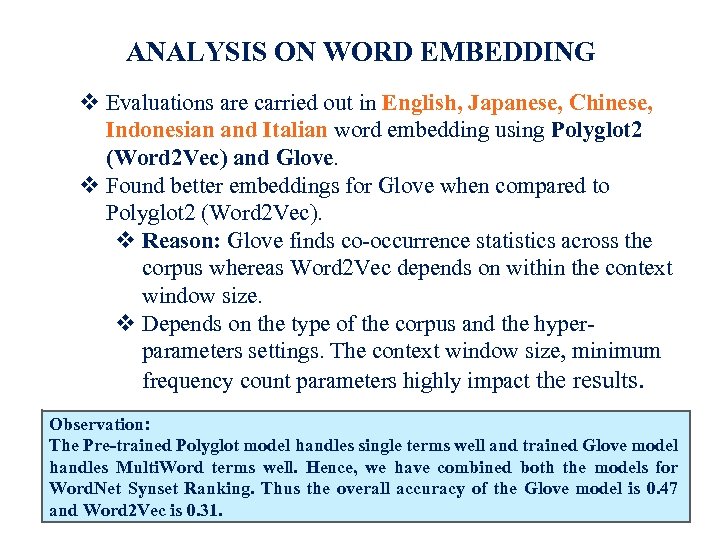
ANALYSIS ON WORD EMBEDDING Evaluations are carried out in English, Japanese, Chinese, Indonesian and Italian word embedding using Polyglot 2 (Word 2 Vec) and Glove. Found better embeddings for Glove when compared to Polyglot 2 (Word 2 Vec). Reason: Glove finds co-occurrence statistics across the corpus whereas Word 2 Vec depends on within the context window size. Depends on the type of the corpus and the hyperparameters settings. The context window size, minimum frequency count parameters highly impact the results. Observation: The Pre-trained Polyglot model handles single terms well and trained Glove model handles Multi. Word terms well. Hence, we have combined both the models for Word. Net Synset Ranking. Thus the overall accuracy of the Glove model is 0. 47 17 and Word 2 Vec is 0. 31.
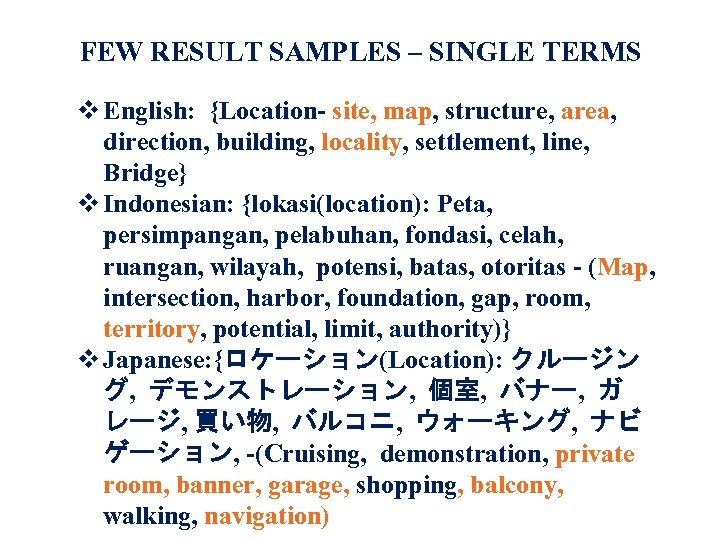
FEW RESULT SAMPLES – SINGLE TERMS English: {Location- site, map, structure, area, direction, building, locality, settlement, line, Bridge} Indonesian: {lokasi(location): Peta, persimpangan, pelabuhan, fondasi, celah, ruangan, wilayah, potensi, batas, otoritas - (Map, intersection, harbor, foundation, gap, room, territory, potential, limit, authority)} Japanese: {ロケーション(Location): クルージン グ, デモンストレーション, 個室, バナー, ガ レージ, 買い物, バルコニ, ウォーキング, ナビ ゲーション, -(Cruising, demonstration, private room, banner, garage, shopping, balcony, walking, navigation) 18
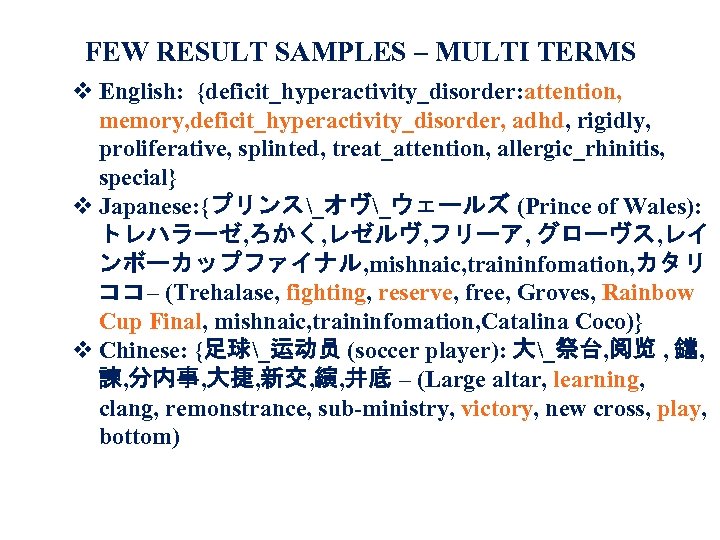
FEW RESULT SAMPLES – MULTI TERMS English: {deficit_hyperactivity_disorder: attention, memory, deficit_hyperactivity_disorder, adhd, rigidly, proliferative, splinted, treat_attention, allergic_rhinitis, special} Japanese: {プリンス_オヴ_ウェールズ (Prince of Wales): トレハラーゼ, ろかく, レゼルヴ, フリーア, グローヴス, レイ ンボーカップファイナル, mishnaic, traininfomation, カタリ ココ– (Trehalase, fighting, reserve, free, Groves, Rainbow Cup Final, mishnaic, traininfomation, Catalina Coco)} Chinese: {足球_运动员 (soccer player): 大_祭台, 阅览 , 鐺, 諫, 分内事, 大捷, 新交, 縯, 井底 – (Large altar, learning, clang, remonstrance, sub-ministry, victory, new cross, play, bottom) 19
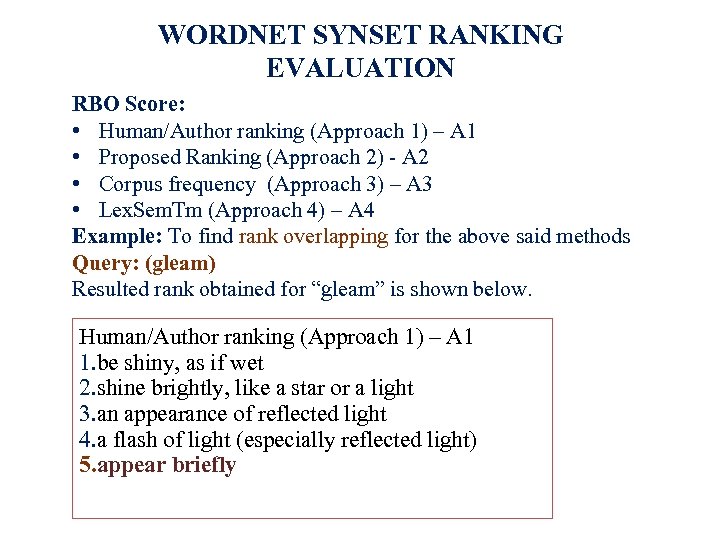
WORDNET SYNSET RANKING EVALUATION RBO Score: • Human/Author ranking (Approach 1) – A 1 • Proposed Ranking (Approach 2) - A 2 • Corpus frequency (Approach 3) – A 3 • Lex. Sem. Tm (Approach 4) – A 4 Example: To find rank overlapping for the above said methods Query: (gleam) Resulted rank obtained for “gleam” is shown below. Human/Author ranking (Approach 1) – A 1 1. be shiny, as if wet 2. shine brightly, like a star or a light 3. an appearance of reflected light 4. a flash of light (especially reflected light) 5. appear briefly 20
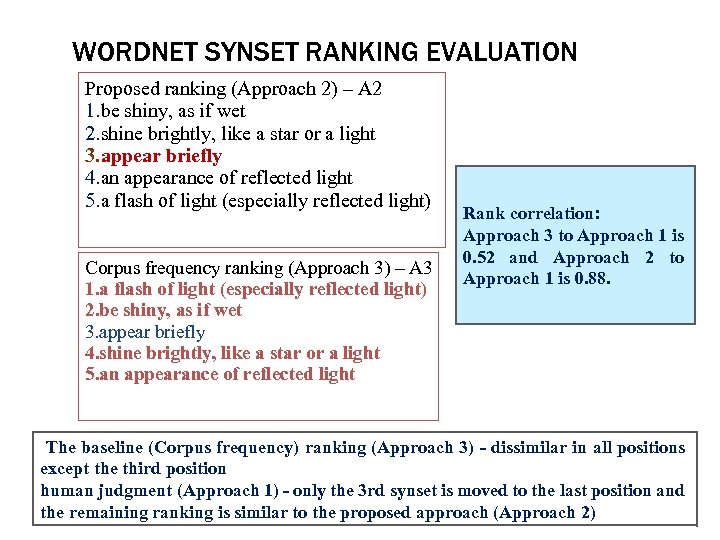
WORDNET SYNSET RANKING EVALUATION Proposed ranking (Approach 2) – A 2 1. be shiny, as if wet 2. shine brightly, like a star or a light 3. appear briefly 4. an appearance of reflected light 5. a flash of light (especially reflected light) Corpus frequency ranking (Approach 3) – A 3 1. a flash of light (especially reflected light) 2. be shiny, as if wet 3. appear briefly 4. shine brightly, like a star or a light 5. an appearance of reflected light Rank correlation: Approach 3 to Approach 1 is 0. 52 and Approach 2 to Approach 1 is 0. 88. The baseline (Corpus frequency) ranking (Approach 3) - dissimilar in all positions except the third position human judgment (Approach 1) - only the 3 rd synset is moved to the last position and 21 the remaining ranking is similar to the proposed approach (Approach 2)
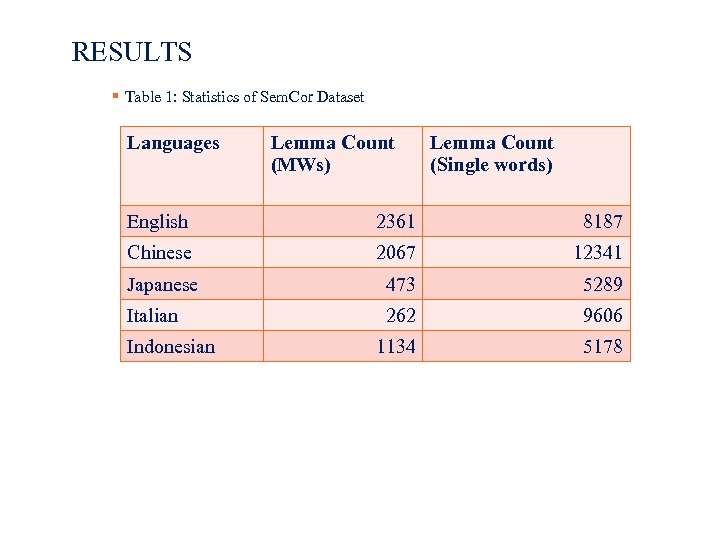
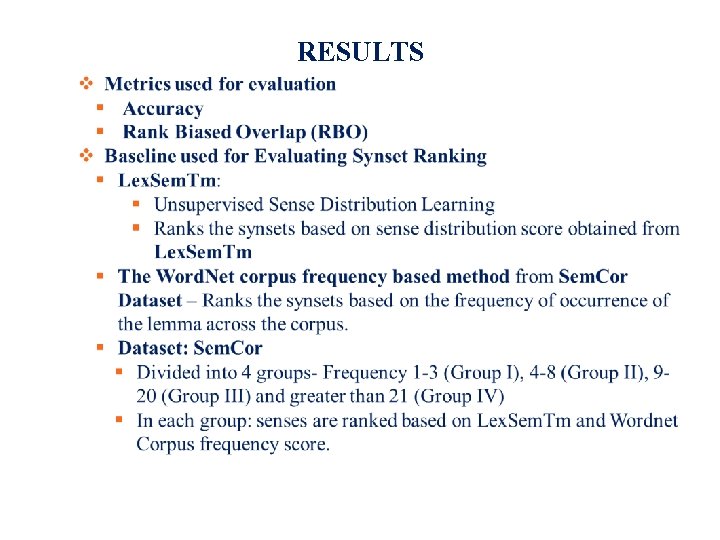
RESULTS Table 1: Statistics of Sem. Cor Dataset Languages Lemma Count (MWs) Lemma Count (Single words) English 2361 8187 Chinese 2067 12341 Japanese 473 5289 Italian 262 9606 1134 5178 Indonesian 22
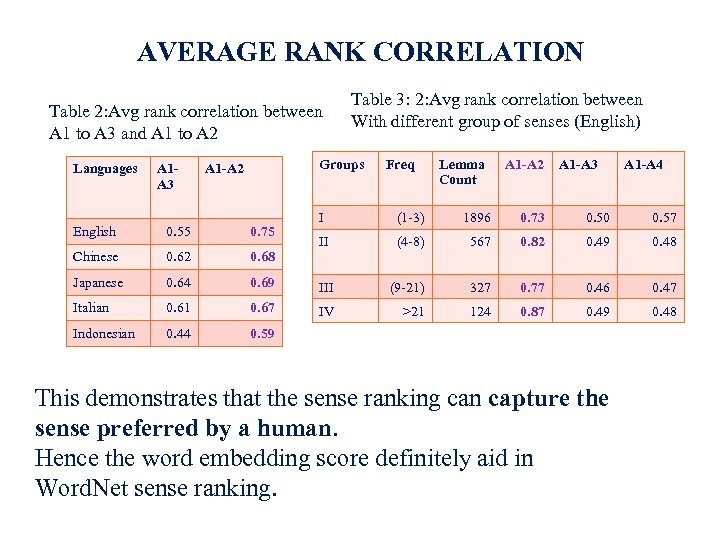
AVERAGE RANK CORRELATION Table 2: Avg rank correlation between A 1 to A 3 and A 1 to A 2 Languages A 1 A 3 Table 3: 2: Avg rank correlation between With different group of senses (English) Groups A 1 -A 2 Freq Lemma Count A 1 -A 2 A 1 -A 3 A 1 -A 4 I (1 -3) 1896 0. 73 0. 50 0. 57 II (4 -8) 567 0. 82 0. 49 0. 48 0. 69 III (9 -21) 327 0. 77 0. 46 0. 47 0. 61 0. 67 IV >21 124 0. 87 0. 49 0. 48 0. 44 0. 59 English 0. 55 0. 75 Chinese 0. 62 0. 68 Japanese 0. 64 Italian Indonesian This demonstrates that the sense ranking can capture the sense preferred by a human. Hence the word embedding score definitely aid in Word. Net sense ranking. 23
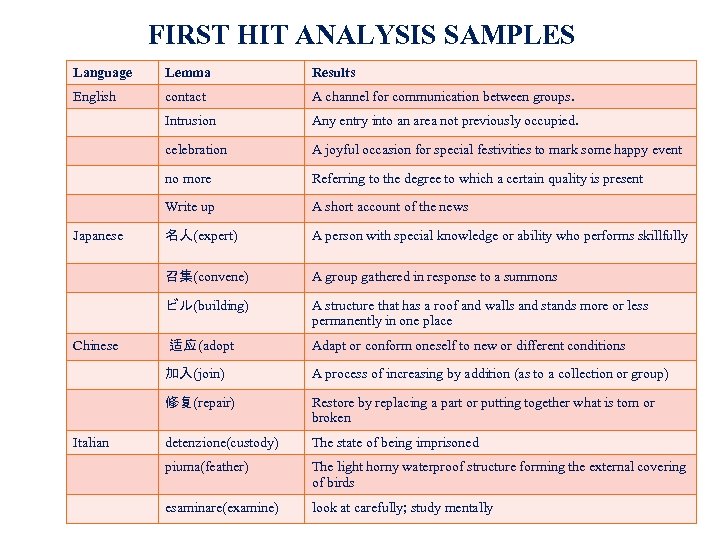
FIRST HIT ANALYSIS SAMPLES Language Lemma Results English contact A channel for communication between groups. Intrusion Any entry into an area not previously occupied. celebration A joyful occasion for special festivities to mark some happy event no more Referring to the degree to which a certain quality is present Write up A short account of the news 名人(expert) A person with special knowledge or ability who performs skillfully 召集(convene) A group gathered in response to a summons ビル(building) A structure that has a roof and walls and stands more or less permanently in one place 适应 (adopt Adapt or conform oneself to new or different conditions 加入(join) A process of increasing by addition (as to a collection or group) 修复(repair) Restore by replacing a part or putting together what is torn or broken detenzione(custody) The state of being imprisoned piuma(feather) The light horny waterproof structure forming the external covering of birds esaminare(examine) look at carefully; study mentally Japanese Chinese Italian 24
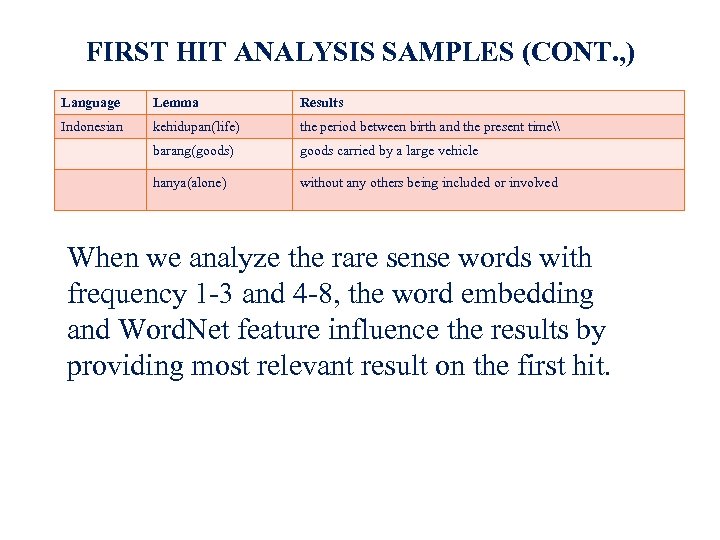
FIRST HIT ANALYSIS SAMPLES (CONT. , ) Language Lemma Results Indonesian kehidupan(life) the period between birth and the present time\ barang(goods) goods carried by a large vehicle hanya(alone) without any others being included or involved When we analyze the rare sense words with frequency 1 -3 and 4 -8, the word embedding and Word. Net feature influence the results by providing most relevant result on the first hit. 25
SCALABILITY 26
CONCLUSION OMW has over 150 languages with Word. Net built automatically (Ranging from major to smaller languages) For all languages, polyglot has data to learn the word embeddings for Word. Net Ranking In future, we will learn ranking for all languages and incorporate to the Word. Net lexicon which is maximally useful for speakers of as many languages as possible. It is possible to extend this work for finding missing senses of Word. Net. 27

THANK YOU.
SELECTED REFERENCES • • • Rami Al-Rfou, Bryan Perozzi, and Steven Skiena. 2013. Polyglot: Distributed word representations for multilingual nlp. In Proceedings of the Seventeenth Conference on Computational Natural Language Learning, pages 183– 192, Sofia, Bulgaria, August. Association for Computational Linguistics. Sanjeev Arora, Yuanzhi Li, Yingyu Liang, Tengyu Ma, and Andrej Risteski. 2016. Linear algebraic structure of word senses, with applications to polysemy. ar. Xiv preprint ar. Xiv: 1601. 03764. Sergey Bartunov, Dmitry Kondrashkin, Anton Osokin, and Dmitry Vetrov. 2015. Breaking sticks and ambiguities with adaptive skip-gram. ar. Xiv preprint ar. Xiv: 1502. 07257, pages 47– 54. Sudha Bhingardive, Dhirendra Singh, Rudra Murthy, Hanumant Redkar, and Pushpak Bhattacharyya. 2015 a. Unsupervised most frequent sense detection using word embeddings. In DENVER. Citeseer. Sudha Bhingardive, Dhirendra Singh, Rudramurthy V, Hanumant Harichandra Redkar, and Pushpak Bhattacharyya. 2015 b. Unsupervised most frequent sense detection using word embeddings. In NAACL HLT 2015, The 2015 Conference of the North American Chapter of the Association for Computational Linguistics: Human Language Technologies, Denver, Colorado, USA, May 31 - June 5, 2015, pages 1238– 1243. Stephen Bird, Ewan Klein, and Edward Loper. 2009. Natural Language Processing with Python. O’Reilly. (www. nltk. org/book). Lars Borin, Markus Forsberg, and Lennart Lönngren. 2013. Saldo: a touch of yin to Word. Net’s yang. Language Resources and Evaluation, 47(4): 1191– 1211. Fišer Darja, Jernej Novak, and Tomaž. 2012. slo. WNet 3. 0: development, extension and cleaning. In Proceedings of 6 th International Global Wordnet Conference (GWC 2012), pages 113– 117. The Global Word. Net Association. Valéria de Paiva, Alexandre Rademaker, and Gerard de Melo. 2012. Open. Word. Net-PT: an open Brazilian Wordnet for reasoning. EMAp technical report, Escola de Matemática Aplicada, FGV, Brazil. Sabri Elkateb, William Black, Horacio Rodríguez, Musa Alkhalifa, Piek Vossen, Adam Pease, and Christiane Fellbaum. 2006. Building a wordnet for Arabic. In Proceedings of The fifth international conference on Language Resources and Evaluation (LREC 2006). Christine Fellbaum, editor. 1998. Word. Net: An Electronic Lexical Database. MIT Press. Radovan Garabík and Indrė Pileckytė. 2013. From multilingual dictionary to lithuanian wordnet. In Katarína Gajdošová and Adriána Žáková, editors, Natural Language Processing, Corpus Linguistics, E-Learning, pages 74– 80. Lüdenscheid: RAMVerlag. http: //korpus. juls. savba. sk/attachments/publications/ lithuanian_wordnet_2013. pdf. 29
SELECTED REFERENCES (CONT. , ) • • • Aitor Gonzalez-Agirre, Egoitz Laparra, and German Rigau. 2012. Multilingual central repository version 3. 0: upgrading a very large lexical knowledge base. In Proceedings of the 6 th Global Word. Net Conference (GWC 2012), Matsue. Donna Harman. 2011. Information retrievaluation. Synthesis Lectures on Information Concepts, Retrieval, and Services, 3(2): 1– 119. Chu-Ren Huang, Shu-Kai Hsieh, Jia-Fei Hong, Yun-Zhu Chen, I-Li Su, Yong-Xiang Chen, and Sheng-Wei Huang. 2010. Chinese wordnet: Design and implementation of a cross-lingual knowledge processing infrastructure. Journal of Chinese Information Processing, 24(2): 14– 23. (in Chinese). Hitoshi Isahara, Francis Bond, Kiyotaka Uchimoto, Masao Utiyama, and Kyoko Kanzaki. 2008. Development of the Japanese Word. Net. In Sixth International conference on Language Resources and Evaluation (LREC 2008), Marrakech. Hong Jin Kang, Tao Chen, Muthu Kumar Chandrasekaran, and Min-Yen Kan. 2016. A comparison of word embeddings for english and cross-lingual chinese word sense disambiguation. ar. Xiv preprint ar. Xiv: 1611. 02956. Ravi Kumar and Sergei Vassilvitskii. 2010. Generalized distances between rankings. In Proceedings of the 19 th International Conference on World Wide Web, WWW ’ 10, pages 571– 580, New York, NY, USA. ACM. Aiden Si Hong Lim. 2014. Acquiring Predominant Word Senses in Multiple Languages. Ph. D. thesis, School of Humanities and Social Sciences, Nanyang Technological University. Krister Lindén and Lauri Carlson. 2010. Finnwordnet — wordnet påfinska via översättning. Lexico. Nordica — Nordic Journal of Lexicography, 17: 119– 140. In Swedish with an English abstract. Quan Liu, Hui Jiang, Si Wei, Zhen-Hua Ling, and Yu Hu. 2015. Learning semantic word embeddings based on ordinal knowledge constraints. In Proceedings of the 53 rd Annual Meeting of the Association for Computational Linguistics and the 7 th International Joint Conference on Natural Language Processing (ACL-IJCNLP), pages 1501– 1511. Teng Long, Ryan Lowe, Jackie Chi Kit Cheung, and Doina Precup. 2016. Leveraging lexical resources for learning entity embeddings in multi-relational data. ar. Xiv preprint ar. Xiv: 1605. 05416. Diana Mc. Carthy and John Carroll. 2003. Disambiguating nouns, verbs and adjectives using automatically acquired selectional preferences. Computational Linguistics, 29(4): 639– 654. 30
Скачать презентацию GWC 2018 — WORD EMBEDDING Multilingual Word Net
4ac8c38e1010082e93b3ab7526efdbdc.ppt