


 Скачать презентацию Guiding the Way to Higher Education Families Counselors
1fce46d51ccf9d4cc5e23bd7d36e437d.ppt
- Количество слайдов: 24
 Guiding the Way to Higher Education Families, Counselors, and Communities Together
 ESSENTIAL II Setting the Stage for Dreams to Become Reality
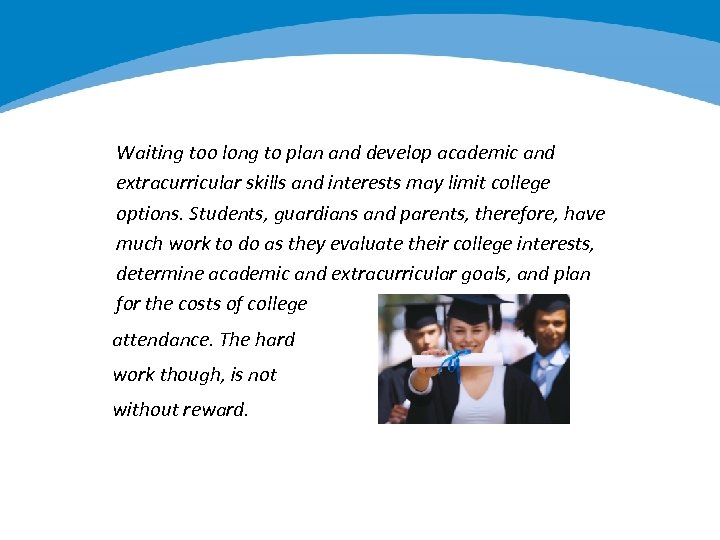 Waiting too long to plan and develop academic and extracurricular skills and interests may limit college options. Students, guardians and parents, therefore, have much work to do as they evaluate their college interests, determine academic and extracurricular goals, and plan for the costs of college attendance. The hard work though, is not without reward.
 Questions 1. What are some examples of how you benefited from planning ahead, setting goals (personal or professional), and working hard? 2. How has your family’s involvement benefited your student academically or personally? 3. Do you know the academic options (courses) at the middle school that will prepare your student to take challenging high school courses?
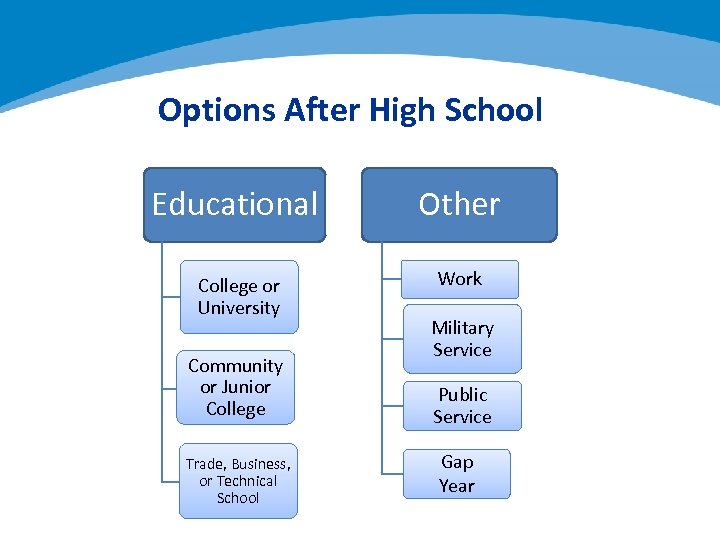 Options After High School Educational Other College or University Work Community or Junior College Trade, Business, or Technical School Military Service Public Service Gap Year
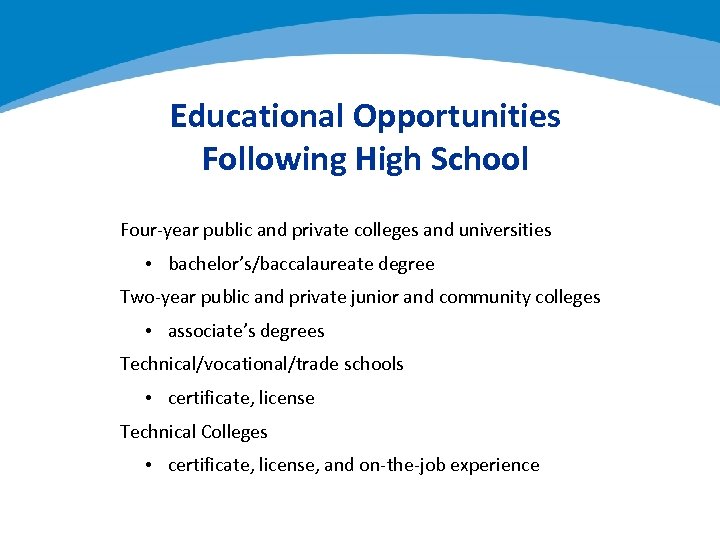 Educational Opportunities Following High School Four-year public and private colleges and universities • bachelor’s/baccalaureate degree Two-year public and private junior and community colleges • associate’s degrees Technical/vocational/trade schools • certificate, license Technical Colleges • certificate, license, and on-the-job experience
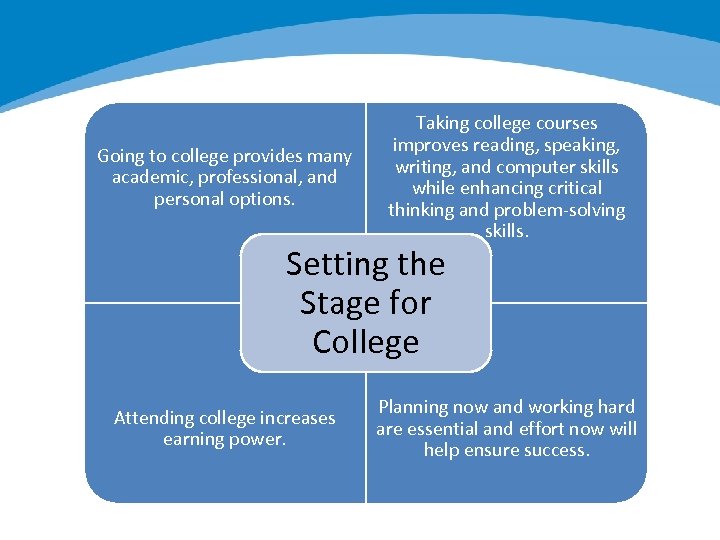 Going to college provides many academic, professional, and personal options. Taking college courses improves reading, speaking, writing, and computer skills while enhancing critical thinking and problem-solving skills. Setting the Stage for College Attending college increases earning power. Planning now and working hard are essential and effort now will help ensure success.
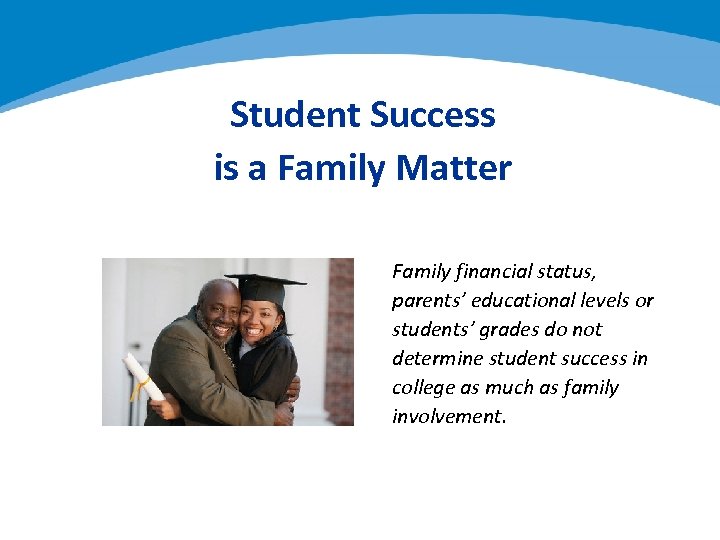 Student Success is a Family Matter Family financial status, parents’ educational levels or students’ grades do not determine student success in college as much as family involvement.
 Connecting with Your Student at Home Families can help their student address academic and personal pressures and changes by: 1. Talking to your student to help him/her become aware of stresses, both academic and personal. 2. Limiting distractions when students’ study. (monitor TV, phone and internet use) 3. Encouraging time-management skills. 4. Promoting daily physical activity, nutritious meals, and adequate sleep. 5. Monitoring after school activities.
 Connecting with Your Student at Home 6. Clearly state values and acceptable behaviors. 7. Setting healthy limits without being too rigid or strict. 8. Offer perspective and focus when young people feel overwhelmed by physical and emotional changes they are experiencing and help them understand real and perceived pressures. 9. Celebrate your students’ academic and extracurricular successes and provide positive involvement by attending school and community events.
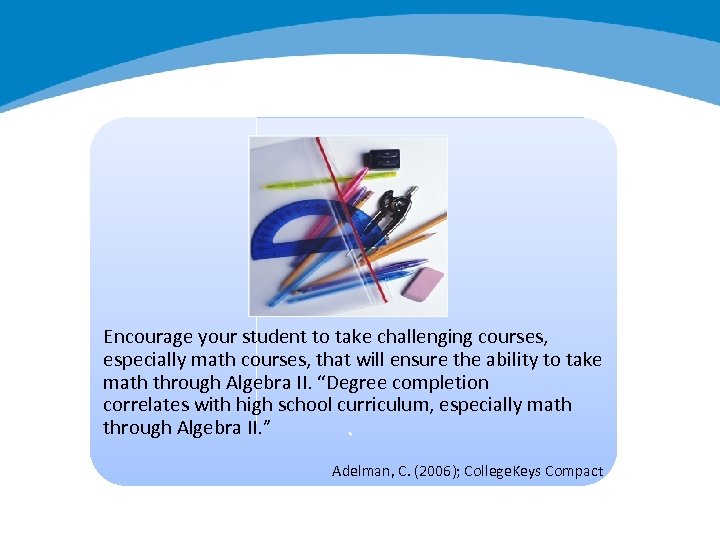 Encourage your student to take challenging courses, especially math courses, that will ensure the ability to take math through Algebra II. “Degree completion correlates with high school curriculum, especially math through Algebra II. ” Adelman, C. (2006); College. Keys Compact
 Connecting with Your Student at School • Ensure that middle and high school students take challenging courses • Expect the school to have learning standards and to encourage family involvement • Keep in touch with the school rather than waiting for a problem to arise • Use community resources: after school programs, adult ed classes, libraries, athletic programs, religious organizations • Expect and ask much of the school, community, and employers • Celebrate student’s academic and extracurricular successes
 The Right Courses for College Begin in Middle School Generally colleges look for the following courses: • • • 4 years of English 3 -4 years of Math Algebra, Geometry, Trigonometry, Pre-calculus, Calculus 2 -4 years of Science Biology, Chemistry, Physics • • • 2 -4 years of History 2 -4 years of the same World language Electives in art, music, computer science, physical education, technical education
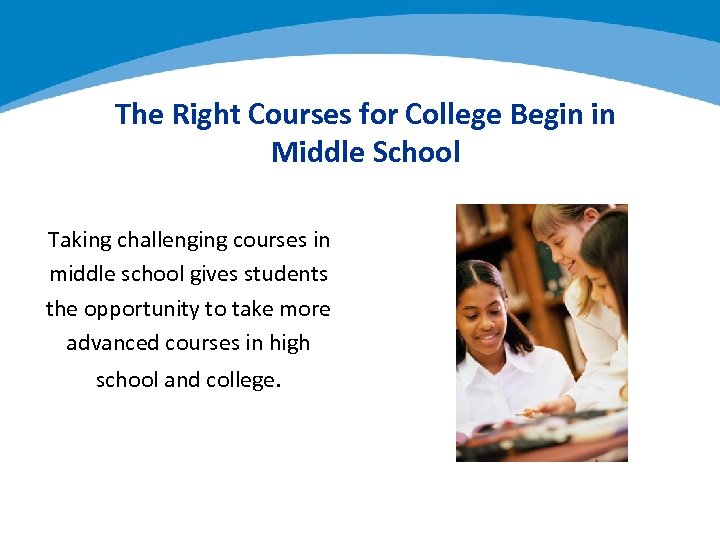 The Right Courses for College Begin in Middle School Taking challenging courses in middle school gives students the opportunity to take more advanced courses in high school and college.
 Create an Academic Portfolio • Save samples of your student’s best work in core academic subjects and in the arts. • Record completion date and course title on each work. • Keep everything in a folder or portfolio, including records of any awards or honors and the dates received. • Consider creating an electronic portfolio.
 Develop Extracurricular Interests • Extracurricular interests enable students to discover their talents and skills in athletic, artistic, academic, community service, and other areas. • Extracurricular interests build confidence, create an identity, and encourage students to see the relationship between the classroom and the world around them.
 Develop Extracurricular Interests • • Extracurricular interests enable students to discover their talents and develop their skills. Interests can develop in athletic, academic and community service. Students can participate in interests at school and community. Extracurricular interests build confidence, create an identity and encourage students to see relationships and connections between what they learn in the classroom, their outside activities, and their future employment and leisure activities. Help students to learn to work collaboratively and independently. Students can share and develop talents and interests by volunteering in their community. Students and parents should maintain extracurricular records in middle school and high school.
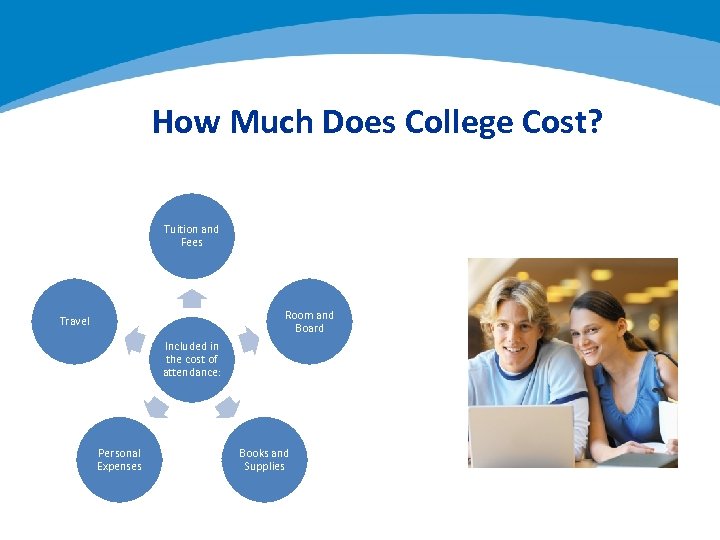 How Much Does College Cost? Tuition and Fees Room and Board Travel Included in the cost of attendance: Personal Expenses Books and Supplies
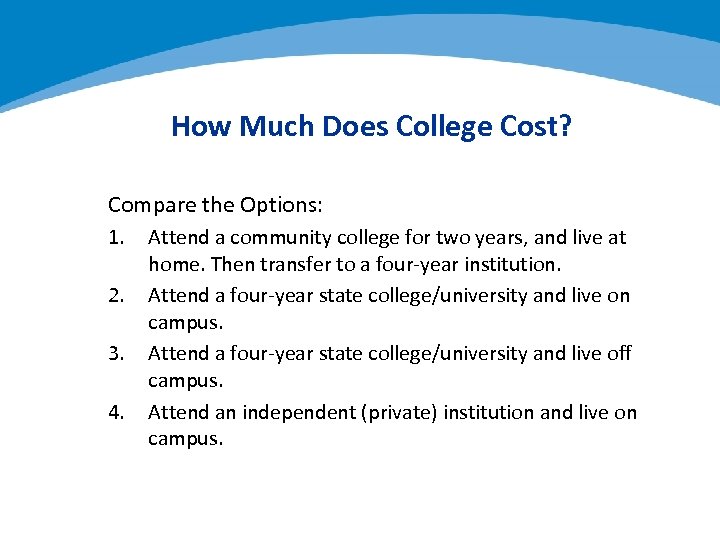 How Much Does College Cost? Compare the Options: 1. 2. 3. 4. Attend a community college for two years, and live at home. Then transfer to a four-year institution. Attend a four-year state college/university and live on campus. Attend a four-year state college/university and live off campus. Attend an independent (private) institution and live on campus.
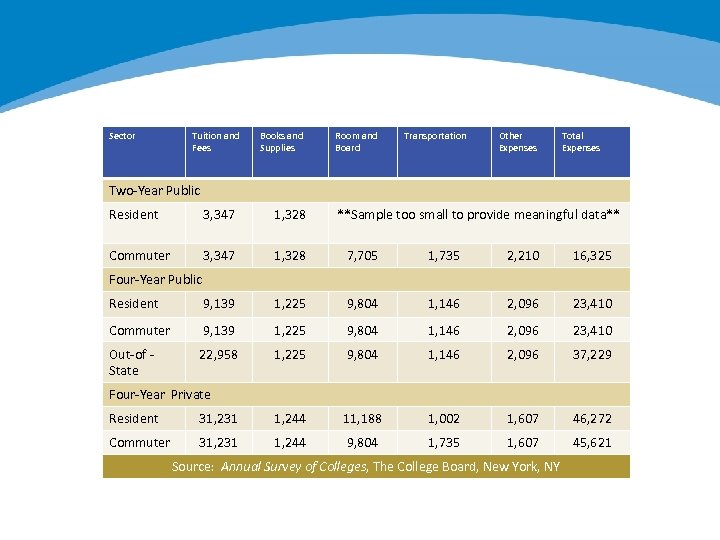 Sector Tuition and Fees Books and Supplies Room and Board Transportation Other Expenses Total Expenses Two-Year Public Resident 3, 347 1, 328 **Sample too small to provide meaningful data** Commuter 3, 347 1, 328 7, 705 1, 735 2, 210 16, 325 Resident 9, 139 1, 225 9, 804 1, 146 2, 096 23, 410 Commuter 9, 139 1, 225 9, 804 1, 146 2, 096 23, 410 Out-of State 22, 958 1, 225 9, 804 1, 146 2, 096 37, 229 Four-Year Public Four-Year Private Resident 31, 231 1, 244 11, 188 1, 002 1, 607 46, 272 Commuter 31, 231 1, 244 9, 804 1, 735 1, 607 45, 621 Source: Annual Survey of Colleges, The College Board, New York, NY
 How to Pay for College • Start Saving Early! • Apply for financial aid from the college at the appropriate time. • Research scholarship opportunities.
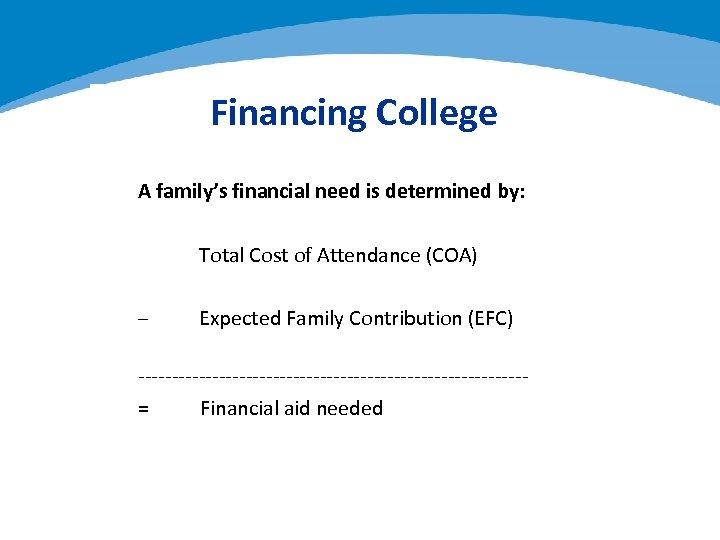 Financing College A family’s financial need is determined by: Total Cost of Attendance (COA) – Expected Family Contribution (EFC) -----------------------------= Financial aid needed
 Financing College Types of Aid: • Grants and Scholarships – gifts of money that do not need to be paid back. • Loans – money that is available to students and parents and must be paid back, sometimes after the student graduates or leaves college. • Work Study – provides a part time job during the school year.
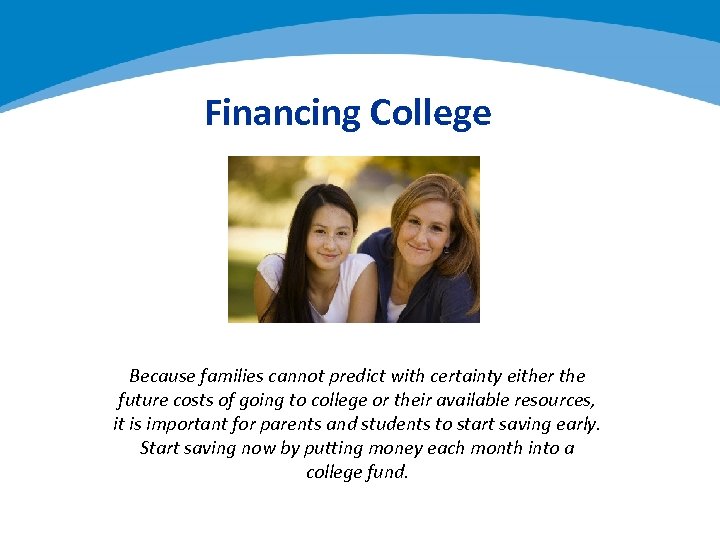 Financing College Because families cannot predict with certainty either the future costs of going to college or their available resources, it is important for parents and students to start saving early. Start saving now by putting money each month into a college fund.