Скачать презентацию Guidelines on participation in EU External Cooperation Programmes
9a5dce44fed61bdd5971227fa6bbff8d.ppt
- Количество слайдов: 30
 Guidelines on participation in EU External Cooperation Programmes Kader Chérigui, Senior Advisor © Transtec Guidelines on participation in EU External Cooperation Programmes, Brussels 2 sd December 2009
 A development consulting firm … The Company A leading European development consulting firm dedicated to delivering technical cooperation services for public, private and third sector organisations in developing economies. Mission To contribute to improvements in governance - the process of decision-making and the process by which decisions are implemented - in developing economies. Values We are committed to cultivating the best relationships with our stakeholders (clients, partners, experts, suppliers and the communities we serve). We are open to new ideas and committed to cooperative problem resolution We pride ourselves on our multi-cultural approach and our commitment to results for our stakeholders.
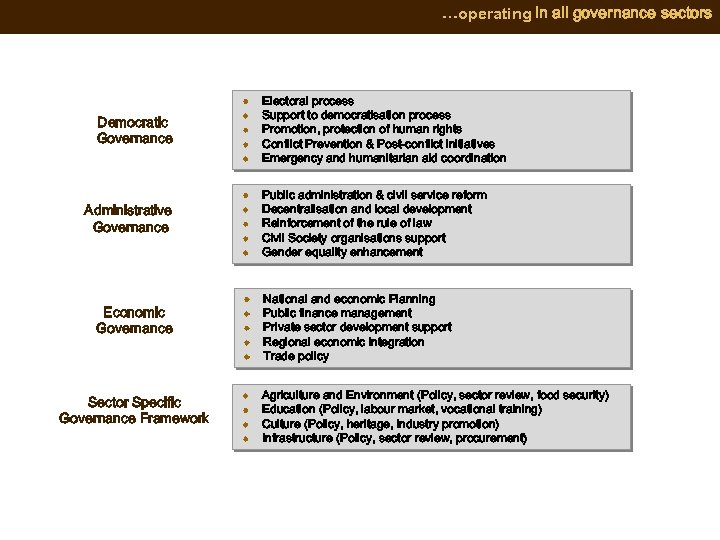 …operating in all governance sectors Democratic Governance Administrative Governance Economic Governance Sector Specific Governance Framework Electoral process Support to democratisation process Promotion, protection of human rights Conflict Prevention & Post-conflict initiatives Emergency and humanitarian aid coordination Public administration & civil service reform Decentralisation and local development Reinforcement of the rule of law Civil Society organisations support Gender equality enhancement National and economic Planning Public finance management Private sector development support Regional economic integration Trade policy Agriculture and Environment (Policy, sector review, food security) Education (Policy, labour market, vocational training) Culture (Policy, heritage, industry promotion) Infrastructure (Policy, sector review, procurement)
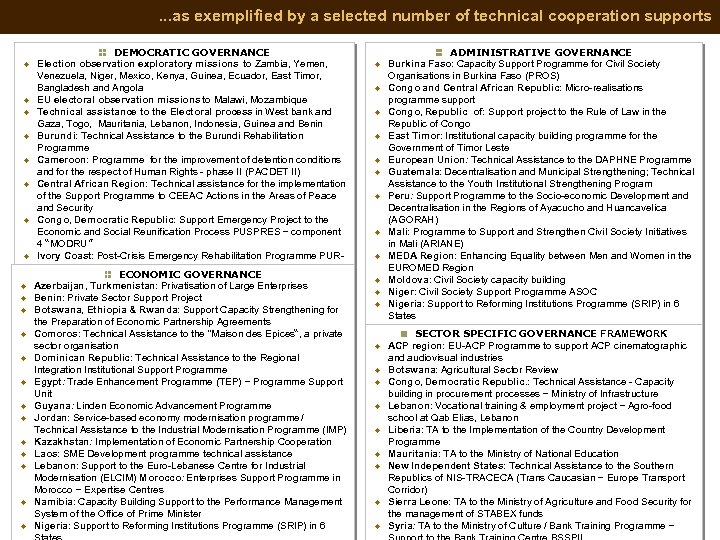 . . . as exemplified by a selected number of technical cooperation supports DEMOCRATIC GOVERNANCE Election observation exploratory missions to Zambia, Yemen, Venezuela, Niger, Mexico, Kenya, Guinea, Ecuador, East Timor, Bangladesh and Angola EU electoral observation missions to Malawi, Mozambique Technical assistance to the Electoral process in West bank and Gaza, Togo, Mauritania, Lebanon, Indonesia, Guinea and Benin Burundi: Technical Assistance to the Burundi Rehabilitation Programme Cameroon: Programme for the improvement of detention conditions and for the respect of Human Rights - phase II (PACDET II) Central African Region: Technical assistance for the implementation of the Support Programme to CEEAC Actions in the Areas of Peace and Security Congo, Democratic Republic: Support Emergency Project to the Economic and Social Reunification Process PUSPRES – component 4 “MODRU” Ivory Coast: Post-Crisis Emergency Rehabilitation Programme PURII ECONOMIC GOVERNANCE Indonesia: ACEH post conflict technical assistance Azerbaijan, Turkmenistan: Privatisation of Large Enterprises Lesotho: Formulation mission on governance and justice in Lesotho Benin: Private Sector Support Project Liberia: Reintegration Programme for Returnees and Displaced Botswana, Ethiopia & Rwanda: Support Capacity Strengthening for People the Preparation of Economic Partnership Agreements Comoros: Technical Assistance to the "Maison des Epices“, a private sector organisation Dominican Republic: Technical Assistance to the Regional Integration Institutional Support Programme Egypt: Trade Enhancement Programme (TEP) – Programme Support Unit Guyana: Linden Economic Advancement Programme Jordan: Service-based economy modernisation programme / Technical Assistance to the Industrial Modernisation Programme (IMP) Kazakhstan: Implementation of Economic Partnership Cooperation Laos: SME Development programme technical assistance Lebanon: Support to the Euro-Lebanese Centre for Industrial Modernisation (ELCIM) Morocco: Enterprises Support Programme in Morocco – Expertise Centres Namibia: Capacity Building Support to the Performance Management System of the Office of Prime Minister Nigeria: Support to Reforming Institutions Programme (SRIP) in 6 ADMINISTRATIVE GOVERNANCE Burkina Faso: Capacity Support Programme for Civil Society Organisations in Burkina Faso (PROS) Congo and Central African Republic: Micro-realisations programme support Congo, Republic of: Support project to the Rule of Law in the Republic of Congo East Timor: Institutional capacity building programme for the Government of Timor Leste European Union: Technical Assistance to the DAPHNE Programme Guatemala: Decentralisation and Municipal Strengthening; Technical Assistance to the Youth Institutional Strengthening Program Peru: Support Programme to the Socio-economic Development and Decentralisation in the Regions of Ayacucho and Huancavelica (AGORAH) Mali: Programme to Support and Strengthen Civil Society Initiatives in Mali (ARIANE) MEDA Region: Enhancing Equality between Men and Women in the EUROMED Region Moldova: Civil Society capacity building Niger: Civil Society Support Programme ASOC Nigeria: Support to Reforming Institutions Programme (SRIP) in 6 States Ukraine: NGO Development – Promotion of Effective Partnerships SECTOR SPECIFIC GOVERNANCE FRAMEWORK with the Local and Regional Administrations ACP region: EU-ACP Programme to support ACP cinematographic Uruguay: Integral Support Programme in the Poor Suburbs of and audiovisual industries Montevideo Botswana: Agricultural Sector Review Congo, Democratic Republic. : Technical Assistance - Capacity building in procurement processes – Ministry of Infrastructure Lebanon: Vocational training & employment project – Agro-food school at Qab Elias, Lebanon Liberia: TA to the Implementation of the Country Development Programme Mauritania: TA to the Ministry of National Education New Independent States: Technical Assistance to the Southern Republics of NIS-TRACECA (Trans Caucasian – Europe Transport Corridor) Sierra Leone: TA to the Ministry of Agriculture and Food Security for the management of STABEX funds Syria: TA to the Ministry of Culture / Bank Training Programme –
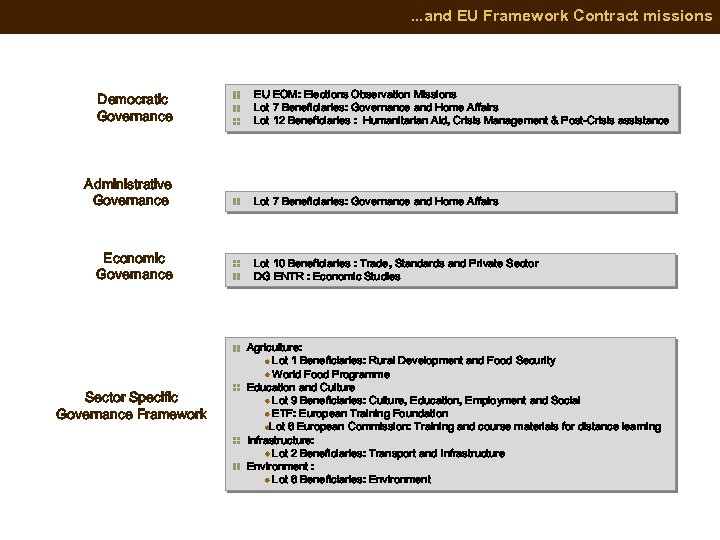 . . . and EU Framework Contract missions Democratic Governance Administrative Governance Economic Governance Sector Specific Governance Framework EU EOM: Elections Observation Missions Lot 7 Beneficiaries: Governance and Home Affairs Lot 12 Beneficiaries : Humanitarian Aid, Crisis Management & Post-Crisis assistance Lot 7 Beneficiaries: Governance and Home Affairs Lot 10 Beneficiaries : Trade, Standards and Private Sector DG ENTR : Economic Studies Agriculture: Lot 1 Beneficiaries: Rural Development and Food Security World Food Programme Education and Culture Lot 9 Beneficiaries: Culture, Education, Employment and Social ETF: European Training Foundation Lot 6 European Commission: Training and course materials for distance learning Infrastructure: Lot 2 Beneficiaries: Transport and Infrastructure Environment : Lot 6 Beneficiaries: Environment
 What is the EU External Cooperation ? © Transtec Guidelines on participation in EU External Cooperation Programmes, Brussels 2 sd December 2009
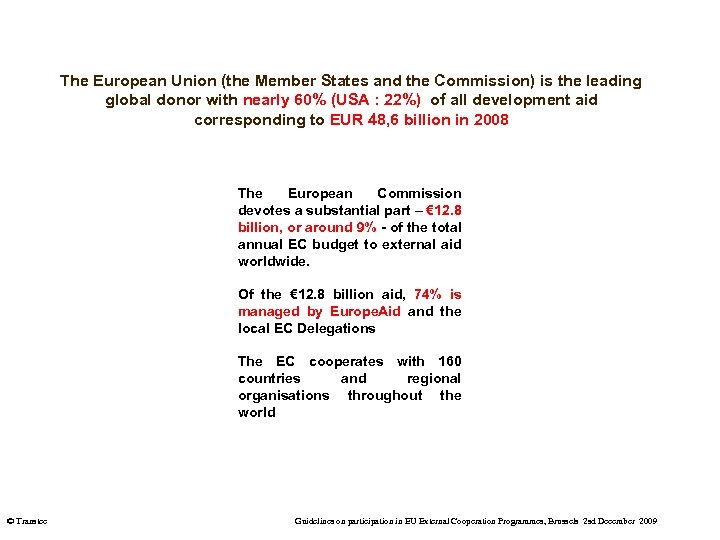 The European Union (the Member States and the Commission) is the leading global donor with nearly 60% (USA : 22%) of all development aid corresponding to EUR 48, 6 billion in 2008 The European Commission devotes a substantial part – € 12. 8 billion, or around 9% - of the total annual EC budget to external aid worldwide. Of the € 12. 8 billion aid, 74% is managed by Europe. Aid and the local EC Delegations The EC cooperates with 160 countries and regional organisations throughout the world © Transtec Guidelines on participation in EU External Cooperation Programmes, Brussels 2 sd December 2009
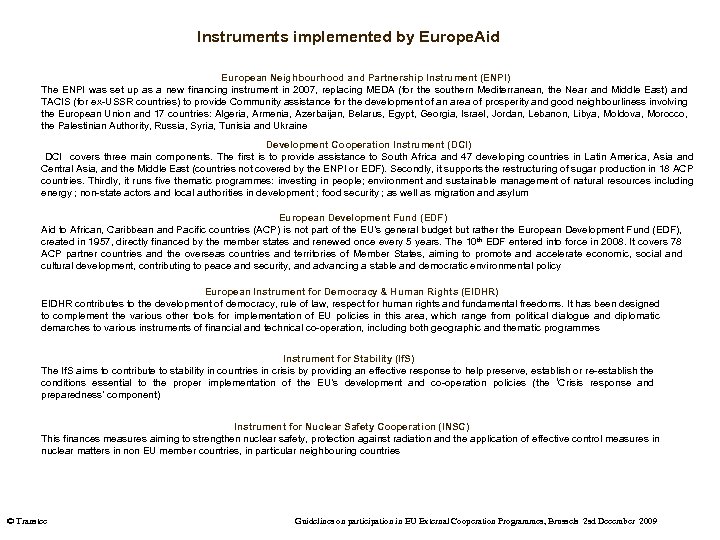 Instruments implemented by Europe. Aid European Neighbourhood and Partnership Instrument (ENPI) The ENPI was set up as a new financing instrument in 2007, replacing MEDA (for the southern Mediterranean, the Near and Middle East) and TACIS (for ex-USSR countries) to provide Community assistance for the development of an area of prosperity and good neighbourliness involving the European Union and 17 countries: Algeria, Armenia, Azerbaijan, Belarus, Egypt, Georgia, Israel, Jordan, Lebanon, Libya, Moldova, Morocco, the Palestinian Authority, Russia, Syria, Tunisia and Ukraine Development Cooperation Instrument (DCI) DCI covers three main components. The first is to provide assistance to South Africa and 47 developing countries in Latin America, Asia and Central Asia, and the Middle East (countries not covered by the ENPI or EDF). Secondly, it supports the restructuring of sugar production in 18 ACP countries. Thirdly, it runs five thematic programmes: investing in people; environment and sustainable management of natural resources including energy ; non-state actors and local authorities in development ; food security ; as well as migration and asylum European Development Fund (EDF) Aid to African, Caribbean and Pacific countries (ACP) is not part of the EU’s general budget but rather the European Development Fund (EDF), created in 1957, directly financed by the member states and renewed once every 5 years. The 10 th EDF entered into force in 2008. It covers 78 ACP partner countries and the overseas countries and territories of Member States, aiming to promote and accelerate economic, social and cultural development, contributing to peace and security, and advancing a stable and democratic environmental policy European Instrument for Democracy & Human Rights (EIDHR) EIDHR contributes to the development of democracy, rule of law, respect for human rights and fundamental freedoms. It has been designed to complement the various other tools for implementation of EU policies in this area, which range from political dialogue and diplomatic demarches to various instruments of financial and technical co-operation, including both geographic and thematic programmes Instrument for Stability (If. S) The If. S aims to contribute to stability in countries in crisis by providing an effective response to help preserve, establish or re-establish the conditions essential to the proper implementation of the EU’s development and co-operation policies (the ‘Crisis response and preparedness’ component) Instrument for Nuclear Safety Cooperation (INSC) This finances measures aiming to strengthen nuclear safety, protection against radiation and the application of effective control measures in nuclear matters in non EU member countries, in particular neighbouring countries © Transtec Guidelines on participation in EU External Cooperation Programmes, Brussels 2 sd December 2009
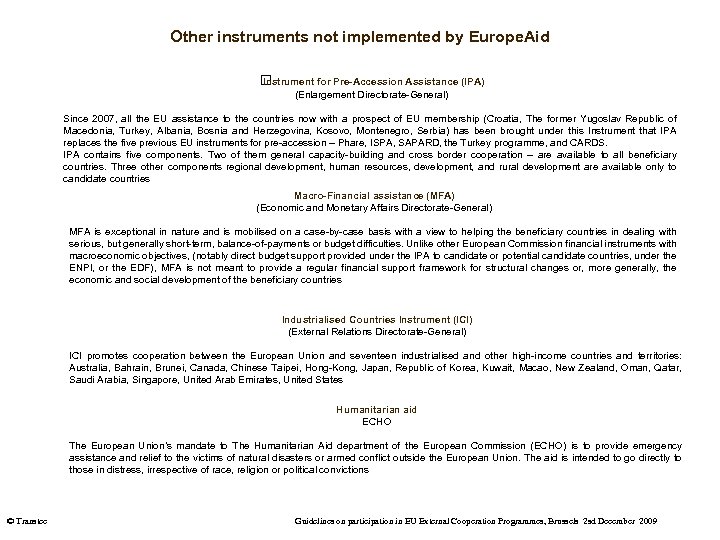 Other instruments not implemented by Europe. Aid Instrument for Pre-Accession Assistance (IPA) (Enlargement Directorate-General) Since 2007, all the EU assistance to the countries now with a prospect of EU membership (Croatia, The former Yugoslav Republic of Macedonia, Turkey, Albania, Bosnia and Herzegovina, Kosovo, Montenegro, Serbia) has been brought under this Instrument that IPA replaces the five previous EU instruments for pre-accession – Phare, ISPA, SAPARD, the Turkey programme, and CARDS. IPA contains five components. Two of them general capacity-building and cross border cooperation – are available to all beneficiary countries. Three other components regional development, human resources, development, and rural development are available only to candidate countries Macro-Financial assistance (MFA) (Economic and Monetary Affairs Directorate-General) MFA is exceptional in nature and is mobilised on a case-by-case basis with a view to helping the beneficiary countries in dealing with serious, but generally short-term, balance-of-payments or budget difficulties. Unlike other European Commission financial instruments with macroeconomic objectives, (notably direct budget support provided under the IPA to candidate or potential candidate countries, under the ENPI, or the EDF), MFA is not meant to provide a regular financial support framework for structural changes or, more generally, the economic and social development of the beneficiary countries Industrialised Countries Instrument (ICI) (External Relations Directorate-General) ICI promotes cooperation between the European Union and seventeen industrialised and other high-income countries and territories: Australia, Bahrain, Brunei, Canada, Chinese Taipei, Hong-Kong, Japan, Republic of Korea, Kuwait, Macao, New Zealand, Oman, Qatar, Saudi Arabia, Singapore, United Arab Emirates, United States Humanitarian aid ECHO The European Union’s mandate to The Humanitarian Aid department of the European Commission (ECHO) is to provide emergency assistance and relief to the victims of natural disasters or armed conflict outside the European Union. The aid is intended to go directly to those in distress, irrespective of race, religion or political convictions © Transtec Guidelines on participation in EU External Cooperation Programmes, Brussels 2 sd December 2009
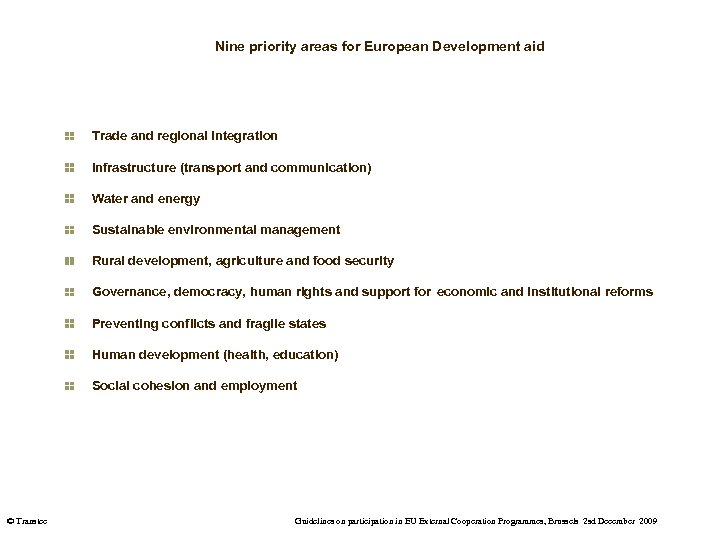 Nine priority areas for European Development aid Trade and regional integration Infrastructure (transport and communication) Water and energy Sustainable environmental management Rural development, agriculture and food security Governance, democracy, human rights and support for economic and institutional reforms Preventing conflicts and fragile states Human development (health, education) Social cohesion and employment © Transtec Guidelines on participation in EU External Cooperation Programmes, Brussels 2 sd December 2009
 Problems with the Cooperation? © Transtec Guidelines on participation in EU External Cooperation Programmes, Brussels 2 sd December 2009
 What are the problems with Technical Cooperation? Evaluations of TC effectiveness and efficiency have pointed to persitent problems with such support: A significant proportion of TC continues to be supply-driven with an overall low level of ownership Many partner countries have insufficient capacity to ensure “active” ownership and coordinated TC In many cases, the provision of TA personnel and the use of “PIU structures” is taken as a given, without questioning their appropriateness TC effectiveness is compromised by lack of clarity about roles and results expected Reliance on Northern providers results in high costs Insufficient attention is given to ensuring that TA personnel have the necessary skills and profiles to be able to engage effectively in demanding change processes Much of the TA and the majority of PIUs are provided to manage EC procedures and to comply with the various related requirements Tendering and contracting procedures are lengthy and slow Operational staff do not always have a clear understanding on how to use existing procedures to promote and comply with aid effectiveness principles There is limited experience in the use of alternative forms of TC provision such as the use of public sector expertise through twinning arrangements, and the use of South-South cooperation The use of TC by the EC partly reflects management structures, incentives and internal capacity gaps Human resource policies and the way delegations are managed has a bearing on current TC and programme implementation arrangements, as do incentives that tend to reward control, disbursements and quick results © Transtec Guidelines on participation in EU External Cooperation Programmes, Brussels 2 sd December 2009
 A response? © Transtec Guidelines on participation in EU External Cooperation Programmes, Brussels 2 sd December 2009
 The ‘Backbone Strategy’ for reforming Technical Cooperation http: //capacity 4 dev. ec. europa. eu/ The EC has launched a strategy to reform how it will work with Technical Cooperation (TC) in the future: the Backbone Strategy on "Reforming Technical Cooperation (TC) and Project Implementation Units (PIU)" is a reform adopted in July 2008 to overhaul the TC funded by EU external assistance following a wide process of consultation with European Commission Delegations, Partner Countries and Members States This Strategy aims to improve the effectiveness of EC aid with respect to capacity development and respond to recommendations of the Special Report on the Effectiveness of Technical Assistance in the context of Capacity Development issued in 2007 by the European Court of Auditors. The strategy is designed to achieve the following: Provide quality Technical Cooperation that supports country-led programmes, based on strong partner demand which focuses on achieving sustainable development results Provide support through partner-owned implementation arrangements, with a substantial reduction in the use of parallel Project Implementation Units (PIUs). Key definitions: Technical cooperation (TC) is the provision of know-how in the form of short and long term personnel, training and research, twinning arrangements, peer support and associated costs. Technical Assistance (TA) refers to the personnel involved (individuals as well as teams of consultants) in developing knowledge, skills, technical know-how or productive aptitudes Capacity is the ability of people, organisations and society as a whole to manage their affairs successfully Capacity development is the process whereby people, organisations and society as a whole unlock, strengthen, create, adapt and maintain capacity over time Promotion of capacity development refers to what outside partners — domestic or foreign — can do to support, facilitate or catalyse capacity development and related change processes Project Implementation Units: When providing development assistance, donors have commonly established Project Implementation Units to take charge of the process of managing project implementation. PIUs are also referred to as project management units, project management offices, project co-ordination offices, etc Parallel PIU: A PIU is parallel when it is created and operates outside of existing country institutional and administrative structures at the behest of a donor © Transtec Guidelines on participation in EU External Cooperation Programmes, Brussels 2 sd December 2009
 How participating ? © Transtec Guidelines on participation in EU External Cooperation Programmes, Brussels 2 sd December 2009
 Key document and annexes to read/check carefully at any stage of the procedure The Practical Guide is the first sole working tool, which explains the contracting procedures applying to all EC external aid contracts financed from the European Communities general budget (Budget) and the 10 th European Development Fund (EDF). http: //ec. europa. eu/europeaid/work/procedures/implementation/ practical_guide/index_en. htm © Transtec Guidelines on participation in EU External Cooperation Programmes, Brussels 2 sd December 2009
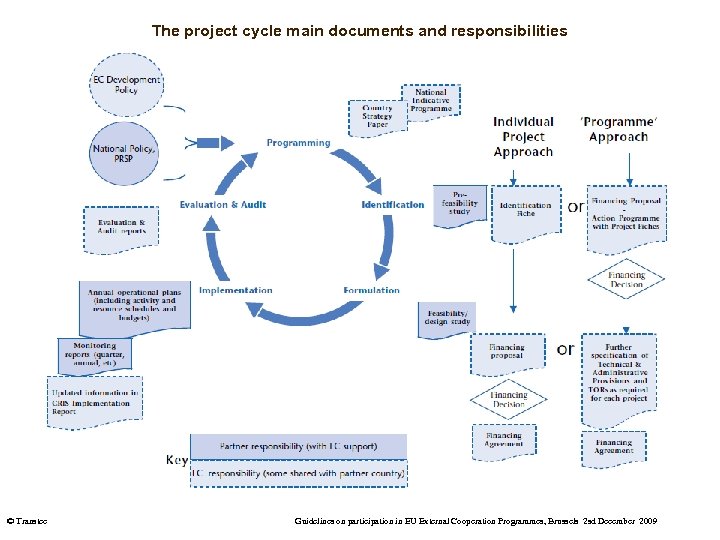 The project cycle main documents and responsibilities © Transtec Guidelines on participation in EU External Cooperation Programmes, Brussels 2 sd December 2009
 A : I elaborate my strategy: RELEX web page http: //ec. europa. eu/external_relations/sp/index_en. htm What Can I find on this page? Country Strategy Papers: Country Strategy Papers (CSPs) are a instrument for guiding, managing and reviewing EC assistance programmes. The purpose of CSPs is to provide a framework for EU assistance programmes based on EU / EC objectives, the Partner Country government policy agenda, an analysis of the partner countries situation, and the activities of other major partners. National Indicative Programmes: The National Indicative Programme is intended to guide the planning and identification of financial cooperation with the benefiting country according to a number of Priority Areas. The national allocation will therefore be dedicated in the main to a closely-focussed, demand-led programme intended to further roadmap objectives identified as priorities for financial support. In practice? üCapacity to have a better understanding of EC cooperation agenda on specific countries and to identify potential future projects to apply for at a later stage © Transtec Guidelines on participation in EU External Cooperation Programmes, Brussels 2 sd December 2009
 B : I fine tune my strategy: Europe. Aid web page http: //ec. europa. eu/europeaid/work/ap/index_en. htm What Can I find on this page? Annual Action Programmes (AAP) are financing decisions adopted by the European Commission, they specify the objectives pursued, the fields of intervention, the expected results, the management procedures and total amount of financing planned. In addition, AAPs contain a description of the operations to be financed, an indication of the amounts allocated for each operation and an indicative implementation timetable In practice? üA key instrument put at disposal by Europe. Aid since 2007 that contribute to face up with asymmetric information and give an opportunity access to relevant information to all actors interested in technical cooperation © Transtec Guidelines on participation in EU External Cooperation Programmes, Brussels 2 sd December 2009
 C 1 : I finalize my strategy: Europe. Aid web pages https: //webgate. ec. europa. eu/europeaid/online-services/index. cfm? do=publi. welcome What Can I find on this page daily updated at midnight? Projects in forecasts Projects opened Short listed entities Awarded projects In practice? ü Daily follow up of the cycle of projects I identified at stage A ü Capacity to identify who may be the main actors: potential partners/leaders/competitors in the countries/sectors I identified © Transtec Guidelines on participation in EU External Cooperation Programmes, Brussels 2 sd December 2009
 C 2 : I finalize my strategy: Europe. Aid web pages http: //ec. europa. eu/europeaid/work/funding/beneficiaries/index. cfm? lang=en&mode=SM&type What Can I find on this page? The European Commission is committed to guarantee full transparency on the beneficiaries of funds in line with the requirements of Article 30 of the Financial Regulations. This section of the Europe. Aid website has been created to find the information covering all the methods used in the implementation of external assistance under the responsibility of Europe. Aid Co-operation Office, whether financed under the General Budget of the Communitities or the European Development Fund In practice? ü Who’s Who classified by countries/sectors/nationalities benefiting from grants and contracts since 2007 ü Please note that it cannot be guaranteed that information available on-line exactly reproduces the facts. In line with the Financial Regulations certain contracts are not published © Transtec Guidelines on participation in EU External Cooperation Programmes, Brussels 2 sd December 2009
 And…then…concretely? © Transtec Guidelines on participation in EU External Cooperation Programmes, Brussels 2 sd December 2009
 Daily watchkeeping on Europe. Aid and TED OJ S Europe. Aid : https: //webgate. ec. europa. eu/europeaid/online-services/index. cfm? do=publi. welcome OJ S : http: //ted. europa. eu/Exec? Template=TED/editorial_page. htm&Data. Flow=Show. Page. dfl&Stat. Lang=EN What Can I find? This Europe. Aid page is daily updated at midnight? The OJ is published from Tuesday to Saturday, updated at 9 AM Projects in forecasts Projects opened Short listed entities Awarded projects In practice? ü I define my position: leader / partner üSet up my timetable of activities ü Prepare my updated references © Transtec Guidelines on participation in EU External Cooperation Programmes, Brussels 2 sd December 2009
 I clearly identify my assets and confront them with my Expectations Readiness capabilities and resources Past similar experience Relevant eligible references Capacity to identify and deploy relevant expertise Capacity to understand meet the CA expectations and clearly demonstrate it in the methodology Financial capacity - financial guarantee © Transtec Guidelines on participation in EU External Cooperation Programmes, Brussels 2 sd December 2009
 My Commitments Each member should abide at least with these rules not to jeopardize the eligibility of the Consortium Commits itself to supply the usual proofs under the law of the country in which it is established that it does not fall into the categories listed on art 2. 3. 3. of the Practical Guide to Contract procedures for EC external actions Commits itself to supply a sworn statement that its situations have not altered in the period that has elapsed since the evidence in question was drawn up Commits itself to supply, if the supporting documents are written in a language other than the language(s) of the call for tenders, a faithful translation into the requested operational language Commits itself to supply the evidence requested in art 2. 4. 11. 1. 3 "Verification of the financial and economic capacities of tenderers or candidates" of the Practical Guide to Contract procedures for EC external actions. Commits itself to supply the evidence requested in art 2. 4. 11. 1. 4 "Verification of the technical and professional capacities of tenderers, candidates and their managerial staff" of the Practical Guide to Contract procedures for EC external actions. Confirms that its Organization has not made false declarations, committed substantial errors or irregularities and fraud Commits itself to supply at any stage the evidence of performance of the experiences (references) carried out under the form of certificates issued or countersigned by the competent authority, Commits itself to communicate accurate, established and verifiable experiences (references), dates, amount, proportion carried out etc. . . Confirms that its Organization is not registered in the Early Warning System © Transtec Guidelines on participation in EU External Cooperation Programmes, Brussels 2 sd December 2009
 Preparation of the Application using the Standard Application Form Available here: http: //ec. europa. eu/europeaid/work/procedures/implementation/services/documents/b 3_applform_en. doc Reminder: Full respect of the selection criteria stipulated in art 21 of the Service Procurement Notice (SPN) Full respect of the Application form, its format, declarations to complete etc… No inventiveness on the references, dates, irrealistic budget to try to be conform with the selection criteria At any time the CA can ask for additional information to check the conformity of the information contained in the Application Form © Transtec Guidelines on participation in EU External Cooperation Programmes, Brussels 2 sd December 2009
 Preparation of an Offer once I’m short listed Preparation of an Offer on the basis of the Tender Dossier (TD) and its Terms of Reference (To. R) through a total quality management 5 W 2 H approach of the project where the Consortium will have to design and present the best technical and financial sustainable strategy. Who: The To. R draw the contextual history of the project and the main actors involved and benefiting from the project What: The To. R describe the main and specific objectives, expected results that should be achieved by the Project Where: The To. R specify where the activities should take place within the Country, related Administrative bodies or adhoc structures to set up When: The To. R establish a calendar of activities to be implemented Why: the To. R raise this question of needs of this Project in order to assess our understanding and capacity to meet clearly those needs How: It belongs to the Consortium to propose the best technical and financial approach to meet the needs and expectations of the Project and highlight that the Consortium has a profound knowledge in the management of long term technical cooperation programmes in all their administrative, contractual and financial regulations How much: the To. R propose a maximum budget covering all the costs related with the implementation of the Project © Transtec Guidelines on participation in EU External Cooperation Programmes, Brussels 2 sd December 2009
 Indicative bibliography Europe. Aid web page: http: //ec. europa. eu/europeaid/index_en. htm Annual Report 2009 on the European Community's Development and External Assistance Policies and their Implementation in 2008 Project Cycle Management Guidelines, 2004 Doing business with the European Commission, Tips for potential contractors IPA, A new focus to EU assistance for enlargement European Court of Auditors, Special Report 06/2007 on the effectiveness of technical assistance in the context of capacity development together with the Commission’s replies Guidelines for Making Technical Cooperation More Effective Reforming Technical Cooperation and Project Implementation Units for External Aid provided by the European Commission, a Backbone Strategy, July 2008 Better Faster More - Implementing EC External Aid 2004 -2009 European Court of Auditors, Annual Report concerning the financial year 2008, chapter 8 European Court of Auditors, Annual report on the activities funded by the Seventh, Eighth, Ninth and Tenth European Development Funds (EDFs) Europe. Aid factsheets 2009 General budget of the European Union for the financial year 2009 © Transtec Guidelines on participation in EU External Cooperation Programmes, Brussels 2 sd December 2009