


 Скачать презентацию Guidelines foreign system developers of ENS Version
9ca026296391f2f342bd823be873dcaf.ppt
- Количество слайдов: 48
 Guidelines foreign system developers of ENS • Version 1. 4 • 2016 -01 -26
 Background • • Until present, a System Vendor sells their system to a Declarant or a Representative With that system, the Declarant or the Representative produces the EDI messages and transmits their own files to Swedish Customs With the introduction of ENS and PKI Certificate new solutions and scenarios were presented to Swedish Customs, especially from foreign system developers that also had established various solutions in other member states in the EU Swedish Customs had to consider if those solutions where acceptable and their effects within the framework of national conditions for EDI communication with Swedish Customs At the same time, Swedish Customs are in the process of changing the EDI platform and introducing a new security concept based on PKI-Certificates. For foreign system developers and their clients an exception was introduced to reduce investments There has been a demand to define the difference between and the ability to identify: – System Vendor – Application Service Provider – IT service Provider There was also a demand to define new rules and guidelines to insure the correct process of application and security identification This is a presentation that, with a bit of luck, gives a better understanding of this process and will help Carriers to begin their operation to submit ENS 2
 Guidelines foreign system developers of ENS • You will find more information available at: www. tullverket. se – Keyword A-Z – Entry and Exit Summary declaration • As you will find in this presentation there are 6 possible scenarios that could be accepted • If you have any problems deciding which scenario corresponds to your solution or if you have any questions – please contact edi. tillstand@tullverket. se 3
 List of contents 1. 2. 3. 4. 5. 6. 7. Validation and controls for secure identification of ENS Who can apply for ENS? Definition of different stakeholders “Approved system for ICS-ENS” - conditions The process for the Client to receive Authorisation to submit ENS with an “Approved system for ICS-ENS” Different combinations to communicate ENS with Swedish Customs Scenarios of accepted and non-accepted combinations for ENS 4
 1. Validation and controls for secure identification of ENS 5
 Validations in ENS • We will validate that the company (EORI) that submits an ENS is the same company that has – The “Authorisation to submit ENS” – A LRN number in the series provided for in that Authorisation – The PKI-Certificate for the electronic signature in AUTACK – The password for UNB in the transmission file – Agreed the communication party to use the passwords for Send/Receive • We will communicate these security data for identification in such a way that the company (EORI) is the one and only responsible for the correct use • Our aim is that the Carrier, responsible for the consequences of the risk analyses, can trust our security arrangement for the lodgement of the Carrier’s ENS, regardless of the scenarios 1 -6 that have been used 6
 Category of security for ENS • With the introduction of a new security concept based on PKI Certificate, EDI messages were categorised in different levels of security conditions • ENS messages were designated to have the level of category 1 • Category 1 requires only that the company is identified • This identification is made with a method based on PKI Certificate that is provided for by Swedish Customs as a Certificate Authority • More information in the Guidelines for security in EDI – http: //www. tullverket. se/download/18. 2 bfaa 48 c 13036155 bb 680003 360/Riktlinjer_sakerhet_EDI_version_2. 0+EN. pdf 7
 2. Who can apply for ENS?
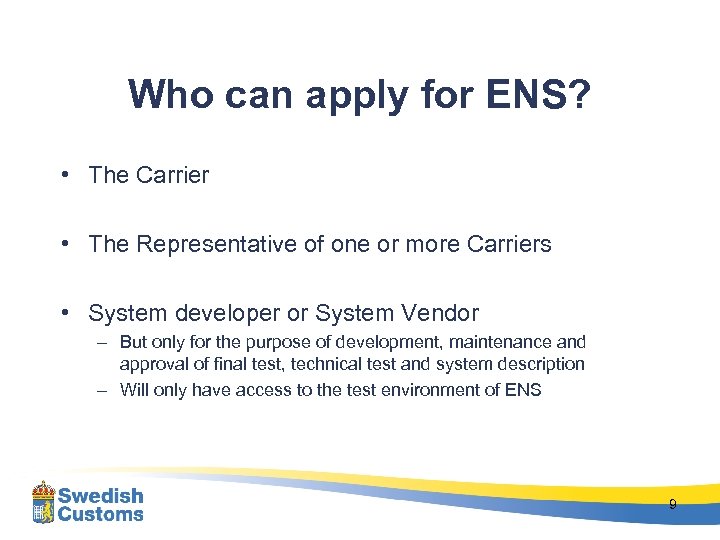 Who can apply for ENS? • The Carrier • The Representative of one or more Carriers • System developer or System Vendor – But only for the purpose of development, maintenance and approval of final test, technical test and system description – Will only have access to the test environment of ENS 9
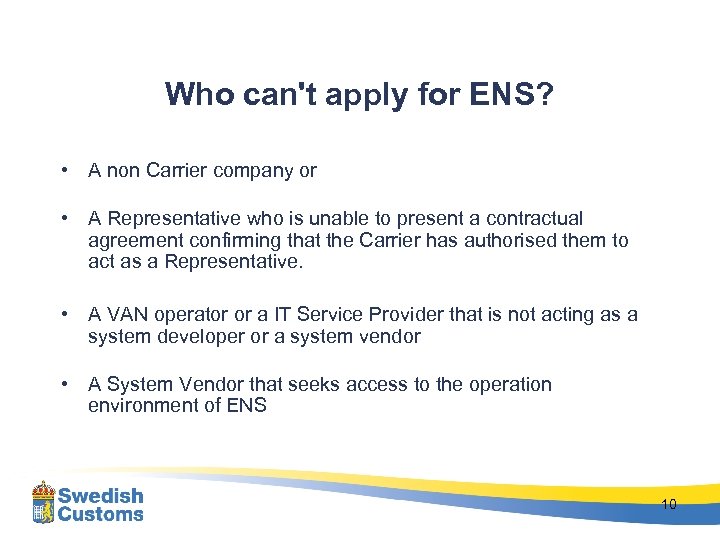 Who can't apply for ENS? • A non Carrier company or • A Representative who is unable to present a contractual agreement confirming that the Carrier has authorised them to act as a Representative. • A VAN operator or a IT Service Provider that is not acting as a system developer or a system vendor • A System Vendor that seeks access to the operation environment of ENS 10
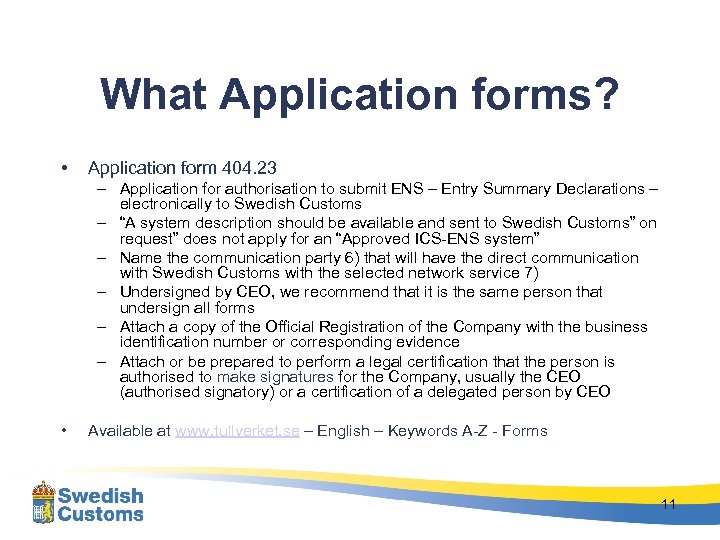 What Application forms? • Application form 404. 23 – Application for authorisation to submit ENS – Entry Summary Declarations – electronically to Swedish Customs – “A system description should be available and sent to Swedish Customs” on request” does not apply for an “Approved ICS-ENS system” – Name the communication party 6) that will have the direct communication with Swedish Customs with the selected network service 7) – Undersigned by CEO, we recommend that it is the same person that undersign all forms – Attach a copy of the Official Registration of the Company with the business identification number or corresponding evidence – Attach or be prepared to perform a legal certification that the person is authorised to make signatures for the Company, usually the CEO (authorised signatory) or a certification of a delegated person by CEO • Available at www. tullverket. se – English – Keywords A-Z - Forms 11
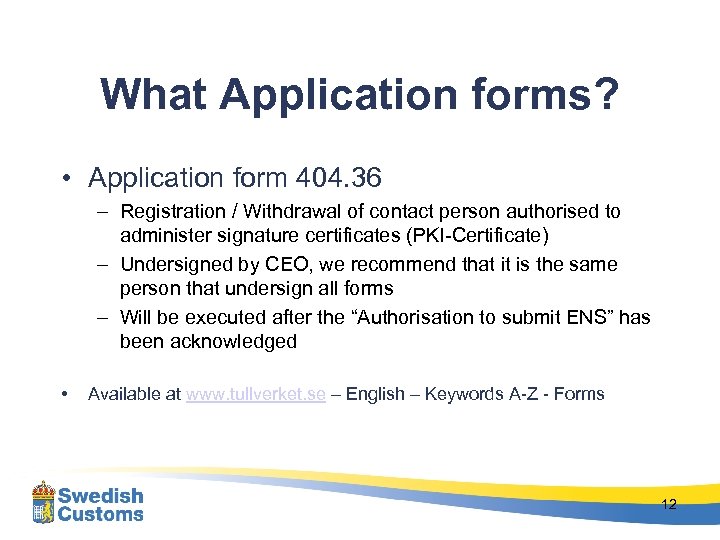 What Application forms? • Application form 404. 36 – Registration / Withdrawal of contact person authorised to administer signature certificates (PKI-Certificate) – Undersigned by CEO, we recommend that it is the same person that undersign all forms – Will be executed after the “Authorisation to submit ENS” has been acknowledged • Available at www. tullverket. se – English – Keywords A-Z - Forms 12
 3. Definition of different stakeholders 13
 First of all. . • The Carrier is responsible to submit ENS • The Carrier can designate a Representative to submit the ENS on his behalf; both are later referred to as CLIENT. • A System Vendor, an ASP or an IT Service Provider can not be approved as holder of an “Authorisation to submit ENS” in operation; they are authorised only for testing and developing purposes. 14
 Carrier • The Carrier will normally be: – – – An Air Line company, An Ocean Vessel Line, A Truck hauler, A Railway transporter and similar, An Integrated Carrier (Express) • Exceptions exists in combined transport or in certain contractual agreements • The Carrier normally applies for “Authorisation to submit ENS” with an “Approved ENS-system” and for “Registration of contact person authorised to administer signature certificates” 15
 Representative • • • A Carrier (X) can chose a company (Y) to submit ENS as a Representative on the Carrier’s behalf and responsibility The Representative (Y) needs to be able to present some sort of certification where the Carrier confirms their designation of the company (Y) to act as their Representative to submit ENS on the Carriers behalf and responsibility If this is the case, the Representative applies for “Authorisation to submit ENS” (as Representative) and for “Registration of contact person authorised to administer signature certificates” Normally a Representative could be an Ocean Liner Agency, a Freight Forwarder or a Customs Agent A Representative can act as a Representative for one or more Carriers A Carrier can have one or more Representatives 16
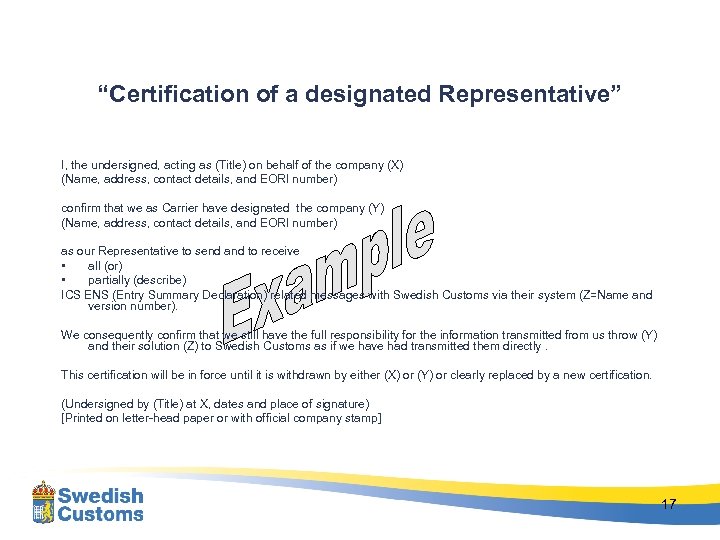 “Certification of a designated Representative” I, the undersigned, acting as (Title) on behalf of the company (X) (Name, address, contact details, and EORI number) confirm that we as Carrier have designated the company (Y) (Name, address, contact details, and EORI number) as our Representative to send and to receive • all (or) • partially (describe) ICS ENS (Entry Summary Declaration) related messages with Swedish Customs via their system (Z=Name and version number). We consequently confirm that we still have the full responsibility for the information transmitted from us throw (Y) and their solution (Z) to Swedish Customs as if we have had transmitted them directly. This certification will be in force until it is withdrawn by either (X) or (Y) or clearly replaced by a new certification. (Undersigned by (Title) at X, dates and place of signature) [Printed on letter-head paper or with official company stamp] 17
 System Vendor • A company that develops and sells a standard system under commercial conditions. • Normally the standard system is intended for installation within the Client’s own IT environment and for the Client’s own use. • The System Vendor applies for “Authorisation to submit ENS” and for “Registration of contact person authorised to administer signature certificates” especially marked as for “System Vendor”. • This “Authorisation to submit ENS” will make it possible for the System Vendor to test and to perform maintenance but it will never be allowed in operation. • It is also necessary for the System Vendor to have an “Authorisation to submit ENS” of their own to meet one of the conditions for an “Approved ENS system”. 18
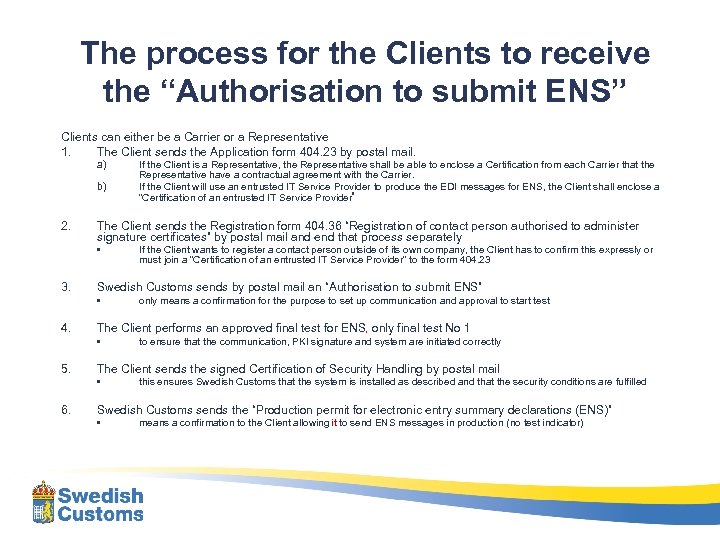
 System Vendor continues. . • The Client applies for “Authorisation to submit ENS” and register the name and version of the System Vendor’s system in the application form. • Each client shall also apply separately for “Registration of contact person authorised to administer signature certificates”. • The Client will receive all security data from Swedish Customs and is responsible that the information will be registered in the System Vendor’s system installed in the Client’s IT environment. • If the System Vendor’s system is confirmed to be an “Approved ENS system”, the Client only needs to perform the simplified final test No 1 to ensure that all parameters are correctly installed and initiated. • If the System Vendor’s system is not an “Approved ENS system”, the Client needs to perform the simplified final test No 1 -6 and to perform a system description. • The Client then sends the Security Certification signed by post mail to Swedish Customs • The Client will then receive the “Production permit for electronic entry summary declarations (ENS)” from Swedish Customs. 19
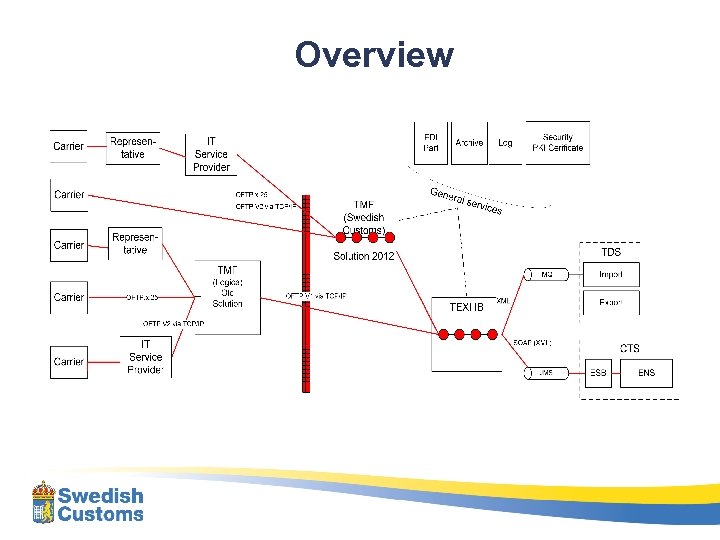
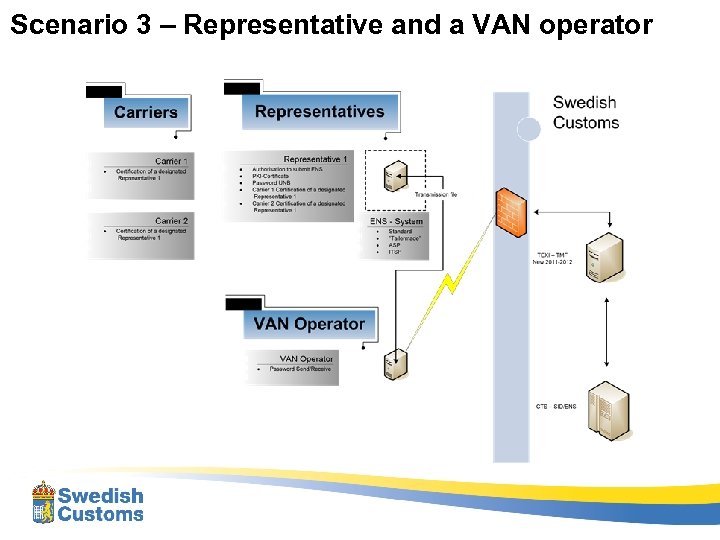
 VAN operator (Value Added Network) • Provides services to switch communication link and/or -protocol between a sender and receiver, without changing the transmission file containing the EDI messages • If the VAN operator is the last party that will communicate directly with Swedish Customs, it should be registered as the “Communication party” in the Application form 404. 23 • A VAN operator could be used in all cases, independent of the stakeholder applying for “Authorisation to submit ENS” 20
 ASP (Application Service Provider) • A user to system solution. An ASP develops a standard system that supports ENS just like a System Vendor, but provides the ASP-system only within the ASP’s own IT environment. • This is an option for the Client instead of developing or installing a standard system within the Client’s IT environment. Normally this is suitable for clients with few ENS messages. • The standard ASP-system can be a Web application or a system where the Client’s user applications is centralized or distributed. The database and functionality for EDIFACT and EDI can be mutually shared, but shall be constructed in such a way that each client can operate and submit ENS within a safe and secured environment separate from other clients. • The ASP should apply for “Authorisation to submit ENS” and for “Registration of contact person authorised to administer signature certificates” especially marked as for “System Vendor”. This “Authorisation to submit ENS” will make it possible for the ASP to test and to perform maintenance of the ASP-system but it will never be allowed in operation. • It is also necessary for the ASP to meet the conditions for an “Approved ENS system” and the special requirements for an ASP-system as it should be constructed for several clients, shall be proven to secure data between each Client and that each Client is responsible to carry out the systems operations. The Client would not be able to produce a description of an ASP-system. 21
 ASP (Application Service Provider) continues. . • When the ASP-system is confirmed to be an “Approved ENS system”, each Client applies separately for “Authorisation to submit ENS” and register the name and version of the ASP-system in the application form. • Each client shall also apply separately for “Registration of contact person authorised to administer signature certificates”. • The Client will receive all security data from Swedish Customs and will normally be responsible that this information be registered in the ASP-system. • The Client only needs to perform the final test No 1 to ensure that all parameters are correctly installed and initiated. • The Client sends the Security Certification undersigned by post mail to Swedish Customs. • The Client will then receive the “Operating permit for electronic entry summary declarations (ENS)” from Swedish Customs. 22
 IT Service Provider • A system to system solution. Can be defined as a combination of System Vendor, VAN and ASP. Provide services to enable Carrier to submit ENS messages to different member states of EU with different conditions in national domain. Normally for clients with large numbers of ENS messages to different member states. • The Client holds all ENS data in the Client’s own IT environment but allows the IT Service Provider (ITSP) to transmit the information to and from Swedish Customs by pull or push techniques throw the ITSP system. • The ITSP system converts automatically the information to EDI ENS messages, add the electronic signature of the Client in AUTACK and submits the transmission file to Swedish Customs directly or through a VAN operator. • The ITSP system receives the EDI ENS respond messages from Swedish Customs and controls the electronic signature of Swedish Customs and converts automatically the information and transmits it all to the Client’s IT environment for ENS data. • The ITSP applies for “Authorisation to submit ENS” and for “Registration of contact person authorised to administer signature certificates” especially marked as for “System Vendor”. This “Authorisation to submit ENS” will make it possible for the ITSP to test and to perform maintenance but it will never be allowed in operation. • If the ITSP-system is meant as a standard solution for more than one client, it is also necessary for the ITSP to meet the conditions for an “Approved ENS system” and the special requirements for an ITSPsystem - it should be constructed for several clients, it should be proven to secure data between each client and if the ITSP should be allowed to carry out some systems operations that normally falls under the clients responsibility. The Client would not be able to produce the description of a ITSP-system. 23
 IT Service Provider continues… • When the ITSP-system is confirmed to be an “Approved ENS system”, each Client applies for “Authorisation to submit ENS” and register the name and version of the ITSP-system in the application form. • Each Client shall separately also apply for “Registration of contact person authorised to administer signature certificates”. This person will normally be a contact person at the ITSP. • The ITSP will require all security data and to designate the contact person authorised to administer signature certificates on behalf of the Client. The ITSP needs to perform and register this information in the ITSP system to be able to produce ENS and AUTACK messages. • If the Client approves that Swedish Customs shall correspond directly with the ITSP in this matters, the Client needs to perform a “Certification of an entrusted IT Service Provider” confirming that the Client takes the full responsibility for the solution and instructs Swedish Customs to correspond all security data directly to the entrusted IT Service Provider under the Clients full responsibility. • The Client only need to perform the simplified final test No 1 to ensure that all parameters are correctly installed and initiated. • The Client sends the Security Certification undersigned by post mail to Swedish Customs • The Client will then receive the “Operating permit for electronic entry summary declarations (ENS)” from Swedish Customs. 24
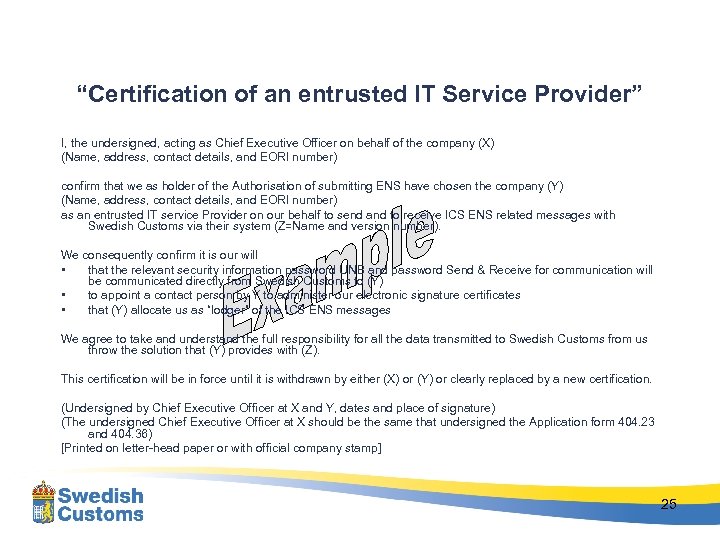 “Certification of an entrusted IT Service Provider” I, the undersigned, acting as Chief Executive Officer on behalf of the company (X) (Name, address, contact details, and EORI number) confirm that we as holder of the Authorisation of submitting ENS have chosen the company (Y) (Name, address, contact details, and EORI number) as an entrusted IT service Provider on our behalf to send and to receive ICS ENS related messages with Swedish Customs via their system (Z=Name and version number). We consequently confirm it is our will • that the relevant security information password UNB and password Send & Receive for communication will be communicated directly from Swedish Customs to (Y) • to appoint a contact person by Y to administer our electronic signature certificates • that (Y) allocate us as “lodger” of the ICS ENS messages We agree to take and understand the full responsibility for all the data transmitted to Swedish Customs from us throw the solution that (Y) provides with (Z). This certification will be in force until it is withdrawn by either (X) or (Y) or clearly replaced by a new certification. (Undersigned by Chief Executive Officer at X and Y, dates and place of signature) (The undersigned Chief Executive Officer at X should be the same that undersigned the Application form 404. 23 and 404. 36) [Printed on letter-head paper or with official company stamp] 25
 4. Approved ICS-ENS system conditions 26
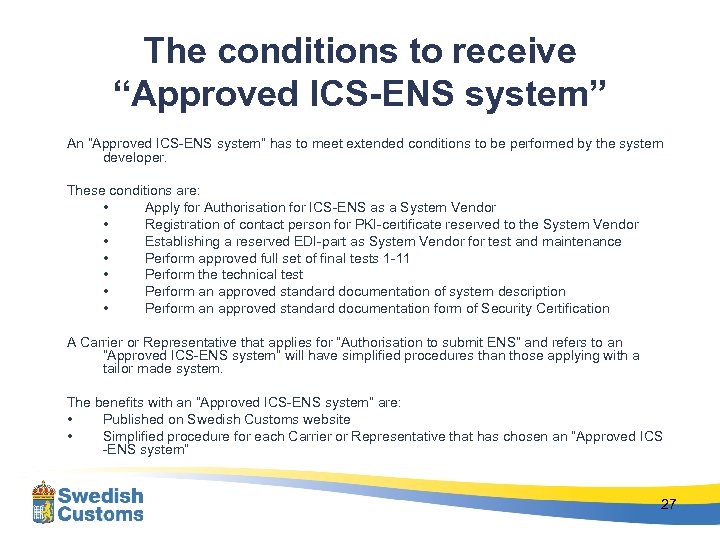 The conditions to receive “Approved ICS-ENS system” An “Approved ICS-ENS system” has to meet extended conditions to be performed by the system developer. These conditions are: • Apply for Authorisation for ICS-ENS as a System Vendor • Registration of contact person for PKI-certificate reserved to the System Vendor • Establishing a reserved EDI-part as System Vendor for test and maintenance • Perform approved full set of final tests 1 -11 • Perform the technical test • Perform an approved standard documentation of system description • Perform an approved standard documentation form of Security Certification A Carrier or Representative that applies for “Authorisation to submit ENS” and refers to an “Approved ICS-ENS system” will have simplified procedures than those applying with a tailor made system. The benefits with an “Approved ICS-ENS system” are: • Published on Swedish Customs website • Simplified procedure for each Carrier or Representative that has chosen an “Approved ICS -ENS system” 27
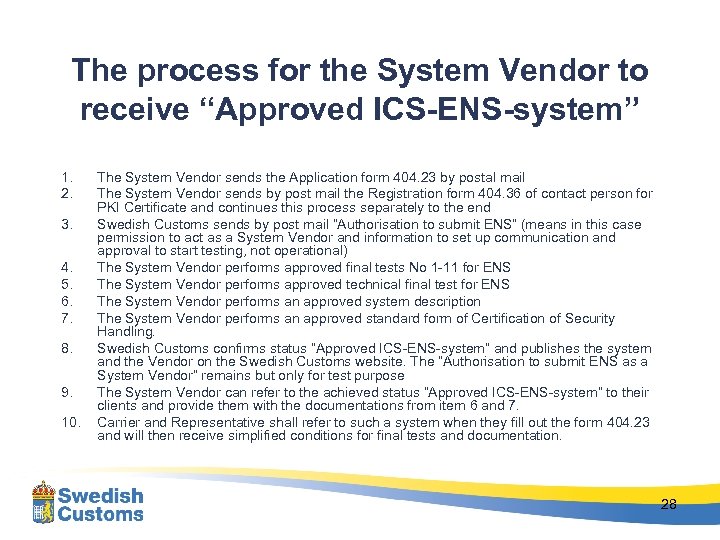 The process for the System Vendor to receive “Approved ICS-ENS-system” 1. 2. 3. 4. 5. 6. 7. 8. 9. 10. The System Vendor sends the Application form 404. 23 by postal mail The System Vendor sends by post mail the Registration form 404. 36 of contact person for PKI Certificate and continues this process separately to the end Swedish Customs sends by post mail “Authorisation to submit ENS” (means in this case permission to act as a System Vendor and information to set up communication and approval to start testing, not operational) The System Vendor performs approved final tests No 1 -11 for ENS The System Vendor performs approved technical final test for ENS The System Vendor performs an approved system description The System Vendor performs an approved standard form of Certification of Security Handling. Swedish Customs confirms status “Approved ICS-ENS-system” and publishes the system and the Vendor on the Swedish Customs website. The “Authorisation to submit ENS as a System Vendor” remains but only for test purpose The System Vendor can refer to the achieved status “Approved ICS-ENS-system” to their clients and provide them with the documentations from item 6 and 7. Carrier and Representative shall refer to such a system when they fill out the form 404. 23 and will then receive simplified conditions for final tests and documentation. 28
 5. The process for the Client to receive Authorisation to submit ENS with an “Approved system for ICS-ENS”
 The process for the Clients to receive the “Authorisation to submit ENS” Clients can either be a Carrier or a Representative 1. The Client sends the Application form 404. 23 by postal mail. a) b) 2. The Client sends the Registration form 404. 36 “Registration of contact person authorised to administer signature certificates” by postal mail and end that process separately • 3. to ensure that the communication, PKI signature and system are initiated correctly The Client sends the signed Certification of Security Handling by postal mail • 6. only means a confirmation for the purpose to set up communication and approval to start test The Client performs an approved final test for ENS, only final test No 1 • 5. If the Client wants to register a contact person outside of its own company, the Client has to confirm this expressly or must join a “Certification of an entrusted IT Service Provider” to the form 404. 23 Swedish Customs sends by postal mail an “Authorisation to submit ENS” • 4. If the Client is a Representative, the Representative shall be able to enclose a Certification from each Carrier that the Representative have a contractual agreement with the Carrier. If the Client will use an entrusted IT Service Provider to produce the EDI messages for ENS, the Client shall enclose a “Certification of an entrusted IT Service Provider” this ensures Swedish Customs that the system is installed as described and that the security conditions are fulfilled Swedish Customs sends the “Production permit for electronic entry summary declarations (ENS)” • means a confirmation to the Client allowing it to send ENS messages in production (no test indicator)
 6. Different combinations to communicate ENS with Swedish Customs
 Overview
 7. Scenarios of accepted and non-accepted combinations for ENS
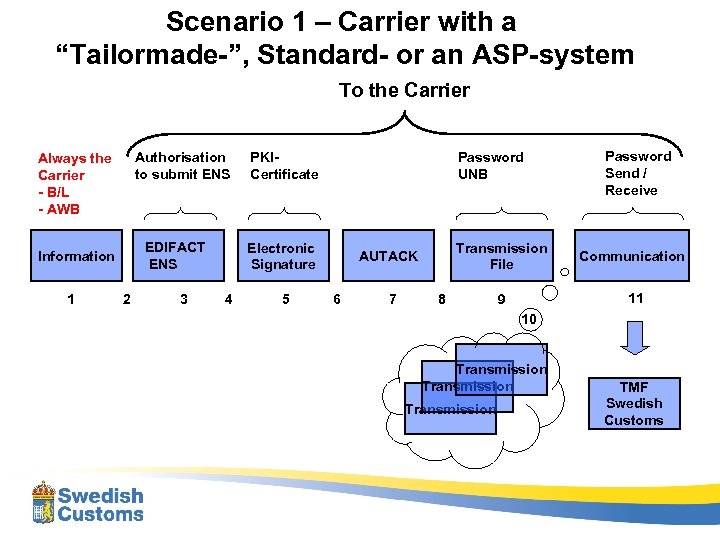 Scenario 1 – Carrier with a “Tailormade-”, Standard- or an ASP-system To the Carrier Authorisation to submit ENS Always the Carrier - B/L - AWB EDIFACT ENS Information 1 2 3 PKICertificate Password UNB Electronic Signature 4 5 Transmission File AUTACK 6 7 Password Send / Receive Communication 9 11 8 10 Transmission TMF Swedish Customs
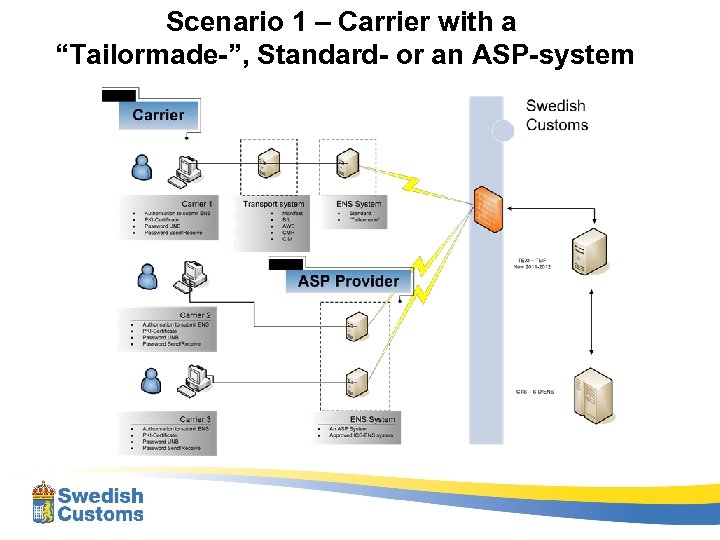 Scenario 1 – Carrier with a “Tailormade-”, Standard- or an ASP-system
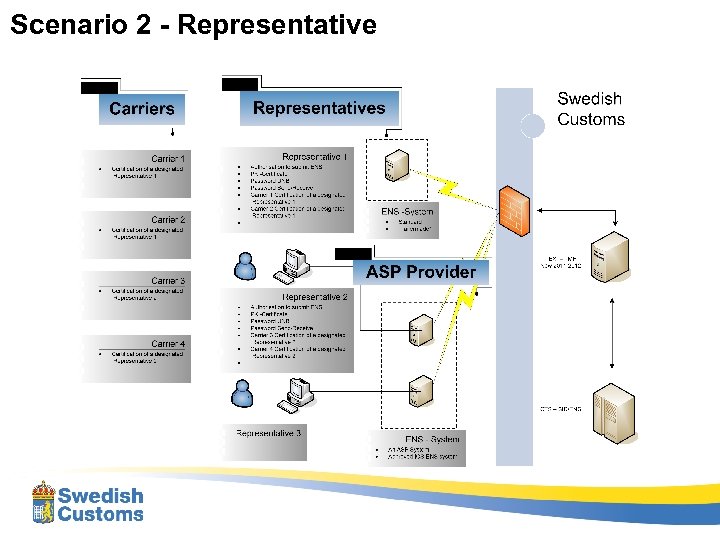
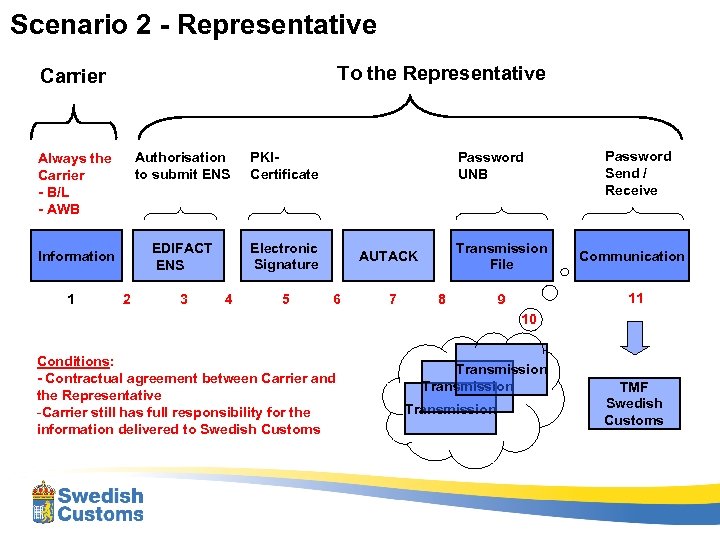 Scenario 2 - Representative To the Representative Carrier Authorisation to submit ENS Information 1 2 PKICertificate EDIFACT ENS Always the Carrier - B/L - AWB Electronic Signature 3 4 5 Password UNB Transmission File AUTACK 6 7 Password Send / Receive Communication 9 11 8 10 Conditions: - Contractual agreement between Carrier and the Representative -Carrier still has full responsibility for the information delivered to Swedish Customs Transmission TMF Swedish Customs
 Scenario 2 - Representative
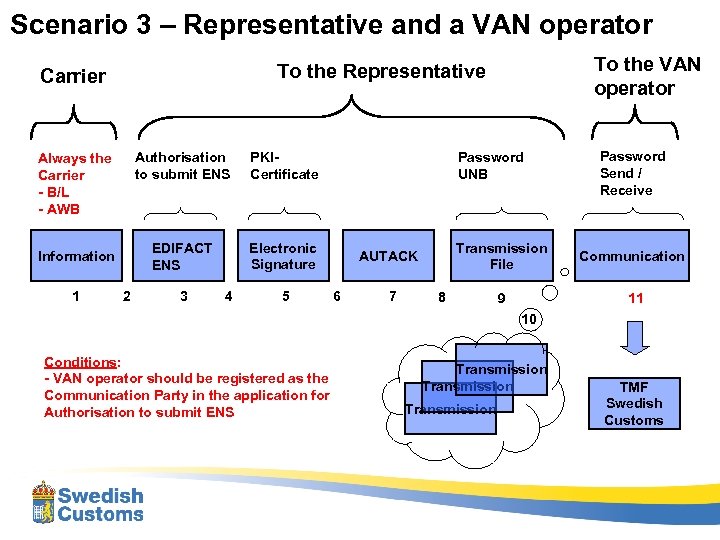 Scenario 3 – Representative and a VAN operator Authorisation to submit ENS Information 2 PKICertificate EDIFACT ENS Always the Carrier - B/L - AWB 1 To the VAN operator To the Representative Carrier Electronic Signature 3 4 5 Password UNB Transmission File AUTACK 6 7 Password Send / Receive Communication 9 11 8 10 Conditions: - VAN operator should be registered as the Communication Party in the application for Authorisation to submit ENS Transmission TMF Swedish Customs
 Scenario 3 – Representative and a VAN operator
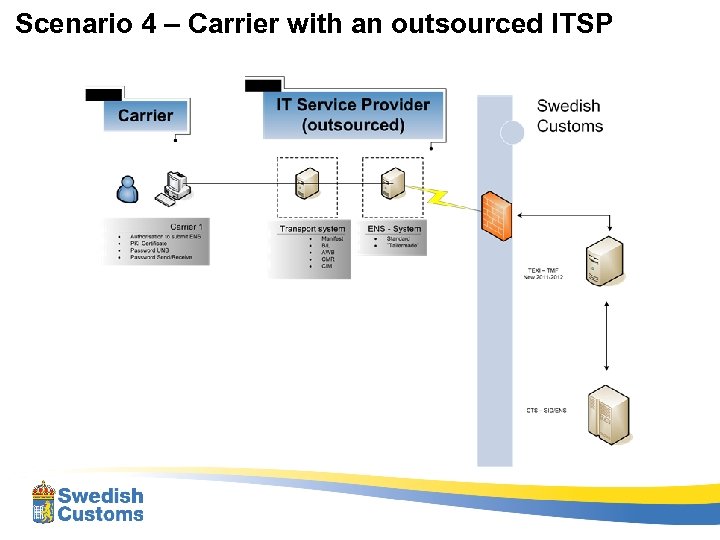
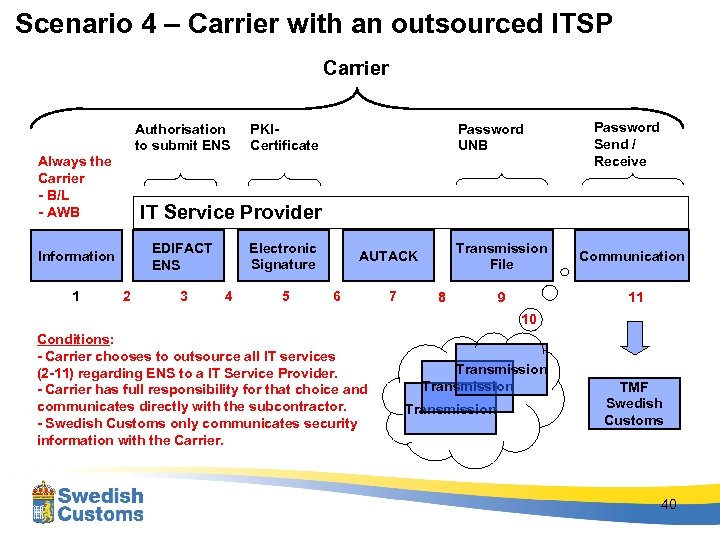 Scenario 4 – Carrier with an outsourced ITSP Carrier Authorisation to submit ENS Always the Carrier - B/L - AWB Password UNB Password Send / Receive IT Service Provider Electronic Signature EDIFACT ENS Information 1 PKICertificate 2 3 4 5 Transmission File AUTACK 6 7 Communication 9 11 8 10 Conditions: - Carrier chooses to outsource all IT services (2 -11) regarding ENS to a IT Service Provider. - Carrier has full responsibility for that choice and communicates directly with the subcontractor. - Swedish Customs only communicates security information with the Carrier. Transmission TMF Swedish Customs 40
 Scenario 4 – Carrier with an outsourced ITSP
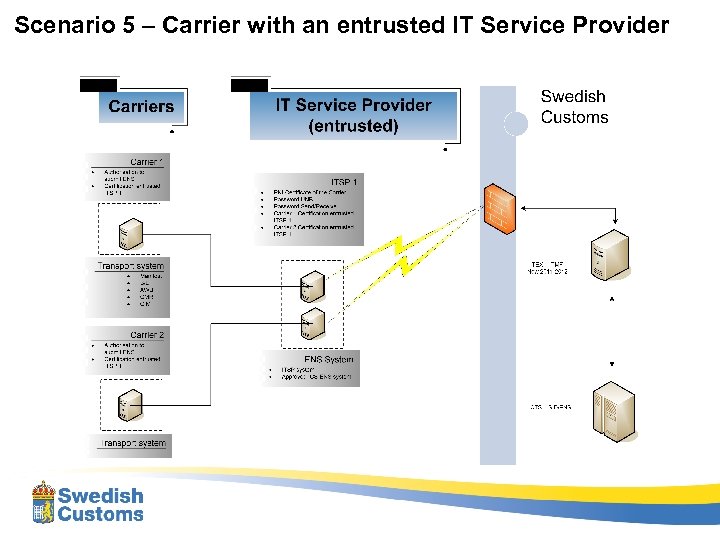
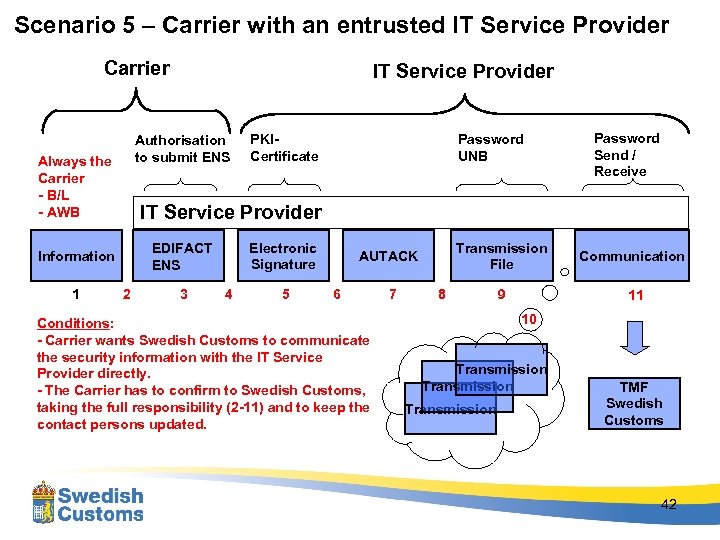 Scenario 5 – Carrier with an entrusted IT Service Provider Carrier Authorisation to submit ENS Always the Carrier - B/L - AWB PKICertificate Password UNB Password Send / Receive IT Service Provider Electronic Signature EDIFACT ENS Information 1 IT Service Provider 2 3 4 5 Transmission File AUTACK 6 Conditions: - Carrier wants Swedish Customs to communicate the security information with the IT Service Provider directly. - The Carrier has to confirm to Swedish Customs, taking the full responsibility (2 -11) and to keep the contact persons updated. 7 Communication 9 11 8 10 Transmission TMF Swedish Customs 42
 Scenario 5 – Carrier with an entrusted IT Service Provider
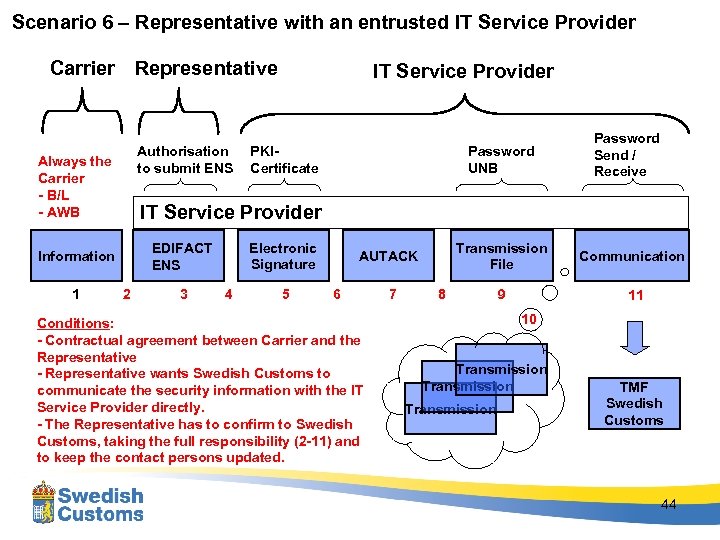 Scenario 6 – Representative with an entrusted IT Service Provider Carrier Representative Authorisation to submit ENS Always the Carrier - B/L - AWB PKICertificate Password UNB Password Send / Receive IT Service Provider Electronic Signature EDIFACT ENS Information 1 IT Service Provider 2 3 4 5 Transmission File AUTACK 6 Conditions: - Contractual agreement between Carrier and the Representative - Representative wants Swedish Customs to communicate the security information with the IT Service Provider directly. - The Representative has to confirm to Swedish Customs, taking the full responsibility (2 -11) and to keep the contact persons updated. 7 Communication 9 11 8 10 Transmission TMF Swedish Customs 44
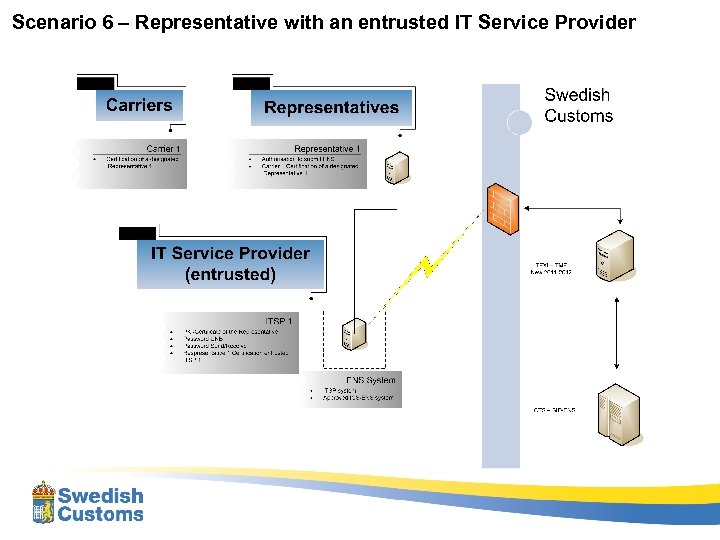 Scenario 6 – Representative with an entrusted IT Service Provider
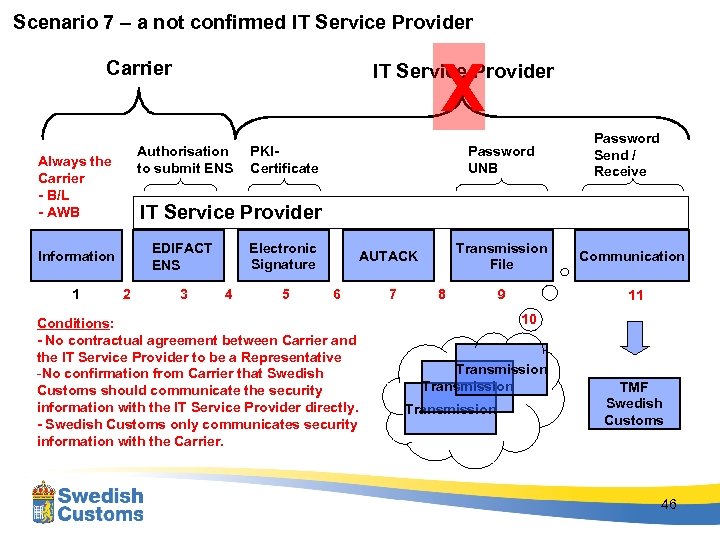 Scenario 7 – a not confirmed IT Service Provider X Carrier Authorisation to submit ENS Always the Carrier - B/L - AWB PKICertificate Password UNB Password Send / Receive IT Service Provider Electronic Signature EDIFACT ENS Information 1 IT Service Provider 2 3 4 5 Transmission File AUTACK 6 Conditions: - No contractual agreement between Carrier and the IT Service Provider to be a Representative -No confirmation from Carrier that Swedish Customs should communicate the security information with the IT Service Provider directly. - Swedish Customs only communicates security information with the Carrier. 7 Communication 9 11 8 10 Transmission TMF Swedish Customs 46
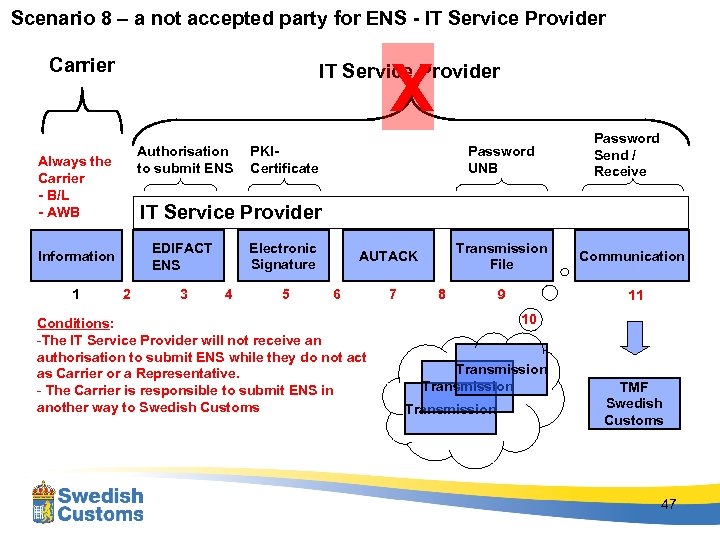 Scenario 8 – a not accepted party for ENS - IT Service Provider X Carrier IT Service Provider Authorisation to submit ENS Always the Carrier - B/L - AWB Password UNB Password Send / Receive IT Service Provider Electronic Signature EDIFACT ENS Information 1 PKICertificate 2 3 4 5 Transmission File AUTACK 6 Conditions: -The IT Service Provider will not receive an authorisation to submit ENS while they do not act as Carrier or a Representative. - The Carrier is responsible to submit ENS in another way to Swedish Customs 7 Communication 9 11 8 10 Transmission TMF Swedish Customs 47
 End 48