


 Скачать презентацию Guest Registration Learning outcomes takeaways It is envisaged
61b64e7432b750812689ea0a2e4acfa5.ppt
- Количество слайдов: 34
 Guest Registration Learning outcomes/takeaways
 It is envisaged that upon successful completion of this module unit you should be able to do the following: • Explain the importance or purpose of registering hotel guests. • Outline the registration process and explain activities of note from the perspective of the front desk agent.
 • Conversant with the various room rates that are charged by Zimbabwean hotels. • Explain various ways used by customers to pay or settle their bills in Zimbabwe.
 The importance of registering hotel guests. 1. To satisfy statutory requirements or legislative imperatives. 2. To create a guest history database for accounting and marketing purposes. 3. To screen out black listed customers, that is, those that are notorious for defaulting from settling their accounts for services rendered. 4. To ascertain occupancy percentages or levels. 5. To provide information on guests in the event of the unforeseen.
 The registration process • Registration begins when the front desk agent/ receptionist cashier extends a sincere welcome to the guest. • The front desk agent moves to the registration process after determining the guest`s reservation status. • Registration relies a lot upon information contained in a reservation record. • The registration process can be divided into six stages:
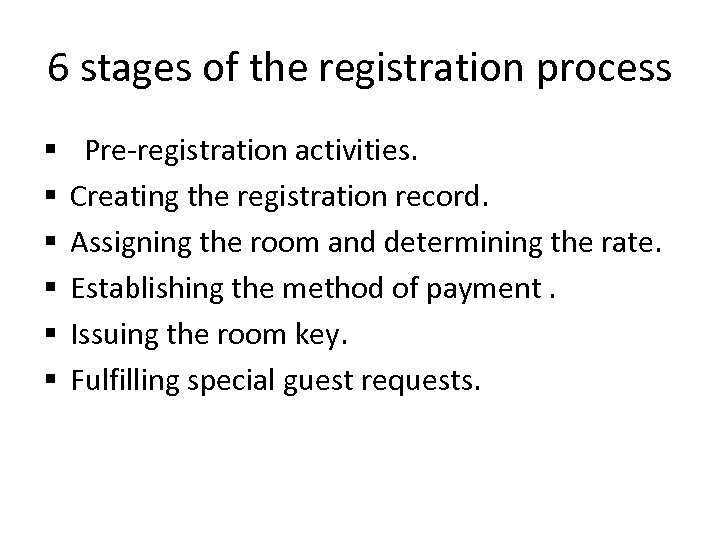 6 stages of the registration process § § § Pre-registration activities. Creating the registration record. Assigning the room and determining the rate. Establishing the method of payment. Issuing the room key. Fulfilling special guest requests.
 Phase 1. Pre-registration activity • These are activities that happen or occur before the guest arrives at the property/hotel. • The intention is to accelerate the registration process. Guests can be pre-registered using information collected by reservation agents. • Part of the pre-registration activities include: a) advance printing of the guest registration card (GRCs),
 a) identification of VVIP, VIP and CIP guests and taking the necessary steps to accord them the status they deserve, and b) identification of any special requests, for example, transfers/transportation, request for wheel chairs.
 Phase 2. Creating the registration record • After the guest arrives at the hotel the front desk agent (receptionist cashier) : • creates the registration record, that is, a collection of important guest information. • Information captured on the GRC includes: guest name, check in and check -out dates, the room number, and method of payment, and a provision for guest signature. • The guest should append his/her signature on the pre-printed GRC as confirmation that the information contained there is accurate.
 • During the stage of checking out the information captured on the GRC may be used as the primary source for creating the guest history record.
 Phase 3. Room and rate assignment • This stage involves : • identifying and allocating an available room in a specific category requested by the guest on the basis of the reservation information. • The appropriate room , eg, - double room-has to be allocated and the room rate, eg, -Family ratedetermined. • The front desk agent`s ability to determining room status and allocate an appropriate room is critical to effective registration process.
 • The room rate is the price the hotel charges for overnight accommodation and should be reconfirmed to the guest during check in. The various room rates include:
 ü Standard rate/rack rate. ü Family rate. ü Corporate. ü Complementary rate. ü Group rate.
 Phase 4. Determining the method of payment • The hotel should take precautionary measures to ensure payment by the guest. • Effective account settlement depends on steps taken during the registration process to determine the guest`s method of payment. • The establishment of proper settlements/credit authorisation at the stage of registration will greatly reduce the potential for collection problems or bad debts.
 • The methods of payment which can be used by customers include: o cash settlement. o use of traveller`s cheque (TCs). o Credit cards. o direct bill account, and o special programs.
 a) Cash • Cash paying guests are usually requested to pay a deposit prior to arrival. • During the registration stage such guests are also asked for advance payments to cover extras or in house accounts, or they are to pay cash for services during their stay. • Hotels at times consider personal cheques, TCs, and money orders as equivalent to cash.
 • On personal cheques individual properties must establish policies for accepting personal cheques and reduce the risk associated with them. • Before accepting personal cheques front desk agent/ staff should check for the following; a) guest details, b) ID or pass port details, c) the written amount in words against that in figures, d) dates on the cheque with an intention to turn down post dated cheques, and bank card limit.
 • Second or third party cheques should be politely turned down and an alternative method of payment requested.
 b) Credit card/plastic money • The choice of cards that can be used to settle the accounts include: 1) Amex, 2) Diners, 3) JCB, Sunset and so on. • Careful authorisation and verification of credit card is as important to front office cash flow as the precautions taken with any other method of payment.
 • Front office policy for handling credit cards should cover the following: Ø expiry dates, that is, card validity, Ø the bank flow limit, that is, the maximum amount that can be charged on the account without referring to the bank for authorisation, Ø whether the card belong to the rightful owner or is a stolen card.
 c) Direct billing • Some hotels extend credit to guests by agreeing to bill them or the company for charges after the check-out process. • DB arrangements are normally established through agreements between the hotel and the company prior to guest arrival. • The front office manager normally reviews and is responsible for approving such credits arrangements.
 • The front desk keeps a list of such approved direct bill accounts. • All that a guest does at checking –out is to check the account and sign for it. • The front desk department then forwards such accounts to the debtor`s clerk for settlement.
 d) Special programs • This covers vouchers, coupons or special incentive awards from business, airlines or authorised agencies. • Special programs are normally associated with marketing or promotional effort where prices are given. • Winners of such prices are then given vouchers that are used for account settlement and treated as DB accounts.
 • In case of guests with poor credit ratings and where it is necessary to deny credit requests the situation should be diplomatically handled by management.
 Phase 5. Issuing the room key • This signals the completion of the registration process. • Room keys must be carefully controlled for the security of both the guest and the property. • The theft, loss or unauthorised duplication of guest room keys threaten hotel security. • Hotels should have written policies governing guest room key control.
 • While taking the guest to the room the porter/ bell person should market hotel facilities and outlets such as bars, restaurants, gift shops, swimming pools and sporting facilities. • Once in the room the porter is also expected to explain the room features before handing over the room key to the guests and wishes them a pleasant stay.
 Phase 6. Fulfilling special requests • Part of the registration activities is making sure that any special requests made at the stage of reservation by guests are acknowledged and acted upon or followed through. Special requests could be on the room, that is, v the location, v room view, v bed type, or the request could be for v special meal requirements, v request for transportation, v request for baby sitters, it could be reservations for the restaurant in the hotel or outside the hotel.
 • The front desk agent should mention the request during check in and ensure that all necessary steps have been taken to provide what the guest has requested.
 Up selling • Part of the front desk agent`s job is to create customer acceptance of the hotel products, that is, guest rooms, facilities and services. • Properly trained front office staff can substantially improve room revenue by applying front office sales techniques especially up selling.
 • Up-selling refers to all efforts of front office and reservation agents to convince guests to rent rooms in categories above the standard accommodation, ie, encouraging or persuading the guest to use a more expensive room than that which they initially wanted to utilise. • The majority of up selling efforts are conducted during reservations while front desk staff can up sell to walk in guests.
 Reflection questions Write explanatory notes on the following terms: • Direct billing • Guest registration card • Room rate • Up-selling • Bank flow limit (5 marks each).
 Essay questions • Provide a detailed account of the guest registration process, noting the stages and emphasizing on the key activities taking place on each stage (25). • Identify and explain the major methods used by customers to pay their hotel bills (25). • Summarise the key registration steps one would observe when checking-in a regular or VIP guest (25).
 • Elaborate on the importance of registering hotel guests in Zimbabwean hotels (25).
 Thank you!!!! -end-