 Скачать презентацию GTAP_E Presented by Belay Fekadu Farzad Taheripour Patrick
d7c41b1bd0162567ec4dd15b9f1a4718.ppt
- Количество слайдов: 30




GTAP_E Presented by Belay Fekadu, Farzad Taheripour, Patrick Georges, David Mayer-Foulkes, Marianne Aasen, Hyun-Sik Chung, Kenatro Katsumata, Christa Clapp
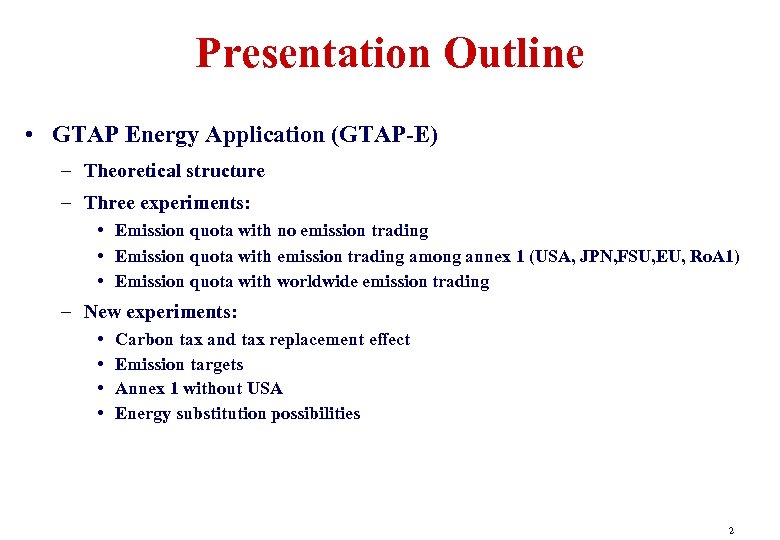
Presentation Outline • GTAP Energy Application (GTAP-E) – Theoretical structure – Three experiments: • Emission quota with no emission trading • Emission quota with emission trading among annex 1 (USA, JPN, FSU, EU, Ro. A 1) • Emission quota with worldwide emission trading – New experiments: • • Carbon tax and tax replacement effect Emission targets Annex 1 without USA Energy substitution possibilities 2
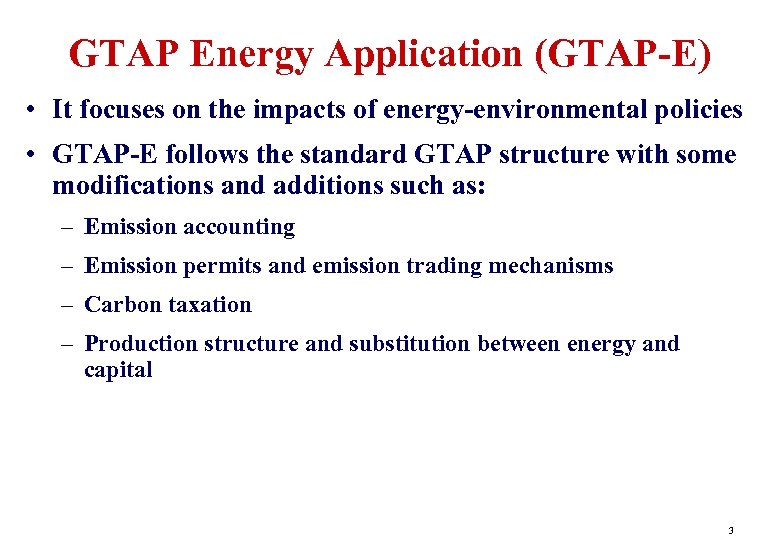
GTAP Energy Application (GTAP-E) • It focuses on the impacts of energy-environmental policies • GTAP-E follows the standard GTAP structure with some modifications and additions such as: – Emission accounting – Emission permits and emission trading mechanisms – Carbon taxation – Production structure and substitution between energy and capital 3
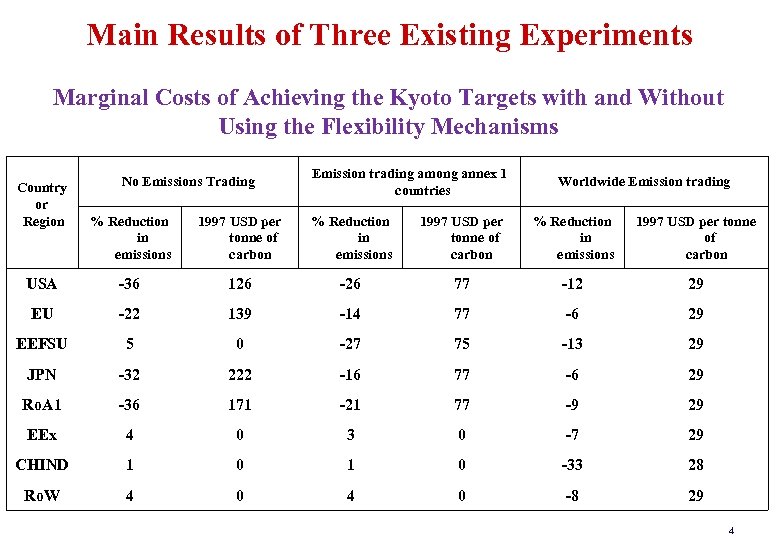
Main Results of Three Existing Experiments Marginal Costs of Achieving the Kyoto Targets with and Without Using the Flexibility Mechanisms Country or Region No Emissions Trading Emission trading among annex 1 countries Worldwide Emission trading % Reduction in emissions 1997 USD per tonne of carbon USA -36 126 -26 77 -12 29 EU -22 139 -14 77 -6 29 EEFSU 5 0 -27 75 -13 29 JPN -32 222 -16 77 -6 29 Ro. A 1 -36 171 -21 77 -9 29 EEx 4 0 3 0 -7 29 CHIND 1 0 -33 28 Ro. W 4 0 -8 29 4
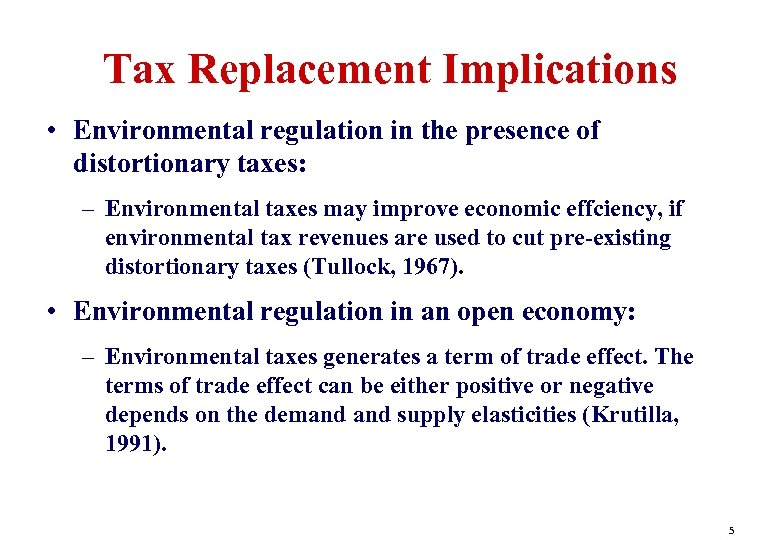
Tax Replacement Implications • Environmental regulation in the presence of distortionary taxes: – Environmental taxes may improve economic effciency, if environmental tax revenues are used to cut pre-existing distortionary taxes (Tullock, 1967). • Environmental regulation in an open economy: – Environmental taxes generates a term of trade effect. The terms of trade effect can be either positive or negative depends on the demand supply elasticities (Krutilla, 1991). 5
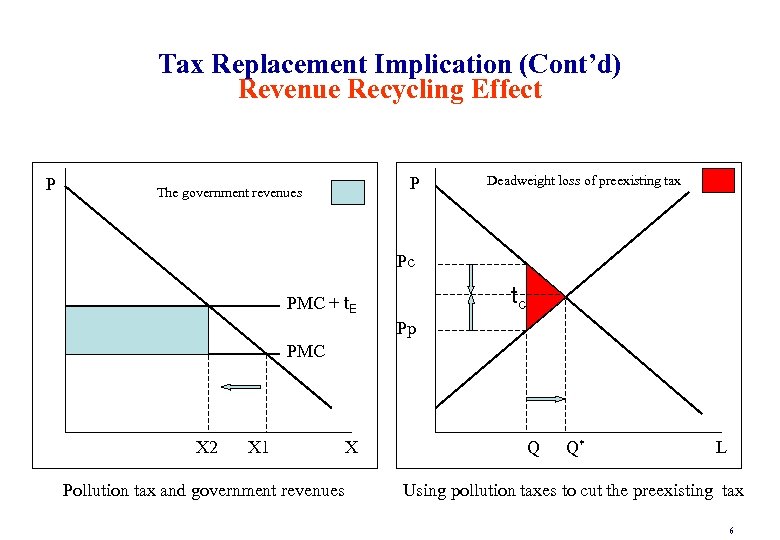
Tax Replacement Implication (Cont’d) Revenue Recycling Effect P P The government revenues Deadweight loss of preexisting tax Pc tc PMC + t. E Pp PMC X 2 X 1 Pollution tax and government revenues X Q Q* L Using pollution taxes to cut the preexisting tax 6
Tax Replacement Implications • Two scenarios: – $10 nominal carbon tax imposed on the US economy – A neutral tax replacement: Carbon tax revenues are used to reduce import tax rates on non-energy commodities • Approach: – From the first scenario we determined total tax revenues from the carbon tax – For the second scenario an iteration approach is used to achieve: Carbon Tax Revenues = Reduction in Import tax Revenues 7
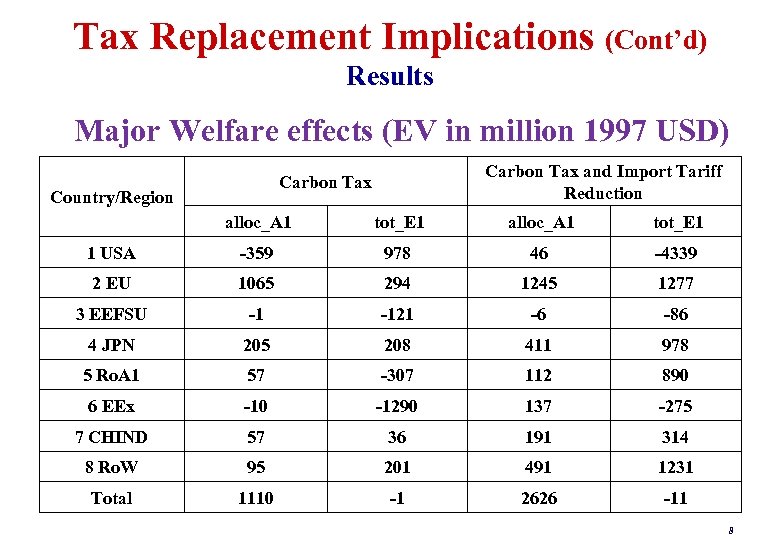
Tax Replacement Implications (Cont’d) Results Major Welfare effects (EV in million 1997 USD) Carbon Tax and Import Tariff Reduction Carbon Tax Country/Region alloc_A 1 tot_E 1 1 USA -359 978 46 -4339 2 EU 1065 294 1245 1277 3 EEFSU -1 -121 -6 -86 4 JPN 205 208 411 978 5 Ro. A 1 57 -307 112 890 6 EEx -10 -1290 137 -275 7 CHIND 57 36 191 314 8 Ro. W 95 201 491 1231 Total 1110 -1 2626 -11 8
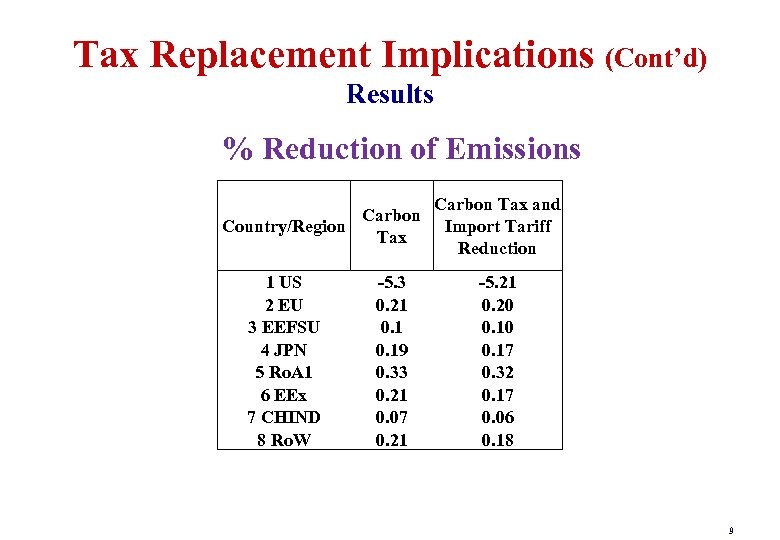
Tax Replacement Implications (Cont’d) Results % Reduction of Emissions Carbon Country/Region Tax 1 US 2 EU 3 EEFSU 4 JPN 5 Ro. A 1 6 EEx 7 CHIND 8 Ro. W -5. 3 0. 21 0. 19 0. 33 0. 21 0. 07 0. 21 Carbon Tax and Import Tariff Reduction -5. 21 0. 20 0. 17 0. 32 0. 17 0. 06 0. 18 9
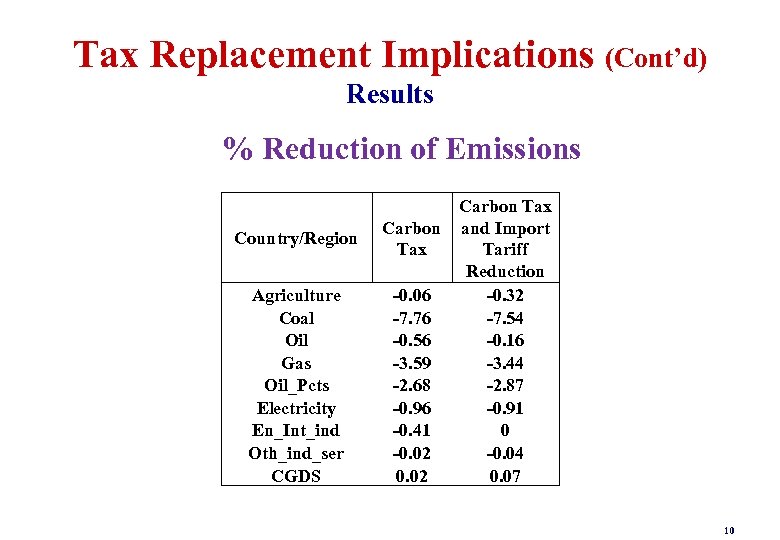
Tax Replacement Implications (Cont’d) Results % Reduction of Emissions Country/Region Agriculture Coal Oil Gas Oil_Pcts Electricity En_Int_ind Oth_ind_ser CGDS Carbon Tax Carbon and Import Tax Tariff Reduction -0. 06 -0. 32 -7. 76 -7. 54 -0. 56 -0. 16 -3. 59 -3. 44 -2. 68 -2. 87 -0. 96 -0. 91 -0. 41 0 -0. 02 -0. 04 0. 02 0. 07 10
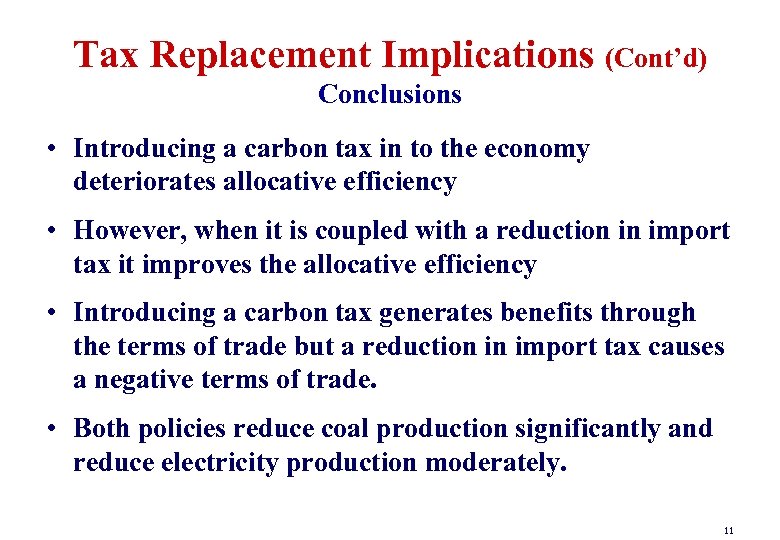
Tax Replacement Implications (Cont’d) Conclusions • Introducing a carbon tax in to the economy deteriorates allocative efficiency • However, when it is coupled with a reduction in import tax it improves the allocative efficiency • Introducing a carbon tax generates benefits through the terms of trade but a reduction in import tax causes a negative terms of trade. • Both policies reduce coal production significantly and reduce electricity production moderately. 11
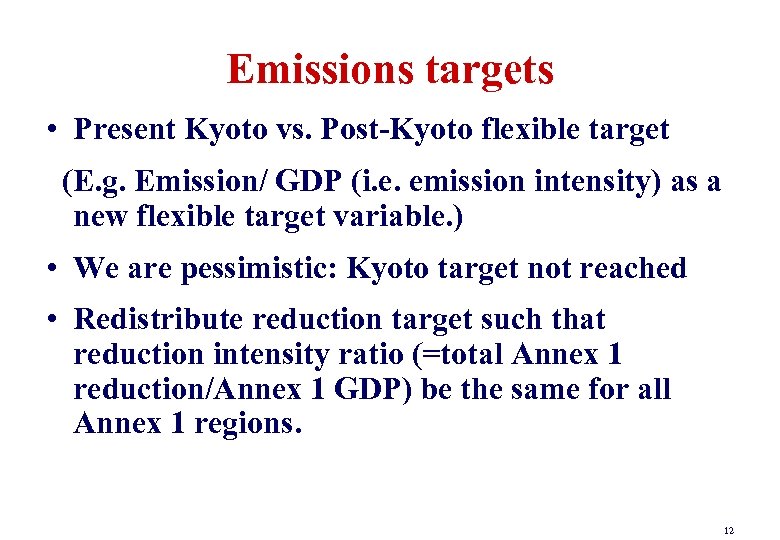
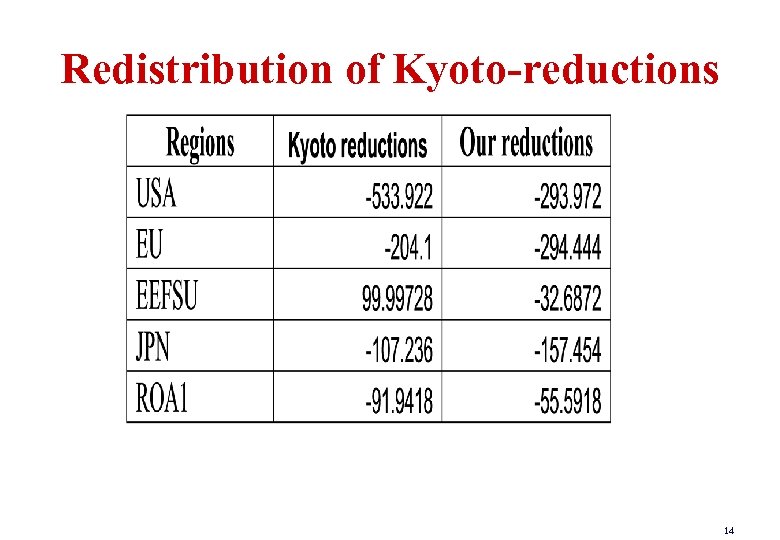
Emissions targets • Present Kyoto vs. Post-Kyoto flexible target (E. g. Emission/ GDP (i. e. emission intensity) as a new flexible target variable. ) • We are pessimistic: Kyoto target not reached • Redistribute reduction target such that reduction intensity ratio (=total Annex 1 reduction/Annex 1 GDP) be the same for all Annex 1 regions. 12
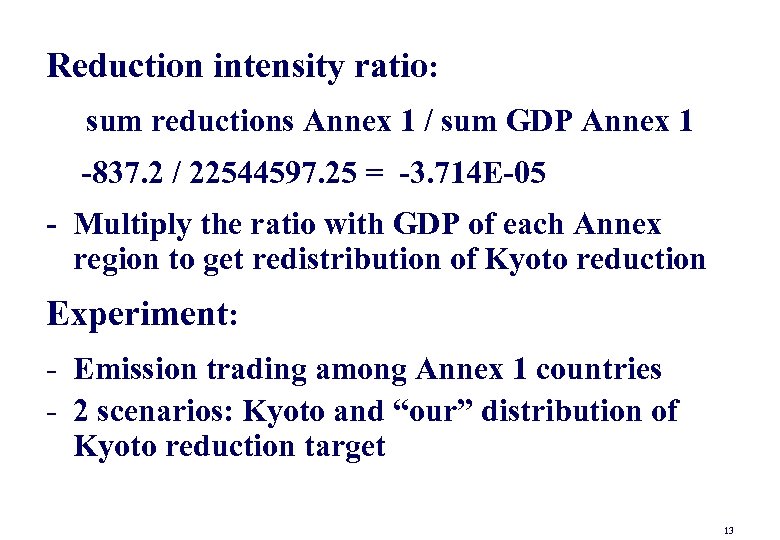
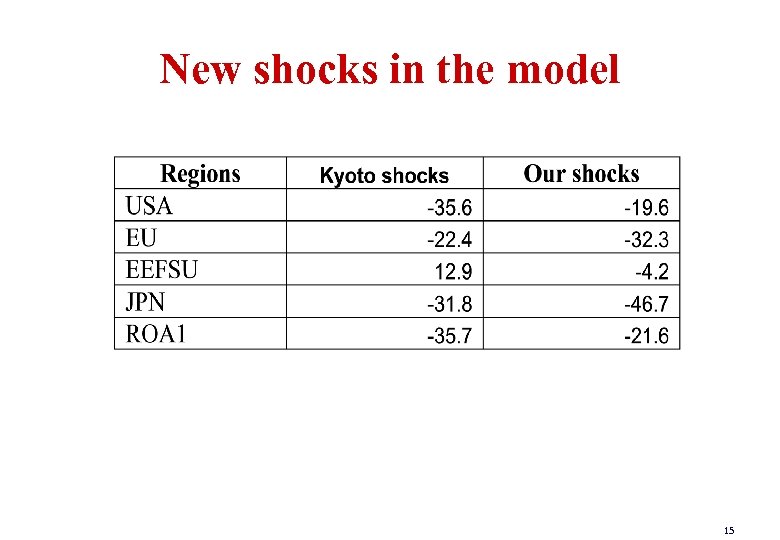
Reduction intensity ratio: sum reductions Annex 1 / sum GDP Annex 1 -837. 2 / 22544597. 25 = -3. 714 E-05 - Multiply the ratio with GDP of each Annex region to get redistribution of Kyoto reduction Experiment: - Emission trading among Annex 1 countries - 2 scenarios: Kyoto and “our” distribution of Kyoto reduction target 13
Redistribution of Kyoto-reductions 14
New shocks in the model 15
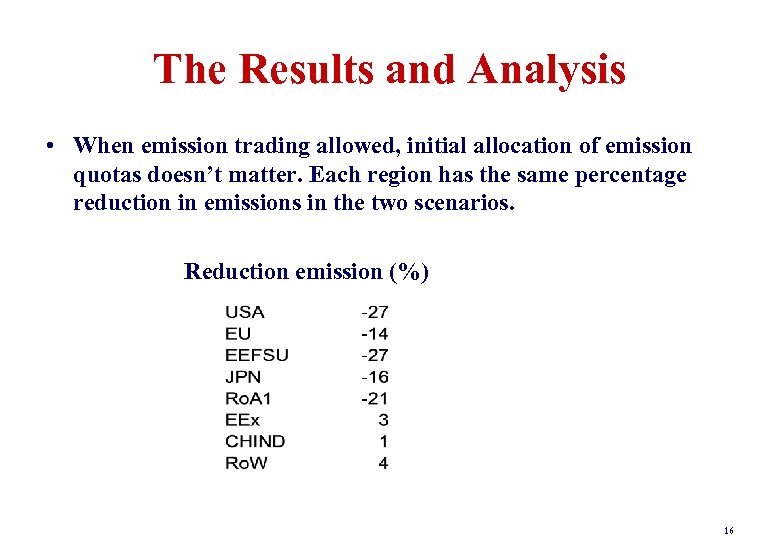
The Results and Analysis • When emission trading allowed, initial allocation of emission quotas doesn’t matter. Each region has the same percentage reduction in emissions in the two scenarios. Reduction emission (%) 16
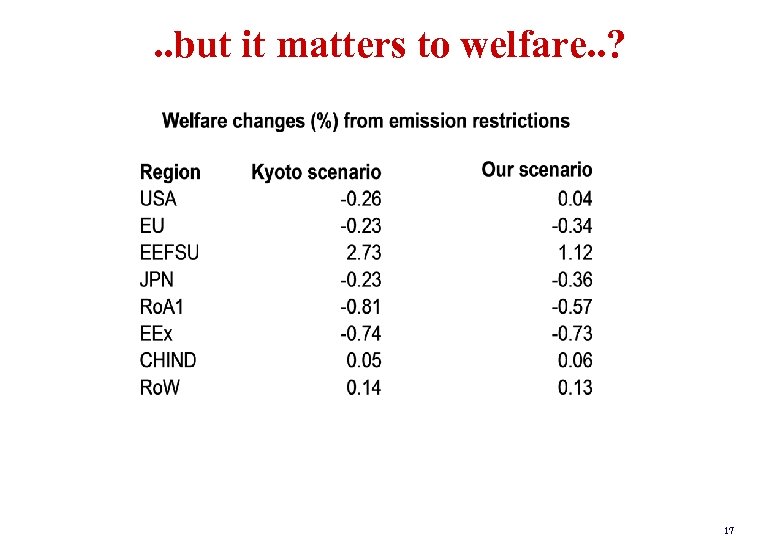
. . but it matters to welfare. . ? 17
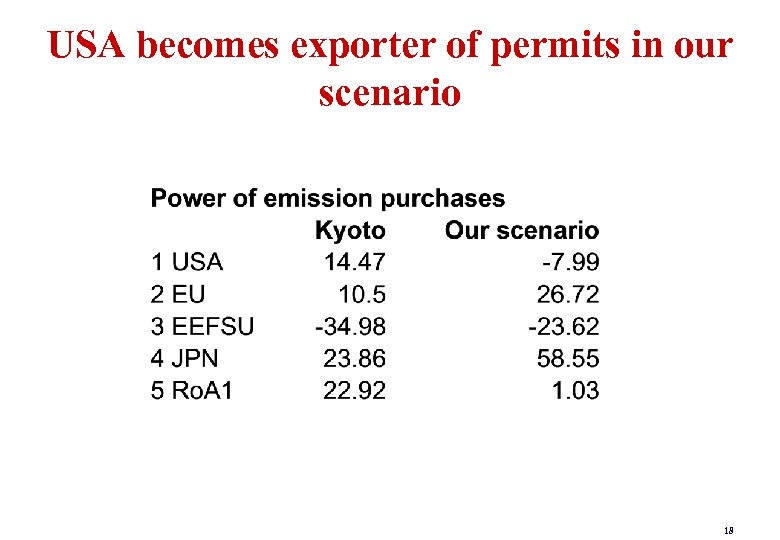
USA becomes exporter of permits in our scenario 18
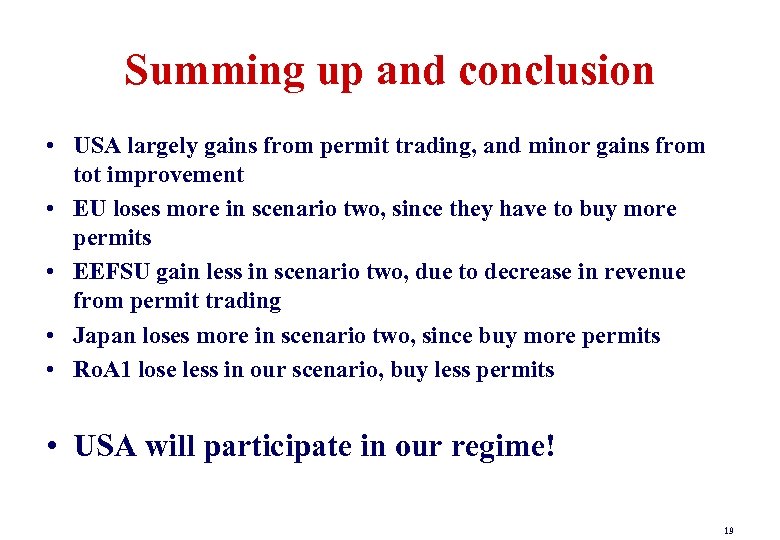
Summing up and conclusion • USA largely gains from permit trading, and minor gains from tot improvement • EU loses more in scenario two, since they have to buy more permits • EEFSU gain less in scenario two, due to decrease in revenue from permit trading • Japan loses more in scenario two, since buy more permits • Ro. A 1 lose less in our scenario, buy less permits • USA will participate in our regime! 19
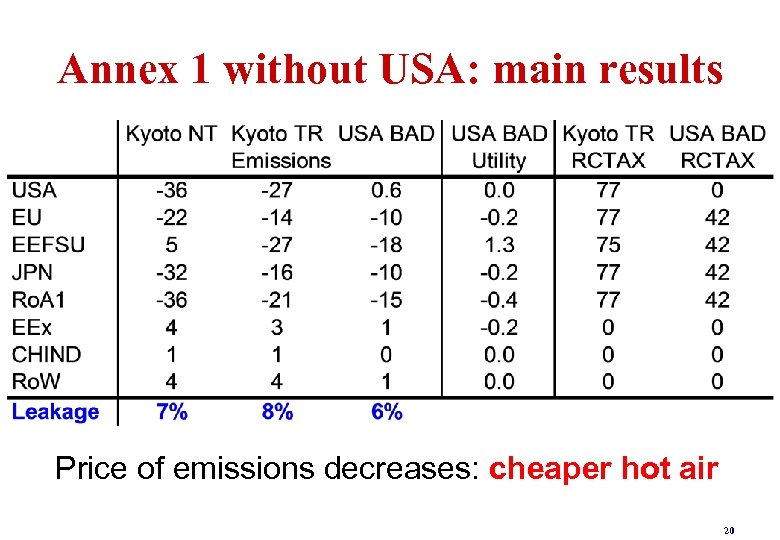
Annex 1 without USA: main results Price of emissions decreases: cheaper hot air 20
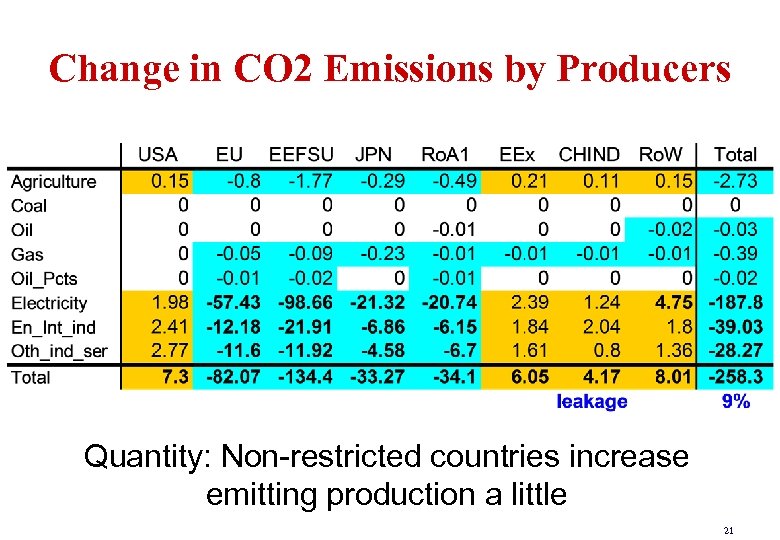
Change in CO 2 Emissions by Producers Quantity: Non-restricted countries increase emitting production a little 21
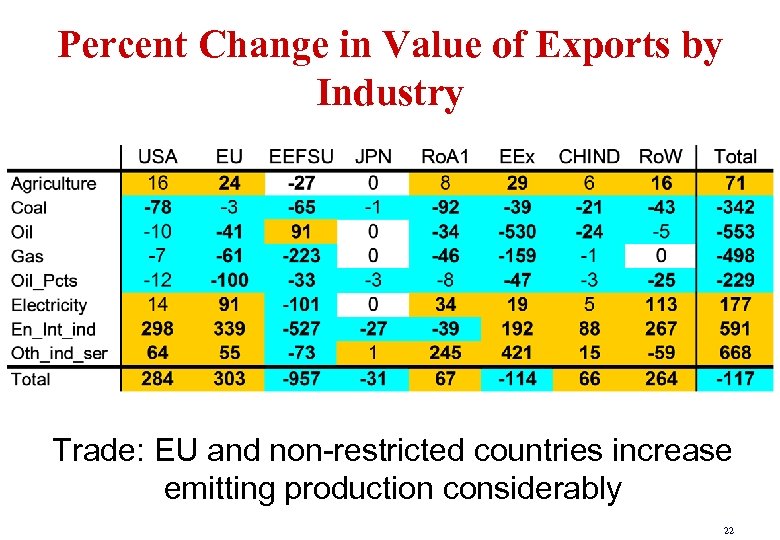
Percent Change in Value of Exports by Industry Trade: EU and non-restricted countries increase emitting production considerably 22
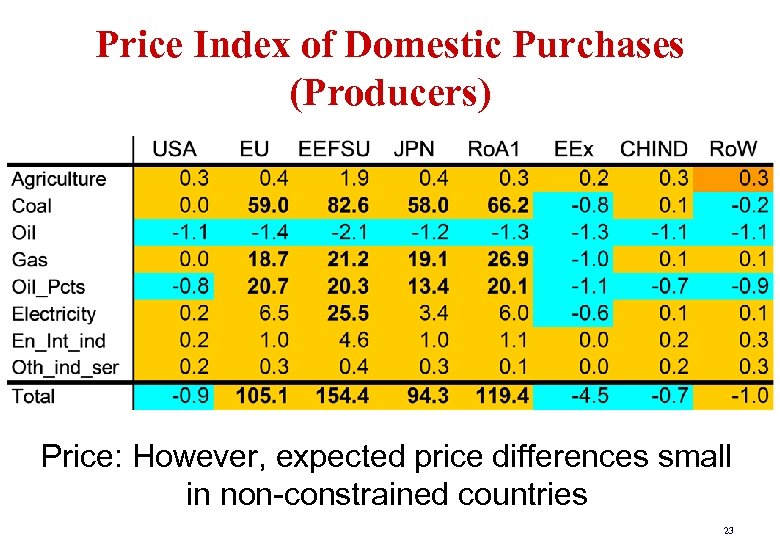
Price Index of Domestic Purchases (Producers) Price: However, expected price differences small in non-constrained countries 23
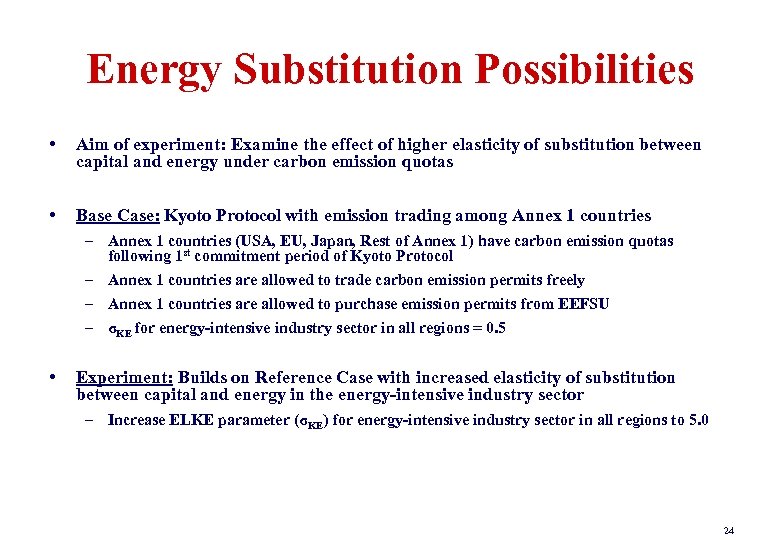
Energy Substitution Possibilities • Aim of experiment: Examine the effect of higher elasticity of substitution between capital and energy under carbon emission quotas • Base Case: Kyoto Protocol with emission trading among Annex 1 countries – Annex 1 countries (USA, EU, Japan, Rest of Annex 1) have carbon emission quotas following 1 st commitment period of Kyoto Protocol – Annex 1 countries are allowed to trade carbon emission permits freely – Annex 1 countries are allowed to purchase emission permits from EEFSU – σKE for energy-intensive industry sector in all regions = 0. 5 • Experiment: Builds on Reference Case with increased elasticity of substitution between capital and energy in the energy-intensive industry sector – Increase ELKE parameter (σKE) for energy-intensive industry sector in all regions to 5. 0 24
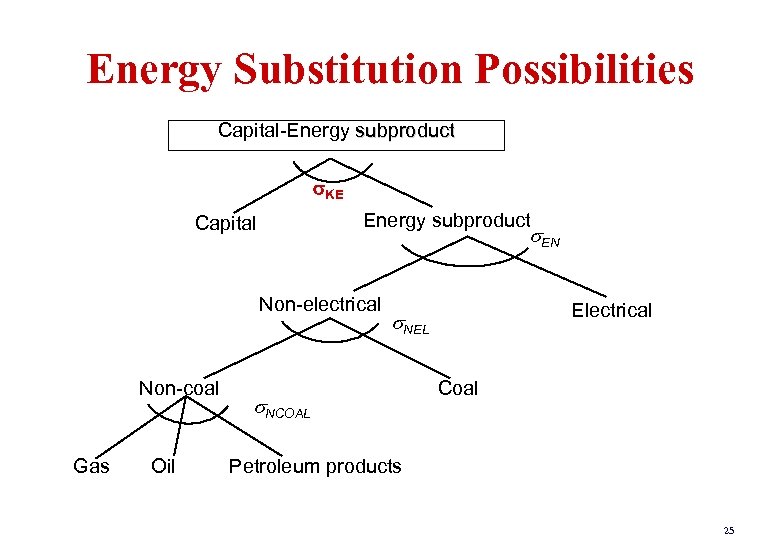
Energy Substitution Possibilities Capital-Energy subproduct s. KE Energy subproduct Capital s. EN Non-electrical Non-coal Gas Oil Electrical s. NEL s. NCOAL Coal Petroleum products 25
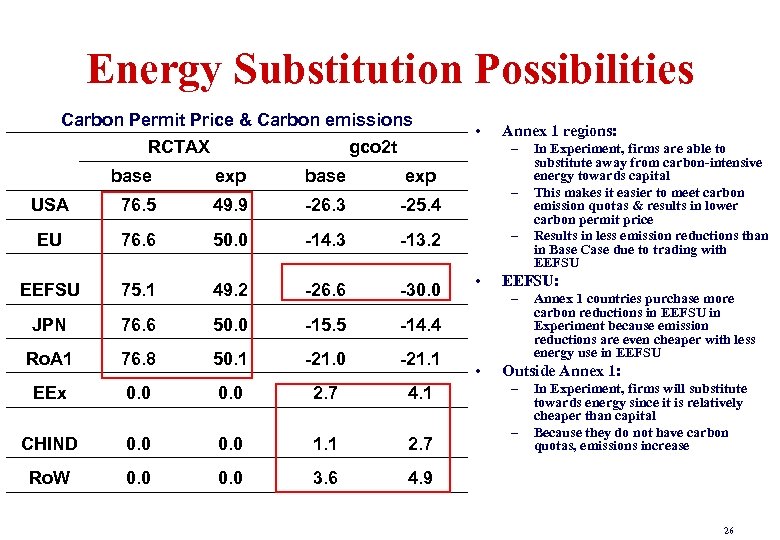
Energy Substitution Possibilities Carbon Permit Price & Carbon emissions RCTAX gco 2 t • Annex 1 regions: – base exp USA 76. 5 49. 9 -26. 3 -25. 4 EU 76. 6 50. 0 -14. 3 -13. 2 EEFSU 75. 1 49. 2 -26. 6 -30. 0 JPN 76. 6 50. 0 -15. 5 -14. 4 Ro. A 1 76. 8 50. 1 -21. 0 -21. 1 EEx 0. 0 2. 7 4. 1 CHIND 0. 0 1. 1 2. 7 Ro. W 0. 0 3. 6 In Experiment, firms are able to substitute away from carbon-intensive energy towards capital This makes it easier to meet carbon emission quotas & results in lower carbon permit price Results in less emission reductions than in Base Case due to trading with EEFSU 4. 9 – – • EEFSU: – • Annex 1 countries purchase more carbon reductions in EEFSU in Experiment because emission reductions are even cheaper with less energy use in EEFSU Outside Annex 1: – – In Experiment, firms will substitute towards energy since it is relatively cheaper than capital Because they do not have carbon quotas, emissions increase 26
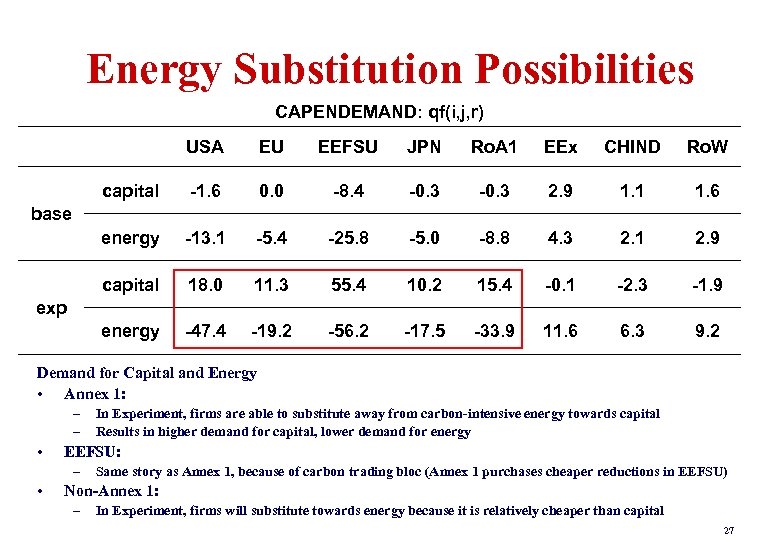
Energy Substitution Possibilities CAPENDEMAND: qf(i, j, r) USA EU EEFSU JPN Ro. A 1 EEx CHIND Ro. W capital -1. 6 0. 0 -8. 4 -0. 3 2. 9 1. 1 1. 6 energy -13. 1 -5. 4 -25. 8 -5. 0 -8. 8 4. 3 2. 1 2. 9 capital 18. 0 11. 3 55. 4 10. 2 15. 4 -0. 1 -2. 3 -1. 9 energy -47. 4 -19. 2 -56. 2 -17. 5 -33. 9 11. 6 6. 3 9. 2 base exp Demand for Capital and Energy • Annex 1: – – • EEFSU: – • In Experiment, firms are able to substitute away from carbon-intensive energy towards capital Results in higher demand for capital, lower demand for energy Same story as Annex 1, because of carbon trading bloc (Annex 1 purchases cheaper reductions in EEFSU) Non-Annex 1: – In Experiment, firms will substitute towards energy because it is relatively cheaper than capital 27
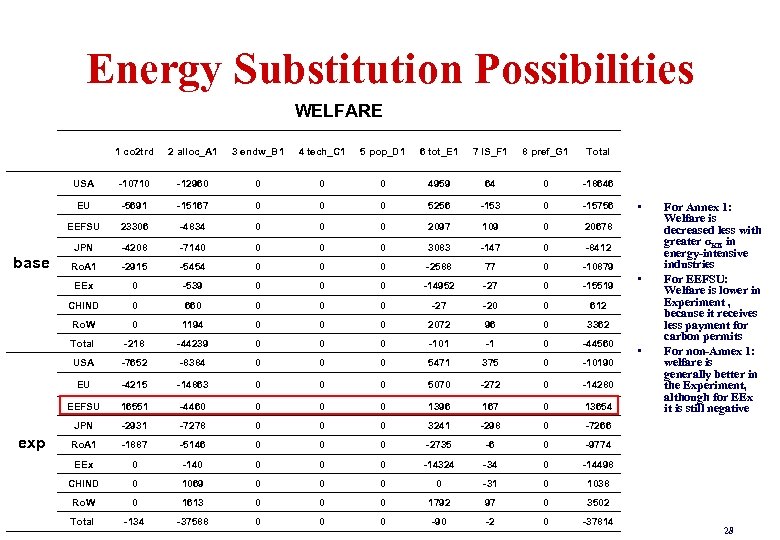
Energy Substitution Possibilities WELFARE 3 endw_B 1 4 tech_C 1 5 pop_D 1 6 tot_E 1 7 IS_F 1 8 pref_G 1 Total -10710 -12960 0 4959 64 0 -18646 EU -5691 -15167 0 0 0 5256 -153 0 -15756 EEFSU 23306 -4834 0 0 0 2097 109 0 20678 JPN -4208 -7140 0 3083 -147 0 -8412 Ro. A 1 -2915 -5454 0 0 0 -2588 77 0 -10879 EEx 0 -539 0 0 0 -14952 -27 0 -15519 CHIND 0 660 0 -27 -20 0 612 Ro. W 0 1194 0 0 0 2072 96 0 3362 Total -218 -44239 0 0 0 -101 -1 0 -44560 USA -7652 -8384 0 0 0 5471 375 0 -10190 EU -4215 -14863 0 0 0 5070 -272 0 -14280 EEFSU 16551 -4460 0 1396 167 0 13654 JPN exp 2 alloc_A 1 USA base 1 co 2 trd -2931 -7278 0 0 0 3241 -298 0 -7266 Ro. A 1 -1887 -5146 0 0 0 -2735 -6 0 -9774 EEx 0 -140 0 -14324 -34 0 -14498 CHIND 0 1069 0 0 -31 0 1038 Ro. W 0 1613 0 0 0 1792 97 0 3502 Total -134 -37588 0 0 0 -90 -2 0 -37814 • • • For Annex 1: Welfare is decreased less with greater σKE in energy-intensive industries For EEFSU: Welfare is lower in Experiment , because it receives less payment for carbon permits For non-Annex 1: welfare is generally better in the Experiment, although for EEx it is still negative 28
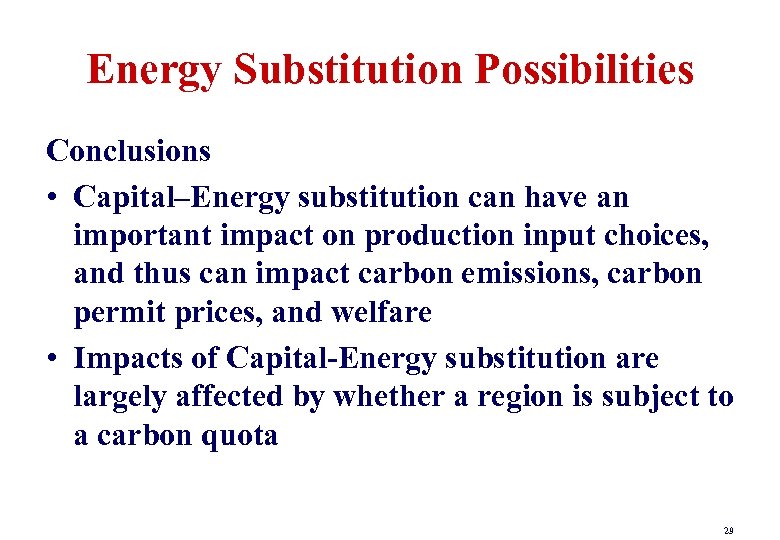
Energy Substitution Possibilities Conclusions • Capital–Energy substitution can have an important impact on production input choices, and thus can impact carbon emissions, carbon permit prices, and welfare • Impacts of Capital-Energy substitution are largely affected by whether a region is subject to a carbon quota 29

Concluding Comments 30
Скачать презентацию GTAP_E Presented by Belay Fekadu Farzad Taheripour Patrick
d7c41b1bd0162567ec4dd15b9f1a4718.ppt