 Скачать презентацию GTA Bell South MPLS Agency Informational and Kick-Off Meeting
960080880c4300172bac449c68d728ca.ppt
- Количество слайдов: 63



GTA/Bell. South MPLS Agency Informational and Kick-Off Meeting
Agenda • • • Introduction Background Overview of MPLS Services Break MPLS Agency Transition Budget and SLA Update Q&A Break for Lunch Afternoon Video Session

Introduction

Background
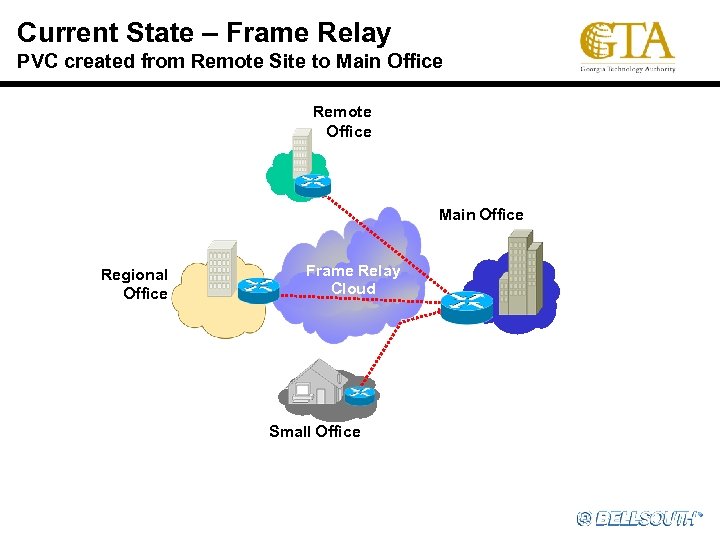
Current State – Frame Relay PVC created from Remote Site to Main Office Remote Office Main Office Regional Office Frame Relay Cloud Small Office
Benefits of Frame Relay • Efficient for hub-and-spoke configurations with stable traffic patterns • Ubiquity -- ability to interconnect local, national, international networks • Mature technology with solid track record and experience • Experienced personnel plentiful in work force • Support of multiple Layer 3 protocols
Background - Changing requirements • Increased Bandwidth • Support for large file transfers –Tax information –Medical files –GIS Maps • Off-site back-up and disaster recovery • Complex, critical applications –People. Soft –GIS –On-line tax payment –On-line Case Management • Support for video and voice
Background - Changing requirements • Convergence • Voice over IP • Video –Streaming Video –Distance Learning –Video testimony, depositions • Security • Support for HIPAA, Sarbanes-Oxley, etc. • Agency segregation • Support VPN for remote workers
Background - Why Change? The state needs to move to a network that is: • More robust • Flexible • Redundant • Capable of combining video, voice, and data • Reduce the State’s overall communication cost • Provide increased services without increasing current costs.
MPLS Overview “The planned MPLS VPN should serve the agency business requirements for more bandwidth for business-critical applications, provide the foundation for secure data, video, and voice communications, provide a more reliable and more flexible core network, and, in many cases, provide network access that is far more economical than is presently available, especially for smaller government offices. ” Section 2. 2 MPLS VPN Statewide Multi Protocol Label Switching (MPLS) Virtual Private Network (VPN) Services RFP No. GTA 000165
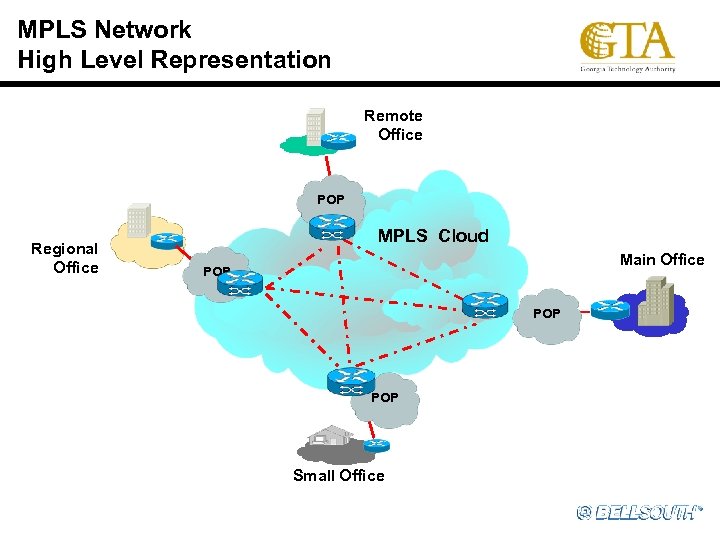
MPLS Network High Level Representation Remote Office POP Regional Office MPLS Cloud Main Office POP POP Small Office
Benefits of MPLS • Enable GTA customers to enjoy economical and reliable network access, regardless of location • Expand Work Away programs • Serve the agency business requirements for more bandwidth for business-critical applications • Provide the foundation for secure data, video, and voice communications
Benefits of MPLS • Enforce post-911 security requirements and privacy regulations • Provide a more reliable and more flexible core network • Help agencies limit future cost growth for the network services
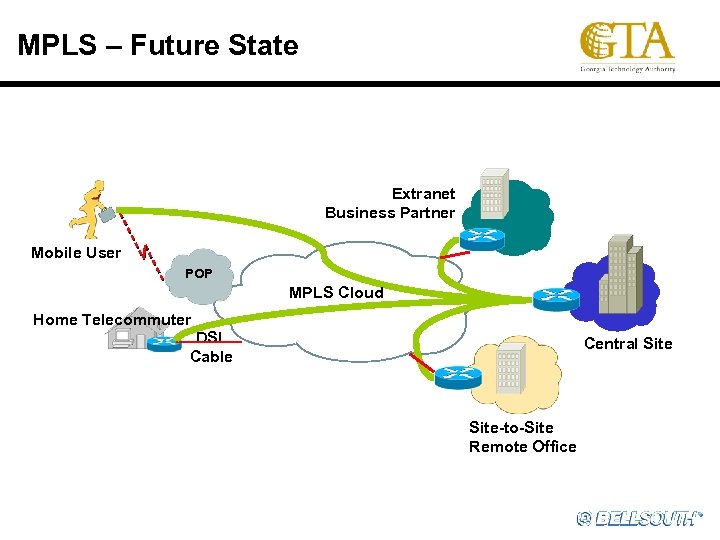
MPLS – Future State Extranet Business Partner Mobile User POP MPLS Cloud Home Telecommuter DSL Cable Central Site-to-Site Remote Office
MPLS Trials • Agency involvement • DOR • DTAE • DOL • Vendor participation • Bell. South • AT&T • Schlumberger/Clearpath • Lessons learned • Technology validated • Identified challenges of implementation
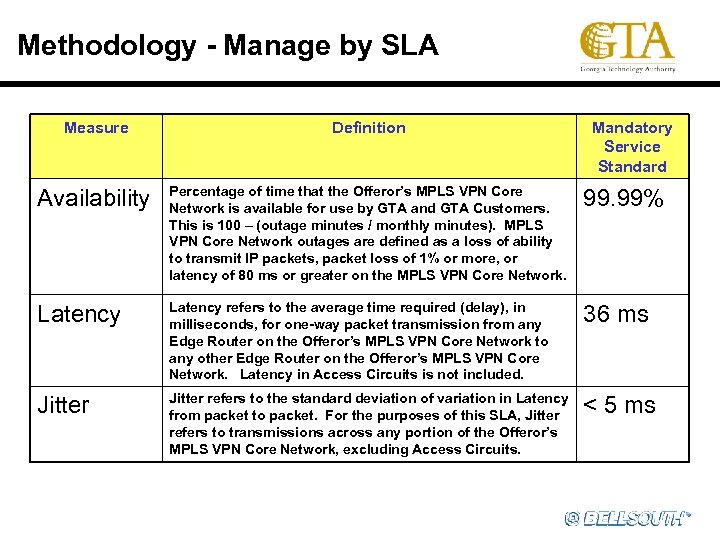
Methodology - Manage by SLA Measure Definition Mandatory Service Standard Availability Percentage of time that the Offeror’s MPLS VPN Core Network is available for use by GTA and GTA Customers. This is 100 – (outage minutes / monthly minutes). MPLS VPN Core Network outages are defined as a loss of ability to transmit IP packets, packet loss of 1% or more, or latency of 80 ms or greater on the MPLS VPN Core Network. 99. 99% Latency refers to the average time required (delay), in milliseconds, for one-way packet transmission from any Edge Router on the Offeror’s MPLS VPN Core Network to any other Edge Router on the Offeror’s MPLS VPN Core Network. Latency in Access Circuits is not included. 36 ms Jitter refers to the standard deviation of variation in Latency from packet to packet. For the purposes of this SLA, Jitter refers to transmissions across any portion of the Offeror’s MPLS VPN Core Network, excluding Access Circuits. < 5 ms
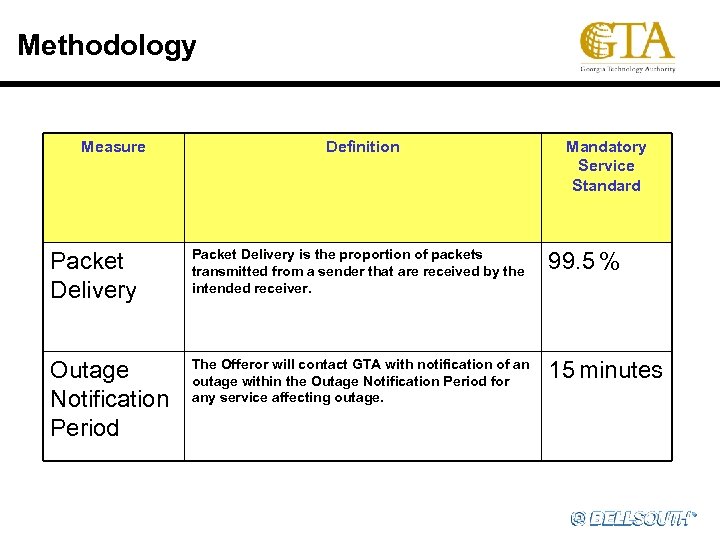
Methodology Measure Definition Mandatory Service Standard Packet Delivery is the proportion of packets transmitted from a sender that are received by the intended receiver. 99. 5 % Outage Notification Period The Offeror will contact GTA with notification of an outage within the Outage Notification Period for any service affecting outage. 15 minutes
RFP Evaluation • Six proposals submitted • Separate technical and pricing evaluation teams • Teams composed of both Agency and GTA personnel
Questions?
MPLS Service Overview
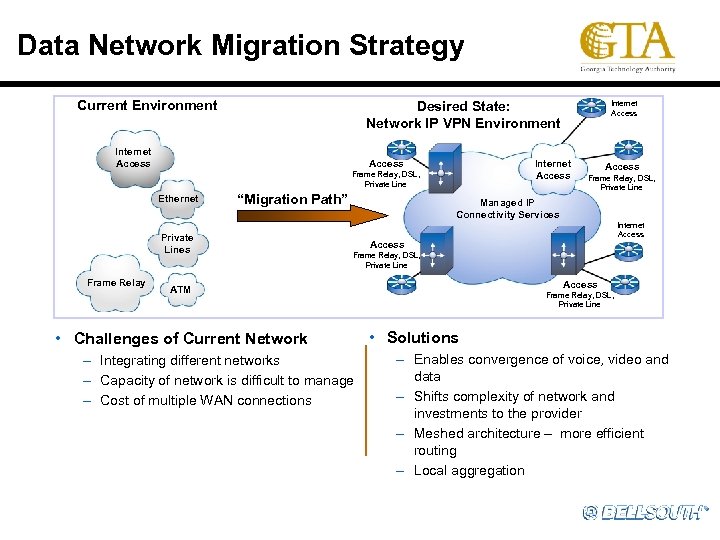
Data Network Migration Strategy Current Environment Desired State: Network IP VPN Environment Internet Access Frame Relay, DSL, Private Line Ethernet “Migration Path” Private Lines Frame Relay Internet Access Frame Relay, DSL, Private Line Managed IP Connectivity Services Internet Access Frame Relay, DSL, Private Line Access ATM • Challenges of Current Network – Integrating different networks – Capacity of network is difficult to manage – Cost of multiple WAN connections Frame Relay, DSL, Private Line • Solutions – Enables convergence of voice, video and data – Shifts complexity of network and investments to the provider – Meshed architecture – more efficient routing – Local aggregation
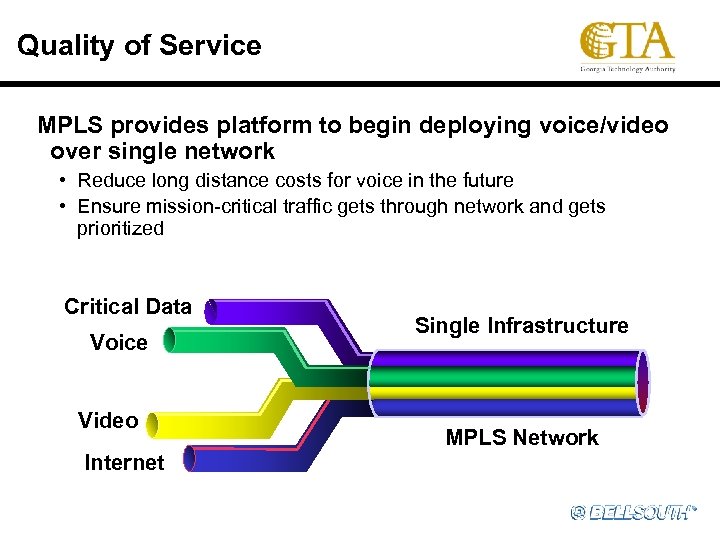
Quality of Service MPLS provides platform to begin deploying voice/video over single network • Reduce long distance costs for voice in the future • Ensure mission-critical traffic gets through network and gets prioritized Critical Data Voice Video Internet Single Infrastructure MPLS Network
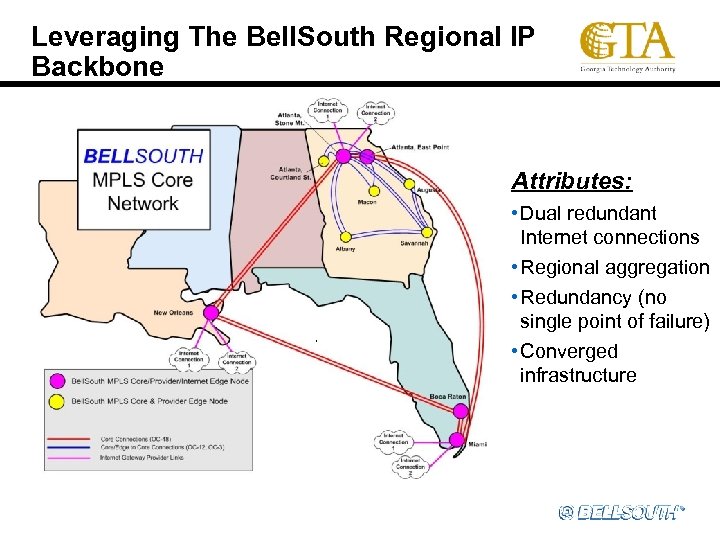
Leveraging The Bell. South Regional IP Backbone Attributes: • Dual redundant Internet connections • Regional aggregation • Redundancy (no single point of failure) • Converged infrastructure
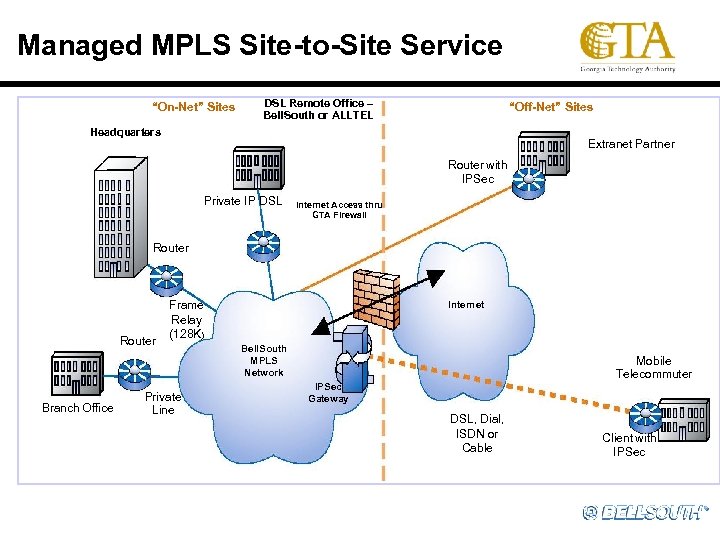
Managed MPLS Site-to-Site Service “On-Net” Sites DSL Remote Office – Bell. South or ALLTEL “Off-Net” Sites Headquarters Extranet Partner Router with IPSec Private IP DSL Internet Access thru GTA Firewall Router Branch Office Frame Relay (128 K) Private Line Internet Bell. South MPLS Network Mobile Telecommuter IPSec Gateway DSL, Dial, ISDN or Cable Client with IPSec
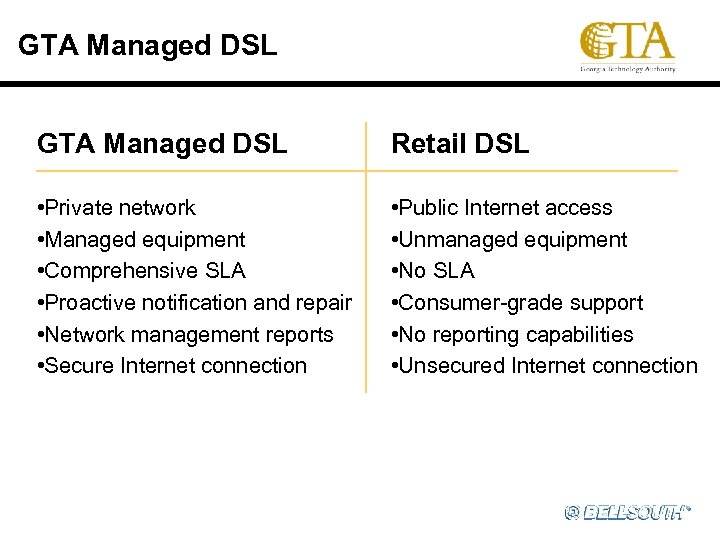
GTA Managed DSL Retail DSL • Private network • Managed equipment • Comprehensive SLA • Proactive notification and repair • Network management reports • Secure Internet connection • Public Internet access • Unmanaged equipment • No SLA • Consumer-grade support • No reporting capabilities • Unsecured Internet connection
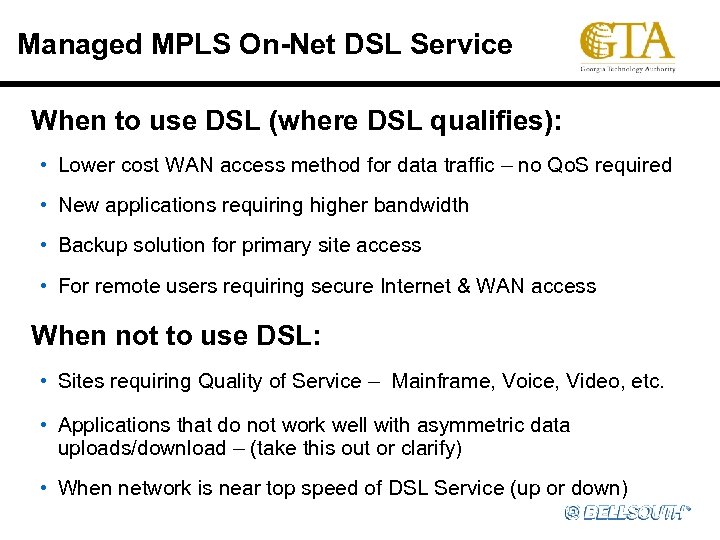
Managed MPLS On-Net DSL Service When to use DSL (where DSL qualifies): • Lower cost WAN access method for data traffic – no Qo. S required • New applications requiring higher bandwidth • Backup solution for primary site access • For remote users requiring secure Internet & WAN access When not to use DSL: • Sites requiring Quality of Service – Mainframe, Voice, Video, etc. • Applications that do not work well with asymmetric data uploads/download – (take this out or clarify) • When network is near top speed of DSL Service (up or down)
Managed MPLS Site-to-Site Access Options Frame Relay • Lower cost option, multiple bandwidth increments, bandwidth guarantees, Qo. S availability for speeds greater than 768 K Private Line and ATM • Best choice for Qo. S, Private Line is distance sensitive, bandwidths up to OC-3 Metro Ethernet (in Metro areas) • Lower cost host circuit access, multiple VLAN’s for shared agency sites, Qo. S support, available in major metro areas, distance sensitive (from Bell. South Po. P)
Support for Teleworkers • Support for remote telecommuters with private DSL, Internet access via DSL, dial-up, ISDN or cable modem access methods used in the home • Encrypted connectivity to MPLS cloud via GTA Managed IPSec Gateway • Port Speed must be determined to engineer Internet access capacity
SNA Site Access Option 1 – SNA to IP Conversion • Some agencies may be ready or mandated to convert to IP end-to-end • Will require up-front investment in equipment • Traffic will be passed as IP across the MPLS network Option 2 – SNA Encapsulation • SNA will be encapsulated at the Bell. South-provided router using DLSw • The traffic will then be passed as IP across the MPLS network • DLSw peers will exchange SNA traffic directly with the mainframe
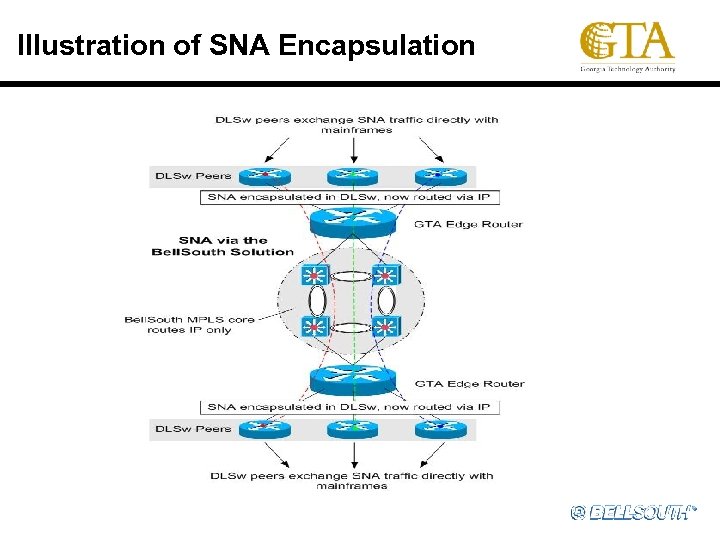
Illustration of SNA Encapsulation
Other GTA Managed MPLS Service Features GTA Project Management, Vendor Coordination, Billing/Ordering, Management Services • Real-time monitoring, management and maintenance of Routers • New CPE provided at each site for initial installation • Full configuration management • SLA’s and network management reports • GTA has streamlined support for CPE and transport – GTA has contracted service levels and reduced number of suppliers
Other GTA Managed MPLS Service Features Equipment and Professional Services • Equipment - New router designed for each service type • Professional services: – Staging, configuration and installation of routers – Equipment maintenance
Other GTA Managed MPLS Service Features Web-based reports available to agencies: • Network Utilization for Capacity Management • Quality of Service Reports - Latency, Jitter, Packet Loss • Trouble Ticket Reports • Mean Time to Repair Reports
Questions?

Break Transition Session Will Begin in 10 minutes
MPLS Agency Transition
MPLS Project Teams Integrated Project Team - State of Georgia and Bell. South Employees: • • Network Architecture/Security Network Management Systems/Network Operations Video Billing/Ordering System SLA Management Process Development Training Communications
Customer Contact Team Initial meeting • • • MPLS Definition Benefits of MPLS Access options Managed MPLS product features Agency current network topology and statistics
Customer Contact Team Include staff who can discuss • • Security requirements Applications IP Addressing Schema Future Requirements including Vo. IP, Video, Prioritization of data, etc. • Business Needs and Constraints
Customer Contact Team What we want to accomplish • • Validation of current configuration Collaborative network design Statement of Work Finalize Order
Provisioning Team • Process orders received from Customer Contact Team • Conduct site surveys • Schedule site conversions • Test and approve each site conversion • Notify billing and network operations after completion of each site conversion
MPLS Agency Conversion Plan Scheduling: • Business Considerations • Each agency will have its own conversion schedule • There will be multiple agency implementations being managed at the same time • There will be up to 200 site conversions per month • GTA will be the pilot
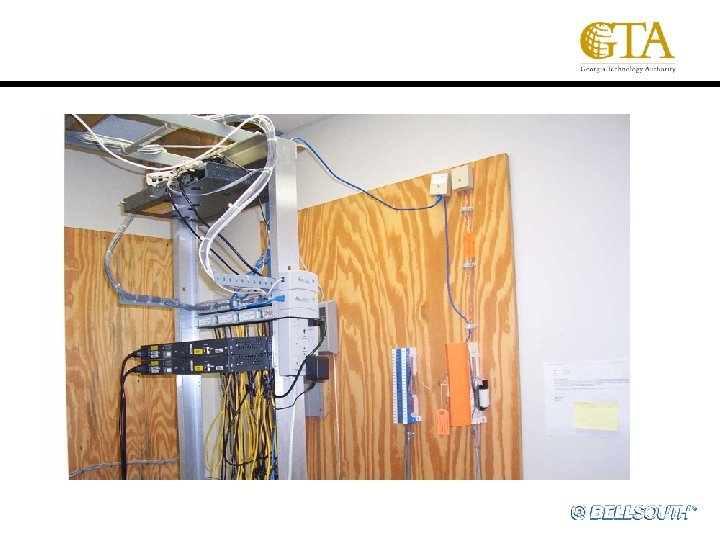
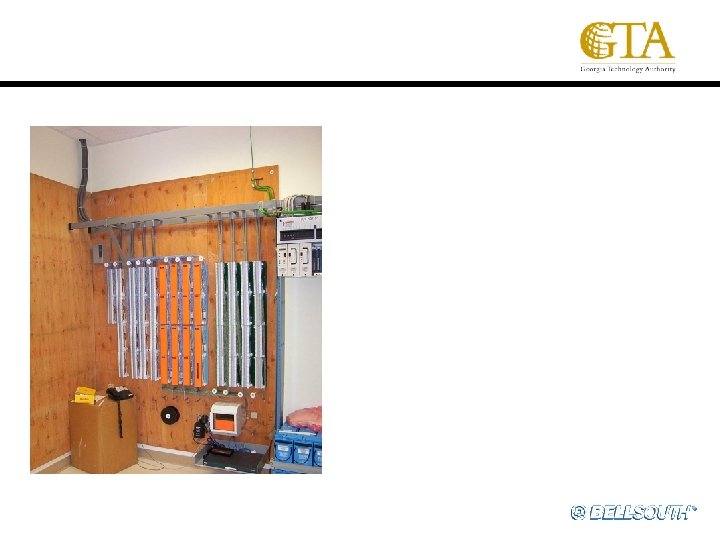
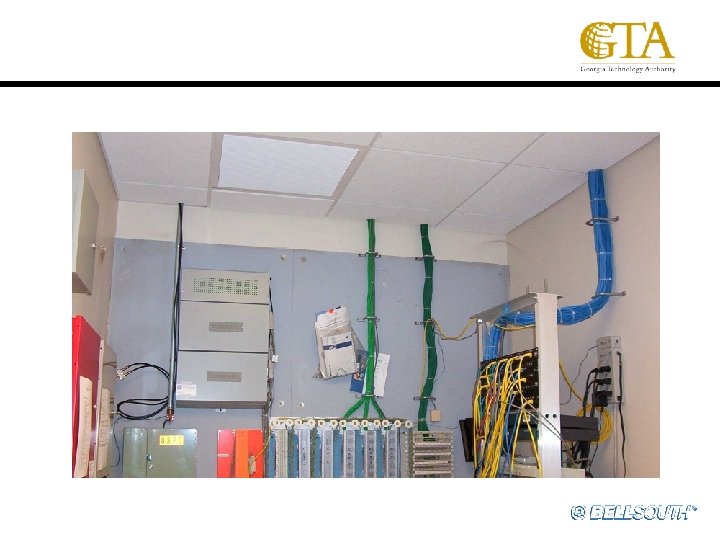
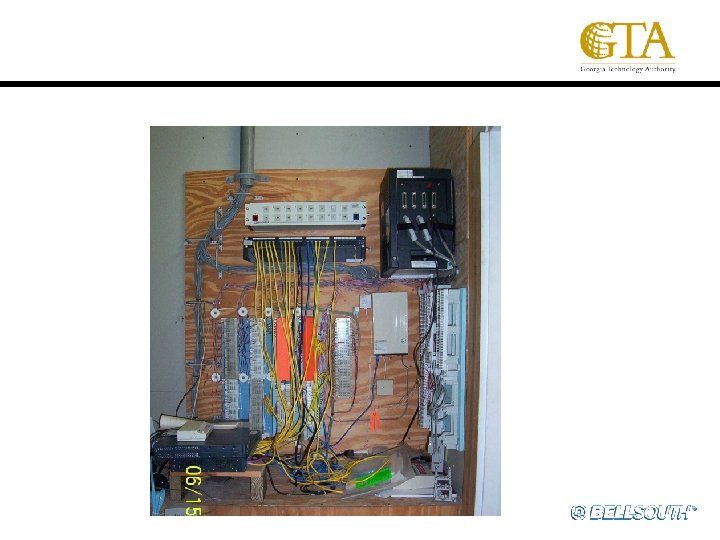
MPLS Agency Conversion Plan To ensure successful conversion of agency sites: • Conduct physical site survey (see handout) • Confirm minimum requirements • Notify agencies of suggested upgrades
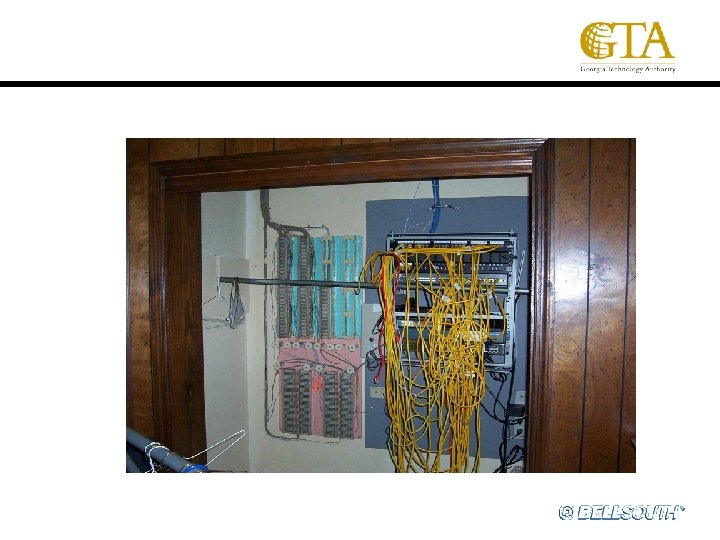
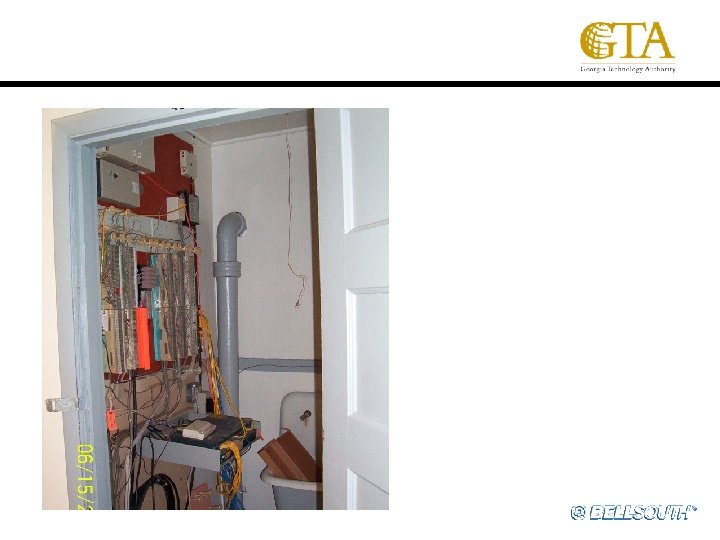
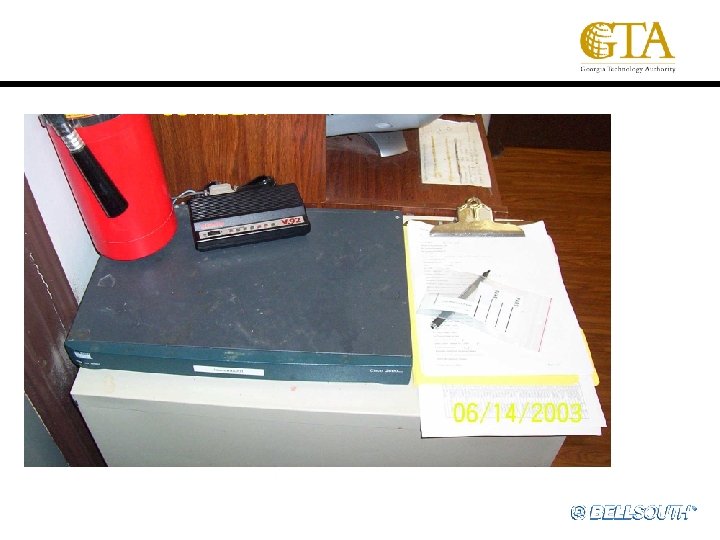
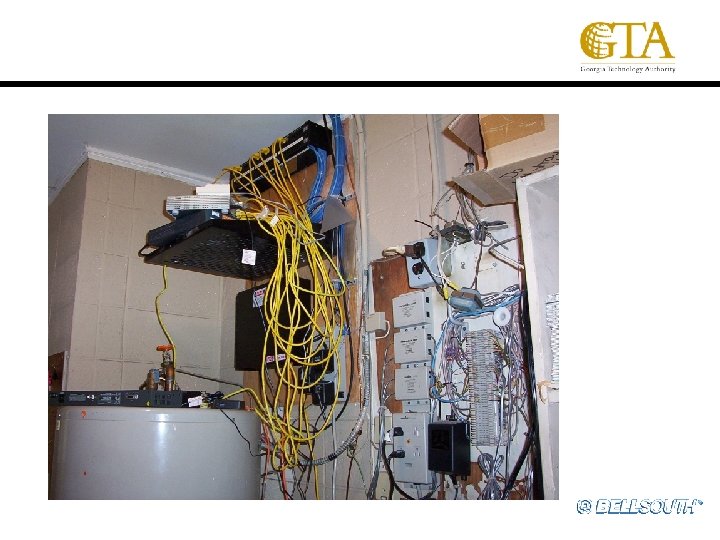
MPLS Agency Conversion Plan Once a Collaborative Network Design is Agreed Upon: • GTA will submit orders to Bell. South • Bell. South will confirm due dates for site conversions to GTA • GTA will coordinate a kick-off meeting with each agency
MPLS Agency Conversion Plan (each individual site) GTA will work with you to coordinate: • Circuit installation (Bell. South) • Router installation and testing (Bell. South) • LAN cutover to MPLS and testing of agency applications (GTA, Bell. South and Agency)
MPLS Agency Conversion Plan (Post MPLS Conversion) • Current Frame Relay services will be discontinued • Current Frame Relay Routers will be decommissioned
Questions?

Break for Lunch Afternoon Video Session Will Begin at 1: 00
Video Conferencing Services General Availability on March 25, 2005 • H. 323 Service Delivered over MPLS Network with Video Bridging/Scheduling Service • New Tiered Video Usage Pricing Model • Applied Global Technologies (AGT) providing Video Bridging/Scheduling • Migration from Bell. South Video Conferencing Service by June 30, 2005
Video Conferencing Migration Plan • Develop Project Schedule for Video with GTA and GSAMS Customers • Implement End-to-End Qo. S • Integrate H. 323 platforms into MPLS Infrastructure • Begin Certification of Sites for H. 323 Video • Perform GTA Site Trials • Complete H. 320 -H. 323 Conversion • Shutdown Existing H. 320 Network
Video Site Scenarios H. 323 CODEC – LAN/WAN Ready for Video over IP • One connection and router for video, data, voice, etc. • One LAN interface connected to Agency • Bridging/Scheduling by AGT H. 323 CODEC - LAN/WAN Not Ready for Video over IP • One connection and router with two interfaces – one for video and one for data (if data required at the site) • Video traffic completely separated from other traffic up to router • Bridging/Scheduling by AGT
Video Site Scenarios (cont. ) H. 320 CODEC – CODEC/LAN/WAN Not Ready for Video over IP • Stay on GSAMS until ready to migrate to H. 323 • Current Bell. South MCU connected to AGT MCU during migration phase • Scheduling done through current Bell. South/GSAMS tool
Video Site Scenarios (cont. ) Video over DSL– Not Recommended for Quality Videoconferencing • Engineered services available– 192 X 192, 384 X 384, 768 X 512 • DSL is a best effort service • Only video should traverse the connection – no mixed traffic • No help desk support if quality of service degrades over DSL connection – i. e. latency, jitter, packet loss • No SLA’s for quality of service attributes
Next Steps Open Discussion
 Скачать презентацию GTA Bell South MPLS Agency Informational and Kick-Off Meeting
960080880c4300172bac449c68d728ca.ppt