


 Скачать презентацию GSSG — GIG Geospatial Information Group Standardizing Antarctica
769402083fedbb38b628144514d9ef91.ppt
- Количество слайдов: 37
 GSSG - GIG Geospatial Information Group Standardizing Antarctica – a challenge for the SCAR Geospatial Information Group Steffen Vogt (IPG University Freiburg / Germany) Henk Brolsma, Ursula Ryan, Lee Belbin (AADC Australian Antarctic Division) Australian Antarctic Data Centre Australian Antarctic Division
 Outline GIG n Introducing ourselves: Who are we? What are we doing? n Implementing ISO TC 211 work - an application-oriented view Example 1: feature catalogueing – SCAR Feature Catalogue Example 2: metadata – SCAR KGIS Project
 SCAR GIG: Who are we? GIG n Scientific Committee on Antarctic Research (SCAR) is an inter-disciplinary committee of the International Council for Science (ICSU). n SCAR is charged with the initiation, promotion and coordination of scientific research in Antarctica. n SCAR also provides scientific advice to the Antarctic Treaty System (e. g. on environmental protection issues) n GIG stands for Geospatial Information Group
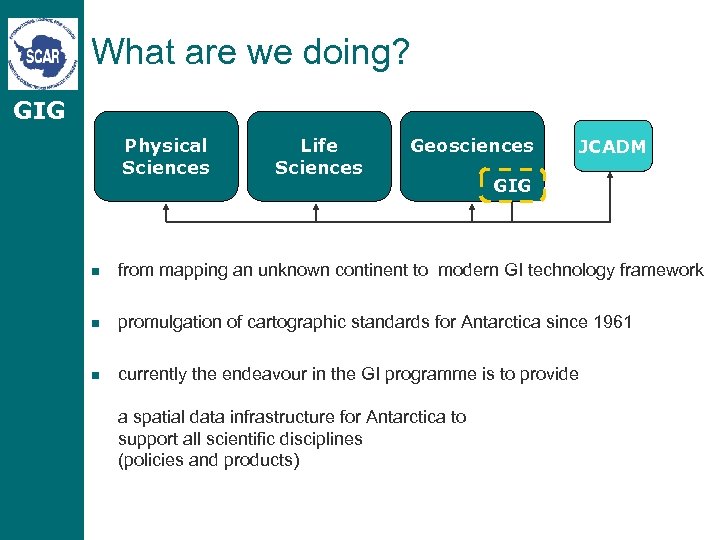 What are we doing? GIG Physical Sciences Life Sciences Geosciences JCADM GIG n from mapping an unknown continent to modern GI technology framework n promulgation of cartographic standards for Antarctica since 1961 n currently the endeavour in the GI programme is to provide a spatial data infrastructure for Antarctica to support all scientific disciplines (policies and products)
 What are we doing? GIG Terms of Reference: n To make fundamental reference data (geographic, geodetic, geophysical) available to the Antarctic and global user communities to meet scientific research requirements n Contribute to global geodesy for the study of the physical processes of the earth and the maintenance of the precise terrestrial reference frame n To integrate and coordinate Antarctic mapping and GIS programs n Provide a common geographic reference system for all Antarctic scientists and operators as the basis for sound data management n To establish and maintain strong links with all Antarctic science research groups and Antarctic data management groups
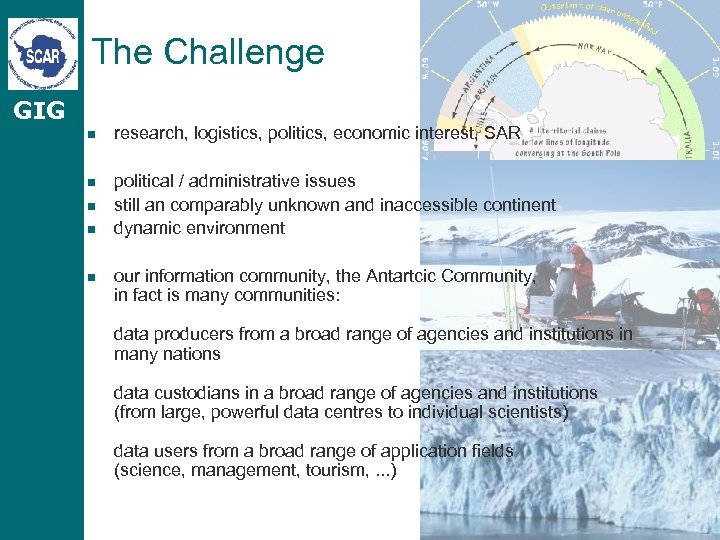 The Challenge GIG n research, logistics, politics, economic interest, SAR n political / administrative issues still an comparably unknown and inaccessible continent dynamic environment n n n our information community, the Antartcic Community, in fact is many communities: data producers from a broad range of agencies and institutions in many nations data custodians in a broad range of agencies and institutions (from large, powerful data centres to individual scientists) data users from a broad range of application fields (science, management, tourism, . . . )
 What are we doing? GIG Current GI activities n n n n Antarctic Digital Database Place Names (SCAR Composite Gazetteer of Antarctica) Map Catalogue National On-line Atlases Cybercartographic Atlas of Antarctica East Antarctica GIS King George Island GIS SCAR Spatial Data Standards - ISO TC 211 standards
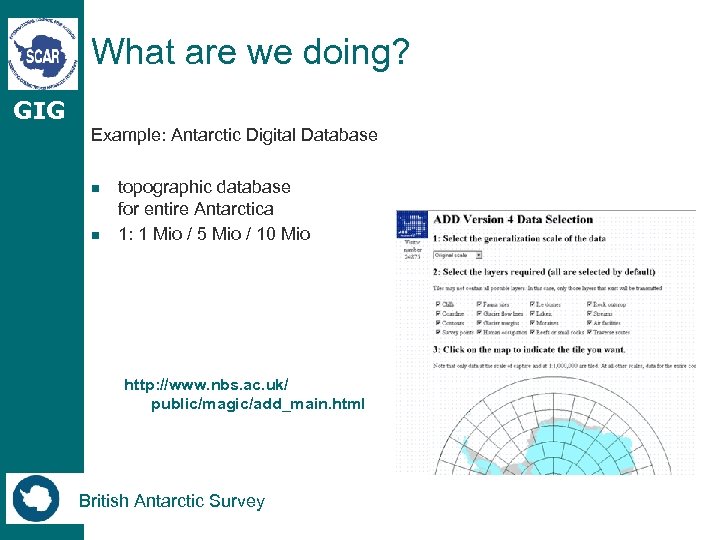 What are we doing? GIG Example: Antarctic Digital Database n n topographic database for entire Antarctica 1: 1 Mio / 5 Mio / 10 Mio http: //www. nbs. ac. uk/ public/magic/add_main. html British Antarctic Survey
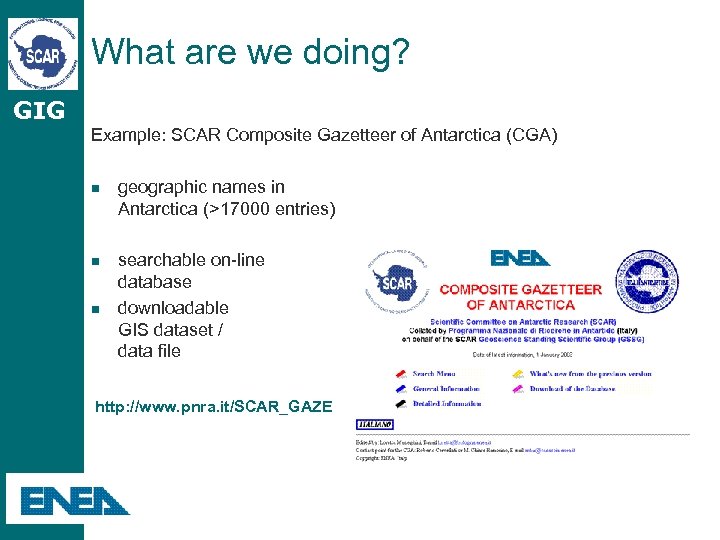 What are we doing? GIG Example: SCAR Composite Gazetteer of Antarctica (CGA) n geographic names in Antarctica (>17000 entries) n searchable on-line database downloadable GIS dataset / data file n http: //www. pnra. it/SCAR_GAZE
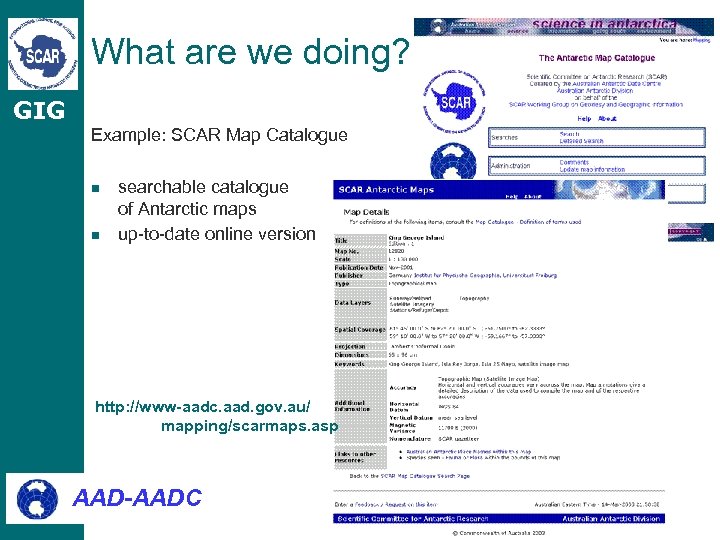 What are we doing? GIG Example: SCAR Map Catalogue n n searchable catalogue of Antarctic maps up-to-date online version http: //www-aadc. aad. gov. au/ mapping/scarmaps. asp AAD-AADC
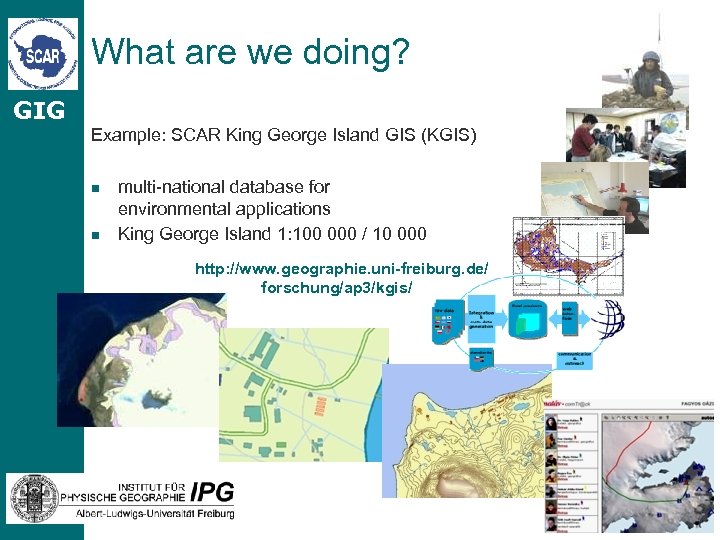 What are we doing? GIG Example: SCAR King George Island GIS (KGIS) n n multi-national database for environmental applications King George Island 1: 100 000 / 10 000 http: //www. geographie. uni-freiburg. de/ forschung/ap 3/kgis/
 What are we doing? GIG n n GI Workshops Outreach http: //www. geoscience. scar. org/geog. htm Ant. GIS 2003 2 nd International Antarctic GIS Workshop Freiburg, April 7 -11
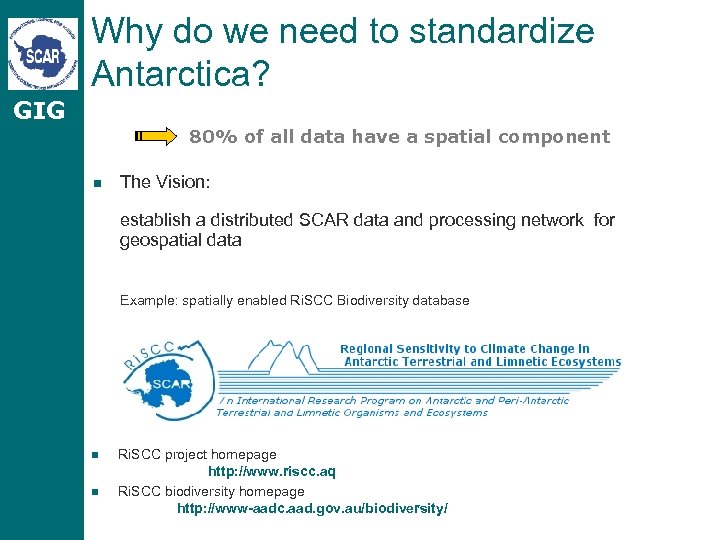 Why do we need to standardize Antarctica? GIG 80% of all data have a spatial component n The Vision: establish a distributed SCAR data and processing network for geospatial data Example: spatially enabled Ri. SCC Biodiversity database n n Ri. SCC project homepage http: //www. riscc. aq Ri. SCC biodiversity homepage http: //www-aadc. aad. gov. au/biodiversity/
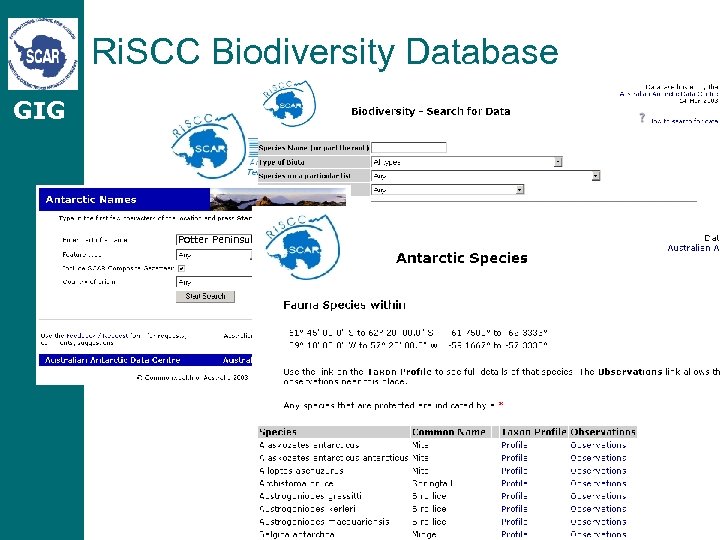 Ri. SCC Biodiversity Database GIG Potter Peninsula
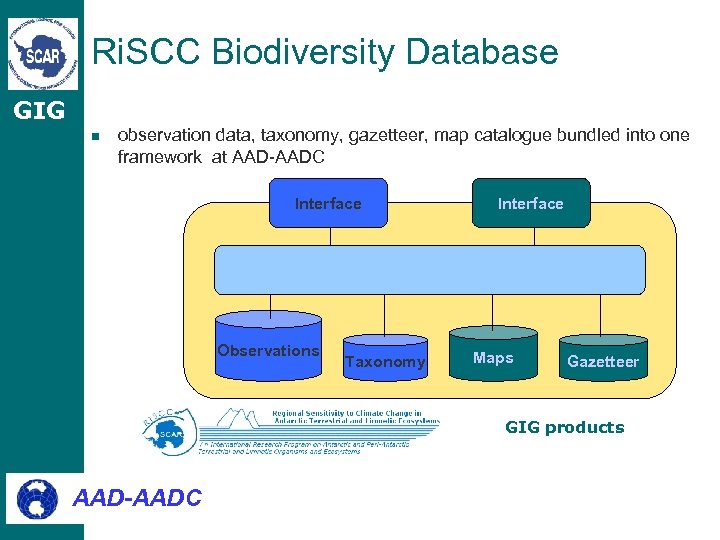 Ri. SCC Biodiversity Database GIG n observation data, taxonomy, gazetteer, map catalogue bundled into one framework at AAD-AADC Interface Observations Taxonomy Interface Maps Gazetteer GIG products AAD-AADC
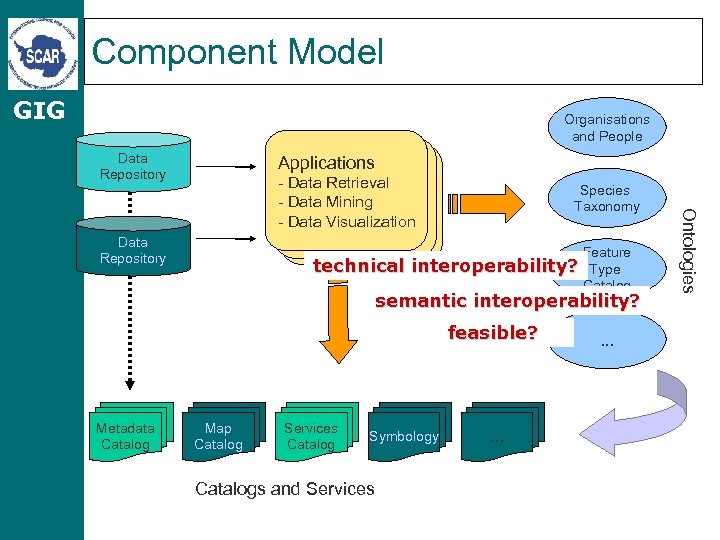 Component Model GIG Organisations and People Data Repository Applications Data Repository technical Species Taxonomy Feature interoperability? Type Catalog semantic interoperability? feasible? Metadata Catalog Map Catalog Services Catalog Symbology Catalogs and Services . . . Ontologies - Data Retrieval Applications - Data Mining Applications - Data Visualization
 Standards and Specifications GIG n open, non-proprietary, well-established technology n maturing of standards and specifications (SCAR GIG Liaision Member of ISO TC 211)
 Standards and Specifications GIG n Example 1: SCAR Feature Catalogue build on 19110 n Example 2: SCAR KGIS Project - A Testbed for 19115 Towards a Metadata Community Profile?
 SCAR Feature Catalogue GIG n should provide common semantics n shoud be applicable to any scale of spatial information n should be applicable to any GIS package n should enable exchange of spatial information across disciplines / agencies / nations / cultures
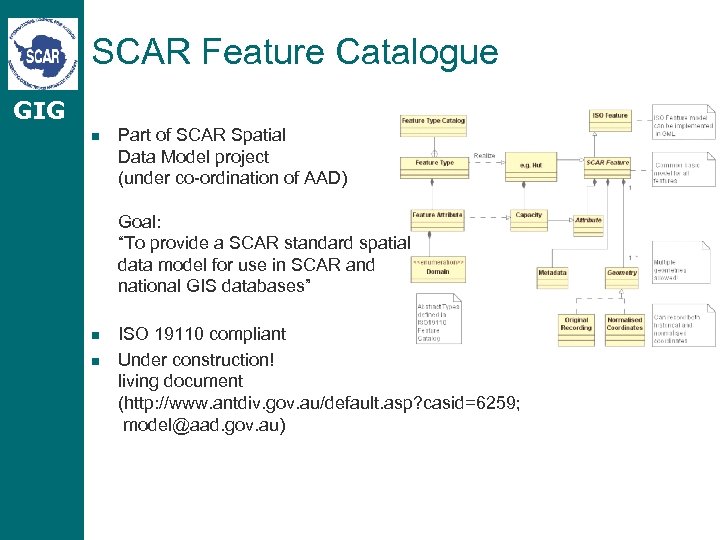 SCAR Feature Catalogue GIG n Part of SCAR Spatial Data Model project (under co-ordination of AAD) Goal: “To provide a SCAR standard spatial data model for use in SCAR and national GIS databases” n n ISO 19110 compliant Under construction! living document (http: //www. antdiv. gov. au/default. asp? casid=6259; model@aad. gov. au)
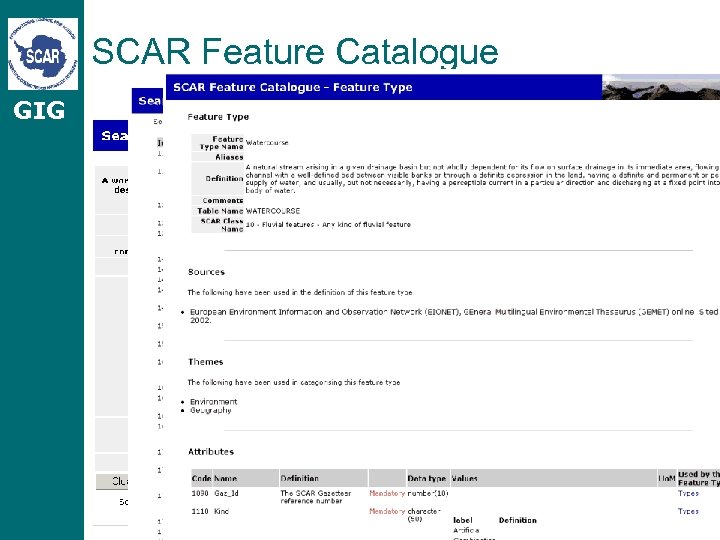 SCAR Feature Catalogue GIG n Part of SCAR Spatial Data Model project (under co-ordination of AAD) n Goal: “To provide a SCAR standard spatial data model for use in SCAR and national GIS databases” http: //www. geoscience. scar. org/geog. htm#stds n ISO 19110 compliant n living document (http: //www. antdiv. gov. au/default. asp? casid=6259; model@aad. gov. au)
 SCAR Feature Catalogue and 19110 GIG n in terms of implementation seems to provide a flexible enough framework n in terms of acceptance the ‘ ISO branding’ might become very helpful
 The SCAR KGIS Project GIG
 King George Island GIG
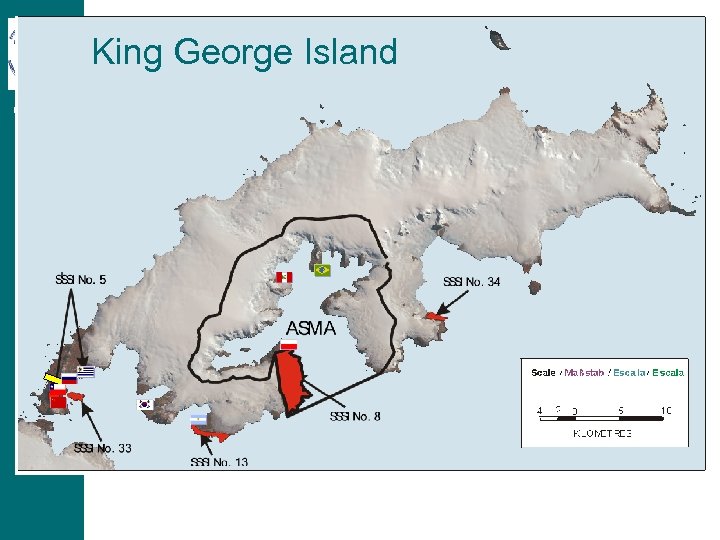 King George Island GIG
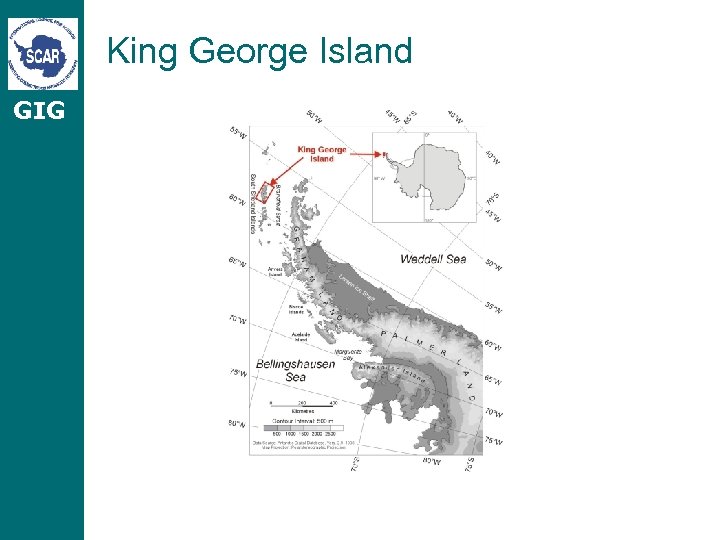
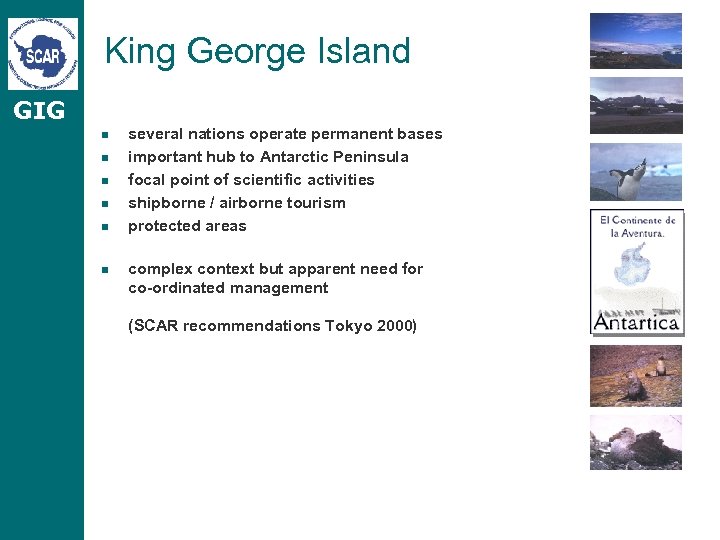 King George Island GIG n n n several nations operate permanent bases important hub to Antarctic Peninsula focal point of scientific activities shipborne / airborne tourism protected areas complex context but apparent need for co-ordinated management (SCAR recommendations Tokyo 2000)
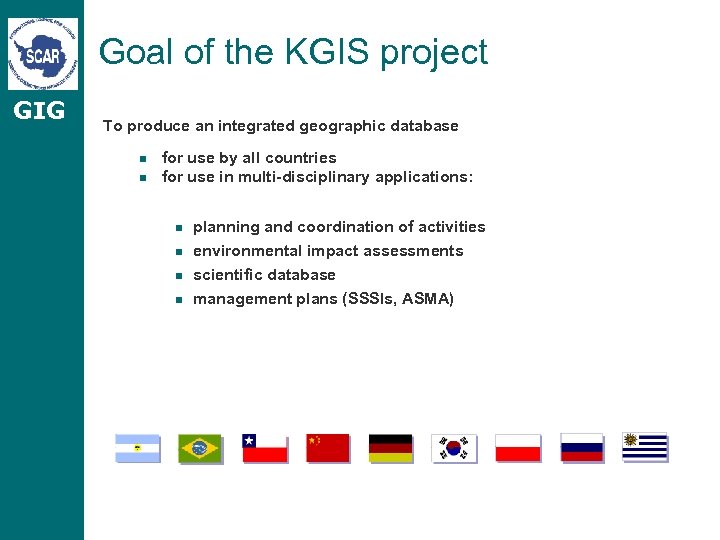 Goal of the KGIS project GIG To produce an integrated geographic database n n for use by all countries for use in multi-disciplinary applications: n n planning and coordination of activities environmental impact assessments scientific database management plans (SSSIs, ASMA)
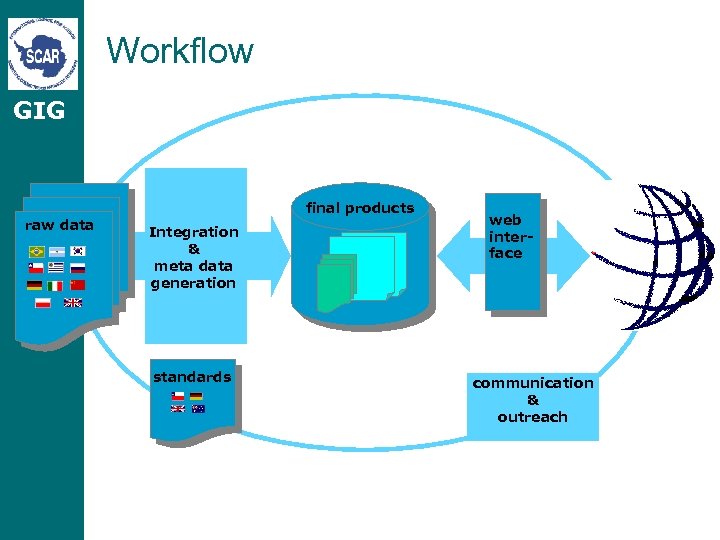 Workflow GIG raw data final products Integration & meta data generation standards web interface communication & outreach
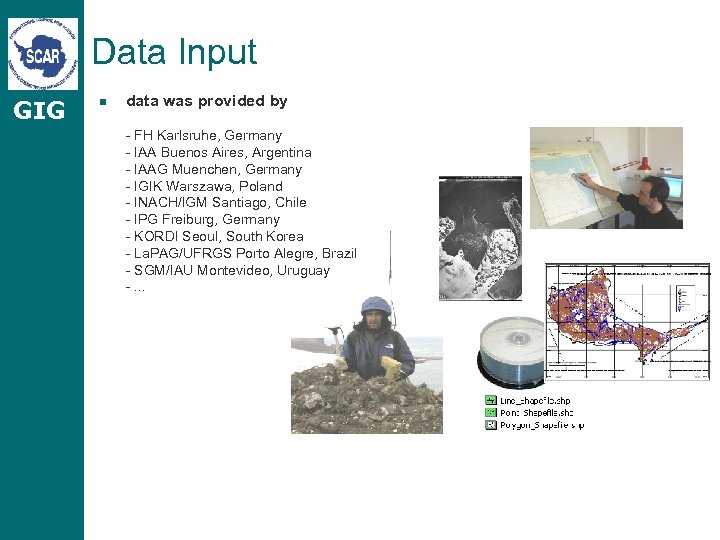 Data Input GIG n data was provided by - FH Karlsruhe, Germany - IAA Buenos Aires, Argentina - IAAG Muenchen, Germany - IGIK Warszawa, Poland - INACH/IGM Santiago, Chile - IPG Freiburg, Germany - KORDI Seoul, South Korea - La. PAG/UFRGS Porto Alegre, Brazil - SGM/IAU Montevideo, Uruguay -. . .
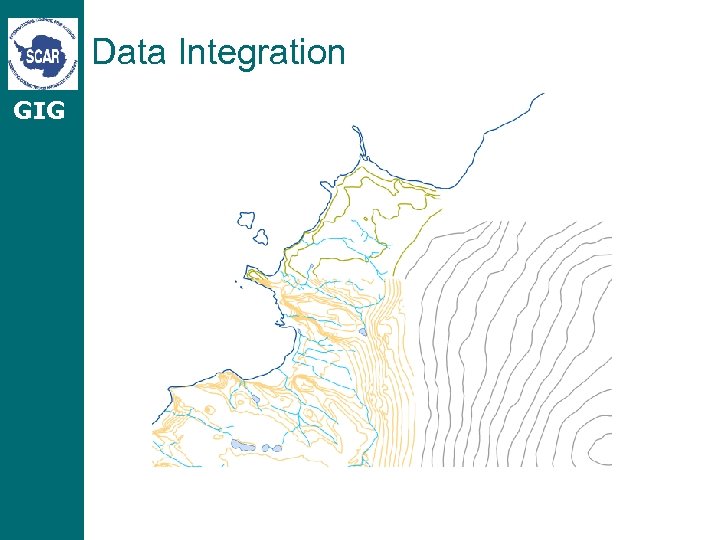 Data Integration GIG
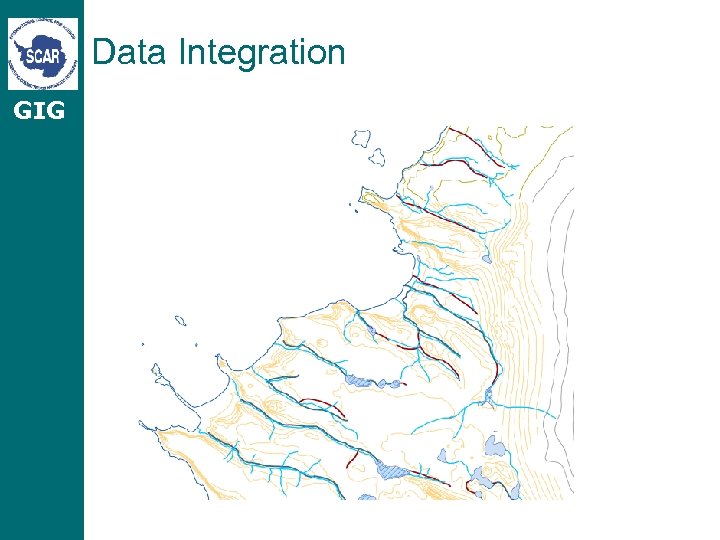 Data Integration GIG
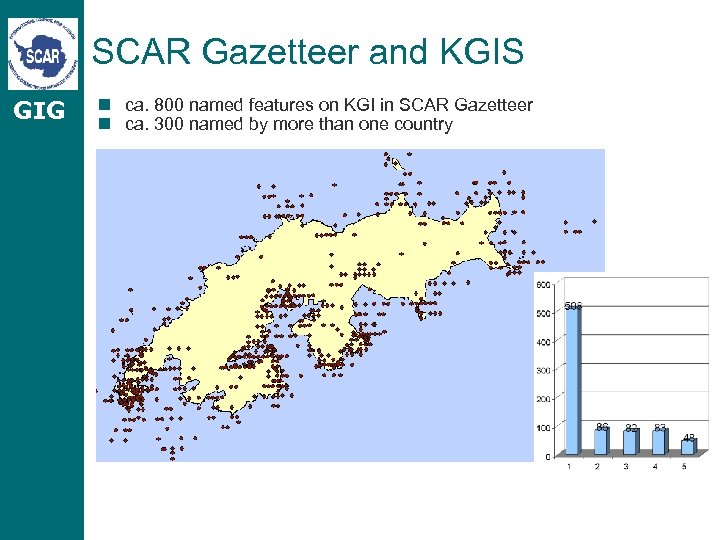 SCAR Gazetteer and KGIS GIG n ca. 800 named features on KGI in SCAR Gazetteer n ca. 300 named by more than one country
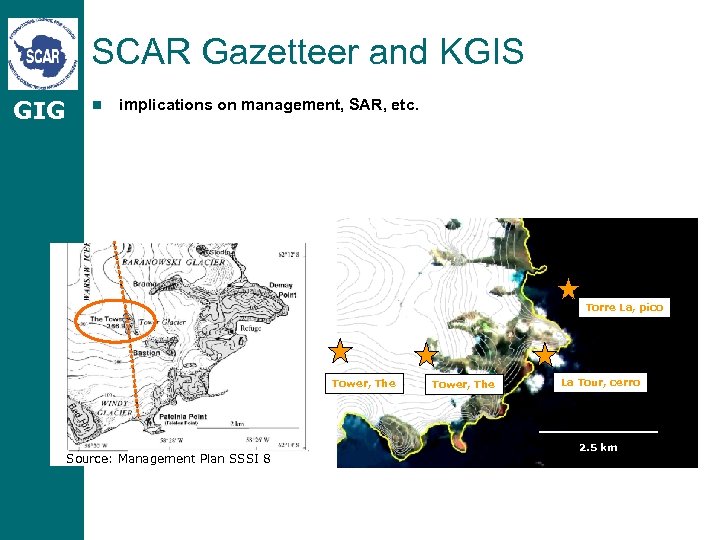 SCAR Gazetteer and KGIS GIG n implications on management, SAR, etc. Torre La, pico Tower, The Source: Management Plan SSSI 8 Tower, The La Tour, cerro 2. 5 km
 Metadata whithin KGIS database GIG n comes typically sparse & incomplete n SCAR adopted standard is DIF (Antarctic Master Directoy is part of Global Change Master Directory) some institutions have strict standards some institutions have no standards at all most important source for metadata typically is personal communication with data producers n n n n we started to construct comprehensive metadata records based on 19115 these are provided as XML, HTML and text files to the users positive feedback if tools to easily access the information are at hand growing acknowledgement of the importance of metadata
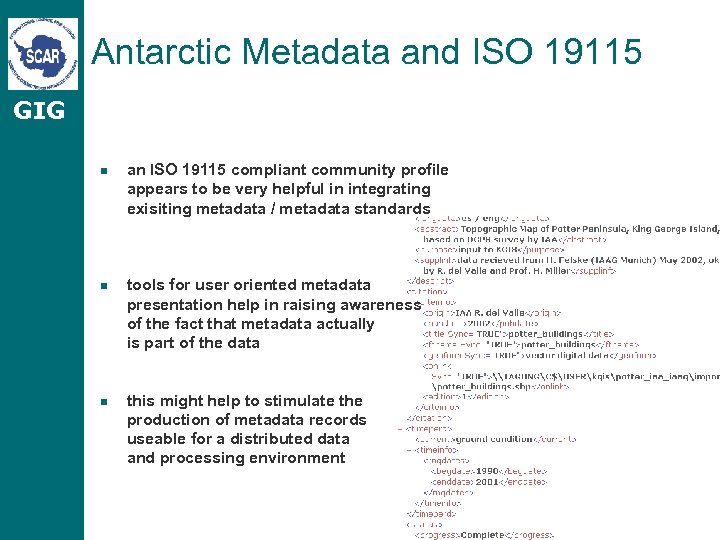 Antarctic Metadata and ISO 19115 GIG n an ISO 19115 compliant community profile appears to be very helpful in integrating exisiting metadata / metadata standards n tools for user oriented metadata presentation help in raising awareness of the fact that metadata actually is part of the data n this might help to stimulate the production of metadata records useable for a distributed data and processing environment
 Conclusions from our application-oriented point of view GIG n users / producers slowly start to realize how they benefit from and why they should adhere to standards n looking at the implementation of some ISO TC 211 based standards: technically: works, but of course the devil’s in the details. . . application-oriented: break the communication barrier!
 SCAR Geospatial Information Group GIG http: //www. geoscience. scar. org/ n Mr. A. Paul R. Cooper British Antarctic Survey Liaison Officer from SCAR to TC 211 aprc@bas. ac. uk n Mr. Larry Hothem United States Geological Survey Liaison Officer from TC 211 to SCAR lhothem@usgs. gov n Mr. Steffen Vogt IPG University Freiburg, Germany steffen. vogt@geographie. uni-freiburg. de