


 Скачать презентацию GSICS Annual Meeting 4 -8 th March 2013
a6db90177ddd6c13a04ae5d7a9110236.ppt
- Количество слайдов: 24
 GSICS Annual Meeting 4 -8 th March 2013, Williamsburg, VA Activities in the framework of GSICS CNES GPRC Report Bertrand Fougnie, Denis Jouglet, Patrice Henry Sophie Lachérade, Eric Péquignot CNES-DCT/SI/MO + support from CNES-DCT/ME
 GSICS Annual Meeting 4 -8 th March 2013, Williamsburg, VA Marquis de Lafayette Williamsburg, Virginia 2
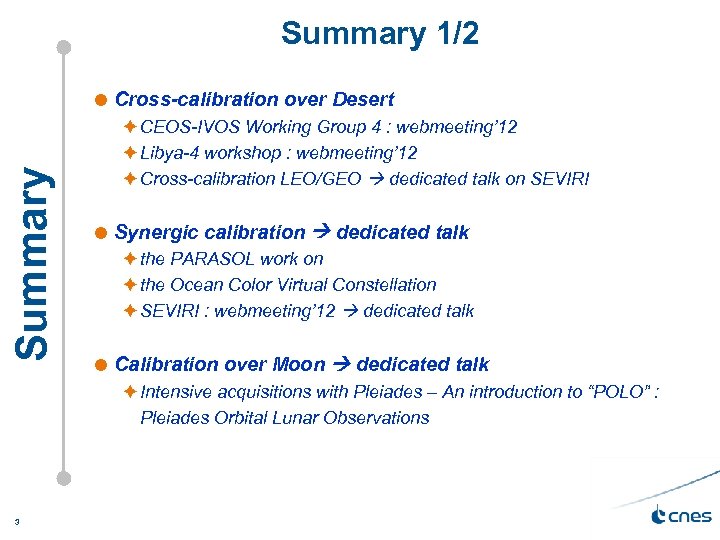 Summary 1/2 Summary Cross-calibration over Desert è CEOS-IVOS Working Group 4 : webmeeting’ 12 è Libya-4 workshop : webmeeting’ 12 è Cross-calibration LEO/GEO dedicated talk on SEVIRI Synergic calibration dedicated talk è the PARASOL work on è the Ocean Color Virtual Constellation è SEVIRI : webmeeting’ 12 dedicated talk Calibration over Moon dedicated talk è Intensive acquisitions with Pleiades – An introduction to “POLO” : Pleiades Orbital Lunar Observations 3
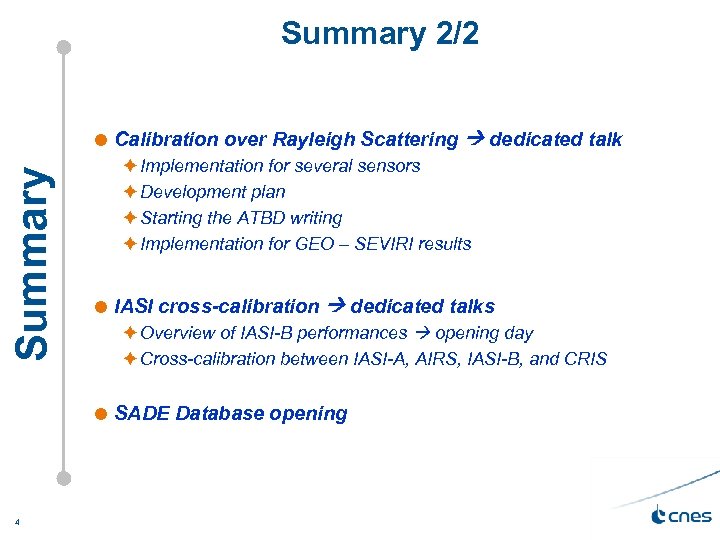 Summary 2/2 Summary è Implementation for several sensors è Development plan è Starting the ATBD writing è Implementation for GEO – SEVIRI results IASI cross-calibration dedicated talks è Overview of IASI-B performances opening day è Cross-calibration between IASI-A, AIRS, IASI-B, and CRIS 4 Calibration over Rayleigh Scattering dedicated talk SADE Database opening
 Cross-Calibration over Desert Sites 5
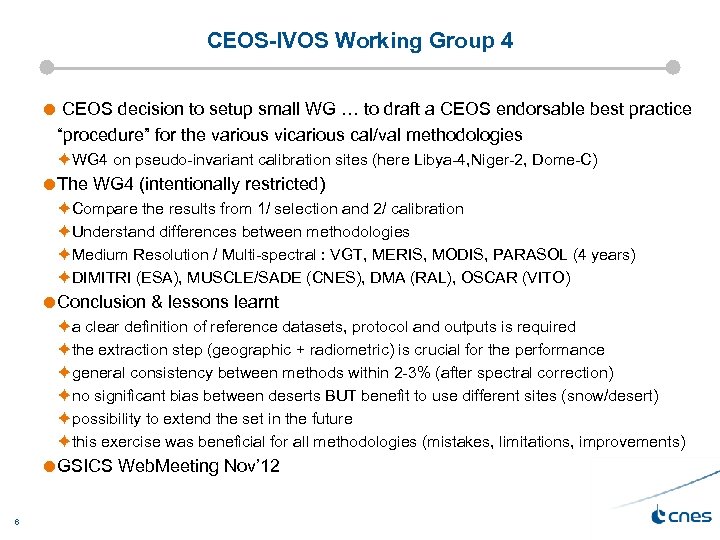 CEOS-IVOS Working Group 4 CEOS decision to setup small WG … to draft a CEOS endorsable best practice “procedure” for the various vicarious cal/val methodologies èWG 4 on pseudo-invariant calibration sites (here Libya-4, Niger-2, Dome-C) The WG 4 (intentionally restricted) èCompare the results from 1/ selection and 2/ calibration èUnderstand differences between methodologies èMedium Resolution / Multi-spectral : VGT, MERIS, MODIS, PARASOL (4 years) èDIMITRI (ESA), MUSCLE/SADE (CNES), DMA (RAL), OSCAR (VITO) Conclusion & lessons learnt èa clear definition of reference datasets, protocol and outputs is required èthe extraction step (geographic + radiometric) is crucial for the performance ègeneral consistency between methods within 2 -3% (after spectral correction) èno significant bias between deserts BUT benefit to use different sites (snow/desert) èpossibility to extend the set in the future èthis exercise was beneficial for all methodologies (mistakes, limitations, improvements) GSICS 6 Web. Meeting Nov’ 12
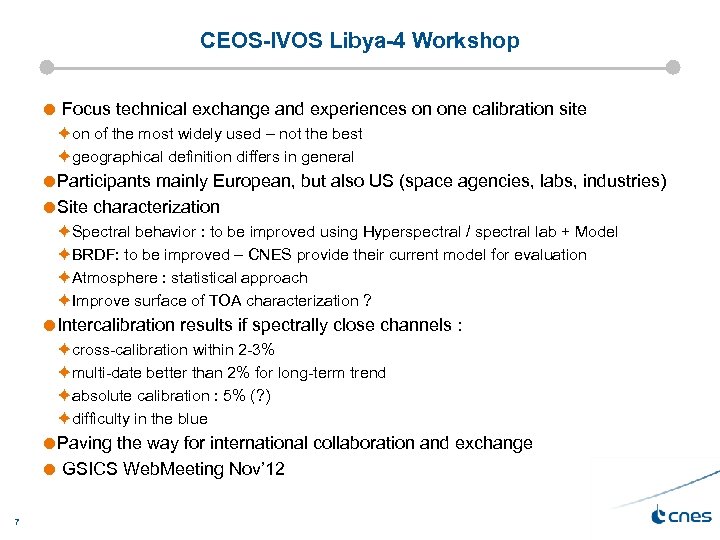 CEOS-IVOS Libya-4 Workshop Focus technical exchange and experiences on one calibration site èon of the most widely used – not the best ègeographical definition differs in general Participants mainly European, but also US (space agencies, labs, industries) Site characterization èSpectral behavior : to be improved using Hyperspectral / spectral lab + Model èBRDF: to be improved – CNES provide their current model for evaluation èAtmosphere : statistical approach èImprove surface of TOA characterization ? Intercalibration results if spectrally close channels : ècross-calibration within 2 -3% èmulti-date better than 2% for long-term trend èabsolute calibration : 5% (? ) èdifficulty in the blue Paving the way for international collaboration and exchange GSICS Web. Meeting Nov’ 12 7
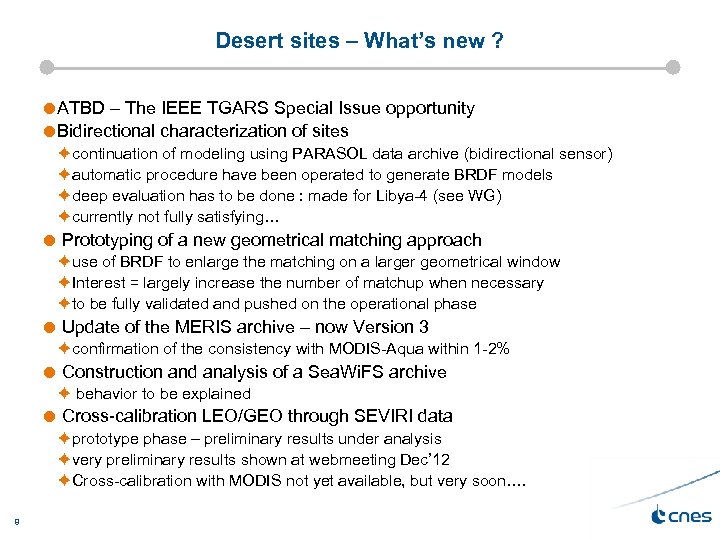 Desert sites – What’s new ? ATBD – The IEEE TGARS Special Issue opportunity Bidirectional characterization of sites ècontinuation of modeling using PARASOL data archive (bidirectional sensor) èautomatic procedure have been operated to generate BRDF models èdeep evaluation has to be done : made for Libya-4 (see WG) ècurrently not fully satisfying… Prototyping of a new geometrical matching approach èuse of BRDF to enlarge the matching on a larger geometrical window èInterest = largely increase the number of matchup when necessary èto be fully validated and pushed on the operational phase Update of the MERIS archive – now Version 3 èconfirmation of the consistency with MODIS-Aqua within 1 -2% Construction and analysis of a Sea. Wi. FS archive è behavior to be explained Cross-calibration LEO/GEO through SEVIRI data èprototype phase – preliminary results under analysis èvery preliminary results shown at webmeeting Dec’ 12 èCross-calibration with MODIS not yet available, but very soon…. 8
 Synergic Calibration 9
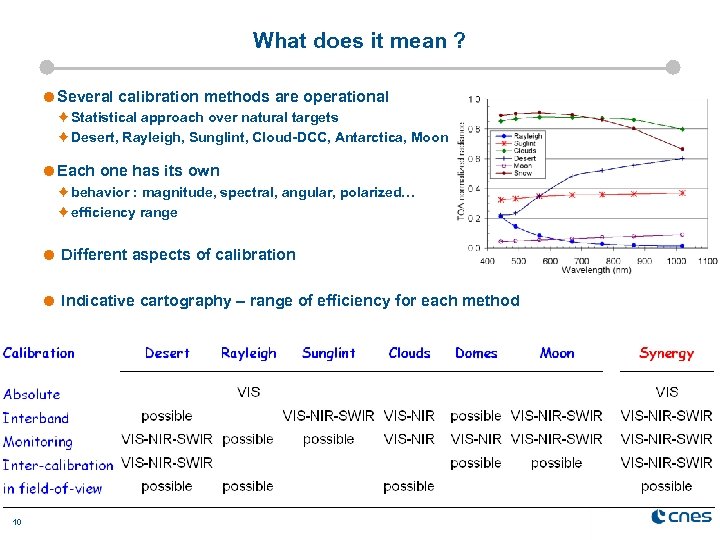 What does it mean ? Several calibration methods are operational è Statistical approach over natural targets è Desert, Rayleigh, Sunglint, Cloud-DCC, Antarctica, Moon Each one has its own è behavior : magnitude, spectral, angular, polarized… è efficiency range 10 Different aspects of calibration Indicative cartography – range of efficiency for each method
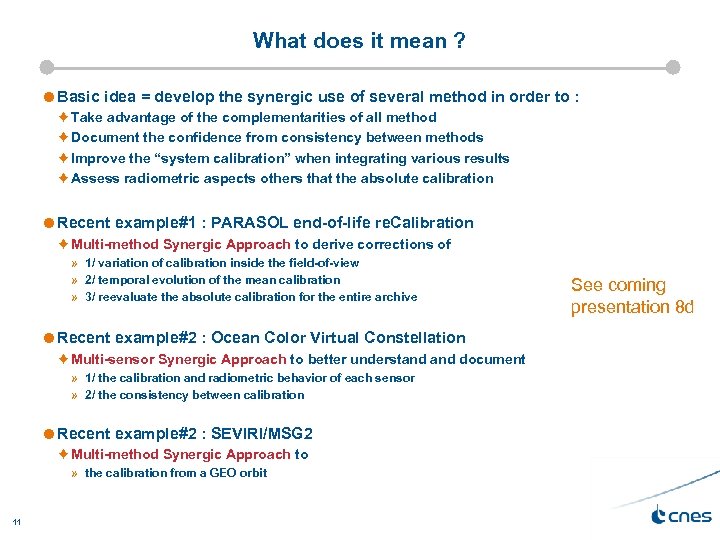 What does it mean ? Basic idea = develop the synergic use of several method in order to : è Take advantage of the complementarities of all method è Document the confidence from consistency between methods è Improve the “system calibration” when integrating various results è Assess radiometric aspects others that the absolute calibration Recent example#1 : PARASOL end-of-life re. Calibration è Multi-method Synergic Approach to derive corrections of » 1/ variation of calibration inside the field-of-view » 2/ temporal evolution of the mean calibration » 3/ reevaluate the absolute calibration for the entire archive Recent example#2 : Ocean Color Virtual Constellation è Multi-sensor Synergic Approach to better understand document » 1/ the calibration and radiometric behavior of each sensor » 2/ the consistency between calibration Recent example#2 : SEVIRI/MSG 2 è Multi-method Synergic Approach to » the calibration from a GEO orbit 11 See coming presentation 8 d
 Calibration over Moon 12
 An introduction to “POLO” It has been demonstrated that the Moon is a very precious way to provide accurate in-orbit monitoring of the radiometric drift Activity under “big” development at CNES è Method implemented in the operational MUSCLE/SADE environment Starting of Pleiades 1 A and 1 B commissioning phases in Jan’ 12 and Jan’ 13 è Strong ability to “catch” the moon è Intensive acquisitions have been performed (recom phase = 40°) » » 13 1 moon every day during one lunar cycle various moon cycles several moons during the day : every orbit, 2 successively, half an orbit 1 moon simultaneously by PH 1 A and PH 1 B This defines the Pleiades Orbital Lunar Observations – “POLO” See coming presentation 8 h è Intensive in-orbit acquisitions in various conditions è Goals are » to better understand the ROLO model on its operational form » to quantify the potential impact of programmation, conditions of acquisition (orientation), spatial sampling and resampling » to derive recommendations » to contribute to improve the use of lunar acquisitions » to develop the use for cross-calibration
 Calibration over Rayleigh Scattering 14
 Implementation Historically developed with POLDER and Végétation sensors è definition, prototyping and improvements between 1998 -2003 è now stabilized on the reference Version 3. 5 Implementation of Version 3. 5 for several sensors è ocean color sensor considered as radiometric reference » Sea. Wi. FS (prototype step) » MERIS (operational, reprocessed for data V 3) also to prepare OLCI (Sentinel-3) » MODIS coming è high-resolution sensors (limited geographical coverage and matchups) » SPOT 6 » Pleiades 1 A and 1 B è geostationary sensor » SEVIRI è future sensors » » 15 Sentinel-2 Sentinel-3 (OLCI and SLSTR) VENUS SPOT 7
 Development Plan Why do we need to clarify a development plan è Better visibility on the state of the art for each sensor » Externally, but also internally èThe method is labeled “operational”, but method = » step 1 = Data selection/extraction : specific step for each sensor (as if common baseline) » step 2 = Algorithm : computation of TOA signal – universal step, but need LUT » step 3 = matchup strategy : i. e. temporal/geometrical sampling : may be specific for each sensor = not the same development status for each sensor Development Plan for Calibration Method (MUSCLE/SADE) First tentative for the reference method Rayleigh Calibration Version 3. 5 (GSICS inspired graphical representation) èDEV = study & ATBD first definition [resp. SI/MO] èPROTO = prototype on dedicated test environment on MUSCLE [resp. SI/MO] Final ATBD (data selection/extraction) computation of LUT, parameterization of SADE/MUSCLE èPre-OPE = test on the operational MUSCLE [resp. ME/EI] èOPE = fully operational method/procedure/processing Traceability guaranteed [resp. ME/EI] 16
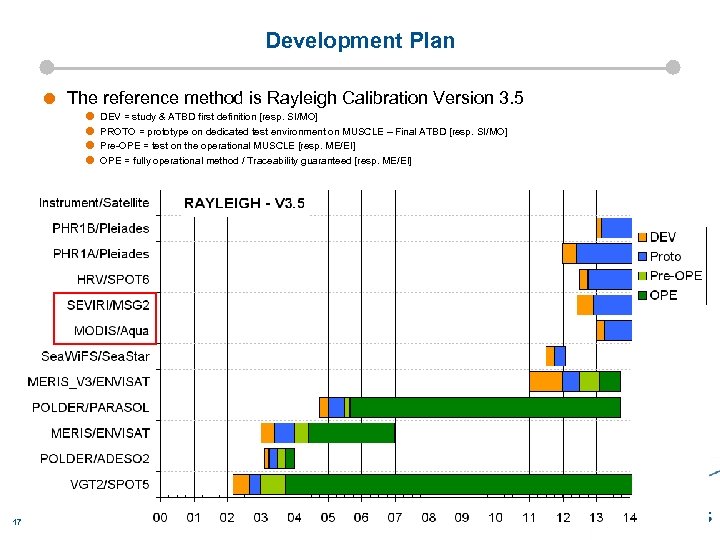 Development Plan The reference method is Rayleigh Calibration Version 3. 5 17 DEV = study & ATBD first definition [resp. SI/MO] PROTO = prototype on dedicated test environment on MUSCLE – Final ATBD [resp. SI/MO] Pre-OPE = test on the operational MUSCLE [resp. ME/EI] OPE = fully operational method / Traceability guaranteed [resp. ME/EI]
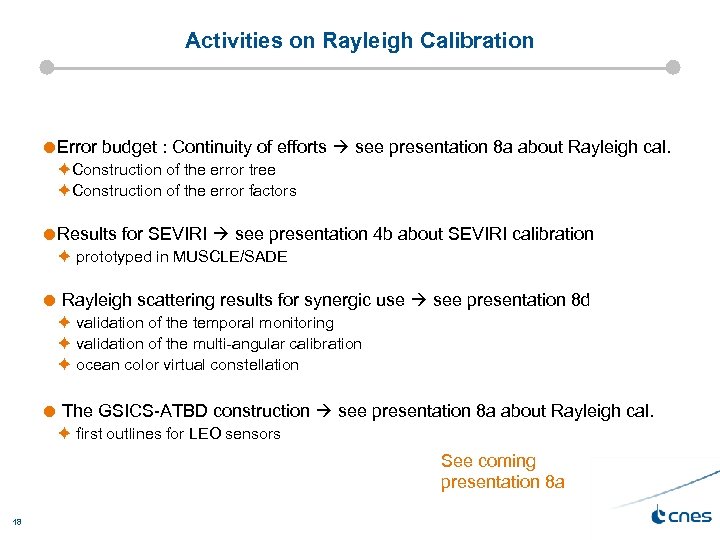 Activities on Rayleigh Calibration Error budget : Continuity of efforts see presentation 8 a about Rayleigh cal. èConstruction of the error tree èConstruction of the error factors Results for SEVIRI see presentation 4 b about SEVIRI calibration è prototyped in MUSCLE/SADE Rayleigh scattering results for synergic use see presentation 8 d è validation of the temporal monitoring è validation of the multi-angular calibration è ocean color virtual constellation The GSICS-ATBD construction see presentation 8 a about Rayleigh cal. è first outlines for LEO sensors See coming presentation 8 a 18
 IASI Cross-calibrations 19
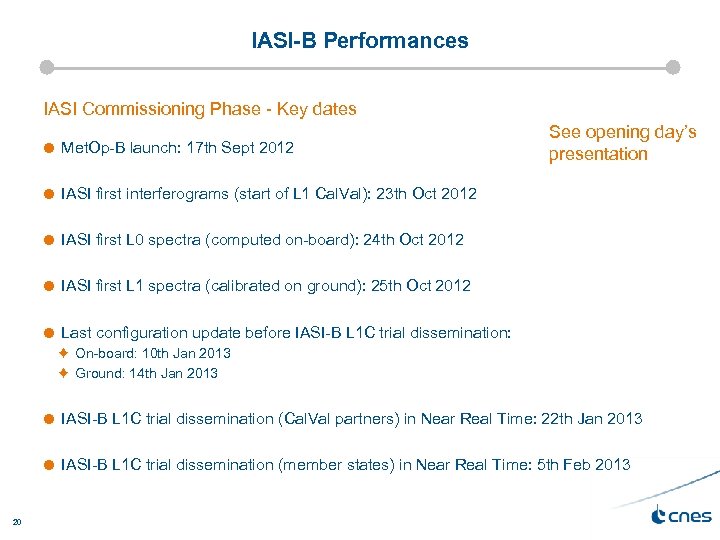 IASI-B Performances IASI Commissioning Phase - Key dates Met. Op-B launch: 17 th Sept 2012 IASI first interferograms (start of L 1 Cal. Val): 23 th Oct 2012 IASI first L 0 spectra (computed on-board): 24 th Oct 2012 IASI first L 1 spectra (calibrated on ground): 25 th Oct 2012 See opening day’s presentation Last configuration update before IASI-B L 1 C trial dissemination: è On-board: 10 th Jan 2013 è Ground: 14 th Jan 2013 20 IASI-B L 1 C trial dissemination (Cal. Val partners) in Near Real Time: 22 th Jan 2013 IASI-B L 1 C trial dissemination (member states) in Near Real Time: 5 th Feb 2013
 IASI-B Performances After 3 months of IASI-B L 1 Cal. Val 21 See opening day’s presentation Instrument & interferogram acquisition are very stable and work perfectly Space & ground segments are now working well with consolidated parameters. The in-depth tuning has started. Performances are very encouraging and already of order of IASI-A
 Massive Cross-calibration The tool for inter-comparison is now operational for the 5 couples of sensors: è IASI-A / AIRS, IASI-A / CRIS è IASI-B / AIRS, IASI-B / CRIS è IASI-A / IASI-B Major result: very accurate cross-calibration! è Bias between 0 K and 0. 2 K, < radiometric absolute specification of 0. 5 K è IASI-B very close to IASI-A (bias ~0. 1 K) continuity of the IASI mission Work on-going: è Increase the size and relevance of the dataset è Go further in the interpretation of small differences è Perform IASI / AIRS and IASI / CRIS at high spectral resolution è Perform a spectral inter-calibration ? The tool should be operational for a long time (decades for climatic studies) Inclusion of the future sensors (IASI-C, IASI-NG, etc. ) See presentation 5 a 22
 SADE Database Opening 23
 SADE Database Opening Few feedbacks from beta-users : only one (very positive…) SADE access through CNES scientific mission website èhttp: //smsc. cnes. fr/CALIBRATION/ (free access) èPassword mandatory (for the “SADE data” page only) A complete reprocessing of SADE exported files was produced in March 2012 èData extension up to 2011 èNew sensors : » Terra/Modis » Landsat 7 » Theos èNew MERIS reprocessing (3 rd) èVGT 1 updated calibration Opening has been announced at the CEOS/IVOS Meeting (May 2012) èNevertheless a small difficulty : no procedure yet available for password delivery (contact Aimé Meygret or Patrice Henry) including the data policy èIf interested, please contact us 24