


 Скачать презентацию GSC 9 GTSC_005 SOURCE ITU-T TITLE NGN Work in
6cc56b19ec1d52d745c67b90455f58e3.ppt
- Количество слайдов: 15
 GSC 9/GTSC_005 SOURCE: ITU-T TITLE: NGN Work in ITU-T SG 11 AGENDA ITEM: 5. 0 CONTACT: Yukio Hiramatsu, hiramatsu. yukio@lab. ntt. co. jp, Tel. +81 -422 -59 -7061, Fax. +81 -422 -59 -5561 NGN Work in ITU-T SG 11 2004. 5. 11 Yukio Hiramatsu Chairman of ITU-T SG 11 GSC-9, Seoul
 Outline • • Major achievements during the current study period NGN activities in SG 11 New Questions of SG 11 for the next study period Work programme for NGN signalling requirements and protocols • Draft Technical Reports on NGN • Draft Technical Report on IP Qo. S • Possible work on security GSC-9, Seoul 2
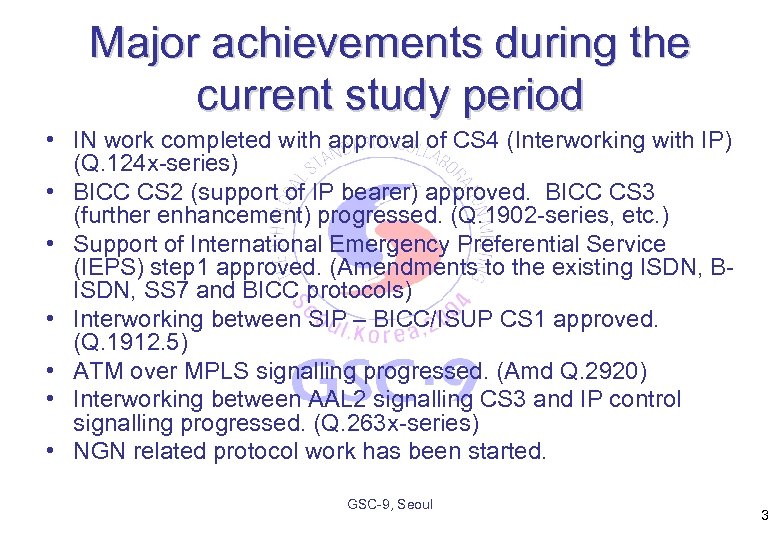 Major achievements during the current study period • IN work completed with approval of CS 4 (Interworking with IP) (Q. 124 x-series) • BICC CS 2 (support of IP bearer) approved. BICC CS 3 (further enhancement) progressed. (Q. 1902 -series, etc. ) • Support of International Emergency Preferential Service (IEPS) step 1 approved. (Amendments to the existing ISDN, BISDN, SS 7 and BICC protocols) • Interworking between SIP – BICC/ISUP CS 1 approved. (Q. 1912. 5) • ATM over MPLS signalling progressed. (Amd Q. 2920) • Interworking between AAL 2 signalling CS 3 and IP control signalling progressed. (Q. 263 x-series) • NGN related protocol work has been started. GSC-9, Seoul 3
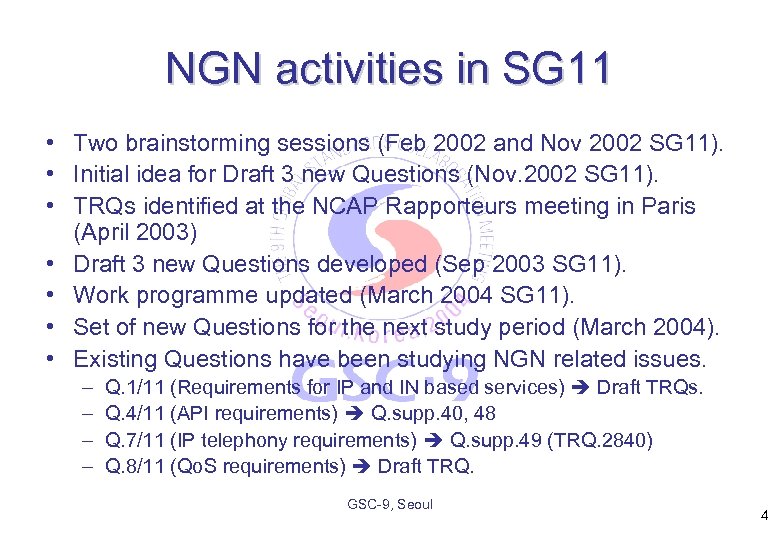 NGN activities in SG 11 • Two brainstorming sessions (Feb 2002 and Nov 2002 SG 11). • Initial idea for Draft 3 new Questions (Nov. 2002 SG 11). • TRQs identified at the NCAP Rapporteurs meeting in Paris (April 2003) • Draft 3 new Questions developed (Sep 2003 SG 11). • Work programme updated (March 2004 SG 11). • Set of new Questions for the next study period (March 2004). • Existing Questions have been studying NGN related issues. – – Q. 1/11 (Requirements for IP and IN based services) Draft TRQs. Q. 4/11 (API requirements) Q. supp. 40, 48 Q. 7/11 (IP telephony requirements) Q. supp. 49 (TRQ. 2840) Q. 8/11 (Qo. S requirements) Draft TRQ. GSC-9, Seoul 4
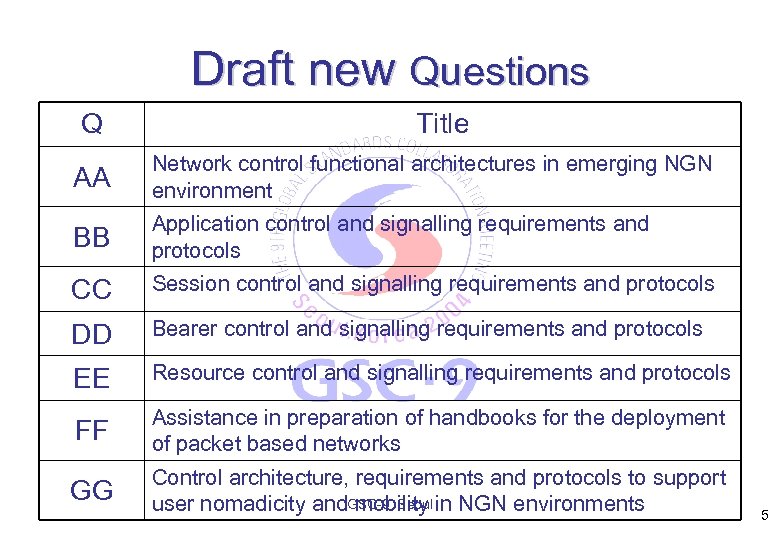 Draft new Questions Q Title AA Network control functional architectures in emerging NGN environment BB Application control and signalling requirements and protocols CC Session control and signalling requirements and protocols DD Bearer control and signalling requirements and protocols EE Resource control and signalling requirements and protocols FF Assistance in preparation of handbooks for the deployment of packet based networks GG Control architecture, requirements and protocols to support user nomadicity and. GSC-9, Seoul in NGN environments mobility 5
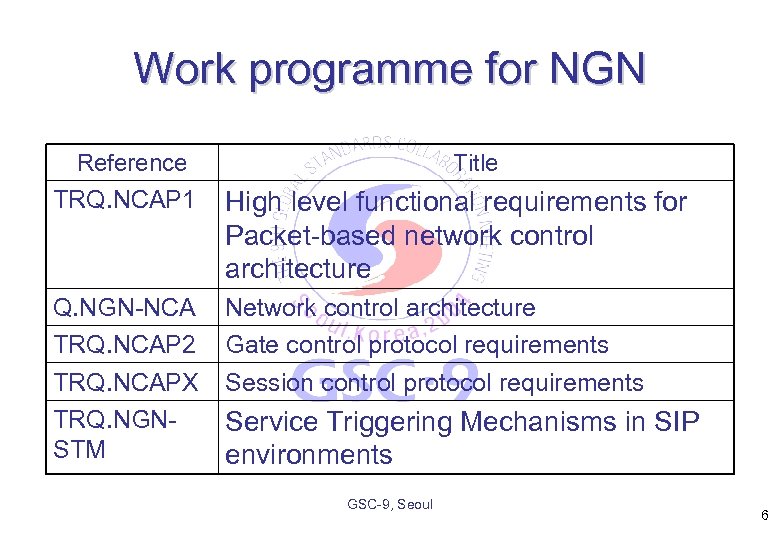 Work programme for NGN Reference Title TRQ. NCAP 1 High level functional requirements for Packet-based network control architecture Q. NGN-NCA TRQ. NCAP 2 TRQ. NCAPX TRQ. NGNSTM Network control architecture Gate control protocol requirements Session control protocol requirements Service Triggering Mechanisms in SIP environments GSC-9, Seoul 6
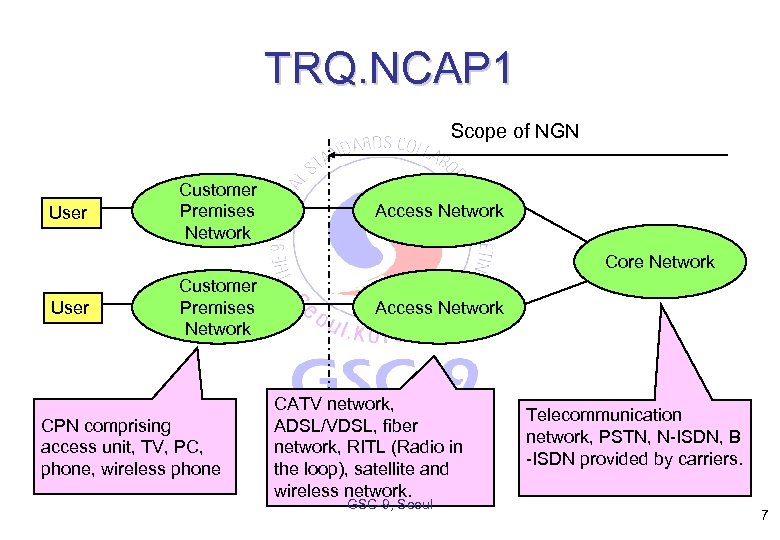 TRQ. NCAP 1 Scope of NGN User Customer Premises Network Access Network Core Network User Customer Premises Network CPN comprising access unit, TV, PC, phone, wireless phone Access Network CATV network, ADSL/VDSL, fiber network, RITL (Radio in the loop), satellite and wireless network. GSC-9, Seoul Telecommunication network, PSTN, N-ISDN, B -ISDN provided by carriers. 7
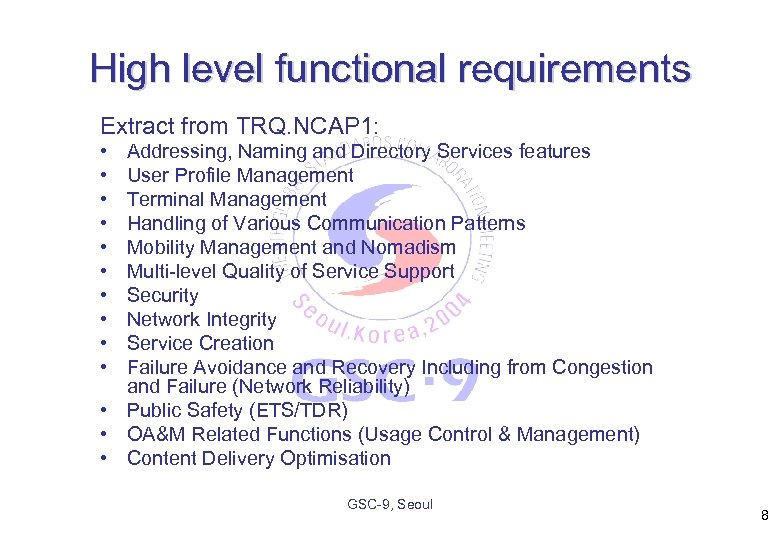 High level functional requirements Extract from TRQ. NCAP 1: • • • Addressing, Naming and Directory Services features User Profile Management Terminal Management Handling of Various Communication Patterns Mobility Management and Nomadism Multi-level Quality of Service Support Security Network Integrity Service Creation Failure Avoidance and Recovery Including from Congestion and Failure (Network Reliability) • Public Safety (ETS/TDR) • OA&M Related Functions (Usage Control & Management) • Content Delivery Optimisation GSC-9, Seoul 8
 Q. NGN-NCA • Description of various service control architecture options in the context of a SIP-based Next Generation Network • 2 scenarios for SIP server with abstract call state machine and trigger processing (INAP based and OSA/Parlay based) • 4 scenarios for SIP server with trigger processing and without abstract call state machine (INAP based, OSA/Parlay based, full SIP and hybrid) • Scenario for SIP server without trigger processing nor abstract call state machine GSC-9, Seoul 9
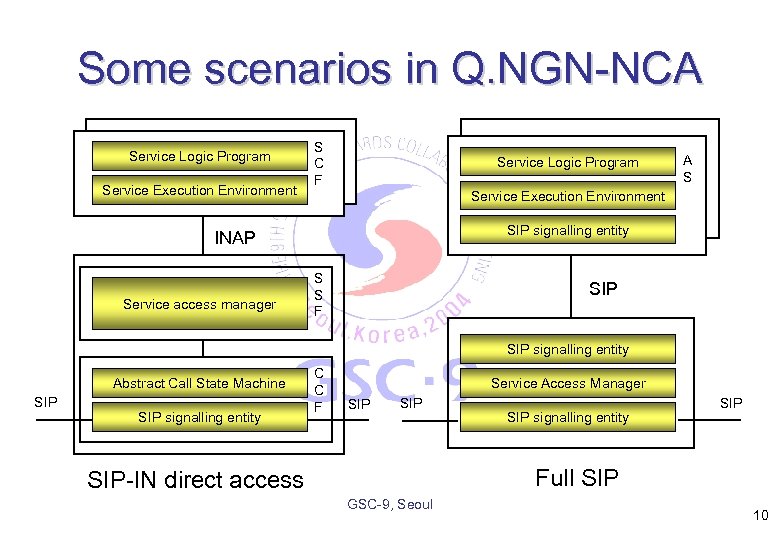 Some scenarios in Q. NGN-NCA Service Logic Program Service Execution Environment S C F Service Logic Program Service Execution Environment SIP signalling entity INAP Service access manager A S S S F SIP signalling entity Abstract Call State Machine SIP signalling entity C C F Service Access Manager SIP SIP signalling entity SIP Full SIP-IN direct access GSC-9, Seoul 10
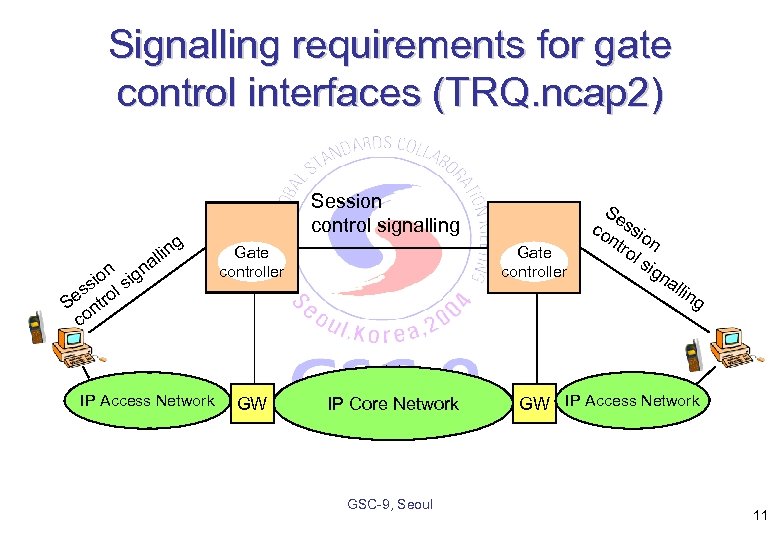 Signalling requirements for gate control interfaces (TRQ. ncap 2) g n n g sio l si s Se ntro co llin a IP Access Network Session control signalling Gate controller Se co ssio ntr n ol sig na ll ing GW IP Core Network GSC-9, Seoul GW IP Access Network 11
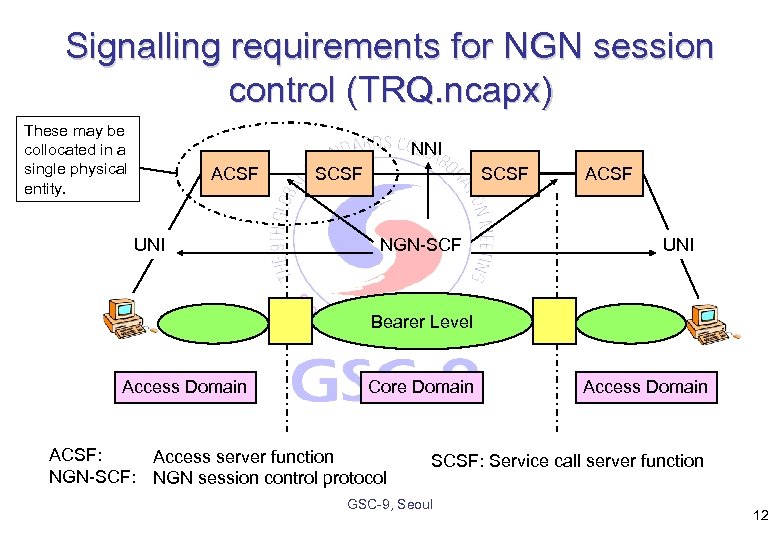 Signalling requirements for NGN session control (TRQ. ncapx) These may be collocated in a single physical entity. NNI ACSF UNI SCSF NGN-SCF ACSF UNI Bearer Level Access Domain Core Domain ACSF: Access server function NGN-SCF: NGN session control protocol Access Domain SCSF: Service call server function GSC-9, Seoul 12
 Work on IP Qo. S • Qo. S is one of the most important features in NGN signalling. • Draft TRQ. IPQOS. SIG. CS 1 is under development in SG 11. • Scope expanded to include both “On-path” and “Off-path”, and to include various underlying technologies other than MPLS. • Mr. Wei Feng (Huawei Technologies, China) has been nominated as Rapporteur on Q. 8/11 dealing with Qo. S signalling in this study period. • Interim Rapporteur meeting has been scheduled in July (in Shenzhen) with kind invitation by China members. GSC-9, Seoul 13
 Possible work on security • Requirements for secured communication interface between PSTN and Vo. IP networks • Analysis and examination of protocols and system interaction such as, but not limited to: Sign. Tran, SS 7, IPSec, H. 248/Megaco, and SIP. • The end result may be enhanced protocol specifications with additional security measures as well as raising awareness of industry best practices. • Draft Recommendation X. 805 - Security Architecture for Systems Providing End-to-End Communication be used as a sample tool for protocol security evaluation GSC-9, Seoul 14
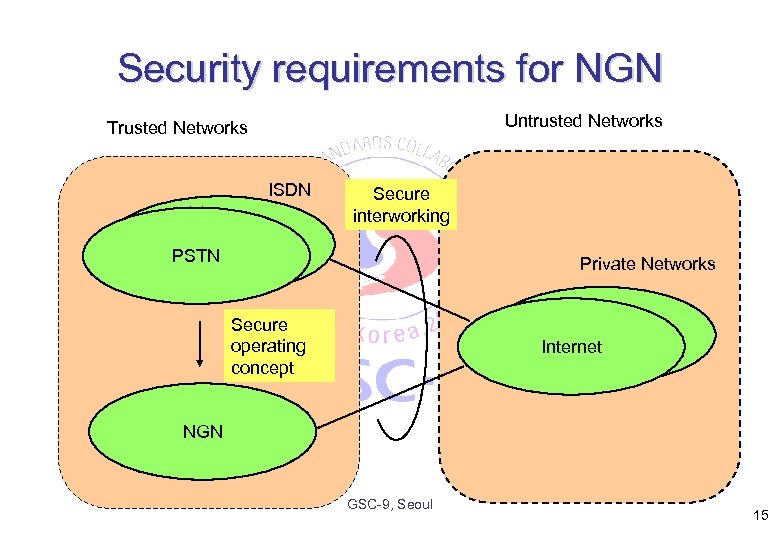 Security requirements for NGN Untrusted Networks Trusted Networks ISDN Secure interworking PSTN Private Networks Secure operating concept Internet NGN GSC-9, Seoul 15