


 Скачать презентацию GSA Office of Government-wide Policy Federal Transportation Officer
022af883587a5d2bd475ed38c3a25491.ppt
- Количество слайдов: 30
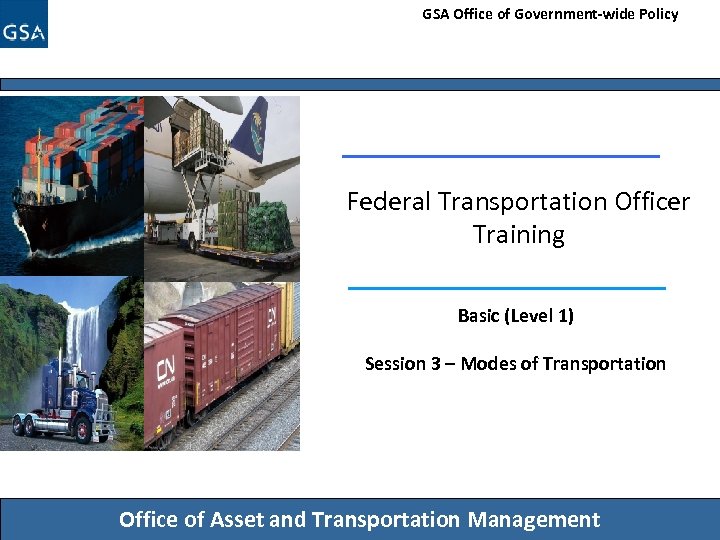 GSA Office of Government-wide Policy Federal Transportation Officer Training Basic (Level 1) Session 3 – Modes of Transportation Office of Asset and Transportation Management
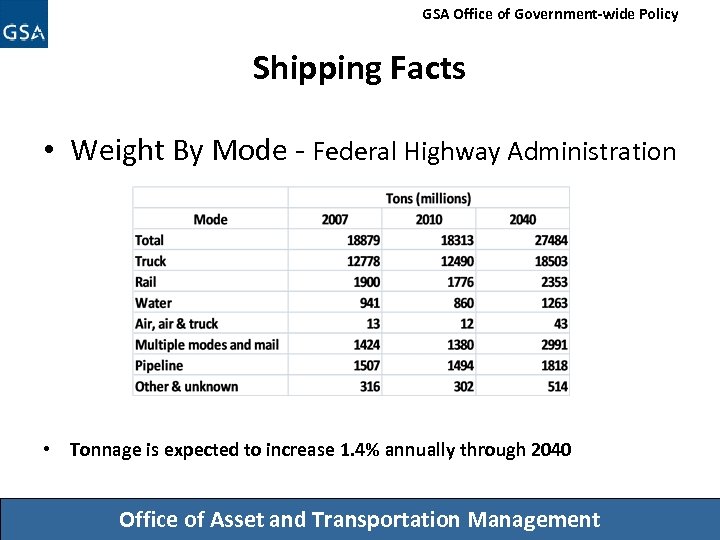 GSA Office of Government-wide Policy Shipping Facts • Weight By Mode - Federal Highway Administration • Tonnage is expected to increase 1. 4% annually through 2040 Office of Asset and Transportation Management
 GSA Office of Government-wide Policy Shipping Facts • Top 3 Water Ports by Containerized Cargo (2010) – Los Angeles, CA – Long Beach, CA – New York, NY • Top 3 Airports by Landed Weight All-Cargo (2009) – Memphis, TN (Memphis International) – Anchorage, AK (Ted Stevens Anchorage International) – Louisville, KY (Louisville International-Standiford Field) Office of Asset and Transportation Management
 GSA Office of Government-wide Policy What You Will Learn What will I learn from this lesson • What a transportation mode is • What the different transportation modes are • Background information that will assist you in making an informed transportation mode selection Office of Asset and Transportation Management
 GSA Office of Government-wide Policy What is a Mode? A mode is a means of transport. Each mode of transport has a fundamentally different technological solution for your transportation needs, and some require a separate environment. Each mode has its own infrastructure and operations, and often has unique regulations. Office of Asset and Transportation Management
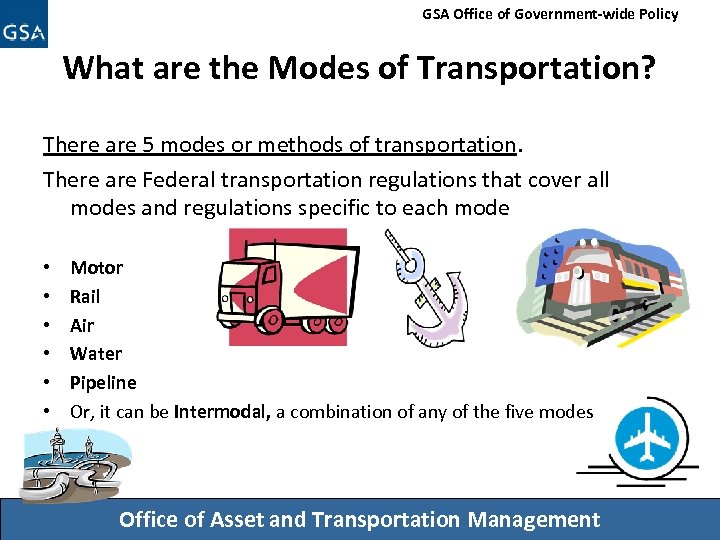 GSA Office of Government-wide Policy What are the Modes of Transportation? There are 5 modes or methods of transportation. There are Federal transportation regulations that cover all modes and regulations specific to each mode • • • Motor Rail Air Water Pipeline Or, it can be Intermodal, a combination of any of the five modes Office of Asset and Transportation Management
 GSA Office of Government-wide Policy Choosing the Correct Mode of Transportation In order to make an informed decision regarding the mode of transportation a Federal transportation officer needs to know: • The commodity or cargo being shipped • Timeline that must be met • Specific routing requirements • If the commodity has specific shipping requirements (packing or mode) • Your Agency policies regarding shipping or transport of the commodity • Cost constraints Office of Asset and Transportation Management
 GSA Office of Government-wide Policy Mode of Transportation: Motor transportation is over the road movement of freight • Dominant mode of shipping in the US • Is generally a cost-effective method • Provides flexibility in scheduling and areas served • Plays a vital role in intermodal shipping • Motor transportation can cross geographical boundaries Office of Asset and Transportation Management
 GSA Office of Government-wide Policy Motor Transportation Regulations • Title 49 Transportation • 41 C. F. R. PART 102– 117—TRANSPORTATION MANAGEMENT • 41 C. F. R. PART 102– 118—TRANSPORTATION PAYMENT AND AUDIT • Federal Motor Carrier Safety Act Office of Asset and Transportation Management
 GSA Office of Government-wide Policy Who Else is Involved with Motor Transportation? • National Motor Freight Traffic Association (NMFTA) – A non-profit comprised of motor carriers and transportation companies operating in interstate, intrastate, and foreign commerce – NMFTA publishes the National Motor Freight Classification (NMFC) – NMFTA assigns the Standard Carrier Alpha Code (SCAC) used to identify transportation companies, and publishes the Directory of SCACs Office of Asset and Transportation Management
 GSA Office of Government-wide Policy Mode of Transportation: Rail transport is a means of delivery of goods by way of wheeled vehicles running on rail tracks • Rail transport is considered to be energy-efficient • Ideal transport for bulk shipping • Specialized rail cars; tankers, auto transport, refrigerated; container • Generally cheaper when shipping long haul • Rail transportation offers the same delivery speed as trucks over long distances however is limited by track location and scheduling Office of Asset and Transportation Management
 GSA Office of Government-wide Policy Rail Transportation Regulations • Interstate Commerce Act of 1887 • Hepburn Act • Staggers Rail Act of 1980 • Railroad Revitalization & Regulatory Reform Act • Title 45 - Railroads Office of Asset and Transportation Management
 GSA Office of Government-wide Policy Mode of Transportation: Air transportation is considered the mode of travel provided for rapid movement of freight through the air over long distances. Air transportation provides for - Ø Faster movement of cargo Ø Frequently used when high-value or time sensitive payloads need to be moved Ø Long distance transport Disadvantages Cost Generally used for smaller volumes of cargo Accessibility – requires intermodal Office of Asset and Transportation Management
 GSA Office of Government-wide Policy Air Transportation Regulations Title 14 Aeronautics and Space 49 USC – 40118 Government Financed Air Transportation Office of Asset and Transportation Management
 GSA Office of Government-wide Policy Mode of Transportation: Water transportation encompasses both Inland Waterway, Domestic and International Ocean Transportation. • Almost always intermodal shipping • Limited to coastal areas or major inland waterways • Packaging of cargo is paramount to deciding what type of ship to use – Bulk Carrier – Container Ship – Tanker • Main advantage is the movement of commodities worldwide Office of Asset and Transportation Management
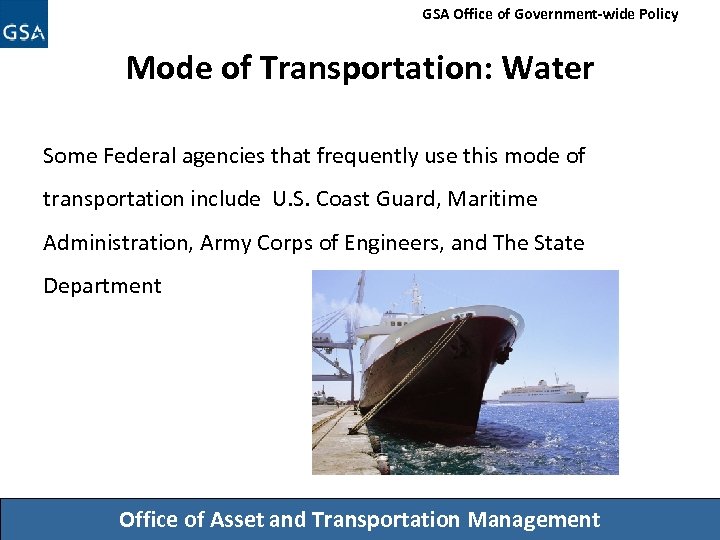 GSA Office of Government-wide Policy Mode of Transportation: Water Some Federal agencies that frequently use this mode of transportation include U. S. Coast Guard, Maritime Administration, Army Corps of Engineers, and The State Department Office of Asset and Transportation Management
 GSA Office of Government-wide Policy Water Transportation Regulations • Title 46 – Shipping • Title 46 – Part 381 Cargo Preference • Title 19 Section 4. 80 • Vessels entitled to engage in coastwise trade Office of Asset and Transportation Management
 GSA Office of Government-wide Policy Mode of Transportation: Pipeline The transport of goods through a pipe • Typically used to transport large volumes of fuels and chemicals • Most widely used for petroleum • Frequently part of an intermodal system Office of Asset and Transportation Management
 GSA Office of Government-wide Policy Mode of Transportation: Pipeline • Pipeline transportation is regulated by U. S. Department of Transportation, Pipeline and Hazardous Materials Safety Administration. • National Pipeline Mapping System (NPMS) is a geographic information system (GIS) created by the U. S. Department of Transportation, Pipeline and Hazardous Materials Safety Administration (PHMSA), Office of Pipeline Safety (OPS) in cooperation with other federal and state governmental agencies and the pipeline industry Office of Asset and Transportation Management
 GSA Office of Government-wide Policy Pipeline Regulations • Title 49 Parts 190 to 199 Pipelines • For more information go to the US Department of Transportation Pipeline and Hazardous Materials Safety Administration (PHMSA) Office of Asset and Transportation Management
 GSA Office of Government-wide Policy Who Else is Involved with the Pipeline System? Other agencies involved in management of the national pipeline system include but are not limited to: ü Whenever new pipe is installed in the ground, workers are protected by requirements of the federal Occupational Safety and Health Administration (OSHA). ü Facilities including pipeline terminals and tank farms fall under local jurisdiction requirements based on codes published by the National Fire Protection Association (NFPA). ü The tariffs pipelines charge for the transportation services they provide are overseen by the Federal Energy Regulatory Commission (FERC). Office of Asset and Transportation Management
 GSA Office of Government-wide Policy Intermodal Shipping is the transportation of freight using multiple shipping modes • Usually involves using an intermodal container that allows cargo to be readily moved from mode to mode • Often used for international or overseas cargo shipments • Usually provides cost savings on long haul intra-continental shipments Office of Asset and Transportation Management
 GSA Office of Government-wide Policy Intermodal Shipping Examples of intermodal shipments: • Trucks are routinely used to transport cargo to : – Trains – Planes – Ships Each combination is an intermodal shipment • Pipelines transport oil from an oil field to a tanker ship This combination is an intermodal shipment • Any combination of two or more modes is an intermodal shipment Office of Asset and Transportation Management
 GSA Office of Government-wide Policy Intermodal Shipping Advantages Intermodal shipping offers: ü Minimized cargo handling, ü Potential of improved security, ü Reduced risk of damages and losses, and ü Often allows freight to reach its destination faster ü Consolidation can reduce the cost of the shipment Office of Asset and Transportation Management
 GSA Office of Government-wide Policy Intermodal Shipping Disadvantages When reviewing logistics of intermodal shipping, you may find disadvantages in using intermodal shipping such as: ü Timeline required for shipping and delivery ü May additional transportation costs depending on the number and types of modes required ü May require tracking using multiple systems or vendors Office of Asset and Transportation Management
 GSA Office of Government-wide Policy Best Value To help you decide which mode and transportation service provider (TSP) provides the best value to your Agency, ask yourself these questions: • • • What is being shipped and how is it packaged? Will the shipment require a special mode or are you limited in your mode selection? Are there time limitations for the shipment? Is the shipment high value, security risk, hazardous, perishable? Does your Agency have rules and restrictions for shipping? – Does the commodity you are shipping fall within these restrictions? • • Does your Agency have TSP Contracts or Tenders in place that you are required to use? If your Agency does not have contract or tenders in place with TSPs, how are you planning on shipping? – GSA, another Agency, commercial? • • Are available vendors capable of meeting your shipping requirements? How has the vendor you selected performed in the past? Office of Asset and Transportation Management
 GSA Office of Government-wide Policy Knowledge Review What is the five modes of transportation? q Air q Water q Motor q Rail q Pipeline q Pony Express (Check all that apply) Office of Asset and Transportation Management
 GSA Office of Government-wide Policy Knowledge Review You are correct if your response was: ü Air ü Water ü Motor ü Pipeline ü Rail CONGRATULATIONS ! Office of Asset and Transportation Management
 GSA Office of Government-wide Policy Glossary of Terms The following terms are those frequently used in Federal transportation, however this is not an inclusive list of terms. Refer to § 102 -117. 25 and § 102 -118. 35 for additional transportation definitions. For specific transportation mode terms, refer to U. S. Department of Transportation, Pipeline and Hazardous Materials Safety Administration website at: www. phmsa. dot. gov Glossary of Shipping Terms; US DOT MARAD - www. marad. dot. gov/documents/Glossary_final. pdf Trucking Industry Terms ; IRS. gov - http: //www. irs. gov/businesses/article/0, , id=170625, 00. html Cargo preference is the legal requirement for all, or a portion of all, ocean-borne cargo to be transported on U. S. flag vessels. Foreign flag vessel is any vessel of foreign registry including vessels owned by U. S. citizens but registered in a foreign country. U. S. flag air carrier is an air carrier holding a certificate issued by the United States under 49 U. S. C. 41102 (49 U. S. C. 40118, 48 CFR part 47, subpart 47. 4). U. S. flag vessel is a commercial vessel, registered and operated under the laws of the U. S. , owned and operated by U. S. citizens, and used in commercial trade of the United States. Freight Forwarder: A person that dispatches shipments via common carriers and books or otherwise arranges space for those shipments on behalf of shippers and processes the documentation or performs related activities incident to those shipments Office of Asset and Transportation Management
 GSA Office of Government-wide Policy Where to Go for More Information • US Department of Transportation www. dot. gov • USDOT Maritime Administration www. marad. dot. gov/ • USDOT Pipeline and Hazardous Materials Safety Administration (PHMSA): www. phmsa. dot. gov • Federal Railroad Administration www. fra. dot. gov/ • International Air Transport Association www. iata. org • American Trucking Association www. trucking. org • GSA Center for Transportation Management www. gsa. gov/portal/content/104554 • Department of Commerce - Export. GOV http: //export. gov/logistics/index. asp • National Motor Freight Traffic Association www. nmfta. org Office of Asset and Transportation Management