 Скачать презентацию GSA Committee Technical Update For Engineers Bo D
c396eb2392bdfbf5ea14fb30b5697de6.ppt
- Количество слайдов: 41



GSA Committee Technical Update For Engineers Bo. D Meeting - Feb 2008
GSA Committee Update • GSA Committees – SAS – GDS – Transport – S 2 S – G 2 S Bo. D Meeting - Feb 2008
Committee Procedures • Committees have a Chair and Vice Chair position • Committees meet Face to Face Quarterly (approximately) • Committees may (and do) meet more regularly on an ad hoc basis – Ad hoc meetings may be as frequent as necessary – They are typically held via teleconference Bo. D Meeting - Feb 2008
Committee Procedures • Formal meetings may be held when binding votes are necessary • Binding votes may only occur at a formal meeting • Formal votes may be face to face or by teleconference • Voting Members must be at the Gold level and must have participated in the last two formal meetings Bo. D Meeting - Feb 2008
Committee Procedures • Each Member gets one vote • Votes are passed by a simple majority • All formal meetings have minutes taken • Many ad hoc (or informal) meetings have unofficial minutes to record progress. • Specific procedures for committees are in GSA policy 124 Bo. D Meeting - Feb 2008
Committee Functions • The committees meet to advance correct or modify the protocols • JIRA is the project tracking program used by the committees – All members may have JIRA access – Contact the JIRA administrator through the GSA website for log in info and password Bo. D Meeting - Feb 2008
Committee Procedures • Virtually all items addressed by the committee are a result of a JIRA item • JIRA allows members to enter an item and to comment on other items already entered • All comments are visible • Members may subscribe to JIRA items so that they are notified when comments are made Bo. D Meeting - Feb 2008
Committee Procedures • The committee Chair determines the agenda and moderates the meetings • All members may participate in any of the committee meetings Bo. D Meeting - Feb 2008
SAS • The SAS committee recently made accommodations in the protocol for existing implementations • The group will be working the 2008 Committee operating guidelines • The group will discuss the Test Script Workgroup Bo. D Meeting - Feb 2008
SAS Committee • Primarily in maintenance mode • No major development • Bug fixes • Additional enhancements approved by the Board of Directors • Final work on Addendum this session • Eventual phase out of the SAS protocol Bo. D Meeting - Feb 2008
SAS Committee • Tool kit being maintained and updated • Test scripts being maintained and updated • Working group to be formed for tool kit and test script maintenance/development Bo. D Meeting - Feb 2008
GDS Committee • USB Based protocol • Designed for peripheral devices such as printer, note acceptor, card reader, etc. • USB 2. 0 based • New revisions to be released within 30 days • Currently working on printable characters description • Will work in conjunction with G 2 S and S 2 S for transmitting characters Bo. D Meeting - Feb 2008
Transport Committee • The 1. 0. 3 Point to Point with errata 1 is the most current protocol • The 1. 0. 7 Multicast protocol is the most current • The committee is correcting bugs and working on Transport Certification requirements • Currently working on Transport Certification • Worked out NTP, SCEP and DHCP Bo. D Meeting - Feb 2008
Transport Status • In our last meeting we discussed the GET and POST SCEP commands and the affects on proxies and caches • We determined that proxies and caches were not suitable for security messages • We will be evaluating a document that provides additional clarifying text for SCEP and OCSP functions in the Transport protocol Bo. D Meeting - Feb 2008
G 2 S • The committee voted to release the latest version 1. 0. 4. 2 for Membership comment • The group will be addressing comments (JIRA items) and deciding on corrections • The group will be discussing new classes: Tournament Class is on the agenda • The group will be discussing backward compatibility Bo. D Meeting - Feb 2008
G 2 S • Backward compatibility has several forms – Application backward compatibility – Schema backward compatibility • Several JIRA items relate to this issue • The group will discuss rules or guidelines referring to changing schemas Bo. D Meeting - Feb 2008
S 2 S • The committee voted to release their protocol to the Member Vote period • The current version for the committee is 1. 2. 6. 5 • The committee will begin discussing the next revision which will be a serious re-write of many of the classes. Bo. D Meeting - Feb 2008
S 2 S • Big Bang Revision – May of the older classes are very element heavy – We have found attribute heavy structures to be easier to maintain. G 2 S is designed as attribute heavy – We will be re-writing these classes to be attribute heavy – We will be adjusting the data structure of S 2 S to be compatible with G 2 S. Bo. D Meeting - Feb 2008
Transport Fundamentals • Currently two transports – Point to Point – Multicast • Point to Point support required for messaging protocols Bo. D Meeting - Feb 2008
Transport Fundamentals • Point to Point transport features – TLS/SSL security – TLS 1. 0 support required – SCEP is the Certificate handling protocol – OSCP is the revocation service – DHCP support with vendor extensions – NTP supported – X 509 v 3 certificate support required Bo. D Meeting - Feb 2008
Transport Fundamentals Point to Point Protocol • Secures both endpoints in a connection • Certificates must reside in both endpoints • Must install the initial certificate manually – Cannot send private key over an unencrypted network – Cannot encrypt the communication without an initial certificate – Several methods of installing initial keys • Subsequent key changes can happen automatically over time or on demand Bo. D Meeting - Feb 2008
Point to Point Transport • Methods for changing symmetric and asymmetric keys are described in the protocol • TLS describes a method of re-handshaking which results in a symmetric key change without tearing down communications • TLS does not describe a method for changing Asymmetric keys • Possible use of expiration dates to trigger generation of new certificates. Bo. D Meeting - Feb 2008
Point to Point Protocol • The transport must ensure messages are received in the order they are sent • The transport must not send duplicate messages • Any violations of the above two criteria is a failure of the transport and requires the transport connection to be aborted Bo. D Meeting - Feb 2008
Multicast Protocol • One to many relationship • Multicast means IP Multicast for networks that support IGMP v 2 • Uses UDP for low overhead – Lightweight – Efficient – Non critical data Bo. D Meeting - Feb 2008
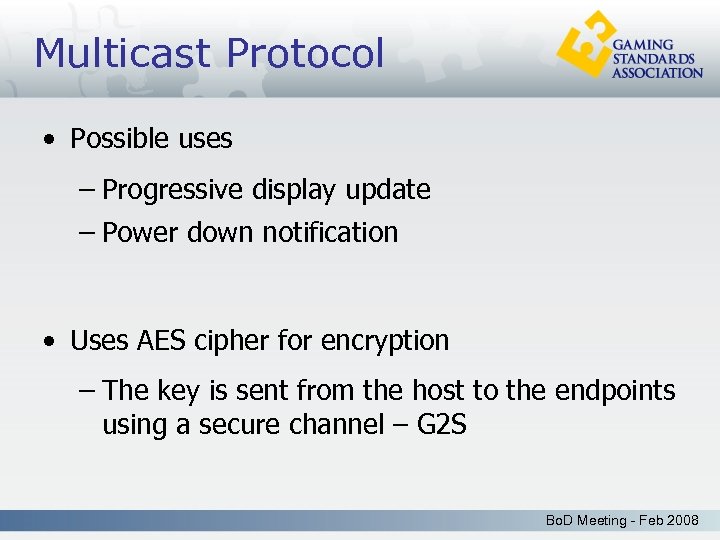
Multicast Protocol • Possible uses – Progressive display update – Power down notification • Uses AES cipher for encryption – The key is sent from the host to the endpoints using a secure channel – G 2 S Bo. D Meeting - Feb 2008
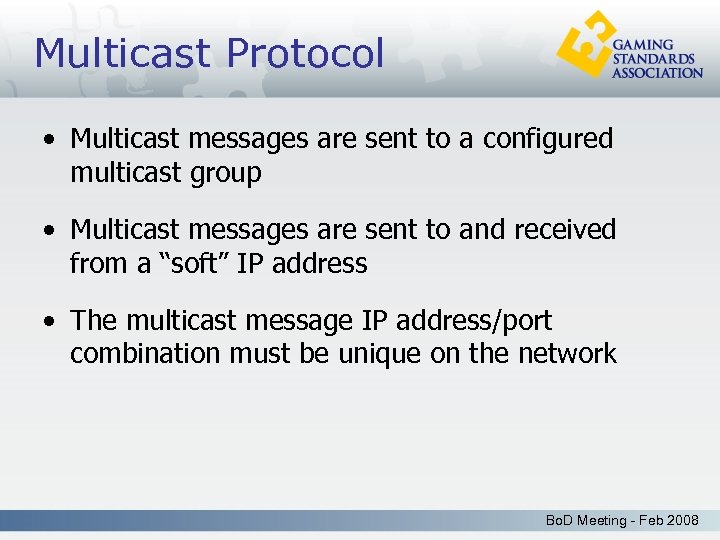
Multicast Protocol • Multicast messages are sent to a configured multicast group • Multicast messages are sent to and received from a “soft” IP address • The multicast message IP address/port combination must be unique on the network Bo. D Meeting - Feb 2008
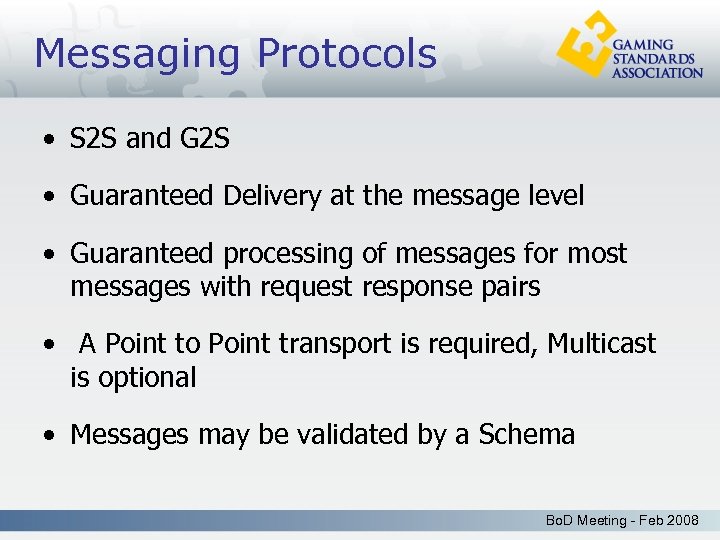
Messaging Protocols • S 2 S and G 2 S • Guaranteed Delivery at the message level • Guaranteed processing of messages for most messages with request response pairs • A Point to Point transport is required, Multicast is optional • Messages may be validated by a Schema Bo. D Meeting - Feb 2008
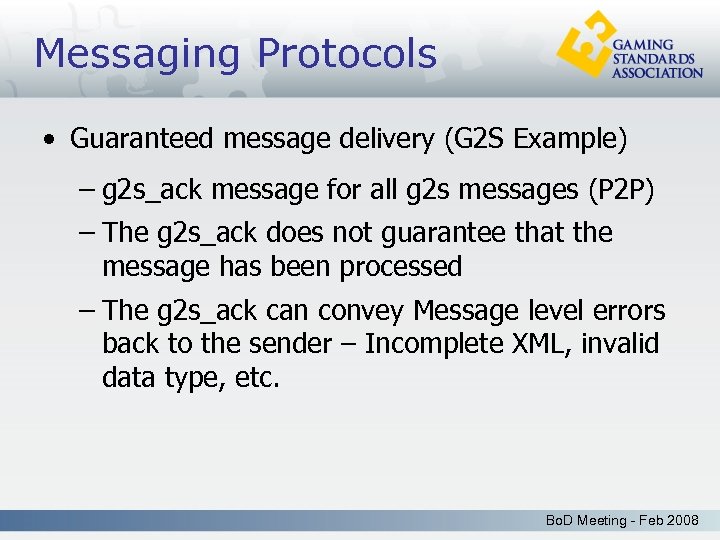
Messaging Protocols • Guaranteed message delivery (G 2 S Example) – g 2 s_ack message for all g 2 s messages (P 2 P) – The g 2 s_ack does not guarantee that the message has been processed – The g 2 s_ack can convey Message level errors back to the sender – Incomplete XML, invalid data type, etc. Bo. D Meeting - Feb 2008
Messaging Protocols • Message flow – Host sends a command – Client receives the command sends the acknowledge – Client processes the command sends a response command (if appropriate) – Host acknowledges the response – Host acts on the contents of the response Bo. D Meeting - Feb 2008
Messaging Protocols • Devices may refer to hardware or software • A software device is an instantiation of the class – A voucher device is an instantiation of the voucher class – In G 2 S, communication to a hardware device (printer, for example) does not directly communicate with the hardware Bo. D Meeting - Feb 2008
G 2 S Protocol • Three types of messages • Requests – Require a response command • Response • Notification – Must not receive a response command • The type is indicated in the session. Type, class level attribute Bo. D Meeting - Feb 2008
G 2 S Protocol • Each class may have one or more devices depending on the class • Meters are kept on a device level and a class level • Logs are kept on a class level • Each device must have an owner host and may have a configurator and guest hosts Bo. D Meeting - Feb 2008
G 2 S Protocol • Devices may be active or inactive – Inactive devices are not accessible to the general EGM commands • Devices may be enabled or disabled – Disabled devices are active but may not perform the function they are intended to – a disabled printer may not print – A device may be disabled as a result of an error Bo. D Meeting - Feb 2008
G 2 S Protocol • Owner hosts control the function of the device • Configurators configure the device • A device may have, at most, one owner and one configurator host • Guest hosts monitor the devices – A device may have multiple guest hosts • Each host has its own host. Id and IP address Bo. D Meeting - Feb 2008
G 2 S Protocol • Everything generates an event – Hosts may subscribe to events – Events notify the host that the event has occurred and may contain associated data – The number of guest hosts is limited by the number of hosts supported by the EGM Bo. D Meeting - Feb 2008
G 2 S Protocol • Event data is gathered when the event is sent – If an event cannot be delivered and is retried, new data is gathered • Events may be sent as notifications or persisted – Events sent as notifications are not retried Bo. D Meeting - Feb 2008
G 2 S Protocol • Meters – Meters may be sent on periodic, EOD, on demand – The EOD meters are designed to be sent at EOD, coin drop, note drop and door open Bo. D Meeting - Feb 2008
S 2 S Protocol • G 2 S is designed to communicate with EGMs • S 2 S is designed to communicate with other clients such as edge servers, accounting systems proxies, signs etc. • 4 new classes were added in the latest version: Authorization, Pass Through, bonus and Progressive Bo. D Meeting - Feb 2008
S 2 S Protocol • Two types of commands – Simple commands – Complex commands • Simple commands do not have an associated response command • Complex commands contain an additional set of class level attributes that indicate the location to send the response, a request/response indicator and others Bo. D Meeting - Feb 2008
S 2 S Protocol • S 2 S does not support Guest Hosts • S 2 S does not have the numerous events that are typically associated with an EGM • S 2 S supports two methods of subscribing to events – S 2 S event. Filter class detects specific events – S 2 S info. Update allows for a client to subscribe to elements the host will send updates for Bo. D Meeting - Feb 2008
S 2 S G 2 S Transport • Questions? ? ? Bo. D Meeting - Feb 2008
Скачать презентацию GSA Committee Technical Update For Engineers Bo D
c396eb2392bdfbf5ea14fb30b5697de6.ppt