


 Скачать презентацию Grzegorz Zając Ph D Polish institutional system of
lect_8_polish_inst_law_system.pptx
- Количество слайдов: 16
 Grzegorz Zając, Ph. D. Polish institutional system of aviation law Lecture Aviation Laws and Organizations, WSIZ Rzeszów 2013/2014
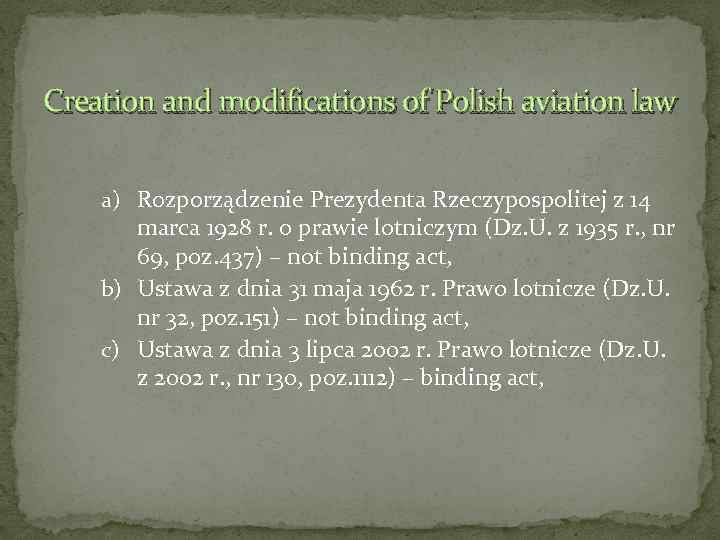 Creation and modifications of Polish aviation law a) Rozporządzenie Prezydenta Rzeczypospolitej z 14 marca 1928 r. o prawie lotniczym (Dz. U. z 1935 r. , nr 69, poz. 437) – not binding act, b) Ustawa z dnia 31 maja 1962 r. Prawo lotnicze (Dz. U. nr 32, poz. 151) – not binding act, c) Ustawa z dnia 3 lipca 2002 r. Prawo lotnicze (Dz. U. z 2002 r. , nr 130, poz. 1112) – binding act,
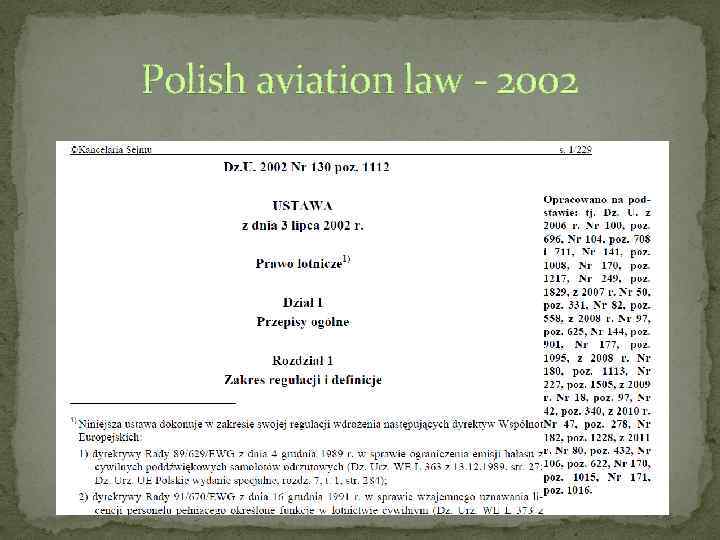 Polish aviation law - 2002
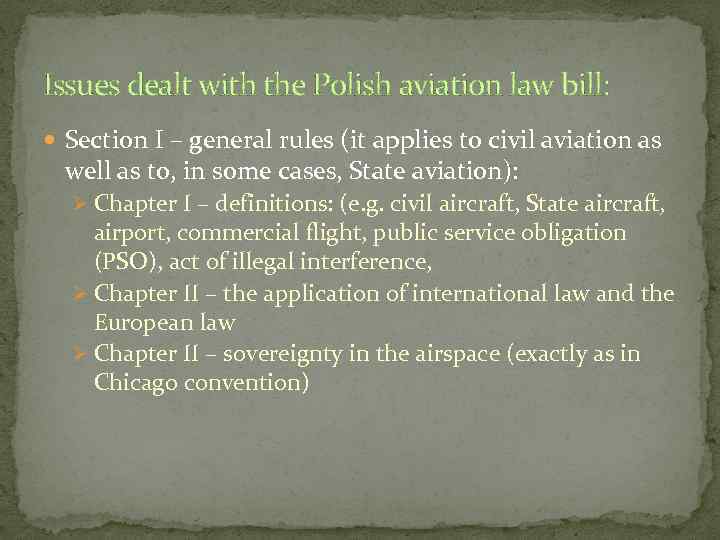 Issues dealt with the Polish aviation law bill: Section I – general rules (it applies to civil aviation as well as to, in some cases, State aviation): Ø Chapter I – definitions: (e. g. civil aircraft, State aircraft, airport, commercial flight, public service obligation (PSO), act of illegal interference, Ø Chapter II – the application of international law and the European law Ø Chapter II – sovereignty in the airspace (exactly as in Chicago convention)
 Section II – Civil Aviation Administration Ø Chapter I – the powers of the Minister of infrastructure (characteristics of different institutions in Polish system of aviation law: State Commission on Accidents Investigations in aviation, Civil Aviation Office, Council for the Security and Facilitation of Civil Aviation) Section III – aircrafts (registration, airworthiness – certification), Section IV – airports (there are two kinds of airports in Polish system: airports for public service purposes and for non-public purposes). The first mentioned airports are opened for all aircrafts, however, airports used for nonpublic purpose is considered to be closed, but only certain types of aircrafts can land as well as aircrafts performing noncommercial flights (e. g. State). operation of airports.
 Section V – aviation personnel (necessary qualifications and licenses, e. g. a pilot of hang gliders may be a person of 16 years), Section VI – air navigation (rules for the use of airspace and the organization of air traffic) – the role and organization of Polish Air Navigation Services Agency), Section VII - maintenance of aircrafts, Section VIII – aviation economic activity (concessions for air carriage operations, concessions economic activity in the field of management of the airport and ground handling) Section IX – aviation security – It is subject to separate provisions and international agreements.
 Section X – air carriage Section Xa – air passengers’ rights Section XI –civil liability (for damages caused by the movement of aircraft and for damages in connection with the air carriage – in accordance with Warsaw-Montreal system) Section XI a – financial penalties Section XII – criminal provisions Section XIII – final and transitional provisions
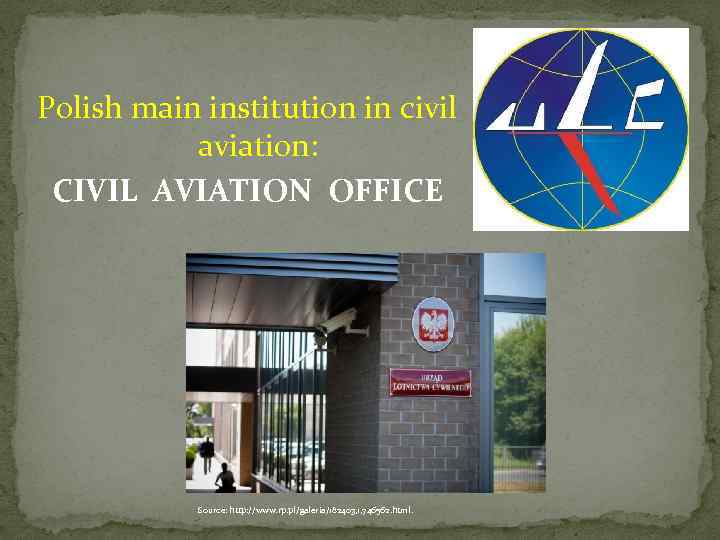 Polish main institution in civil aviation: CIVIL AVIATION OFFICE Source: http: //www. rp. pl/galeria/182403, 1, 746562. html.
 Main competences of CAO: The main tasks of the ULC: supervision on the market of air traffic for the implementation of the principles of free competition, transparency and non-discrimination, creating conditions for sustainable development of the aviation infrastructure corresponding to the reasonable needs of the market and economic efficiency, maintenance and improvement of the external relations conducive to the development of the Polish civil aviation in particular through cooperation and activities in international organizations (ICAO, IATA, ECAC, EUROCONTROL, EASA),
 to enhance the safety of air transport by: Introduction to the Polish legal system the international regulations and specifications and operational and supervision of their compliance, licensing of air personnel and technical and periodic inspections, certification and surveillance of organizations dealing with aviation activity, as well as on the organizations that manufacture and support aircraft and equipment, implementation and supervision of the National Civil Aviation Security Programme, National Quality Control Programme, and the National Training Programme in the field of civil aviation security,
 Inspection of institutions acting in aviation in order to comply with rules and procedures established as well as effective capacity to maintain real safety, cooperation with the institutions responsible for the security of the State (ABW, AW, Police, Border Guard). performing tasks on behalf of Minister of Defense.
 State Commission on Aviation Accident Investigation This is a central institution of Poland which is entitled to carry out investigations when accidents or incidents occur in civil aviation. The legal basis: article 17 of Polish „aviation law” act of 2002. The Commission performs tasks on behalf of the Minister competent for transportation, based on the following provisions: Aviation law act of 3 July 2002, Implementation acts; Annex No 13 to Chicago convention (aviation accidents investigation), Regulation of the Minister of transport (order No 12 the Minister of transport of 30 June 2006.
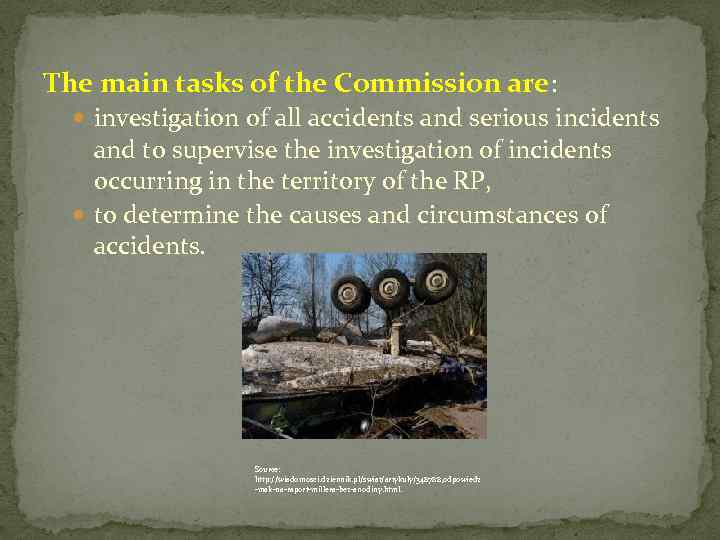 The main tasks of the Commission are: investigation of all accidents and serious incidents and to supervise the investigation of incidents occurring in the territory of the RP, to determine the causes and circumstances of accidents. Source: http: //wiadomosci. dziennik. pl/swiat/artykuly/348788, odpowiedz -mak-na-raport-millera-bez-anodiny. html.
 Polish Air Navigation Services Agency Each Member State must have the authorities responsible for the provision of air navigation services in aviation, or to use services offered by other suppliers. It is necessary to maintain the safety of air navigation. In Poland, this task is performed by Polish Air Navigation Services Agency. The legal basis: a) Act of 8 December 2006, b) Statute of PANSA (as Regulation of Ministry of Transportation from 28 March 2007.
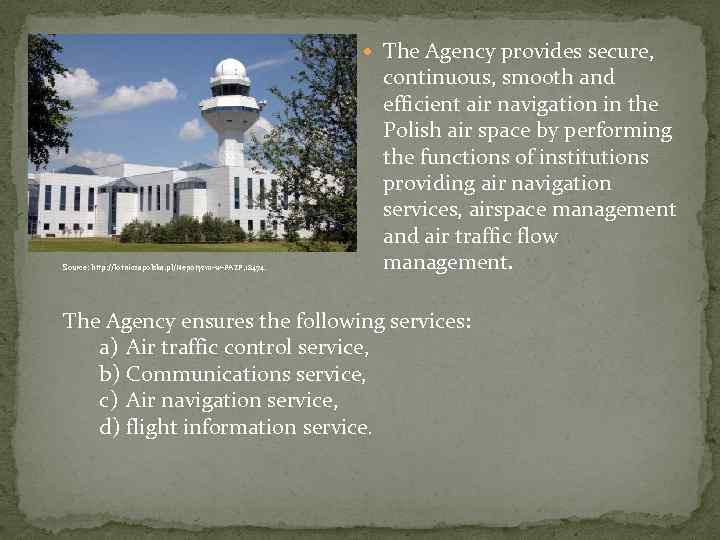 The Agency provides secure, Source: http: //lotniczapolska. pl/Nepotyzm-w-PAZP, 18474. continuous, smooth and efficient air navigation in the Polish air space by performing the functions of institutions providing air navigation services, airspace management and air traffic flow management. The Agency ensures the following services: a) Air traffic control service, b) Communications service, c) Air navigation service, d) flight information service.
 Thank You ! © Dr Grzegorz Zając