


 Скачать презентацию GRS LX 700 Language Acquisition and Linguistic Theory
b770b081cce1d83ed68801fa85c30bfa.ppt
- Количество слайдов: 46
 GRS LX 700 Language Acquisition and Linguistic Theory Week 9. Second Language Acquisition
 Scientific study of language • What constitutes one’s knowledge of language? • How is that knowledge acquired? • Looking at adult native languages, we’ve found that language is very complex (see LX 522, 523, for example) • Looking at kids, we’ve found that kids seem to learn this complicated system with surprisingly little help from the environment.
 L 1 acquisition • We posited a genetic predisposition for language, something which guides the kinds of languages kids learn (Universal Grammar): – Kids learn fast – Kids end up with systems that are more complicated than the input data justifies (they can judge ungrammatical sentences in the same way as other native speakers – Kids don’t fail to learn language despite differences in environment – Kids seem to go through similar stages.
 But what about L 2 acquisition? • Adults seem to have a harder time learning language than kids do learning their first language (there may be a “critical period” for language). • Adult second language learners rarely reach a nativespeaker-like level of competence. • Adult second language learners already know a language. • Adult second language learners are often given negative evidence (“you don’t say it that way”) when t classroom.
 L 2 A seems very different from L 1 A. • Is L 2 A like learning to play chess? Like learning calculus? Do we just learn the rules of the language and apply them (sometimes forgetting some of the rules, never quite learning all of them, etc. )? • It’s very tempting to think that’s true.
 Scientific study of language • What constitutes one’s knowledge of language? • How is that knowledge acquired? • We can still study these questions in L 2 A as well and try to determine the answers, whether they are related to L 1 A or not. And perhaps surprisingly, they might be.
 L 2 competence • Learners of a second language have some kind of linguistic knowledge. They have retained their L 1 knowledge, and they have knowledge of a sort which approximates (perhaps poorly) the knowledge held by a native speaker of the learner’s L 2. • This knowledge is often referred to as an interlanguage grammar—not L 1, not L 2, but something different (…and to what extent this knowledge might be related to or influenced by L 1 or L 2 is yet to be determined).
 A real-world example, Japanese case-marker omission • Adult knowledge is complicated, relies on the Empty Category Principle, which says that an empty category (including a dropped Case marker) must be properly governed. • The long and the short of this in Japanese is that you can drop a Case marker in object position but you cannot drop a Case marker in subject position.
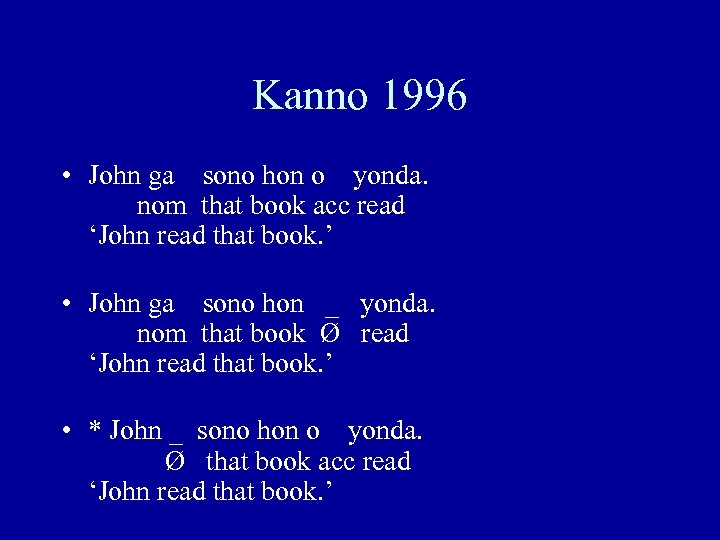 Kanno 1996 • John ga sono hon o yonda. nom that book acc read ‘John read that book. ’ • John ga sono hon _ yonda. nom that book Ø read ‘John read that book. ’ • * John _ sono hon o yonda. Ø that book acc read ‘John read that book. ’
 Kanno 1996 • English speakers learning Japanese know the ECP, because they know: – Who did you say Ø t left? – *Who did you say that t left? • But this is a very different context of use from the use in Case marker drop. The question is: Do English speakers respect the ECP in their interlanguage grammar (toward Japanese)? • A broader way to ask the question: Is the interlanguage grammar constrained by UG?
 Kanno 1996 • To discover the answer Kanno tested 26 college students in Japanese II on case particle drop. • Kanno looked at what the students would have been exposed to by the textbook up to the point where they took the test, to see if they were taught when not to drop the case markers.
 What the Japanese II students saw… • 41 cases of object case-marker drop, like: – Enpitsu Ø kudasai ? pencil give ‘Can you give me a pencil? ’ • 8 cases of subject case-marker drop, in the exceptional case when it is allowed (with a final emphatic particle—these don’t violate the ECP): – John Ø sono hon o yonda yo. John that book acc read part ‘John (indeed) read the book. ’ (I think)
 What the Japanese II students saw… • Certain verbs have nominative case on their objects, and case can be dropped on those objects too… – John ga kankokugo (ga) dekimasu. John nom Korean nom can-do ‘John can speak Korean. ’ • 69 of 110 such verbs in the book had the object case marker dropped.
 What the Japanese II students saw… • Japanese allows arguments to be omitted (somewhat like Italian pro drop), so there were many cases with just one argument (the object) with no case marker: – Kami Ø irimasu ka? paper need Q ‘Do you need paper? / Is paper necessary? ’
 What the Japanese II students saw… • Worst of all, the topic marker can be dropped, which looks a lot like a subject marker being dropped. – Tanaka-san (wa) itsu kaimasita ka? top when bought Q ‘When did Tanaka buy it? ’ ‘As for Tanaka, when did he buy it? ’
![What the Japanese II students saw… • “ga [nom] might be deleted, but with](https://present5.com/presentation/b770b081cce1d83ed68801fa85c30bfa/image-16.jpg "What the Japanese II students saw… • “ga [nom] might be deleted, but with") What the Japanese II students saw… • “ga [nom] might be deleted, but with a reduction of the emphasis and focus conveyed by its inclusion. ” (No hint that sometimes—even usually —it is not allowed) • “If o [acc] is deleted, [the object] would simply lose a bit of its emphasis and focus. On the other hand, the addition of o would give added emphasis and focus. ”
What the Japanese II students saw… • “ga [nom] might be deleted, but with a reduction of the emphasis and focus conveyed by its inclusion. ” (No hint that sometimes—even usually —it is not allowed) • “If o [acc] is deleted, [the object] would simply lose a bit of its emphasis and focus. On the other hand, the addition of o would give added emphasis and focus. ”
 The poor Japanese II students… • There’s pretty much no way they could have reached the right generalization based on what they were provided. – Nom can be dropped from object position – Top can be dropped from subject position – Nom subject can be dropped with a particle – Explicit instruction was only about emphasis.
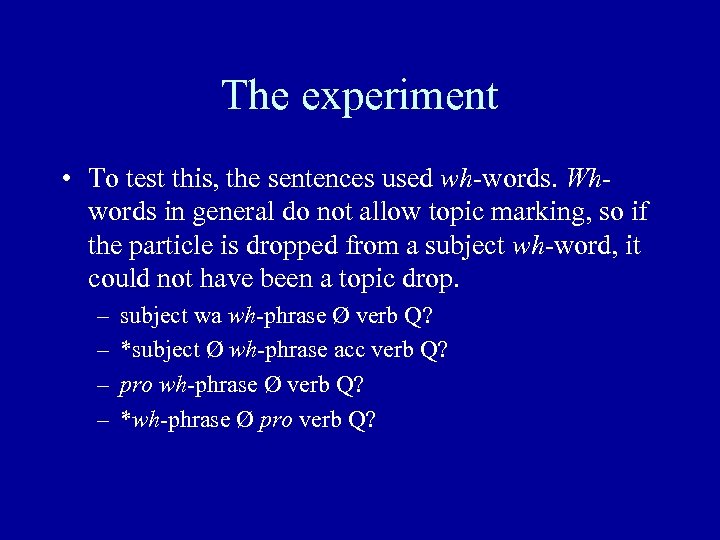 The experiment • To test this, the sentences used wh-words. Whwords in general do not allow topic marking, so if the particle is dropped from a subject wh-word, it could not have been a topic drop. – – subject wa wh-phrase Ø verb Q? *subject Ø wh-phrase acc verb Q? pro wh-phrase Ø verb Q? *wh-phrase Ø pro verb Q?
 (a missing control) • There a couple of things that this experiment lacks (did you notice? )… • Naturalness of a dropped case marker is tested, but never the naturalness of an overt case or topic marker on a wh-phrase. • Wh-phrases are used because they do not permit topic marking—but do the students know this?
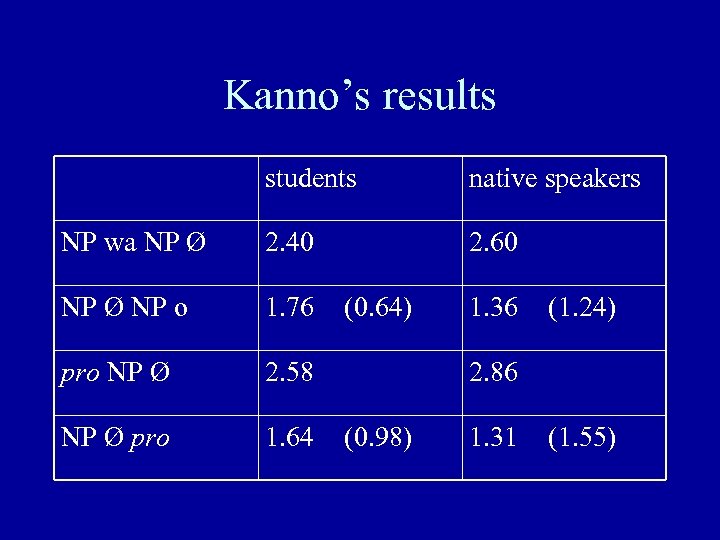 Kanno’s results students native speakers NP wa NP Ø 2. 40 2. 60 NP Ø NP o 1. 76 pro NP Ø 2. 58 NP Ø pro 1. 64 (0. 64) 1. 36 (1. 24) 2. 86 (0. 98) 1. 31 (1. 55)
 UG in L 2 A • The conclusion is that L 2 learners of Japanese have nevertheless (statistically significantly) gotten the rule about dropping subject case markers, despite the lack of evidence from the textbook, the instructor, or even English. • It appears that UG is still constraining language in some way even in adult second language acquisition.
 Miscellaneous Chomsky quote – “The linkage of concept and sound can be acquired on minimal evidence, so variation [among languages] here is not surprising. However, the possible sounds are narrowly constrained, and the concepts may be virtually fixed. It is hard to imagine otherwise, given the rate of lexical acquisition, which is about a word an our from ages two to eight, with lexical items typically acquired on a single exposure, in highly ambiguous circumstances, but understood in delicate and extraordinary complexity that goes vastly beyond what is recorded in the most comprehensive dictionary, which, like the most comprehensive traditional grammar, merely gives hints that suffice for people who basically know the answers, largely innately. ” Chomsky (2000, New Horizons in the Study of Language and Mind), p. 120.
 Influence of UG in some form is probably inevitable… • Like in L 1 A, the input is almost certainly degenerate, and the negative evidence there might be isn’t enough to make the subtle complexities of language learnable, and for negative evidence (in the form of correction) to be of any use, L 2 learners have to make errors, yet for these subtle complexities, the learners don’t seem to make the crucial errors that would be required to learn them. • Kanno’s experiment (among others) shows that L 2 learners seem to “go beyond the evidence. ”
 How is UG “used” in L 2 A? • What is UG really? • Probably the simplest view of it is that UG constrains the kinds of languages we can learn. For the moment, assume we’re talking about L 1 A. • UG says: You can’t learn a language that lacks the ECP. You can’t learn a language that doesn’t respect constraints on movement out of an island…
 How is UG “used” in L 2 A? • UG shaped your L 1, this is essentially beyond dispute… but when you learn L 2, you still know L 1. • So, perhaps: UG constrains how you learn L 2 (directly, like it constrained your L 1) • Or, perhaps: Your L 1 constrains how you learn L 2 (indirectly, UG constrains L 1, L 1 constrains L 2) • Or, perhaps: Nothing language-related constrains how you learn L 2—it’s like learning chess
 How is UG “used” in L 2 A? • The three views have been named, although they’re somewhat iffy as terms. • Full Access—UG constrains L 2 A. • Partial Access—L 1 constrains L 2 A. • No Access—UG’s not involved in L 2 A.
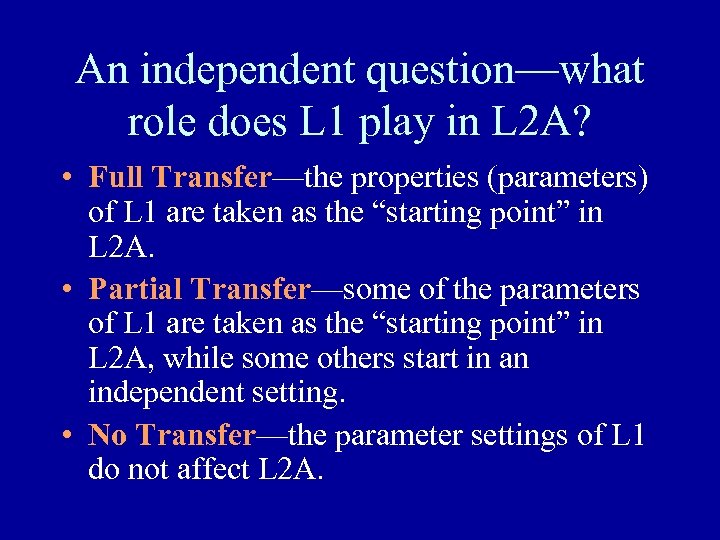 An independent question—what role does L 1 play in L 2 A? • Full Transfer—the properties (parameters) of L 1 are taken as the “starting point” in L 2 A. • Partial Transfer—some of the parameters of L 1 are taken as the “starting point” in L 2 A, while some others start in an independent setting. • No Transfer—the parameter settings of L 1 do not affect L 2 A.
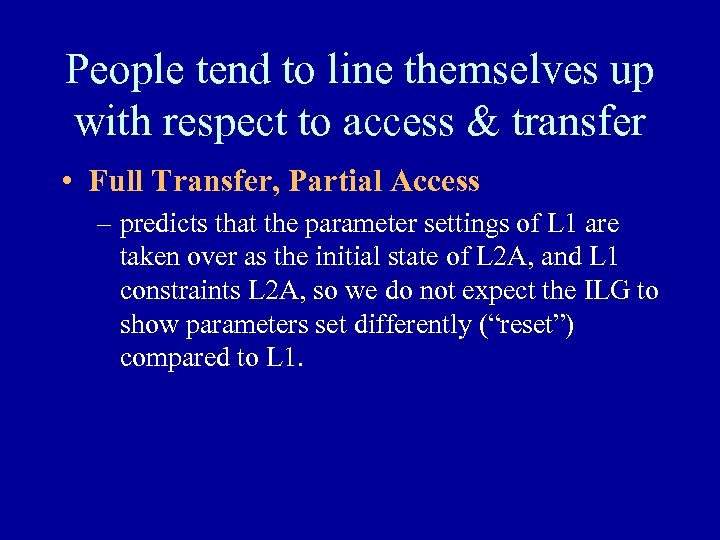 People tend to line themselves up with respect to access & transfer • Full Transfer, Partial Access – predicts that the parameter settings of L 1 are taken over as the initial state of L 2 A, and L 1 constraints L 2 A, so we do not expect the ILG to show parameters set differently (“reset”) compared to L 1.
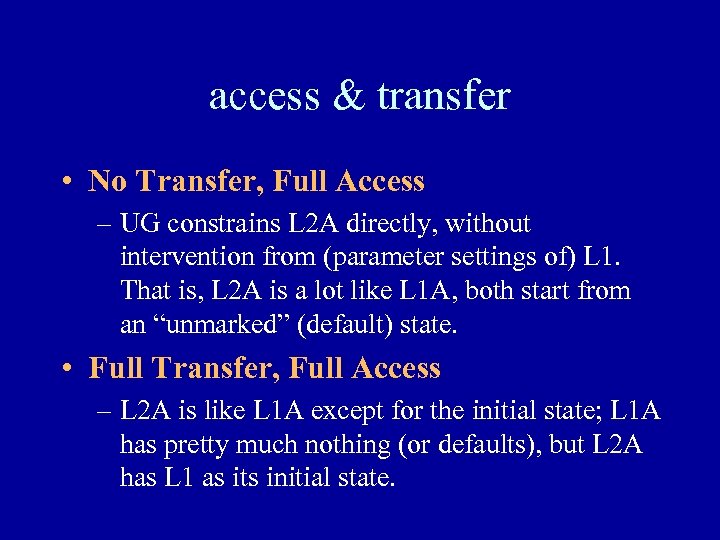 access & transfer • No Transfer, Full Access – UG constrains L 2 A directly, without intervention from (parameter settings of) L 1. That is, L 2 A is a lot like L 1 A, both start from an “unmarked” (default) state. • Full Transfer, Full Access – L 2 A is like L 1 A except for the initial state; L 1 A has pretty much nothing (or defaults), but L 2 A has L 1 as its initial state.
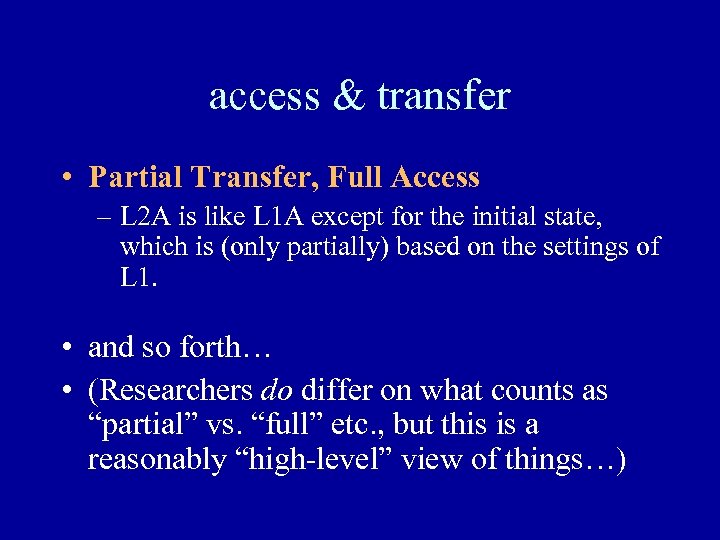 access & transfer • Partial Transfer, Full Access – L 2 A is like L 1 A except for the initial state, which is (only partially) based on the settings of L 1. • and so forth… • (Researchers do differ on what counts as “partial” vs. “full” etc. , but this is a reasonably “high-level” view of things…)
 Something’s right, we assume • How do we go about finding out what is right? • What does the situation matter? – Some people learn their L 2 in a “natural (immersion) setting. – Some people learn their L 2 in a classroom, with instructions.
 Getting at the “IL grammar” • What do the L 2 learners know? • *Productions: We don’t have a great deal of success learning about the structure of linguistic knowledge in the native speaker domain by looking just at productions. Things aren’t different for L 2 learners. – No information on what is ungrammatical—at best, information on what is dispreferred/avoided. – Performance errors happen, but that doesn’t indicate a lack of competence.
 Grammaticality judgments • One way of testing people’s (whole) competence is to ask them to rate sentences in their second language. • Who did you say that bought John dinner? 1 -sounds bad 2 -a little weird 3 -natural • I wonder what will John wear tomorrow. 1 -sounds bad 2 -a little weird 3 -natural
 GJ tasks aren’t perfect, though… • As in any experiment, you may have biases… • Some people are hesitant to take an extreme position, may never rate a sentence 1 or 3. • Some people may rate the sentences based on how much sense it makes, rather than on the syntactic structure. And it’s hard to correct for that, because if you ask someone what’s wrong with – What did you laugh after John bought for Sue? (or how to correct it), even native speakers won’t be able to say.
 GJ tasks • But we have the same trouble with kids too… We can try to employ the same kinds of tricks with adults… – acting out a sentence – identifying which picture best depicts the subject matter of the sentence – judging whether a sentence is true or false of a scene. – answering an ambiguous question to see wh-word scope. – …
 Locating the source of the errors • Suppose that an adult L 2 learner rates – What did you laugh after John bought for Sue? as natural. Does that mean they don’t know Subjacency? • Well, not necessarily. They may also now understand how to make complex clauses, adverbial clauses, etc. • Like with kids and quantifiers Principle B, one can only really say that people know or don’t know a principle of UG once they have the appropriate structures to apply them to.
 “How involved is UG in L 2 A? ” • Very (UG constrains IL) vs. not (L 1 constrains IL) • To figure out which is right, we need to look at UG constraints or parameters which are not used in the learner’s L 1. If there is something that holds in all languages, say, the q-criterion, showing that L 2 learners respect the q-criterion doesn’t tell us whether that is because UG required it or because their L 1 does.
 Two things to look at • Parameter settings which vary between L 1 and L 2… – English: Bounding nodes for Subjacency are DP and IP. – Italian/French: Bounding nodes for Subjacency are DP and CP. • Universal principles which are inapplicable in L 1 but apply in L 2… – The ECP as used to control case marker drop in Japanese
 “Universal principles inapplicable in L 1? ” • As our theories of syntax develop, finding such things becomes harder and harder, since the goal of theoretical syntax is in general to say “All languages are really the same except for some very surface-y phenomena. ”
 wh-movement • English moves its wh-words, Japanese doesn’t? Subjacency should not be relevant for Japanese? • However, since then, the proposals have changed —all languages move their wh-words to Spec. CP, just some do it after SS. • Evidence has appeared which shows that under the right conditions, Japanese does respect Subjacency. • Thus: Looking at whether Japanese speakers learning English respect Subjacency or not still hasn’t necessarily gotten away from L 1.
 Kanno again • Even Kanno’s experiment, neat as it is, doesn’t really escape L 1 under this kind of view—if we were right about how the ECP is formulated. • The ECP controls that-trace phenomena in English, but it is actually a constraint against ungoverned empty categories. • If English speakers know the ECP, they know this. • If the ECP controls case drop in Japanese because these are empty categories, then if English speakers know the ECP, then they’ll know not to drop subject case markers.
 In general • The L 2 A literature tends to take a fairly old, conservative view of UG, in a way. It tends to assume that UG provides options from which languages choose, and that something that a language doesn’t choose might become unavailable as a choice later. • That is, the underlying assumption seems to be that English speakers don’t know the ECP, really. What they know is to behave according to the way the ECP would require for embedded subject questions.
 Parameters • The bottom line is: it’s going to be hard to make a convincing case that you’ve got a principle of UG which is not known (utilized) by an L 1 speaker. Perhaps, if you are lucky, you might find something plausible now, but advances in syntactic theory will do everything they can to undermine your position. • However, languages do differ in the values of the parameters (e. g. , Subjacency).
 Parameters • We can also look at aspects of parameter setting in L 2 A. • Part transfer (what settings get adopted as part of the initial state of the second language learner’s interlanguage grammar? ), part accessibility/involvement of UG (can second language learners “reset” these parameters? If so, the lists of options provided by UG are still available—that is, UG is available/involved).

 For next time: • Read White, ch. 4, and Vainikka and Young -Scholten (1996 a, 1996 b) • Happily, no summary due. • Perhaps less happily, the final project proposal is due.