


 Скачать презентацию GRS LX 700 Language Acquisition and Linguistic Theory
82a55c4d693f999aa112fd1678df1ce2.ppt
- Количество слайдов: 83
 GRS LX 700 Language Acquisition and Linguistic Theory Week 12. Acquirers and questions
 Question formation n Perhaps one of the most “syntacticky” things in language is the formation of questions. n n Often involves pretty dramatic word order changes. Word order changes vary from language to language. Subtle restrictions on what is and isn’t a possible question. So, it’s a interesting place to look to assess the state of children’s knowledge of language
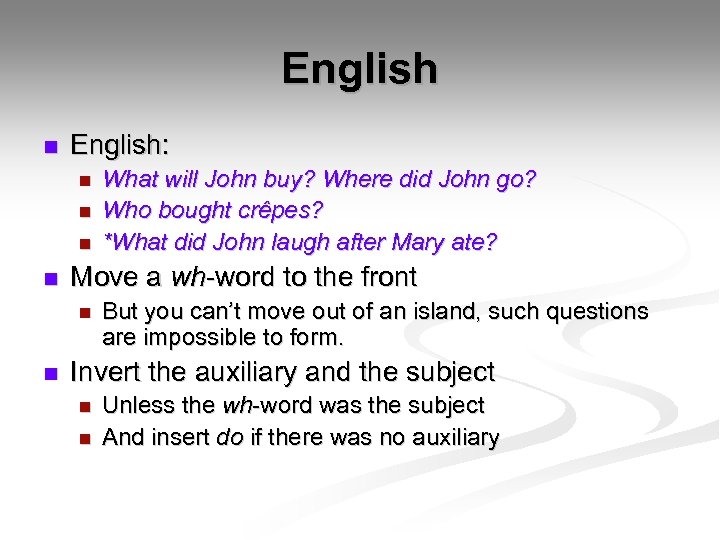 English n English: n n Move a wh-word to the front n n What will John buy? Where did John go? Who bought crêpes? *What did John laugh after Mary ate? But you can’t move out of an island, such questions are impossible to form. Invert the auxiliary and the subject n n Unless the wh-word was the subject And insert do if there was no auxiliary
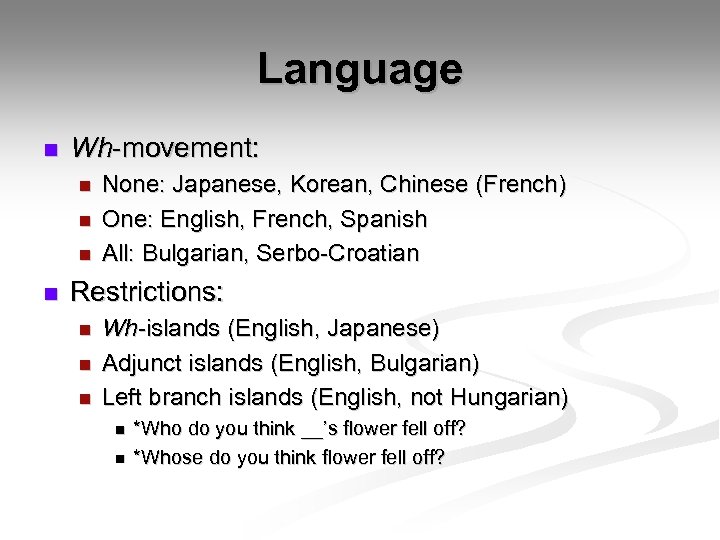 Language n Wh-movement: n n None: Japanese, Korean, Chinese (French) One: English, French, Spanish All: Bulgarian, Serbo-Croatian Restrictions: n n n Wh-islands (English, Japanese) Adjunct islands (English, Bulgarian) Left branch islands (English, not Hungarian) n n *Who do you think __’s flower fell off? *Whose do you think flower fell off?
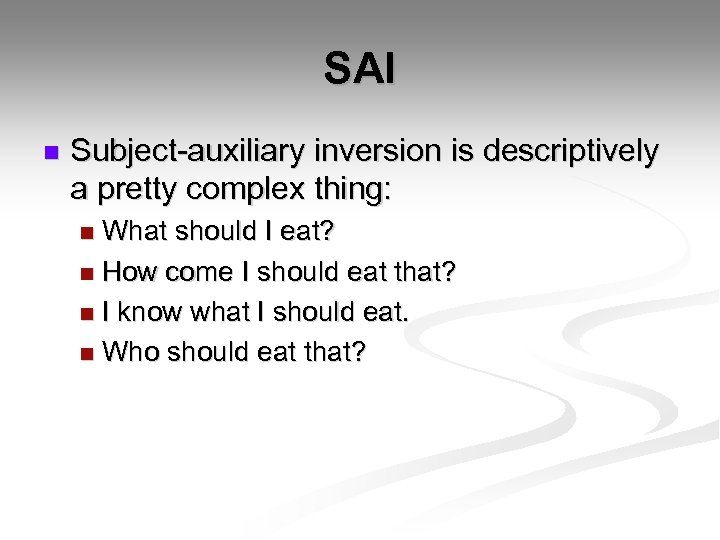 SAI n Subject-auxiliary inversion is descriptively a pretty complex thing: What should I eat? n How come I should eat that? n I know what I should eat. n Who should eat that? n
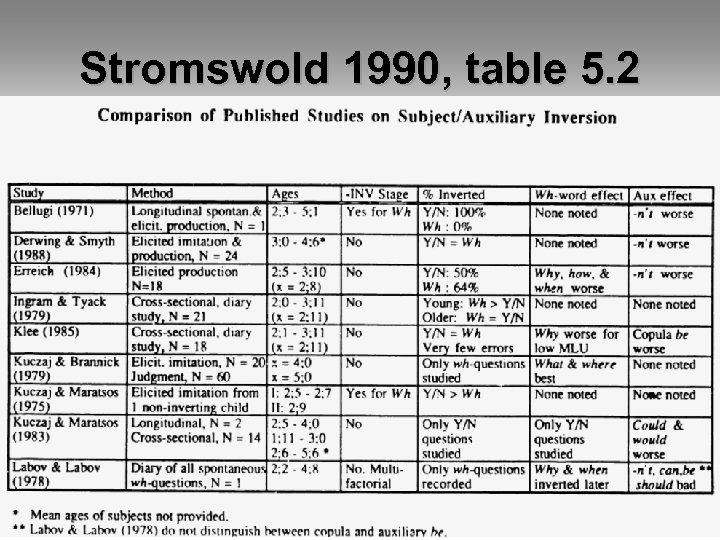 Stromswold 1990, table 5. 2
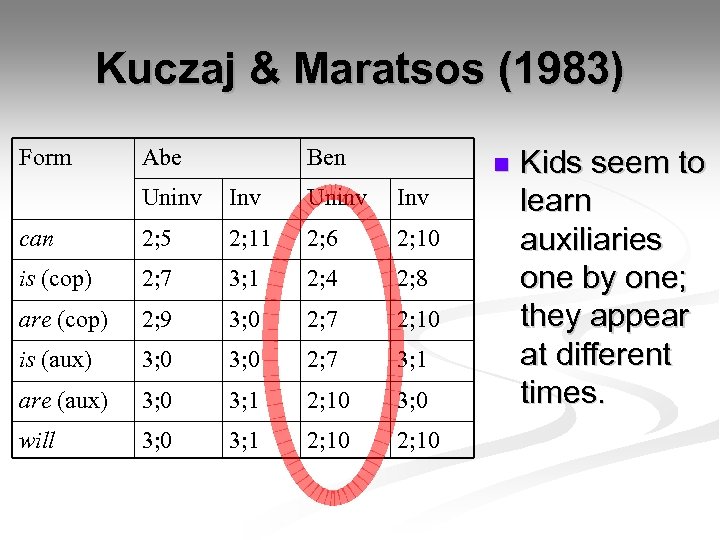 Kuczaj & Maratsos (1983) Form Abe Ben n Uninv Inv can 2; 5 2; 11 2; 6 2; 10 is (cop) 2; 7 3; 1 2; 4 2; 8 are (cop) 2; 9 3; 0 2; 7 2; 10 is (aux) 3; 0 2; 7 3; 1 are (aux) 3; 0 3; 1 2; 10 3; 0 will 3; 0 3; 1 2; 10 Kids seem to learn auxiliaries one by one; they appear at different times.
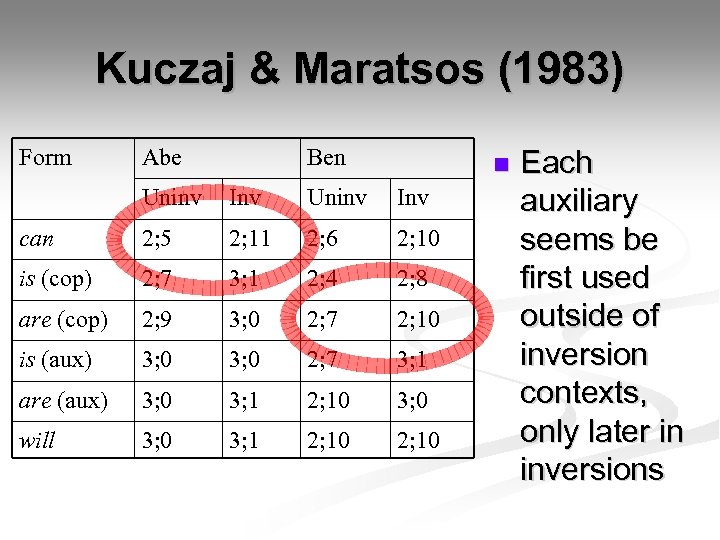 Kuczaj & Maratsos (1983) Form Abe Ben n Uninv Inv can 2; 5 2; 11 2; 6 2; 10 is (cop) 2; 7 3; 1 2; 4 2; 8 are (cop) 2; 9 3; 0 2; 7 2; 10 is (aux) 3; 0 2; 7 3; 1 are (aux) 3; 0 3; 1 2; 10 3; 0 will 3; 0 3; 1 2; 10 Each auxiliary seems be first used outside of inversion contexts, only later in inversions
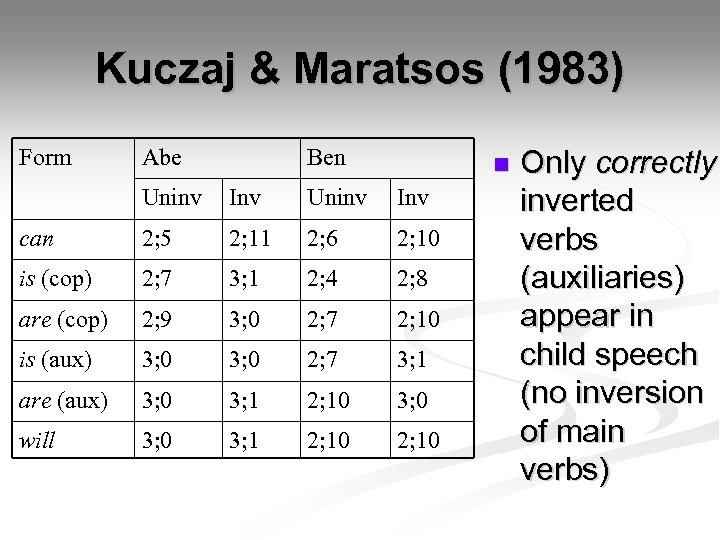 Kuczaj & Maratsos (1983) Form Abe Ben n Uninv Inv can 2; 5 2; 11 2; 6 2; 10 is (cop) 2; 7 3; 1 2; 4 2; 8 are (cop) 2; 9 3; 0 2; 7 2; 10 is (aux) 3; 0 2; 7 3; 1 are (aux) 3; 0 3; 1 2; 10 3; 0 will 3; 0 3; 1 2; 10 Only correctly inverted verbs (auxiliaries) appear in child speech (no inversion of main verbs)
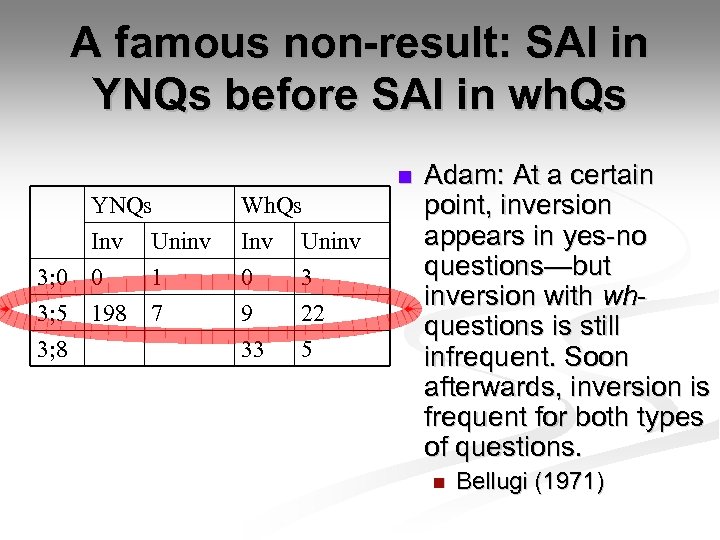 A famous non-result: SAI in YNQs before SAI in wh. Qs n YNQs Inv Uninv 3; 0 0 1 3; 5 198 7 Wh. Qs Inv Uninv 0 3 9 22 3; 8 33 5 Adam: At a certain point, inversion appears in yes-no questions—but inversion with whquestions is still infrequent. Soon afterwards, inversion is frequent for both types of questions. n Bellugi (1971)
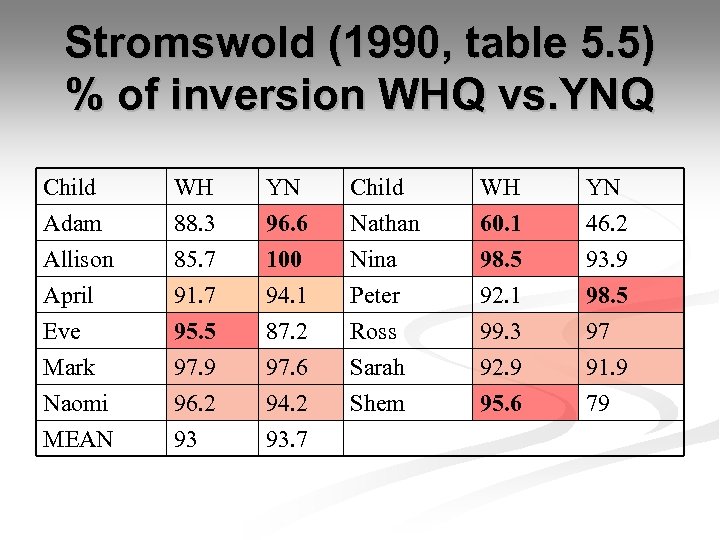 Stromswold (1990, table 5. 5) % of inversion WHQ vs. YNQ Child Adam Allison April WH 88. 3 85. 7 91. 7 YN 96. 6 100 94. 1 Child Nathan Nina Peter WH 60. 1 98. 5 92. 1 YN 46. 2 93. 9 98. 5 Eve Mark Naomi MEAN 95. 5 97. 9 96. 2 93 87. 2 97. 6 94. 2 93. 7 Ross Sarah Shem 99. 3 92. 9 95. 6 97 91. 9 79
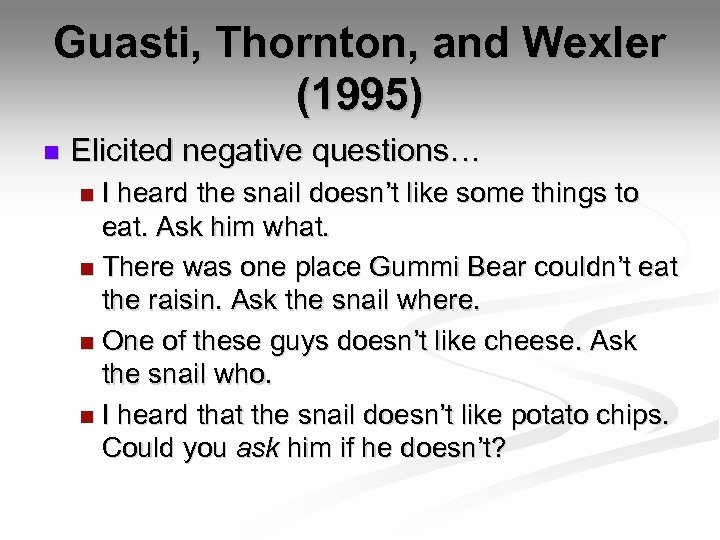 Guasti, Thornton, and Wexler (1995) n Elicited negative questions… I heard the snail doesn’t like some things to eat. Ask him what. n There was one place Gummi Bear couldn’t eat the raisin. Ask the snail where. n One of these guys doesn’t like cheese. Ask the snail who. n I heard that the snail doesn’t like potato chips. Could you ask him if he doesn’t? n
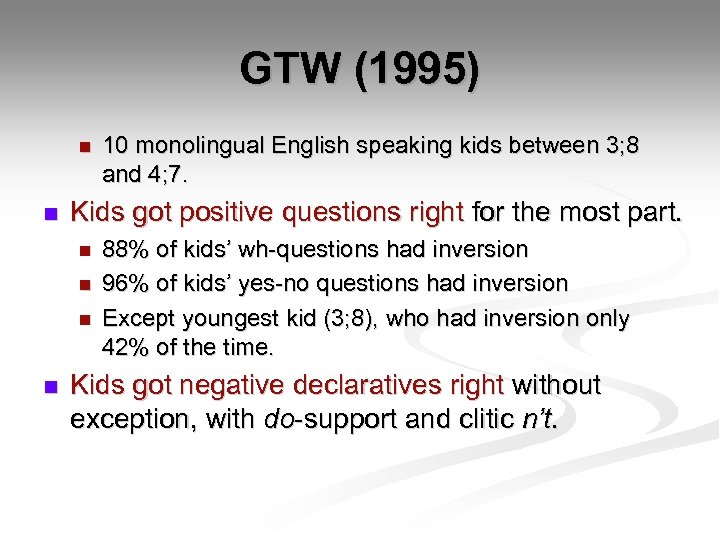 GTW (1995) n n Kids got positive questions right for the most part. n n 10 monolingual English speaking kids between 3; 8 and 4; 7. 88% of kids’ wh-questions had inversion 96% of kids’ yes-no questions had inversion Except youngest kid (3; 8), who had inversion only 42% of the time. Kids got negative declaratives right without exception, with do-support and clitic n’t.
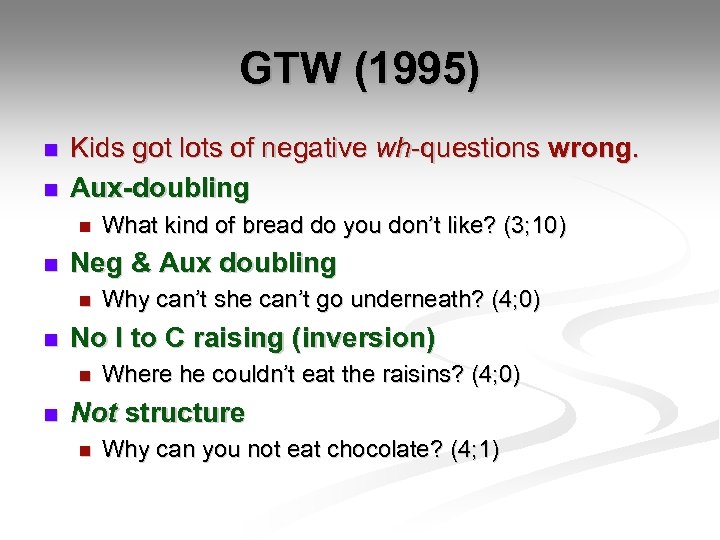 GTW (1995) n n Kids got lots of negative wh-questions wrong. Aux-doubling n n Neg & Aux doubling n n Why can’t she can’t go underneath? (4; 0) No I to C raising (inversion) n n What kind of bread do you don’t like? (3; 10) Where he couldn’t eat the raisins? (4; 0) Not structure n Why can you not eat chocolate? (4; 1)
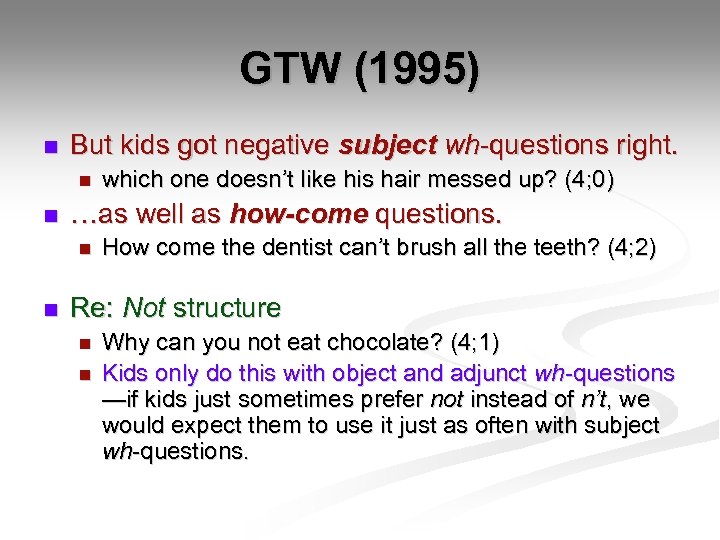 GTW (1995) n But kids got negative subject wh-questions right. n n …as well as how-come questions. n n which one doesn’t like his hair messed up? (4; 0) How come the dentist can’t brush all the teeth? (4; 2) Re: Not structure n n Why can you not eat chocolate? (4; 1) Kids only do this with object and adjunct wh-questions —if kids just sometimes prefer not instead of n’t, we would expect them to use it just as often with subject wh-questions.
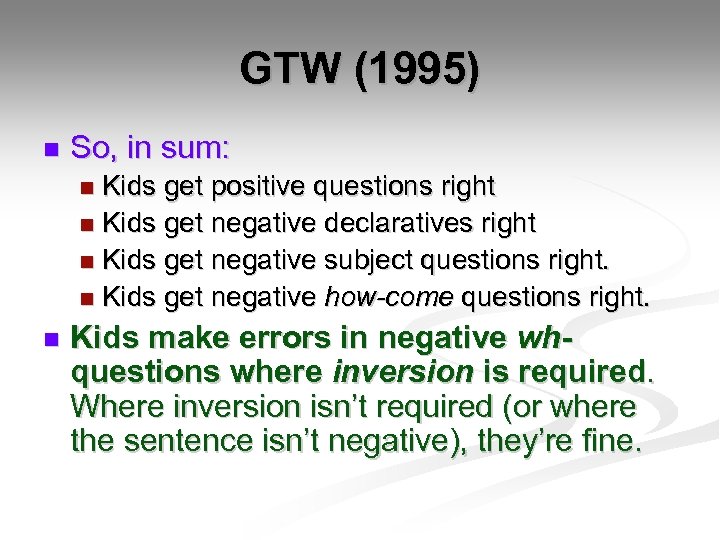 GTW (1995) n So, in sum: Kids get positive questions right n Kids get negative declaratives right n Kids get negative subject questions right. n Kids get negative how-come questions right. n n Kids make errors in negative whquestions where inversion is required. Where inversion isn’t required (or where the sentence isn’t negative), they’re fine.
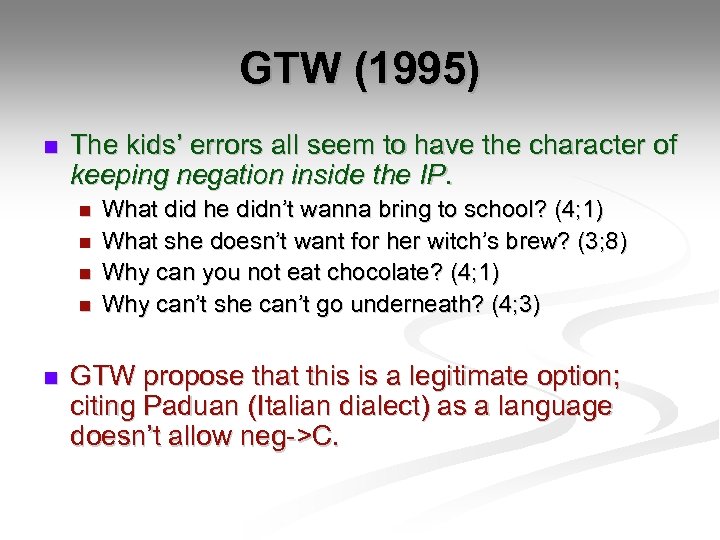 GTW (1995) n The kids’ errors all seem to have the character of keeping negation inside the IP. n n n What did he didn’t wanna bring to school? (4; 1) What she doesn’t want for her witch’s brew? (3; 8) Why can you not eat chocolate? (4; 1) Why can’t she can’t go underneath? (4; 3) GTW propose that this is a legitimate option; citing Paduan (Italian dialect) as a language doesn’t allow neg->C.
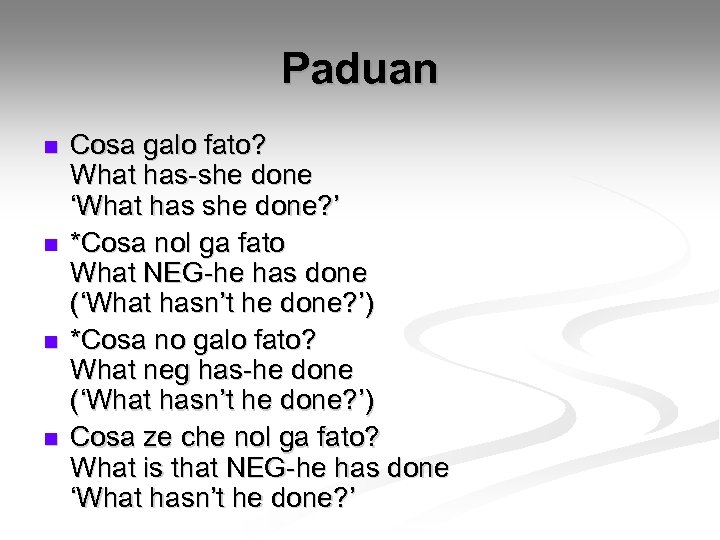 Paduan n n Cosa galo fato? What has-she done ‘What has she done? ’ *Cosa nol ga fato What NEG-he has done (‘What hasn’t he done? ’) *Cosa no galo fato? What neg has-he done (‘What hasn’t he done? ’) Cosa ze che nol ga fato? What is that NEG-he has done ‘What hasn’t he done? ’
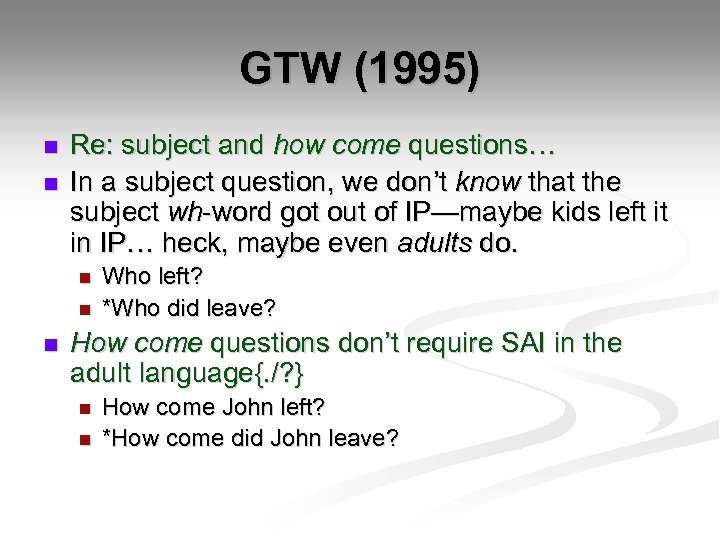 GTW (1995) n n Re: subject and how come questions… In a subject question, we don’t know that the subject wh-word got out of IP—maybe kids left it in IP… heck, maybe even adults do. n n n Who left? *Who did leave? How come questions don’t require SAI in the adult language{. /? } n n How come John left? *How come did John leave?
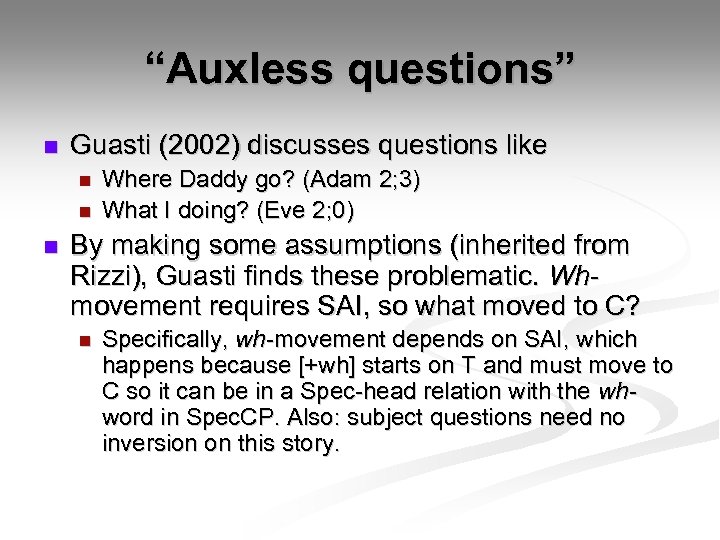 “Auxless questions” n Guasti (2002) discusses questions like n n n Where Daddy go? (Adam 2; 3) What I doing? (Eve 2; 0) By making some assumptions (inherited from Rizzi), Guasti finds these problematic. Whmovement requires SAI, so what moved to C? n Specifically, wh-movement depends on SAI, which happens because [+wh] starts on T and must move to C so it can be in a Spec-head relation with the whword in Spec. CP. Also: subject questions need no inversion on this story.
 Auxless questions n Auxless questions are relatively common among wh-questions in the 2 -4 age range. n n Guasti/Rizzi’s suggestion: An auxiliary at the head of the root can be null (similar to the null subject story). For adults, the head of the root is Force. P, but for kids it might be lower (Foc. P, where wh-words go). Kids who might otherwise say What I doing? will nevertheless not say Who laughing? . Subject wh -questions seem immune from “auxiliary drop. ” n n The Guasti/Rizzi explanation is pretty contrived, actually. The aux need not proceed as high as Foc. P for subject questions, so it ends up not being highest. Not really any clear alternative, though…
 Early, early wh-questions n n n There may be an early “formulaic” stage where kids ask questions by just asking “Wh(’s) NP? ”. O’Grady (1997): “Because of their formulaic character, it seems reasonable to treat these utterances as instantiations of a simple template rather than the product of whatever mechanism forms wh-questions in the adult grammar. ” But why? We already have lots of reason to think young kids know a lot about adult grammar by then… What is simpler about a “simple template”?
 Wh-subjects and wh-objects n Is there a difference in the timing of emergence between subject wh-questions and object wh-questions? In English, there is an apparent difference in complexity (“distance” of movement, SAI).
 Early, early wh-questions Seidl and Hollich (2003) looked at headturn preferences in really young kids. n Minimizes demands of task n Use looking preferences to “answer” whquestions. n What hit the apple? n What did the apple hit? n Where is the apple? n
 Seidl et al. Kids saw a little simplistic computergenerated movie where, e. g. , a book hit some keys. n Then there were two screens presented side by side, one with a book displayed, one with keys displayed. n What hit the keys? (book) n What did the book hit? (keys) n Where is the book? (book) n
 Seidl et al. n n n Graph shows differences (target minus non-target). 20 -month-olds seemed quite capable of comprehending all three kinds. 15 -month-olds couldn’t do objects; 13 -month-olds couldn’t do any.
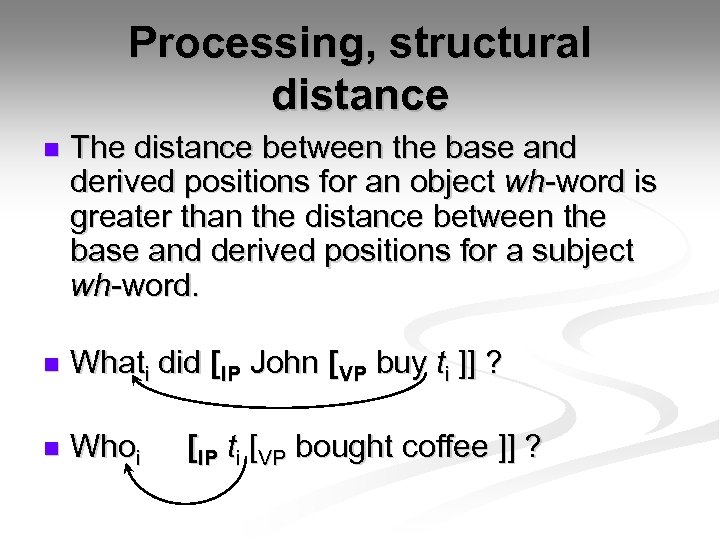 Processing, structural distance n The distance between the base and derived positions for an object wh-word is greater than the distance between the base and derived positions for a subject wh-word. n Whati did [IP John [VP buy ti ]] ? n Whoi [IP ti [VP bought coffee ]] ?
 Processing, structural distance n Re: preference for subject wh-questions; perhaps kids are sensitive to the number of phrases a moving wh-phrase has to escape. This also makes other predictions: Whati will [IP Sue [VP read ti ]]? n Whati will [IP Sue [VP talk [PP about ti ]]]? n Whati will [IP Sue [VP read [NP a book [PP about ti ]]]]? n
 Hildebrand (1987) n Tested (fairly old) kids on a paradigm of wh-questions of varying “depth” to see if more embedded wh-words are harder. n In a repetition task (4 -10 year olds), it was almost uniformly true that the more deeply embedded the wh-word was, the more errors the kids made trying to repeat it.
 But wait… n So kids make more errors extracting from more deeply embedded structures. Is this a fact about the acquisition of wh-movement? Or is it just a fact about language processing in general? n What do adults do? n My guess: Even for adults, the more complex structures are (marginally) harder to process. Certainly true for subject vs. object relative clauses (the man who _ left vs. the man who I met _). n Cf. NPAH.
 Does child wh-movement obey the adult rules for wh-movement? n When the kids ask wh-questions, what structures are they using? Are they like the adult structures? If not, how are they different? Are they performing movement? Are there traces? Do the movements obey constraints (e. g. , wh-island, ECP, …)?
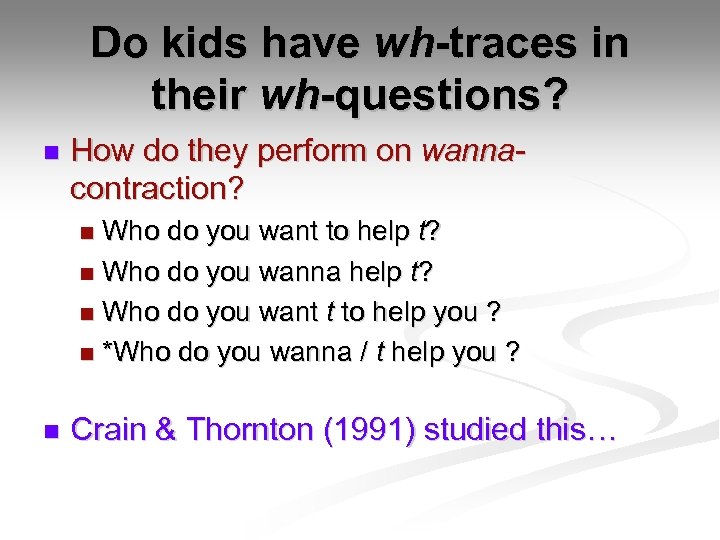 Do kids have wh-traces in their wh-questions? n How do they perform on wannacontraction? Who do you want to help t? n Who do you wanna help t? n Who do you want t to help you ? n *Who do you wanna / t help you ? n n Crain & Thornton (1991) studied this…
 Crain & Thornton (1991) n There are three guys in this story: Cookie Monster, a dog, and this baby. One of them gets to take a walk, one gets to take a nap, and one gets to eat a cookie. The rat gets to choose who does each thing. So one gets to take a walk, right? Ask Ratty who he wants. n Kid: Who do you want to take a walk?
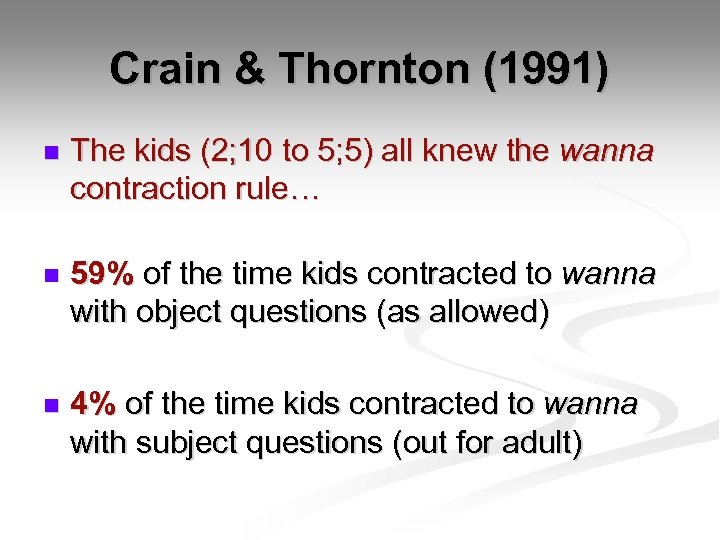 Crain & Thornton (1991) n The kids (2; 10 to 5; 5) all knew the wanna contraction rule… n 59% of the time kids contracted to wanna with object questions (as allowed) n 4% of the time kids contracted to wanna with subject questions (out for adult)
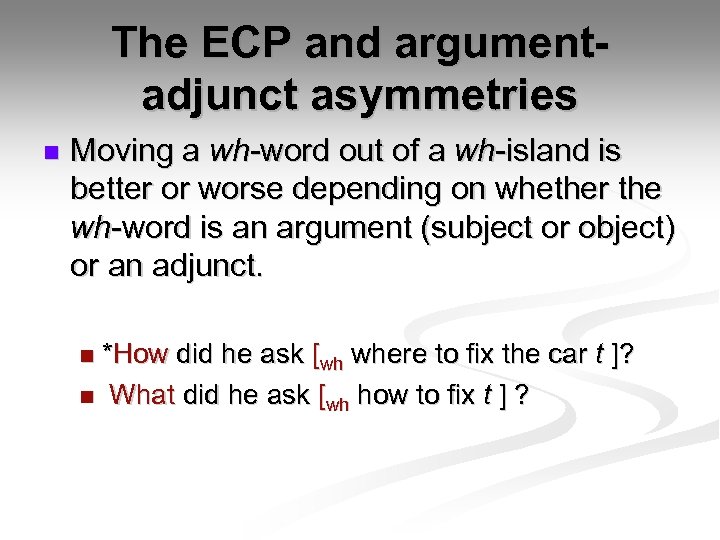 The ECP and argumentadjunct asymmetries n Moving a wh-word out of a wh-island is better or worse depending on whether the wh-word is an argument (subject or object) or an adjunct. *How did he ask [wh where to fix the car t ]? n What did he ask [wh how to fix t ] ? n
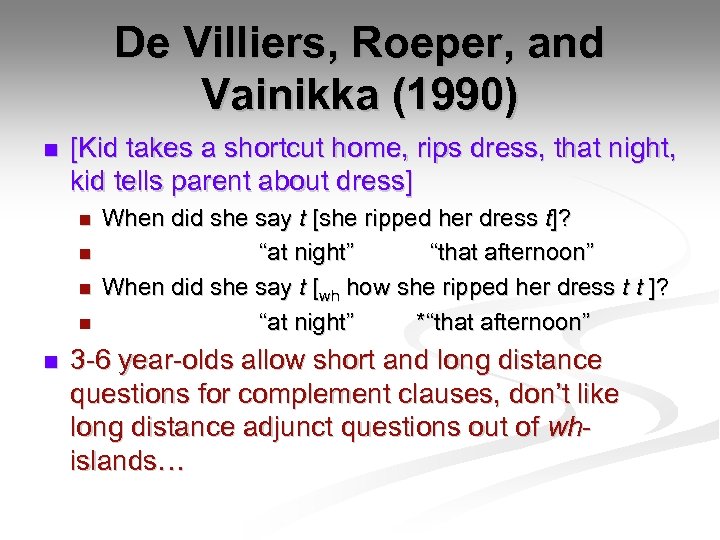 De Villiers, Roeper, and Vainikka (1990) n [Kid takes a shortcut home, rips dress, that night, kid tells parent about dress] n n n When did she say t [she ripped her dress t]? “at night” “that afternoon” When did she say t [wh how she ripped her dress t t ]? “at night” *“that afternoon” 3 -6 year-olds allow short and long distance questions for complement clauses, don’t like long distance adjunct questions out of whislands…
 De Villiers, Roeper, and Vainikka (1990) And kids make the argument-adjunct distinction the ECP makes for adults: n No wh-island, arguments/adjuncts both take long distance interpretation about 3040% the time n Argument wh-island, neither argument nor adjuncts can move out (2 -8% LD) n Adjunct wh-islands, arguments can move out (30% LD) but not adjuncts (6% LD). n
 Again, kids have a lot right—but what do they have wrong? n When kids make a mistake with a question like… n n When did she say how she ripped her dress? …it will often be that they answer something like “climbing over the fence”— answering the question How did she say t she ripped her dress? instead.
 n What are kids doing when they answer a medial whword? Are they answering the last wh-word they saw? n Kids don’t answer medial wh-words in yes-no questions. n Did n Mickey tell Minnie what he bought? Kids don’t answer wh-words in relatives. n How did you meet the man who sang?
 German partial whmovement? n Kids have been observed to produce questions with an initial wh-word and a lower copy. n What do you think what’s in her hat? n n What do you think where the marble is? n n ‘What do you think is in her hat? ’ ‘Where do you think the marble is? ’ What do you think what Cookie Monster eats? n ‘What do you think Cookie Monster eats? ’
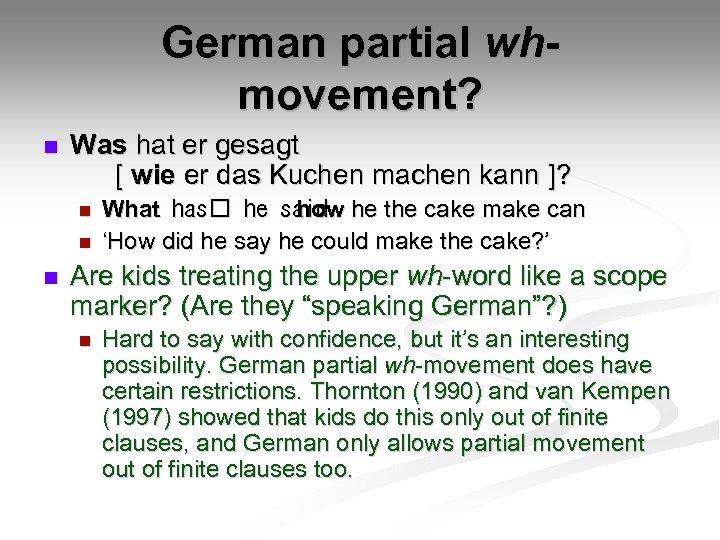 German partial whmovement? n Was hat er gesagt [ wie er das Kuchen machen kann ]? n n n What has he said he the cake make can how ‘How did he say he could make the cake? ’ Are kids treating the upper wh-word like a scope marker? (Are they “speaking German”? ) n Hard to say with confidence, but it’s an interesting possibility. German partial wh-movement does have certain restrictions. Thornton (1990) and van Kempen (1997) showed that kids do this only out of finite clauses, and German only allows partial movement out of finite clauses too.
 Processing constraints? n O’Grady (1997) suggests that another reason why kids might answer the intermediate wh-word is that they’ve already forgotten the matrix clause (citing Phinney 1981, who found that 3 -year olds often delete the matrix subject and verb when repeating biclausal sentences). n Kids don’t answer a medial wh-word in a yes-no question, though. . ?
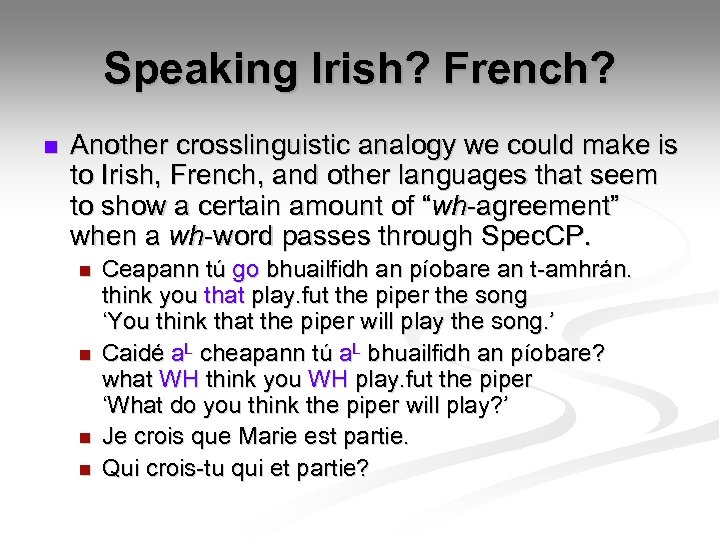 Speaking Irish? French? n Another crosslinguistic analogy we could make is to Irish, French, and other languages that seem to show a certain amount of “wh-agreement” when a wh-word passes through Spec. CP. n n Ceapann tú go bhuailfidh an píobare an t-amhrán. think you that play. fut the piper the song ‘You think that the piper will play the song. ’ Caidé a. L cheapann tú a. L bhuailfidh an píobare? what WH think you WH play. fut the piper ‘What do you think the piper will play? ’ Je crois que Marie est partie. Qui crois-tu qui et partie?
 Speaking Irish? French? n So, perhaps the kids’ non-adult use of intermediate wh-words is actually a mis-analysis of English. n First, they suppose it is Irish, and the intermediate whwords are the pronunciations of agreeing complementizers. n n Then, they suppose it is French, and limit the agreement to subject wh-words. n n A medial wh-word is never a whole wh-phrase. A head? Sometimes production goes from S&O medial wh-questions to just S. Then, they get to English.
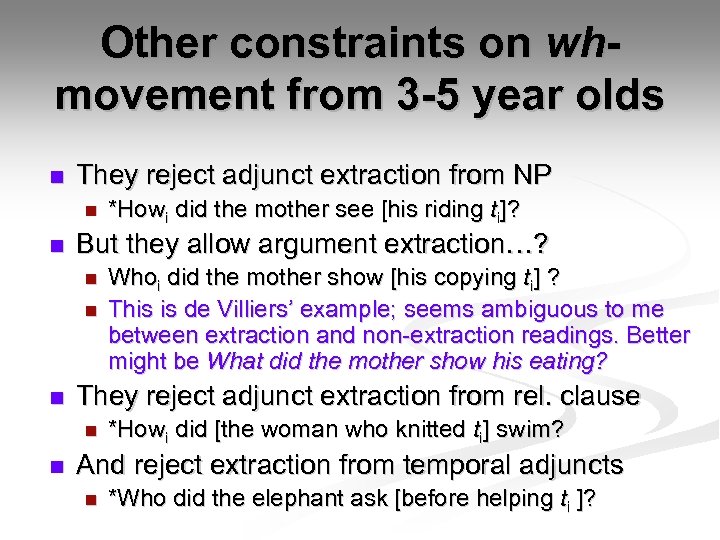 Other constraints on whmovement from 3 -5 year olds n They reject adjunct extraction from NP n n But they allow argument extraction…? n n n Whoi did the mother show [his copying ti] ? This is de Villiers’ example; seems ambiguous to me between extraction and non-extraction readings. Better might be What did the mother show his eating? They reject adjunct extraction from rel. clause n n *Howi did the mother see [his riding ti]? *Howi did [the woman who knitted ti] swim? And reject extraction from temporal adjuncts n *Who did the elephant ask [before helping ti ]?
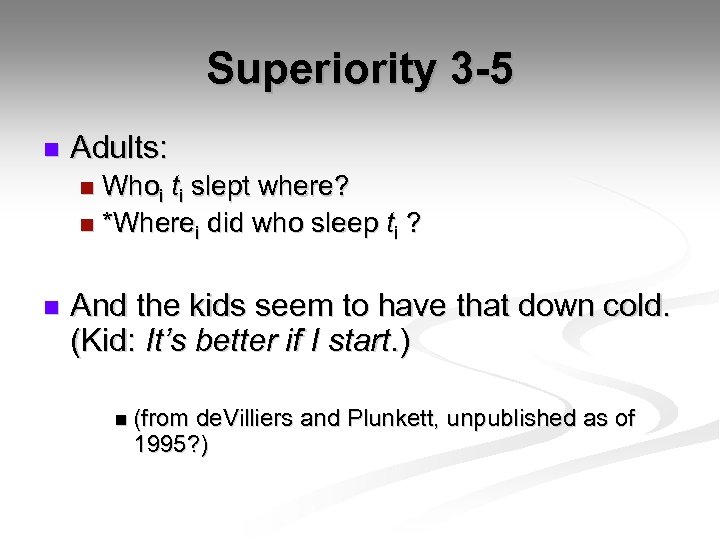 Superiority 3 -5 n Adults: Whoi ti slept where? n *Wherei did who sleep ti ? n n And the kids seem to have that down cold. (Kid: It’s better if I start. ) n (from de. Villiers and Plunkett, unpublished as of 1995? )
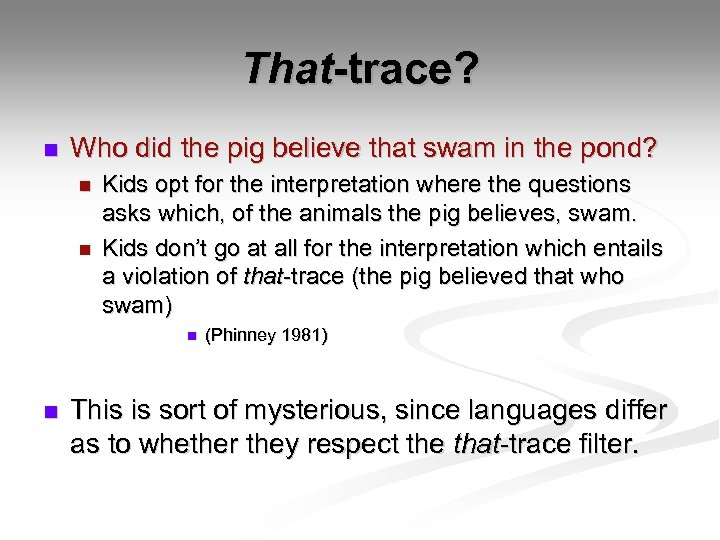 That-trace? n Who did the pig believe that swam in the pond? n n Kids opt for the interpretation where the questions asks which, of the animals the pig believes, swam. Kids don’t go at all for the interpretation which entails a violation of that-trace (the pig believed that who swam) n n (Phinney 1981) This is sort of mysterious, since languages differ as to whether they respect the that-trace filter.
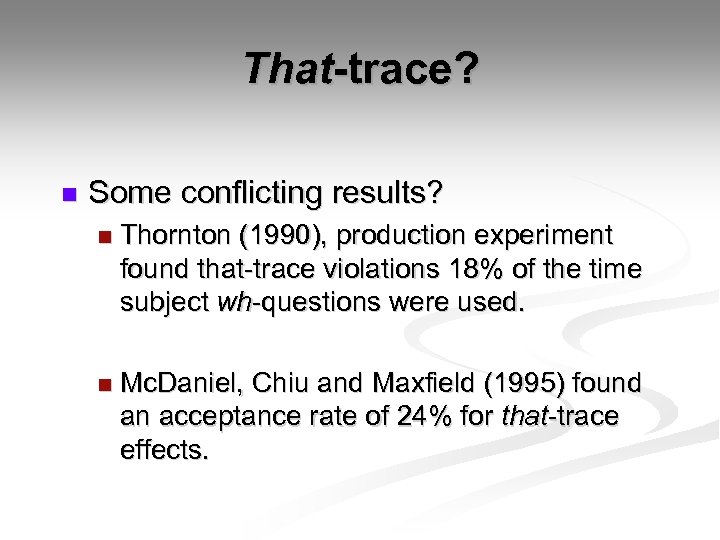 That-trace? n Some conflicting results? n Thornton (1990), production experiment found that-trace violations 18% of the time subject wh-questions were used. n Mc. Daniel, Chiu and Maxfield (1995) found an acceptance rate of 24% for that-trace effects.
 Grammar vs. Preferences n n n These experiments are really testing preferences not grammaticality. If they prefer the that-less variant, we won’t see that-trace violations even if they are strictly grammatical for the kid. Just because a structure is dispreferred (for whatever reason—frequency, difficulty, etc. ) does not mean that it is ungrammatical in the child’s grammar. Preferences are not the best route to discovering the properties of child grammar, though it’s hard to design grammaticality judgment experiments. .
 Questioning out of quotations n Adult languages generally can not question out of a quotation: n *Whati did the boy say “Can I bring ti” ? But English, French and German kids (3 -6 years) seem to allow it. n Why? n
 Correlates to questioning out of quotations n n Kids may not quite grasp the quotation yet. A significant proportion of kids around the same age range allow co-reference between a pronoun in the quotation and the subject: n n “Hei can sit here” said Mickeyi. Perhaps, it has more to do with the fact that it requires “getting into someone else’s head”…
 False beliefs n Kids before a certain age (usually before 4) seem unable to take another person’s perspective: n Little rabbit puts carrot in red basket, leaves. Mother rabbit comes in, moves carrot to blue basket. Little rabbit comes back. Where does he look for the carrot? n Some kids will answer “the blue basket”—unable to see that the little rabbit shouldn’t have known.
 False beliefs & quotations n Those same kids who answered “blue basket” were also those who would do this: n n Mother bought cake, but wanted to surprise girl. When asked, mother claimed to have bought paper towels. What did Mother say she bought? n The “blue basket” kids answer “cake. ”
 False beliefs & quotations n So, perhaps it is understanding what a quotation is that is allowing kids to extract from them—they treat a quotation as a regular clausal complement.
 Weak islands n In the adult language, there is a certain configuration which seems to create an island for movement of wh-adjuncts, which arguably has to do with the logical meaning. Coming by train is a subset of the events coming. n John said Mary was coming by train implies John said Mary was coming. n
 Weak islands n In weak islands the implication fails: n Negation: n John didn’t say Mary was coming by train. n John didn’t say Mary was coming. n Factives: n John forgot Mary was coming by train. n John forgot Mary was coming. n With quantificational adverbs: n John often eats grapes with a fork. n John often eats grapes.
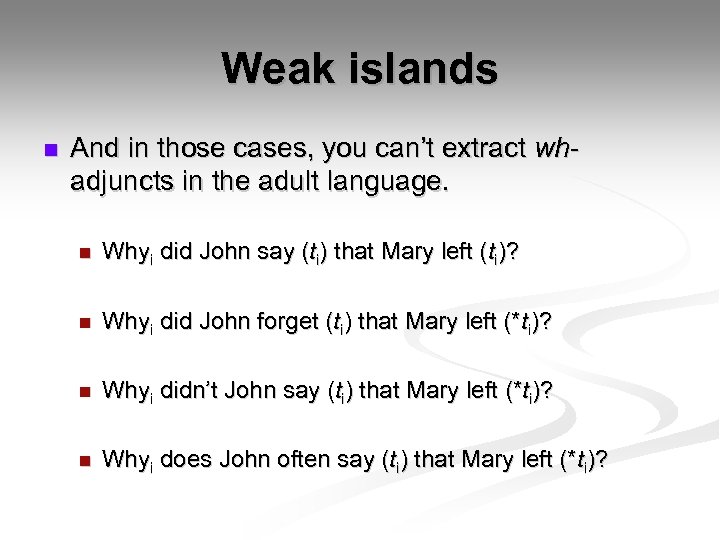 Weak islands n And in those cases, you can’t extract whadjuncts in the adult language. n Whyi did John say (ti) that Mary left (ti)? n Whyi did John forget (ti) that Mary left (*ti)? n Whyi didn’t John say (ti) that Mary left (*ti)? n Whyi does John often say (ti) that Mary left (*ti)?
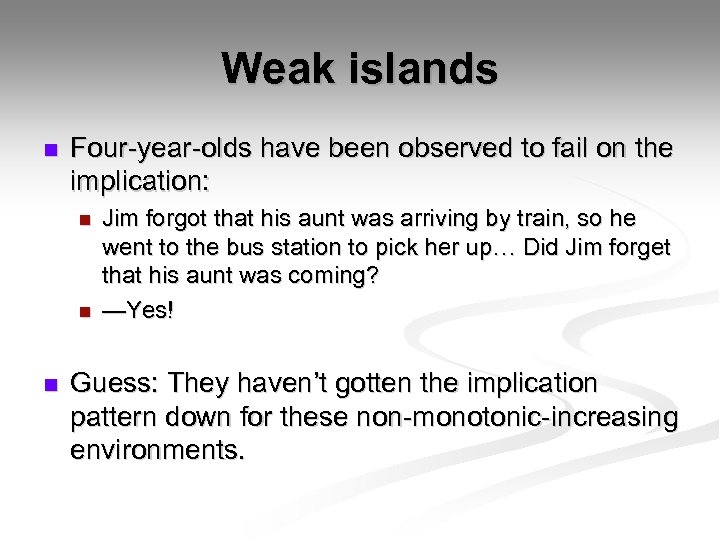 Weak islands n Four-year-olds have been observed to fail on the implication: n n n Jim forgot that his aunt was arriving by train, so he went to the bus station to pick her up… Did Jim forget that his aunt was coming? —Yes! Guess: They haven’t gotten the implication pattern down for these non-monotonic-increasing environments.
 Weak islands n Now: If kids haven’t gotten the implication pattern, and if the implication pattern is implicated in the islandhood, do kids fail to observe weak islands just when they also fail on the implication pattern? n Philip and de Villiers (1992) looked into this…
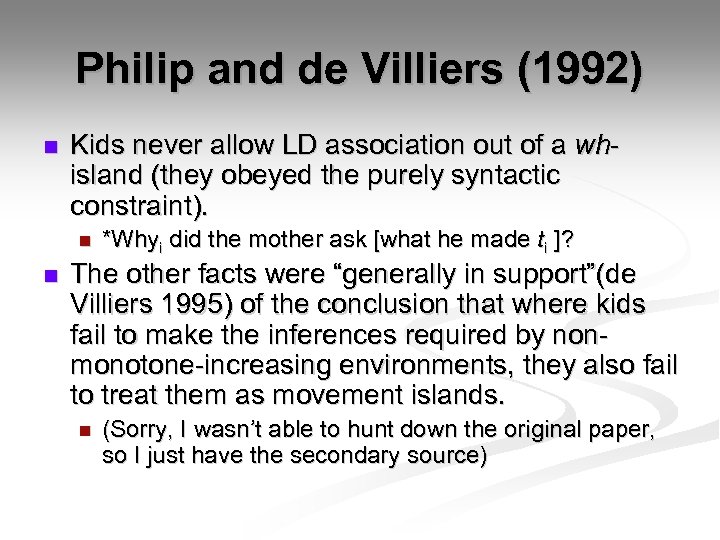 Philip and de Villiers (1992) n Kids never allow LD association out of a whisland (they obeyed the purely syntactic constraint). n n *Whyi did the mother ask [what he made ti ]? The other facts were “generally in support”(de Villiers 1995) of the conclusion that where kids fail to make the inferences required by nonmonotone-increasing environments, they also fail to treat them as movement islands. n (Sorry, I wasn’t able to hunt down the original paper, so I just have the secondary source)
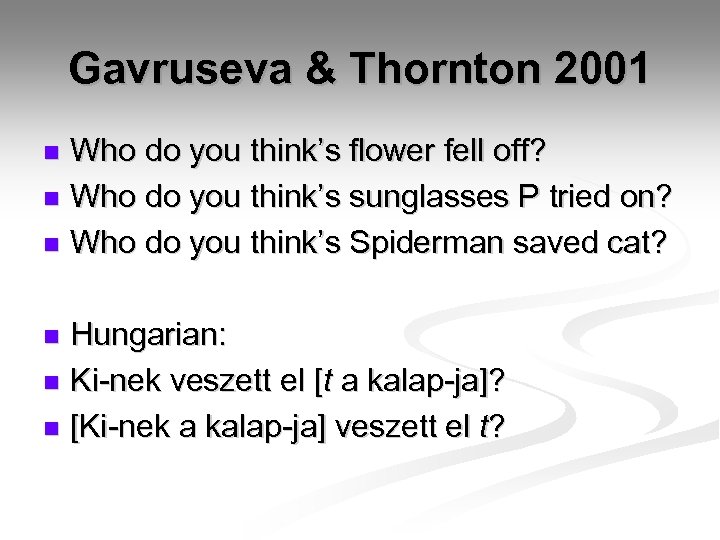 Gavruseva & Thornton 2001 Who do you think’s flower fell off? n Who do you think’s sunglasses P tried on? n Who do you think’s Spiderman saved cat? n Hungarian: n Ki-nek veszett el [t a kalap-ja]? n [Ki-nek a kalap-ja] veszett el t? n
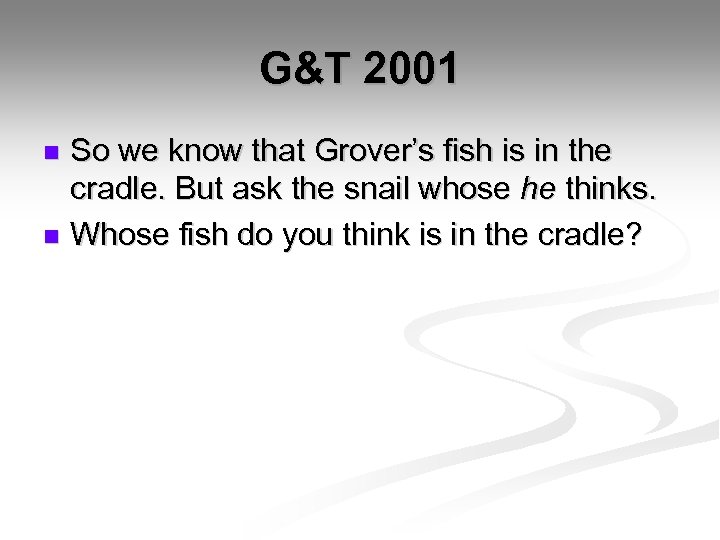 G&T 2001 So we know that Grover’s fish is in the cradle. But ask the snail whose he thinks. n Whose fish do you think is in the cradle? n
 Multiple questions n A fair amount of theoretical work has concerned the treatment of multiple whquestions. n n E. g. , the wh-typology: English (move one) vs. Japanese (move none) vs. Bulgarian (move all). What do kids do with them? n Well, but that’s lunacy—adults barely use them, how are we going to find out about kids?
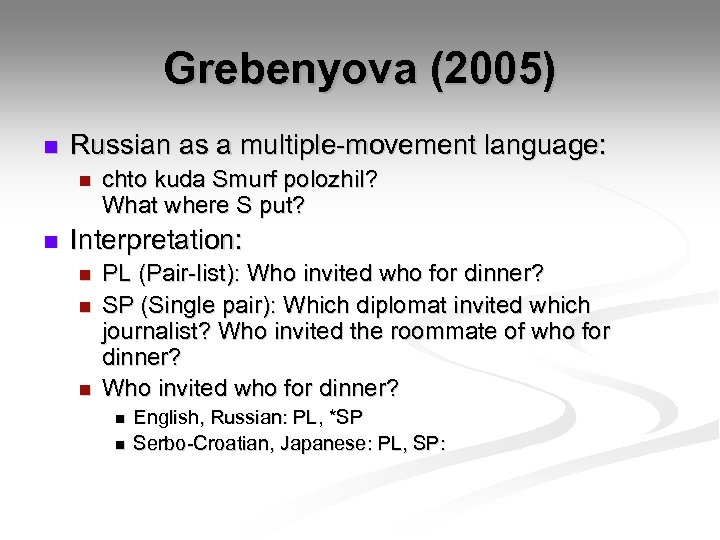 Grebenyova (2005) n Russian as a multiple-movement language: n n chto kuda Smurf polozhil? What where S put? Interpretation: n n n PL (Pair-list): Who invited who for dinner? SP (Single pair): Which diplomat invited which journalist? Who invited the roommate of who for dinner? Who invited who for dinner? n n English, Russian: PL, *SP Serbo-Croatian, Japanese: PL, SP:
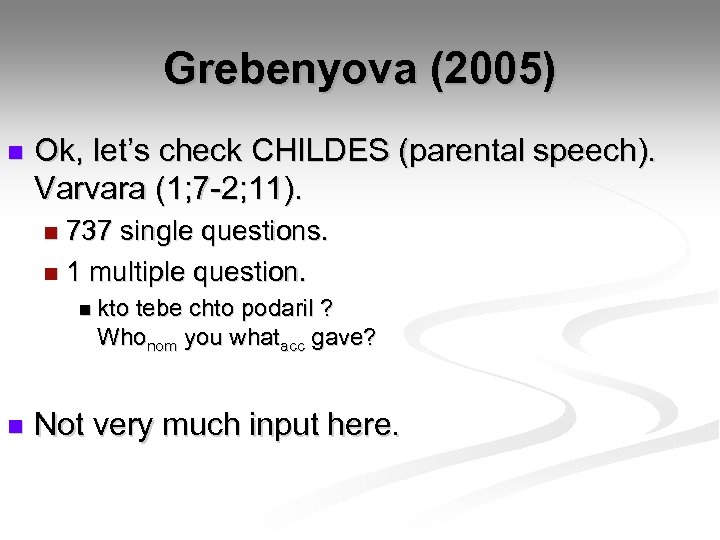 Grebenyova (2005) n Ok, let’s check CHILDES (parental speech). Varvara (1; 7 -2; 11). 737 single questions. n 1 multiple question. n n kto tebe chto podaril ? Whonom you whatacc gave? n Not very much input here.
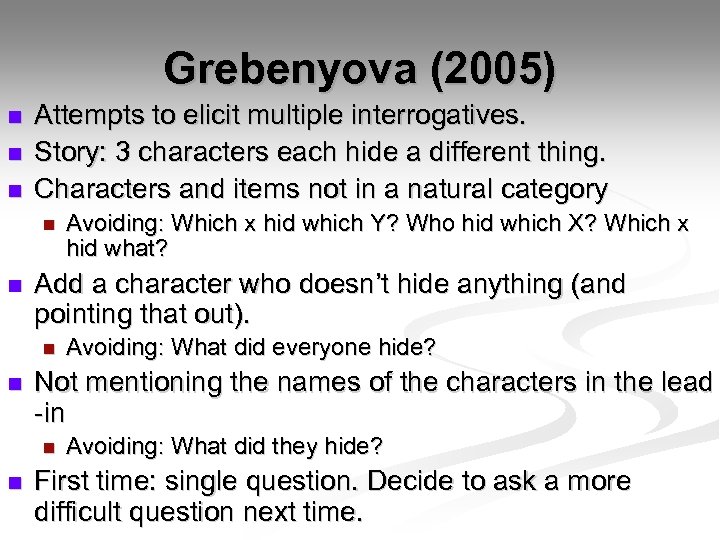 Grebenyova (2005) n n n Attempts to elicit multiple interrogatives. Story: 3 characters each hide a different thing. Characters and items not in a natural category n n Add a character who doesn’t hide anything (and pointing that out). n n Avoiding: What did everyone hide? Not mentioning the names of the characters in the lead -in n n Avoiding: Which x hid which Y? Who hid which X? Which x hid what? Avoiding: What did they hide? First time: single question. Decide to ask a more difficult question next time.
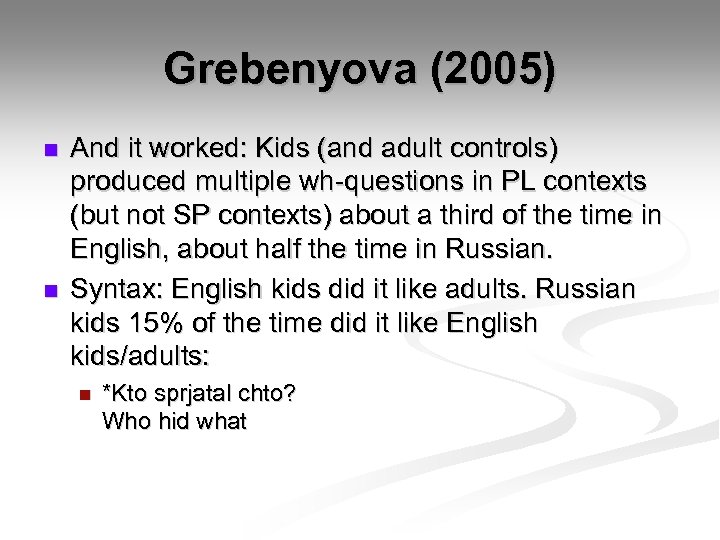 Grebenyova (2005) n n And it worked: Kids (and adult controls) produced multiple wh-questions in PL contexts (but not SP contexts) about a third of the time in English, about half the time in Russian. Syntax: English kids did it like adults. Russian kids 15% of the time did it like English kids/adults: n *Kto sprjatal chto? Who hid what
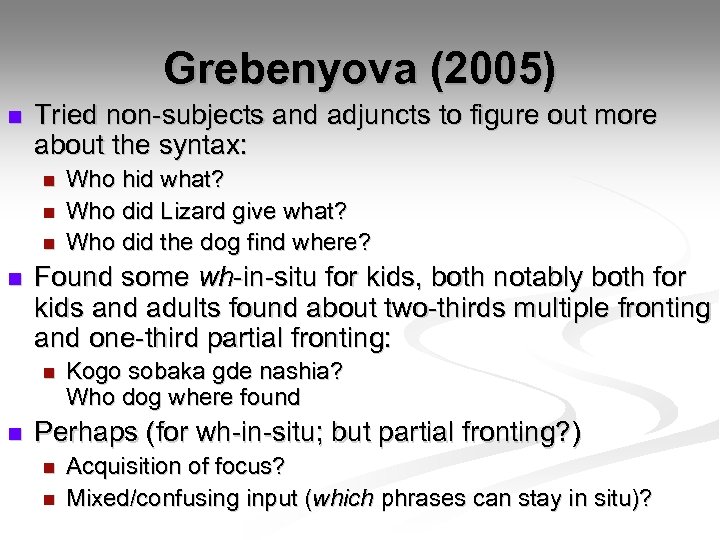 Grebenyova (2005) n Tried non-subjects and adjuncts to figure out more about the syntax: n n Found some wh-in-situ for kids, both notably both for kids and adults found about two-thirds multiple fronting and one-third partial fronting: n n Who hid what? Who did Lizard give what? Who did the dog find where? Kogo sobaka gde nashia? Who dog where found Perhaps (for wh-in-situ; but partial fronting? ) n n Acquisition of focus? Mixed/confusing input (which phrases can stay in situ)?

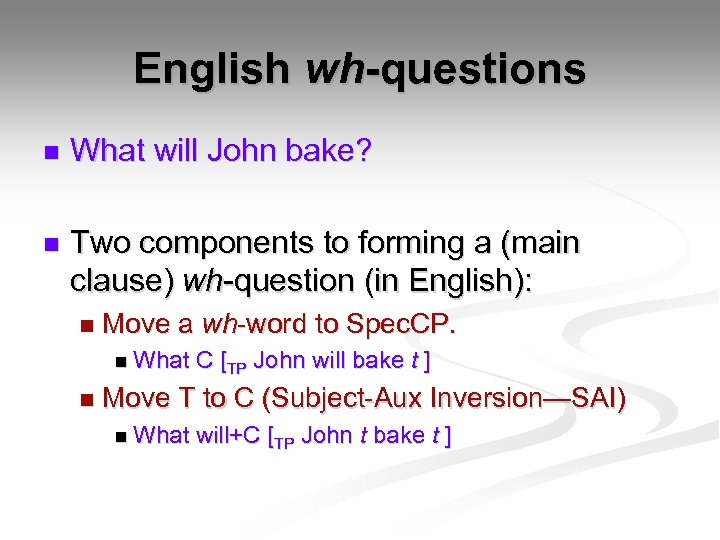 English wh-questions n What will John bake? n Two components to forming a (main clause) wh-question (in English): n Move a wh-word to Spec. CP. n What n C [TP John will bake t ] Move T to C (Subject-Aux Inversion—SAI) n What will+C [TP John t bake t ]
 The Wh-criterion What will John bake? n Who will bake the cake? n n One of the most robust movement operations, and there are two mo
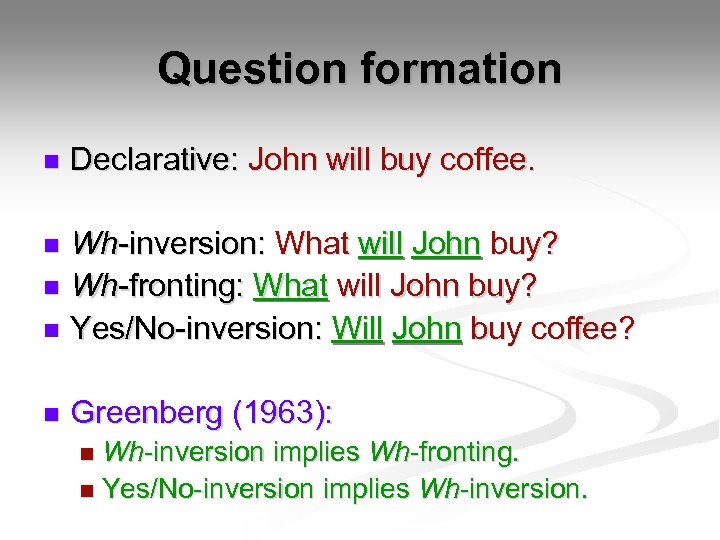 Question formation n Declarative: John will buy coffee. Wh-inversion: What will John buy? n Wh-fronting: What will John buy? n Yes/No-inversion: Will John buy coffee? n n Greenberg (1963): Wh-inversion implies Wh-fronting. n Yes/No-inversion implies Wh-inversion. n
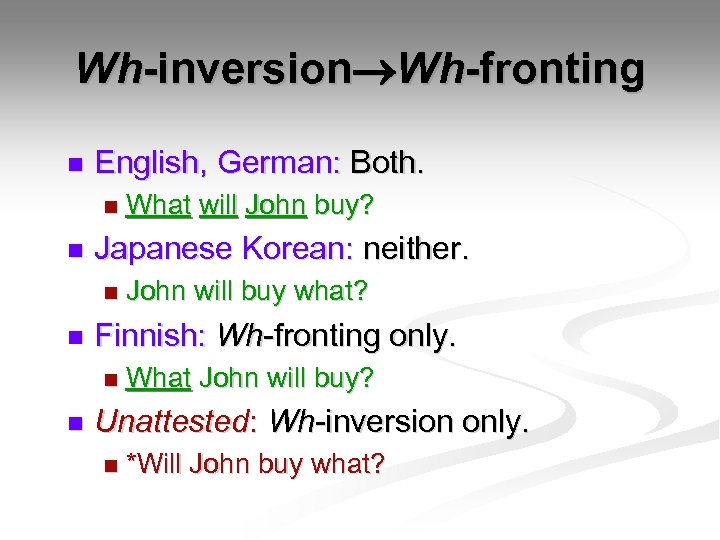 Wh-inversion Wh-fronting n English, German: Both. n n Japanese Korean: neither. n n John will buy what? Finnish: Wh-fronting only. n n What will John buy? What John will buy? Unattested: Wh-inversion only. n *Will John buy what?
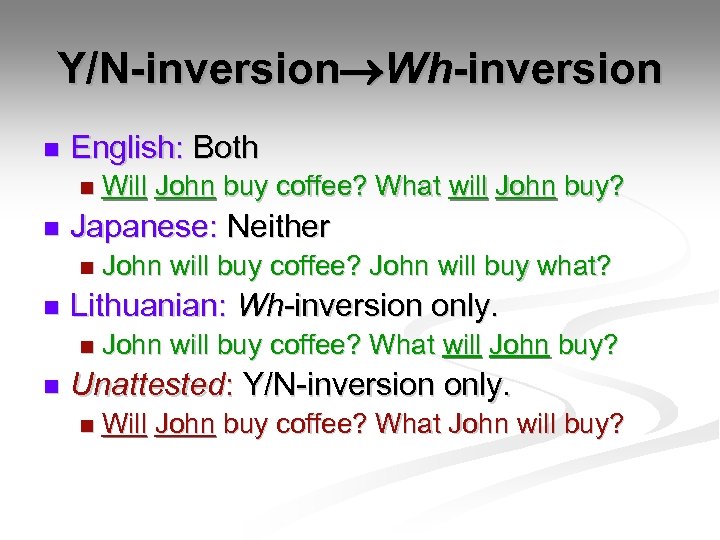 Y/N-inversion Wh-inversion n English: Both n n Japanese: Neither n n John will buy coffee? John will buy what? Lithuanian: Wh-inversion only. n n Will John buy coffee? What will John buy? John will buy coffee? What will John buy? Unattested: Y/N-inversion only. n Will John buy coffee? What John will buy?
 Universals and parameters n n Even if it’s not completely clear what accounts for the implicational universals, inversion and wh -fronting do seem to be independent. A kid needs to learn what his/her language does in each domain. n n Wh-inversion implies Wh-fronting: Perhaps the only reason you’d move T to C is to get a [wh] feature originally on T into a position where it can be checked by a wh-word in Spec. CP (Wh-criterion, see Guasti). Y/N-inversion implies Wh-inversion: ?
 Kids get these parameters down early n n n Guasti (2000): Adam, Eve, and Sarah pretty much never left wh-words in situ, and when they did it was generally in a (grammatical) echo question. Same with inversion, there seem to be very few (on the order of 1%) errors of non-inversion in German, Italian, Swedish. Yet Bellugi (1971)—very famously—seemed to find something different in English… Stages: n SAI in yes-no questions, not in wh-questions n n Notice this runs counter to Greenberg’s univeral. SAI in positive questions, not in negative questions.
 Conclusion really seems to be Kids will sometimes fail to invert. n Kids will sometimes fail to invert more in one construction (e. g. , wh-questions) than in another (e. g. , yes/no-questions), but which one gets the advantage seems to vary by kid. n
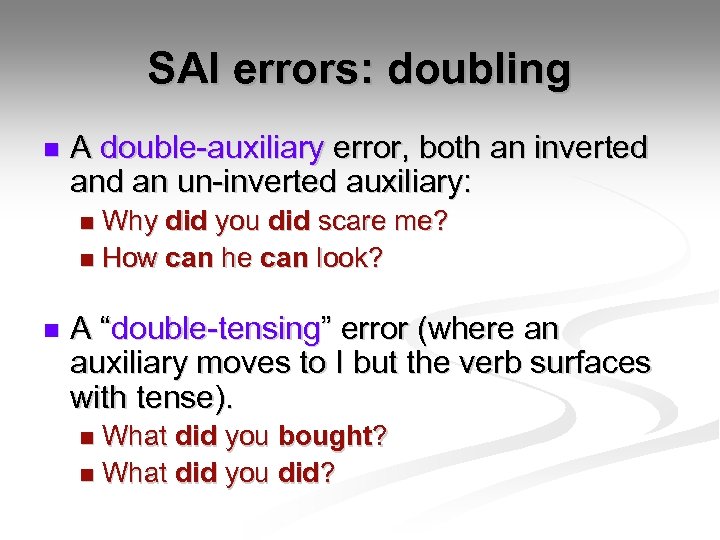 SAI errors: doubling n A double-auxiliary error, both an inverted an un-inverted auxiliary: Why did you did scare me? n How can he can look? n n A “double-tensing” error (where an auxiliary moves to I but the verb surfaces with tense). What did you bought? n What did you did? n
 Doubling errors Are the kids pronouncing a “loud trace” of (head-)movement? (Are they moving the auxiliary but failing to leave the trace unpronounced? ) That would be interesting. n Are they just forgetting what they are trying to say midway through and “blending” two structures? (one with and one without movement) n
 Nakayama (1987) n The longer the subject is, the more likely a kid is to make a doubling error; the length of the VP makes no difference. n n Is [the boy who is watching Mickey] is happy? Looks like blending, rather than the (more interesting) “loud trace” idea… Common error type: n Is [the boy who is watching M], is he happy?
 Inversion in negation n Guasti, Thornton & Wexler (BUCLD 1995) looked at doubling in negative questions. n Previous results (Bellugi 1967, 1971, Stromswold 1990) indicated that kids tend to invert less often in negative questions. First: True? n Second: Why? n
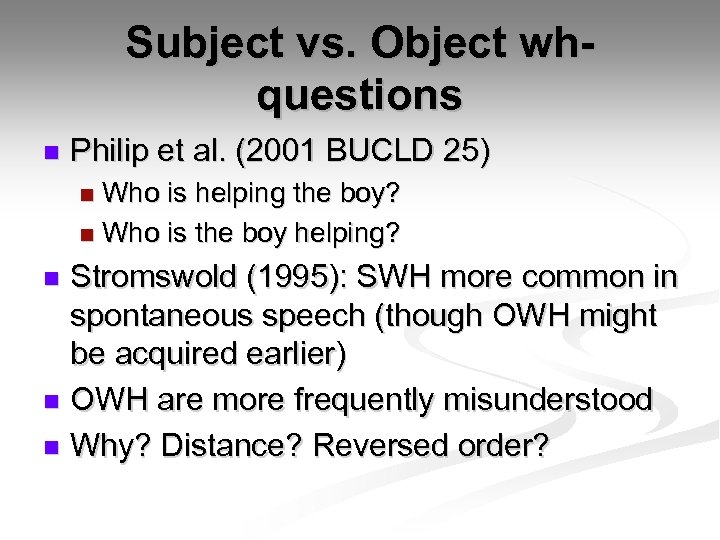 Subject vs. Object whquestions n Philip et al. (2001 BUCLD 25) Who is helping the boy? n Who is the boy helping? n Stromswold (1995): SWH more common in spontaneous speech (though OWH might be acquired earlier) n OWH are more frequently misunderstood n Why? Distance? Reversed order? n
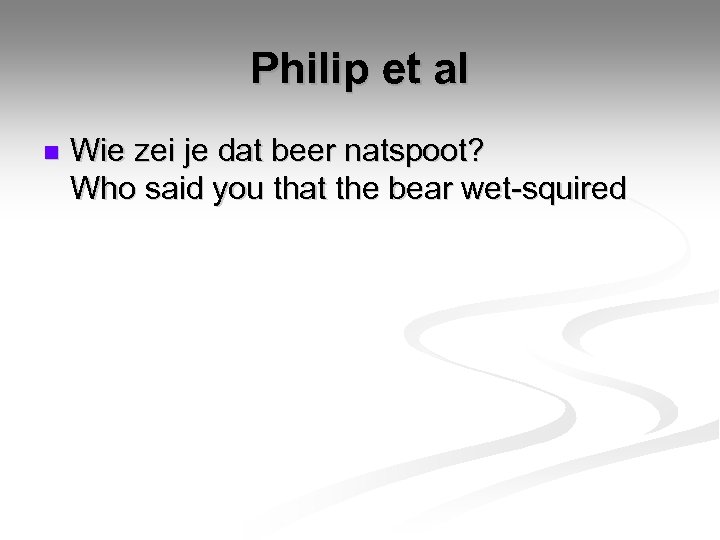 Philip et al n Wie zei je dat beer natspoot? Who said you that the bear wet-squired