Скачать презентацию GRS LX 700 Language Acquisition and Linguistic Theory
55f5cb21922482fe4e2fbea1709b4aff.ppt
- Количество слайдов: 129
 GRS LX 700 Language Acquisition and Linguistic Theory Week 12. Acquirers and questions
 English wh-questions n What will John bake? n Two components to forming a (main clause) wh-question (in English): Move a wh-word to Spec. CP. n Move T to C (Subject-Aux Inversion—SAI) n
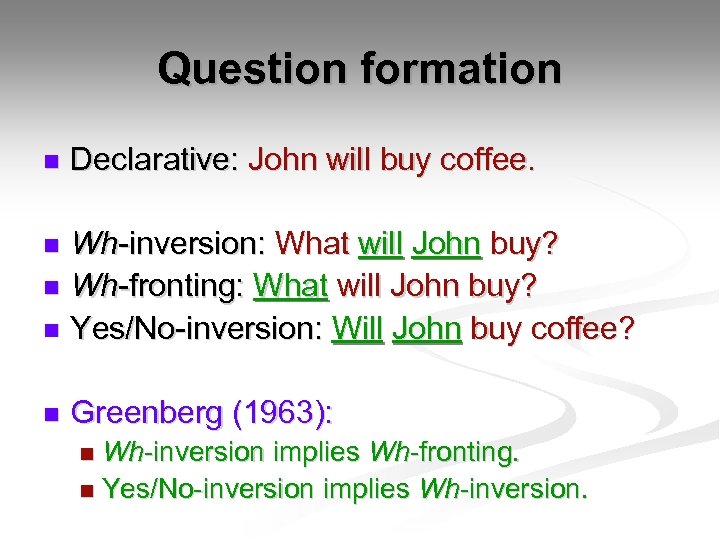 Question formation n Declarative: John will buy coffee. Wh-inversion: What will John buy? n Wh-fronting: What will John buy? n Yes/No-inversion: Will John buy coffee? n n Greenberg (1963): Wh-inversion implies Wh-fronting. n Yes/No-inversion implies Wh-inversion. n
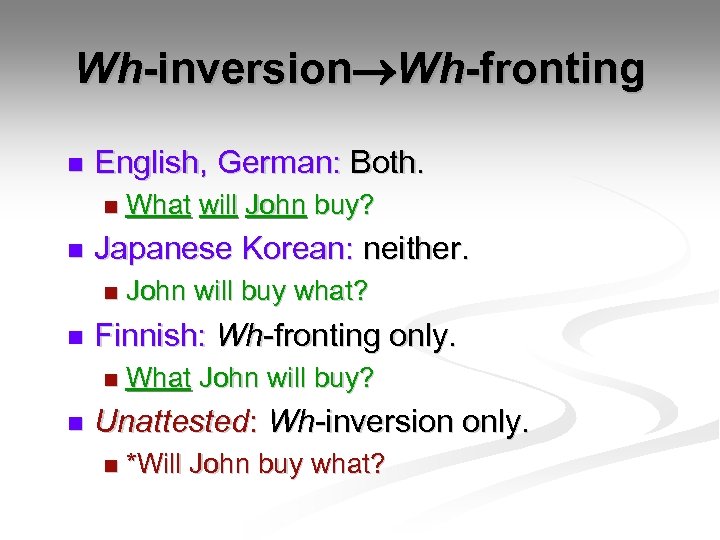 Wh-inversion Wh-fronting n English, German: Both. n n Japanese Korean: neither. n n John will buy what? Finnish: Wh-fronting only. n n What will John buy? What John will buy? Unattested: Wh-inversion only. n *Will John buy what?
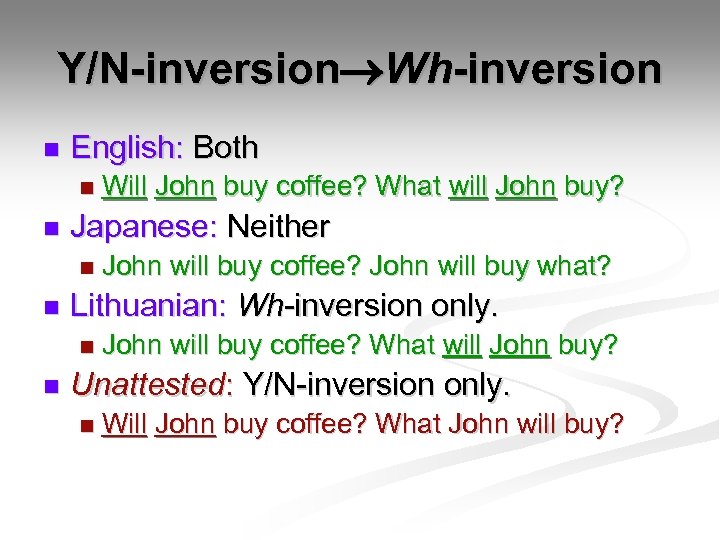 Y/N-inversion Wh-inversion n English: Both n n Japanese: Neither n n John will buy coffee? John will buy what? Lithuanian: Wh-inversion only. n n Will John buy coffee? What will John buy? John will buy coffee? What will John buy? Unattested: Y/N-inversion only. n Will John buy coffee? What John will buy?
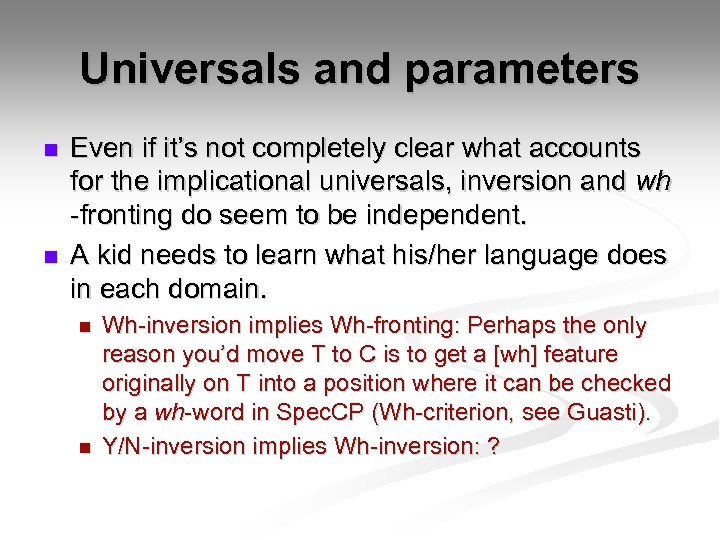 Universals and parameters n n Even if it’s not completely clear what accounts for the implicational universals, inversion and wh -fronting do seem to be independent. A kid needs to learn what his/her language does in each domain. n n Wh-inversion implies Wh-fronting: Perhaps the only reason you’d move T to C is to get a [wh] feature originally on T into a position where it can be checked by a wh-word in Spec. CP (Wh-criterion, see Guasti). Y/N-inversion implies Wh-inversion: ?
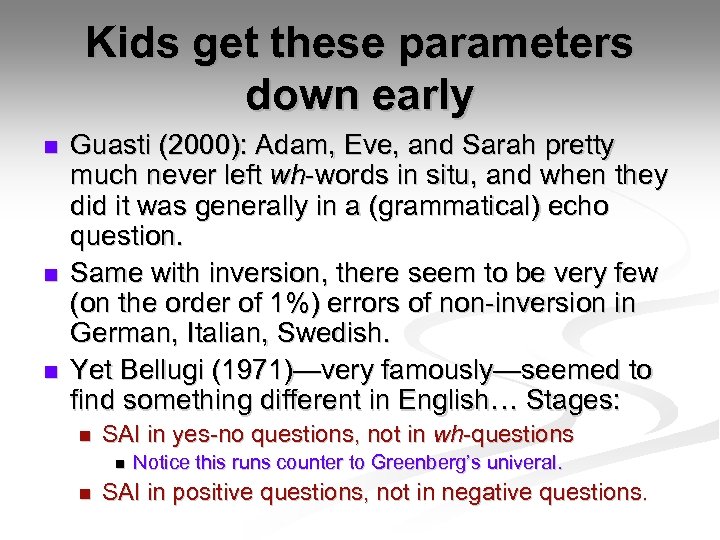 Kids get these parameters down early n n n Guasti (2000): Adam, Eve, and Sarah pretty much never left wh-words in situ, and when they did it was generally in a (grammatical) echo question. Same with inversion, there seem to be very few (on the order of 1%) errors of non-inversion in German, Italian, Swedish. Yet Bellugi (1971)—very famously—seemed to find something different in English… Stages: n SAI in yes-no questions, not in wh-questions n n Notice this runs counter to Greenberg’s univeral. SAI in positive questions, not in negative questions.
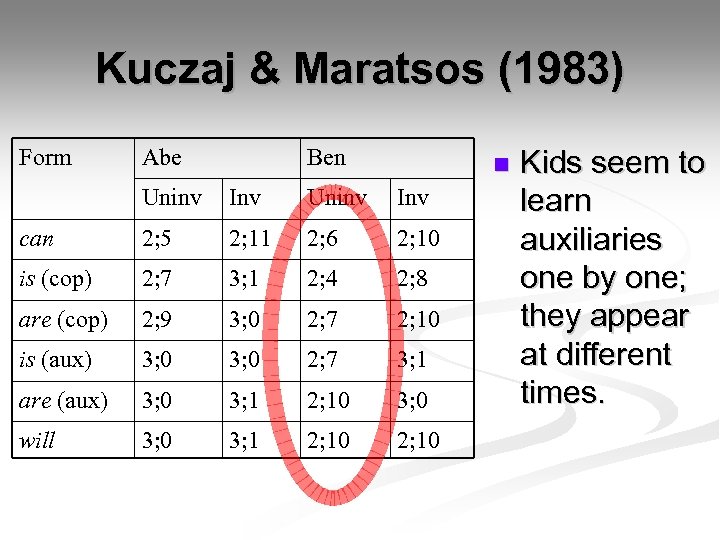 Kuczaj & Maratsos (1983) Form Abe Ben n Uninv Inv can 2; 5 2; 11 2; 6 2; 10 is (cop) 2; 7 3; 1 2; 4 2; 8 are (cop) 2; 9 3; 0 2; 7 2; 10 is (aux) 3; 0 2; 7 3; 1 are (aux) 3; 0 3; 1 2; 10 3; 0 will 3; 0 3; 1 2; 10 Kids seem to learn auxiliaries one by one; they appear at different times.
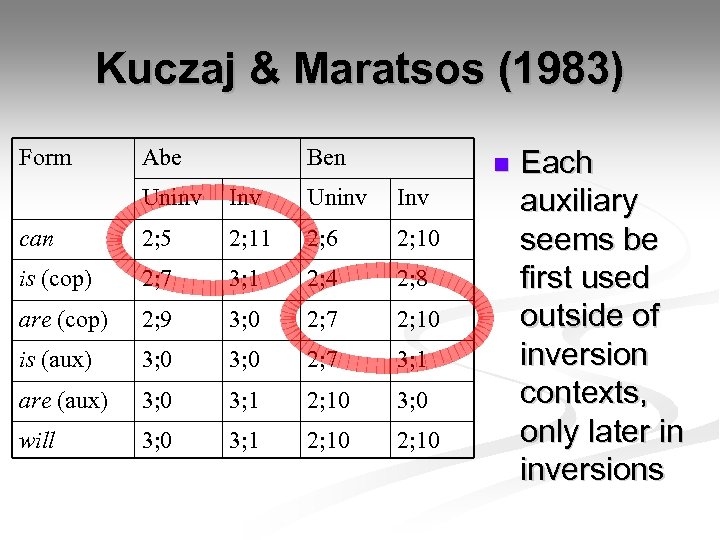 Kuczaj & Maratsos (1983) Form Abe Ben n Uninv Inv can 2; 5 2; 11 2; 6 2; 10 is (cop) 2; 7 3; 1 2; 4 2; 8 are (cop) 2; 9 3; 0 2; 7 2; 10 is (aux) 3; 0 2; 7 3; 1 are (aux) 3; 0 3; 1 2; 10 3; 0 will 3; 0 3; 1 2; 10 Each auxiliary seems be first used outside of inversion contexts, only later in inversions
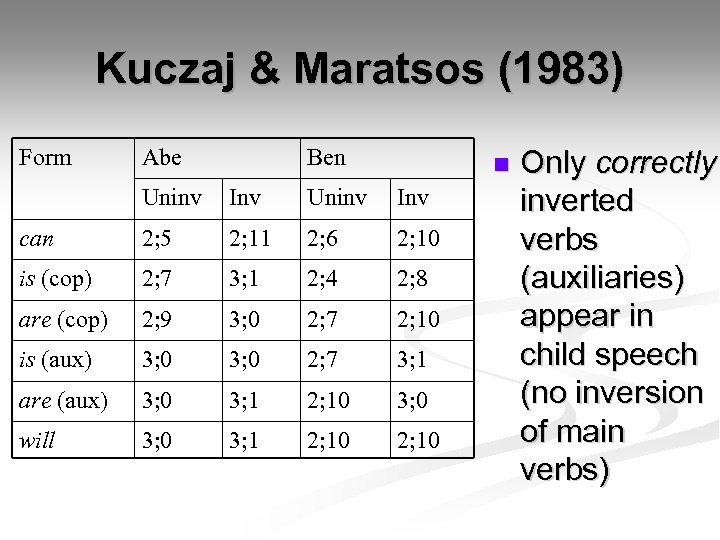 Kuczaj & Maratsos (1983) Form Abe Ben n Uninv Inv can 2; 5 2; 11 2; 6 2; 10 is (cop) 2; 7 3; 1 2; 4 2; 8 are (cop) 2; 9 3; 0 2; 7 2; 10 is (aux) 3; 0 2; 7 3; 1 are (aux) 3; 0 3; 1 2; 10 3; 0 will 3; 0 3; 1 2; 10 Only correctly inverted verbs (auxiliaries) appear in child speech (no inversion of main verbs)
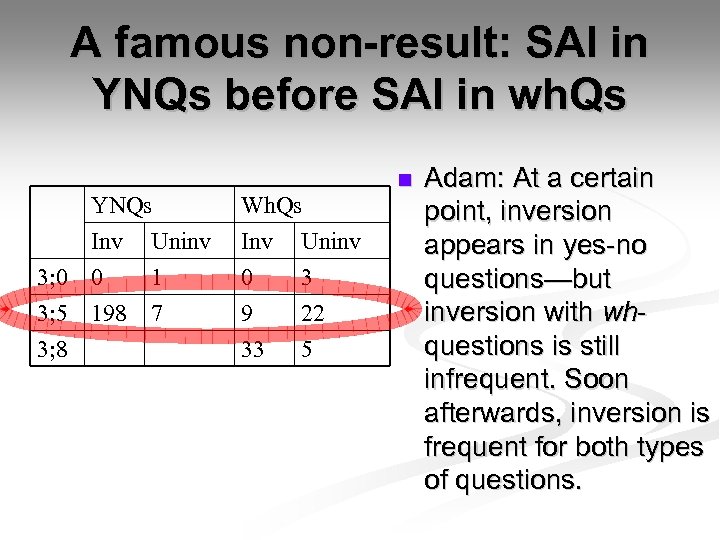 A famous non-result: SAI in YNQs before SAI in wh. Qs YNQs Inv Uninv 3; 0 0 1 3; 5 198 7 Wh. Qs Inv Uninv 0 3 9 22 3; 8 33 5 n Adam: At a certain point, inversion appears in yes-no questions—but inversion with whquestions is still infrequent. Soon afterwards, inversion is frequent for both types of questions.
 A famous non-result: SAI in YNQs before SAI in wh. Qs Problem is, seems to be true of Adam’s files, but not true generally… n Several later studies with better sampling show no identifiable stage where yes-no questions invert while wh-questions don’t —in fact, even the frequency doesn’t go in one direction for all kids. n
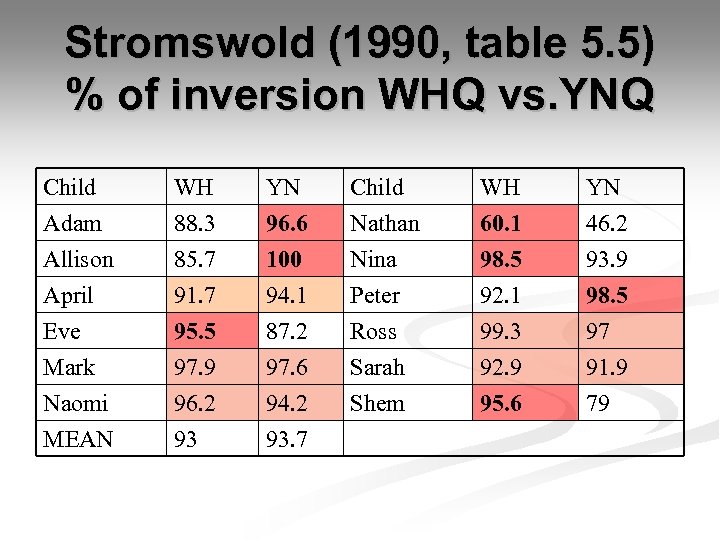 Stromswold (1990, table 5. 5) % of inversion WHQ vs. YNQ Child Adam Allison April WH 88. 3 85. 7 91. 7 YN 96. 6 100 94. 1 Child Nathan Nina Peter WH 60. 1 98. 5 92. 1 YN 46. 2 93. 9 98. 5 Eve Mark Naomi MEAN 95. 5 97. 9 96. 2 93 87. 2 97. 6 94. 2 93. 7 Ross Sarah Shem 99. 3 92. 9 95. 6 97 91. 9 79
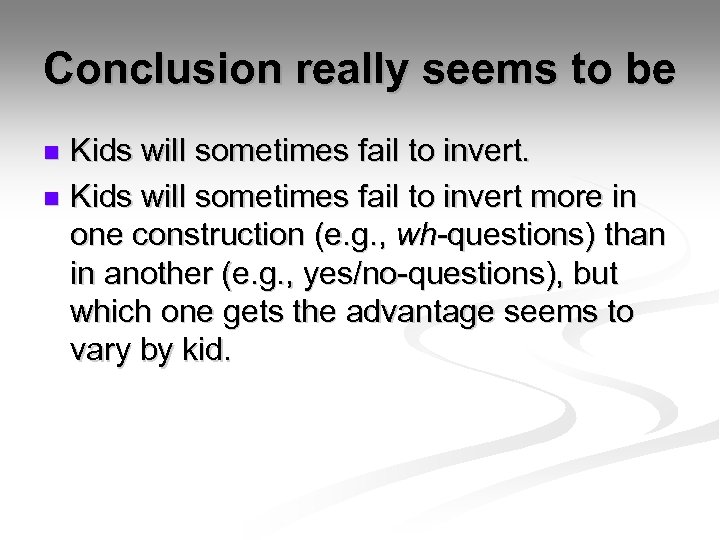 Conclusion really seems to be Kids will sometimes fail to invert. n Kids will sometimes fail to invert more in one construction (e. g. , wh-questions) than in another (e. g. , yes/no-questions), but which one gets the advantage seems to vary by kid. n
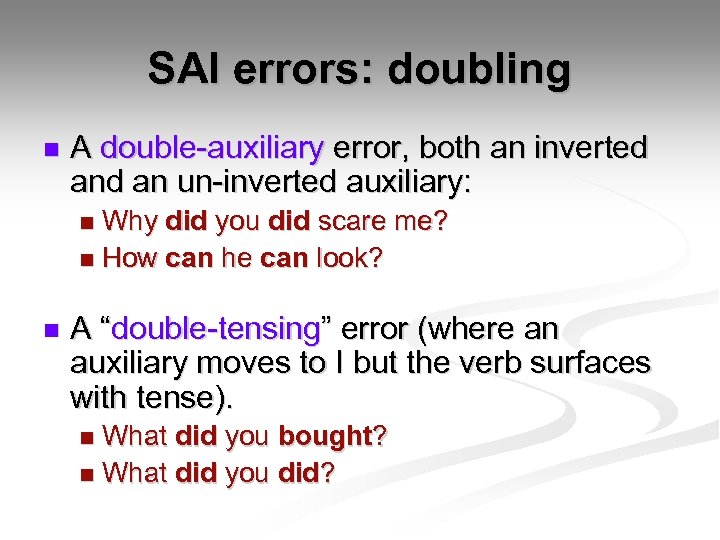 SAI errors: doubling n A double-auxiliary error, both an inverted an un-inverted auxiliary: Why did you did scare me? n How can he can look? n n A “double-tensing” error (where an auxiliary moves to I but the verb surfaces with tense). What did you bought? n What did you did? n
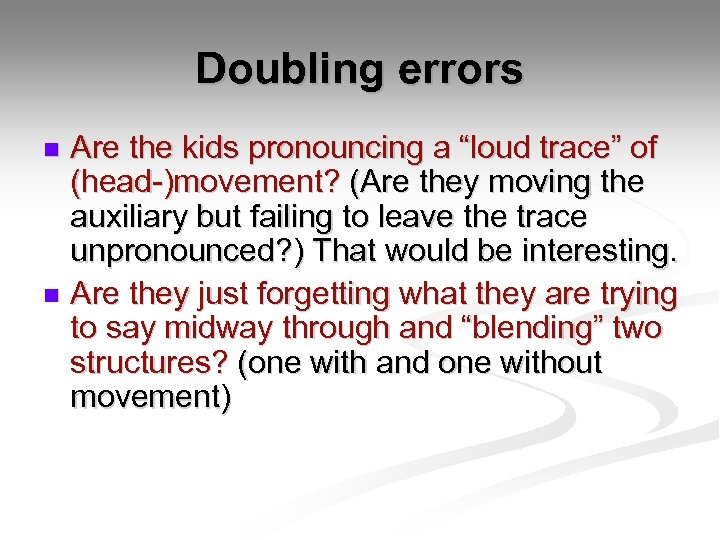 Doubling errors Are the kids pronouncing a “loud trace” of (head-)movement? (Are they moving the auxiliary but failing to leave the trace unpronounced? ) That would be interesting. n Are they just forgetting what they are trying to say midway through and “blending” two structures? (one with and one without movement) n
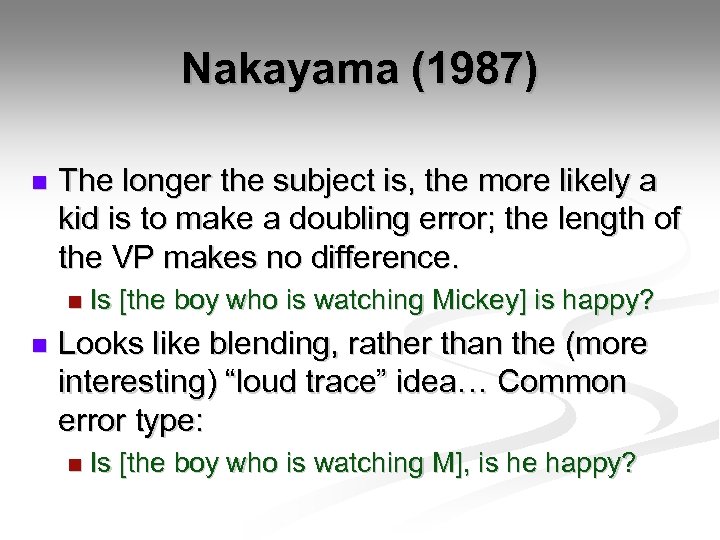 Nakayama (1987) n The longer the subject is, the more likely a kid is to make a doubling error; the length of the VP makes no difference. n n Is [the boy who is watching Mickey] is happy? Looks like blending, rather than the (more interesting) “loud trace” idea… Common error type: n Is [the boy who is watching M], is he happy?
 Inversion in negation n Guasti, Thornton & Wexler (BUCLD 1995) looked at doubling in negative questions. n Previous results (Bellugi 1967, 1971, Stromswold 1990) indicated that kids tend to invert less often in negative questions. First: True? n Second: Why? n
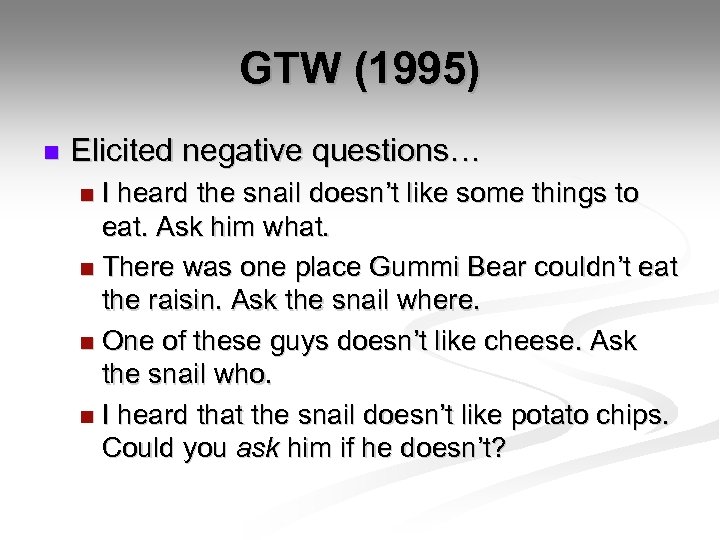 GTW (1995) n Elicited negative questions… I heard the snail doesn’t like some things to eat. Ask him what. n There was one place Gummi Bear couldn’t eat the raisin. Ask the snail where. n One of these guys doesn’t like cheese. Ask the snail who. n I heard that the snail doesn’t like potato chips. Could you ask him if he doesn’t? n
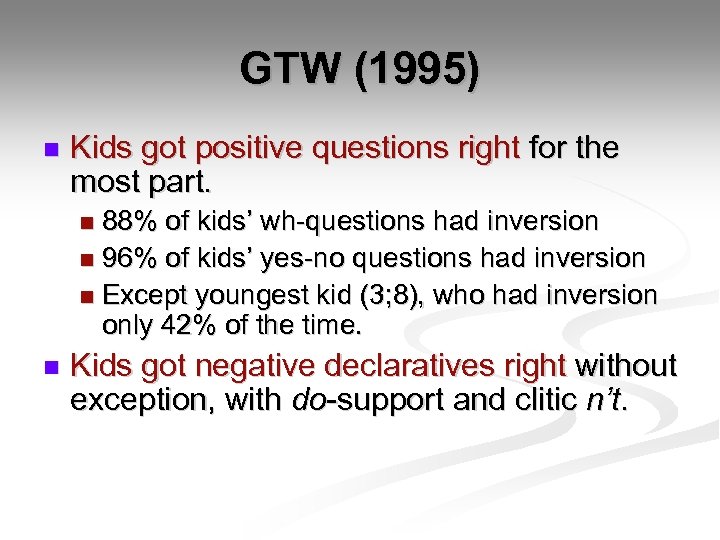 GTW (1995) n Kids got positive questions right for the most part. 88% of kids’ wh-questions had inversion n 96% of kids’ yes-no questions had inversion n Except youngest kid (3; 8), who had inversion only 42% of the time. n n Kids got negative declaratives right without exception, with do-support and clitic n’t.
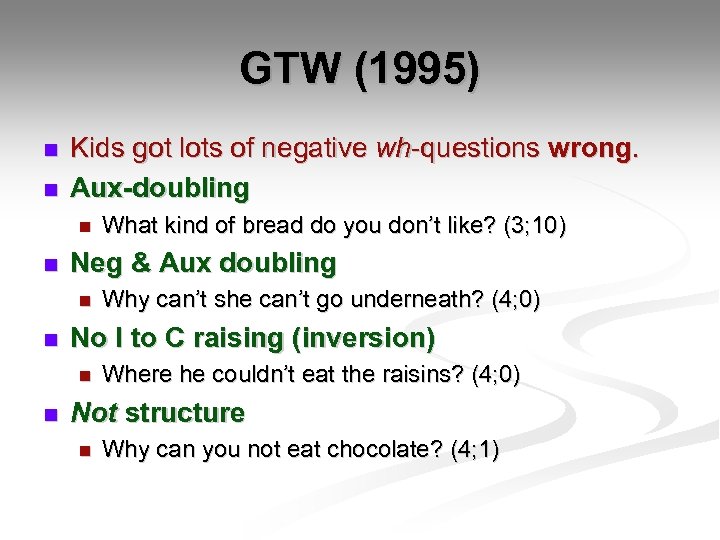 GTW (1995) n n Kids got lots of negative wh-questions wrong. Aux-doubling n n Neg & Aux doubling n n Why can’t she can’t go underneath? (4; 0) No I to C raising (inversion) n n What kind of bread do you don’t like? (3; 10) Where he couldn’t eat the raisins? (4; 0) Not structure n Why can you not eat chocolate? (4; 1)
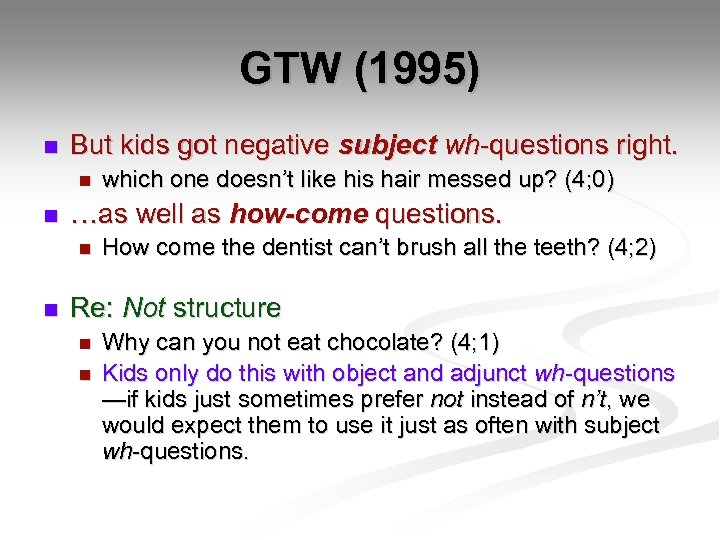 GTW (1995) n But kids got negative subject wh-questions right. n n …as well as how-come questions. n n which one doesn’t like his hair messed up? (4; 0) How come the dentist can’t brush all the teeth? (4; 2) Re: Not structure n n Why can you not eat chocolate? (4; 1) Kids only do this with object and adjunct wh-questions —if kids just sometimes prefer not instead of n’t, we would expect them to use it just as often with subject wh-questions.
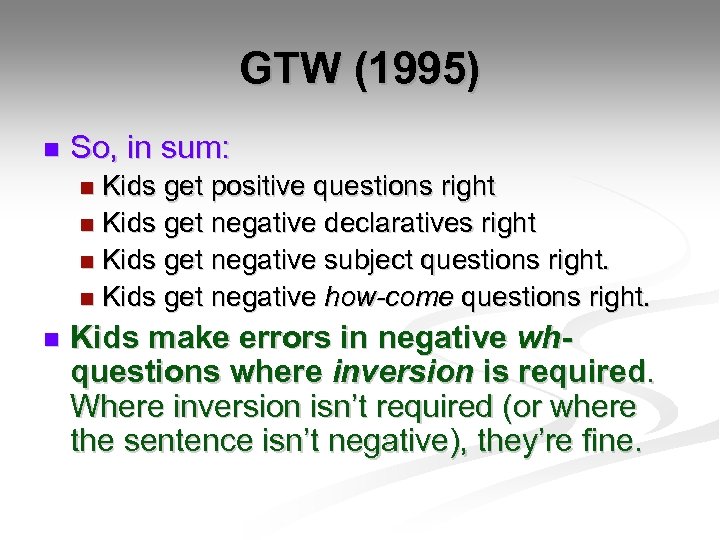 GTW (1995) n So, in sum: Kids get positive questions right n Kids get negative declaratives right n Kids get negative subject questions right. n Kids get negative how-come questions right. n n Kids make errors in negative whquestions where inversion is required. Where inversion isn’t required (or where the sentence isn’t negative), they’re fine.
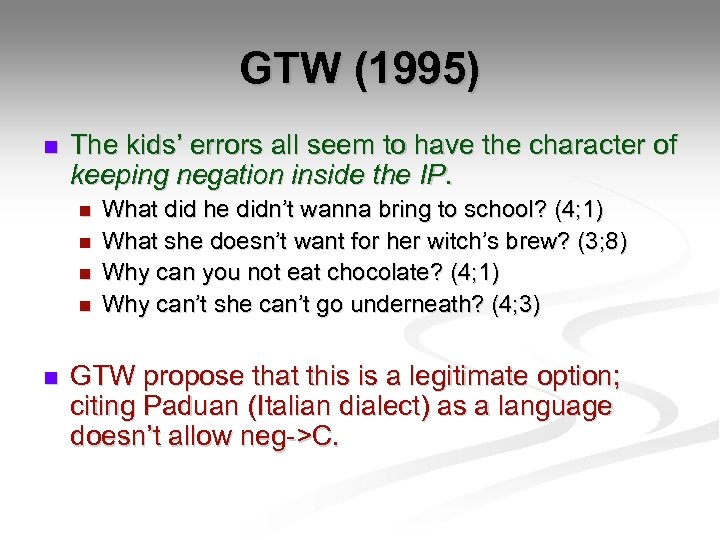 GTW (1995) n The kids’ errors all seem to have the character of keeping negation inside the IP. n n n What did he didn’t wanna bring to school? (4; 1) What she doesn’t want for her witch’s brew? (3; 8) Why can you not eat chocolate? (4; 1) Why can’t she can’t go underneath? (4; 3) GTW propose that this is a legitimate option; citing Paduan (Italian dialect) as a language doesn’t allow neg->C.
 GTW (1995) n n Re: subject and how come questions… In a subject question, we don’t know that the subject wh-word got out of IP—maybe kids left it in IP… heck, maybe even adults do. n n n Who left? *Who did leave? How come questions don’t require SAI in the adult language{. /? } n n How come John left? *How come did John leave?
 “Auxless questions” n Guasti (2002) discusses questions like n n n Where Daddy go? (Adam 2; 3) What I doing? (Eve 2; 0) By making some assumptions (inherited from Rizzi), Guasti finds these problematic. Whmovement requires SAI, so what moved to C? n Specifically, wh-movement depends on SAI, which happens because [+wh] starts on T and must move to C so it can be in a Spec-head relation with the whword in Spec. CP. Also: subject questions need no inversion on this story.
 Auxless questions n Auxless questions are relatively common among wh-questions in the 2 -4 age range. n n Guasti/Rizzi’s suggestion: An auxiliary at the head of the root can be null (similar to the null subject story). For adults, the head of the root is Force. P, but for kids it might be lower (Foc. P, where wh-words go). Kids who might otherwise say What I doing? will nevertheless not say Who laughing? . Subject wh -questions seem immune from “auxiliary drop. ” n n The Guasti/Rizzi explanation is pretty contrived, actually. The aux need not proceed as high as Foc. P for subject questions, so it ends up not being highest. Not really any clear alternative, though…
 Early, early wh-questions n n n There may be an early “formulaic” stage where kids ask questions by just asking “Wh(’s) NP? ”. O’Grady (1997): “Because of their formulaic character, it seems reasonable to treat these utterances as instantiations of a simple template rather than the product of whatever mechanism forms wh-questions in the adult grammar. ” But why? We already have lots of reason to think young kids know a lot about adult grammar by then… What is simpler about a “simple template”?
 Wh-subjects and wh-objects n Is there a difference in the timing of emergence between subject wh-questions and object wh-questions? In English, there is an apparent difference in complexity (“distance” of movement, SAI).
 Early, early wh-questions Seidl and Hollich (2003) looked at headturn preferences in really young kids. n Minimizes demands of task n Use looking preferences to “answer” whquestions. n What hit the apple? n What did the apple hit? n Where is the apple? n
 Seidl et al. Kids saw a little simplistic computergenerated movie where, e. g. , a book hit some keys. n Then there were two screens presented side by side, one with a book displayed, one with keys displayed. n What hit the keys? (book) n What did the book hit? (keys) n Where is the book? (book) n
 Seidl et al. n n n Graph shows differences (target minus non-target). 20 -month-olds seemed quite capable of comprehending all three kinds. 15 -month-olds couldn’t do objects; 13 -month-olds couldn’t do any.
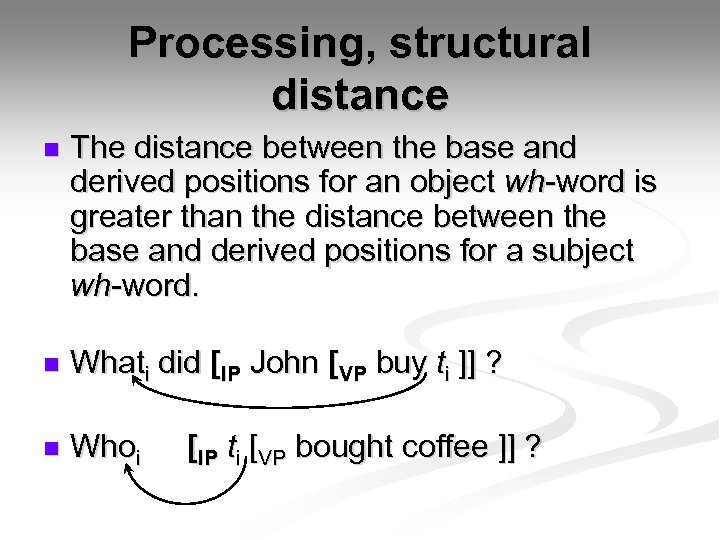 Processing, structural distance n The distance between the base and derived positions for an object wh-word is greater than the distance between the base and derived positions for a subject wh-word. n Whati did [IP John [VP buy ti ]] ? n Whoi [IP ti [VP bought coffee ]] ?
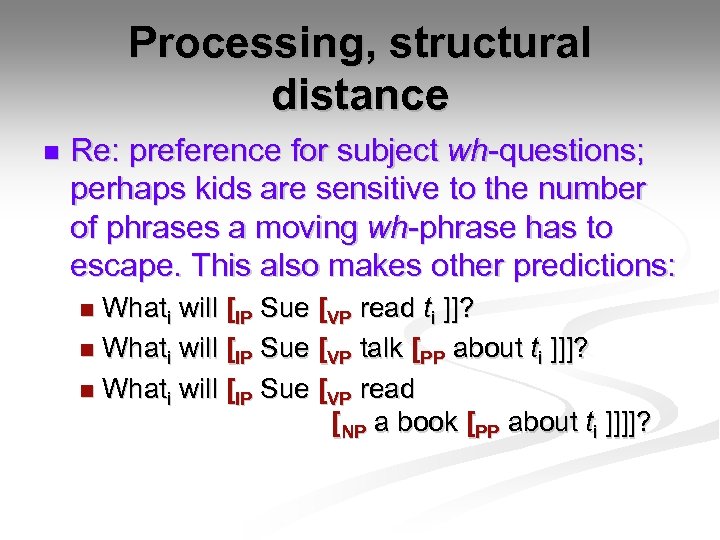 Processing, structural distance n Re: preference for subject wh-questions; perhaps kids are sensitive to the number of phrases a moving wh-phrase has to escape. This also makes other predictions: Whati will [IP Sue [VP read ti ]]? n Whati will [IP Sue [VP talk [PP about ti ]]]? n Whati will [IP Sue [VP read [NP a book [PP about ti ]]]]? n
 Hildebrand (1987) n Tested (fairly old) kids on a paradigm of wh-questions of varying “depth” to see if more embedded wh-words are harder. n In a repetition task (4 -10 year olds), it was almost uniformly true that the more deeply embedded the wh-word was, the more errors the kids made trying to repeat it.
 But wait… n So kids make more errors extracting from more deeply embedded structures. Is this a fact about the acquisition of wh-movement? Or is it just a fact about language processing in general? n What do adults do? n My guess: Even for adults, the more complex structures are (marginally) harder to process. Certainly true for subject vs. object relative clauses (the man who _ left vs. the man who I met _). n Cf. NPAH later.
 Does child wh-movement obey the adult rules for wh-movement? n When the kids ask wh-questions, what structures are they using? Are they like the adult structures? If not, how are they different? Are they performing movement? Are there traces? Do the movements obey constraints (e. g. , wh-island, ECP, …)?
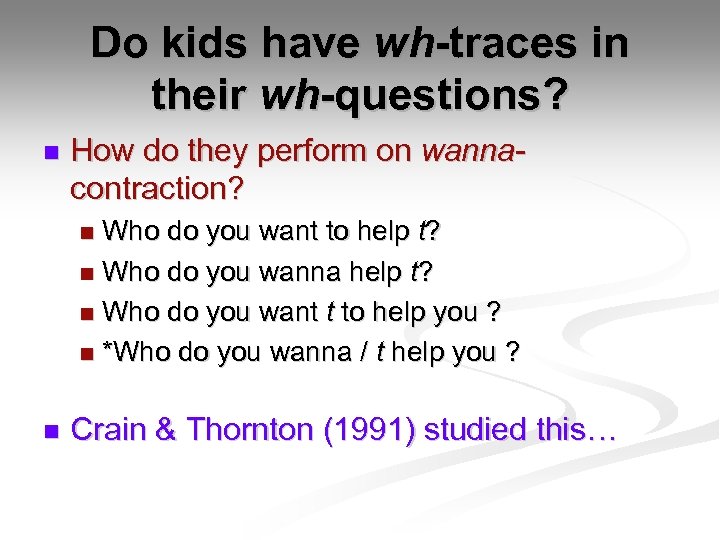 Do kids have wh-traces in their wh-questions? n How do they perform on wannacontraction? Who do you want to help t? n Who do you wanna help t? n Who do you want t to help you ? n *Who do you wanna / t help you ? n n Crain & Thornton (1991) studied this…
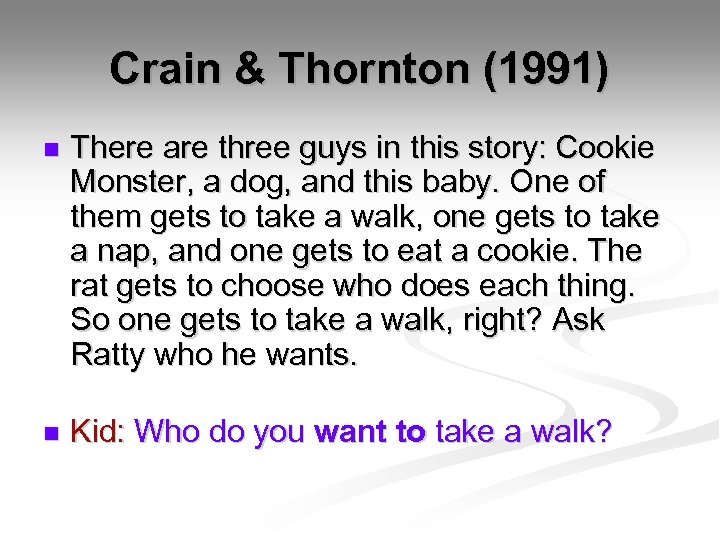 Crain & Thornton (1991) n There are three guys in this story: Cookie Monster, a dog, and this baby. One of them gets to take a walk, one gets to take a nap, and one gets to eat a cookie. The rat gets to choose who does each thing. So one gets to take a walk, right? Ask Ratty who he wants. n Kid: Who do you want to take a walk?
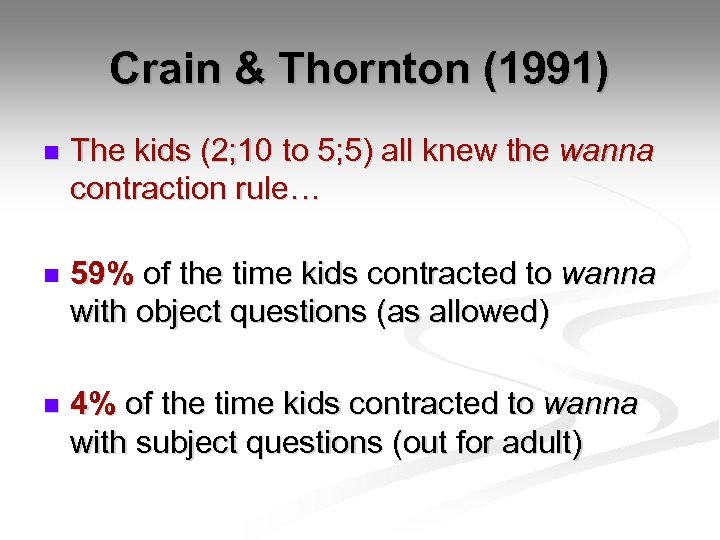 Crain & Thornton (1991) n The kids (2; 10 to 5; 5) all knew the wanna contraction rule… n 59% of the time kids contracted to wanna with object questions (as allowed) n 4% of the time kids contracted to wanna with subject questions (out for adult)
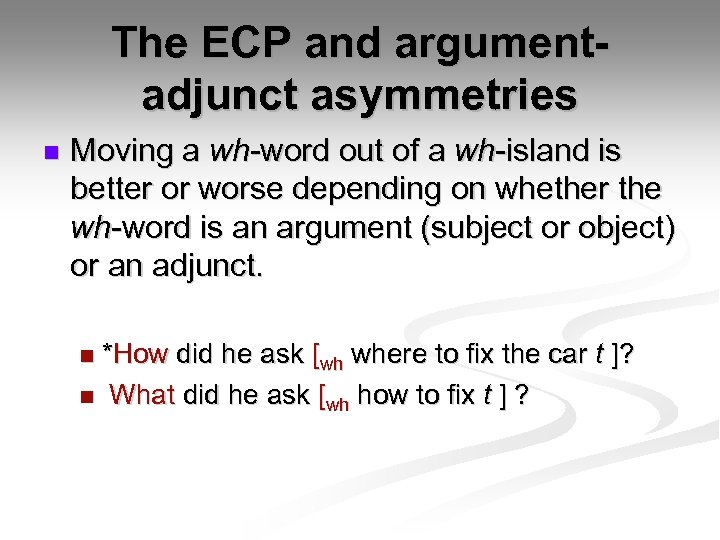 The ECP and argumentadjunct asymmetries n Moving a wh-word out of a wh-island is better or worse depending on whether the wh-word is an argument (subject or object) or an adjunct. *How did he ask [wh where to fix the car t ]? n What did he ask [wh how to fix t ] ? n
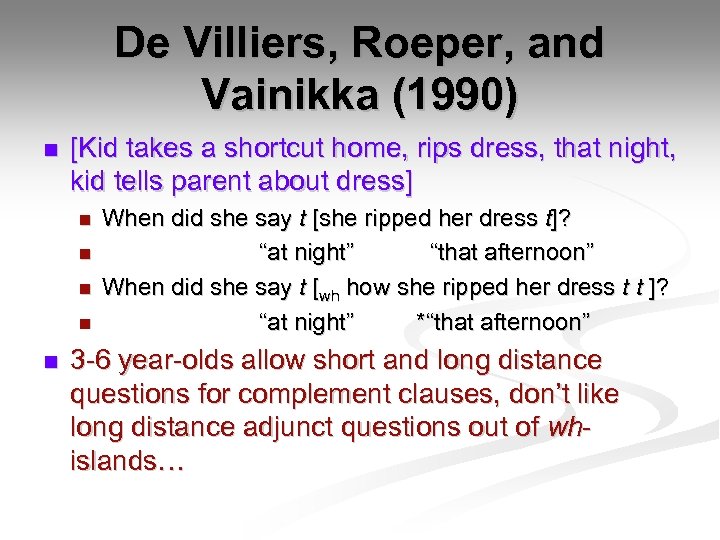 De Villiers, Roeper, and Vainikka (1990) n [Kid takes a shortcut home, rips dress, that night, kid tells parent about dress] n n n When did she say t [she ripped her dress t]? “at night” “that afternoon” When did she say t [wh how she ripped her dress t t ]? “at night” *“that afternoon” 3 -6 year-olds allow short and long distance questions for complement clauses, don’t like long distance adjunct questions out of whislands…
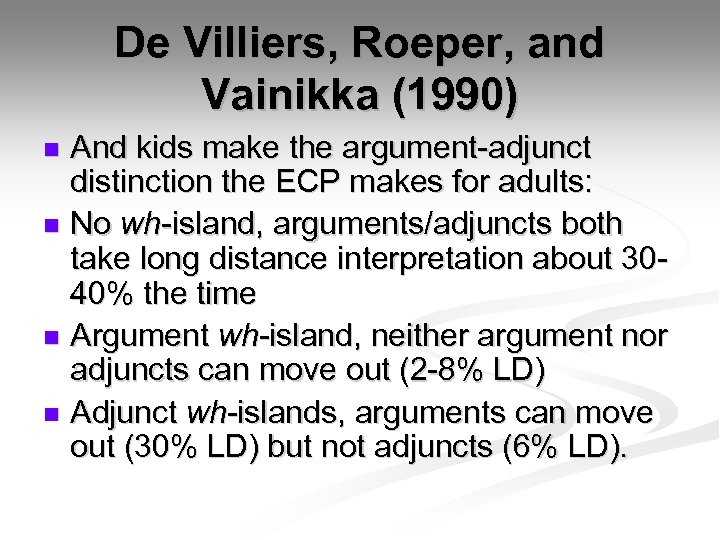 De Villiers, Roeper, and Vainikka (1990) And kids make the argument-adjunct distinction the ECP makes for adults: n No wh-island, arguments/adjuncts both take long distance interpretation about 3040% the time n Argument wh-island, neither argument nor adjuncts can move out (2 -8% LD) n Adjunct wh-islands, arguments can move out (30% LD) but not adjuncts (6% LD). n
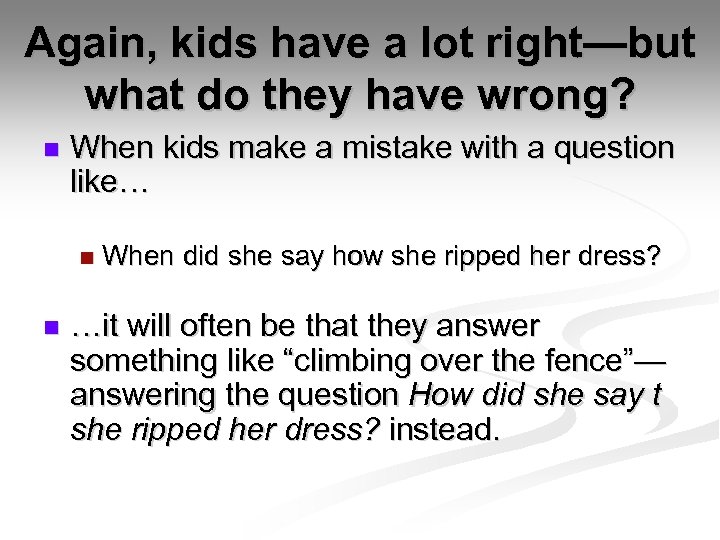 Again, kids have a lot right—but what do they have wrong? n When kids make a mistake with a question like… n n When did she say how she ripped her dress? …it will often be that they answer something like “climbing over the fence”— answering the question How did she say t she ripped her dress? instead.
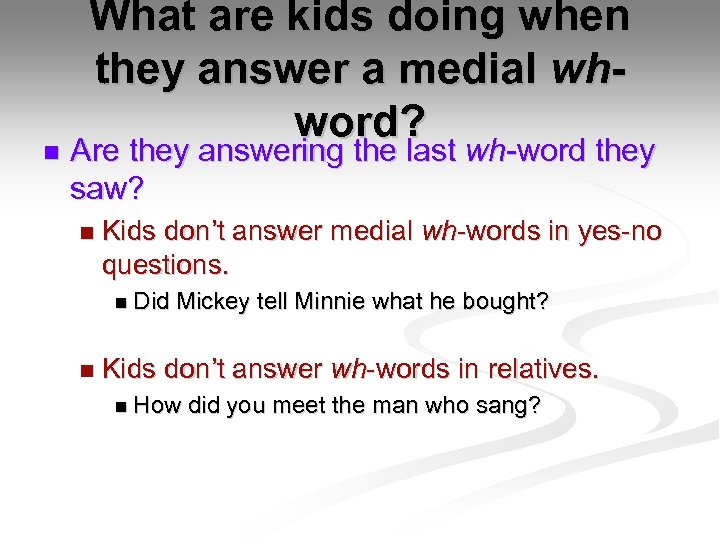 n What are kids doing when they answer a medial whword? Are they answering the last wh-word they saw? n Kids don’t answer medial wh-words in yes-no questions. n Did n Mickey tell Minnie what he bought? Kids don’t answer wh-words in relatives. n How did you meet the man who sang?
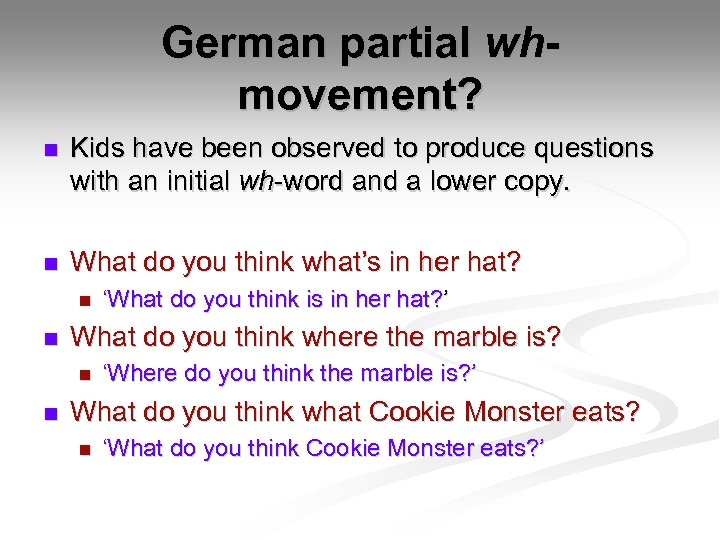 German partial whmovement? n Kids have been observed to produce questions with an initial wh-word and a lower copy. n What do you think what’s in her hat? n n What do you think where the marble is? n n ‘What do you think is in her hat? ’ ‘Where do you think the marble is? ’ What do you think what Cookie Monster eats? n ‘What do you think Cookie Monster eats? ’
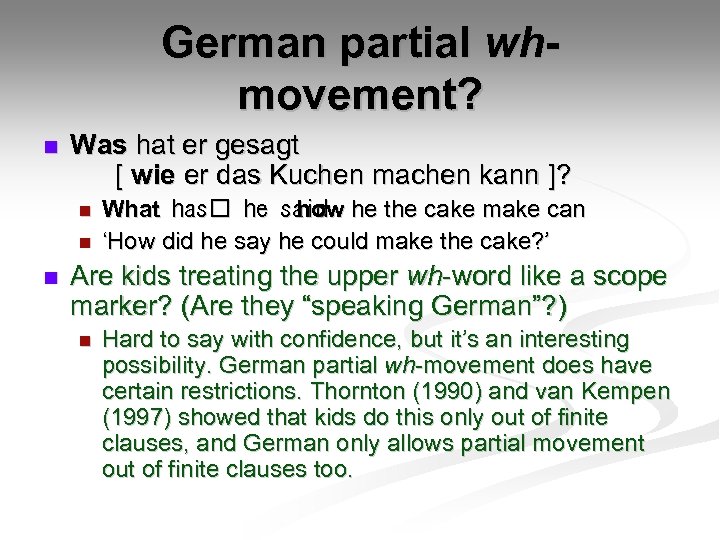 German partial whmovement? n Was hat er gesagt [ wie er das Kuchen machen kann ]? n n n What has he said he the cake make can how ‘How did he say he could make the cake? ’ Are kids treating the upper wh-word like a scope marker? (Are they “speaking German”? ) n Hard to say with confidence, but it’s an interesting possibility. German partial wh-movement does have certain restrictions. Thornton (1990) and van Kempen (1997) showed that kids do this only out of finite clauses, and German only allows partial movement out of finite clauses too.
 Processing constraints? n O’Grady (last year’s textbook) suggests that another reason why kids might answer the intermediate wh-word is that they’ve already forgotten the matrix clause (citing Phinney 1981, who found that 3 -year olds often delete the matrix subject and verb when repeating biclausal sentences). n Kids don’t answer a medial wh-word in a yes-no question, though. . ?
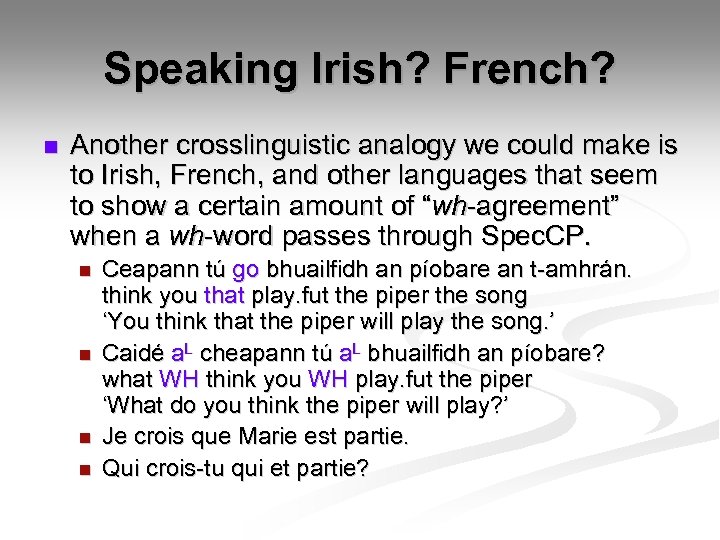 Speaking Irish? French? n Another crosslinguistic analogy we could make is to Irish, French, and other languages that seem to show a certain amount of “wh-agreement” when a wh-word passes through Spec. CP. n n Ceapann tú go bhuailfidh an píobare an t-amhrán. think you that play. fut the piper the song ‘You think that the piper will play the song. ’ Caidé a. L cheapann tú a. L bhuailfidh an píobare? what WH think you WH play. fut the piper ‘What do you think the piper will play? ’ Je crois que Marie est partie. Qui crois-tu qui et partie?
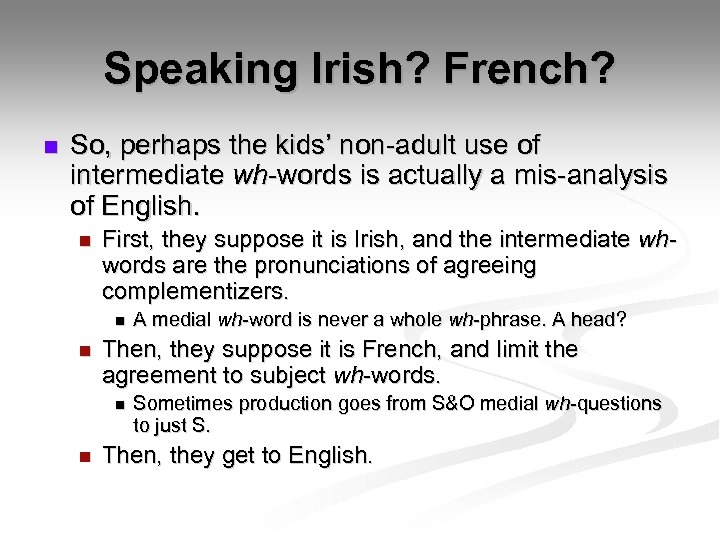 Speaking Irish? French? n So, perhaps the kids’ non-adult use of intermediate wh-words is actually a mis-analysis of English. n First, they suppose it is Irish, and the intermediate whwords are the pronunciations of agreeing complementizers. n n Then, they suppose it is French, and limit the agreement to subject wh-words. n n A medial wh-word is never a whole wh-phrase. A head? Sometimes production goes from S&O medial wh-questions to just S. Then, they get to English.
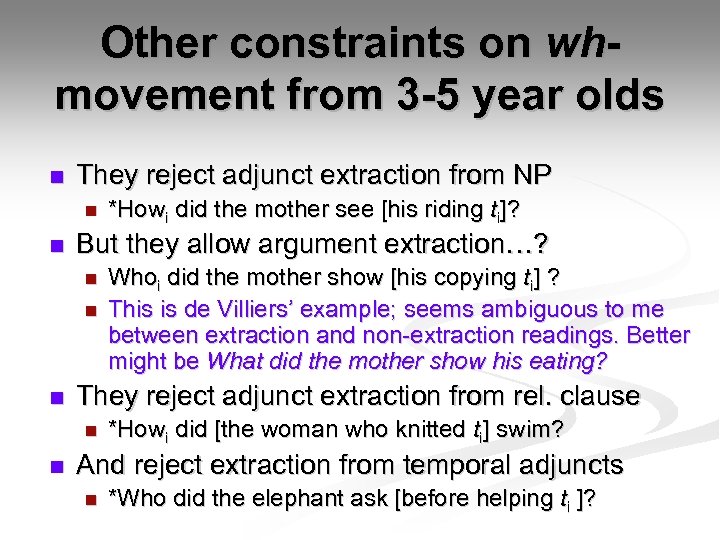 Other constraints on whmovement from 3 -5 year olds n They reject adjunct extraction from NP n n But they allow argument extraction…? n n n Whoi did the mother show [his copying ti] ? This is de Villiers’ example; seems ambiguous to me between extraction and non-extraction readings. Better might be What did the mother show his eating? They reject adjunct extraction from rel. clause n n *Howi did the mother see [his riding ti]? *Howi did [the woman who knitted ti] swim? And reject extraction from temporal adjuncts n *Who did the elephant ask [before helping ti ]?
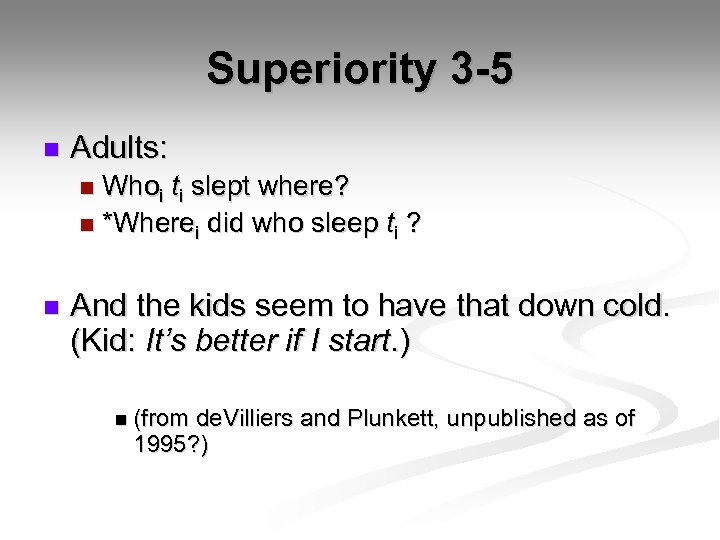 Superiority 3 -5 n Adults: Whoi ti slept where? n *Wherei did who sleep ti ? n n And the kids seem to have that down cold. (Kid: It’s better if I start. ) n (from de. Villiers and Plunkett, unpublished as of 1995? )
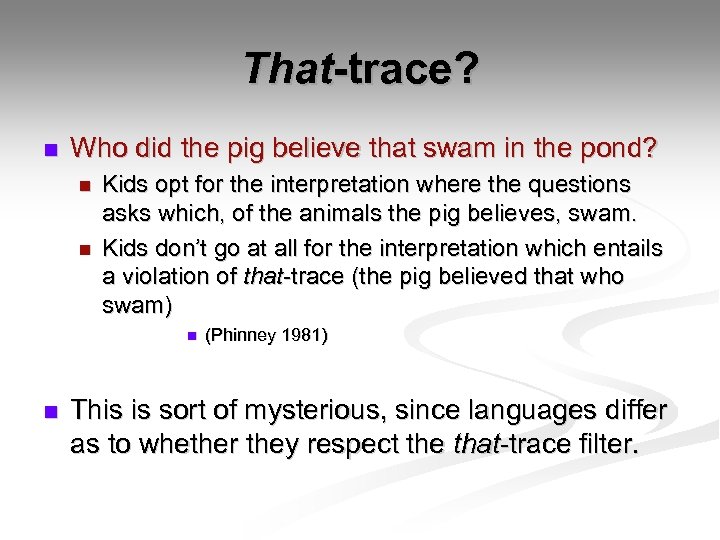 That-trace? n Who did the pig believe that swam in the pond? n n Kids opt for the interpretation where the questions asks which, of the animals the pig believes, swam. Kids don’t go at all for the interpretation which entails a violation of that-trace (the pig believed that who swam) n n (Phinney 1981) This is sort of mysterious, since languages differ as to whether they respect the that-trace filter.
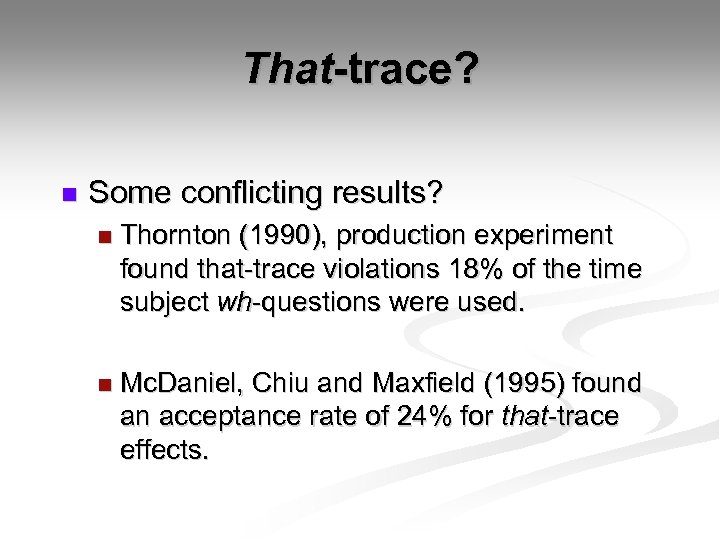 That-trace? n Some conflicting results? n Thornton (1990), production experiment found that-trace violations 18% of the time subject wh-questions were used. n Mc. Daniel, Chiu and Maxfield (1995) found an acceptance rate of 24% for that-trace effects.
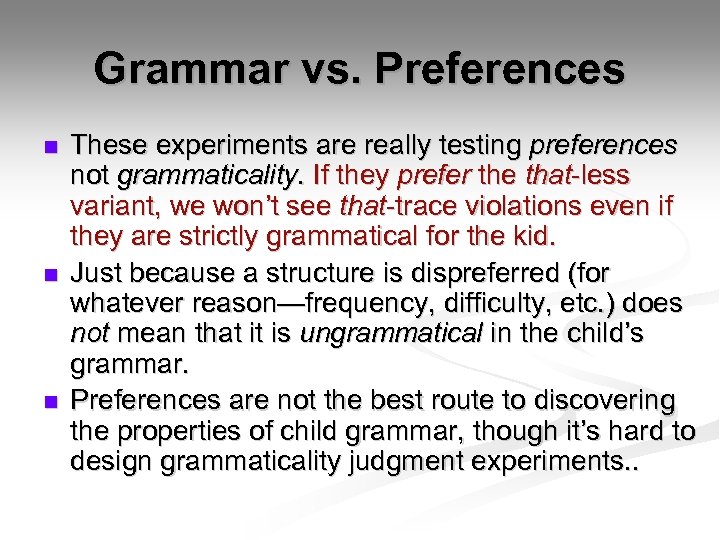 Grammar vs. Preferences n n n These experiments are really testing preferences not grammaticality. If they prefer the that-less variant, we won’t see that-trace violations even if they are strictly grammatical for the kid. Just because a structure is dispreferred (for whatever reason—frequency, difficulty, etc. ) does not mean that it is ungrammatical in the child’s grammar. Preferences are not the best route to discovering the properties of child grammar, though it’s hard to design grammaticality judgment experiments. .
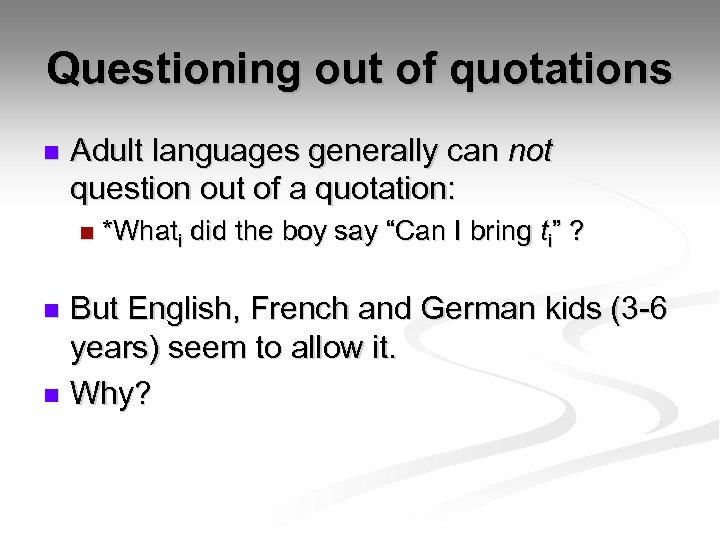 Questioning out of quotations n Adult languages generally can not question out of a quotation: n *Whati did the boy say “Can I bring ti” ? But English, French and German kids (3 -6 years) seem to allow it. n Why? n
 Correlates to questioning out of quotations n n Kids may not quite grasp the quotation yet. A significant proportion of kids around the same age range allow co-reference between a pronoun in the quotation and the subject: n n “Hei can sit here” said Mickeyi. Perhaps, it has more to do with the fact that it requires “getting into someone else’s head”…
 False beliefs n Kids before a certain age (usually before 4) seem unable to take another person’s perspective: n Little rabbit puts carrot in red basket, leaves. Mother rabbit comes in, moves carrot to blue basket. Little rabbit comes back. Where does he look for the carrot? n Some kids will answer “the blue basket”—unable to see that the little rabbit shouldn’t have known.
 False beliefs & quotations n Those same kids who answered “blue basket” were also those who would do this: n n Mother bought cake, but wanted to surprise girl. When asked, mother claimed to have bought paper towels. What did Mother say she bought? n The “blue basket” kids answer “cake. ”
 False beliefs & quotations n So, perhaps it is understanding what a quotation is that is allowing kids to extract from them—they treat a quotation as a regular clausal complement.
 Weak islands n In the adult language, there is a certain configuration which seems to create an island for movement of wh-adjuncts, which arguably has to do with the logical meaning. Coming by train is a subset of the events coming. n John said Mary was coming by train implies John said Mary was coming. n
 Weak islands n In weak islands the implication fails: n Negation: n John didn’t say Mary was coming by train. n John didn’t say Mary was coming. n Factives: n John forgot Mary was coming by train. n John forgot Mary was coming. n With quantificational adverbs: n John often eats grapes with a fork. n John often eats grapes.
 Weak islands n And in those cases, you can’t extract whadjuncts in the adult language. n Whyi did John say (ti) that Mary left (ti)? n Whyi did John forget (ti) that Mary left (*ti)? n Whyi didn’t John say (ti) that Mary left (*ti)? n Whyi does John often say (ti) that Mary left (*ti)?
 Weak islands n Four-year-olds have been observed to fail on the implication: n n n Jim forgot that his aunt was arriving by train, so he went to the bus station to pick her up… Did Jim forget that his aunt was coming? —Yes! Guess: They haven’t gotten the implication pattern down for these non-monotonic-increasing environments.
 Weak islands n Now: If kids haven’t gotten the implication pattern, and if the implication pattern is implicated in the islandhood, do kids fail to observe weak islands just when they also fail on the implication pattern? n Philip and de Villiers (1992) looked into this…
 Philip and de Villiers (1992) n Kids never allow LD association out of a whisland (they obeyed the purely syntactic constraint). n n *Whyi did the mother ask [what he made ti ]? The other facts were “generally in support”(de Villiers 1995) of the conclusion that where kids fail to make the inferences required by nonmonotone-increasing environments, they also fail to treat them as movement islands.
 Multiple questions n A fair amount of theoretical work has concerned the treatment of multiple whquestions. n n E. g. , the wh-typology: English (move one) vs. Japanese (move none) vs. Bulgarian (move all). What do kids do with them? n Well, but that’s lunacy—adults barely use them, how are we going to find out about kids?
 Grebenyova (2005) n Russian as a multiple-movement language: n n chto kuda Smurf polozhil? What where S put? Interpretation: n n n PL (Pair-list): Who invited who for dinner? SP (Single pair): Which diplomat invited which journalist? Who invited the roommate of who for dinner? Who invited who for dinner? n n English, Russian: PL, *SP Serbo-Croatian, Japanese: PL, SP:
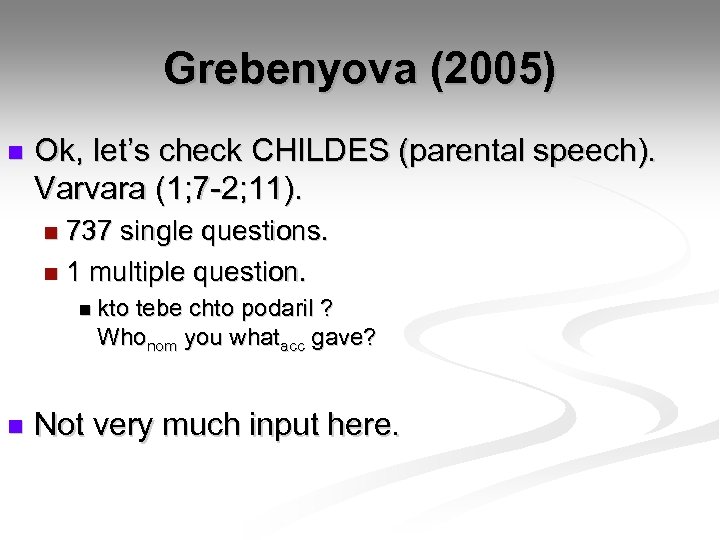 Grebenyova (2005) n Ok, let’s check CHILDES (parental speech). Varvara (1; 7 -2; 11). 737 single questions. n 1 multiple question. n n kto tebe chto podaril ? Whonom you whatacc gave? n Not very much input here.
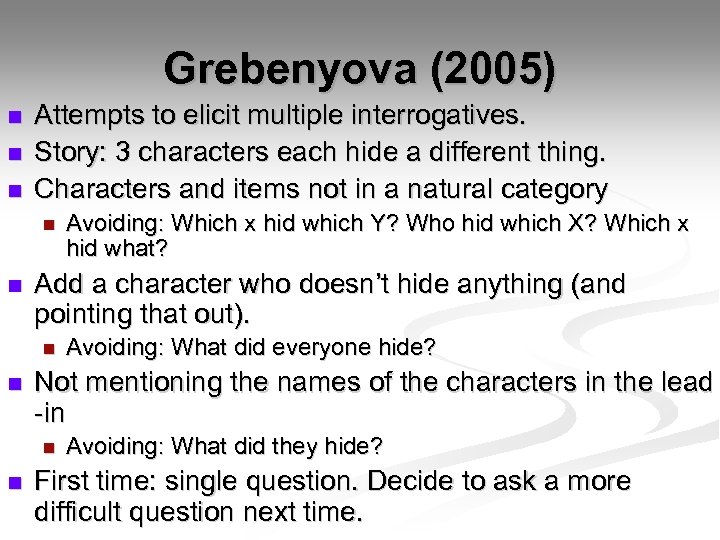 Grebenyova (2005) n n n Attempts to elicit multiple interrogatives. Story: 3 characters each hide a different thing. Characters and items not in a natural category n n Add a character who doesn’t hide anything (and pointing that out). n n Avoiding: What did everyone hide? Not mentioning the names of the characters in the lead -in n n Avoiding: Which x hid which Y? Who hid which X? Which x hid what? Avoiding: What did they hide? First time: single question. Decide to ask a more difficult question next time.
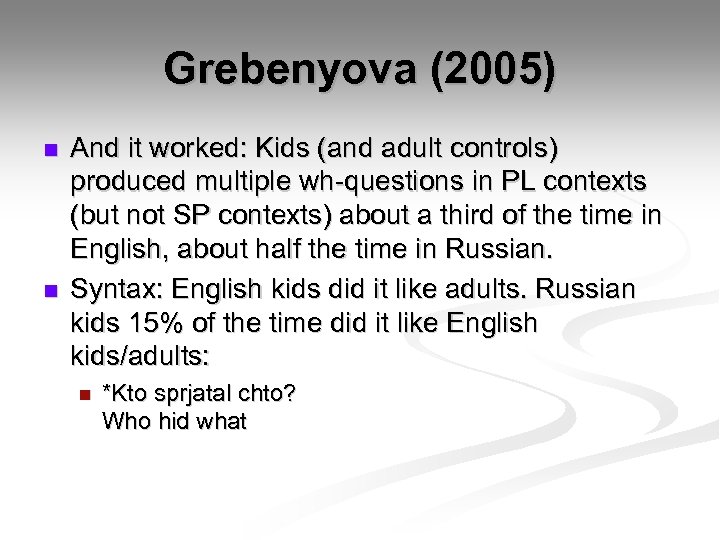 Grebenyova (2005) n n And it worked: Kids (and adult controls) produced multiple wh-questions in PL contexts (but not SP contexts) about a third of the time in English, about half the time in Russian. Syntax: English kids did it like adults. Russian kids 15% of the time did it like English kids/adults: n *Kto sprjatal chto? Who hid what
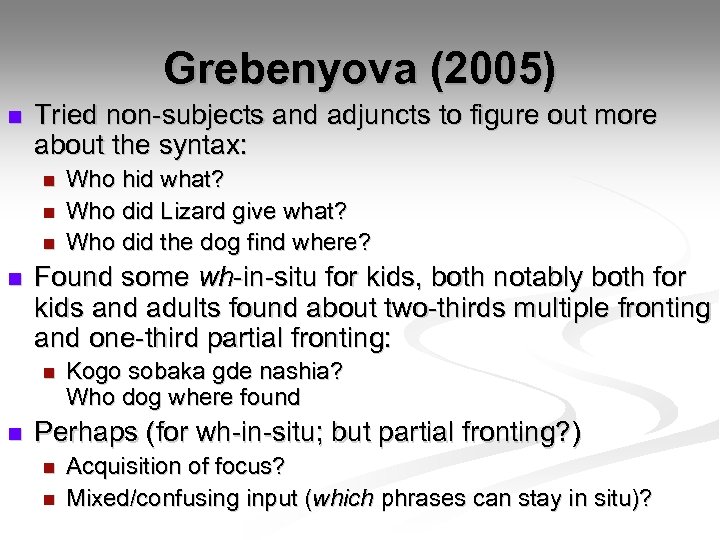 Grebenyova (2005) n Tried non-subjects and adjuncts to figure out more about the syntax: n n Found some wh-in-situ for kids, both notably both for kids and adults found about two-thirds multiple fronting and one-third partial fronting: n n Who hid what? Who did Lizard give what? Who did the dog find where? Kogo sobaka gde nashia? Who dog where found Perhaps (for wh-in-situ; but partial fronting? ) n n Acquisition of focus? Mixed/confusing input (which phrases can stay in situ)?

 Stepping back a bit n Let’s take some time to look at a few results coming out of an earlier tradition, not strictly Principles & Parameters (and not covered by White) but still suggesting that to a certain extent L 2 learners may know something (perhaps unconsciously) about “what Language is like” (which is a certain way we might characterize the content of UG).
 Typological universals 1960’s and 1970’s saw a lot of activity aimed at identifying language universals, properties of Language. n Class of possible languages is smaller than you might think. n If a language has one property (A), it will necessarily have another (B). n n +A+B, –A–B, –A+B but never +A–B.
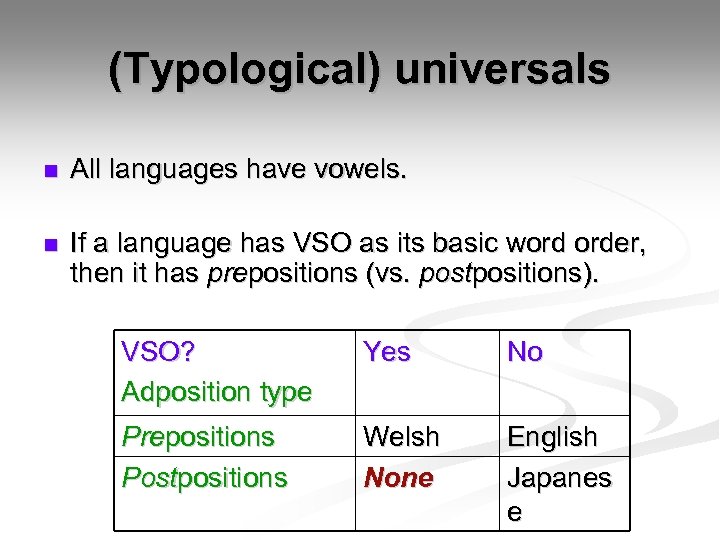 (Typological) universals n All languages have vowels. n If a language has VSO as its basic word order, then it has prepositions (vs. postpositions). VSO? Adposition type Yes No Prepositions Postpositions Welsh None English Japanes e
 Markedness n n Having duals implies having plurals Having plurals says nothing about having duals. Having duals is marked—infrequent, more complex. Having plurals is (relative to having duals) unmarked. Generally markedness is in terms of comparable dimensions, but you could also say that being VSO is marked relative to having prepositions.
 Markedness “Markedness” actually has been used in a couple of different ways, although they share a common core. n Marked: More unlikely, in some sense. n Unmarked: More likely, in some sense. n n You have to “mark” something marked; unmarked is what you get if you don’t say anything extra.
![“Unlikeliness” n Typological / crosslinguistic infrequency. n n More complex constructions. n n [ts]](https://present5.com/presentation/55f5cb21922482fe4e2fbea1709b4aff/image-79.jpg "“Unlikeliness” n Typological / crosslinguistic infrequency. n n More complex constructions. n n [ts]") “Unlikeliness” n Typological / crosslinguistic infrequency. n n More complex constructions. n n [ts] is more marked than [t]. The non-default setting of a parameter. n n VOS word order is marked. Non-null subjects? Language-specific/idiosyncratic features. n Vs. UG/universal features…?
“Unlikeliness” n Typological / crosslinguistic infrequency. n n More complex constructions. n n [ts] is more marked than [t]. The non-default setting of a parameter. n n VOS word order is marked. Non-null subjects? Language-specific/idiosyncratic features. n Vs. UG/universal features…?
 Berlin & Kay 1969: Color terms (On the boundaries of psychophysics, linguistics, anthropology, and with issues about its interpretation, but still…) n Basic color terms across languages. n It turns out that languages differ in how many color terms count as basic. (blueish, salmon-colored, crimson, blond, … are not basic). n
 Berlin & Kay 1969: Color terms n The segmentation of experience by speech symbols is essentially arbitrary. The different sets of words for color in various languages are perhaps the best ready evidence for such essential arbitrariness. For example, in a high percentage of African languages, there are only three “color words, ” corresponding to our white, black, red, which nevertheless divide up the entire spectrum. In the Tarahumara language of Mexico, there are five basic color words, and here “blue” and “green” are subsumed under a single term. n Eugene Nida (1959)
 Berlin & Kay 1969: Color terms n n n n n Arabic (Lebanon) Bulgarian (Bulgaria) Catalan (Spain) Cantonese (China) Mandarin (China) English (US) Hebrew (Israel) Hungarian (Hungary) Ibibo (Nigeria) Indonesian (Indonesia) n n n n n Japanese (Japan) Korean (Korea) Pomo (California) Spanish (Mexico) Swahili (East Africa) Tagalog (Philippines) Thai (Thailand) Tzeltal (Southern Mexico) Urdu (India) Vietnamese (Vietnam)
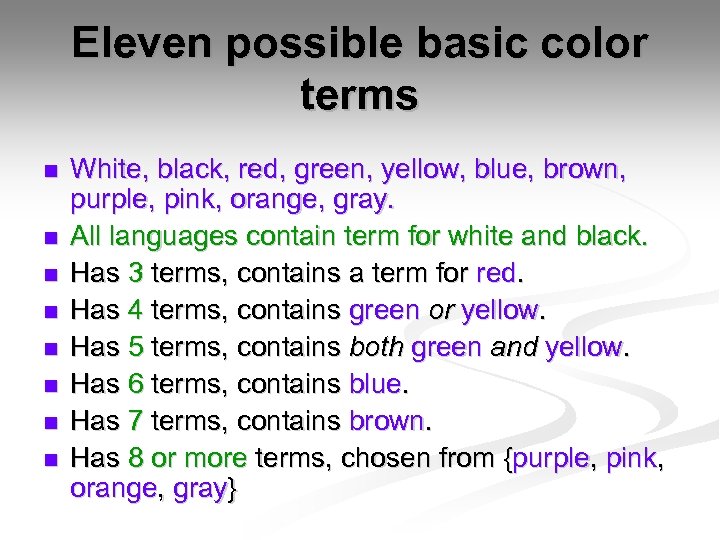 Eleven possible basic color terms n n n n White, black, red, green, yellow, blue, brown, purple, pink, orange, gray. All languages contain term for white and black. Has 3 terms, contains a term for red. Has 4 terms, contains green or yellow. Has 5 terms, contains both green and yellow. Has 6 terms, contains blue. Has 7 terms, contains brown. Has 8 or more terms, chosen from {purple, pink, orange, gray}
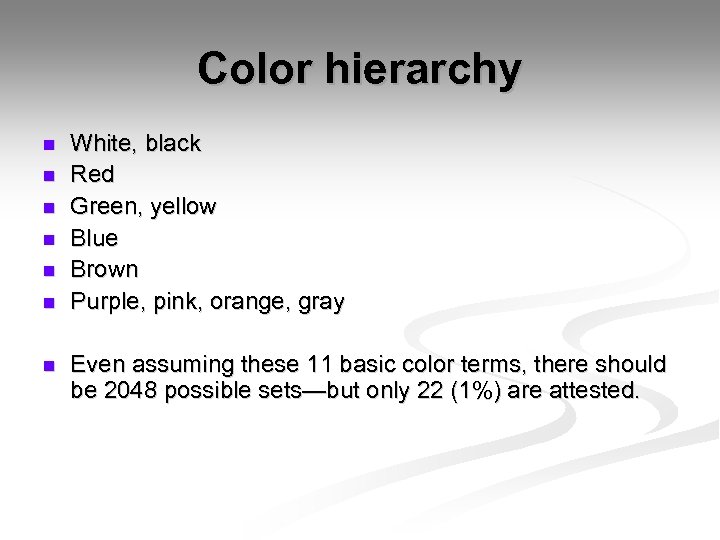 Color hierarchy n n n n White, black Red Green, yellow Blue Brown Purple, pink, orange, gray Even assuming these 11 basic color terms, there should be 2048 possible sets—but only 22 (1%) are attested.
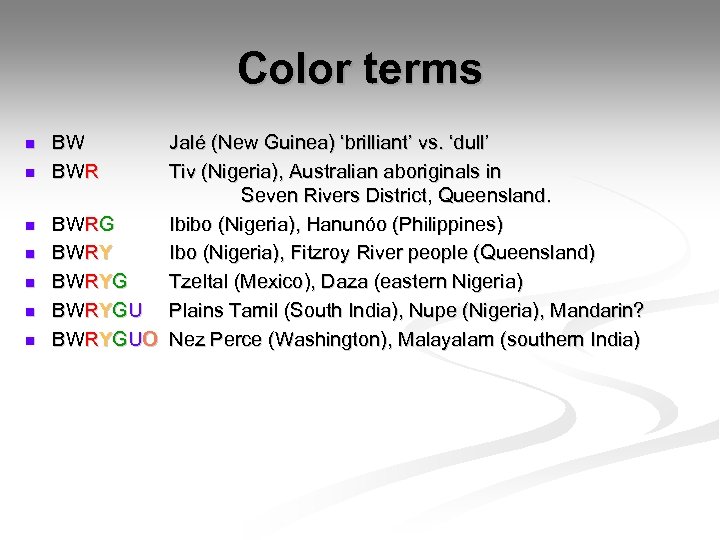 Color terms n n n n BW BWR Jalé (New Guinea) ‘brilliant’ vs. ‘dull’ Tiv (Nigeria), Australian aboriginals in Seven Rivers District, Queensland. BWRG Ibibo (Nigeria), Hanunóo (Philippines) BWRY Ibo (Nigeria), Fitzroy River people (Queensland) BWRYG Tzeltal (Mexico), Daza (eastern Nigeria) BWRYGU Plains Tamil (South India), Nupe (Nigeria), Mandarin? BWRYGUO Nez Perce (Washington), Malayalam (southern India)
 Color terms Interesting questions abound, including why this order, why these eleven—and there are potential reasons for it that can be drawn from the perception of color spaces which we will not attempt here. n The point is: This is a fact about Language: If you have a basic color term for blue, you also have basic color terms for black, white, red, green, and yellow. n
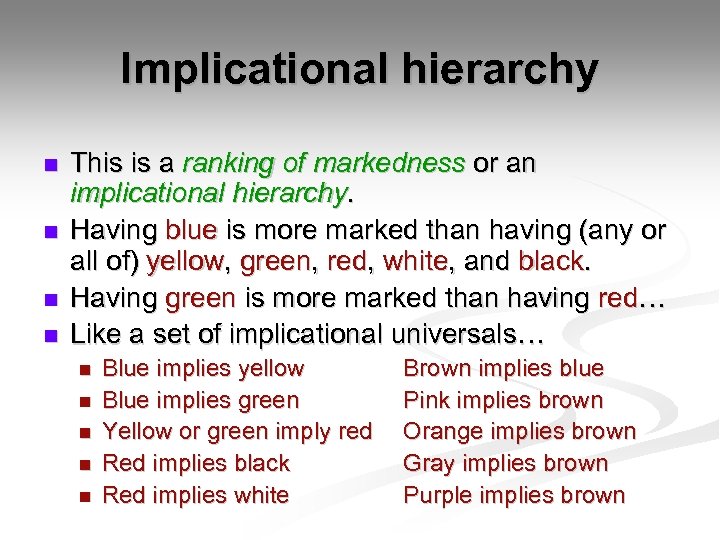 Implicational hierarchy n n This is a ranking of markedness or an implicational hierarchy. Having blue is more marked than having (any or all of) yellow, green, red, white, and black. Having green is more marked than having red… Like a set of implicational universals… n n n Blue implies yellow Blue implies green Yellow or green imply red Red implies black Red implies white Brown implies blue Pink implies brown Orange implies brown Gray implies brown Purple implies brown
 L 2 A? Our overarching theme: How much is L 2/IL like a L 1? n Do L 2/IL languages obey the language universals that hold of native languages? n This question is slightly less theory-laden than the questions we were asking about principles and parameters, although it’s similar… n To my knowledge nobody has studied L 2 acquisitions of color terms… n
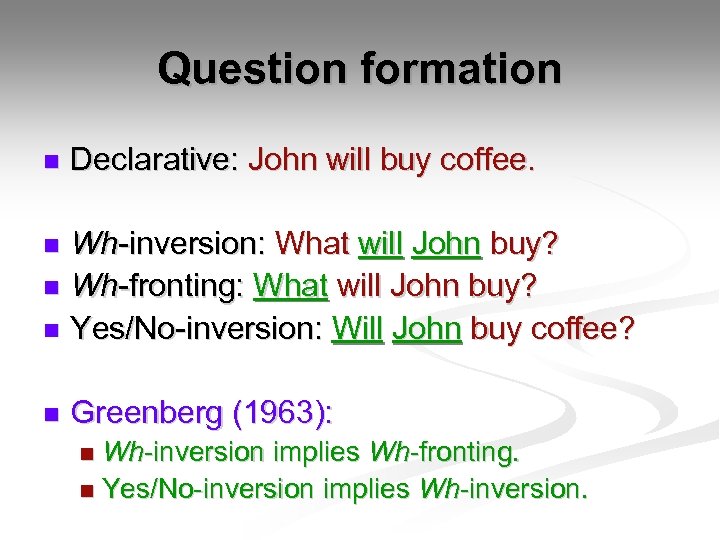 Question formation n Declarative: John will buy coffee. Wh-inversion: What will John buy? n Wh-fronting: What will John buy? n Yes/No-inversion: Will John buy coffee? n n Greenberg (1963): Wh-inversion implies Wh-fronting. n Yes/No-inversion implies Wh-inversion. n
 Eckman, Moravcsik, Wirth (1989) L 1: Korean (4), Japanese (6), Turkish (4) n L 2: English n Note L 1 s chosen because they are neither/neither type languages, to avoid questions of transfer. n Subjects tried to determine what was going on in a scene by asking questions. n
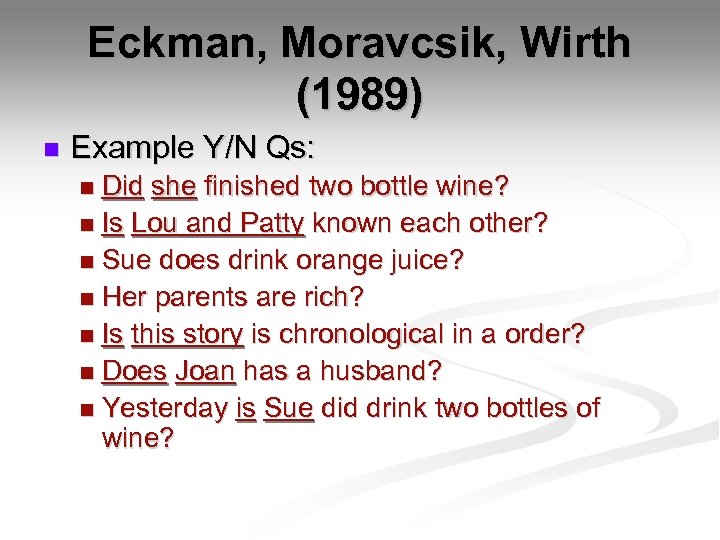 Eckman, Moravcsik, Wirth (1989) n Example Y/N Qs: Did she finished two bottle wine? n Is Lou and Patty known each other? n Sue does drink orange juice? n Her parents are rich? n Is this story is chronological in a order? n Does Joan has a husband? n Yesterday is Sue did drink two bottles of wine? n
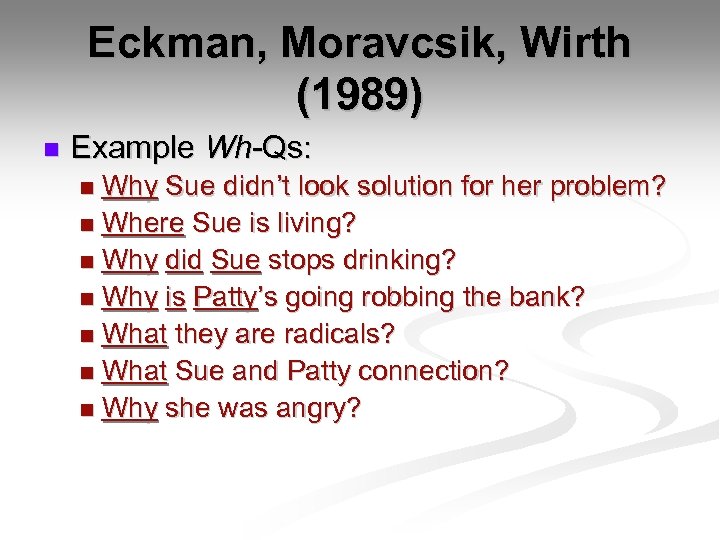 Eckman, Moravcsik, Wirth (1989) n Example Wh-Qs: Why Sue didn’t look solution for her problem? n Where Sue is living? n Why did Sue stops drinking? n Why is Patty’s going robbing the bank? n What they are radicals? n What Sue and Patty connection? n Why she was angry? n
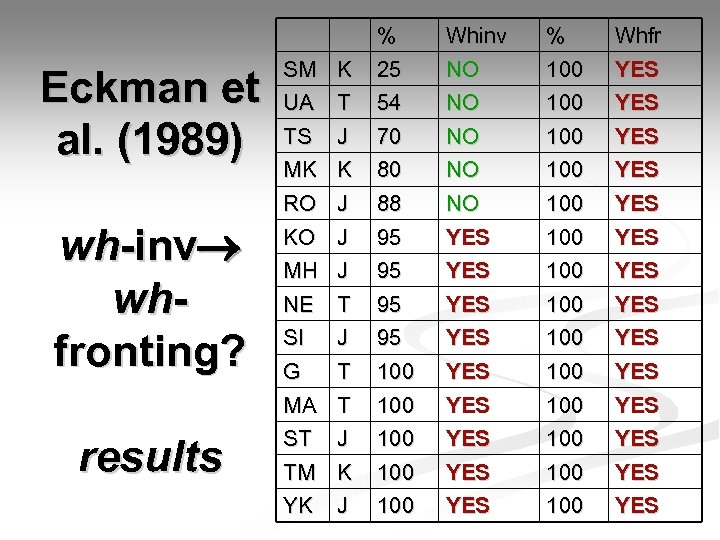 Eckman et al. (1989) wh-inv whfronting? results SM K UA T TS J MK K RO J KO J MH J NE T SI J G T MA T ST J TM K YK J % 25 Whinv NO % 100 Whfr YES 54 70 NO NO 100 YES 80 88 NO NO 100 100 YES YES 95 95 YES YES 100 100 YES YES 100 YES
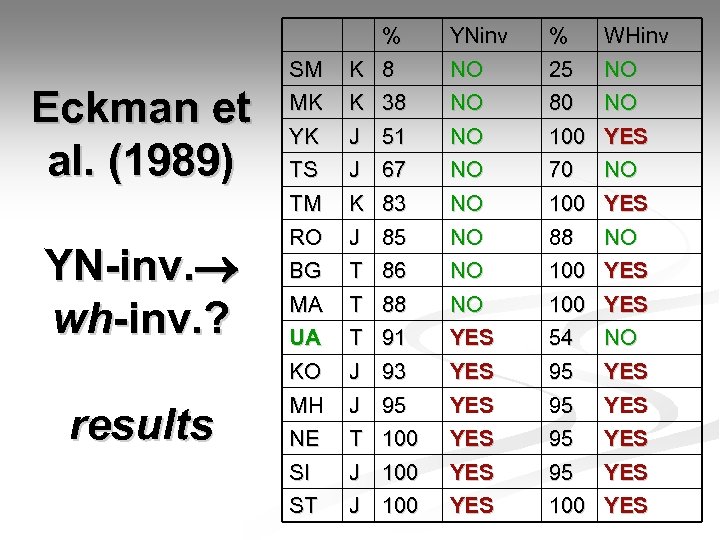 Eckman et al. (1989) YN-inv. wh-inv. ? results SM MK YK TS TM RO BG MA UA KO MH NE SI ST % K 8 K 38 J 51 J 67 K 83 J 85 T 86 T 88 T 91 J 93 J 95 T 100 J 100 YNinv NO % 25 NO NO 80 NO 100 YES 70 NO NO NO YES YES YES WHinv NO 100 YES 88 NO 100 YES 54 NO 95 YES 95 YES 100 YES
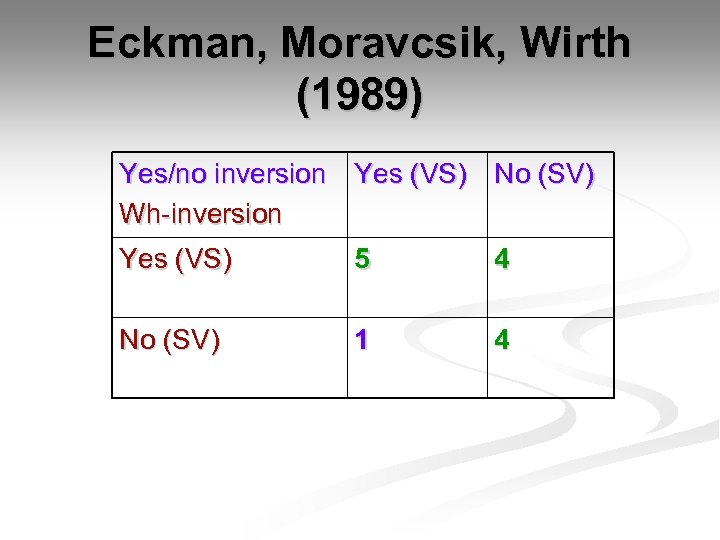 Eckman, Moravcsik, Wirth (1989) Yes/no inversion Yes (VS) No (SV) Wh-inversion Yes (VS) 5 4 No (SV) 1 4
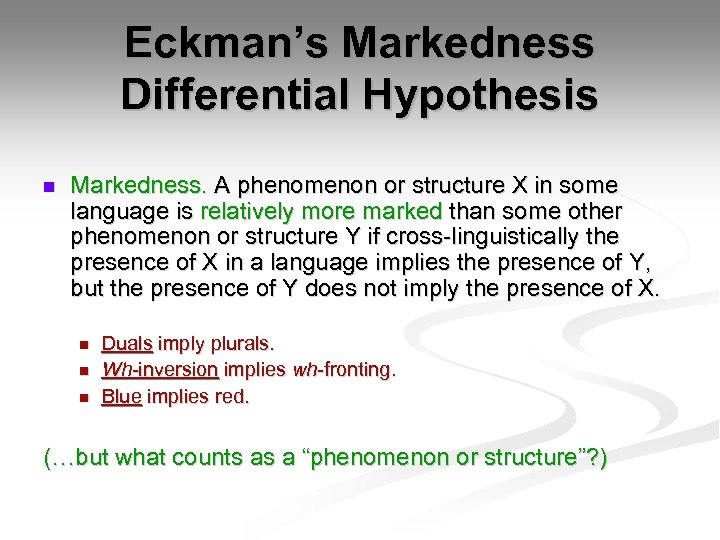 Eckman’s Markedness Differential Hypothesis n Markedness. A phenomenon or structure X in some language is relatively more marked than some other phenomenon or structure Y if cross-linguistically the presence of X in a language implies the presence of Y, but the presence of Y does not imply the presence of X. n n n Duals imply plurals. Wh-inversion implies wh-fronting. Blue implies red. (…but what counts as a “phenomenon or structure”? )
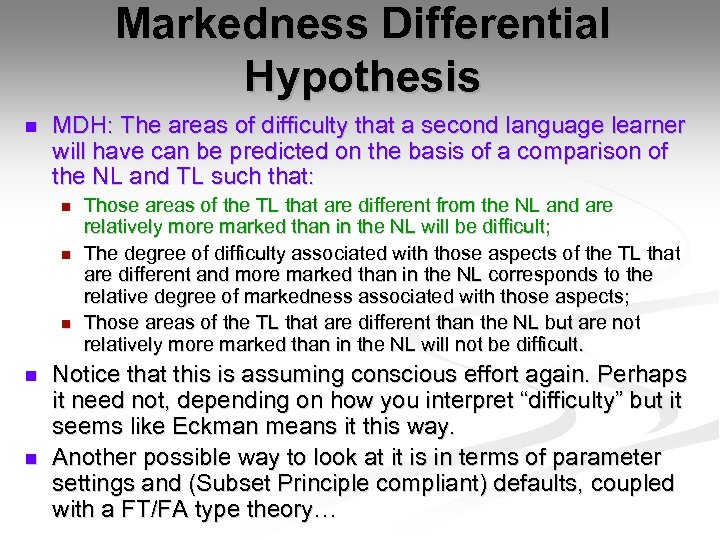 Markedness Differential Hypothesis n MDH: The areas of difficulty that a second language learner will have can be predicted on the basis of a comparison of the NL and TL such that: n n n Those areas of the TL that are different from the NL and are relatively more marked than in the NL will be difficult; The degree of difficulty associated with those aspects of the TL that are different and more marked than in the NL corresponds to the relative degree of markedness associated with those aspects; Those areas of the TL that are different than the NL but are not relatively more marked than in the NL will not be difficult. Notice that this is assuming conscious effort again. Perhaps it need not, depending on how you interpret “difficulty” but it seems like Eckman means it this way. Another possible way to look at it is in terms of parameter settings and (Subset Principle compliant) defaults, coupled with a FT/FA type theory…
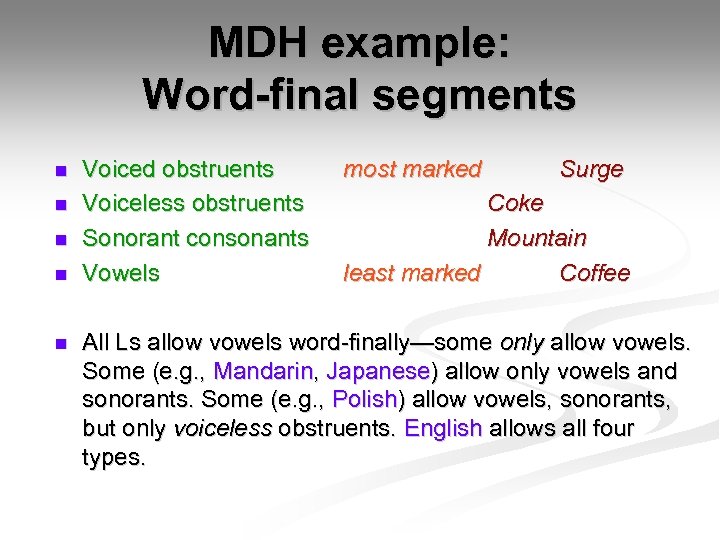 MDH example: Word-final segments n n n Voiced obstruents Voiceless obstruents Sonorant consonants Vowels most marked Surge Coke Mountain least marked Coffee All Ls allow vowels word-finally—some only allow vowels. Some (e. g. , Mandarin, Japanese) allow only vowels and sonorants. Some (e. g. , Polish) allow vowels, sonorants, but only voiceless obstruents. English allows all four types.
![Eckman (1981) e e IL form [b p] [b bi] [r t] [w t]](https://present5.com/presentation/55f5cb21922482fe4e2fbea1709b4aff/image-99.jpg "Eckman (1981) e e IL form [b p] [b bi] [r t] [w t]") Eckman (1981) e e IL form [b p] [b bi] [r t] [w t] [s. Ik] Mandarin L 1 Gloss IL form Tag [tæg ] And [ænd ] Wet [w t] Deck [d k] Letter [l t r] Bleeding [blid. In] e e c c e Spanish L 1 Gloss Bobby Red Wet Sick
Eckman (1981) e e IL form [b p] [b bi] [r t] [w t] [s. Ik] Mandarin L 1 Gloss IL form Tag [tæg ] And [ænd ] Wet [w t] Deck [d k] Letter [l t r] Bleeding [blid. In] e e c c e Spanish L 1 Gloss Bobby Red Wet Sick
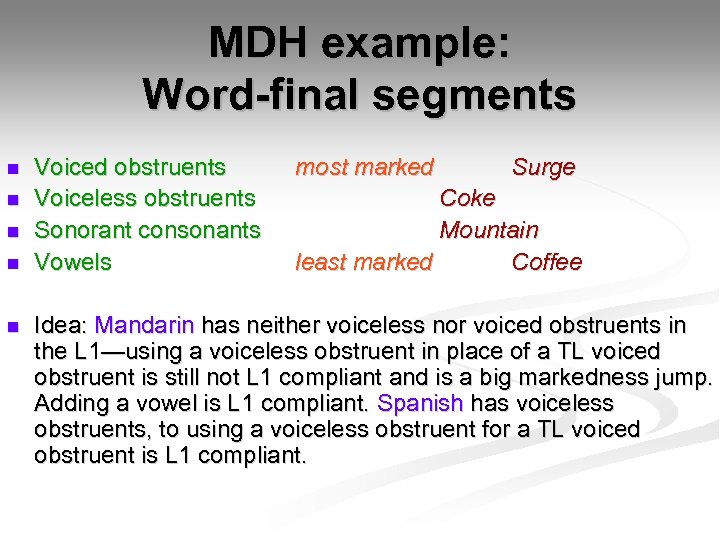 MDH example: Word-final segments n n n Voiced obstruents Voiceless obstruents Sonorant consonants Vowels most marked Surge Coke Mountain least marked Coffee Idea: Mandarin has neither voiceless nor voiced obstruents in the L 1—using a voiceless obstruent in place of a TL voiced obstruent is still not L 1 compliant and is a big markedness jump. Adding a vowel is L 1 compliant. Spanish has voiceless obstruents, to using a voiceless obstruent for a TL voiced obstruent is L 1 compliant.
 MDH and IL The MDH presupposes that the IL obeys the implicational universals too. n Eckman et al. (1989) suggests that this is at least reasonable. n The MDH suggests that there is a natural order of L 2 A along a markedness scale (stepping to the next level of markedness is easiest). n Let’s consider what it means that an IL obeys implicational universals… n
 MDH and IL n n IL obeys implicational universals. That is, we know that IL is a language. So, we know that languages are such that having word-final voiceless obstruents implies that you also have word-final sonorant consonants, among other things. What would happen if we taught Japanese L 2 learners of English only—and at the outset—voiced obstruents?
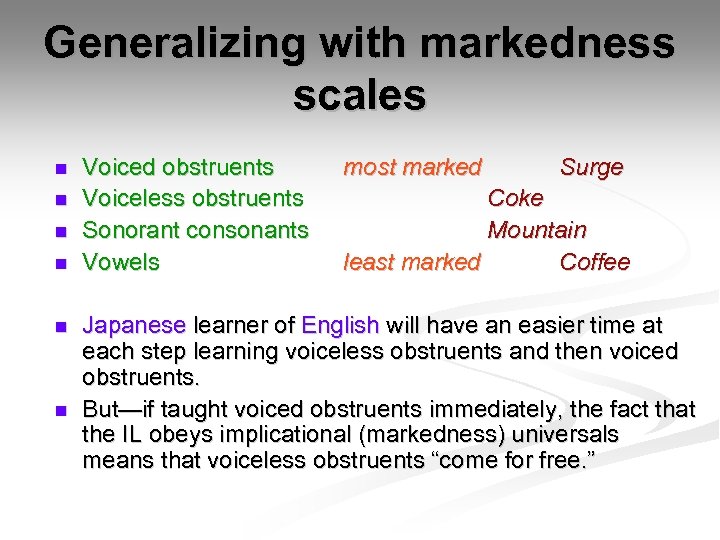 Generalizing with markedness scales n n n Voiced obstruents Voiceless obstruents Sonorant consonants Vowels most marked Surge Coke Mountain least marked Coffee Japanese learner of English will have an easier time at each step learning voiceless obstruents and then voiced obstruents. But—if taught voiced obstruents immediately, the fact that the IL obeys implicational (markedness) universals means that voiceless obstruents “come for free. ”
 Nifty! Does it work? Does it help? n Answers seem to be: n Yes, it seems to at least sort of work. n Maybe it helps. n n Learning a marked structure is harder. So, if you learn a marked structure, you can automatically generalize to the less marked structures, but was it faster than learning the easier steps in succession would have been?
 The Noun Phrase Accessibility Hierarchy n n n Keenan & Comrie (1977) observed a hierarchy among the kinds of relative clauses that languages allow. The astronaut [(that) I met yesterday]. Head noun: astronaut Modifying clause: (that/who) I met — yesterday. Compare: I met the astronaut yesterday. This is an object relative because the place where the head noun would be in the simple sentence version is the object.
 The Noun Phrase Accessibility Hierarchy n n There are several kinds of relative clauses, based on where the head noun “comes from” in the modifying clause: The astronaut… n n n [I met — yesterday] [who — met me yesterday] [I gave a book to —] [I was talking about —] [whose house I like —] [I am braver than —] object subject indirect obj. of P Genitive (possessor) obj. of comparative
 The Noun Phrase Accessibility Hierarchy n Turns out: Languages differ in what positions they allow relative clauses to be formed on. n English allows all the positions mentioned to be used to make relative clauses. Arabic allows relative clauses to be formed only with subjects. Greek allows relative clauses to be formed only with subjects or objects. n n
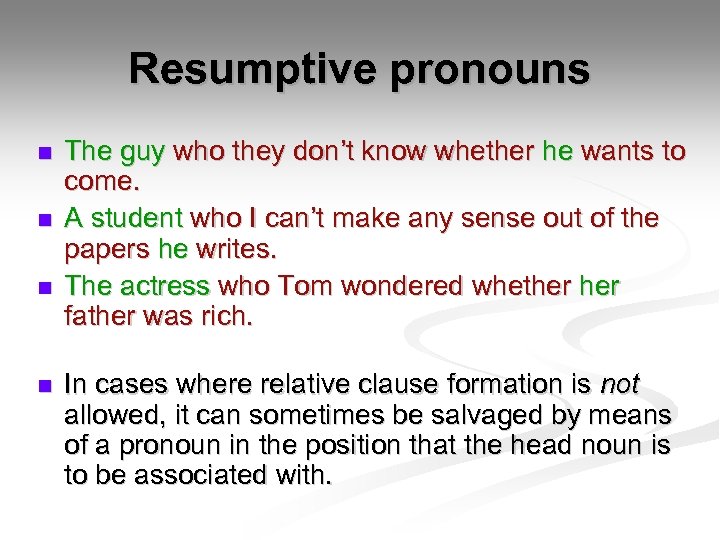 Resumptive pronouns n n The guy who they don’t know whether he wants to come. A student who I can’t make any sense out of the papers he writes. The actress who Tom wondered whether father was rich. In cases where relative clause formation is not allowed, it can sometimes be salvaged by means of a pronoun in the position that the head noun is to be associated with.
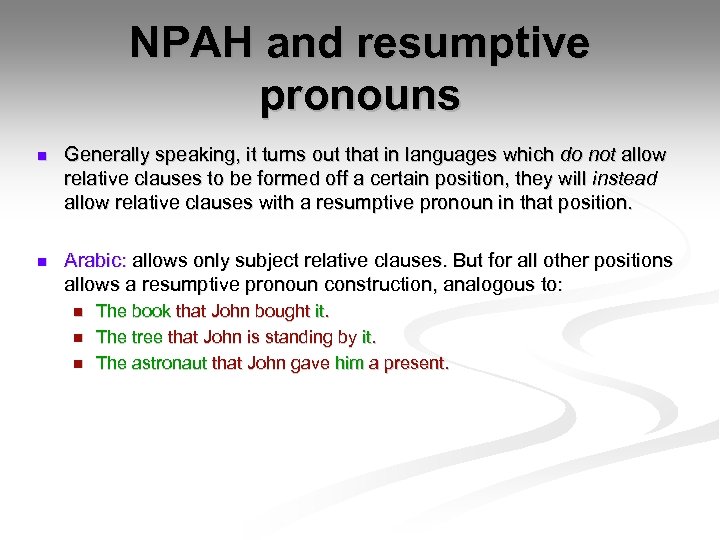 NPAH and resumptive pronouns n Generally speaking, it turns out that in languages which do not allow relative clauses to be formed off a certain position, they will instead allow relative clauses with a resumptive pronoun in that position. n Arabic: allows only subject relative clauses. But for all other positions allows a resumptive pronoun construction, analogous to: n n n The book that John bought it. The tree that John is standing by it. The astronaut that John gave him a present.
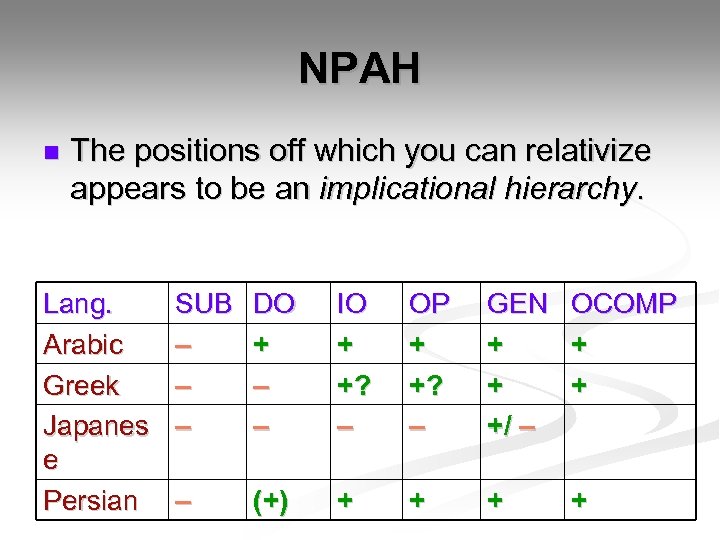 NPAH n The positions off which you can relativize appears to be an implicational hierarchy. Lang. Arabic Greek Japanes e Persian SUB – – – DO + – – IO + +? – OP + +? – GEN OCOMP + + +/ – – (+) + +
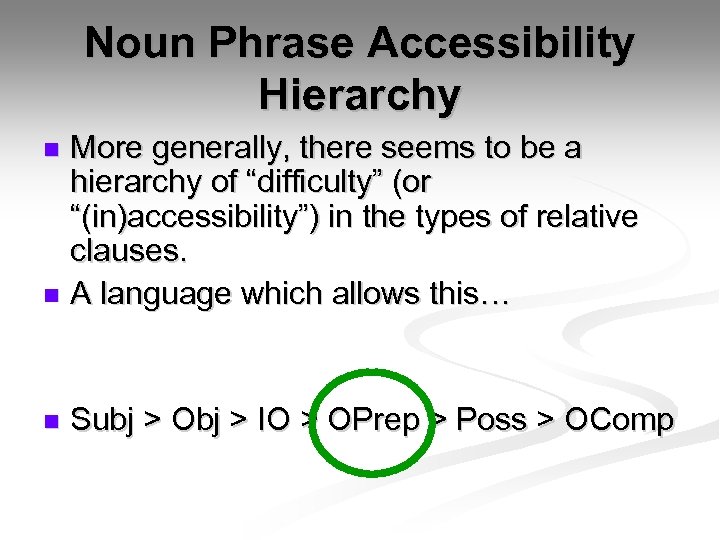 Noun Phrase Accessibility Hierarchy More generally, there seems to be a hierarchy of “difficulty” (or “(in)accessibility”) in the types of relative clauses. n A language which allows this… n n Subj > Obj > IO > OPrep > Poss > OComp
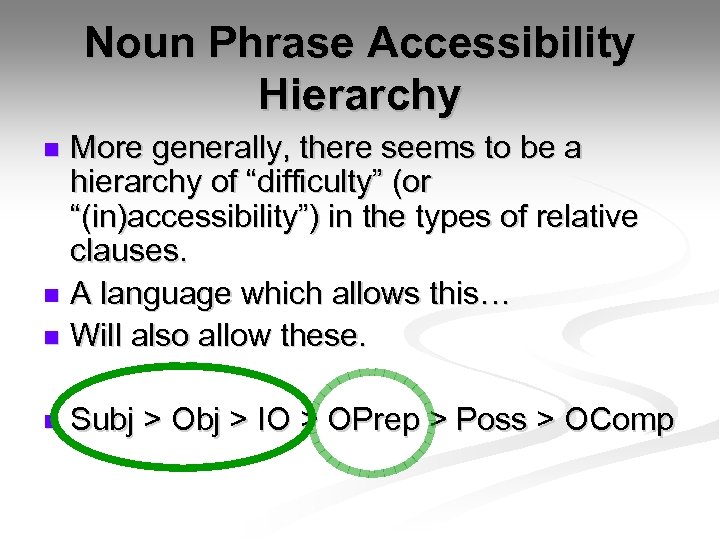 Noun Phrase Accessibility Hierarchy More generally, there seems to be a hierarchy of “difficulty” (or “(in)accessibility”) in the types of relative clauses. n A language which allows this… n Will also allow these. n n Subj > Obj > IO > OPrep > Poss > OComp
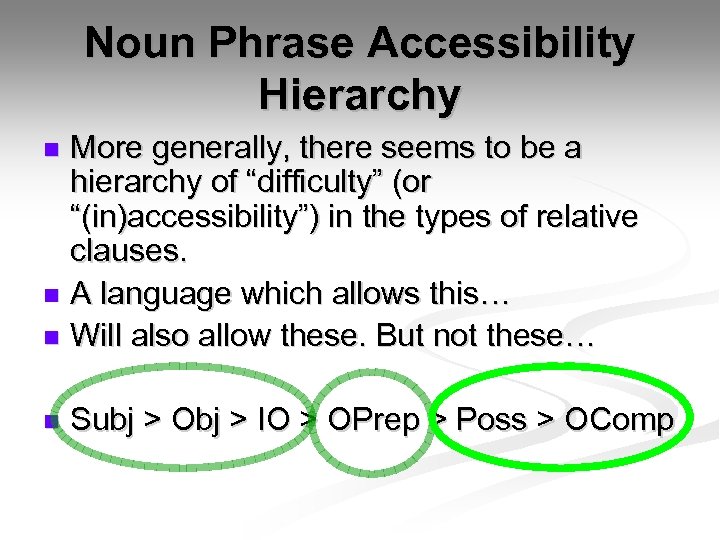 Noun Phrase Accessibility Hierarchy More generally, there seems to be a hierarchy of “difficulty” (or “(in)accessibility”) in the types of relative clauses. n A language which allows this… n Will also allow these. But not these… n n Subj > Obj > IO > OPrep > Poss > OComp
 Relation to L 2 A? n n Suppose that Ko. L includes where the target language is on the NPAH. Do L 2’ers learn the easy/unmarked/simple relative clauses before the others? Do L 2’ers transfer the position of their L 1 first? Does a L 2’ers interlanguage grammar obey this typological generalization (if they can relativize a particular point on the NPAH, can they relativize everything higher too? )?
 NPAH and L 2 A? n n n Probably: The higher something is on the NPAH, the easier (faster) it is to learn. So, it might be easier to start by teaching subject relatives, then object, then indirect object, etc. At each step, the difficulty would be low. But, it might be more efficient to teach the (hard) object of a comparison—because if L 2’ers interlanguage grammar includes whatever the NPAH describes, knowing that OCOMP is possible implies that everything (higher) on the NPAH is possible too. That is, they might know it without instruction. (Same issue as before with the phonology)
 NPAH in L 2 A n Very widely studied implicational universal in L 2 A—many people have addressed the question of whether the IL obeys the NPAH and whether teaching aa marked structure can help. n Eckman et al. (1989) was about this second question…
 Change from pre- to post-test Eckman, Bell, & Nelson (1988)
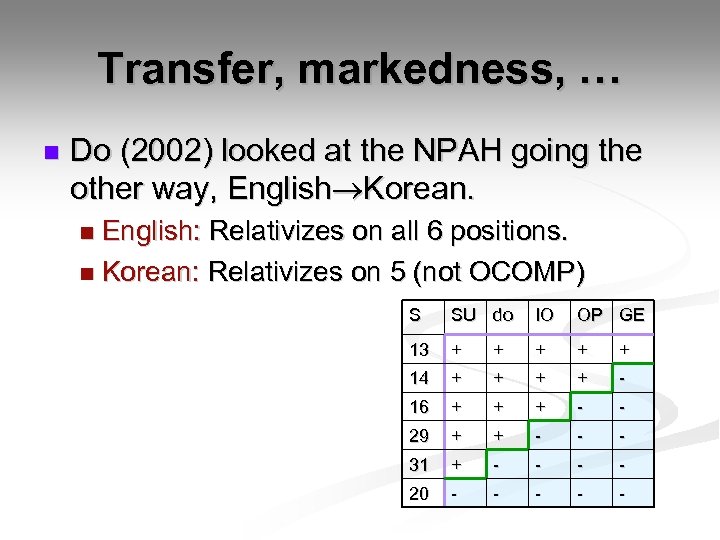 Transfer, markedness, … n Do (2002) looked at the NPAH going the other way, English Korean. English: Relativizes on all 6 positions. n Korean: Relativizes on 5 (not OCOMP) n S SU do IO OP GE 13 + + + 14 + + - 16 + + + - - 29 + + - - - 31 + - - 20 - - -
 Transfer, markedness, … The original question Do was looking at was: Do English speakers transfer their position on the NPAH to the IL Korean? n But look: If English allows all 6 positions, why do some of the learners only relativize down to DO, some to IO, some to OPREP? n It looks like they started over. n
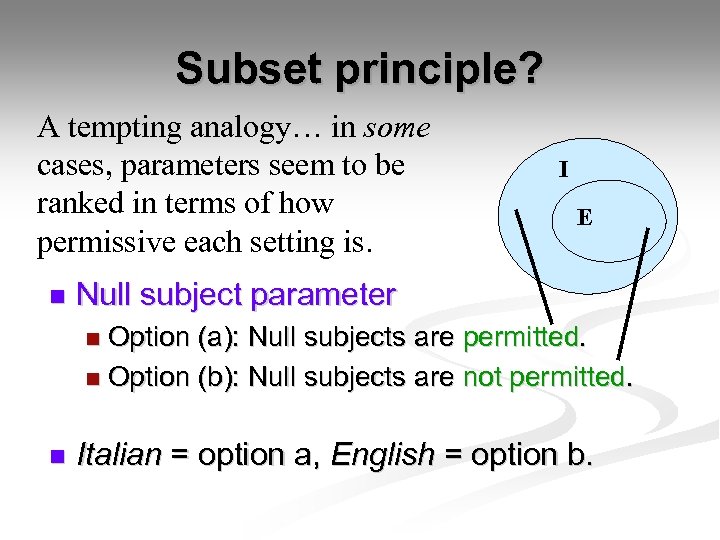 Subset principle? A tempting analogy… in some cases, parameters seem to be ranked in terms of how permissive each setting is. n I E Null subject parameter Option (a): Null subjects are permitted. n Option (b): Null subjects are not permitted. n n Italian = option a, English = option b.
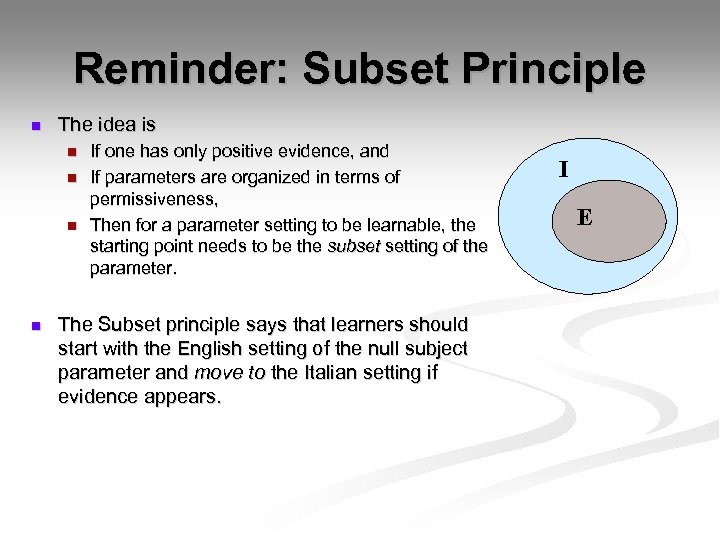 Reminder: Subset Principle n The idea is n n If one has only positive evidence, and If parameters are organized in terms of permissiveness, Then for a parameter setting to be learnable, the starting point needs to be the subset setting of the parameter. The Subset principle says that learners should start with the English setting of the null subject parameter and move to the Italian setting if evidence appears. I E
 Reminder: Subset Principle n n The Subset Principle is basically that learners are conservative—they only assume a grammar sufficient to generate the sentences they hear, allowing positive evidence to serve to move them to a different parameter setting. Applied to L 2: Given a choice, the L 2’er assumes a grammatical option that generates a subset of the what the alternative generates. Does this describe L 2 A? Is this a useful sense of markedness?
 Subset principle and markedness n Based on the Subset principle, we’d expect the unmarked values (in a UG where languages are learnable) to be the ones which produce the “smallest” grammars. n Given that in L 1 A we don’t seem to see any “misset” parameters, we have at least indirect evidence that the Subset principle is at work. Is there any evidence for it in L 2 A? Do these NPAH results constitute such evidence?
 Subset vs. Transfer n n The Subset Principle, if it operating, would say that L 2 A starts with all of the defaults, the maximally conservative grammar. Another, mutually exclusive possibility (parameter by parameter, anyway) is that L 2 A starts with the L 1 setting. n n This means that for certain pairs of L 1 and L 2, where the L 1 has the marked (superset) value and L 2 has the unmarked (subset) value, only negative evidence could move the L 2’er to the right setting. Or, some mixture of the two in different areas.
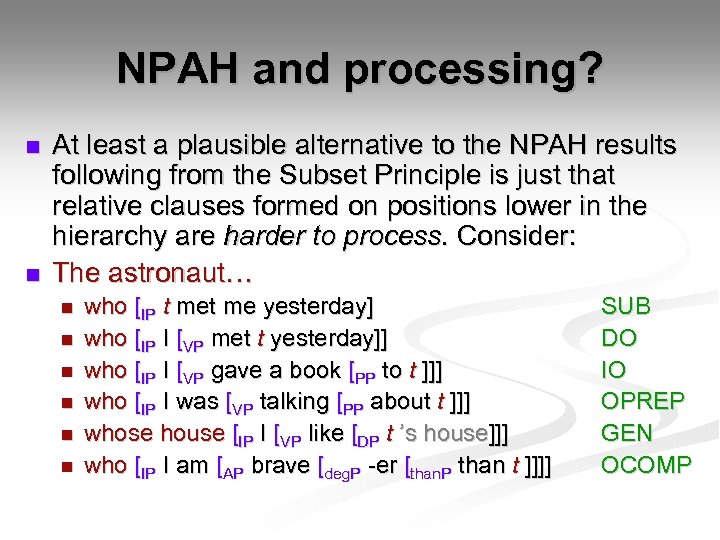 NPAH and processing? n n At least a plausible alternative to the NPAH results following from the Subset Principle is just that relative clauses formed on positions lower in the hierarchy are harder to process. Consider: The astronaut… n n n who [IP t me yesterday] who [IP I [VP met t yesterday]] who [IP I [VP gave a book [PP to t ]]] who [IP I was [VP talking [PP about t ]]] whose house [IP I [VP like [DP t ’s house]]] who [IP I am [AP brave [deg. P -er [than. P than t ]]]] SUB DO IO OPREP GEN OCOMP
 NPAH and processing? If it’s about processing, then the reason L 2’ers progress through the “hierarchy” might be that initially they have limited processing room—they’re working too hard at the L 2 to be able to process such deep extractions. n Why are they working so hard? n n (Well, maybe L 2 A is like learning history? )
 NPAH and processing? n n n Is the NPAH itself simply a result of processing? The NPAH is a typological generalization about languages not about the course of acquisition. Does Arabic have a lower threshhold for processing difficulty than English? Doubtful. The NPAH may still be real, still be a markedness hierarchy based in something grammatical, but it turns out to be confounded by processing. So finding evidence of NPAH position transfer is very difficult.
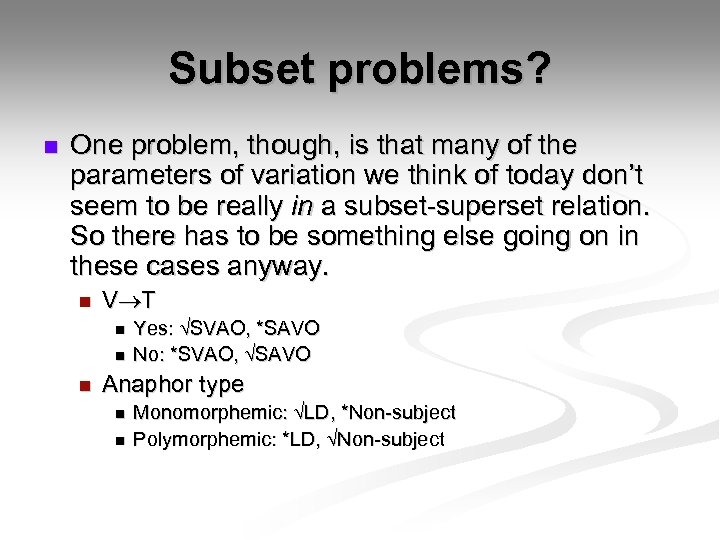 Subset problems? n One problem, though, is that many of the parameters of variation we think of today don’t seem to be really in a subset-superset relation. So there has to be something else going on in these cases anyway. n V T n n n Yes: √SVAO, *SAVO No: *SVAO, √SAVO Anaphor type n n Monomorphemic: √LD, *Non-subject Polymorphemic: *LD, √Non-subject