


 Скачать презентацию Growth outside the core MKT 5102 Managing Marketing
Growth outside the core.pptx
- Количество слайдов: 14
 Growth outside the core MKT 5102 Managing Marketing Instructor Dr. Bulent Dumlupinar Ordabayev Saniyaz 20142321 Hacer Pamuk 20142437
 Outline Introduction Nike’s case The Discipline Needed The Benefits Gained – Learning curve effect – Reduced complexity & Speed – Strategic clarity • The source of repeatability – Segmenting customers & Growing share of wallet – Mirroring customer adjacencies • Conclusion • •
 Introduction • Seventy-five percent of growth initiatives fail. So how do the few firms that generate sustained, profitable growth succeed? They expand their strong, core businesses—in predictable, repeatable ways—into related markets where they can excel
 Nike’s case • Nike begins by establishing a leading position in athletic shoes in the target market. • Next, Nike launches a clothing line endorsed by the sport’s top athletes—like Tiger Woods, whose $100 million deal in 1996 gave Nike the visibility it needed to get traction in golf apparel and accessories. Expanding into new categories allows the company to forge new distribution channels and lock in suppliers. • Then it starts to feed higher-margin equipment into the market— irons first, in the case of golf clubs, and subsequently drivers. • In the final step, Nike moves beyond the U. S. market to global distribution.
 Nike’s case(cont. ) • In 1987, Nike’s operating profits were $164 million to Reebok’s $309 million, and Nike’s market valuation was half the size of Reebok’s. By 2002, Nike had grown its profits to $1. 1 billion, while Reebok’s had declined to $247 million. Both companies had started out in the same business with the same manufacturing technology and comparable brand names.
 The Discipline Needed • First, they were extraordinarily disciplined, applying rigorous screens before they made an adjacency move. This discipline paid off in the form of learning-curve benefits, increased speed, and lower complexity. • Second, in almost all cases, they developed their repeatable formulas by studying their customers and their customers’ economics very, very carefully.
 The Benefits Gained • • Learning curve effect Reduced complexity Speed Strategic clarity
 Learning-Curve Effects. • A repeatable model allows managers to refine skills and systematize processes that are developed mostly through guesswork the first time.
 Reduced Complexity & Speed • “Complexity is the bane of a large organization, It strangles growth” • When a company has mastered a repeatable formula for adjacency moves, it can successfully start—and finish—a number of moves faster than a competitor would.
 Strategic Clarity • A surprising number of chief executives fail to communicate a clear growth strategy to the investment community—and they pay a high price. • First, repeatability doesn’t happen overnight. Nike took a while to find its repeatable pattern. Second, a repeatable formula for adjacency expansion is practically imitation proof. Nike’s formula helped it pull away from competitors that were watching its success but unable to match it.
 The Sources of Repeatability • Failed experiments aren’t the only way to figure out what works. Nearly 80% of the successful adjacency formulas we studied were built around insights about customer behavior. It’s a logical connection for companies to make: The more attuned a company is to its customers’ preferences the more readily it can spot untapped opportunities.
 Segmenting customers & Growing share of wallet • The foundation for a repeatable formula is effective customer segmentation. • Selling related products to customers you know intimately—in other words, growing share of wallet—is another highly successful expansion strategy, according to our study.
 Mirroring Customer Adjacencies • Other companies uncover opportunities by tracking their customers’ expansion plans and anticipating their needs. • Repeatability is just one formula for profitably outstripping the average growth rate in your sector. There are others: Investing in faster product innovation or cornering market power, to name a couple. But focused companies with a strong core that hit upon a formula for repeatedly expanding their strengths to new arenas have it made for the long term. Such repeatability becomes a source of growth and value year after year. The formula for repeatability is already lodged in your experience—you just need to look for it.
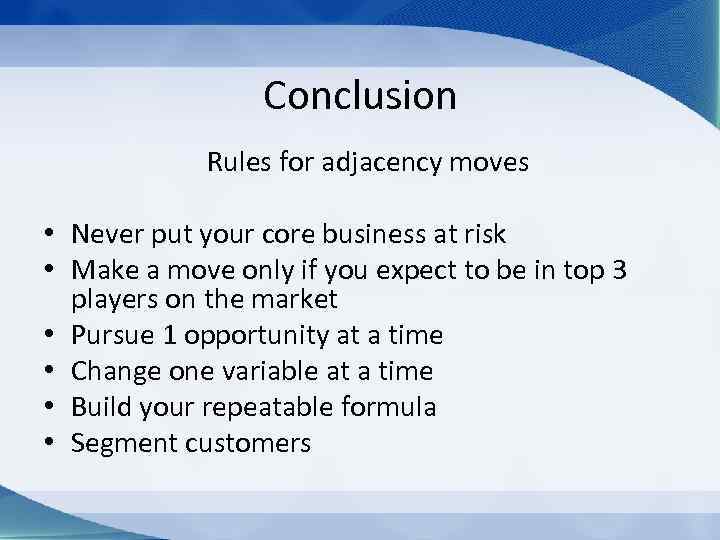 Conclusion Rules for adjacency moves • Never put your core business at risk • Make a move only if you expect to be in top 3 players on the market • Pursue 1 opportunity at a time • Change one variable at a time • Build your repeatable formula • Segment customers