 Скачать презентацию GROWING ORGANIC MANGO NATURAL HERBAL ORGANIC and BIOLOGICAL
6fd2779c752021eadee550f885be8bb6.ppt
- Количество слайдов: 80



GROWING ORGANIC MANGO NATURAL HERBAL ORGANIC and BIOLOGICAL FARMING in MANGO PRODUCTION 2008 Prepared by: REX A. RIVERA Agronomist & Mango Specialist
INTRODUCTION ¡ ¡ ¡ The emerging domestic and export markets are demanding Organically Grown Fruits and Vegetables Free from Toxic Chemical Content and Residues. This compels us to produce ORGANICALLY GROWN MANGO. This is now possible with present technology on Natural Organic and Biological Farming System developed.
Issues and Concerns of the Mango Industry Predominance of backyard farms. Divers cultural practices. ¡ Erratic and relatively low yield ¡ Susceptibility to wide range of insects and diseases. Mono crop ¡ Highly perishable ¡ High cost of production inputs ¡ Multi-layered sector resulting in marketing inefficiency ¡
HISTORY ¡ ¡ ¡ ¡ ¡ 1950 – Most if not all mango were naturally grown. 1960 – Conventional Farming using Chemicals adopted. 1970 – Dr. Ramon Barba discovered KNO 3 as inducer. 1980 – Commercial Mango Production using Chemicals. 1990 – Growing Market Demand for Organic Food Crops 2000 – New Organic Fertilizers and Foliar Fertilizers use. 2005 – EO -481 Promoting Organic Farming nationwide. 2005 – HOC (Herbal Organic Concentrate) developed. 2007 – 9 th NMC Growing Organic Mango was introduced 2008 – First National Organic Mango Conference. In Olongapo City. Sponsored by PREDA – Fair Trade
NATURAL LAWS During the creation of the World, the Creator in placed NATURAL LAWS governing life and the environment. • These are GOD’s Laws, we have to obey. • These laws govern the environment and living things includes the mango tree and its culture. • As farmers, we have to know and obey them to produce more good quality fruits. •
NATURAL VEGETATION See the forest and wild vegetation how they grow without man’s intervention. • • Trees, shrubs, vines and grass grow big, healthy with bio diversity. • The soil is fertile, moist & full of life. • Pest and diseases are minimal The environment is fresh and healthy. •
DESCRIPTION OF MANGO Scientific name: Mangifera indica L. ¡ Family: Anacardiaceae ¡ Origin: Mangos are indigenous to India & Southeast Asia, as the Philippines. ¡ Tree: medium to large (9. 1 to 30. 5 m) symmetrical, rounded canopy and root system. ¡ Leaves: alternately arranged 15 to 40. 6 cm in length Pinkish, amber or pale green when young become dark green at maturity. . ¡
Inflorescence: Flower of Mango Primarily terminal Panicle length 6. 4 to 40. 6 cm Panicles consists of main axis bearing many branched 2 o axis bear a cyme of 3 flowers Each flower borne in bracteate pedicels Flowers are small, yellowish to pinkish-white majority staminate (80%) and the remainder perfect (20%). 550 to more than 4000 flowers.
Flowering Behavior of Mango male flowers opened during 5 pm to 7 am E yellowish petals turned red when aging. E redish-purple anthers darkened E dehiscence occur between 10 am to 2 pm E flowers lasted up to 5 days. E perfect flowers behaved similar to male E ovaries turned greenish and enlarged as flowers aged.
CUTURAL REQUIREMENTS IDEAL FOR MANGO 1. 2. 3. 4. 5. 6. 7. 8. Elevation: Sea level to 600 up to 800 meters. Need 3 -5 months dry period (Summer). Temperature: 21 to 37 degrees centigrade. Soil: Deep loamy rich in organic matter with balance plant nutrient both macro and micro. Land topography: slightly rolling well drain. Moisture: Adequate water supply especially during vegetative, flowering and fruit dev. Restrict water before flowering and during fruit maturation 100 -120 DAFI. Soil p. H: 6 – 7 range Abundant sunlight and free air movement
PROPAGATION OF MANGO ¡ Mango are propagated: 1. Sexually by seed. 2. Asexually by grafting the common practice. It can also be propagated by cutting, marcoting, and lately by tissue culture.
ESTABLISHMENT OF A MANGO ORCHARD 1. 2. 3. 4. 5. Look for land based on ideal cultural requirements of mango. Select healthy pest and disease free planting materials – ready to plant. Clear land. Prepare holes, Dist. 20 x 20 M. Use fully decomposed organic fertilizer or farm manure, sun dried and sanitized. Plant seedling with right procedure.
PLANTING PROCEDURE 1. Dig one cubic meter hole. 2. Replace soil with fertile top soil mixed with organic fertilizer. 3. Fill up to level of soil surface. 4. Make small hole and pour water. 5. Plant gently the seedling 6. Cover, press, mulch and stake.
CARE AND MANAGEMENT OF YOUNG MANGO TREES 1. 2. 3. 4. 5. Weed, cultivate, fertilize, and mulch every 3 months. Water trees when soil gets dry. Refrain from pruning unless necessary. Remove diseases and deformed and overlapping branches. Intercrop field with seasonal and high value cash crops and smaller trees. Use herbal organic and biological pest and disease spray control.
CARE AND MANAGEMENT OF BEARING MANGO TREES 1. 2. 3. 4. 5. Secure the orchard from astray animals, vandals and thieves. Philippine Mango are biennial bearer we can program yearly production. Provide adequate fertilizer, water and protect against pest and diseases using organic bio-spray. (Herbal Organic Con. ) Weed, cultivate, prune periodically. Intercrop with high value crops and pest repellant herbs.
NATURAL ORGANIC FERTILIZER 1. Natural Organic and Bio-produced fertilizer can not completely be replaced by synthetic chemical fertilizer. It is more complete and balance than synth. 2. Natural Fertilizer can be produced right in the farm with the Living Soil as part of Sustainable Agriculture. 3. Farmers can learn Sustainable Farming. Make their own fertilizers & pest control.
Fertilization ¡ Soil and tissue analysis is recommended. If this is not available, the following are fertilizer options: ¡ Apply Fertilizer after weeding and cultivation 3 -6 mon. ¡ Five to six years old – 5 -8 kg manure (cattle/chicken) + guano and burned rice hull. ¡ Seven to eight years old – 7 -8 kg organic fertilizer plus 3 -4 agricultural lime or lime powder + 2 kg guano. ¡ Nine to ten years old – 9 -10 kg manure + 3 kg guano and lime powder. ¡ 11 to 15 years – 11 -15 kg manure.
Fertilization ¡ 16 – 20 years – 16 -20 kg organic manure. ¡ Above 20 years – 20 kg organic manure. ¡ Soil fertilizer maybe applied twice at the start and before the end of rainy season. ¡ Fertilizer can be placed and spread uniformly under the canopy 1 -2 meters away from the trunk. ¡ For big and old trees apply fertilizer following the drip line of tree canopy. Spread manure under tree canopy at start of rainy season.
Pruning ¡ Removal of dead, insect/disease affected parts and crowded branches ¡ Pruning should be done within the canopy ¡ Avoid excessive pruning on bearing trees (minimal pruning for small trees and open center for big trees) ¡ Preferably done during summer after harvest ¡ Drastic pruning (top working) to change variety or rejuvenate old trees
Management of New Leaves (First 10 Days After Flushing) ¡ ¡ Expect insect pests during dry season and diseases during rainy season: Scale insects / mealybugs – Prune and Spray with HOC, soap and water, / and insecticide application ¡ Tip borer – Prune / Spray with HOC (Herbal Organic Concentrate) insect repellent application every 3 days. ¡ Corn silk beetle – avoid corn as intercrop / Herbal repellant insecticide application ¡ Cecid fly – pruning of infested leaves/ HOC application ¡ Grubs/termites – Drench with HOC (Herbal Organic Concentrate) ¡ Anthracnose, Scab - pruning / Spray with Herbal fungicides. (Garlic, kamantigui, ginger, etc. )
FLOWER INDUCTION ¡ Theoretically, mango can be induced any time of the year provided induction was done during sunny days. ¡ Induction response also increases if in the next 2 -3 days after induction, a continued sunny days would prevail. ¡ This can be done by monitoring the weather condition for the next ten days, thru the internet or access thru the local weather stations.
CONSIDERATION ¡ ¡ ¡ Leaves that are 8 -9 months old from flushing. Trees that was able to rest following the fruiting season. Trees that was able to produce flowers last season but was aborted and did not produce fruits. Dormant trees that undergo pruning with good fertilizer application. Philippine carabao mango is a biennial bearer
Flower Induction ¡ Age of leaves should be between 7 to 8 months, dark green and brittle from flushing. ¡ Spray potassium nitrate (KNO 3) by thorough wetting the leaves. Agricultural KNO 3 at 2 to 3 percent or formulated products (liquid/solid) are recommended. ¡ Natural Alternatives: Season climate, smudging, girdling, stressing plants with mature ready to flower buds.
FLOWER MANAGEMENT AT BUD BREAK (7– 14 DAFI) ¡ ¡ ¡ Establish lights traps using a kerosene lamp. Spray HOC Start smudging as soon as floral bud emerge
FLOWER MANAGEMENT AT BUD BREAK (10– 12 DAFI) ¡ Bud break occurs 7 -11 days after induction. ¡ On the terminal end of a bud without a prominent bulging bud, induction response can be observed, 3 -5 days after induction. ¡ A dirty white latex will exudes on the surfaces of the terminal buds as a sign that the induced trees responded to the applied inducer.
FLOWER MANAGEMENT AT BUD BREAK (10– 12 DAFI) ¡ On some instances on terminal buds with a very plump bud, the bud will just bulge without latex exudates and then the floral bud (in some instance a vegetative bud) will just protrude and produce a beak-shape bud panicle.
FLOWER MANAGEMENT AT BUD BREAK (10– 12 DAFI) ¡ Complete monitoring from 7 -12 days after induction should be done to assess and evaluate the incidence and severity of potential pests. ¡ Decision should be done within these period once incidence and severity increase up to the economic injury/threshold level or based from your own instinct, assessment or experience. ¡ HOC-3 n 1 Spray as repellant prevention.
FLOWER MANAGEMENT AT PANICLE ELONGATION (14– 21 DAFI) ¡ Rapid panicle elongation occurs from 1417 days after induction and slow down from 18 -21 days after induction. ¡ At this stage the elongating panicle may formed into different morphological types. ¡ Some panicle may elongate resulting to newly flushed vegetative leaves or floral structure or a mixture of both flowers and leaves.
FLOWER MANAGEMENT AT PANICLE ELONGATION (15– 19 DAFI) ¡ To protect the elongating panicle from physical injury, insect pests and diseases the following recommendations should be practice depending on the incidence and severity of damage:
FLOWER MANAGEMENT AT PANICLE ELONGATION (15– 19 DAFI) ¡ Side pruned overlapping canopies before induction (Distance of planting: 20 x 20 M) ¡ Avoid and cut and clear adjacent branches from other plants that would interfere in the growth and elongation of the panicle ¡ Establish a canopy perimeter with enough distance for farm operations
FLOWER MANAGEMENT AT PANICLE ELONGATION (14– 21 DAFI) Continue the lights traps using a kerosene lamp. Monitor insects. ¡ Spray HOC-4 n 1 and HOC-GO ¡ Margarine has a repellent odor to some insects and flies. ¡ Continue the smudging using rice hull files or any other materials that will emit a smoke to disturb insect pests infestation. ¡
FLOWER MANAGEMENT AT PANICLE ELONGATION (15– 19 DAFI) ¡ Spray the necessary Herbal (HOC 3 n 1) insecticides (for tipborer & other lepidopterous insect pests and for hopper control) + fungicide + foliar fertilizer at 17 -19 DAFI only when necessary. (OPTIONAL)
FLOWER MANAGEMENT AT PRE BLOOM (19– 23 DAFI) ¡ 19 -23 DAFI, the inflorescence, a manybranched panicle borne at shoot terminals, about 6. 4 to 40. 6 cm long, and possessing 550 to more than 4000 flowers are ready to bloom. ¡ The pre-opening of the inflorescence (80% male (staminate) and 20% perfect (hermaphrodite)) needs all the necessary protection from physical, chemical and biological harm. DO NOT DISTURB.
FLOWER MANAGEMENT AT PRE BLOOM (19– 23 DAFI) ¡ ¡ ¡ Do not allow roaming animals (like goats, cow, carabao, turkey, etc) to enter the orchard at all times. Establish a canopy perimeter with enough distance for farm operations Cut and clear adjacent branches from other plants and neighboring trees: that will damage the inflorescence specially during times of strong winds will caused shading during flower opening and for easy access from pollinators.
FLOWER MANAGEMENT AT PRE BLOOM (19– 23 DAFI) ¡ Hoppers, thrips, flower beetles and other small insects can be monitored by tapping lightly the inflorescence on a clean white bond paper and then counting the insects that would fall on the surface of the white bond paper. ¡ Sample at least 5 inflorescence per tree and at least 10 trees at random per hectare.
FLOWER MANAGEMENT AT BLOOM (25– 35 DAFI) ¡ ¡ ¡ Although flowers lasts only for 5 days, flowering usually takes place from 25 to 35 DAFI as flowers do not open at the same time. The Flowers are small, pinkish-white, with the majority staminate and the remainder perfect. Maximum anthesis occurred in Carabao from 12: 00 am to 2: 00 am. While in Pico and Katchamitha from 10: 00 am to 11: 00 am. Stigma receptivity was optimum on the day of anthesis on the three cultivars
FLOWER MANAGEMENT AT BLOOM (25– 35 DAFI) ¡ High percentage of perfect flowers was observed in the apical portion as compared to the middle and basal portions of the panicle. ¡ The duration of blooming period in Carabao was 15 days Pico 24 days and Katchamitha 11. 4 days. ¡ Carabao and Pico reached maturity from bud break 1 n 120 days and Katchamitha in 86 days.
FLOWER MANAGEMENT AT BLOOM (25– 35 DAFI) ¡ ¡ House fly and blow fly (“bangaw”) are the most prolific and very active pollinators, Spray HOC-GO. It will serve as attractant to pollinators to flowers and will strengthen flowers and developing fruits from dropping.
FLOWER MANAGEMENT AT BLOOM (25– 35 DAFI) ¡ ¡ ¡ It can be easily grown and multiplied on a medium of saw dust 70 : sand 30 and rotten fish and animal entrails on a basin. The preparation can be done 2 to 3 days after induction. 20 to 22 days after the preparation the newly emerged flies are now ready to pollinate and this will coincide with the full bloom stage of flowering. Place a drinking water basins for flies after their release
FLOWER MANAGEMENT AT BLOOM (25– 35 DAFI) ¡ ¡ ¡ Reinforcement of collected flies using an insect net from swine and poultry farm can also be done for immediate releases if the said media preparation was not done. Install/spray the flowering trees with attractant to flies (FLY TRAP), wasp or honeybees and other pollinators Reinforcement using honey bee colonies strategically placed in the orchard
FLOWER MANAGEMENT AT BLOOM (25 DAFI) ¡ ¡ ¡ Spray HOC-GO Foliar Fertilizer Apply HOC at 1 tbsp. /gal. Full bloom application of HOC-GO with Amino Acid improved fruit retention until 3 weeks of development. Follow up application of HOC-4 n 1 and HOC-GO 1 week after full bloom improved fruit retention during stages of development.
FLOWER MANAGEMENT AT BLOOM (25 DAFI) ¡ IRRIGATION at 25 DAFI especially during hot sunny days can also enhanced and improved flowering and fruit setting. ¡ Irrigate the flowering trees at 200 L/tree in a weekly interval until 70 to 90 DAFI. ¡ Shallow cultivation and weed mulching in upland areas will help retain soil moisture.
FLOWER MANAGEMENT AT BLOOM (25 DAFI) ¡ ¡ Temporarily stop the lights traps and smudging. Avoid insecticide application at this stage as it may kill the pollinators and at the same time can caused phytotoxicity on the flowers.
MANAGEMENT AT FRUIT SETTING STAGE (31 -33 DAFI) ¡ While some flowers are still on their bloom stage, others have started fruit setting as early as 31 to 33 DAFI and formed ricesize fruits as the ovaries turned greenish and enlarged and becomes mongo-bean-size at 35 DAFI.
MANAGEMENT AT FRUIT SETTING STAGE (31 -33 DAFI) ¡ The newly developed fruit sets are very sensitive to anthracnose, scab and sooty mold disease and physical damage from strong winds and high pressure spray application.
MANAGEMENT AT FRUIT SETTING STAGE (31 -33 DAFI) ¡ ¡ Before spraying the trees, lightly shake the branches and twigs to ward off and eliminate infested dried aborted flowers Regulate the pressure of the power sprayer to reduce physical damage on the newly developed fruits while spraying
MANAGEMENT AT FRUIT SETTING STAGE (31 -33 DAFI) ¡ ¡ ¡ Continue the installation of light traps and smudging around the orchard at strategic places. Continue the selective irrigation of fruiting trees. Spray preventive odorous herbal pesticide (HOC-4 n 1)
MANAGEMENT AT FRUIT SETTING STAGE (31 -33 DAFI) ¡ Monitor and assess the incidence and severity of insect pests (esp. gall midge, mirid bug, web worm, adult seed borer and the nymphal stages of mango hoppers and thrips) and diseases (anthracnose, scab and sooty molds). MANAGEMENT AT FRUIT SETTING STAGE (31 -33 DAFI)
MANAGEMENT AT EARLY FRUIT DEVELOPMENT STAGE (40 -43 DAFI) ¡ ¡ Forty to forty three (40 -43) days after induction the developing fruits will become peanut-seed size fruits. Spray HOC-4 n 1 and HOC-GO
FRUIT DEVELOPMENT STAGE (40 -45 DAFI) ¡ The small fruits are susceptible to both fungal and bacterial diseases resulting to an early abortion or rotting of fruits. ¡ They are also sensitive to physical damages especially strong winds that would left a scar or scab on fruit surfaces. ¡ Most of the fruit drops, abnormalities and malformations can also be observed at this stage.
FRUIT DEVELOPMENT STAGE (40 -45 DAFI) ¡ ¡ Continuous rainfall for at least 4 -5 days can result to fruit susceptibility at this stage to gall midge (Cecidomyiidae), mirid bug (Helopeltis sp. ) seed borer, scab and anthracnose. Spray HOC-4 n 1 and HOC-GO
FRUIT DEVELOPMENT STAGE (40 -45 DAFI) ¡ ¡ ¡ Continue the installation of light traps and smudging around the orchard at strategic places. Spray preventive odorous herbal pesticide. Continue the selective irrigation of fruiting trees.
FRUIT DEVELOPMENT STAGE (40 -45 DAFI) ¡ Monitor and assess the incidence and severity of insect pests and diseases. ¡ Spray (HOC-4 n 1 and HOC-GO) the necessary herbal insecticides + fungicide + foliar fertilizer (with high percentage of Potassium-Calcium. Boron-Zinc and Molybdenum) + adjuvant or spreader sticker at 40 to 43 DAI.
FRUIT DEVELOPMENT STAGE (40 - 50 DAFI) ¡ ¡ Monitor and assess the incidence and severity of gall midge and bug. Spray with HOC-4 n 1
FRUIT DEVELOPMENT STAGE ( 60 -70 DAFI) ¡ ¡ Sixty to Seventy ( 60 -70) days after induction, the developing fruits becomes chicken egg size and ready for bagging. There will be less dropping at this stage of fruit development.
FRUIT DEVELOPMENT STAGE ( 60 - 70 DAFI) ¡ Bagging protects the fruits from insect pests damage and ensures good quality of the fruits and helps the grower determine the number of fruits in a particular tree. It reduces fruit rejects from 15% to 60% of the total harvest.
FRUIT DEVELOPMENT STAGE ( 60 - 70 DAFI) ¡ ¡ ¡ Continue the installation of light traps and smudging around the orchard at strategic places. Spray preventive odorous herbal pesticide (HOC-4 n 1). Continue the selective irrigation of fruiting trees.
FRUIT DEVELOPMENT STAGE ( 60 -70 DAFI) ¡ ¡ Review bagging one week after, to update volume of production. Collect and burned or burry fruit drops to reduce gall midge, seed borer and other insect pests attacking the fruits.
FRUIT DEVELOPMENT TO FRUIT MATURITY ( 90 -110 -120 -130 DAFI) ¡ ¡ Fruits start to mature at 90 days from flower induction. 90 -120 DAFI bagged egg size to harvestable size fruits that were left hanging on the trees should be protected from strong winds, insect pests and roaming animals and man.
FRUIT DEVELOPMENT TO FRUIT MATURITY ( 90 -110 -120 -130 DAFI) ¡ ¡ Continue the installation of light traps and smudging around the orchard at strategic places. Spray preventive odorous herbal pesticide. Use HOC-4 n 1.
FRUIT DEVELOPMENT TO FRUIT MATURITY ( 90 -110 -120 -130 DAFI) ¡ ¡ Monitor and assess the incidence and severity of seed borer and fruit fly Spray only when necessary the needed herbal spray after monitoring and evaluation.
FRUIT MATURITY (110 -120 -130 DAFI) ¡ The number of days from induction is commonly used to determine fruit maturity for harvesting. This maturity indicator in practice is usually combined with an examination of the shape and other visual characteristics of the fruit like the following:
FRUIT MATURITY (110 -120 -130 DAFI) Flattened shoulders at the stem –end ¡ Fullness of cheeks ¡ Presence of white powdery deposits on the peel ¡ Yellow-green pedicel-end in some of the fruits ¡ Yellowing of the pulp ¡ Sinkers ¡
HARVESTING (110 -120 -130 DAFI) ¡ Harvest the fruits when fully mature. In general, harvesting is done 110 -120 days after flower induction. At this stage, the fruits have yellow pulp and about 80% of the fruit sink in 1% salt solution (10 g salt dissolved in 1 L of water) ¡ Avoid harvesting too early in the morning. This will cause rapid flow of latex from the pedicel-end. Harvest the fruits when the leaves are dry from 9 am to 3 pm. OPTION IF ONLY FEW TREES TO HARVEST
Methods of Harvesting ¡ Picking pole. Avoid hitting fruits. ¡ Time of harvesting 9 a. m. to 3 p. m. ¡ For large plantation harvesting starts at day break to sundown. ¡ Leaving short pedicel (2. 0 – 5. 0 cm) on the fruit to minimize latex flow
POSTHARVEST OPERATIONS 1. 2. 3. 4. 5. 6. 7. Bring harvest to packing house. Weigh, sort and classify. Washing with soap & warm water. Separate sinkers from floaters. Dip in Hot Water Tank (1 -10 min. ) Cool and air dry fruits. Final sorting, packaging and weigh
Sorting and Packaging ¡ Sorting of fruits as to marketable and non-marketable (size, quality) ¡ Always handle fruits gently with care. ¡ Bamboo basket (kaing) lined with newspaper ¡ Use Plastic crates when available.
Post Harvest Treatment Hot water treatment (HWT) – Dip newly harvested fruits in hot water (52 to 55°C) for 10 min. Rinse in cool running water for 10 min. , air dry and pack. Modified HWT, 59 -60°C for 3060 sec. , no hydro cooling. Dry with blower, then wrap and package.
Post Harvest Treatment Vapor heat treatment (VHT) – Heating of fruits in a chamber with vapor saturated air until pulp reaches a temperature of 46°C. This temperature is maintained for 10 minutes after which, the chamber is ventilated. Use to disinfest fruits from fruit flies.
STORAGE Newly harvested and treated fruits. 1. Separate the green from ripening. 2. Keep them dry in airy container. 3. Store in cool place 15*C aircon rm. 4. 100 -110 DAFI slower ripening rate 5. 115 -120 DAFI faster ripening rate 6. Ethylene release induces ripening
RIPENING MANGO FRUITS After 90 DAFI up, fruits will ripen. 1. Fully mature fruits will ripen in room temperature in 4 -6 days. 2. Use of Carbide: Place 1 tbsp. wrap in paper and place at bottom of ripening basket, airtight paper pad 3. Use Ethylene spray or dip and dry. 4. Use madre de cacao leaves.
MANGO TRADING Mango trading is the last step in the Mango Industry. It is where the money is. ¡ Most Mango Farmers give little attention to this stage. ¡ The traders make the most profit. ¡ Farmers should have their own marketing service organization. ¡
GAP and Product Traceability Accreditation of mango growers/municipality ¡ Grower/owner (code) ¡ Place/location of farm (code) ¡ No. of bearing trees ¡ Experience/training in mango production ¡ Accreditation of traders.
Cultural management employed in relation to mango GAP ¡ ¡ ¡ Monitoring of activities for accredited growers/supervised farms Modification/change in management Record keeping
Field harvesting ¡ Proper fruit age at maturity ¡ Pre-sorting in the field. ¡ Inspection of harvested fruits (marketable/export and nonmarketable)
Packaging ¡ Final sorting of exportable fruits in approved packing house (size/quality) ¡ Fruits placed in boxes (17 kg), ventilation holes covered with nylon mesh. Shrinkage allowance 22 -25%. ¡ Sealing of boxes by plant quarantine officer and placement of PQS decal (seal)
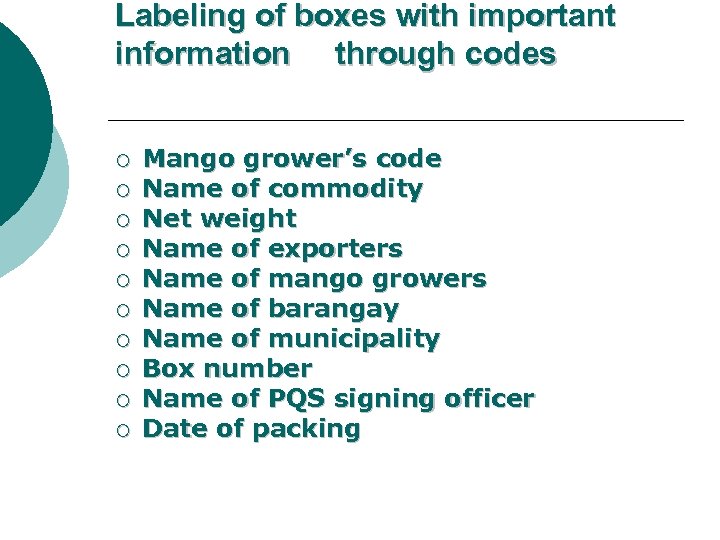
Labeling of boxes with important information through codes ¡ ¡ ¡ ¡ ¡ Mango grower’s code Name of commodity Net weight Name of exporters Name of mango growers Name of barangay Name of municipality Box number Name of PQS signing officer Date of packing
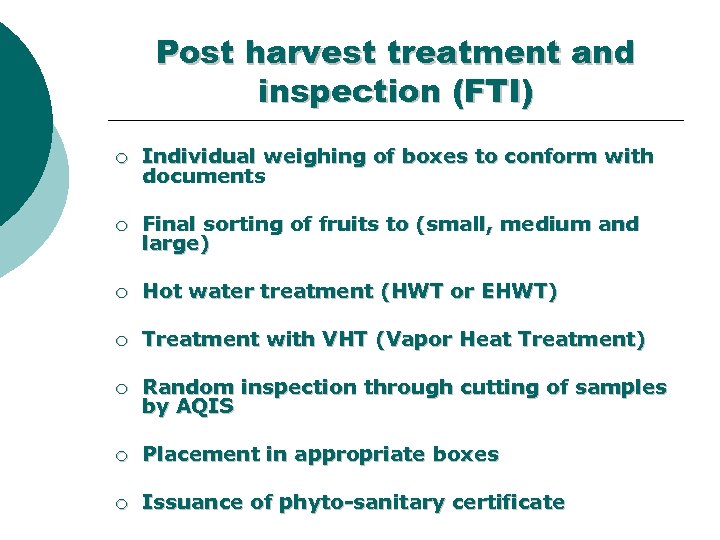
Post harvest treatment and inspection (FTI) ¡ Individual weighing of boxes to conform with documents ¡ Final sorting of fruits to (small, medium and large) ¡ Hot water treatment (HWT or EHWT) ¡ Treatment with VHT (Vapor Heat Treatment) ¡ Random inspection through cutting of samples by AQIS ¡ Placement in appropriate boxes ¡ Issuance of phyto-sanitary certificate
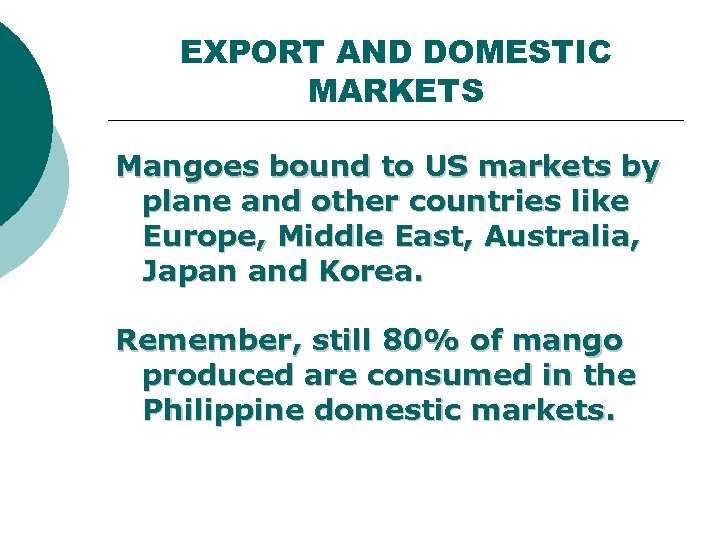
EXPORT AND DOMESTIC MARKETS Mangoes bound to US markets by plane and other countries like Europe, Middle East, Australia, Japan and Korea. Remember, still 80% of mango produced are consumed in the Philippine domestic markets.
GROWING ORGANIC MANGO SALAMAT PO SANA MASARAP at MATAMIS ANG MANGGA NA MAANI NYO!!! REX A. RIVERA AGRONOMIST
Скачать презентацию GROWING ORGANIC MANGO NATURAL HERBAL ORGANIC and BIOLOGICAL
6fd2779c752021eadee550f885be8bb6.ppt