


 Скачать презентацию Growing Competitiveness through support for Innovation Research and
a969ce9c0e93c5f06ff5989f9bf1d814.ppt
- Количество слайдов: 23
 Growing Competitiveness through support for Innovation, Research and Development Professor Tim Cook, Oxford University Managing Director, Isis Innovation Visiting Professor in Science Entrepreneurship Said Business School, Oxford
 Contents 1. 2. 3. 4. Economic contribution from higher education What are universities really for? The challenge of cross-cultural communication Catalysts to support technology transfer
 UK Higher Education generates > 350 000 jobs directly (300 000 full time equivalent) > For every 100 Higher Education jobs 89 generated are from knock on effects > 560 000 f. t. e. jobs through direct and knock-on effects > 2. 7% of UK workforce in employment > € 53 billion of output http: //bookshop. universitiesuk. ac. uk/downloads/economicimpact. pdf Rounded figures!
 What are Universities for? > Research & Teaching > The creation and transmission of knowledge > These both have a major economic impact > Creative thinkers (in science, arts and humanities) > A workforce trained in some useful areas > But not all useful areas!
 University Innovations > Range from inventions & new processes to new philosophies & political thought > Most of this talk is about the former but let’s not forget the others They may well have a more profound long-term impact on our lives
 The third stream > Since 1997 UK national government has become increasingly aware of a very useful by-product from universities > The so called third arm, third leg, third stream > I. e. inventions with commercial potential
 Before 1997 > 1950 Treasury Circular 5/50 (TC 5/50) > Government claims rights to Intellectual Property from publicly funded research > 1985 Thatcher Government rescinds TC 5/50. > Universities that can commercialise IP will own inventions funded by the taxpayer > Universities were free to commercialise > But no public resources available > Odd scattered initiatives but not much money
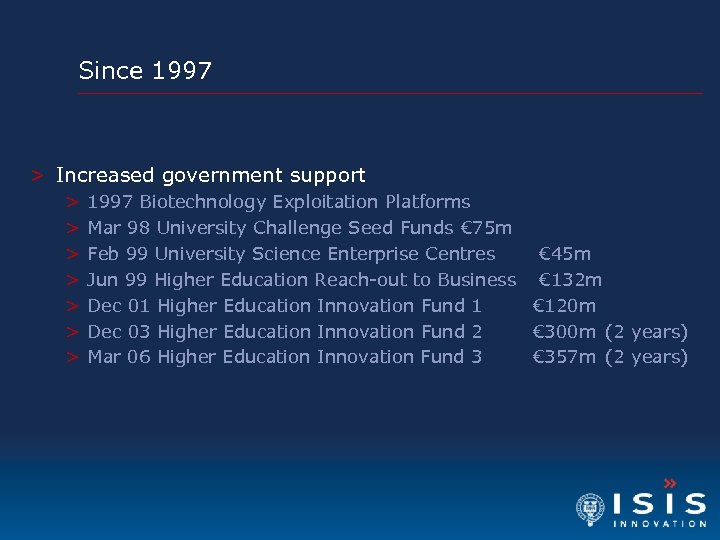 Since 1997 > Increased government support > > > > 1997 Biotechnology Exploitation Platforms Mar 98 University Challenge Seed Funds € 75 m Feb 99 University Science Enterprise Centres € 45 m Jun 99 Higher Education Reach-out to Business € 132 m Dec 01 Higher Education Innovation Fund 1 € 120 m Dec 03 Higher Education Innovation Fund 2 € 300 m (2 years) Mar 06 Higher Education Innovation Fund 3 € 357 m (2 years)
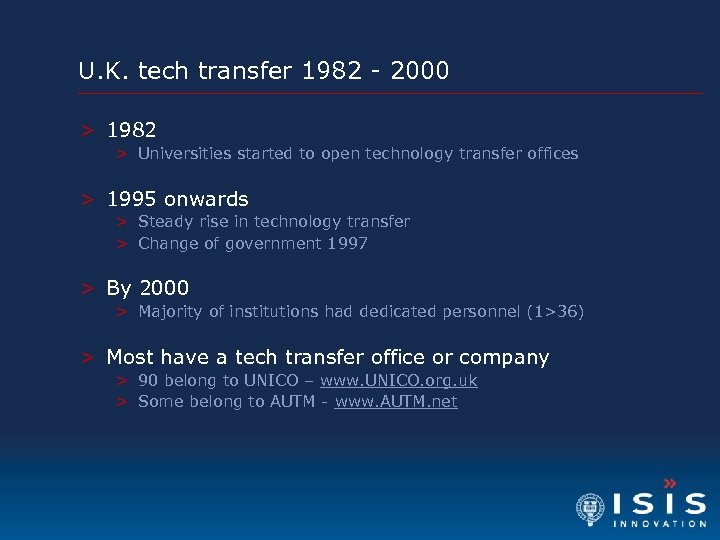 U. K. tech transfer 1982 - 2000 > 1982 > Universities started to open technology transfer offices > 1995 onwards > Steady rise in technology transfer > Change of government 1997 > By 2000 > Majority of institutions had dedicated personnel (1>36) > Most have a tech transfer office or company > 90 belong to UNICO – www. UNICO. org. uk > Some belong to AUTM - www. AUTM. net
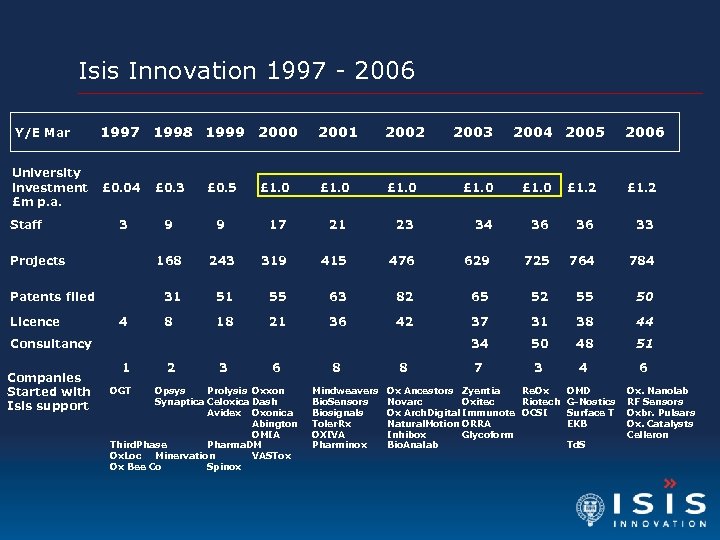 Isis Innovation 1997 - 2006 Y/E Mar 1997 1998 1999 2000 2001 2002 University investment £m p. a. £ 0. 04 £ 0. 3 £ 0. 5 £ 1. 0 3 9 9 17 21 23 168 243 319 415 31 51 55 8 18 21 Staff Patents filed 4 Companies Started with Isis support 2006 £ 1. 0 £ 1. 2 34 36 36 33 476 629 725 764 784 63 82 65 52 55 50 36 42 37 31 38 44 50 48 51 7 3 4 6 Consultancy 1 OGT 2 3 6 Opsys Prolysis Oxxon Synaptica Celoxica Dash Avidex Oxonica Abington OMIA Third. Phase Pharma. DM Ox. Loc Minervation VASTox Ox Bee Co Spinox 8 Mindweavers Bio. Sensors Biosignals Toler. Rx OXIVA Pharminox 8 £ 1. 0 2004 2005 34 Projects Licence 2003 Ox Ancestors Zyentia Re. Ox Novarc Oxitec Riotech Ox Arch. Digital Immunote OCSI Natural. Motion ORRA Inhibox Glycoform Bio. Analab OMD G-Nostics Surface T EKB Td. S Ox. Nanolab RF Sensors Oxbr. Pulsars Ox. Catalysts Celleron
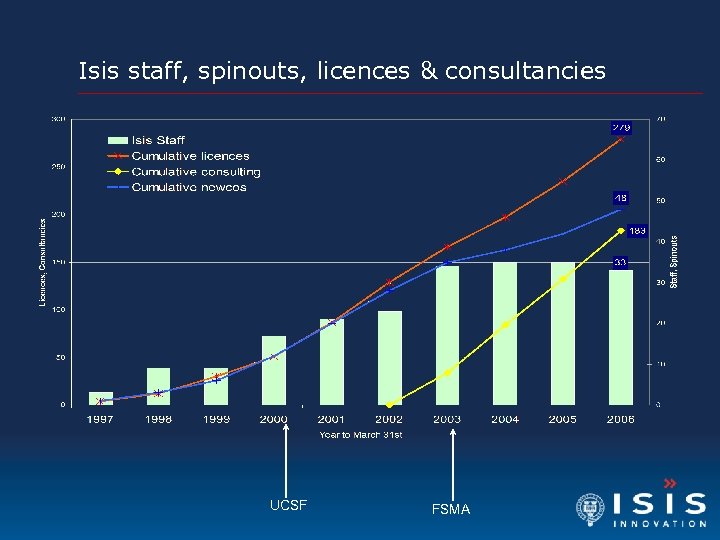 Isis staff, spinouts, licences & consultancies UCSF FSMA
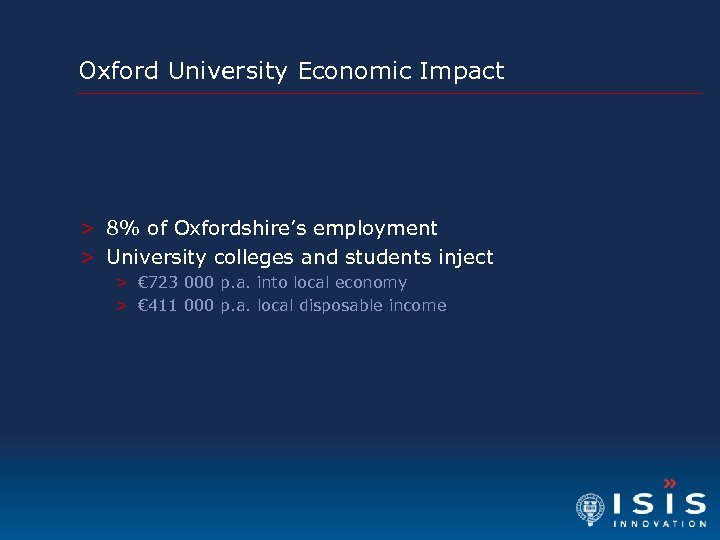 Oxford University Economic Impact > 8% of Oxfordshire’s employment > University colleges and students inject > € 723 000 p. a. into local economy > € 411 000 p. a. local disposable income
 Universities Inventions are not new > Over the years there have been lots of useful inventions from universities: > Cephalosporin came out of Oxford just after the war > Monoclonal antibodies from Cambridge > What is new is the increasing effort and resource being spent on maximising the transfer of ideas
 Maximising Economic Impact > If we accept that university innovations are a resource for economic development and > This resource is currently underutilised > It might be useful to look at why > and what we can do about it
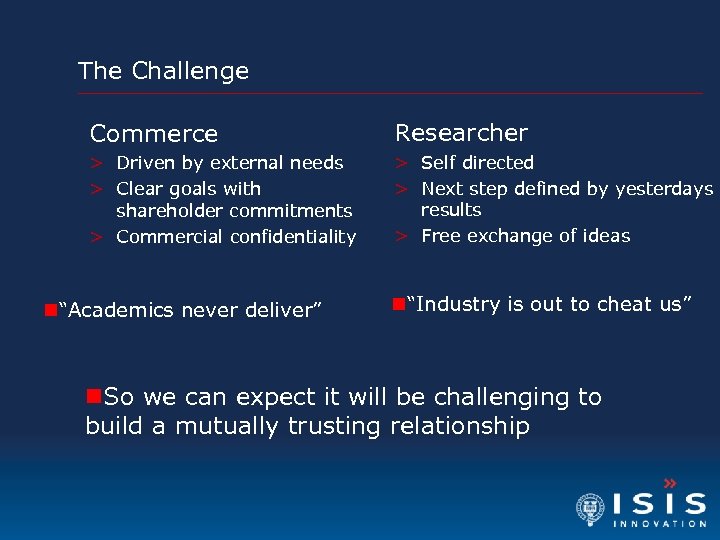 The Challenge Commerce Researcher > Driven by external needs > Clear goals with shareholder commitments > Commercial confidentiality > Self directed > Next step defined by yesterdays results > Free exchange of ideas n“Academics never deliver” n“Industry is out to cheat us” n. So we can expect it will be challenging to build a mutually trusting relationship
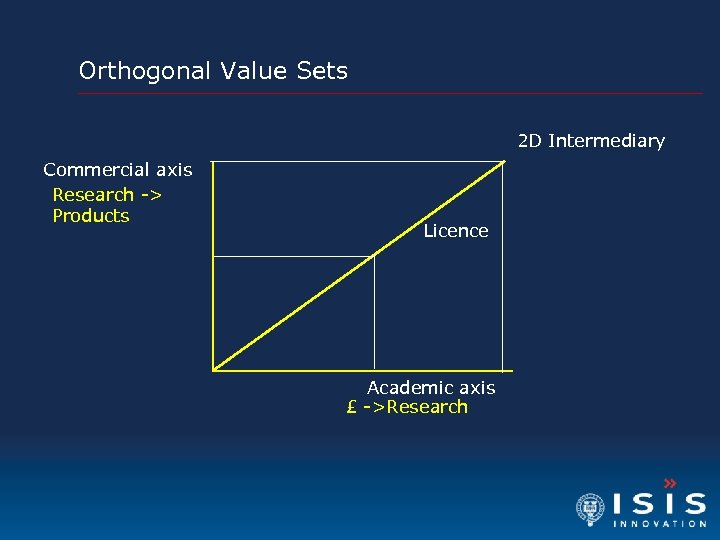 Orthogonal Value Sets 2 D Intermediary Commercial axis Research -> Products Licence Academic axis £ ->Research
 Requirements for intermediaries > Must understand both value systems > Ideally should have lived in both > Must be fluent in both vocabularies > And able to translate > Must be trusted by both sides > So the academics will risk “being cheated” > And the industrialists will risk “having their time wasted”
 Sources of intermediaries > University technology transfer offices > As long as they employ bilingual staff > Diplomatically adept property owners > Science parks, private developers > Public sector (government officers) > If they really do understand both values systems > The Professionals > Accountants, lawyers, consultants, investors, etc. > As long as they can suspend their self-interest long enough for the creative interactions to start > Divisive advisors inhibit the process > Protect their client and kill the deal
 The difficulty > In the long term it is in everybody’s interest But > In the short term the costs are from a single party
 An additional challenge > If we are talking about spinout companies rather than consultancy or licensing there is a third axis > In addition to academia and industry there are investors > Investors are not the same as industrialists
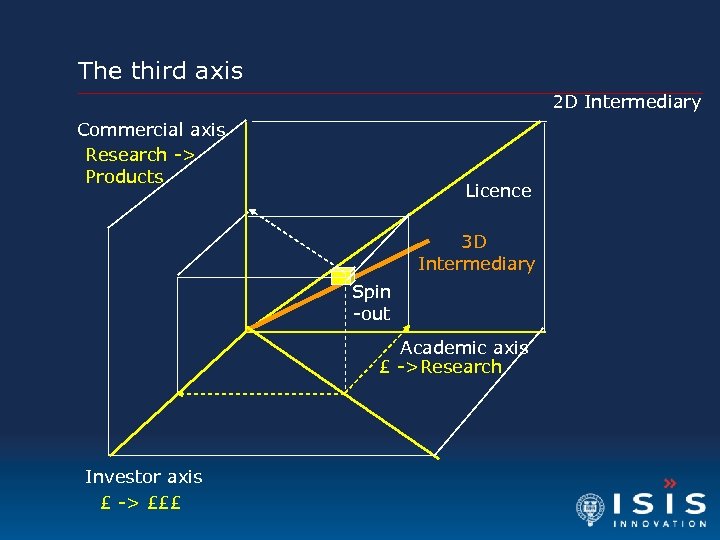 The third axis 2 D Intermediary Commercial axis Research -> Products Licence 3 D Intermediary Spin -out Academic axis £ ->Research Investor axis £ -> £££
 Conclusions > More commercial benefits can be extracted from Universities > But let us not turn universities into contract research companies > Its worthwhile teaching academics about industry and teaching industry about universities > So they can communicate constructively but. . > It is generally a waste of academics to turn them into industrialists & > It is generally a waste of industrialists to turn them into academics > Multi-lingual intermediaries make a difference > Positive if they are competent > Negative if they are not competent > Science parks & intermediaries can contribute to this interface and benefit from it
 Contacts Isis Innovation Ltd Ewert House Ewert Place Summertown Oxford OX 2 7 SG T 01865 280830 F 01865 280831 E innovation@isis. ox. ac. uk www. isis-innovation. com