


 Скачать презентацию GROUP HOMES ZONING AND THE FAIR HOUSING ACT
bb03337ec4aceacc43cb32ba28dd37e3.ppt
- Количество слайдов: 49
 GROUP HOMES, ZONING, AND THE FAIR HOUSING ACT HOW TO MAKE IT A BEAUTIFUL DAY IN THE NEIGHBORHOOD
 GROUPS HOMES IS A NEVERENDING PROBLEM • RIPPED FROM THE HEADLINES
 Packed meeting seeks solutions for sober-living homes • COSTA MESA— Frustrated with the proliferation of sober-living homes and tenants in their neighborhoods, more than 200 Costa Mesa residents packed an auditorium Wednesday night to hear City Hall's plans about how to address them. .
 Rehab homes discussed at meet-themayor event City officials answer questions from residents who say they're negatively affected by the houses. • COSTA MESA - Some Eastside residents who were against rehab homes complained of petty theft, speeding, excessive congregating and smoking in and around the houses. One resident who just bought a home on Fullerton Avenue said he wasn't notified by his real estate agent that a rehab home was so close by.
 Group home a concern for neighbors • A new women’s group home on Klaus Anderson Road is a cause of concern for neighbors and the board of selectmen. • “We don’t feel safe at night, ” said a neighbor “And with the warm weather coming, I don’t know if we will want to sit out in our own yards.
 Unintended consequences hinder further tightening of group home rules • Tighter rules on group homes would go well beyond the City of Prescott's intended purpose of getting a handle on the number of "sober living" homes. Prescott City Attorney Jon Paladini emphasized to the Prescott City Council several times on Tuesday that any new laws passed by the city to deal with the ongoing proliferation of drug and alcohol treatment group homes would apply to everyone else in the community as well. Take, for instance, the suggestion to reduce the number to four (from the current six) of unrelated people allowed to live together in a home. Such a rule would apply just as much to a group of college students sharing a house as it would to a group of recovering alcoholics or drug addicts, Paladini said.
 Cumberland County church faces neighborhood backlash against group home • Some neighbors even put a digital billboard in their driveway, warning others of what they say is a danger to the community. • "Once they get control of the building, things could snowball and we could have sex offenders and everything here right in the middle of a residential neighborhood, " said a neighbor
 Egg Harbor City residents object to planned home for recovering addicts in their neighborhood •
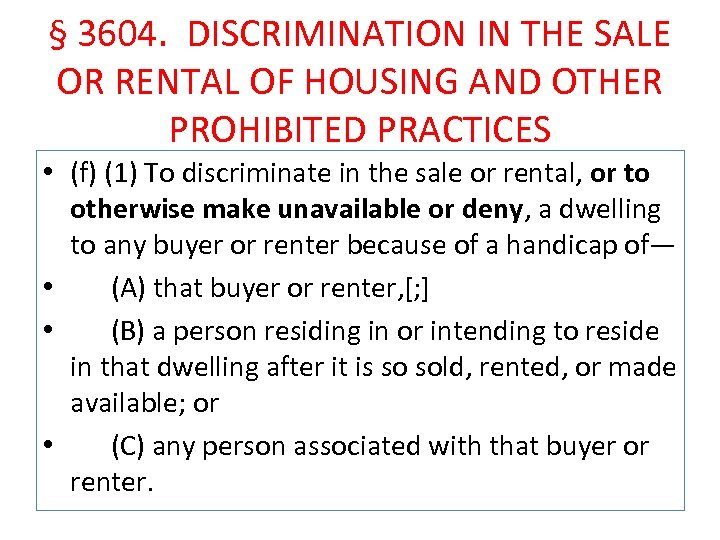 § 3604. DISCRIMINATION IN THE SALE OR RENTAL OF HOUSING AND OTHER PROHIBITED PRACTICES • (f) (1) To discriminate in the sale or rental, or to otherwise make unavailable or deny, a dwelling to any buyer or renter because of a handicap of— • (A) that buyer or renter, [; ] • (B) a person residing in or intending to reside in that dwelling after it is so sold, rented, or made available; or • (C) any person associated with that buyer or renter.
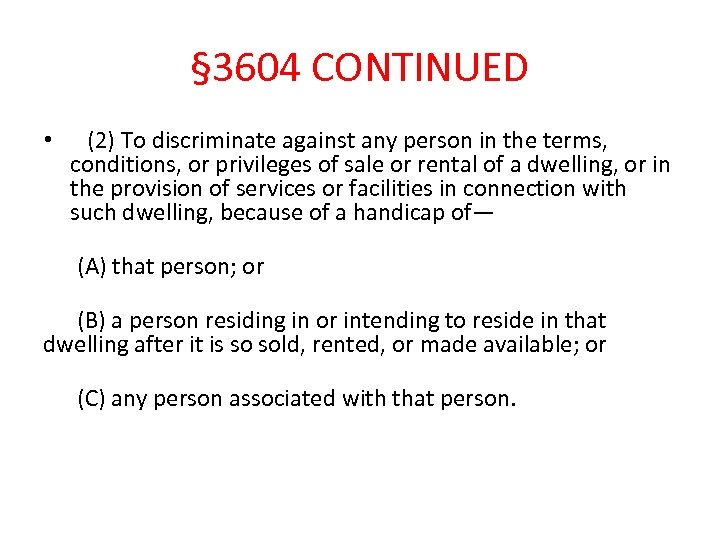 § 3604 CONTINUED • (2) To discriminate against any person in the terms, conditions, or privileges of sale or rental of a dwelling, or in the provision of services or facilities in connection with such dwelling, because of a handicap of— (A) that person; or (B) a person residing in or intending to reside in that dwelling after it is so sold, rented, or made available; or (C) any person associated with that person.
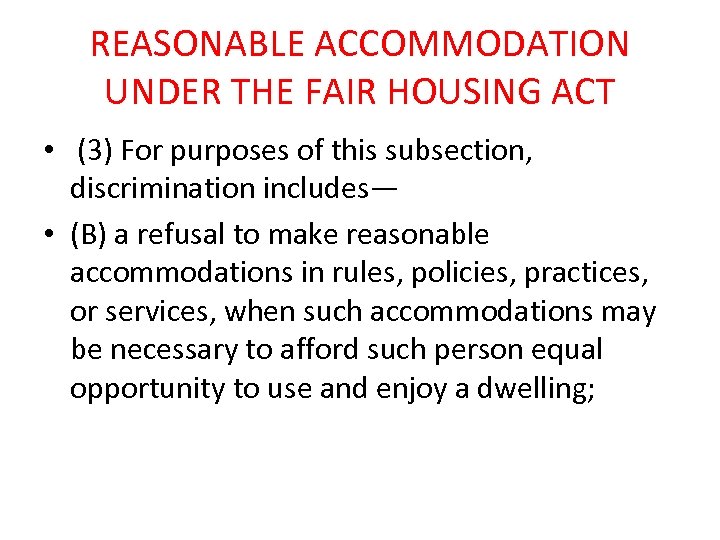 REASONABLE ACCOMMODATION UNDER THE FAIR HOUSING ACT • (3) For purposes of this subsection, discrimination includes— • (B) a refusal to make reasonable accommodations in rules, policies, practices, or services, when such accommodations may be necessary to afford such person equal opportunity to use and enjoy a dwelling;
 THE AMERICANS WITH DISABILITIES ACT • THE ADA DOES NOT PERTAIN TO HOUSING DISCRIMINATION. • IT DOES PROVIDE PROTECTION IN THE ADMINISTRATION OF MUNICIPAL SERVICES
 42 USCS § 12132 • § 12132. Discrimination • Subject to the provisions of this title, no qualified individual with a disability shall, by reason of such disability, be excluded from participation in or be denied the benefits of the services, programs, or activities of a public entity, or be subjected to discrimination by any such entity
 DISCRIMATORY PRACTICES UNDER THE ADA, § 42 USCS § 12182(b)(2) • 2) Specific prohibitions. • (A) Discrimination. For purposes of subsection (a), discrimination includes— • (i) the imposition or application of eligibility criteria that screen out or tend to screen out an individual with a disability or any class of individuals with disabilities from fully and equally enjoying any goods, services, facilities, privileges, advantages, or accommodations, unless such criteria can be shown to be necessary for the provision of the goods, services, facilities, privileges, advantages, or accommodations being offered;
 REASONABLE MODIFICATION 42 USCS § 12182(b)(2)(A)(ii) • (ii) a failure to make reasonable modifications in policies, practices, or procedures, when such modifications are necessary to afford such goods, services, facilities, privileges, advantages, or accommodations to individuals with disabilities, unless the entity can demonstrate that making such modifications would fundamentally alter the nature of such goods, services, facilities, privileges, advantages, or accommodations
 ASSOCIATIONAL PROTECTION 42 U. S. C. § 12182(b)1(A) (iv) Individual or class of individuals. For purposes of clauses (i) through (iii) of this subparagraph, the term "individual or class of individuals" refers to the clients or customers of the covered public accommodation that enters into the contractual, licensing or other arrangement. (E) (iv) Individual or class of individuals. For purposes of clauses (i) through (iii) of this subparagraph, the term "individual or class of individuals" refers to the clients or customers of the covered public accommodation that enters into the contractual, licensing or other arrangement.
 FHAA DEFINITION OF DISABILITY 42 U. S. C. S. § 3602(h) • The Fair Housing Act (FHA) provides that "handicap" means, with respect to a person -- (1) a physical or mental impairment which substantially limits one or more of such person's major life activities, (2) a record of having such an impairment, or (3) being regarded as having such an impairment, but such term does not include current, illegal use of or addiction to a controlled substance.
 HUD REGULATIONS • Handicap means, with respect to a person, a physical or mental impairment which substantially limits one or more major life activities; a record of such an impairment; or being regarded as having such an impairment. This term does not include current, illegal use of or addiction to a controlled substance. For purposes of this part, an individual shall not be considered to have a handicap solely because that individual is a transvestite. As used in this definition:
 HUD REGULATIONS CONTINUED • (a) Physical or mental impairment includes: • (1) Any physiological disorder or condition, cosmetic disfigurement, or anatomical loss affecting one or more of the following body systems: Neurological; musculoskeletal; special sense organs; respiratory, including speech organs; cardiovascular; reproductive; disgestive; genito-urinary; hemic and lymphatic; skin; and endocrine; or
 HUD REGULATIONS CONTINUED • (2) Any mental or psychological disorder, such as mental retardation, organic brain syndrome, emotional or mental illness, and specific learning disabilities. The term physical or mental impairment includes, but is not limited to, such diseases and conditions as orthopedic, visual, speech and hearing impairments, cerebral palsy, autism, epilepsy, muscular dystrophy, multiple sclerosis, cancer, heart disease, diabetes, Human Immunodeficiency Virus infection, mental retardation, emotional illness, drug addiction (other than addiction caused by current, illegal use of a controlled substance) and alcoholism.
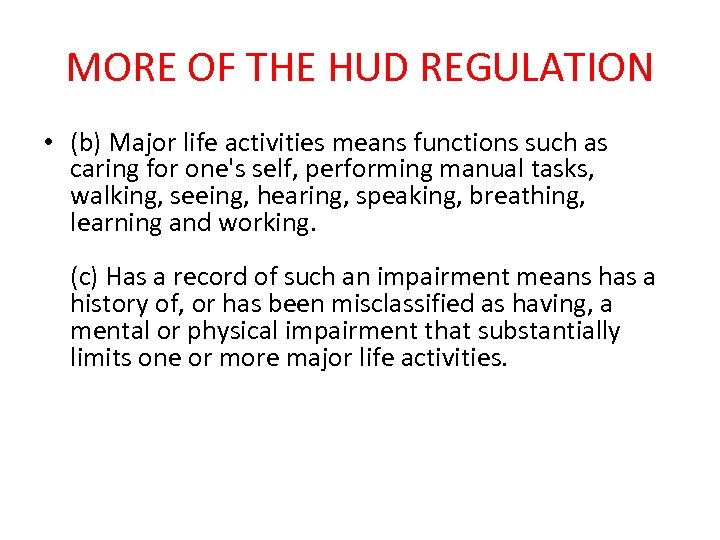 MORE OF THE HUD REGULATION • (b) Major life activities means functions such as caring for one's self, performing manual tasks, walking, seeing, hearing, speaking, breathing, learning and working. (c) Has a record of such an impairment means has a history of, or has been misclassified as having, a mental or physical impairment that substantially limits one or more major life activities.
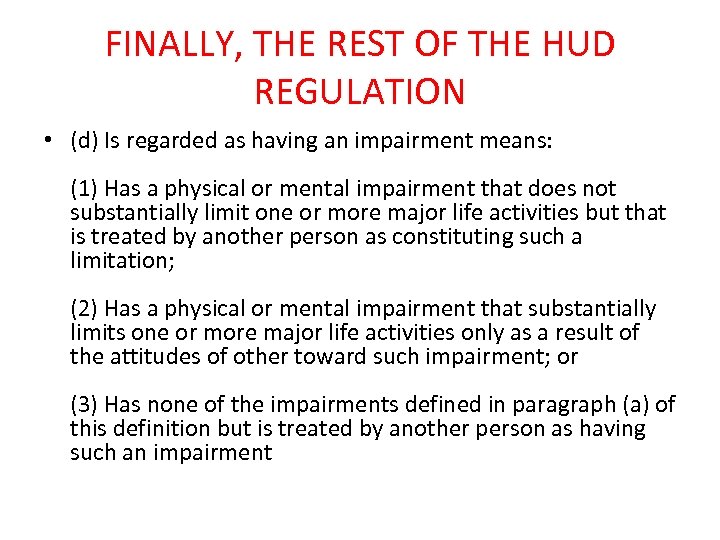 FINALLY, THE REST OF THE HUD REGULATION • (d) Is regarded as having an impairment means: (1) Has a physical or mental impairment that does not substantially limit one or more major life activities but that is treated by another person as constituting such a limitation; (2) Has a physical or mental impairment that substantially limits one or more major life activities only as a result of the attitudes of other toward such impairment; or (3) Has none of the impairments defined in paragraph (a) of this definition but is treated by another person as having such an impairment
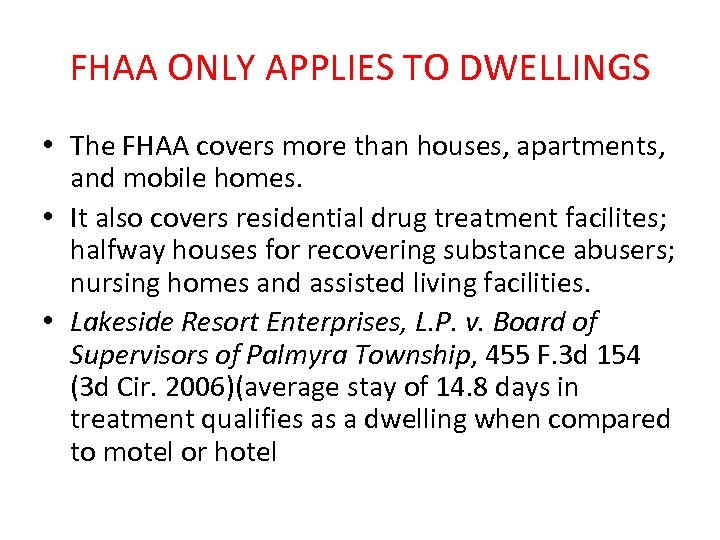 FHAA ONLY APPLIES TO DWELLINGS • The FHAA covers more than houses, apartments, and mobile homes. • It also covers residential drug treatment facilites; halfway houses for recovering substance abusers; nursing homes and assisted living facilities. • Lakeside Resort Enterprises, L. P. v. Board of Supervisors of Palmyra Township, 455 F. 3 d 154 (3 d Cir. 2006)(average stay of 14. 8 days in treatment qualifies as a dwelling when compared to motel or hotel
 HOW DO NIMBY ISSUES ARISE • Complaints by neighbors when learning about use of a house • Code enforcement investigation • Zoning applications
 WHAT ARE THE NIMBY ISSUES • Excess number of unrelated persons • Running a business in a residential zone • Non permitted use in a residential zone based on classification • Property values • Safety and crime issues • Proximity to schools • Sex offenders • Persons with disabilities
 RESPONSE TO NIMBY ISSUES • Group home issues almost always involved zoning issues • The fair housing act and ada must be interjected in the process at the earliest possible moment • Always try to educate
 NIMBY ISSUES USUALLY MEANS ANGRY AND HOSTILE NEIGHBORS • Group homes often result in hot button emotional responses by neighbors • Misunderstanding the nature of the disabilities of the residents often is often at the center of the discriminatory animus • Outreach and meetings is one strategy must be done with the understanding that logic and reason will not rule the day
 ALL ZONING IS POLITICAL • ZONING MATTERS ARE LOCAL • POLITICS IS LOCAL • THEREFORE, ALL ZONING IS POLITICAL
 FFHA SHOULD BE INVOKED AT EARLIEST OPPORTUNITY • It is important to protect group home providers by making a zoning issue into a fair housing issue • Written request for a reasonable accommodation at the earliest possible time for • Waiver of unrelated persons • Treat as single family use • Treat residents as the functional equivalent of a family • File a housing discrimination complaint with hud • File a lawsuit in federal court
 REASONABLE ACCOMMODATION REQUIREMENTS • Is the request reasonable? Asking for a waiver of cap on unrelated persons is considered to be a reasonable request
 MUNICPALITY DETERMINATIONS • A municipality who is in receipt of a reasonable request can argue that it is not reasonable by one of two ways: • Does the request cause an undue burden administratively or financially? • Does the request cause a fundamental alteration to the zoning scheme?
 IS THE REQUEST NECESSARY? • The third prong of the reasonable accommodation analysis falls on the provider. • Is the request necessary, i. e. Will the request amelioriate or provide a benefit the residents with the disability • Does the request provide an equal opportunity to use and enjoy a dwelling? – Does the accommodation level the playing field? – Does the accommodation allow the use of the dwelling of choice
 RESPONSES TO REASONABLE ACCOMMODATION REQUEST • • Grant the request as presented Grant the request with conditions Deny the request Reasonable accommodation requests must be handled promptly Failure to respond is a denial Delay in responding is a denial Exhaustion of remedies not required No requirement to seek accommodation if it would be futile
 LEGISLATION AS A MEANS OF REGULATION • Another response is to enact legislation regulating group homes • Any legislation must comply with the requirements of the fair housing act • Creation of classification that pertain only to group homes for persons with disabilities may be illegal • Did the decision makers “reverse engineer” the ordinance
 CONDITIONS OR RESTRICTIONS WHICH MAY VIOLATE THE FAIR HOUSING ACT • • Licensing or registration requirements Turnover restrictions Residency based on non-transiency requirements Payment of fees Background checks Prohibition of probationers or parolees Restrictions on siting in single family zones vs. Multi family or industrial or commercial zones
 FAIR HOUSING ANALYSIS OF GROUP HOME ORDINANCES • Review of the ordinance for non neutral language, i. e. Does the ordinance single out a particular class of disabled persons • Review of intent of the legislators • Review legislative history of the ordinance, i. e. Is there community pressure • Is disability a motivating factor in the decision making
 OTHER FACTORS IN ANALYZING GROUP HOME LEGISLATION • Does state law mandate that state licensed programs be treated as single family uses? If so, how does municipality treat unlicensed homes? • Does the ordinance have the effect of making housing unavailable for persons with disabilities, see § 3604 • Were the decision makers influenced by the discriminatory animus of the citizens • If a zoning application or reasonable accommodation request, were the reasons for denial pretextual
 PACIFIC SHORES, ET AL V. CITY OF NEWPORT BEACH • Prior to 2008, "group homes"—i. e. , homes in which recovering alcoholics and drug users live communally and mutually support each other's recovery—were generally permitted to locate in residential zones in the City of Newport Beach ("the City") and they did so freely.
 PACIFIC SHORES, CONT. • By 2008, a number of residents of the City launched a campaign to restrict or eliminate group homes in their neighborhoods. After enacting several moratoria, the City enacted an Ordinance ("the Ordinance") which had the practical effect of prohibiting new group homes from opening in most residential zones. Even in the few areas where they were permitted to open, new group homes were required to submit to a permit process. Existing group homes also had to undergo the same permit process in order to continue their operations. Among the factors to be considered when granting or denying a permit to any group home was the number of other such facilities in the neighborhood.
 MORE PACIFIC SHORES • On its face, the Ordinance did not single out group homes; persons recovering from addiction are protected from housing discrimination under state and federal antidiscrimination laws. Instead, the Ordinance facially imposed restrictions on some other types of group living arrangements as well. At the same time, the City did not impose similar regulations on properties rented by homeowners to vacationing tourists, despite the fact that such rental properties may cause similar social problems as group homes. On advice of counsel, the City had initially planned to regulate such rental properties in order to avoid the appearance of discriminating against group homes, but it backed down from doing so in the face of opposition from a number of City residents.
 STILL MORE PACIFIC SHORES • At the same time, the City did not impose similar regulations on properties rented by homeowners to vacationing tourists, despite the fact that such rental properties may cause similar social problems as group homes. On advice of counsel, the City had initially planned to regulate such rental properties in order to avoid the appearance of discriminating against group homes, but it backed down from doing so in the face of opposition from a number of City residents.
 PACIFIC SHORES CONCLUSIONS • Although plaintiffs in an anti-discrimination lawsuit may survive summary judgment by identifying similarly situated individuals who were treated better than themselves, this is not the only way to demonstrate that intentional discrimination has occurred. Where there is direct or circumstantial evidence that the defendant has acted with a discriminatory purpose and has caused harm to members of a protected class, such evidence is sufficient to permit the protected individuals to proceed to trial under a disparate treatment theory. This is no less true where the defendant is willing to harm certain similarly-situated individuals who are not members of the disfavored group in order to accomplish a discriminatory objective, while preserving the appearance of neutrality
 MORE PACIFIC SHORES’ HOLDINGS • Plaintiffs who allege disparate treatment under statutory antidiscrimination laws need not demonstrate the existence of a similarly situated entity who or which was treated better than the plaintiffs in order to prevail. Proving the existence of a similarly situated entity is only one way to survive summary judgment on a disparate treatment claim. A plaintiff does not, however, have to rely on the Mc. Donnell Douglas approach to create a triable issue of fact regarding discriminatory intent in a disparate treatment case. Instead, he may simply produce direct or circumstantial evidence demonstrating that a discriminatory reason more likely than not motivated the defendant and that the defendant's actions adversely affected the plaintiff in some way. The Mc. Donnell Douglas test is inapplicable where the plaintiff presents direct evidence of discrimination.
 MORE HOLDINGS • A willingness to inflict collateral damage by harming some, or even all, individuals from a favored group in order to successfully harm members of a disfavored class does not cleanse the taint of discrimination; it simply underscores the depth of the defendant's animus. That an ordinance also discriminates against individuals unprotected by the Fair Housing Act (FHA) does not eliminate an FHA violation
 ONE MORE PRINCIPLE FROM PACIFIC SHORES • The principle that overdiscrimination is prohibited undergirds all of constitutional and statutory anti-discrimination law, although it often goes unsaid precisely because it is so foundational. Discriminatory laws, policies, or actions will often have negative effects (whether intended or not) on individuals who do not belong to the disfavored group. This does not, however, change the fact that such laws, policies, or actions are discriminatory when they are undertaken for the purpose of harming protected individuals.
 ORDINANCES WHICH HAVE BEEN HELD TO VIOLATE THE FAIR HOUSING ACT • • • BOCA RATON – RESTRICTIONS ON SITING OF HOUSING FOR PERSONS IN RECOVERY BY CLASSIFICATION OTHER THAN FAMILY DELRAY BEACH – ATTEMPT TO REDEFINE FAMILY BY REDUCTION OF NUMBER OF UNRELATED PERSONS COUPLED WITH TURNOVER OR TRANSCIENY RESTRICTIONS BATON ROUGE- REASONABLE ACCOMMODATION PROCESS THAT IS AVAILABLE ONLY TO STATE LICENSED AND AROUND THE CLOCK STAFFED HOUSES SUFFOLK COUNTY, NY- (1) a notice requirement and approval procedure to assess the desirability of a proposed substance abuse recovery house in an area, (2) a requirement that each substance abuse recovery house must have a certified site manager living on-site, (3) a limitation of six individuals receiving substance abuse services in the house, and (4) a licensing requirement. NEWPORT BEACH, CA- 9 th Circuit did not strike down the ordinance for procedural reasons. In analyzing the ordinance, which resulted in the loss of approximately 2/3 of the available beds for recovery homes, and no new homes opening since enactment, found that the triable issues of discriminatory intent were presented.
 GOLD STAR FOR CHARLESTON, WV • Family. One or more persons occupying a single welling unit, provided that unless all members arerelated by blood, marriage or legal adoption, no such family contain more than five nontransient unrelated persons, except where disability requires that more than five unrelated persons reside together; in such cases there shall be no requirement for persons with disabilities to petition, apply or experience a process to obtain approval to live in any zoning district in the City.
 COSTS TO TAXPAYERS FOR FAIR HOUSING VIOLATIONS • TRACI P. V. SARASOTA COUNTY, FL - $700, 00 TO PLAINTIFFS, LEGAL COST TO COUNTY $3. 2 MILLION • SCHWARZ V. CITY OF TREASURE ISLAND - $3. 725 MILLION TO PLAINTIFFS • ST. PAUL SOBER LIVING V. GARFIELD COUNTY, CO, JURY AWARD OF $400, 000, PENDING PETITION FOR ATTORNEYS FEES AND COST OF NEARLY $500, 000 • JEFFREY O. V. CITY OF BOCA RATON – PLAINTIFFS ATTORNEYS FEES APPROX. $600, 000 - LEGAL COST TO CITY APPROX. $500, 000 • ALAMAR RANCH, LLC. V. BOISE COUNTY, IDAHO, JURY AWARD OF $4 MILLION, ATTORNEYS FEES $1. 4 MILLION
 CONTACT INFORMATION • • • Steven G. Polin Law office of Steven G. Polin 3034 Tennyson Street, NW Washington, D. C. 20015 202 -331 -5848 spolin 2@earthlink. net