 Скачать презентацию Ground Resource Management Luzerne County Pennsylvania Mr Brian
8fed6293a2bb97f8f9470d22fc532374.ppt
- Количество слайдов: 58



Ground Resource Management Luzerne County, Pennsylvania Mr. Brian Oram, PG Professional Geologist, Soil Scientist, PASEO, Certified Geothermal Installer, Licensed Well Driller Wilkes University – Center for Environmental Quality and B. F. Environmental Consultants Inc. Dallas, Pennsylvania http: //www. water-research. net http: //www. bfenvironmental. com 3/15/2018 1
Supporters Carbon County Groundwater Guardians http: //www. carbonwaters. org l C-SAW Program - Consortium for Scientific Assistance to Watersheds Program http: //pa. water. usgs. gov/csaw/ l Pocono Northeast Resource Conservation & Development Council http: //www. pnercd. org l Wilkes University http: //www. wilkes. edu l 3/15/2018 2
l Latest Announcements - Working with the PADEP on Revisions to Stormwater Manual. - Partnered with National Educator to Provide Distance Learning Courses for Work-Force Development and Continuing Education for Engineering, Environmental, and Architects. - Featured Courses in Alternative Energy, Stormwater Management, and Health and Safety and teach field course locally in Soil Science for SEOs, Engineers, Wetland Scientists, and other professionals. - Working with local RC&D Council on the formation of a Regional Alternative Energy Committee, Local Green Building Council, Water Resource Management, Stormwater Management, and Forest Management Programs. - Working with Royalty Owners and Private Well Owners on Issues related to the Marcellus Shale. - http: //www. bfenvironmental. com
Why Be Concerned about Groundwater Quality / Quantity ? l In Luzerne County - 18 % of residents serviced by private wells, but Virtually 100 % are supported by groundwater withdrawal. l Groundwater helps to maintain and sustain recreational areas and habitats, i. e. , streams, lakes, wetlands, and most surfacewater features. l Over withdrawal or groundwater mining can impact existing and future uses, facilitate contamination, decrease stream aquatic habitat, and result in subsidence. l Improper planning can result in groundwater contamination, which can cause a financial burden on individuals, business, and other entities in the Community. l Changing land-usage and infiltration capacity can adversely impact both groundwater quality and quantity. 3/15/2018 4
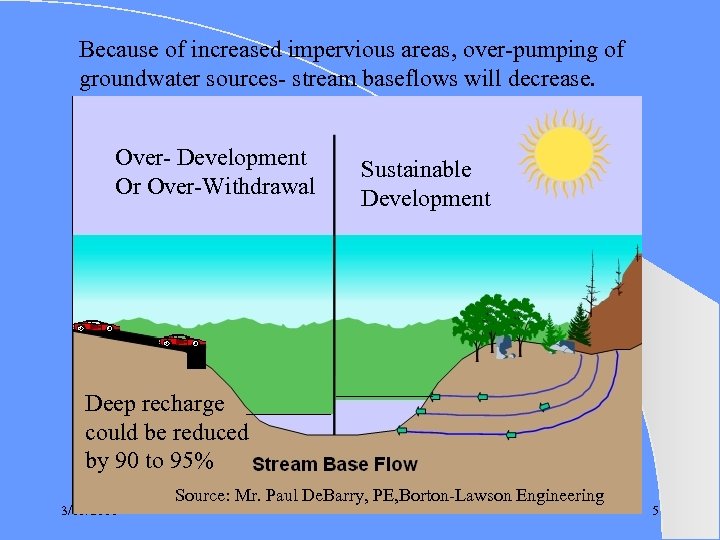
Because of increased impervious areas, over-pumping of groundwater sources- stream baseflows will decrease. Over- Development Or Over-Withdrawal Sustainable Development Deep recharge could be reduced by 90 to 95% 3/15/2018 Source: Mr. Paul De. Barry, PE, Borton-Lawson Engineering 5
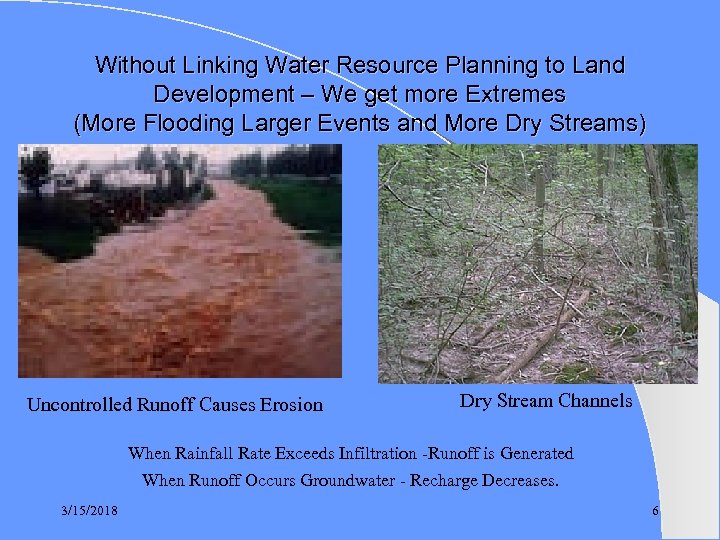
Without Linking Water Resource Planning to Land Development – We get more Extremes (More Flooding Larger Events and More Dry Streams) Uncontrolled Runoff Causes Erosion Dry Stream Channels When Rainfall Rate Exceeds Infiltration -Runoff is Generated When Runoff Occurs Groundwater - Recharge Decreases. 3/15/2018 6
Groundwater and Surfacewater Withdrawals (Who does what? ) l Depending on the size of a project or proposed use, the use of water for consumption or withdrawal may be regulated and permitted by the local PADEP and River Basin Commissions with feedback from the other state and federal organizations. Local agencies can not allocate water. l PADEP and the River Basin Commission are not a local or county planning agency – they are state/federal permitting agencies. l PADEP Permits and Regulates – Public Water Systems Sizing and Engineering and River Basin Commission Allocates Water. l River Basin Commissions are typically involved with consumptive use or withdrawals starting at 20, 000 gallons or 100, 000 + gpd, but in certain areas the River Basin Commission evaluates consumptive water use at a level of 10, 000 gpd. l PADEP and River Basin Commissions do not contact local planning, but require local planning approval before permits. 3/15/2018 7
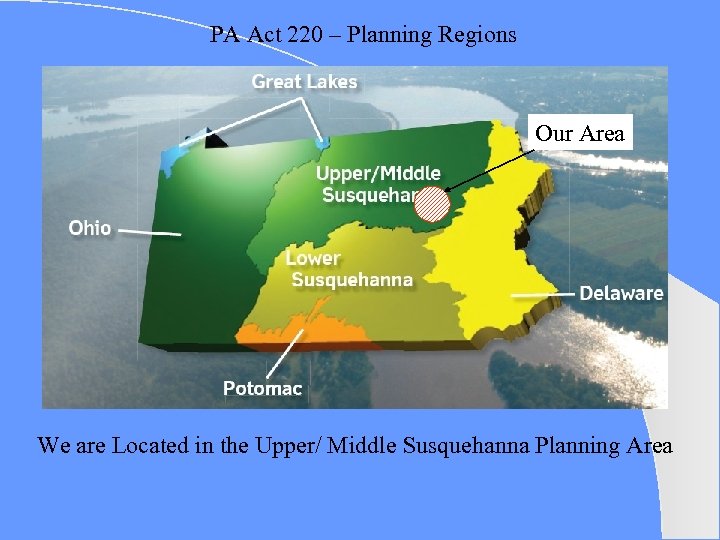
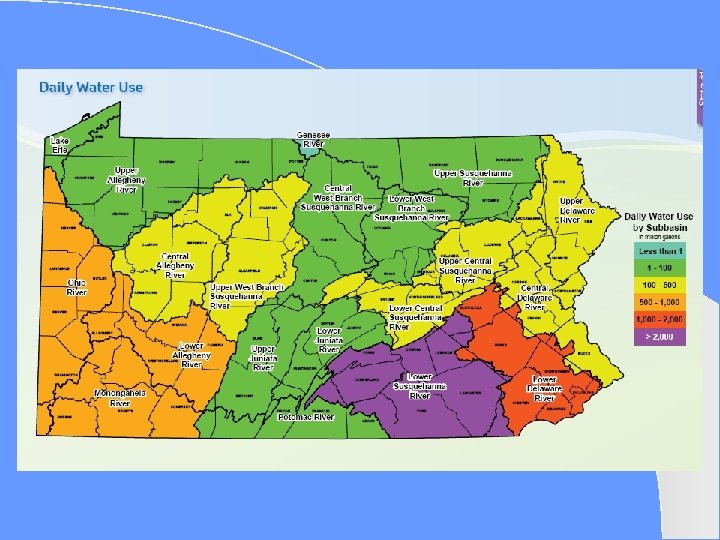
PA Act 220 – Planning Regions Our Area We are Located in the Upper/ Middle Susquehanna Planning Area
Act 220 PA Water Resources Planning Act Passed into law in 2002. Act does not allocate water – just a planning tool. Requires registration of all water users exceeding 10, 000 gpd – Helping to develop a database of users. l Regional Committees meet to identify “Critical Areas” within the state. l Make Recommendations regarding long-term best practices and assessments that are needed for each area and provide other recommendations to manage the resource. l l l
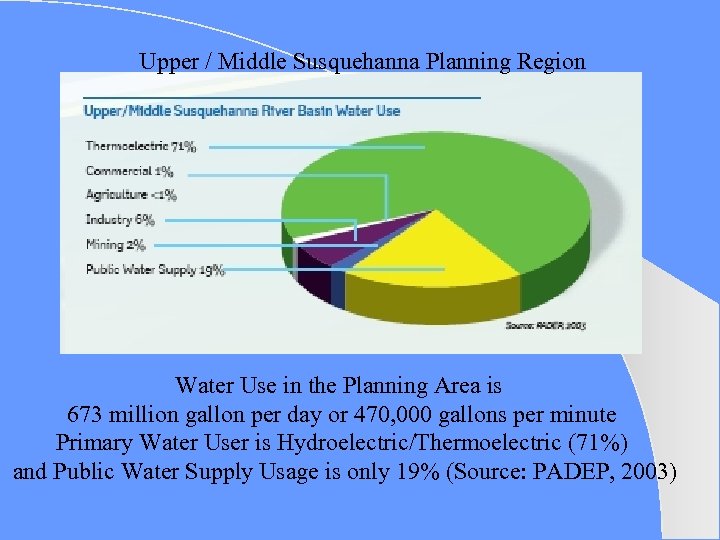
Upper / Middle Susquehanna Planning Region Water Use in the Planning Area is 673 million gallon per day or 470, 000 gallons per minute Primary Water User is Hydroelectric/Thermoelectric (71%) and Public Water Supply Usage is only 19% (Source: PADEP, 2003)
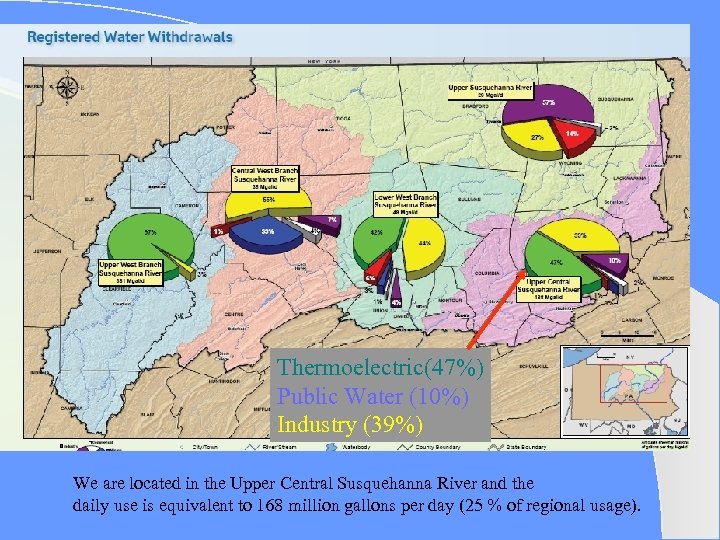
Thermoelectric(47%) Public Water (10%) Industry (39%) We are located in the Upper Central Susquehanna River and the daily use is equivalent to 168 million gallons per day (25 % of regional usage).
Preliminary Conclusions Toby Creek Watershed was identified as a “Potential” Critical Water Planning Area in Act 220. l General Recommendations l Encourage Conservation and Add Metering (not on private wells) Control Water Loss Due to Leakage Develop Groundwater Recharge Systems Implement Stormwater Management Systems Encourage Water Reuse Remediate Contaminated or Impacted Waters, such as Mine Drainage as Industrial Water Source. – Develop and Implement Private Well Construction Standards. – Encourage Best Management Practices for Developments, Industry, and Agricultural Users – Develop Land Use Planning Approaches that Consider Water Resource Issues , such as Development Rights Transfers, Infill, Conservation Subdivisions, and more. – – –
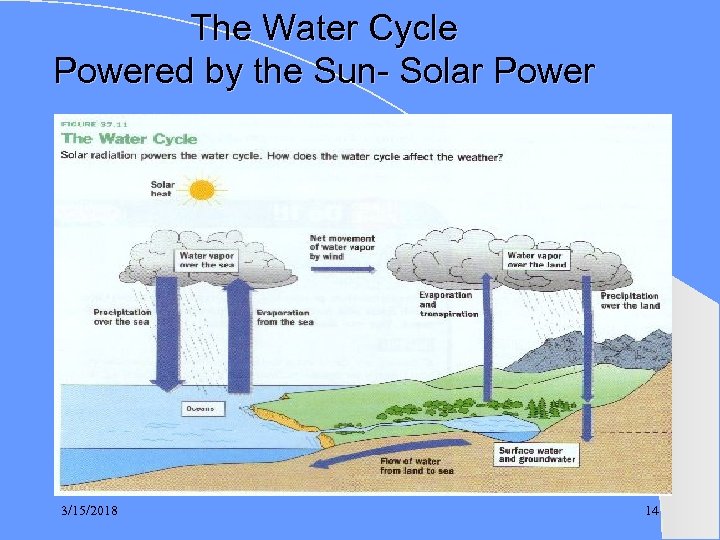
The Water Cycle Powered by the Sun- Solar Power 3/15/2018 14
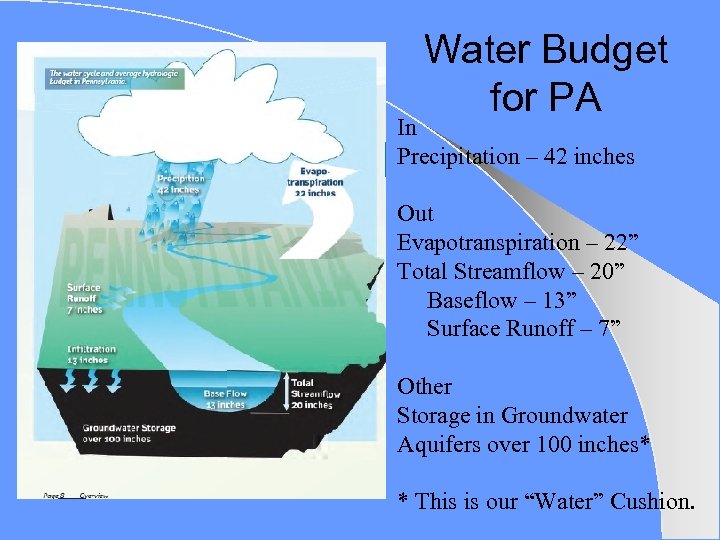
Water Budget for PA In Precipitation – 42 inches Out Evapotranspiration – 22” Total Streamflow – 20” Baseflow – 13” Surface Runoff – 7” Other Storage in Groundwater Aquifers over 100 inches* * This is our “Water” Cushion.
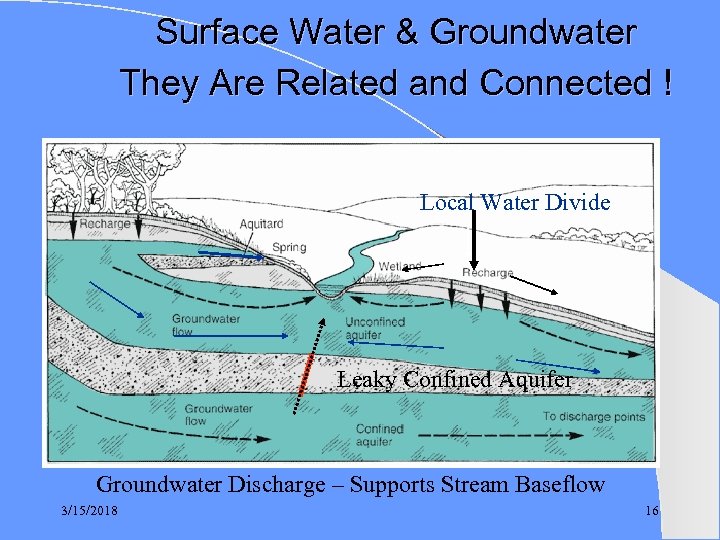
Surface Water & Groundwater They Are Related and Connected ! Local Water Divide Leaky Confined Aquifer Groundwater Discharge – Supports Stream Baseflow 3/15/2018 16
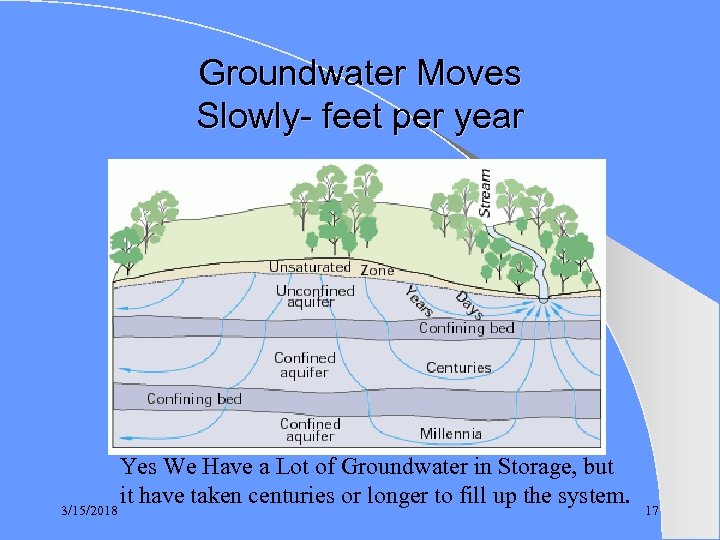
Groundwater Moves Slowly- feet per year 3/15/2018 Yes We Have a Lot of Groundwater in Storage, but it have taken centuries or longer to fill up the system. 17
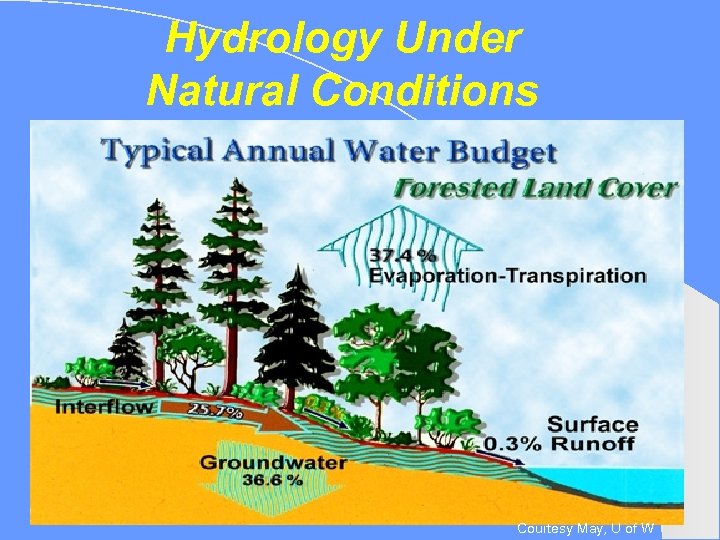
Hydrology Under Natural Conditions 3/15/2018 18 Courtesy May, U of W
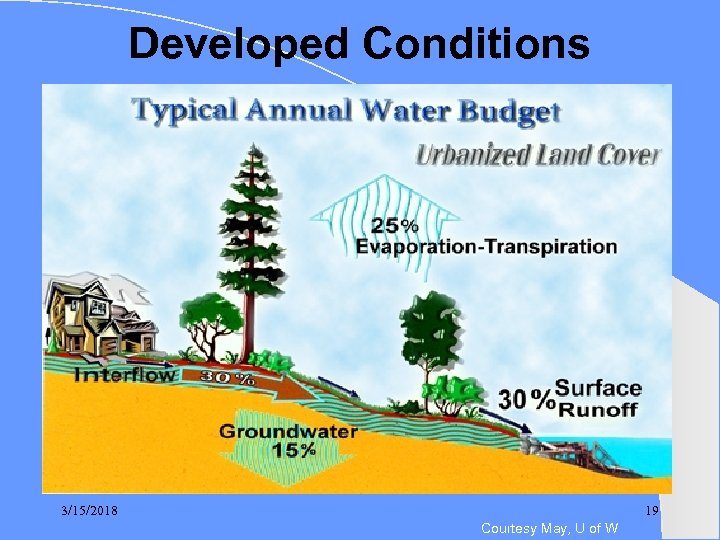
Developed Conditions 3/15/2018 19 Courtesy May, U of W
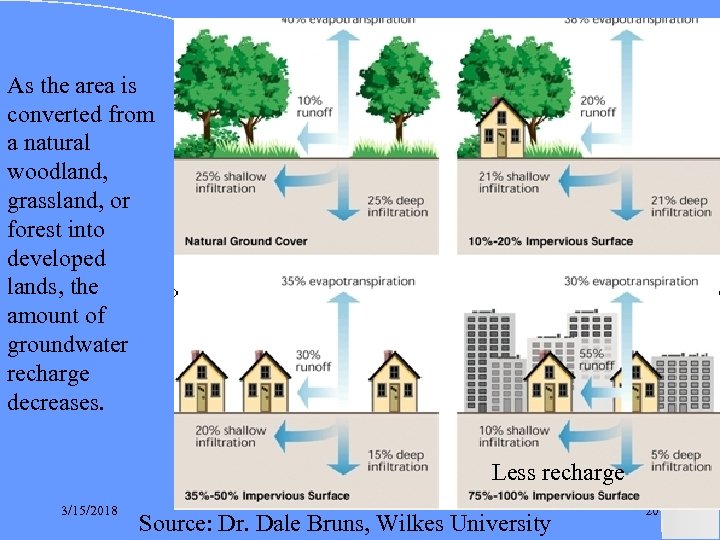
As the area is converted from a natural woodland, grassland, or forest into developed lands, the amount of groundwater recharge decreases. Less recharge 3/15/2018 Source: Dr. Dale Bruns, Wilkes University 20
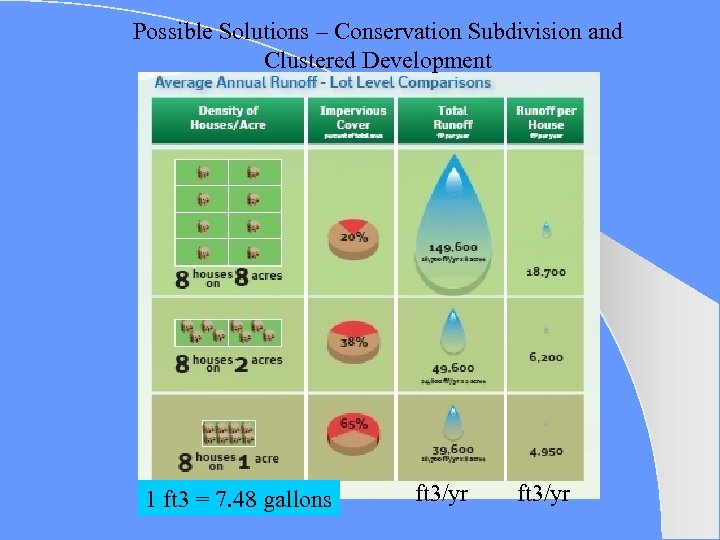
Possible Solutions – Conservation Subdivision and Clustered Development 1 ft 3 = 7. 48 gallons ft 3/yr
Protect Your Water Source Things Local Agency Can Do l Zoning and Planning Process that includes a Groundwater Availability Analysis, Encourages Groundwater Recharge, and Water Reuse. l Developing a Well Water Ordinance and Linking the Well Water Ordinance to Act 537 Planning (possible assistance with operating cost through Act 537 funding) l Developing Well Construction Standards and Encouraging Groundwater Recharge (Low Impact Development and Stormwater Recharge Systems for New and Existing Developments) l Start or Support a Community Based Groundwater Education Program (Carbon County Groundwater Guardians, County Conservation District, and other partners) l Encourage on-site septic and private well systems over developments with central water and sewer. Problem – this really targets future development ! 3/15/2018 22
What About the Existing Development ? How do we turn back the clock? 1. The runoff from one acre of paved parking generates the same amount of annual runoff as: a) b) c) d) 36 acres of forest 20 acres of grassland 14 acre subdivision – 2 acre lots 10 acre subdivision – 0. 5 acre lots All of the above – Does this mean we are missing a possible effective means of “turning” back the stormwater clock. Maybe we need to consider – “greening” some of the existing impervious areas. Maybe the plan needs to include a combination of updated land Development ordinances and “Greening” Strategies.

What Next ? What Action a Community Can Take ? 3/15/2018 24
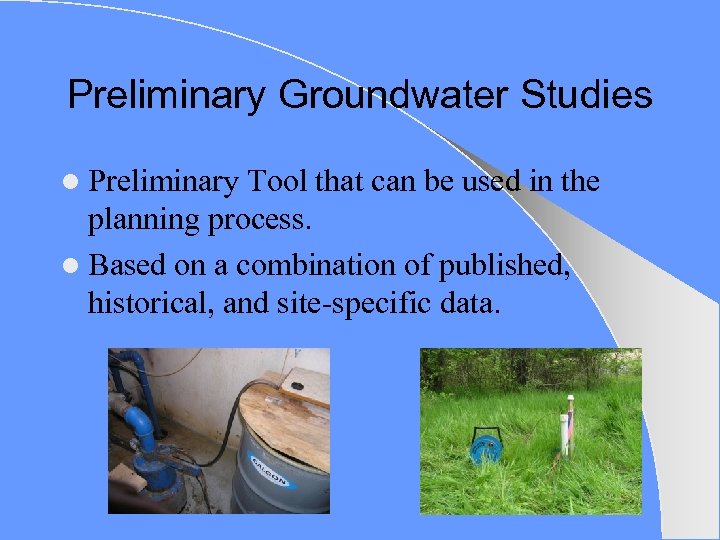
Preliminary Groundwater Studies l Preliminary Tool that can be used in the planning process. l Based on a combination of published, historical, and site-specific data.
Why Conduct a Groundwater Availability Analysis ? l A preliminary desktop assessment could help to identify potential impacts on existing uses or other regulated facilities during the planning process and existing problems within the community. l Desktop assessments can be used to develop site-specific criteria for well construction for unregulated projects and long-term sustainability. l For larger projects, a preliminary analysis may compile enough information to show that a more comprehensive site-specific analysis would provide sufficient data to show if the withdrawal is sustainable. l Helps to provide a proactive means of managing groundwater and water resources and helps to ensure the long-term reliability, quality, and sustainability of the system. l The groundwater system helps to sustain the water cycle during droughts. 3/15/2018 26
When Should a Groundwater or Water Availability Analysis l As part of planning and local approvals for new subdivisions or expansion of unregulated water systems, the applicant would conduct a groundwater availability analysis. l For the Luzerne County area, the analysis should be requested when the proposed density is greater than 1 edu per acre or when the project is proposing the use of a central wastewater disposal system with a stream discharge and not a land-based wastewater disposal system. l Groundwater availability analysis and hydrological description should be conducted by a licensed professional geologist. l Where the desktop evaluation indicates the potential for over-pumping of the aquifer, insufficient yield, poor water quality, or withdrawal of over 60 % of baseflow, the local regulations could require a more comprehensive hydrological analysis that could include the installation of test wells and conducting a short-term pumping test (24 to 72 hours). 3/15/2018 27
Desktop Analysis l Desktop Analysis should include the following: – Review of available baseflow and geological data, – Nature of the development (i. e. , percent impervious, wastewater disposal options, and landscape changes) – Existing Water Withdrawals within recharge area and existing users.
Project Site- Current Conditions l 100 acre Forest Area- Parcel Area l Annual Rainfall – 45 inches l Evapotranspiration – 24 inches l Mean Annual Recharge – 12 ac-inches/year l Drought Year Recharge – 7 ac-inches/year l Impervious Area – 0 %
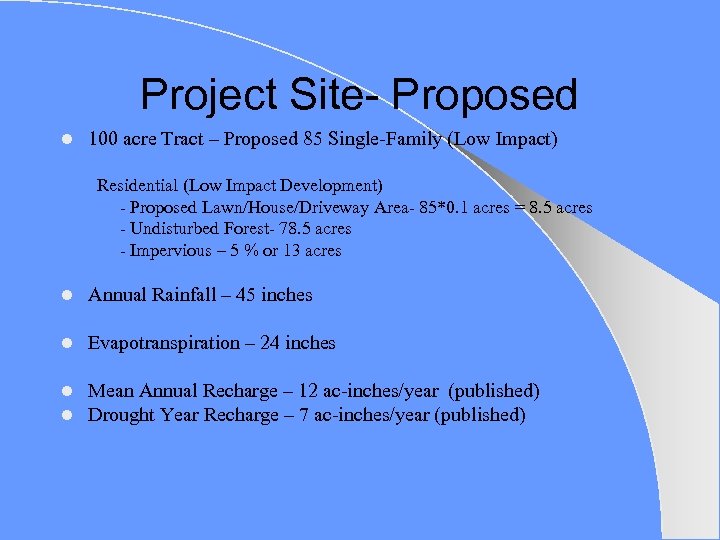
Project Site- Proposed l 100 acre Tract – Proposed 85 Single-Family (Low Impact) Residential (Low Impact Development) - Proposed Lawn/House/Driveway Area- 85*0. 1 acres = 8. 5 acres - Undisturbed Forest- 78. 5 acres - Impervious – 5 % or 13 acres l Annual Rainfall – 45 inches l Evapotranspiration – 24 inches l l Mean Annual Recharge – 12 ac-inches/year (published) Drought Year Recharge – 7 ac-inches/year (published)
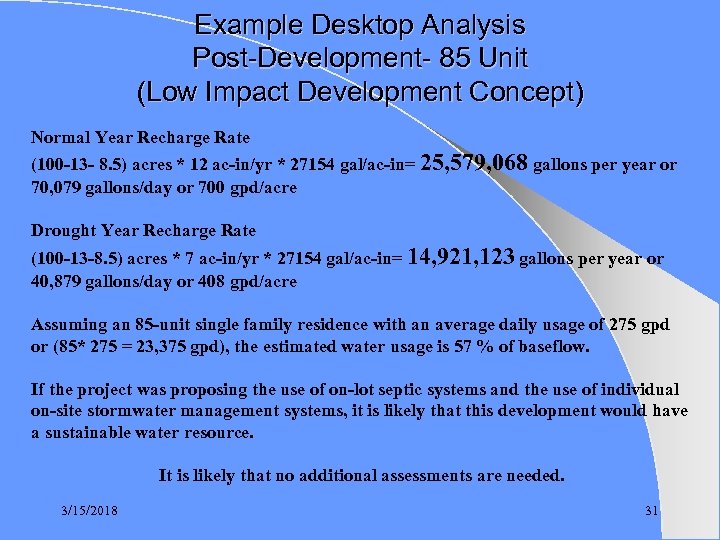
Example Desktop Analysis Post-Development- 85 Unit (Low Impact Development Concept) Normal Year Recharge Rate (100 -13 - 8. 5) acres * 12 ac-in/yr * 27154 gal/ac-in= 25, 579, 068 gallons per year or 70, 079 gallons/day or 700 gpd/acre Drought Year Recharge Rate (100 -13 -8. 5) acres * 7 ac-in/yr * 27154 gal/ac-in= 14, 921, 123 gallons per year or 40, 879 gallons/day or 408 gpd/acre Assuming an 85 -unit single family residence with an average daily usage of 275 gpd or (85* 275 = 23, 375 gpd), the estimated water usage is 57 % of baseflow. If the project was proposing the use of on-lot septic systems and the use of individual on-site stormwater management systems, it is likely that this development would have a sustainable water resource. It is likely that no additional assessments are needed. 3/15/2018 31
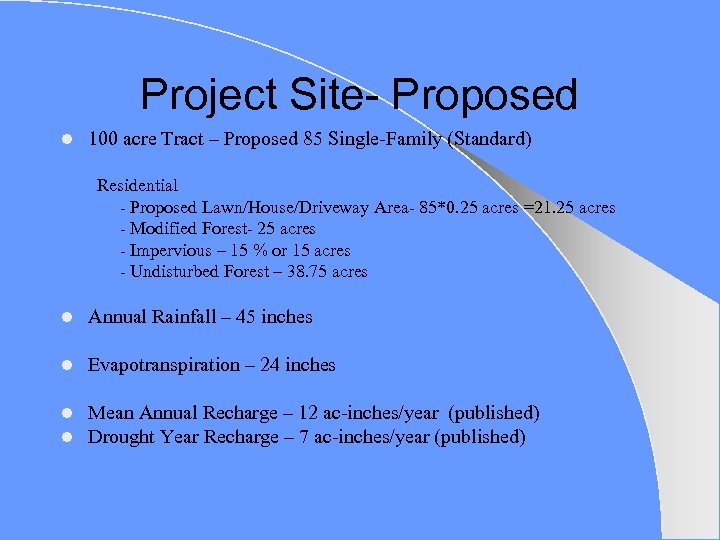
Project Site- Proposed l 100 acre Tract – Proposed 85 Single-Family (Standard) Residential - Proposed Lawn/House/Driveway Area- 85*0. 25 acres =21. 25 acres - Modified Forest- 25 acres - Impervious – 15 % or 15 acres - Undisturbed Forest – 38. 75 acres l Annual Rainfall – 45 inches l Evapotranspiration – 24 inches l l Mean Annual Recharge – 12 ac-inches/year (published) Drought Year Recharge – 7 ac-inches/year (published)
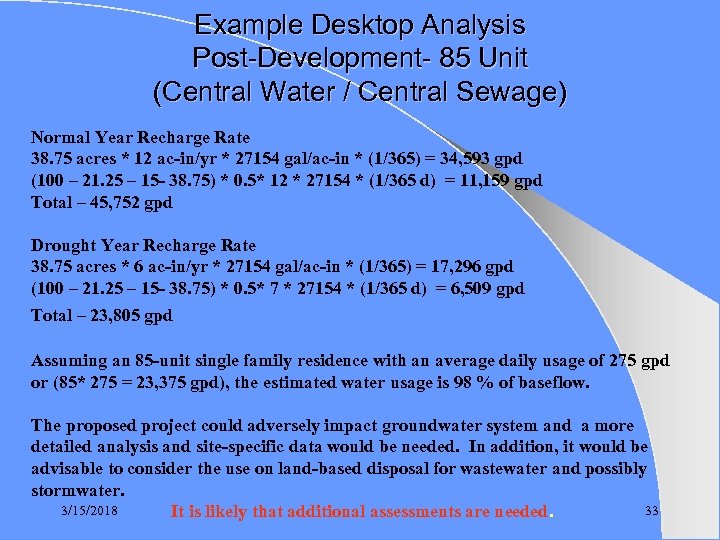
Example Desktop Analysis Post-Development- 85 Unit (Central Water / Central Sewage) Normal Year Recharge Rate 38. 75 acres * 12 ac-in/yr * 27154 gal/ac-in * (1/365) = 34, 593 gpd (100 – 21. 25 – 15 - 38. 75) * 0. 5* 12 * 27154 * (1/365 d) = 11, 159 gpd Total – 45, 752 gpd Drought Year Recharge Rate 38. 75 acres * 6 ac-in/yr * 27154 gal/ac-in * (1/365) = 17, 296 gpd (100 – 21. 25 – 15 - 38. 75) * 0. 5* 7 * 27154 * (1/365 d) = 6, 509 gpd Total – 23, 805 gpd Assuming an 85 -unit single family residence with an average daily usage of 275 gpd or (85* 275 = 23, 375 gpd), the estimated water usage is 98 % of baseflow. The proposed project could adversely impact groundwater system and a more detailed analysis and site-specific data would be needed. In addition, it would be advisable to consider the use on land-based disposal for wastewater and possibly stormwater. 3/15/2018 33 It is likely that additional assessments are needed.
Additional Evaluations l May require a modification to design. l A more detailed site-specific and watershed based hydrological evaluation. l A more detailed evaluation that includes the installation of on-site water wells.
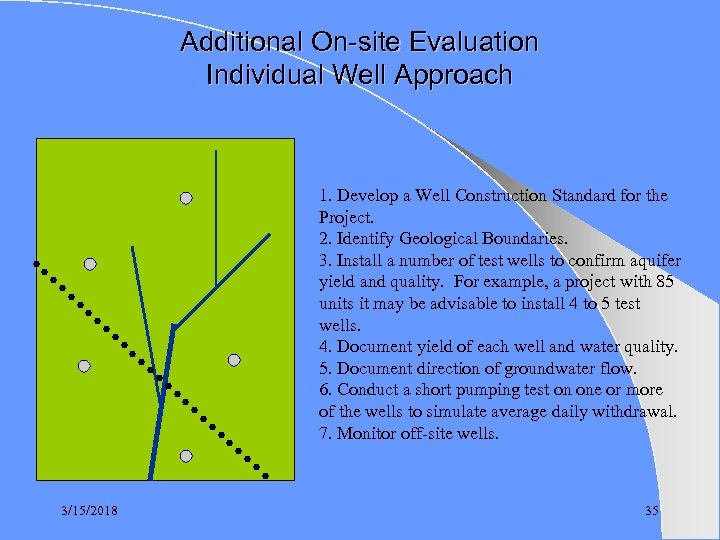
Additional On-site Evaluation Individual Well Approach 1. Develop a Well Construction Standard for the Project. 2. Identify Geological Boundaries. 3. Install a number of test wells to confirm aquifer yield and quality. For example, a project with 85 units it may be advisable to install 4 to 5 test wells. 4. Document yield of each well and water quality. 5. Document direction of groundwater flow. 6. Conduct a short pumping test on one or more of the wells to simulate average daily withdrawal. 7. Monitor off-site wells. 3/15/2018 35
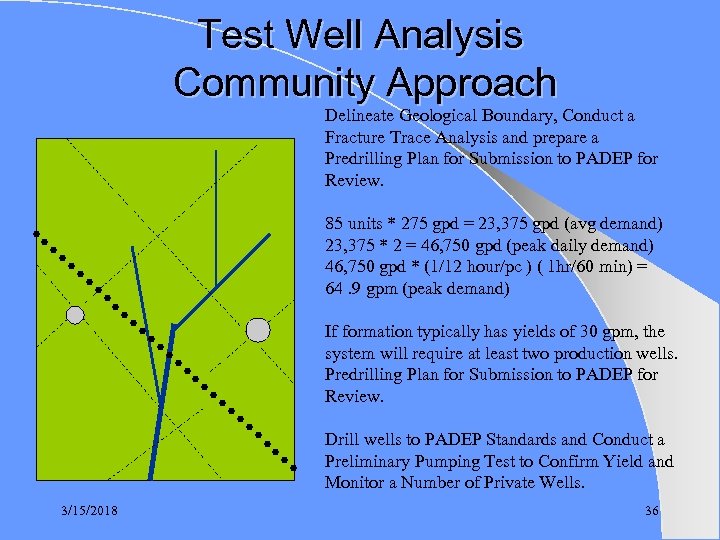
Test Well Analysis Community Approach Delineate Geological Boundary, Conduct a Fracture Trace Analysis and prepare a Predrilling Plan for Submission to PADEP for Review. 85 units * 275 gpd = 23, 375 gpd (avg demand) 23, 375 * 2 = 46, 750 gpd (peak daily demand) 46, 750 gpd * (1/12 hour/pc ) ( 1 hr/60 min) = 64. 9 gpm (peak demand) If formation typically has yields of 30 gpm, the system will require at least two production wells. Predrilling Plan for Submission to PADEP for Review. Drill wells to PADEP Standards and Conduct a Preliminary Pumping Test to Confirm Yield and Monitor a Number of Private Wells. 3/15/2018 36
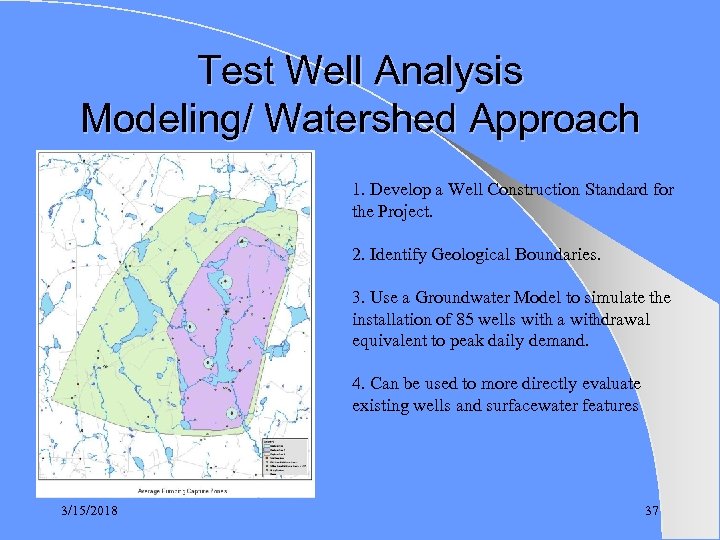
Test Well Analysis Modeling/ Watershed Approach 1. Develop a Well Construction Standard for the Project. 2. Identify Geological Boundaries. 3. Use a Groundwater Model to simulate the installation of 85 wells with a withdrawal equivalent to peak daily demand. 4. Can be used to more directly evaluate existing wells and surfacewater features 3/15/2018 37
Protect Your Water Source Things Local Agency Can Do l Zoning and Planning Process that includes a Groundwater Availability Analysis, Encourages Groundwater Recharge, and Water Reuse. l Developing a Well Water Ordinance and Linking the Well Water Ordinance to Act 537 Planning (possible assistance with operating cost through Act 537 funding) l Developing Well Construction Standards and Encouraging Groundwater Recharge (Low Impact Development and Stormwater Recharge Systems for New and Existing Developments) l Start or Support a Community Based Groundwater Education Program (Carbon County Groundwater Guardians, County Conservation District, and other partners) 3/15/2018 38
Additional Options for Local Agency Developing Water Well Ordinance that provides construction standards and an initial water quality and yield analysis. l Developing Well Construction and Placement standards – beyond a minimum isolation distance from land-based wastewater systems, what about hazardous chemicals, manure storage, stormwater facilities, floodplains, etc. l 3/15/2018 39
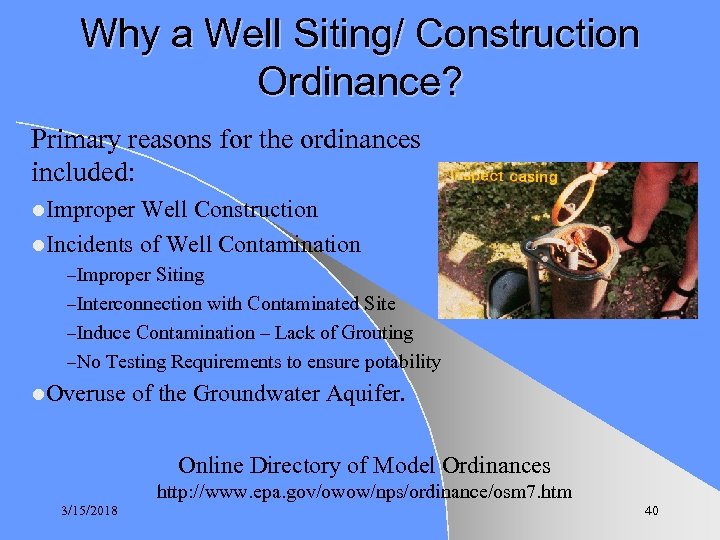
Why a Well Siting/ Construction Ordinance? Primary reasons for the ordinances included: l. Improper Well Construction l. Incidents of Well Contamination –Improper Siting –Interconnection with Contaminated Site –Induce Contamination – Lack of Grouting –No Testing Requirements to ensure potability l. Overuse of the Groundwater Aquifer. Online Directory of Model Ordinances http: //www. epa. gov/owow/nps/ordinance/osm 7. htm 3/15/2018 40
Well Construction Specs Jackson Township, Monroe County, PA l l l Casing must be 18 inch above grade Must use a sanitary well seal 19# casing must be at least 40 feet in length and 10 feet into bedrock (does not say the bedrock should be firm) All casing must be threaded and coupled or if welded, a certified welder must weld it. Annulus must be grouted with neat cement grout, Promix cement grout, or concrete grout to within approximately 5 feet of the top of the casing. Well must be disinfected – this does not mean long-term disinfection treatment, but shock disinfected. 3/15/2018 41
Well Construction Specs Paradise Township, Monroe County, PA l l l Casing must be 24 inch above grade or the 100 year flood level of record Must use a sanitary well seal 19# casing must be at least 50 feet in length and 10 feet into bedrock (does not say the bedrock should be firm) Annulus must be grouted with bentonite grout. Well must be disinfected – this does not mean long -term disinfection treatment, but shock disinfected. 3/15/2018 42
Well Construction Specs Ryan Township, Schuylkill County, PA l l l Casing must be 12 inch above grade Casing wall thickness must be at least 0. 1875 inch (13#) Must use a sanitary well seal Casing must be at least 40 feet in length and 10 feet into bedrock (does not say the bedrock should be firm) Annulus must be grouted within 24 hours with bentonite grout or Neat cement grout (No disturbance – 2 hours bentonite and 48 -hours cement). Well must be disinfected – this does not mean long-term disinfection treatment, but shock disinfected. 3/15/2018 43
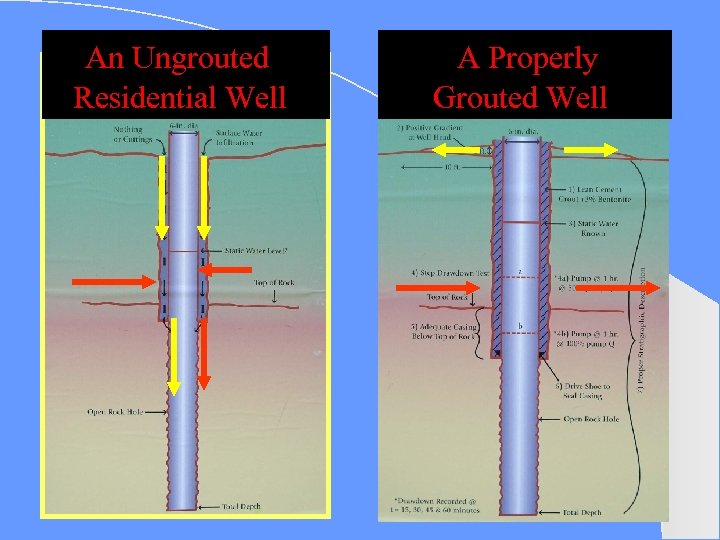
An Ungrouted Residential Well 3/15/2018 A Properly Grouted Well 44
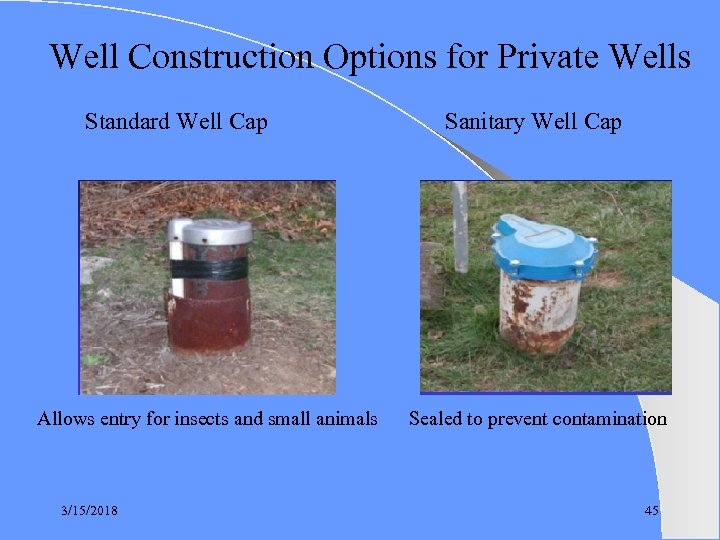
Well Construction Options for Private Wells Standard Well Cap Allows entry for insects and small animals 3/15/2018 Sanitary Well Cap Sealed to prevent contamination 45
Why Care About Well Construction ? l Poor construction can affect drinking water quality for well user and regional well users l Poor construction can contribute, promote, and facilitate pollution and contamination of the groundwater aquifer l Proper construction can prolong the life and yield of the well 3/15/2018 46
A Properly Constructed (Sanitary) Residential Water Well Has: l casing that extends at least 15 feet into firm bedrock or 40 feet below ground, whichever is greater l casing of adequate wall thickness (meet PADEP Requirements Community Water Supplies- recommend 19#) l a driveshoe on the bottom of the casing l annular space should be grouted and casing should have a sanitary well cap. l casing at least 12 inches above grade and 3 feet above flood elevation. 3/15/2018 47
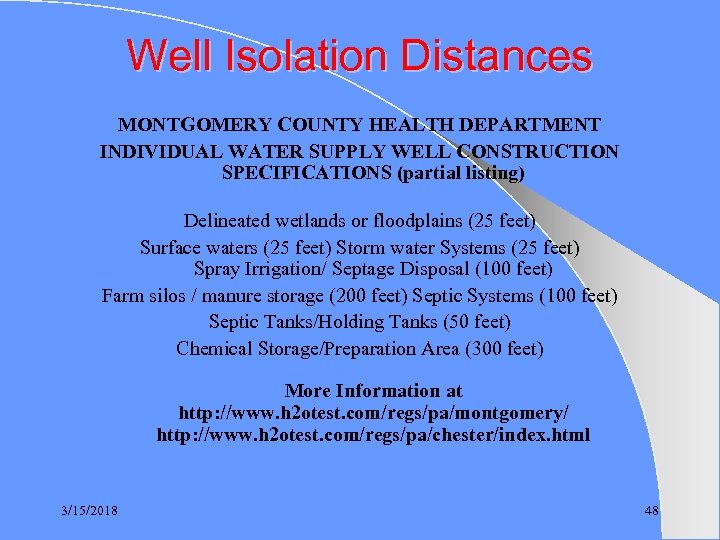
Well Isolation Distances MONTGOMERY COUNTY HEALTH DEPARTMENT INDIVIDUAL WATER SUPPLY WELL CONSTRUCTION SPECIFICATIONS (partial listing) Delineated wetlands or floodplains (25 feet) Surface waters (25 feet) Storm water Systems (25 feet) Spray Irrigation/ Septage Disposal (100 feet) Farm silos / manure storage (200 feet) Septic Systems (100 feet) Septic Tanks/Holding Tanks (50 feet) Chemical Storage/Preparation Area (300 feet) More Information at http: //www. h 2 otest. com/regs/pa/montgomery/ http: //www. h 2 otest. com/regs/pa/chester/index. html 3/15/2018 48
Importance of Groundwater Analysis and Planning • Protect the health, security, and well-being of the current residences and water users. • Protect the environmental and recreational activities that rely on surfacewater – Groundwater and Surfacewater are linked. • Protect long-term economic growth by properly managing are resources. • Evaluate projects to make sure that proposed densities or demands do not exceed the natural recharge capacity of the site or establish artificial recharge systems, such as: stormwater recharge and land-based wastewater disposal. 3/15/2018 49
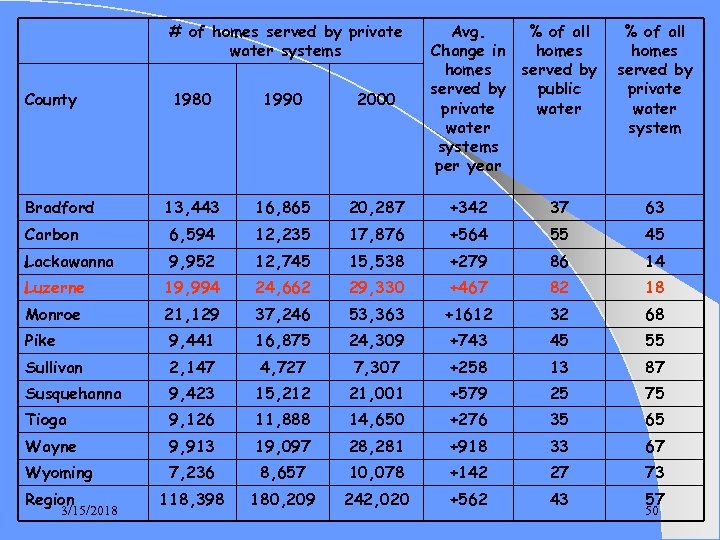
# of homes served by private water systems County Avg. % of all Change in homes served by public private water systems per year % of all homes served by private water system 1980 1990 2000 13, 443 16, 865 20, 287 +342 37 63 Carbon 6, 594 12, 235 17, 876 +564 55 45 Lackawanna 9, 952 12, 745 15, 538 +279 86 14 Luzerne 19, 994 24, 662 29, 330 +467 82 18 Monroe 21, 129 37, 246 53, 363 +1612 32 68 Pike 9, 441 16, 875 24, 309 +743 45 55 Sullivan 2, 147 4, 727 7, 307 +258 13 87 Susquehanna 9, 423 15, 212 21, 001 +579 25 75 Tioga 9, 126 11, 888 14, 650 +276 35 65 Wayne 9, 913 19, 097 28, 281 +918 33 67 Wyoming 7, 236 8, 657 10, 078 +142 27 73 118, 398 180, 209 242, 020 +562 43 Bradford Region 3/15/2018 57 50
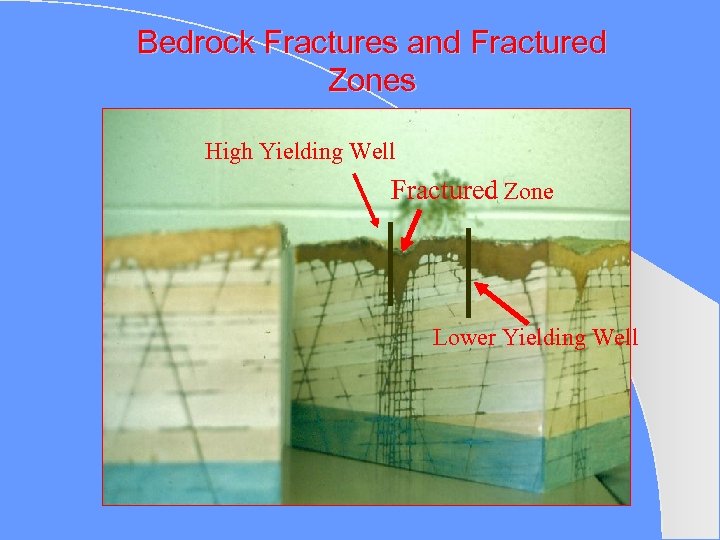
Bedrock Fractures and Fractured Zones High Yielding Well Fractured Zone Lower Yielding Well
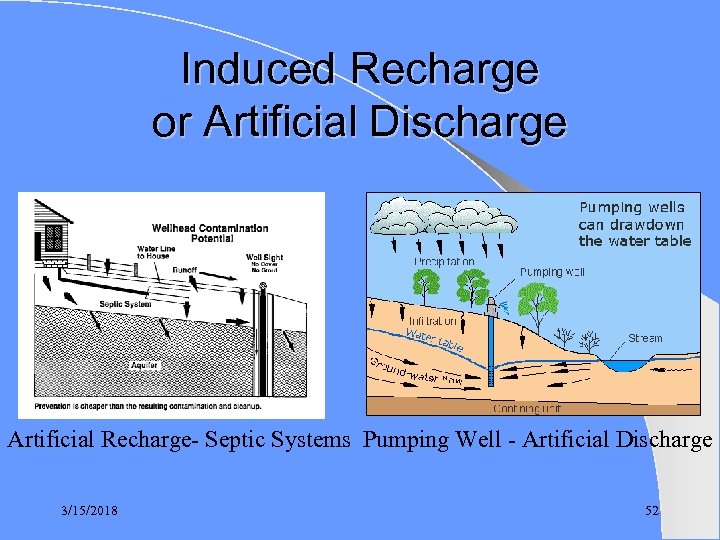
Induced Recharge or Artificial Discharge Artificial Recharge- Septic Systems Pumping Well - Artificial Discharge 3/15/2018 52
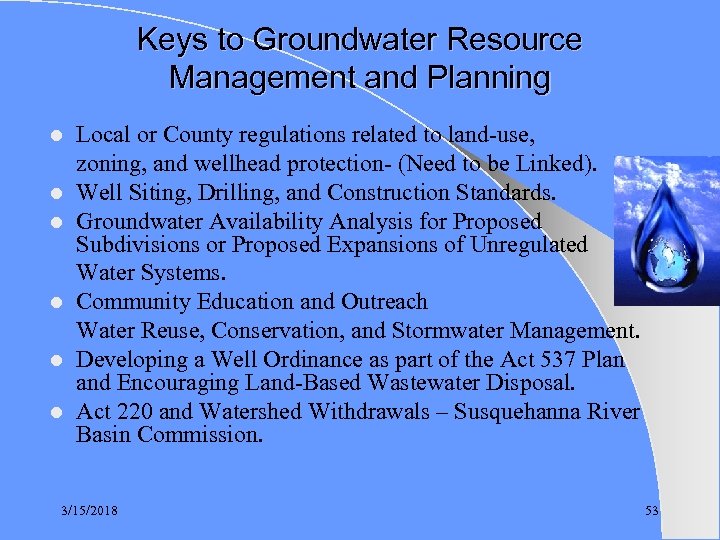
Keys to Groundwater Resource Management and Planning l l l Local or County regulations related to land-use, zoning, and wellhead protection- (Need to be Linked). Well Siting, Drilling, and Construction Standards. Groundwater Availability Analysis for Proposed Subdivisions or Proposed Expansions of Unregulated Water Systems. Community Education and Outreach Water Reuse, Conservation, and Stormwater Management. Developing a Well Ordinance as part of the Act 537 Plan and Encouraging Land-Based Wastewater Disposal. Act 220 and Watershed Withdrawals – Susquehanna River Basin Commission. 3/15/2018 53
Presentation Sponsors Carbon County Groundwater Guardians http: //www. carbonwaters. org l C-SAW Program - Consortium for Scientific Assistance to Watersheds Program http: //pa. water. usgs. gov/csaw/ l Pocono Northeast Resource Conservation & Development Council http: //www. pnercd. org l Wilkes University http: //www. wilkes. edu l 3/15/2018 54
Announcements l 2009 Pennsylvania Stormwater Management Symposium - the title l At the same site, the Municipal Workshop is being held on October 14, 2009 at Villanova University. l To Register for either event, please visit: http: //www 3. villanova. edu/VUSP/PASWM/index. htm of the Symposium is "Bailing Out Stormwater". The event will occur on October 14 - 15, 2009 at Villanova University.
Announcements l Announcement 1 2009 Pennsylvania Stormwater Management Symposium - the title of the Symposium is "Bailing Out Stormwater". The event will occur on October 14 - 15, 2009 at Villanova University. l At the same site, the Municipal Workshop is being held on October 14, 2009 at Villanova University. To Register for either event, please visit: http: //www 3. villanova. edu/VUSP/PASWM/index. htm l Announcement 2 Pocono Northeast Resource, Conservation & Development Council is looking for Community Partners and Developing Local Projects http: //www. pnercd. org

Ground Resource Management Luzerne County, Pennsylvania Mr. Brian Oram, PG Professional Geologist, Soil Scientist, PASEO, Certified Geothermal Installer, Licensed Well Driller Wilkes University and B. F. Environmental Consultants Inc. Dallas, Pennsylvania http: //www. water-research. net http: //www. bfenvironmental. com 3/15/2018 57

Ground Resource Management Luzerne County, Pennsylvania Mr. Brian Oram, PG Professional Geologist, Soil Scientist, PASEO, Certified Geothermal Installer, Licensed Well Driller Wilkes University and B. F. Environmental Consultants Inc. Dallas, Pennsylvania http: //www. water-research. net http: //www. bfenvironmental. com 3/15/2018 58
Скачать презентацию Ground Resource Management Luzerne County Pennsylvania Mr Brian
8fed6293a2bb97f8f9470d22fc532374.ppt