 Скачать презентацию Grmmz in Chinese Elly van Gelderen 4 November
53632725530d2a6af7e15bca8bda4df4.ppt
- Количество слайдов: 26



Grmmz in Chinese Elly van Gelderen 4 November 2013
What do we know about grammaticalization/cycles? Lexical > grammatical loss of semantic features some loss of phonological weight in tree: specifier to head higher up
To be reviewed Two kinds of le ba/jiang bei gei dao mei
Characteristics of East Asian (e. g. Thai and Chinese) • • No specifier > head Lex > Gramm > more Gramm Areal similarities Increase in synthetic
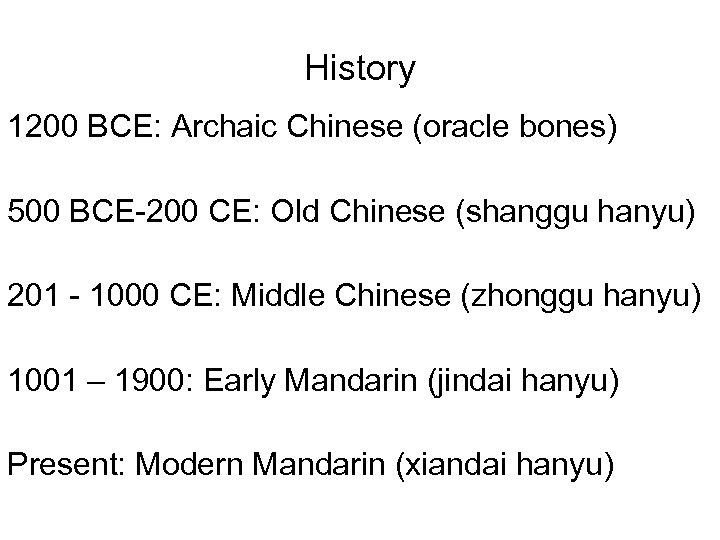
History 1200 BCE: Archaic Chinese (oracle bones) 500 BCE-200 CE: Old Chinese (shanggu hanyu) 201 - 1000 CE: Middle Chinese (zhonggu hanyu) 1001 – 1900: Early Mandarin (jindai hanyu) Present: Modern Mandarin (xiandai hanyu)
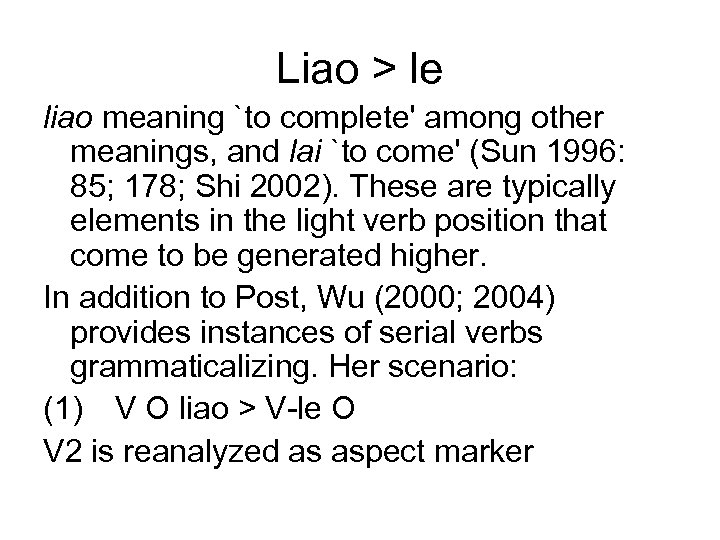
Liao > le liao meaning `to complete' among other meanings, and lai `to come' (Sun 1996: 85; 178; Shi 2002). These are typically elements in the light verb position that come to be generated higher. In addition to Post, Wu (2000; 2004) provides instances of serial verbs grammaticalizing. Her scenario: (1) V O liao > V-le O V 2 is reanalyzed as aspect marker
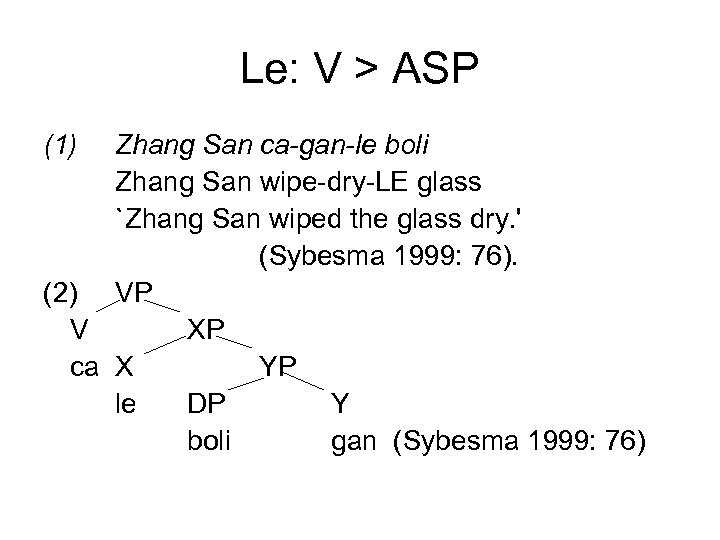
Le: V > ASP (1) Zhang San ca-gan-le boli Zhang San wipe-dry-LE glass `Zhang San wiped the glass dry. ' (Sybesma 1999: 76). (2) VP V XP ca X YP le DP Y boli gan (Sybesma 1999: 76)
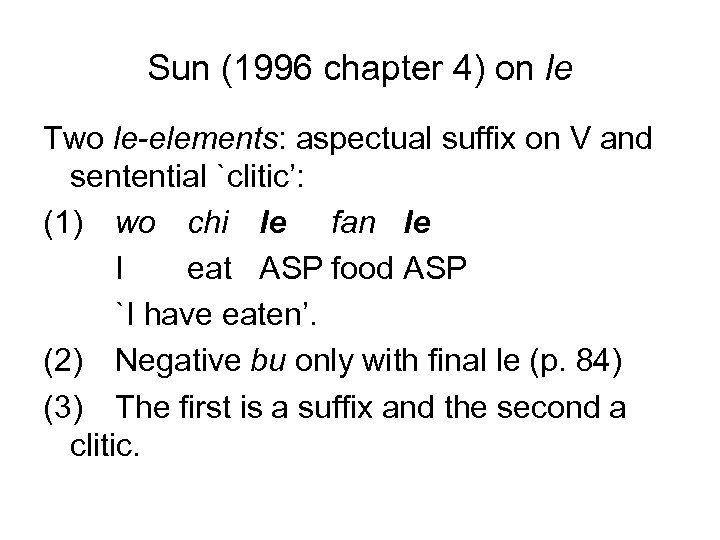
Sun (1996 chapter 4) on le Two le-elements: aspectual suffix on V and sentential `clitic’: (1) wo chi le fan le I eat ASP food ASP `I have eaten’. (2) Negative bu only with final le (p. 84) (3) The first is a suffix and the second a clitic.
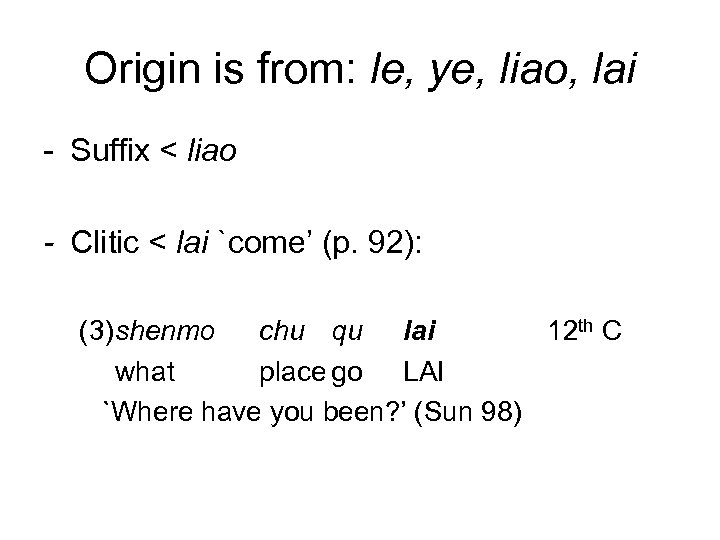
Origin is from: le, ye, liao, lai - Suffix < liao - Clitic < lai `come’ (p. 92): (3)shenmo chu qu lai 12 th C what place go LAI `Where have you been? ’ (Sun 98)
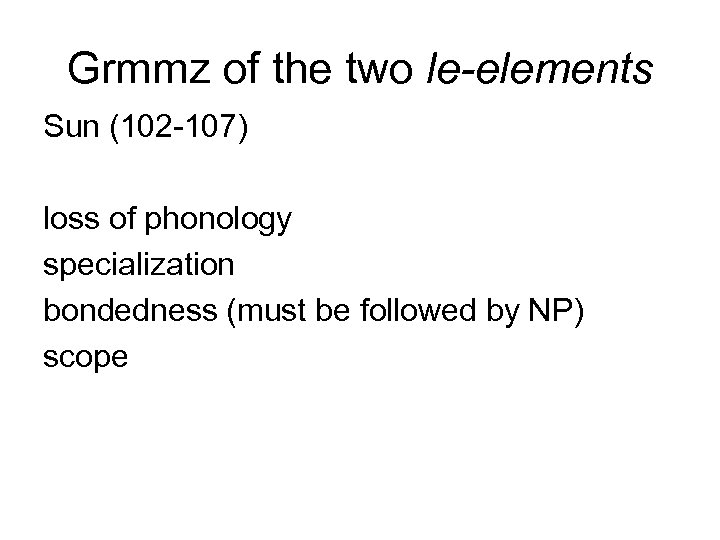
Grmmz of the two le-elements Sun (102 -107) loss of phonology specialization bondedness (must be followed by NP) scope
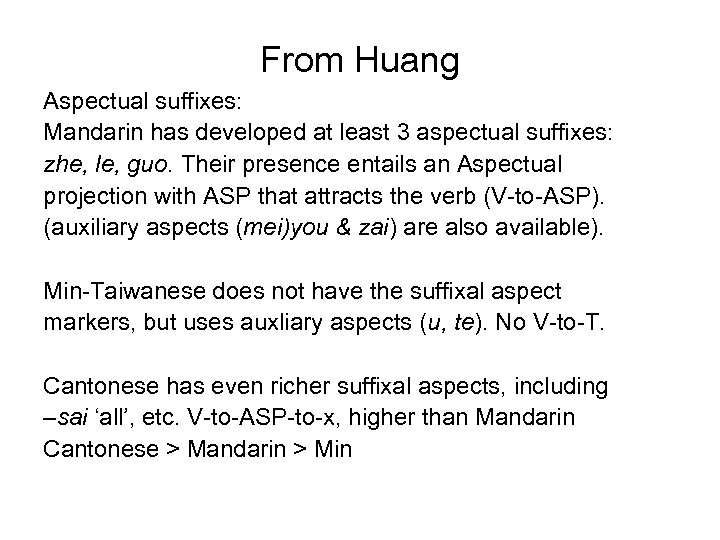
From Huang Aspectual suffixes: Mandarin has developed at least 3 aspectual suffixes: zhe, le, guo. Their presence entails an Aspectual projection with ASP that attracts the verb (V-to-ASP). (auxiliary aspects (mei)you & zai) are also available). Min-Taiwanese does not have the suffixal aspect markers, but uses auxliary aspects (u, te). No V-to-T. Cantonese has even richer suffixal aspects, including –sai ‘all’, etc. V-to-ASP-to-x, higher than Mandarin Cantonese > Mandarin > Min
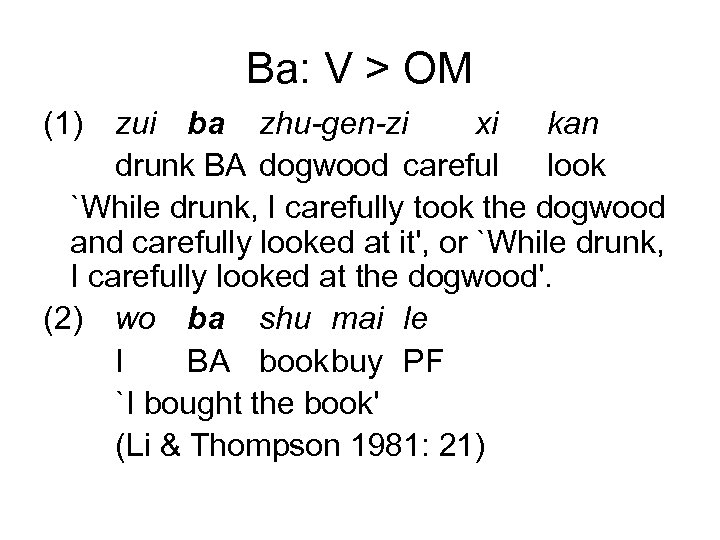
Ba: V > OM (1) zui ba zhu-gen-zi xi kan drunk BA dogwood careful look `While drunk, I carefully took the dogwood and carefully looked at it', or `While drunk, I carefully looked at the dogwood'. (2) wo ba shu mai le I BA bookbuy PF `I bought the book' (Li & Thompson 1981: 21)
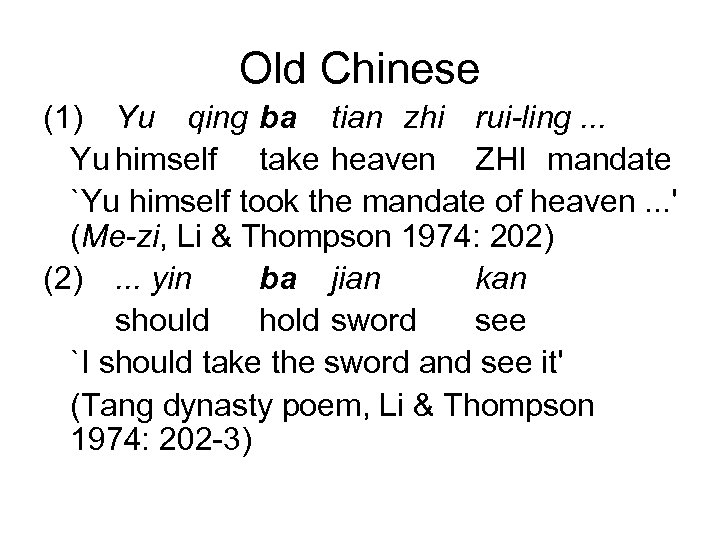
Old Chinese (1) Yu qing ba tian zhi rui-ling. . . Yu himself take heaven ZHI mandate `Yu himself took the mandate of heaven. . . ' (Me-zi, Li & Thompson 1974: 202) (2). . . yin ba jian kan should hold sword see `I should take the sword and see it' (Tang dynasty poem, Li & Thompson 1974: 202 -3)
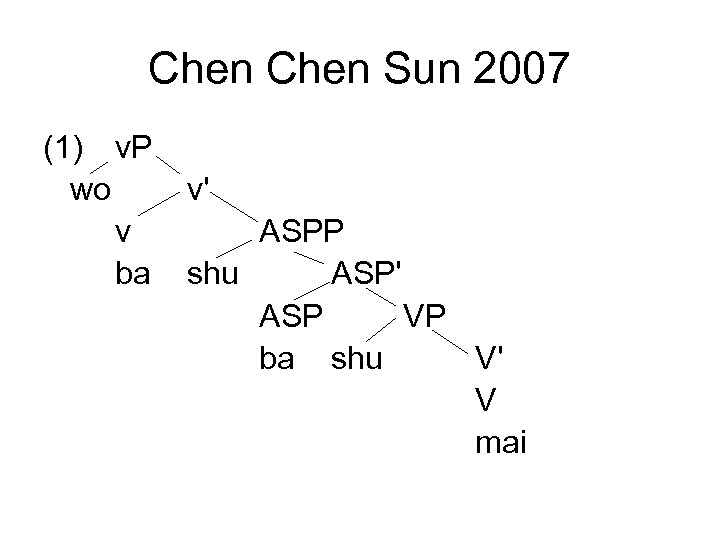
Chen Sun 2007 (1) v. P wo v ba v' ASPP shu ASP' ASP VP ba shu V' V mai
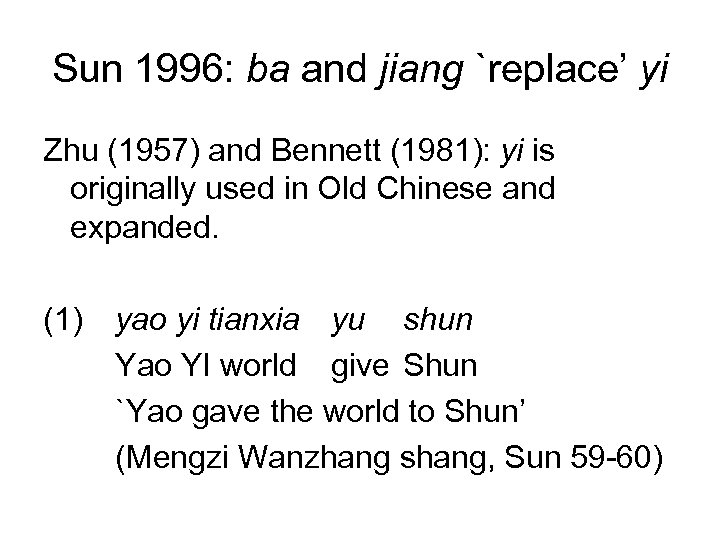
Sun 1996: ba and jiang `replace’ yi Zhu (1957) and Bennett (1981): yi is originally used in Old Chinese and expanded. (1) yao yi tianxia yu shun Yao YI world give Shun `Yao gave the world to Shun’ (Mengzi Wanzhang shang, Sun 59 -60)
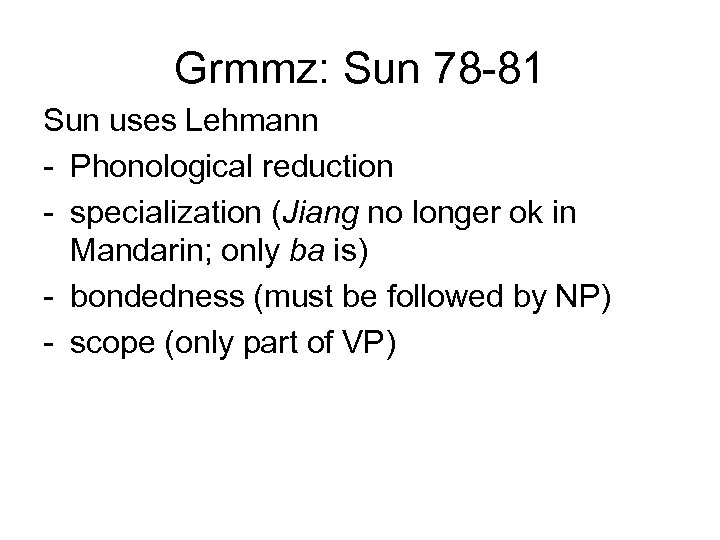
Grmmz: Sun 78 -81 Sun uses Lehmann - Phonological reduction - specialization (Jiang no longer ok in Mandarin; only ba is) - bondedness (must be followed by NP) - scope (only part of VP)
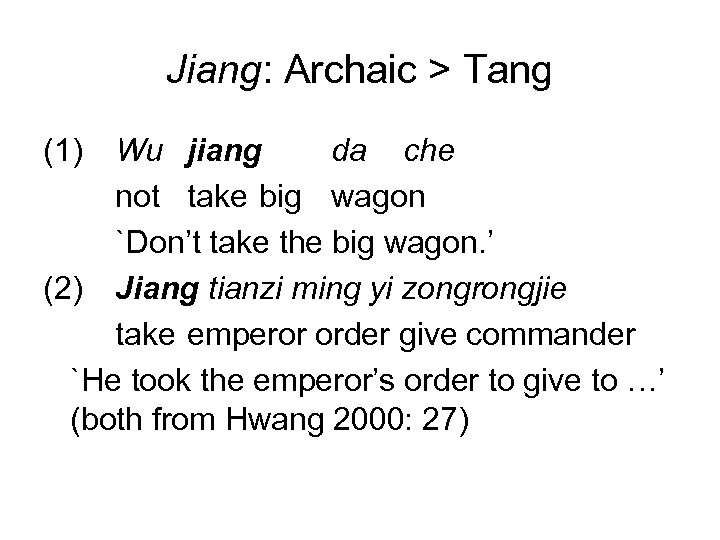
Jiang: Archaic > Tang (1) Wu jiang da che not take big wagon `Don’t take the big wagon. ’ (2) Jiang tianzi ming yi zongrongjie take emperor order give commander `He took the emperor’s order to give to …’ (both from Hwang 2000: 27)
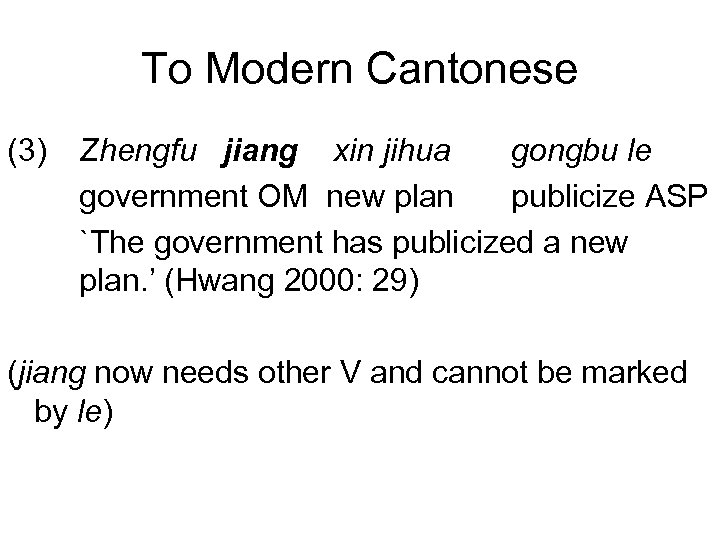
To Modern Cantonese (3) Zhengfu jiang xin jihua gongbu le government OM new plan publicize ASP `The government has publicized a new plan. ’ (Hwang 2000: 29) (jiang now needs other V and cannot be marked by le)
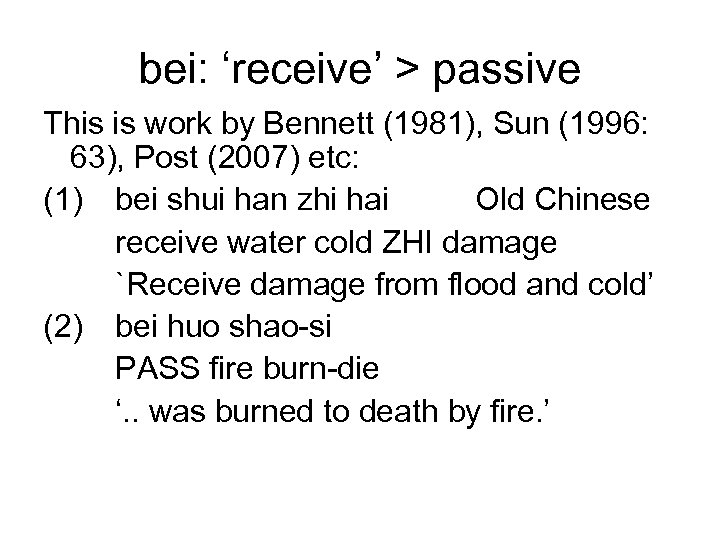
bei: ‘receive’ > passive This is work by Bennett (1981), Sun (1996: 63), Post (2007) etc: (1) bei shui han zhi hai Old Chinese receive water cold ZHI damage `Receive damage from flood and cold’ (2) bei huo shao-si PASS fire burn-die ‘. . was burned to death by fire. ’
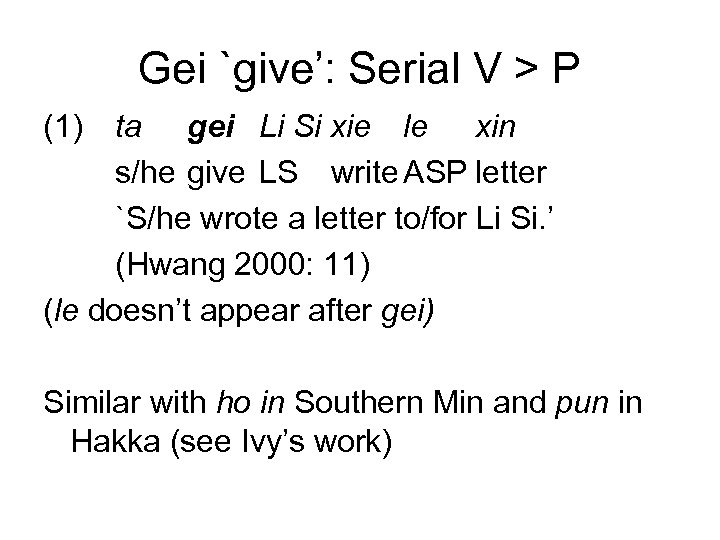
Gei `give’: Serial V > P (1) ta gei Li Si xie le xin s/he give LS write ASP letter `S/he wrote a letter to/for Li Si. ’ (Hwang 2000: 11) (le doesn’t appear after gei) Similar with ho in Southern Min and pun in Hakka (see Ivy’s work)
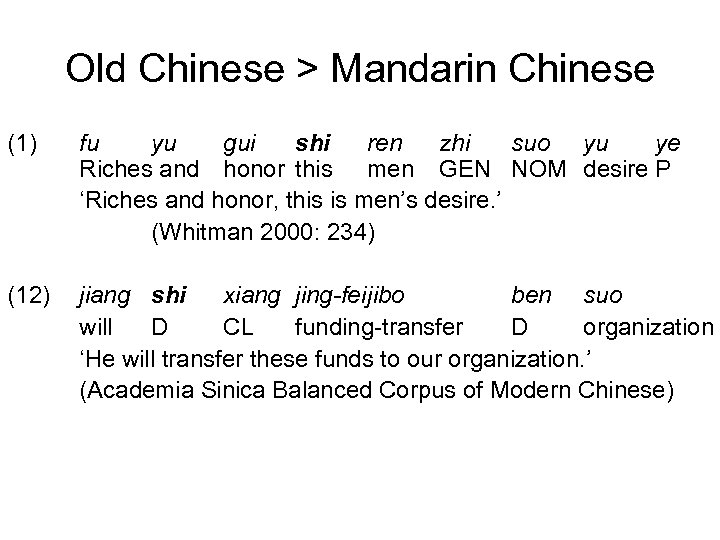
Old Chinese > Mandarin Chinese (1) fu yu gui shi ren zhi suo yu ye Riches and honor this men GEN NOM desire P ‘Riches and honor, this is men’s desire. ’ (Whitman 2000: 234) (12) jiang shi xiang jing-feijibo ben suo will D CL funding-transfer D organization ‘He will transfer these funds to our organization. ’ (Academia Sinica Balanced Corpus of Modern Chinese)
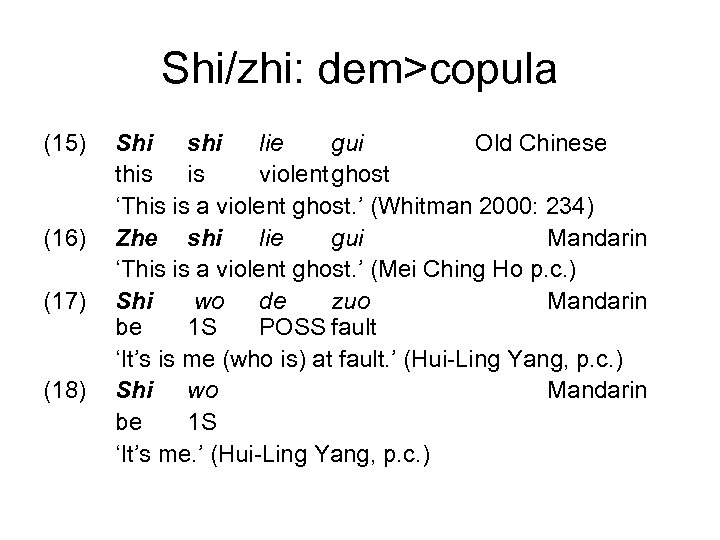
Shi/zhi: dem>copula (15) (16) (17) (18) Shi shi lie gui Old Chinese this is violent ghost ‘This is a violent ghost. ’ (Whitman 2000: 234) Zhe shi lie gui Mandarin ‘This is a violent ghost. ’ (Mei Ching Ho p. c. ) Shi wo de zuo Mandarin be 1 S POSS fault ‘It’s is me (who is) at fault. ’ (Hui-Ling Yang, p. c. ) Shi wo Mandarin be 1 S ‘It’s me. ’ (Hui-Ling Yang, p. c. )
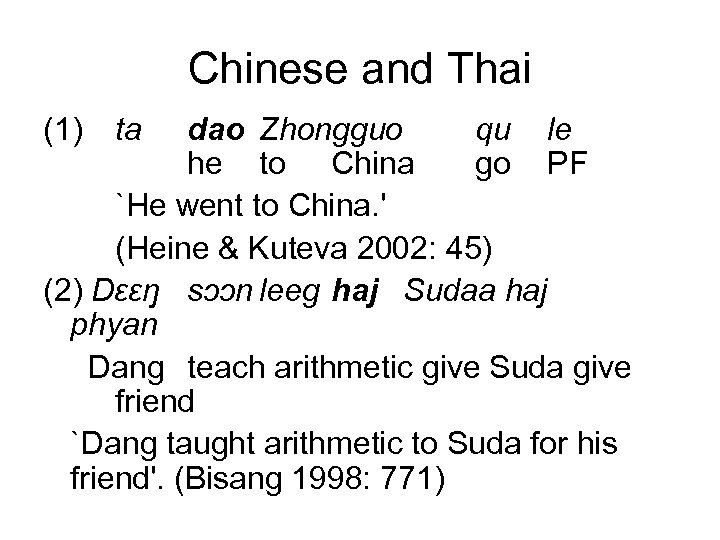
Chinese and Thai (1) ta dao Zhongguo qu le he to China go PF `He went to China. ' (Heine & Kuteva 2002: 45) (2) Dεεŋ sɔɔn leeg haj Sudaa haj phyan Dang teach arithmetic give Suda give friend `Dang taught arithmetic to Suda for his friend'. (Bisang 1998: 771)
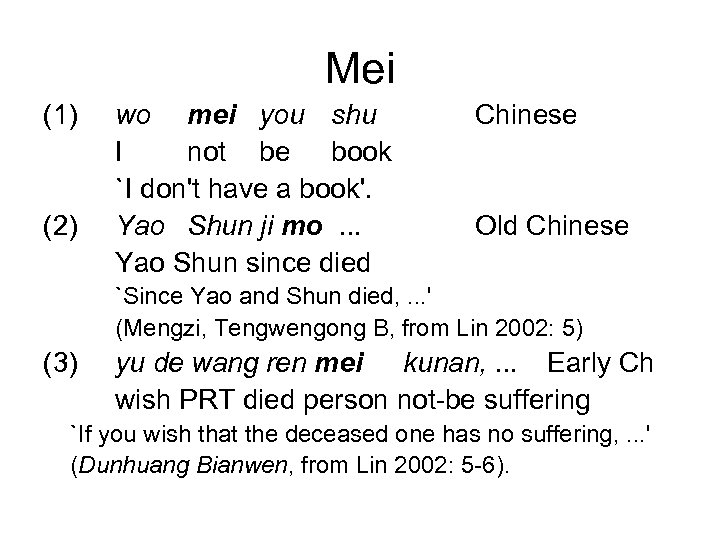
Mei (1) (2) wo mei you shu I not be book `I don't have a book'. Yao Shun ji mo. . . Yao Shun since died Chinese Old Chinese `Since Yao and Shun died, . . . ' (Mengzi, Tengwengong B, from Lin 2002: 5) (3) yu de wang ren mei kunan, . . . Early Ch wish PRT died person not-be suffering `If you wish that the deceased one has no suffering, . . . ' (Dunhuang Bianwen, from Lin 2002: 5 -6).
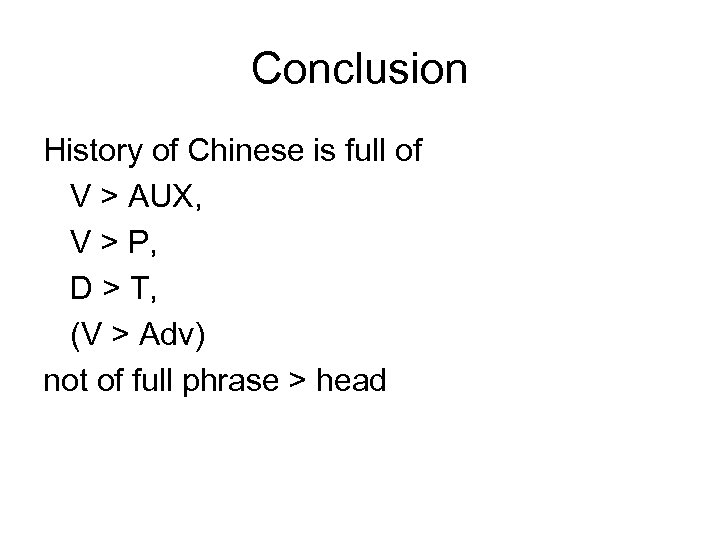
Conclusion History of Chinese is full of V > AUX, V > P, D > T, (V > Adv) not of full phrase > head
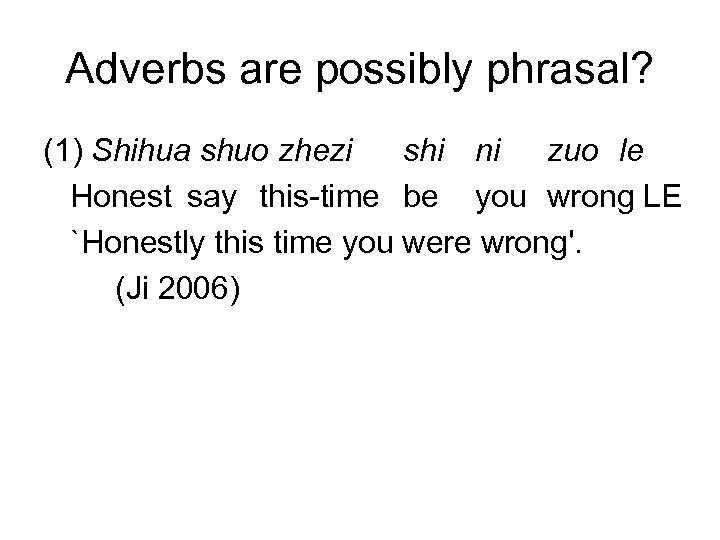
Adverbs are possibly phrasal? (1) Shihua shuo zhezi shi ni zuo le Honest say this-time be you wrong LE `Honestly this time you were wrong'. (Ji 2006)
Скачать презентацию Grmmz in Chinese Elly van Gelderen 4 November
53632725530d2a6af7e15bca8bda4df4.ppt