 Скачать презентацию Grid Technologies Enabling Collaborative Science Ian Foster Mathematics
aa7f22d34a801bff917cc9436ea2ccf5.ppt
- Количество слайдов: 34



Grid Technologies Enabling Collaborative Science Ian Foster Mathematics and Computer Science Division Argonne National Laboratory and Department of Computer Science The University of Chicago http: //www. mcs. anl. gov/~foster Plenary Talk, I 2 Virtual Conference, October 2, 2001
Issues I Will Address l Problem statement: What are Grids? l Architecture and technologies l Projects and futures foster@mcs. anl. gov ARGONNE CHICAGO
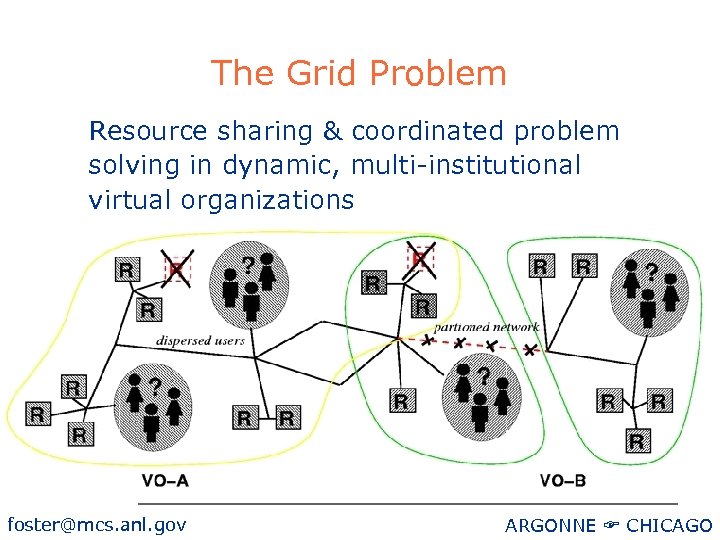
The Grid Problem Resource sharing & coordinated problem solving in dynamic, multi-institutional virtual organizations foster@mcs. anl. gov ARGONNE CHICAGO
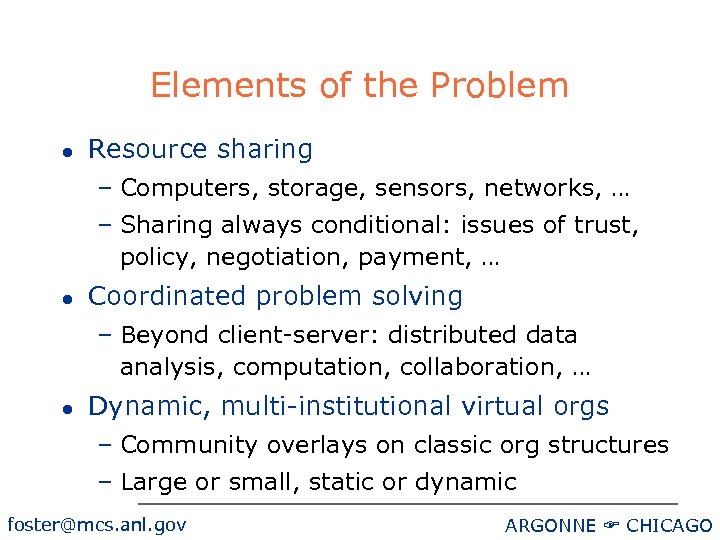
Elements of the Problem l Resource sharing – Computers, storage, sensors, networks, … – Sharing always conditional: issues of trust, policy, negotiation, payment, … l Coordinated problem solving – Beyond client-server: distributed data analysis, computation, collaboration, … l Dynamic, multi-institutional virtual orgs – Community overlays on classic org structures – Large or small, static or dynamic foster@mcs. anl. gov ARGONNE CHICAGO
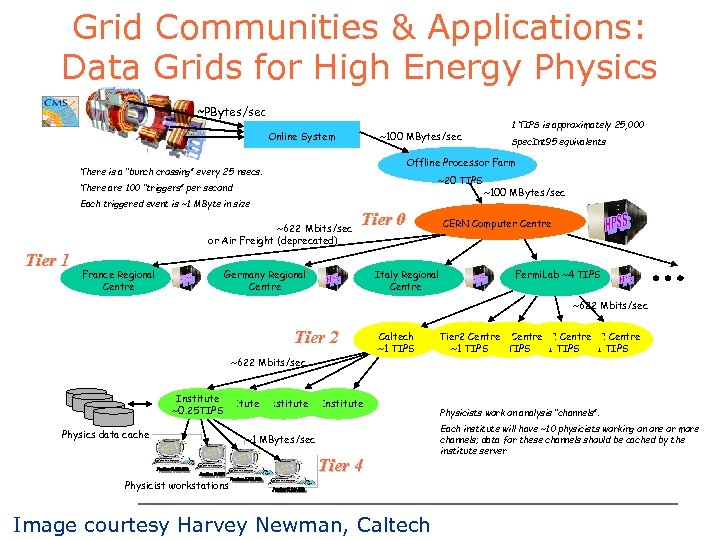
Grid Communities & Applications: Data Grids for High Energy Physics ~PBytes/sec Online System ~100 MBytes/sec ~20 TIPS There are 100 “triggers” per second Each triggered event is ~1 MByte in size ~622 Mbits/sec or Air Freight (deprecated) France Regional Centre Spec. Int 95 equivalents Offline Processor Farm There is a “bunch crossing” every 25 nsecs. Tier 1 1 TIPS is approximately 25, 000 Tier 0 Germany Regional Centre Italy Regional Centre ~100 MBytes/sec CERN Computer Centre Fermi. Lab ~4 TIPS ~622 Mbits/sec Tier 2 ~622 Mbits/sec Institute ~0. 25 TIPS Physics data cache Caltech ~1 TIPS Institute ~1 MBytes/sec Tier 4 Tier 2 Centre Tier 2 Centre ~1 TIPS Physicists work on analysis “channels”. Each institute will have ~10 physicists working on one or more channels; data for these channels should be cached by the institute server Physicist workstations foster@mcs. anl. gov Image courtesy Harvey Newman, Caltech ARGONNE CHICAGO
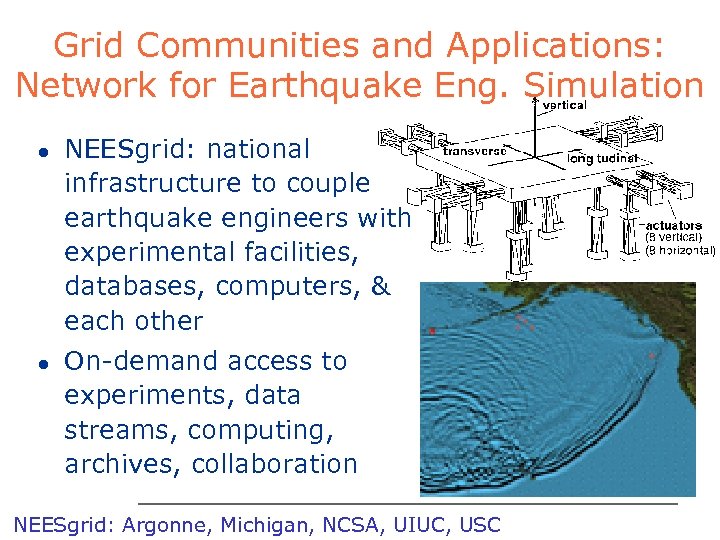
Grid Communities and Applications: Network for Earthquake Eng. Simulation l l NEESgrid: national infrastructure to couple earthquake engineers with experimental facilities, databases, computers, & each other On-demand access to experiments, data streams, computing, archives, collaboration foster@mcs. anl. gov NEESgrid: Argonne, Michigan, NCSA, UIUC, USC ARGONNE CHICAGO
Why Discuss Architecture? l Descriptive – Provide a common vocabulary for use when describing Grid systems l Guidance – Identify key areas in which services are required l Prescriptive – Define standard “Intergrid” protocols and APIs to facilitate creation of interoperable Grid systems and portable applications foster@mcs. anl. gov ARGONNE CHICAGO
What Sorts of Standards? l Need for interoperability when different groups want to share resources – E. g. , IP lets me talk to your computer, but how do we establish & maintain sharing? – How do I discover, authenticate, authorize, describe what I want to do, etc. ? l Need for shared infrastructure services to avoid repeated development, installation, e. g. – One port/service for remote access to computing, not one per tool/application – X. 509 enables sharing of Certificate Authorities foster@mcs. anl. gov ARGONNE CHICAGO
So, in Defining Grid Architecture, We Must Address … l Development of Grid protocols & services – Protocol-mediated access to remote resources – New services: e. g. , resource brokering – “On the Grid” = speak Intergrid protocols – Mostly (extensions to) existing protocols l Development of Grid APIs & SDKs – Facilitate application development by supplying higher-level abstractions l The model is the Internet and Web foster@mcs. anl. gov ARGONNE CHICAGO
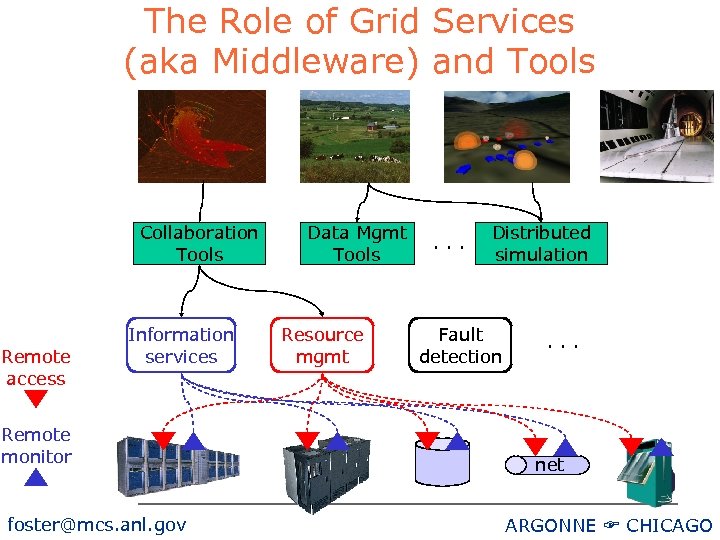
The Role of Grid Services (aka Middleware) and Tools Collaboration Tools Remote access Information services Remote monitor foster@mcs. anl. gov Data Mgmt Tools Resource mgmt . . . Distributed simulation Fault detection . . . net ARGONNE CHICAGO
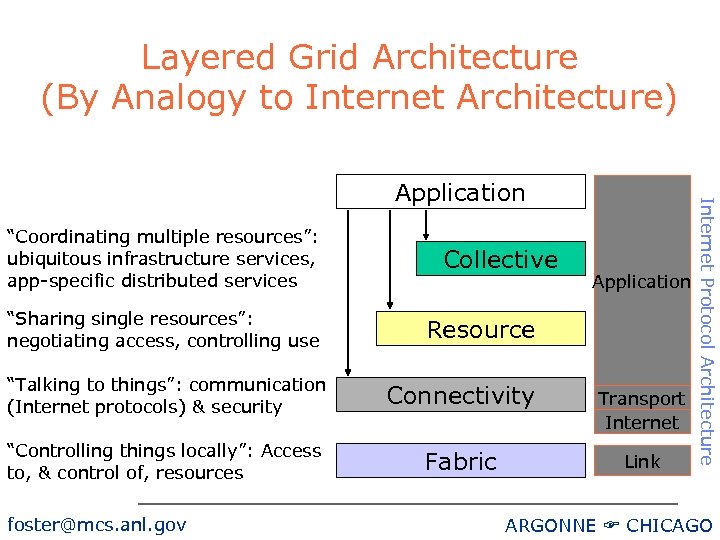
Layered Grid Architecture (By Analogy to Internet Architecture) “Coordinating multiple resources”: ubiquitous infrastructure services, app-specific distributed services “Sharing single resources”: negotiating access, controlling use Collective Application Resource “Talking to things”: communication (Internet protocols) & security Connectivity Transport Internet “Controlling things locally”: Access to, & control of, resources Fabric Link foster@mcs. anl. gov Internet Protocol Architecture Application ARGONNE CHICAGO
Where Are We With Architecture? l No “official” standards exist l But: – Globus Toolkit has emerged as the de facto standard for several important Connectivity, Resource, and Collective protocols – GGF has an architecture working group – Technical specifications are being developed for architecture elements: e. g. , security, data, resource management, information – Internet drafts submitted in security area foster@mcs. anl. gov ARGONNE CHICAGO
Grid Services Architecture: Connectivity Layer Protocols & Services l Communication – Internet protocols: IP, DNS, routing, etc. l Security: Grid Security Infrastructure (GSI) – Uniform authentication & authorization mechanisms in multi-institutional setting – Single sign-on, delegation, identity mapping – Public key technology, SSL, X. 509, GSS-API (several Internet drafts document extensions) – Supporting infrastructure: Certificate Authorities, key management, etc. foster@mcs. anl. gov ARGONNE CHICAGO
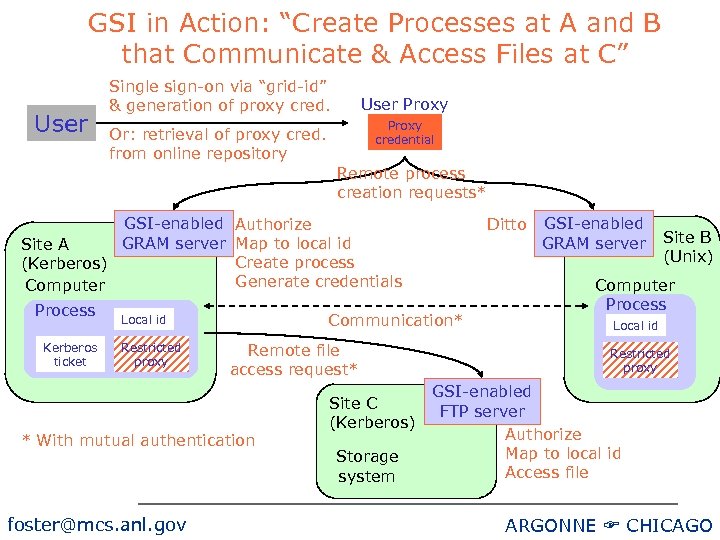
GSI in Action: “Create Processes at A and B that Communicate & Access Files at C” User Single sign-on via “grid-id” & generation of proxy cred. User Proxy credential Or: retrieval of proxy cred. from online repository Remote process creation requests* GSI-enabled Authorize GRAM server Map to local id Site A Create process (Kerberos) Generate credentials Computer Process Kerberos ticket Communication* Local id Restricted proxy Remote file access request* * With mutual authentication foster@mcs. anl. gov Ditto Site C (Kerberos) Storage system GSI-enabled GRAM server Site B (Unix) Computer Process Local id Restricted proxy GSI-enabled FTP server Authorize Map to local id Access file ARGONNE CHICAGO
Grid Services Architecture (3): Resource Layer Protocols & Services l Resource management: GRAM – Remote allocation, reservation, monitoring, control of [compute] resources l Data access: Grid. FTP – High-performance data access & transport l Information: MDS (GRRP, GRIP) – Access to structure & state information l l & others emerging: catalog access, code repository access, accounting, … All integrated with GSI foster@mcs. anl. gov ARGONNE CHICAGO
GRAM Resource Management Protocol l Grid Resource Allocation & Management – Allocation, monitoring, control of computations l Simple HTTP-based RPC – Job request: Returns opaque, transferable “job contact” string for access to job – Job cancel, Job status, Job signal – Event notification (callbacks) for state changes l l Protocol/server address robustness (exactly once execution), authentication, authorization Servers for most schedulers; C and Java APIs foster@mcs. anl. gov ARGONNE CHICAGO
Resource Management Futures: GRAM-2 (planned for late 2001) l Advance reservations – As prototyped in GARA in previous 2 years l Multiple resource types – Manage anything: storage, networks, etc. l Recoverable requests, timeout, etc. – Build on early work with Condor group l Use of SOAP (RPC using HTTP + XML) – First step towards Web Services l Policy evaluation points for restricted proxies foster@mcs. anl. gov. Steve Tuecke, others Karl Czajkowski, ARGONNE CHICAGO
Data Access & Transfer l l Grid. FTP: extended version of popular FTP protocol for Grid data access and transfer Secure, efficient, reliable, flexible, extensible, parallel, concurrent, e. g. : – Third-party data transfers, partial file transfers – Parallelism, striping (e. g. , on PVFS) – Reliable, recoverable data transfers l Reference implementations – Existing clients and servers: wuftpd, nicftp – Flexible, extensible libraries foster@mcs. anl. gov ARGONNE CHICAGO
Grid Services Architecture (4): Collective Layer Protocols & Services l Index servers aka metadirectory services – Custom views on dynamic resource collections assembled by a community l Resource brokers (e. g. , Condor Matchmaker) – Resource discovery and allocation l Replica management and replica selection – Optimize aggregate data access performance l Co-reservation and co-allocation services – End-to-end performance l Etc. , etc. foster@mcs. anl. gov ARGONNE CHICAGO
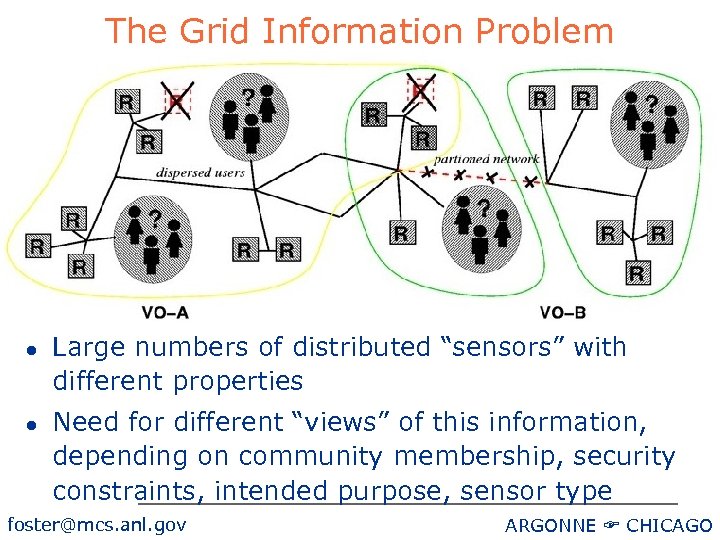
The Grid Information Problem l l Large numbers of distributed “sensors” with different properties Need for different “views” of this information, depending on community membership, security constraints, intended purpose, sensor type foster@mcs. anl. gov ARGONNE CHICAGO
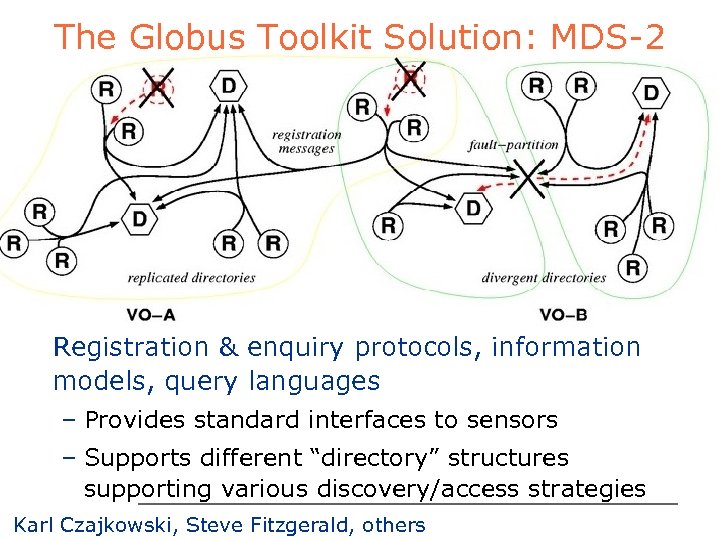
The Globus Toolkit Solution: MDS-2 Registration & enquiry protocols, information models, query languages – Provides standard interfaces to sensors – Supports different “directory” structures supporting various discovery/access strategies foster@mcs. anl. gov. Steve Fitzgerald, others Karl Czajkowski, ARGONNE CHICAGO
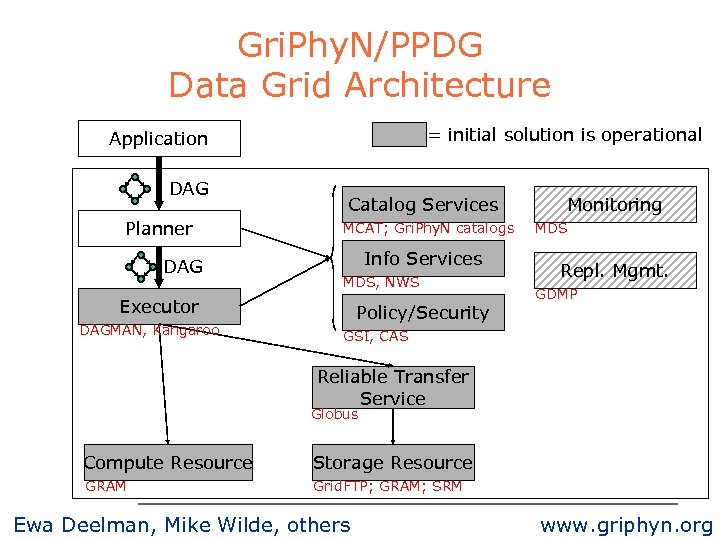
Gri. Phy. N/PPDG Data Grid Architecture = initial solution is operational Application DAG Planner DAG Catalog Services MCAT; Gri. Phy. N catalogs Info Services MDS, NWS Executor DAGMAN, Kangaroo Monitoring Policy/Security MDS Repl. Mgmt. GDMP GSI, CAS Reliable Transfer Service Globus Compute Resource Storage Resource GRAM Grid. FTP; GRAM; SRM foster@mcs. anl. gov Ewa Deelman, Mike Wilde, others www. griphyn. org ARGONNE CHICAGO
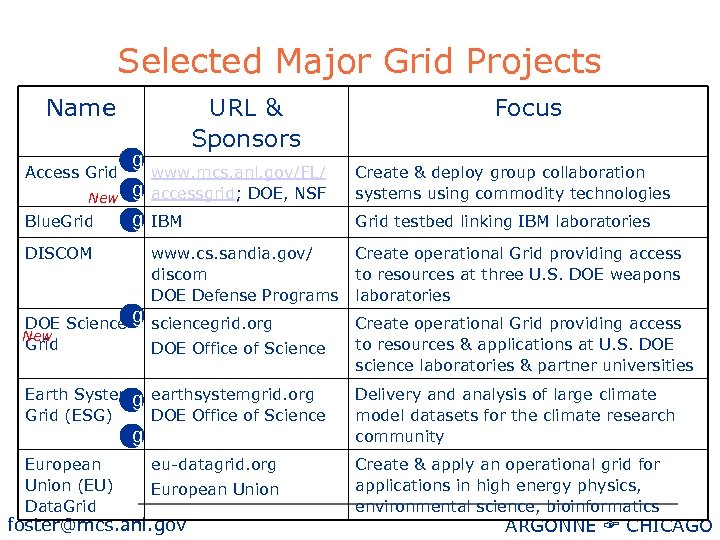
Selected Major Grid Projects Name Access Grid New Blue. Grid g g g DISCOM DOE Science New Grid g URL & Sponsors Focus www. mcs. anl. gov/FL/ accessgrid; DOE, NSF Create & deploy group collaboration systems using commodity technologies IBM Grid testbed linking IBM laboratories www. cs. sandia. gov/ discom DOE Defense Programs Create operational Grid providing access to resources at three U. S. DOE weapons laboratories sciencegrid. org Create operational Grid providing access to resources & applications at U. S. DOE science laboratories & partner universities DOE Office of Science Earth Systemg earthsystemgrid. org Grid (ESG) DOE Office of Science Delivery and analysis of large climate model datasets for the climate research community European Union (EU) Data. Grid Create & apply an operational grid for applications in high energy physics, environmental science, bioinformatics g eu-datagrid. org European Union foster@mcs. anl. gov ARGONNE CHICAGO
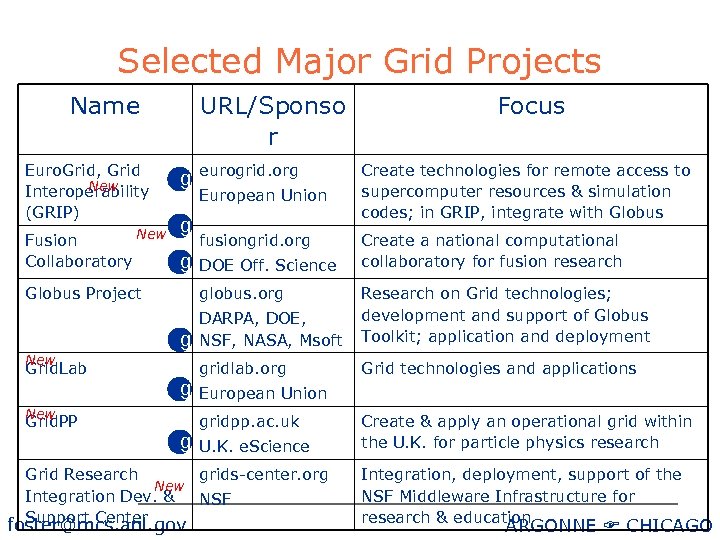
Selected Major Grid Projects Name Euro. Grid, Grid New Interoperability (GRIP) Fusion Collaboratory New URL/Sponso r g g g Globus Project New Grid. PP European Union fusiongrid. org DOE Off. Science globus. org g Grid. Lab eurogrid. org g g Create technologies for remote access to supercomputer resources & simulation codes; in GRIP, integrate with Globus Create a national computational collaboratory for fusion research DARPA, DOE, NSF, NASA, Msoft Research on Grid technologies; development and support of Globus Toolkit; application and deployment gridlab. org Grid technologies and applications European Union gridpp. ac. uk U. K. e. Science Grid Research grids-center. org New Integration Dev. & NSF Support Center foster@mcs. anl. gov Focus Create & apply an operational grid within the U. K. for particle physics research Integration, deployment, support of the NSF Middleware Infrastructure for research & education ARGONNE CHICAGO
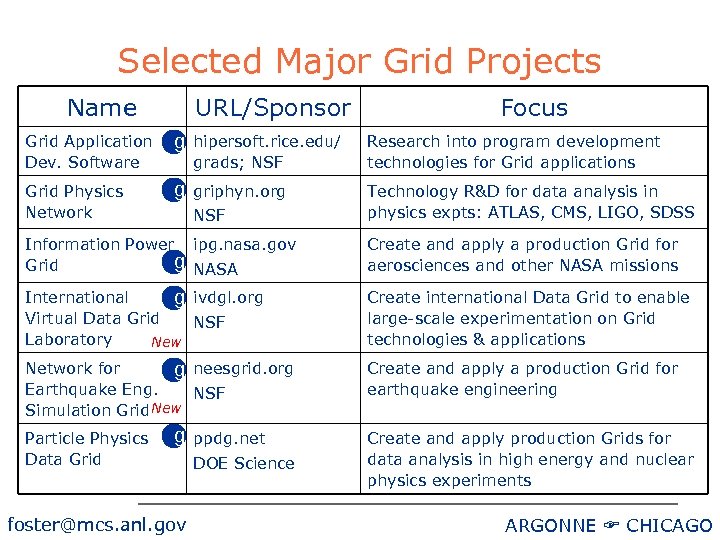
Selected Major Grid Projects Name URL/Sponsor Focus Grid Application Dev. Software g hipersoft. rice. edu/ grads; NSF Research into program development technologies for Grid applications Grid Physics Network g griphyn. org Technology R&D for data analysis in physics expts: ATLAS, CMS, LIGO, SDSS NSF Information Power ipg. nasa. gov g NASA Grid Create and apply a production Grid for aerosciences and other NASA missions International g ivdgl. org Virtual Data Grid NSF Laboratory New Create international Data Grid to enable large-scale experimentation on Grid technologies & applications Network for g neesgrid. org Earthquake Eng. NSF Simulation Grid New Create and apply a production Grid for earthquake engineering Particle Physics Data Grid g foster@mcs. anl. gov ppdg. net DOE Science Create and apply production Grids for data analysis in high energy and nuclear physics experiments ARGONNE CHICAGO
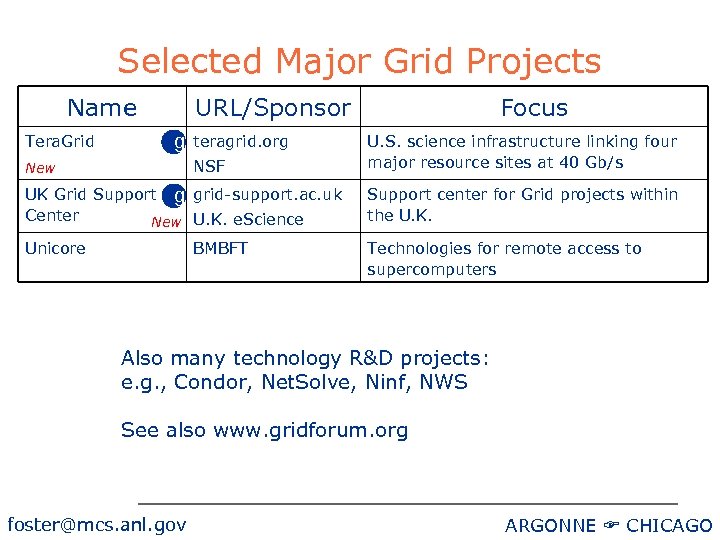
Selected Major Grid Projects Name Tera. Grid URL/Sponsor g teragrid. org NSF New Focus U. S. science infrastructure linking four major resource sites at 40 Gb/s UK Grid Support g grid-support. ac. uk Center New U. K. e. Science Support center for Grid projects within the U. K. Unicore Technologies for remote access to supercomputers BMBFT Also many technology R&D projects: e. g. , Condor, Net. Solve, Ninf, NWS See also www. gridforum. org foster@mcs. anl. gov ARGONNE CHICAGO
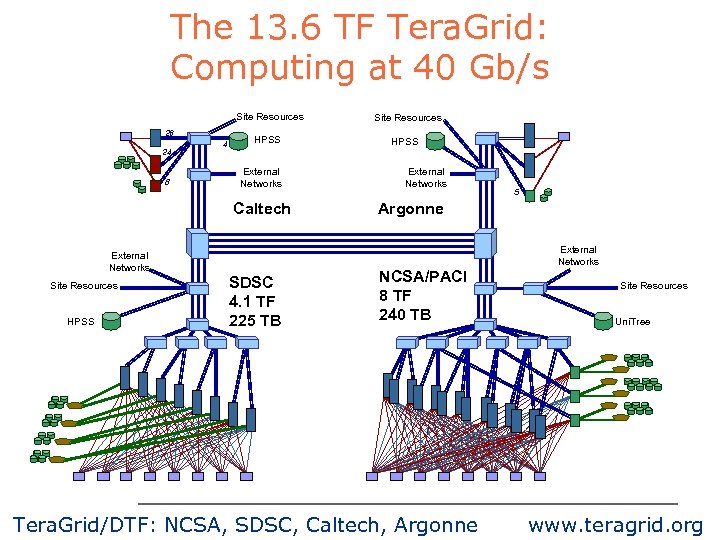
The 13. 6 TF Tera. Grid: Computing at 40 Gb/s Site Resources 26 24 8 4 HPSS External Networks Caltech External Networks Site Resources HPSS SDSC 4. 1 TF 225 TB Site Resources HPSS External Networks 5 Argonne NCSA/PACI 8 TF 240 TB foster@mcs. anl. gov Tera. Grid/DTF: NCSA, SDSC, Caltech, Argonne External Networks Site Resources Uni. Tree www. teragrid. org ARGONNE CHICAGO
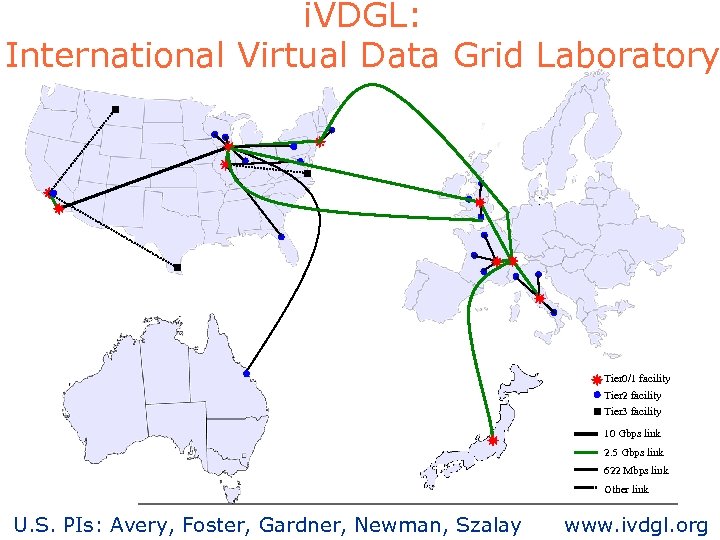
i. VDGL: International Virtual Data Grid Laboratory Tier 0/1 facility Tier 2 facility Tier 3 facility 10 Gbps link 2. 5 Gbps link 622 Mbps link Other link foster@mcs. anl. gov U. S. PIs: Avery, Foster, Gardner, Newman, Szalay www. ivdgl. org ARGONNE CHICAGO
GRIDS NSF GRIDS Center l l Grid Research, Integration, Deployment, & Support (GRIDS) Center Develop, deploy, support – Middleware infrastructure for national-scale collaborative science and engineering – Integration platform for experimental middleware technologies l l UC, USC/ISI, UW, NCSA, SDSC Partner with Internet-2, SURA, Educause in NSF Middleware Initiative foster@mcs. anl. gov www. grids-center. org www. nsf-middleware-org ARGONNE CHICAGO
And What’s This Got To Do With … l CORBA? – Grid-enabled CORBA underway l Java, Jini, Jxta? – Java Co. G Kit. Jini, Jxta: future uncertain l Web Services, . NET, J 2 EE? – Major Globus focus (GRAM-2: SOAP, WSDL) – Workflow/choreography services – Q: What can Grid offer to Web services? l Next revolutionary technology of the month? – They’ll need Grid technologies too foster@mcs. anl. gov ARGONNE CHICAGO
The Future: All Software is Network-Centric l We don’t build or buy “computers” anymore, we borrow or lease required resources – When I walk into a room, need to solve a problem, need to communicate l A “computer” is a dynamically, often collaboratively constructed collection of processors, data sources, sensors, networks – Similar observations apply for software foster@mcs. anl. gov ARGONNE CHICAGO
And Thus … l l l Reduced barriers to access mean that we do much more computing, and more interesting computing, than today => Many more components (& services); massive parallelism All resources are owned by others => Sharing (for fun or profit) is fundamental; trust, policy, negotiation, payment All computing is performed on unfamiliar systems => Dynamic behaviors, discovery, adaptivity, failure foster@mcs. anl. gov ARGONNE CHICAGO
Acknowledgments l Globus R&D is joint with numerous people – Carl Kesselman, Co-PI – Steve Tuecke, principal architect at ANL – Others to be acknowledged l Gri. Phy. N R&D is joint with numerous people – Paul Avery, Co-PI; Newman, Lazzarini, Szalay – Mike Wilde, project coordinator – Carl Kesselman, Miron Livny CS leads – ATLAS, CMS, LIGO, SDSS participants; others l Support: DOE, DARPA, NSF, NASA, Microsoft foster@mcs. anl. gov ARGONNE CHICAGO
Summary l l The Grid problem: Resource sharing & coordinated problem solving in dynamic, multi-institutional virtual organizations Grid architecture: Emphasize protocol and service definition to enable interoperability and resource sharing Globus Toolkit a source of protocol and API definitions, reference implementations See: globus. org, griphyn. org, gridforum. org, grids-center. org, nsf-middleware. org foster@mcs. anl. gov ARGONNE CHICAGO
Скачать презентацию Grid Technologies Enabling Collaborative Science Ian Foster Mathematics
aa7f22d34a801bff917cc9436ea2ccf5.ppt