


 Скачать презентацию Grid Systems and scheduling Grid systems
a909b2f5744c20e41f3f547f54d7761b.ppt
- Количество слайдов: 84
 Grid Systems and scheduling
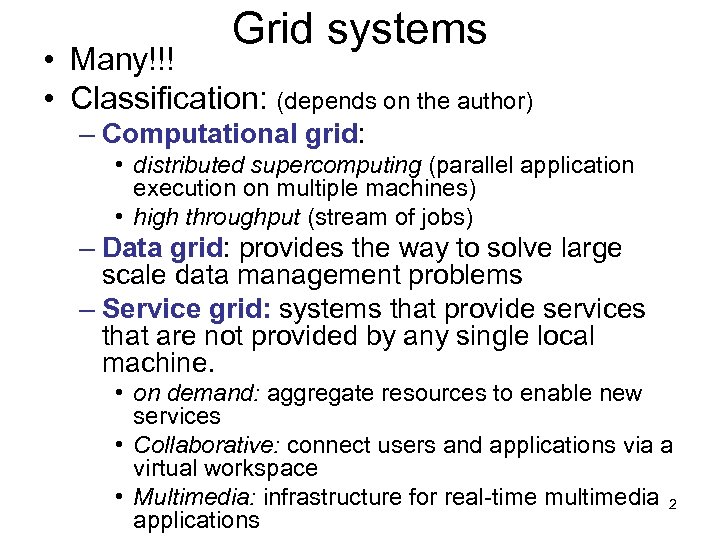 Grid systems • Many!!! • Classification: (depends on the author) – Computational grid: • distributed supercomputing (parallel application execution on multiple machines) • high throughput (stream of jobs) – Data grid: provides the way to solve large scale data management problems – Service grid: systems that provide services that are not provided by any single local machine. • on demand: aggregate resources to enable new services • Collaborative: connect users and applications via a virtual workspace • Multimedia: infrastructure for real-time multimedia 2 applications
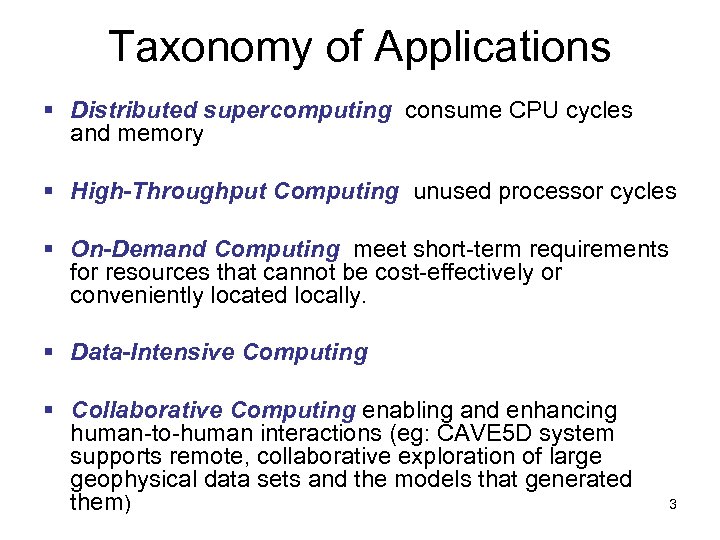 Taxonomy of Applications § Distributed supercomputing consume CPU cycles and memory § High-Throughput Computing unused processor cycles § On-Demand Computing meet short-term requirements for resources that cannot be cost-effectively or conveniently located locally. § Data-Intensive Computing § Collaborative Computing enabling and enhancing human-to-human interactions (eg: CAVE 5 D system supports remote, collaborative exploration of large geophysical data sets and the models that generated them) 3
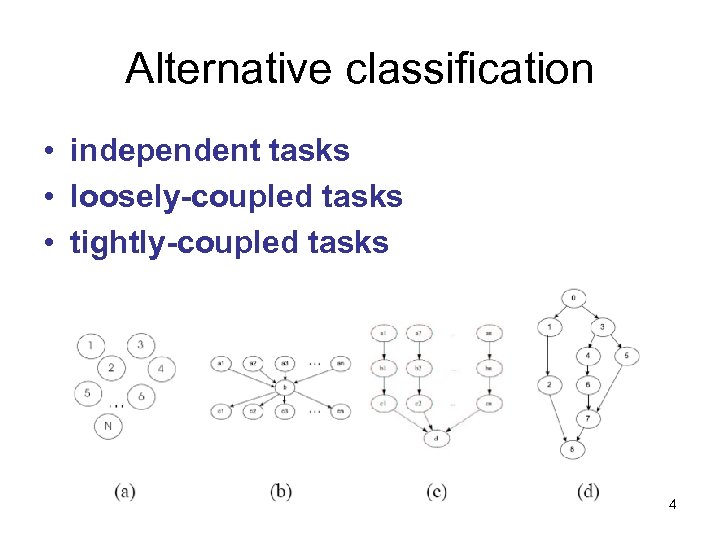 Alternative classification • independent tasks • loosely-coupled tasks • tightly-coupled tasks 4
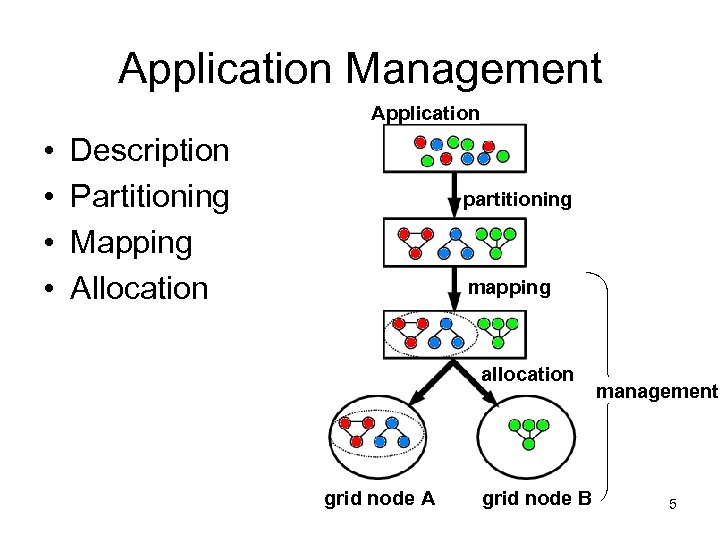 Application Management Application • • Description Partitioning Mapping Allocation partitioning mapping allocation grid node A grid node B management 5
 Description • Use a grid application description language • Grid-ADL and GEL – One can take advantage of loop construct to use compilation mechanisms for vectorization 6
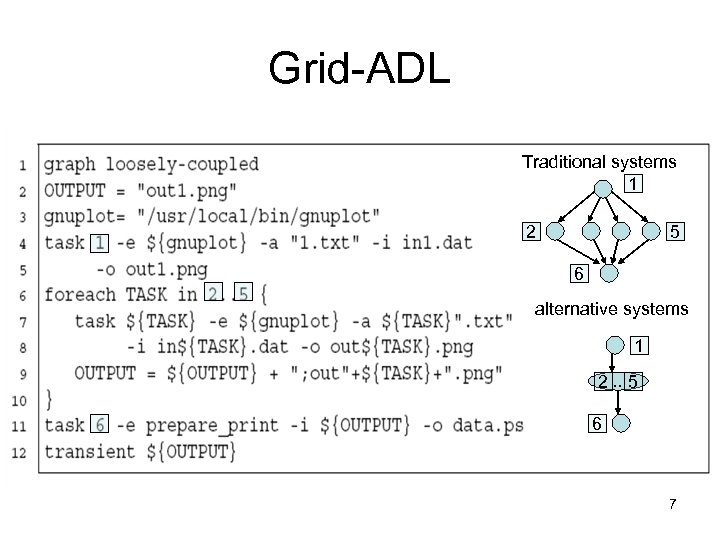 Grid-ADL Traditional systems 1 2 5 6 alternative systems 1 2. . 5 6 7
 Partitioning/Clustering • Application represented as a graph – Nodes: job – Edges: precedence • Graph partitioning techniques: – Minimize communication – Increase throughput or speedup – Need good heuristics • Clustering 8
 Graph Partitioning • Optimally allocating the components of a distributed program over several machines • Communication between machines is assumed to be the major factor in application performance • NP-hard for case of 3 or more terminals 9
 Graph partitioning and cut set • The partition of the program on to machines that minimizes the interprocessor communication corresponds to the minimal cut set for the graph • Finding a minimal cut set is an np-hard problem • heuristics 10
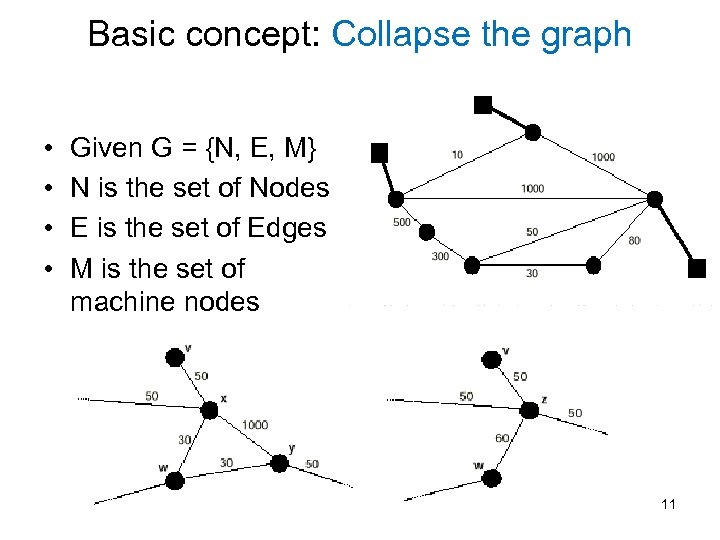 Basic concept: Collapse the graph • • Given G = {N, E, M} N is the set of Nodes E is the set of Edges M is the set of machine nodes 11
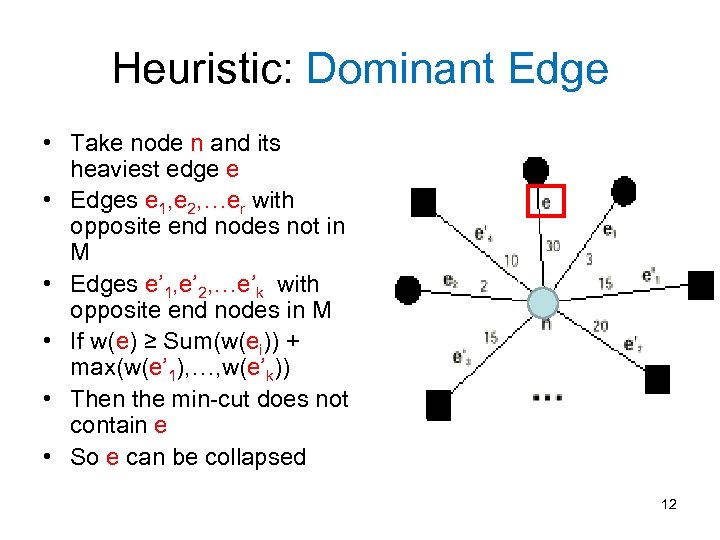 Heuristic: Dominant Edge • Take node n and its heaviest edge e • Edges e 1, e 2, …er with opposite end nodes not in M • Edges e’ 1, e’ 2, …e’k with opposite end nodes in M • If w(e) ≥ Sum(w(ei)) + max(w(e’ 1), …, w(e’k)) • Then the min-cut does not contain e • So e can be collapsed 12
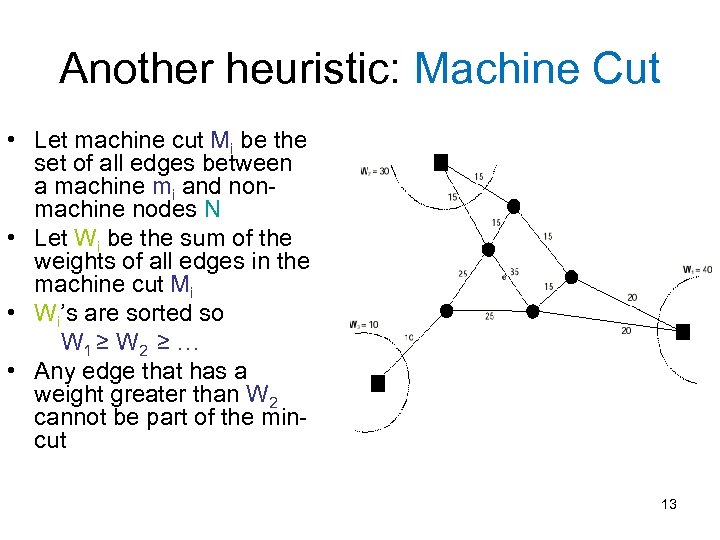 Another heuristic: Machine Cut • Let machine cut Mi be the set of all edges between a machine mi and nonmachine nodes N • Let Wi be the sum of the weights of all edges in the machine cut Mi • Wi’s are sorted so W 1 ≥ W 2 ≥ … • Any edge that has a weight greater than W 2 cannot be part of the mincut 13
 Yet another heuristic: Zeroing • Assume that node n has edges to each of the m machines in M with weights w 1 ≤ w 2 ≤ … ≤ w m • Reducing the weights of each of the m edges from n to machines M by w 1 doesn’t change the assignment of nodes for the min-cut • It reduces the cost of the minimum cut by (m-1)w 1 14
 Heuristics: Order of Application • If the previous 3 techniques are repeatedly applied on a graph until none of them are applicable then: – the resulting reduced graph is independent of the order of application of the techniques 15
 Output • List of nodes collapsed into each of the machine nodes • Weight of edges connecting the machine nodes • Source: Graph Cutting Algorithms for Distributed Applications Partitioning, Karin Hogstedt, Doug Kimelman, VT Rajan, Tova Roth, and Mark Wegman ACM SIGMETRICS, v. 28: 4, 2001 • homepages. cae. wisc. edu/~ece 556/fall 2002/PROJECT/distributed_applications. ppt 16
 Graph partitioning • Hendrickson and Kolda, 2000: edge cuts: – are not proportional to the total communication volume – try to (approximately) minimize the total volume but not the total number of messages – do not minimize the maximum volume and/or number of messages handled by any single processor – do not consider distance between processors (number of switches the message passes through, for example) – undirected graph model can only express symmetric data dependencies. 17
 Graph partitioning • To avoid message contention and improve the overall throughput of the message traffic, it is preferable to have communication restricted to processors which are near to each other • But, edge-cut is appropriate to applications whose graph has locality and few neighbors 18
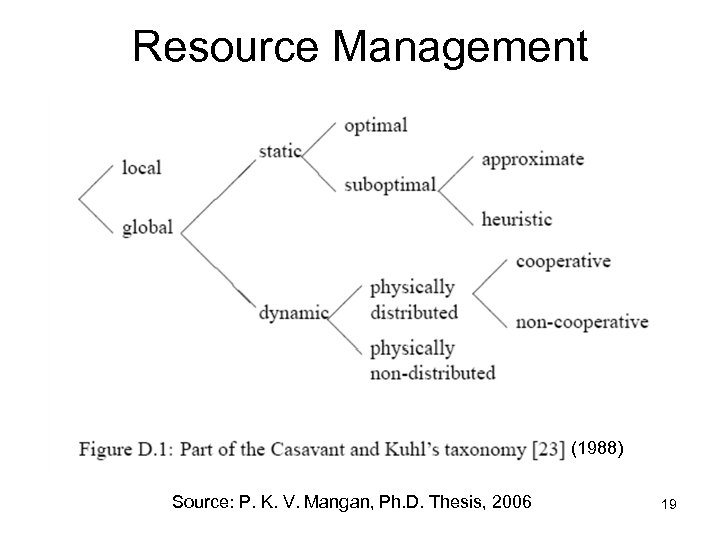 Resource Management (1988) Source: P. K. V. Mangan, Ph. D. Thesis, 2006 19
 Static scheduling task precedence graph DSC: Dominance Sequence Clustering • Yang and Gerasoulis, 1994: two step method for scheduling with communication: (focus on the critical path) 1) schedule an unbounded number of completely connected processors (cluster of tasks); 2) if the number of clusters is larger than the number of available processors, then merge the clusters until it gets the number of real processors, considering the network topology 20 (merging step).
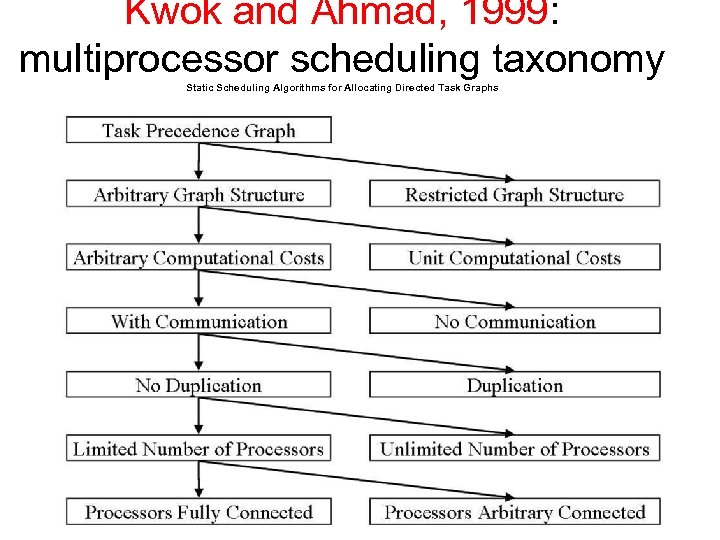 Kwok and Ahmad, 1999: multiprocessor scheduling taxonomy Static Scheduling Algorithms for Allocating Directed Task Graphs to Multiprocessors 21
 List Scheduling • make an ordered list of processes by assigning them some priorities • repeatedly execute the following two steps until a valid schedule is obtained: – Select from the list, the process with the highest priority for scheduling. – Select a resource to accommodate this process. • priorities are determined statically before the scheduling process begins. The first step chooses the process with the highest priority, the second step selects the best possible resource. • Some known list scheduling strategies: • Highest Level First algorithm or HLF • Longest Path algorithm or LP • Longest Processing Time • Critical Path Method • List scheduling algorithms only produce good results for coarsegrained applications 22
 Graph partitioning • Kumar and Biswas, 2002: Mini. Max – multilevel graph partitioning scheme – Grid-aware – consider two weighted undirected graphs: • a work-load graph (to model the problem domain) • a system graph (to model the heterogeneous system) 23
 Resource Management • The scheduling algorithm has four components: – transfer policy: when a node can take part of a task transfer; – selection policy: which task must be transferred; – location policy: which node to transfer to; – information policy: when to collect system state information. 24
 Resource Management • Location policy: – Sender-initiated – Receiver-initiated – Symmetrically-initiated 25
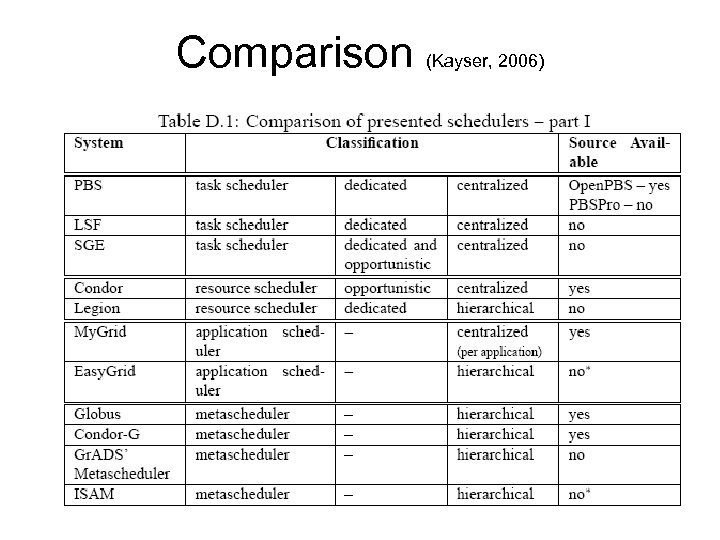
 Scheduling mechanisms for grid • Berman, 1998 (ext. by Kayser, 2006): – Job scheduler – Resource scheduler – Application scheduler – Meta-scheduler 26
 Scheduling mechanisms for grid • Legion – University of Virginia (Grimshaw, 1993) – Supercomputing 1997 – Commercialized in 2003 by Avaki 27
 Legion • is an object oriented infrastructure for grid environments layered on top of existing software services. (some say it is gridaware operating system) • uses the existing operating systems, resource management tools, and security mechanisms at host sites to implement higher level system-wide services • design is based on a set of core objects 28
 Legion • Uses the concept of Context Spaces to implement the objects (processes, file names etc) • Proxy. Multi. Object: container process used to represent files and contexts residing on one host 29
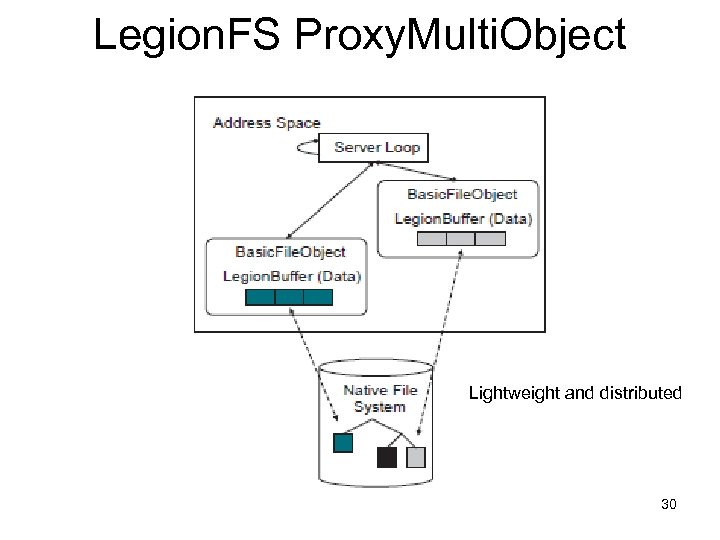 Legion. FS Proxy. Multi. Object Lightweight and distributed 30
 Legion • resource management is a negotiation between resources and active objects that represent the distributed application • three steps to allocate resources for a task: – Decision: considers task’s characteristics and requirements, resource’s properties and policies, and users’ preferences – Enactment: the class object receives an activation request; if the placement is acceptable, start the task – Monitoring: ensures that the task is operating correctly 31
 Globus • From version 1. 0 in 1998 to the 2. 0 release in 2002 and the latest 3. 0, the emphasis is to provide a set of components that can be used either independently or together to develop applications • The Globus Toolkit version 2 (GT 2) design is highly related to the architecture proposed by Foster et al. • The Globus Toolkit version 3 (GT 3) design is based on grid services, which are quite similar to web services. GT 3 implements the Open Grid Service Infrastructure (OGSI). • GT 4 is also based on grid services, but with some changes in the standard • GT 5 provides an API multithreaded implementation based on an asynchronous event model 32
 Globus • Toolkit with a set of components that implement basic services: – Security – resource location – resource management – data management – resource reservation – Communication 33
 Core Globus Services • Communication Infrastructure (Nexus) • Information Services (MDS) • Remote File and Executable Management (GASS, RIO, and GEM) • Resource Management (GRAM) • Security (GSS) 17 -Mar-18 MCC/MIERSI Grid Computing 34
 Communications (Nexus) • Communication library (ANL & Caltech) – Asynchronous communications – Multithreading – Dynamic resource management 17 -Mar-18 MCC/MIERSI Grid Computing 35
 Communications (Nexus) • 5 basic abstractions – Nodes – Contexts (Address spaces) – Threads – Communication links (global pointers) – Remote service requests • Startpoints and Endpoints 36
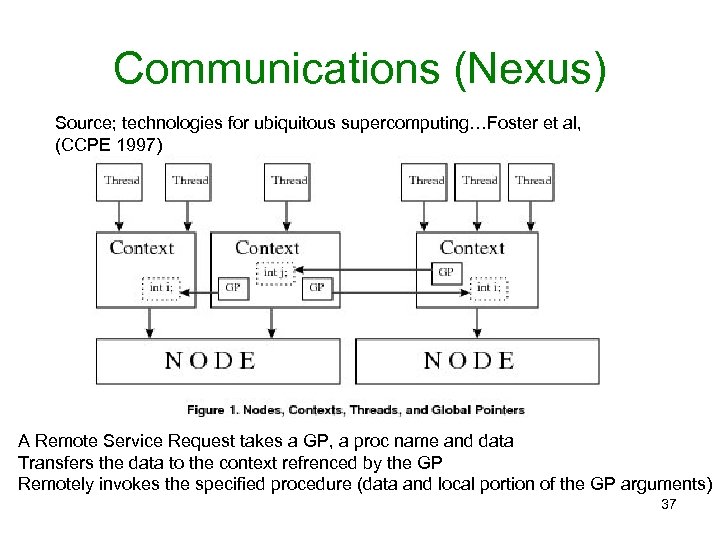 Communications (Nexus) Source; technologies for ubiquitous supercomputing…Foster et al, (CCPE 1997) A Remote Service Request takes a GP, a proc name and data Transfers the data to the context refrenced by the GP Remotely invokes the specified procedure (data and local portion of the GP arguments) 37
 Information Services (Metacomputing Directory Service - MDS) • Required information – Configuration details about resources • Amount of memory • CPU speed – Performance information • Network latency • CPU load – Application specific information • Memory requirements 17 -Mar-18 MCC/MIERSI Grid Computing 38
 Remote file and executable management • Global Access to Secondary Storage (GASS) – basic access to remote files, operations supported include remote read, remote write and append • Remote I/O (RIO) – distributed implementation of the MPI-IO, parallel I/O API • Globus Executable Management (GEM) – enables loading and executing a remote file through the GRAM resource manager 17 -Mar-18 MCC/MIERSI Grid Computing 39
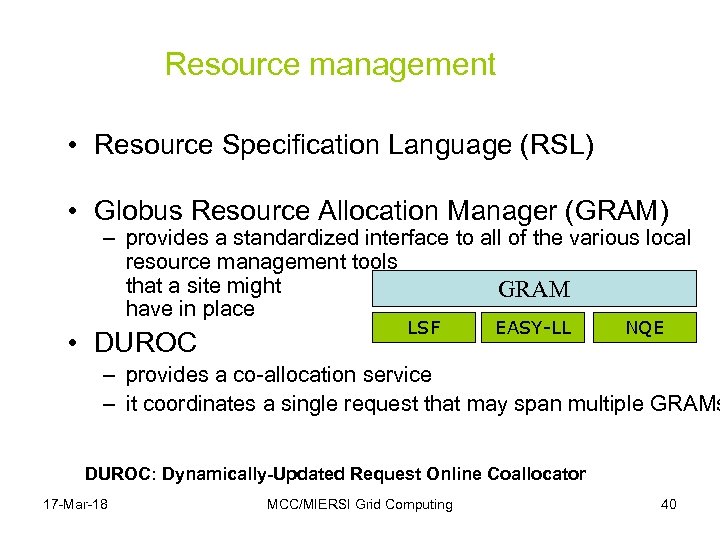 Resource management • Resource Specification Language (RSL) • Globus Resource Allocation Manager (GRAM) – provides a standardized interface to all of the various local resource management tools that a site might GRAM have in place • DUROC LSF EASY-LL NQE – provides a co-allocation service – it coordinates a single request that may span multiple GRAMs DUROC: Dynamically-Updated Request Online Coallocator 17 -Mar-18 MCC/MIERSI Grid Computing 40
 Authentication Model • Authentication is done on a “user” basis – Single authentication step allows access to all grid resources • No communication of plaintext passwords • Most sites will use conventional account mechanisms – You must have an account on a resource to use that resource 17 -Mar-18 MCC/MIERSI Grid Computing 41
 Grid Security Infrastructure • Each user has: – a Grid user id (called a Subject Name) – a private key (like a password) – a certificate signed by a Certificate Authority (CA) • A “gridmap” file at each site specifies grid-id to local-id mapping 17 -Mar-18 MCC/MIERSI Grid Computing 42
 Certificate Based Authentication • User has a certificate, signed by a trusted “certificate authority” (CA) – Certificate contains user name and public key – Globus project operates a CA 17 -Mar-18 MCC/MIERSI Grid Computing 43
 “Logging” onto the Grid • To run programs, authenticate to Globus: % grid-proxy-init Enter PEM pass phrase: ****** • Creates a temporary, short-lived credential for use by our computations Private key is not exposed past grid-proxy-init 17 -Mar-18 MCC/MIERSI Grid Computing 44
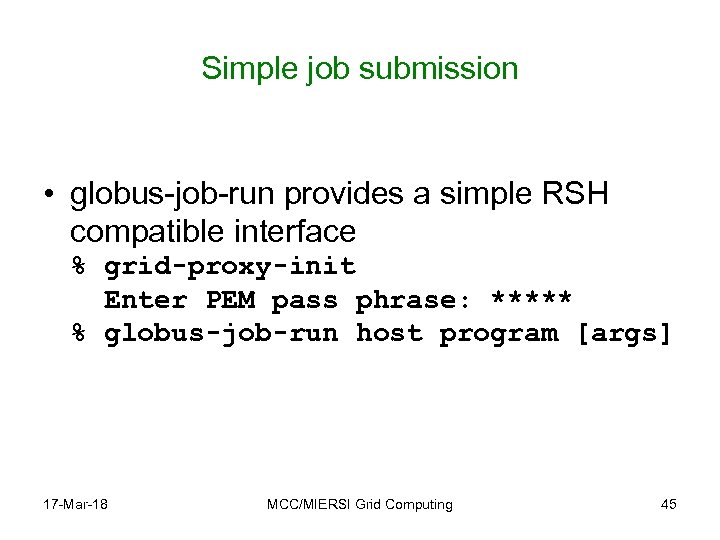 Simple job submission • globus-job-run provides a simple RSH compatible interface % grid-proxy-init Enter PEM pass phrase: ***** % globus-job-run host program [args] 17 -Mar-18 MCC/MIERSI Grid Computing 45
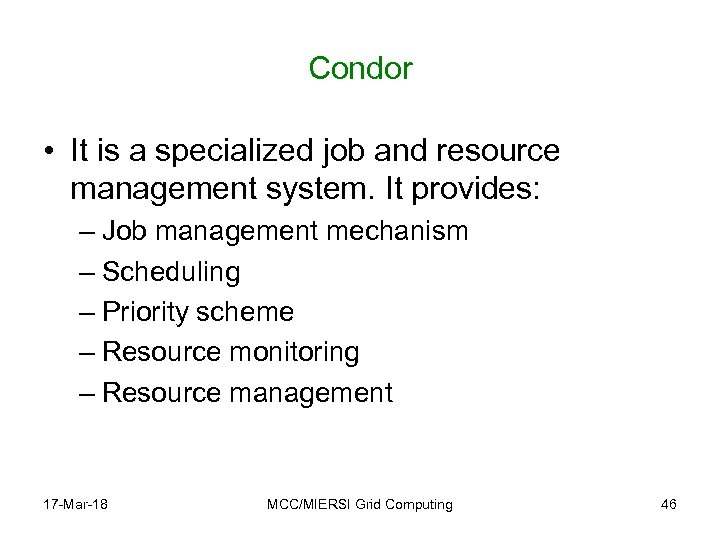 Condor • It is a specialized job and resource management system. It provides: – Job management mechanism – Scheduling – Priority scheme – Resource monitoring – Resource management 17 -Mar-18 MCC/MIERSI Grid Computing 46
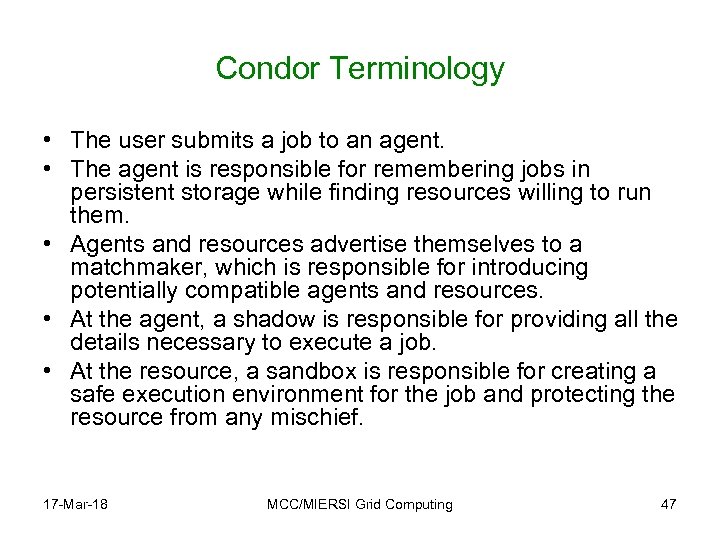 Condor Terminology • The user submits a job to an agent. • The agent is responsible for remembering jobs in persistent storage while finding resources willing to run them. • Agents and resources advertise themselves to a matchmaker, which is responsible for introducing potentially compatible agents and resources. • At the agent, a shadow is responsible for providing all the details necessary to execute a job. • At the resource, a sandbox is responsible for creating a safe execution environment for the job and protecting the resource from any mischief. 17 -Mar-18 MCC/MIERSI Grid Computing 47
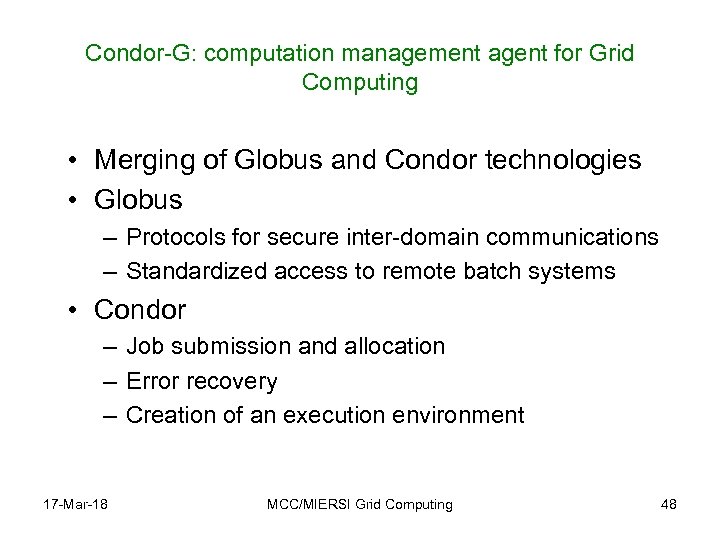 Condor-G: computation management agent for Grid Computing • Merging of Globus and Condor technologies • Globus – Protocols for secure inter-domain communications – Standardized access to remote batch systems • Condor – Job submission and allocation – Error recovery – Creation of an execution environment 17 -Mar-18 MCC/MIERSI Grid Computing 48
 Globus: scheduling • Resource Specification Language (RSL) is used to communicate requirements. • To take advantage of GRAM, a user still needs a system that can remember what jobs have been submitted, where they are, and what they are doing. • To track large numbers of jobs, the user needs queuing, prioritization, logging, and accounting. These services cannot be found in GRAM alone, but are provided by systems such as Condor-G 49
 My. Grid and Our. Grid (Cirne et al. ) • Mainly for bag-of-tasks (Bo. T) applications • uses the dynamic algorithm Work Queue with Replication (WQR) • hosts that finished their tasks are assigned to execute replicas of tasks that are still running. • Tasks are replicated until a predefined maximum number of replicas is achieved (in My. Grid, the default is one). 50
 Our. Grid • An extension of My. Grid • resource sharing system based on peer-to -peer technology • resources are shared according to a “network of favors model”, in which each peer prioritizes those who have credit in their past history of interactions. • Interoperates with g. Lite 51
 Gr. ADS Grid Application Development Software • is an application scheduler • The user invokes the Grid Routine component to execute an application • The Grid Routine invokes the component Resource Selector • The Resource Selector accesses the Globus Meta. Directory Service (MDS) to get a list of machines that are alive and then contact the Network Weather Service (NWS) to get system information for the machines. 52
 Gr. ADS Grid Application Development Software • The Grid Routine then invokes a component called Performance Modeler with the problem parameters, machines and machine information. • The Performance Modeler builds the final list of machines and sends it to the Contract Developer for approval. • The Grid Routine then passes the problem, its parameters, and the final list of machines to the Application Launcher. 53
 Gr. ADS Grid Application Development Software • The Application Launcher spawns the job using the Globus resource management mechanism (GRAM) and also spawns the Contract Monitor. • The Contract Monitor monitors the application, displays the actual and predicted times, and can report contract violations to a re-scheduler. 54
 Gr. ADS Grid Application Development Software • Although the execution model is efficient from the application perspective, it does not take into account the existence of other applications in the system 55
 Gr. ADS Grid Application Development Software • Vadhiyar and Dongarra, 2002: proposed a metascheduling architecture in the context of the Gr. ADS Project. • The metascheduler receives candidate schedules of different application level schedulers and implements scheduling policies for balancing the interests of different applications. 56
 Easy. Grid (Rebello & Boeres et al. ) • Mainly concerned with MPI applications • Allows intercluster execution of MPI processes that belong to the same application 57
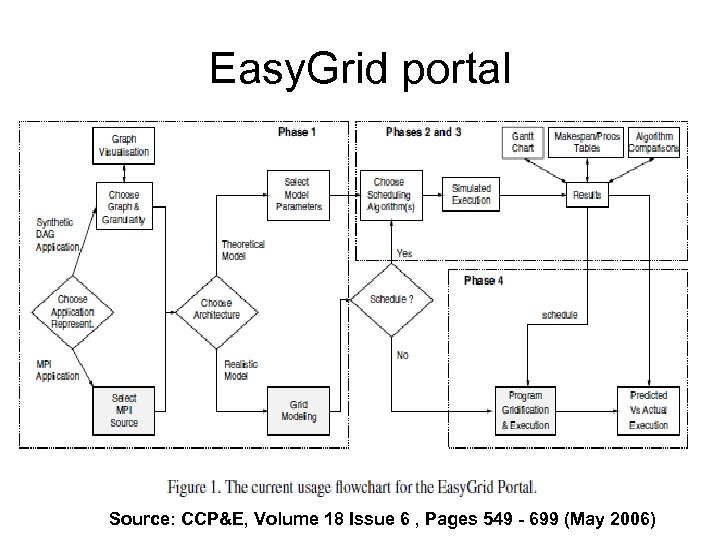 Easy. Grid portal Source: CCP&E, Volume 18 Issue 6 , Pages 549 - 699 (May 2006) 58
 Nimrod (Buyya et al. ) • uses a simple declarative parametric modeling language to express parametric experiments • provides machinery that automates task of: – – formulating, running, monitoring, collating results from the multiple individual experiments. • incorporates distributed scheduling that can manage the scheduling of individual experiments to idle computers in a local area network • has been applied to a range of application areas, e. g. : Bioinformatics, Operations Research, Network Simulation, Electronic CAD, Ecological Modelling and Business Process Simulation. 59
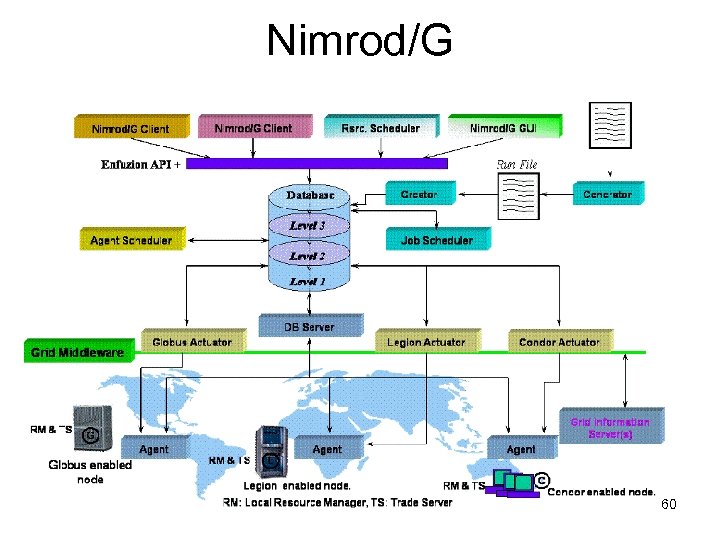 Nimrod/G 60
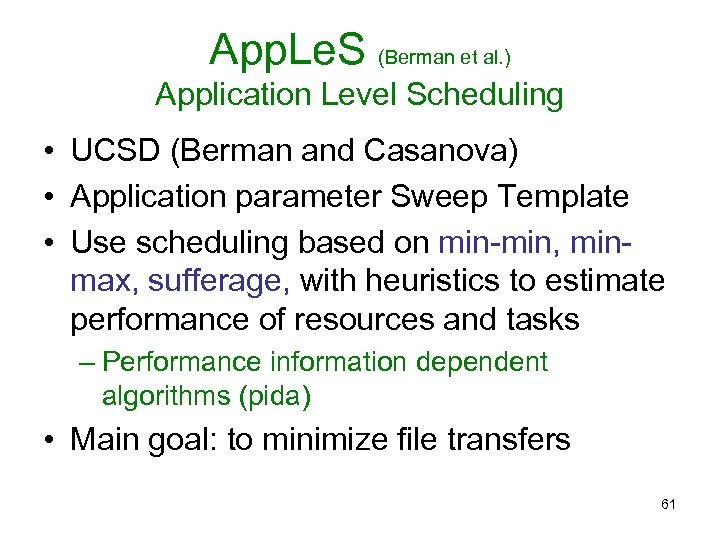 App. Le. S (Berman et al. ) Application Level Scheduling • UCSD (Berman and Casanova) • Application parameter Sweep Template • Use scheduling based on min-min, minmax, sufferage, with heuristics to estimate performance of resources and tasks – Performance information dependent algorithms (pida) • Main goal: to minimize file transfers 61
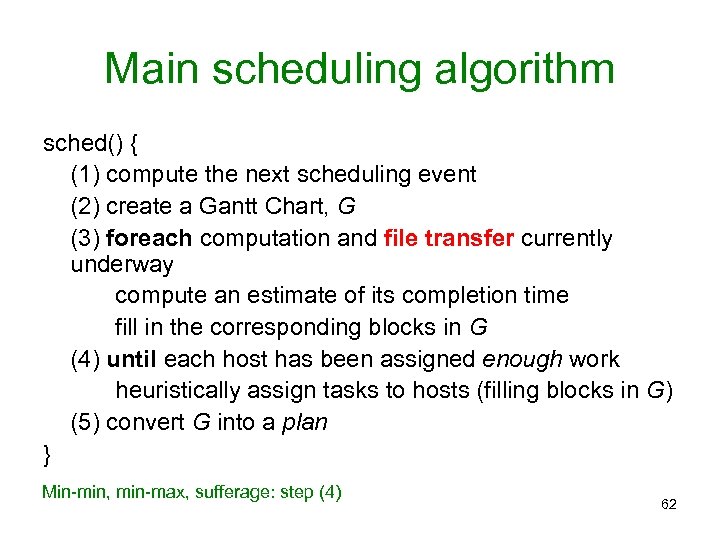 Main scheduling algorithm sched() { (1) compute the next scheduling event (2) create a Gantt Chart, G (3) foreach computation and file transfer currently underway compute an estimate of its completion time fill in the corresponding blocks in G (4) until each host has been assigned enough work heuristically assign tasks to hosts (filling blocks in G) (5) convert G into a plan } Min-min, min-max, sufferage: step (4) 62
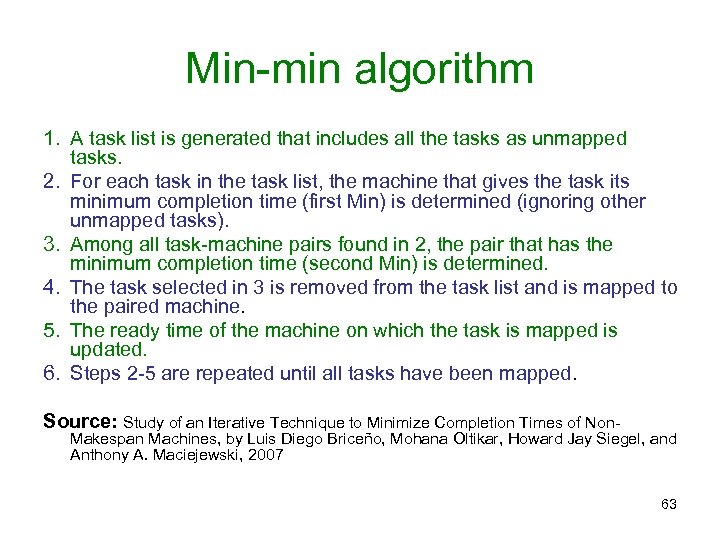 Min-min algorithm 1. A task list is generated that includes all the tasks as unmapped tasks. 2. For each task in the task list, the machine that gives the task its minimum completion time (first Min) is determined (ignoring other unmapped tasks). 3. Among all task-machine pairs found in 2, the pair that has the minimum completion time (second Min) is determined. 4. The task selected in 3 is removed from the task list and is mapped to the paired machine. 5. The ready time of the machine on which the task is mapped is updated. 6. Steps 2 -5 are repeated until all tasks have been mapped. Source: Study of an Iterative Technique to Minimize Completion Times of Non- Makespan Machines, by Luis Diego Briceño, Mohana Oltikar, Howard Jay Siegel, and Anthony A. Maciejewski, 2007 63
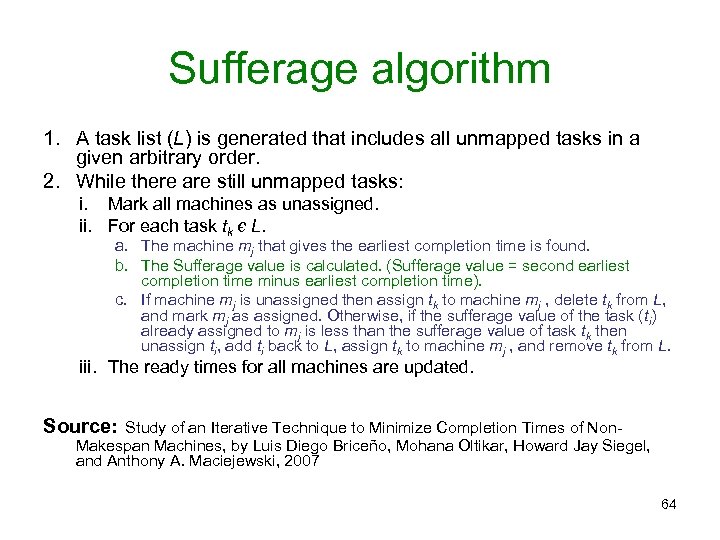 Sufferage algorithm 1. A task list (L) is generated that includes all unmapped tasks in a given arbitrary order. 2. While there are still unmapped tasks: i. Mark all machines as unassigned. ii. For each task tk є L. a. The machine mj that gives the earliest completion time is found. b. The Sufferage value is calculated. (Sufferage value = second earliest completion time minus earliest completion time). c. If machine mj is unassigned then assign tk to machine mj , delete tk from L, and mark mj as assigned. Otherwise, if the sufferage value of the task (ti) already assigned to mj is less than the sufferage value of task tk then unassign ti, add ti back to L, assign tk to machine mj , and remove tk from L. iii. The ready times for all machines are updated. Source: Study of an Iterative Technique to Minimize Completion Times of Non. Makespan Machines, by Luis Diego Briceño, Mohana Oltikar, Howard Jay Siegel, and Anthony A. Maciejewski, 2007 64
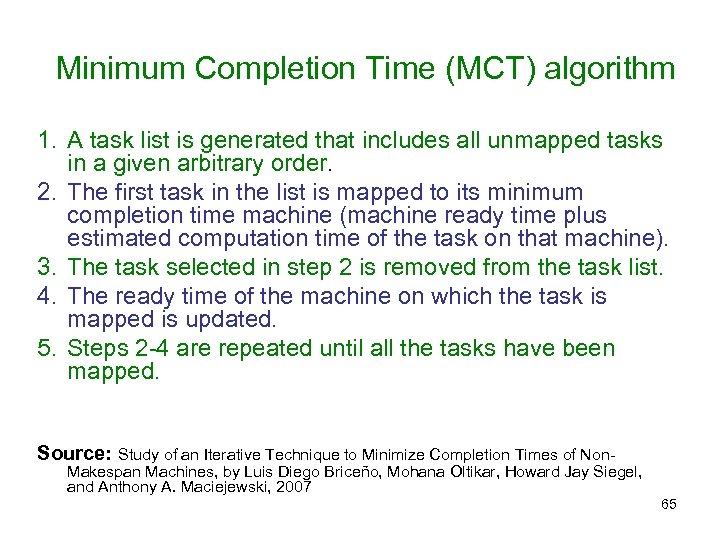 Minimum Completion Time (MCT) algorithm 1. A task list is generated that includes all unmapped tasks in a given arbitrary order. 2. The first task in the list is mapped to its minimum completion time machine (machine ready time plus estimated computation time of the task on that machine). 3. The task selected in step 2 is removed from the task list. 4. The ready time of the machine on which the task is mapped is updated. 5. Steps 2 -4 are repeated until all the tasks have been mapped. Source: Study of an Iterative Technique to Minimize Completion Times of Non. Makespan Machines, by Luis Diego Briceño, Mohana Oltikar, Howard Jay Siegel, and Anthony A. Maciejewski, 2007 65
![GRAn. D [Kayser et al. , CCP&E, 2007 Grid Robust Application Deployment] • •](https://present5.com/presentation/a909b2f5744c20e41f3f547f54d7761b/image-66.jpg "GRAn. D [Kayser et al. , CCP&E, 2007 Grid Robust Application Deployment] • •") GRAn. D [Kayser et al. , CCP&E, 2007 Grid Robust Application Deployment] • • Distributed submission control Data locality automatic staging of data optimization of file transfer 66
GRAn. D [Kayser et al. , CCP&E, 2007 Grid Robust Application Deployment] • • Distributed submission control Data locality automatic staging of data optimization of file transfer 66
![Distributed submission Results of simulation with Monarc: http: //monarc. web. cern. ch/MONARC/ [Kayser, 2006]](https://present5.com/presentation/a909b2f5744c20e41f3f547f54d7761b/image-67.jpg "Distributed submission Results of simulation with Monarc: http: //monarc. web. cern. ch/MONARC/ [Kayser, 2006]") Distributed submission Results of simulation with Monarc: http: //monarc. web. cern. ch/MONARC/ [Kayser, 2006] 67
Distributed submission Results of simulation with Monarc: http: //monarc. web. cern. ch/MONARC/ [Kayser, 2006] 67
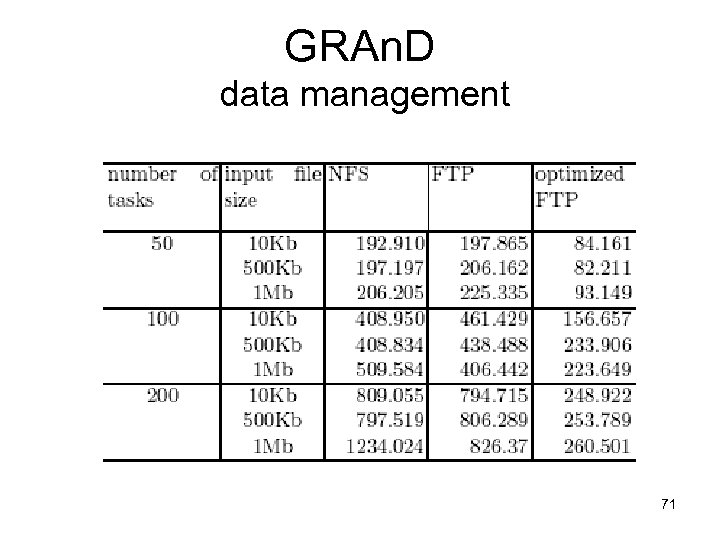
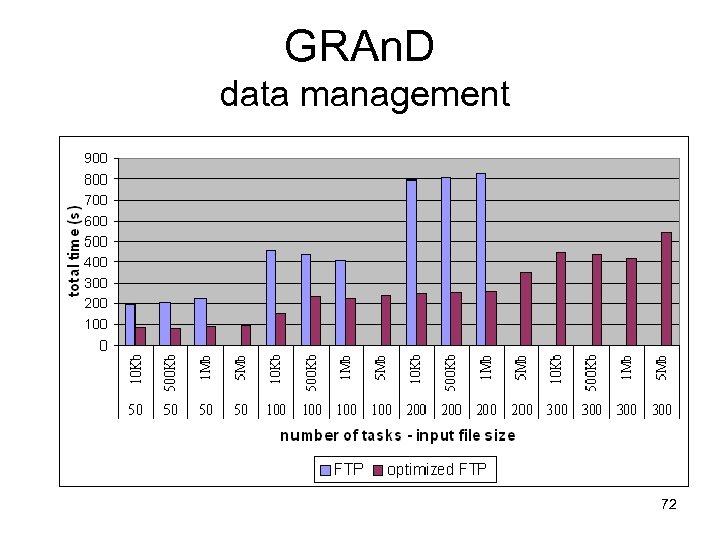
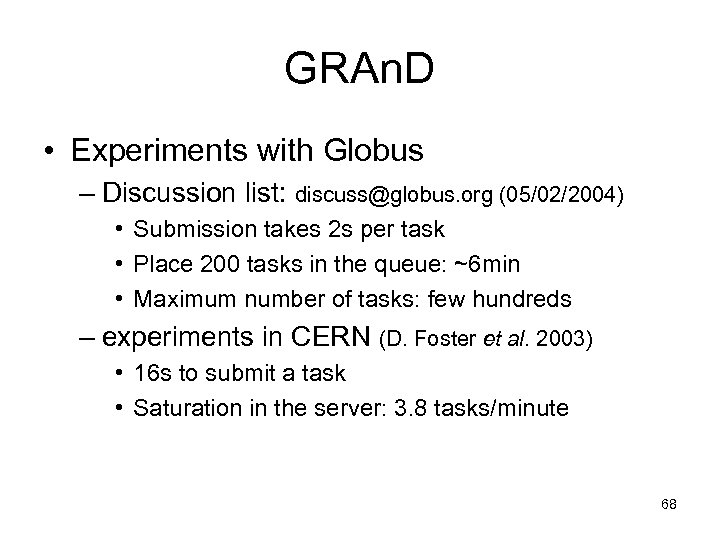 GRAn. D • Experiments with Globus – Discussion list: discuss@globus. org (05/02/2004) • Submission takes 2 s per task • Place 200 tasks in the queue: ~6 min • Maximum number of tasks: few hundreds – experiments in CERN (D. Foster et al. 2003) • 16 s to submit a task • Saturation in the server: 3. 8 tasks/minute 68
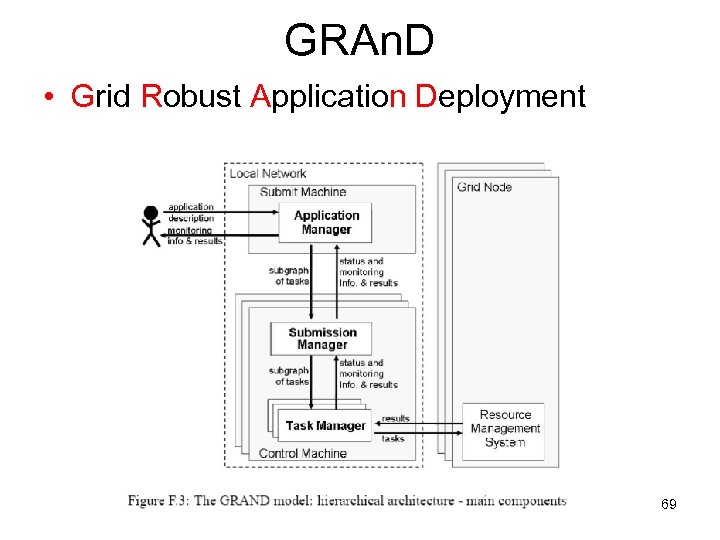 GRAn. D • Grid Robust Application Deployment 69
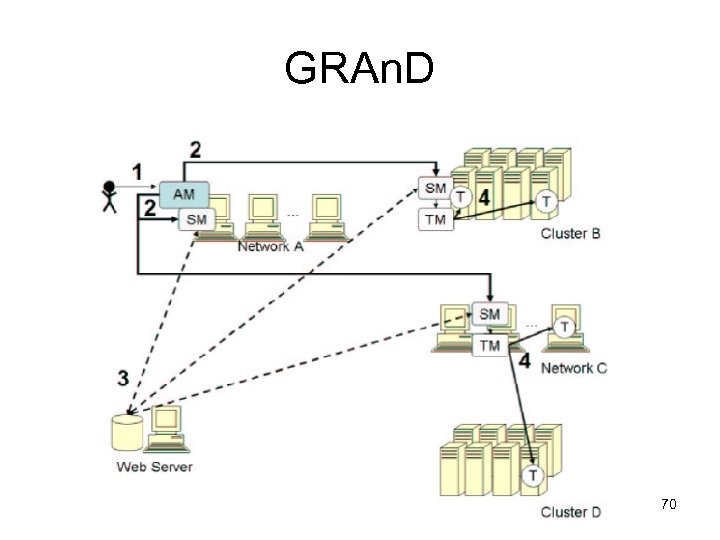 GRAn. D 70
 GRAn. D data management 71
 GRAn. D data management 72
 Comparison (Kayser, 2006) 73
 Comparison (Kayser, 2006) 74
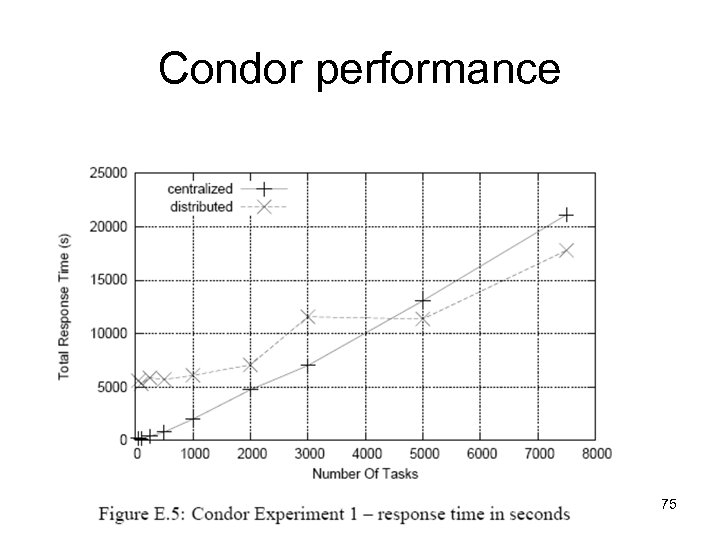 Condor performance 75
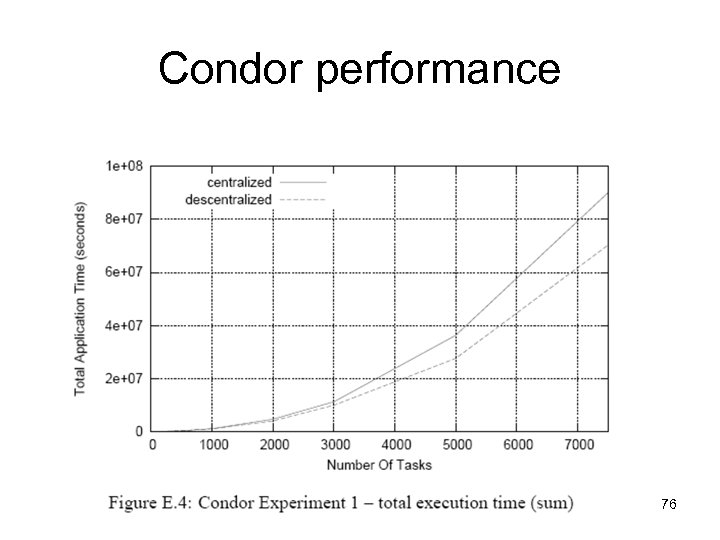 Condor performance 76
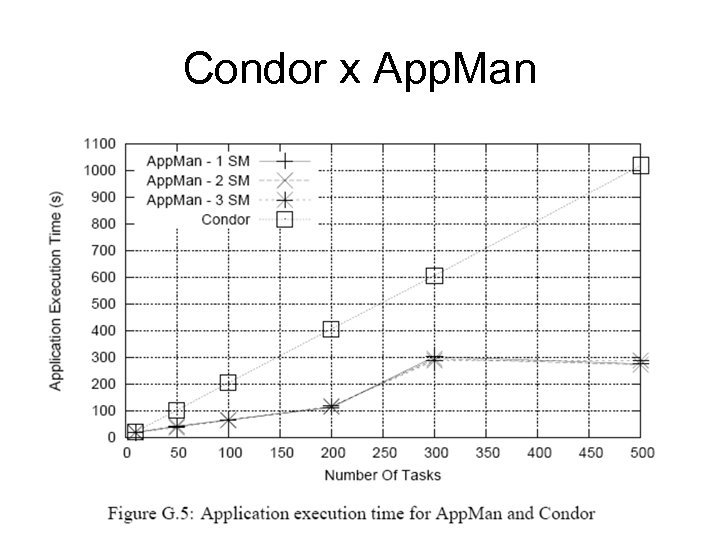 Condor x App. Man 77
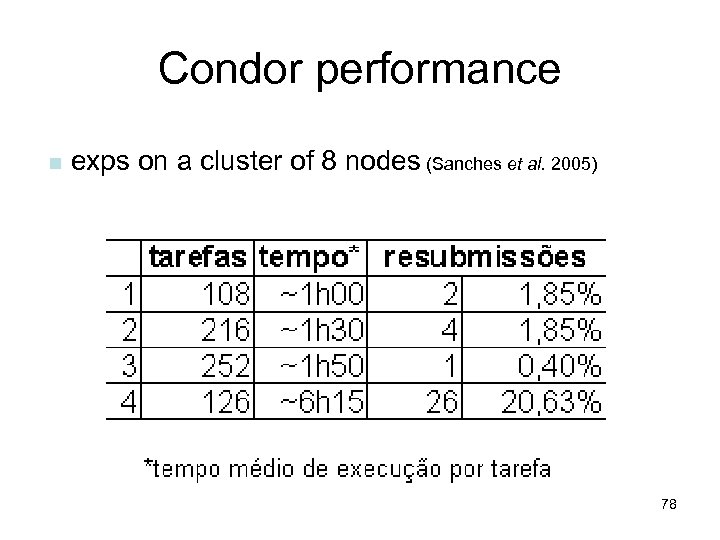 Condor performance n exps on a cluster of 8 nodes (Sanches et al. 2005) 78
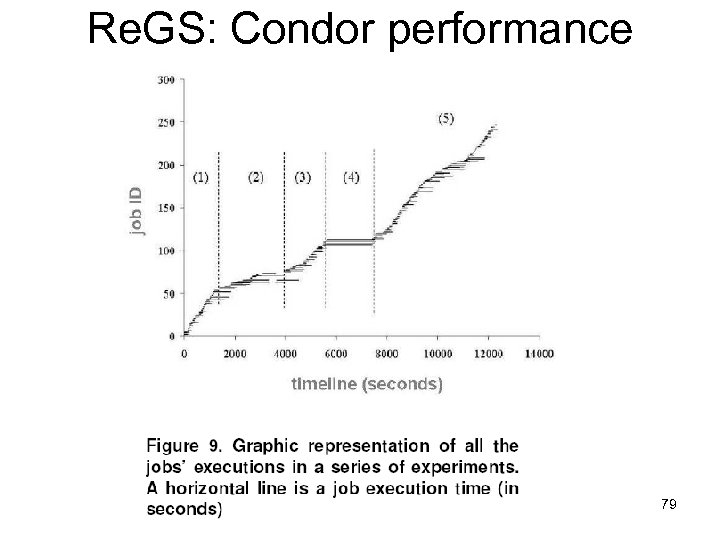 Re. GS: Condor performance 79
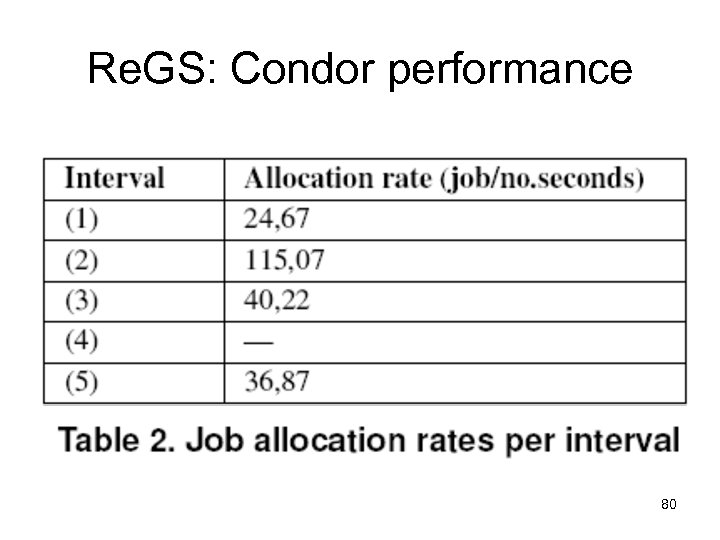 Re. GS: Condor performance 80
 Toward Grid Operating Systems • Vega GOS • G SMA 81
 Vega GOS (the CNGrid OS) GOS overview A user-level middleware running on a client machine • GOS has 2 components: GOS and gnetd • GOS is a daemon running on the client machine • gnetd is a daemon on the grid server 82
 GOS • Grid process and Grid thread – Grid process is a unit for managing the whole resource of the Grid. – Grid thread is a unit for executing computation on the Grid. • GOS API – GOS API for application developers • • grid(): constructs a Grid process on the client machine. gridcon(): grid process connects to the Grid system. • gridclose(): close a connected grid. – gnetd API for service developer on Grid servers • grid_register(): register a service to Grid. • grid_unregister(): unregister a service. 83
 Others • Xtreem. OS (challenge this year!!!!) http: //www. xtreemos. eu/hotspot_news/xtreemos-computing-challenge • Mosix • Environments: g-Eclipse • …. 84