


 Скачать презентацию Grid Security Slides for Grid Computing Techniques and
fc2024f107735dc03c733eeefeb9a957.ppt
- Количество слайдов: 75
 Grid Security Slides for Grid Computing: Techniques and Applications by Barry Wilkinson, Chapman & Hall/CRC press, © 2009. Chapter 5, pp. 149 -174. For educational use only. All rights reserved. Sept 7, 2009 5 -1. 1
 User activities on Grid Environment • Run jobs using one or possibly multiple resources • Transfer files from one resource to another where needed, not necessarily to/from computer system logged onto (so-called third-party transfers). • Replicate/divide large data files among remote resources • Develop programs to run on different types of computers as Grid resources often heterogeneous. • Develop programs that can automatically discover resources and distribute work accordingly. • Key aspect - the ability to have remote resource act on our behalf – delegation. 5 -1. 2
 Authentication • Process of deciding whether a particular identity is who he says he is (applies to humans and systems) 5 -1. 3
 Authorization • Process of deciding whether a particular identity can access a particular resource – Assumes identify has been previously validated through authentication • Access control - what type of access – Finer level of authorization rather than blanket ability to make any type of access 5 -1. 4
 Access control • Need mechanism to control access to files: – User’s files – Files of other users in collaborative projects • Well-known situation applied to all computer systems, distributed or not • Most common approach - access control lists (ACLs). – Have been around for many years e. g. Linux file permissions 5 -1. 5
 Accounts • Accounts have to exist on each computer system that users wish to access. • Each user might have an individual account on each system • Setting up individual accounts timeconsuming. Multiple system administrators involved. • Sometimes, convenient to have a group account for virtual organization and virtual organization users share this account. 5 -1. 6
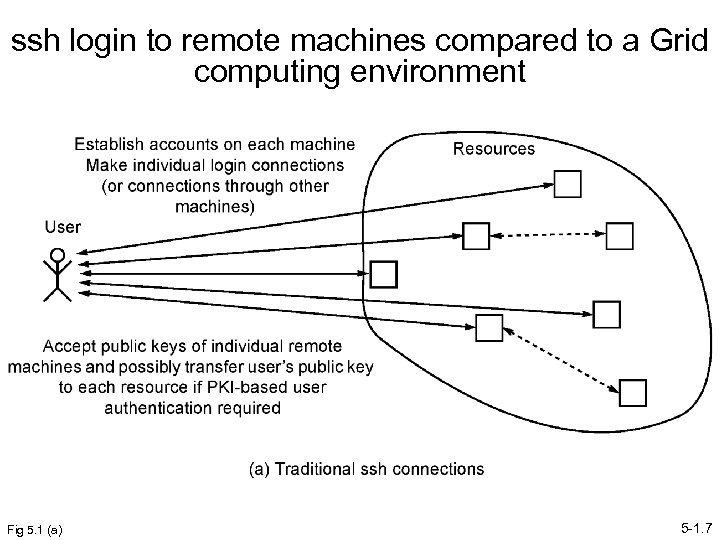 ssh login to remote machines compared to a Grid computing environment Fig 5. 1 (a) 5 -1. 7
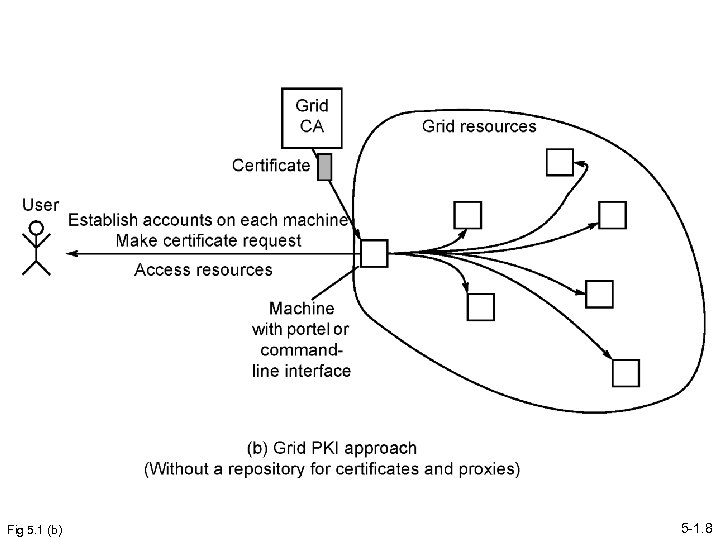 Fig 5. 1 (b) 5 -1. 8
 (Globus) Grid Security Infrastructure (GSI) 5 -1. 9
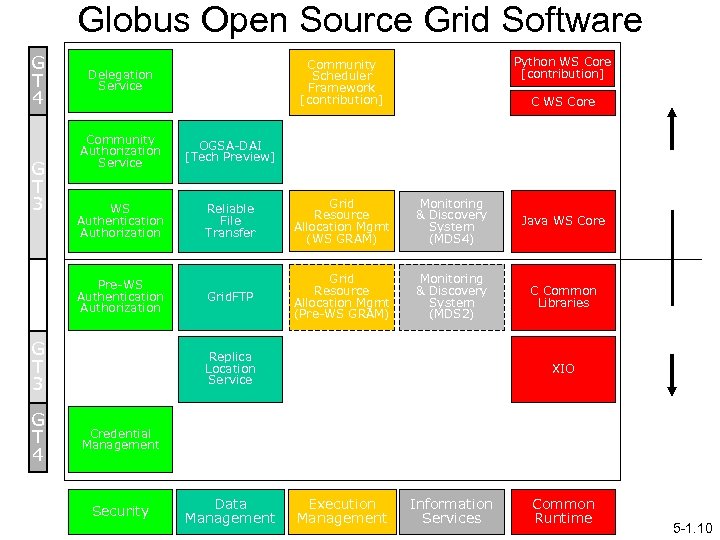 Globus Open Source Grid Software G T 4 G T 3 G T 2 C WS Core Community Authorization Service OGSA-DAI [Tech Preview] WS Authentication Authorization Reliable File Transfer Grid Resource Allocation Mgmt (WS GRAM) Monitoring & Discovery System (MDS 4) Java WS Core Grid. FTP Grid Resource Allocation Mgmt (Pre-WS GRAM) Monitoring & Discovery System (MDS 2) C Common Libraries Pre-WS Authentication Authorization Web Services Components Non-WS Components G T 3 G T 4 Python WS Core [contribution] Community Scheduler Framework [contribution] Delegation Service Replica Location Service XIO Credential Management Security Data Management Execution Management Information Services Common Runtime I Foster 5 -1. 10
 GSI Communication Protocols GT 3/GT 4 based upon Web services security. Two types • Transport-level protocols • Message-level protocols. 5 -1. 11
 Transport-level protocols In transport-level protocols, whole message encrypted before being sent and decrypted when received. Already seen transport-level protocols in SSL/TLS. 5 -1. 12
 Message-level protocols Only message content, or specific portions of message contents encrypted. Provides greater. Various authentication schemes and intermediate message processing can be employed. Conceptually, at a higher level than transport-level protocols and can use various transport-level protocols. However, slower than transport-level protocols. 5 -1. 13
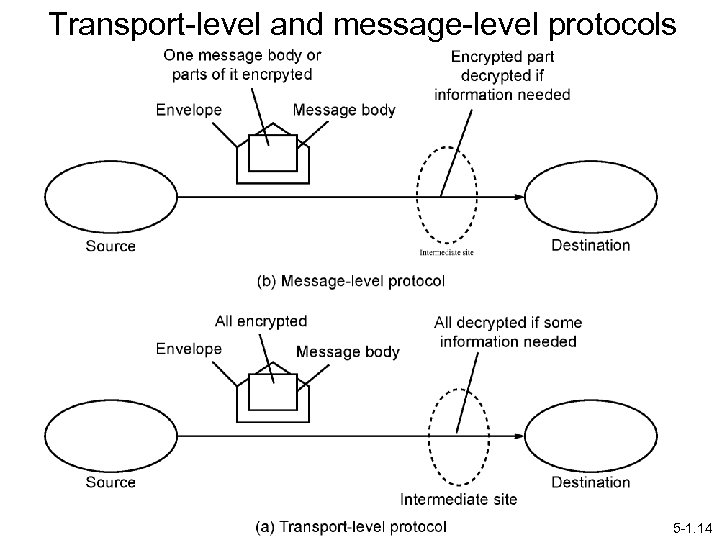 Transport-level and message-level protocols 5 -1. 14
 GSI Authentication Basically same as regular PKI authentication. Users have credentials they use to prove their identity. Credentials consist of: • X. 509 certificate • Private key kept secret by owner (or on owner’s behalf at a secure repository) and encrypted with a passphrase. X. 509 certificate is available to all. 5 -1. 15
 Passphase Similar to password but implies can be very long and incorporate complete sentences with spaces. Properly chosen long passphrase makes it more secure. Good for security, but inconvenient for repeated usage. Mechanisms in place to reduce repeated access to private key. 5 -1. 16
 Certificate Authorities for Grid Computing A Grid computing group (virtual organization) requires one or more certificate authorities to sign certificates. Generally, cannot use existing commercial certificate authorities that one would find recognized by a browser (such as listed in Internet Explorer) because virtual organization wants to control who becomes a member of organization. This is done by issuing certificates signed by a certificate authority of the virtual organization. 5 -1. 17
 Globus Certificate Authorities Globus certificate service A on-line certificate signing service that issues “lowquality” GSI certificates to users who want to experiment with Grid software without having to set up or have access to a certificate authority. Can be used for testing and can be used in Grid service training tutorials but is insufficient for any serious Grid computing work. No means of verifying users nor does it ensure that distinguished names provided are in fact unique. 5 -1. 18
 Simple. CA Simplementation of a certificate authority Part of Globus toolkit Can be installed easily. Simple. CA commands creates the Open. SSL certificate authority configured to work with Globus Open. SSL could be used directly Simple. CA used in UNC-C/UNC-W Grid computing course -- multiple certificate authorities, one at each institution for signing certificates of students at that institution and then arrange for Globus to accept certificates signed by each certificate authorities. 5 -1. 19
 Certificate Authorities for Grid Computing Some projects keep to one certificate authority -certainly simplifies management and creates centralized point for signing. Large Grid computing projects might have multiple certificate authorities with bridge or hierarchical certificate authorities as described earlier. UK e-Science national Grid has a centralized certificate authority but uses registration authorities spread around country for identity management and accepting the initial request for a certificate. Registrations manned by individuals who will require positive proof of identity (photo ID). 5 -1. 20
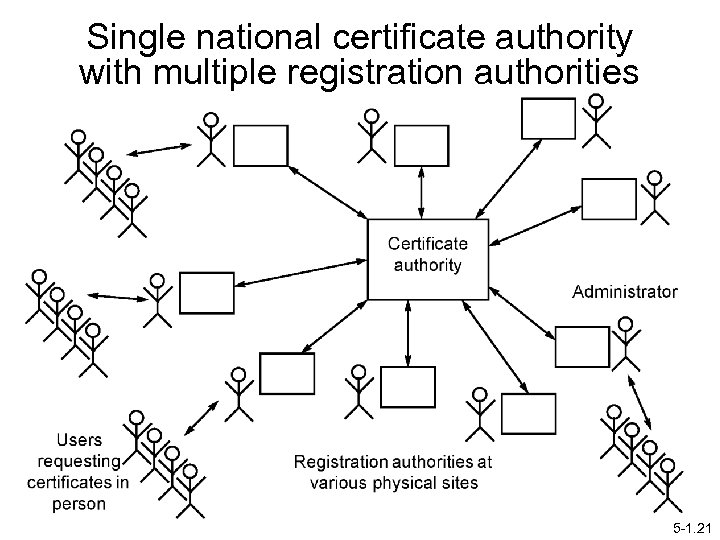 Single national certificate authority with multiple registration authorities 5 -1. 21
 Getting a Certificate using Globus Commands First, you need to generate your own public/private key pair. You do not actually need the public key separate from your certificate as your certificate will hold your public key, so in the process described, you will be left with your private key and your signed certificate. 5 -1. 22
 Globus command grid-cert-request will create a private key pair and request for a signed certificate, that is, an unsigned certificate containing the subject name and public key. A default distinguished name (certificate subject) will be displayed for the user as part of the message. Command requires that you create a passphrase, which will be used to encrypt the private key and must be remembered. 5 -1. 23
 Three files created by command in user’s. GLOBUS directory, namely: • User request: usercert_request. pem • User’s private key: userkey. pem • Empty file: usercert. pem usercert_request. pem -- can be considered as an unsigned certificate containing the subject name and public key. Critical private key is not compromised. usercert. pem -- a placeholder for where the signed certificate will be put later. 5 -1. 24
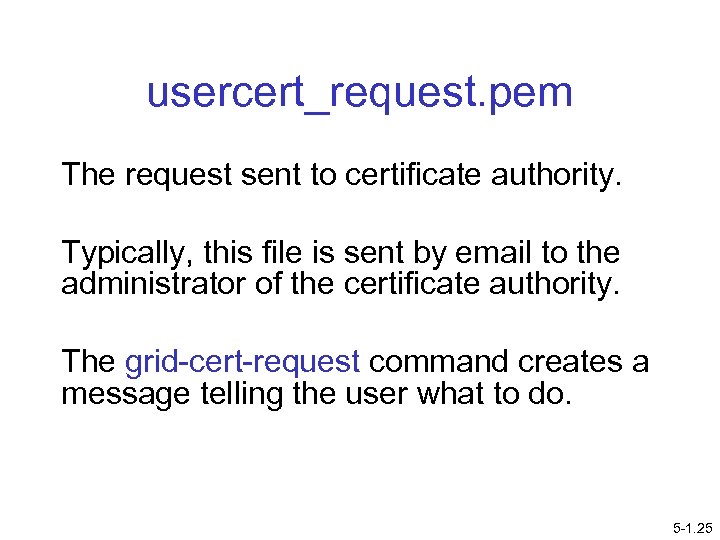 usercert_request. pem The request sent to certificate authority. Typically, this file is sent by email to the administrator of the certificate authority. The grid-cert-request command creates a message telling the user what to do. 5 -1. 25
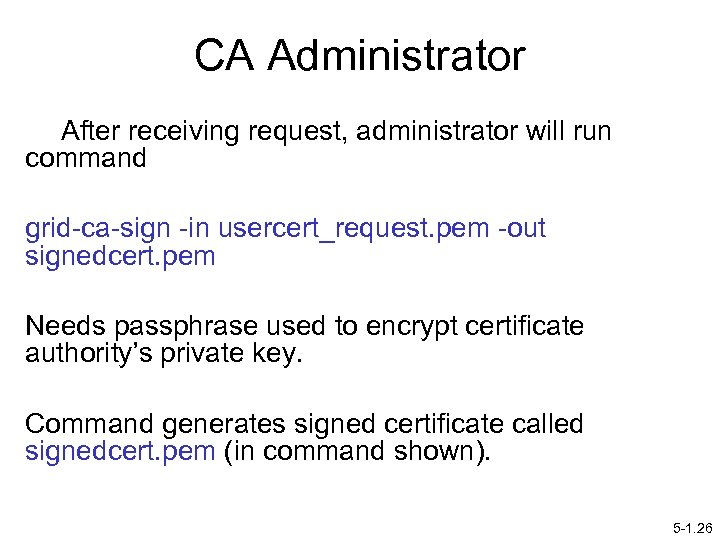 CA Administrator After receiving request, administrator will run command grid-ca-sign -in usercert_request. pem -out signedcert. pem Needs passphrase used to encrypt certificate authority’s private key. Command generates signed certificate called signedcert. pem (in command shown). 5 -1. 26
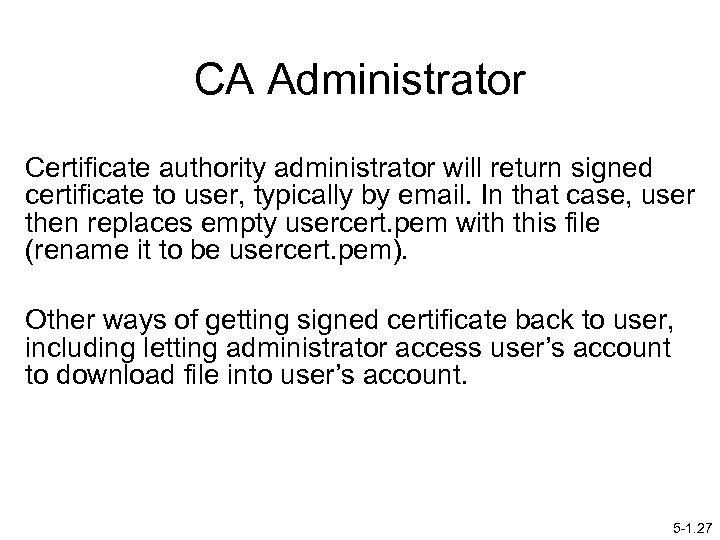 CA Administrator Certificate authority administrator will return signed certificate to user, typically by email. In that case, user then replaces empty usercert. pem with this file (rename it to be usercert. pem). Other ways of getting signed certificate back to user, including letting administrator access user’s account to download file into user’s account. 5 -1. 27
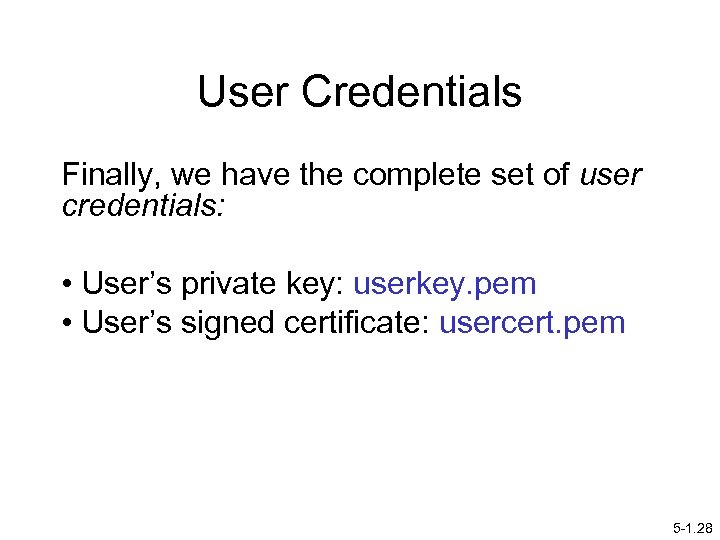 User Credentials Finally, we have the complete set of user credentials: • User’s private key: userkey. pem • User’s signed certificate: usercert. pem 5 -1. 28
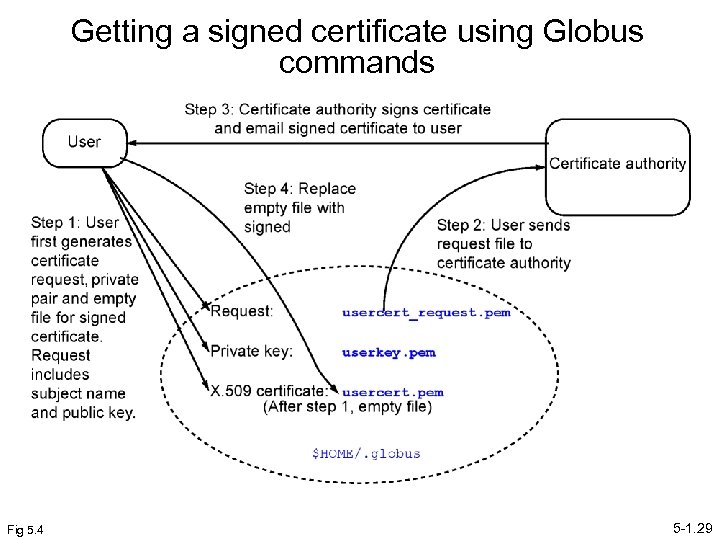 Getting a signed certificate using Globus commands Fig 5. 4 5 -1. 29
 Certificates for Resources Computing resources used in a Grid also need their identity verified in a formalized manner when added to the Grid infrastructure. They will need their own host certificate signed by a certificate authority trusted by the Grid. Only such machines will be allowed to participate in the Grid activities. They might be used under certain access rights and at certain times or with certain users, especially if the computers are shared with non-Grid activities. 5 -1. 30
 Host credentials Consist of the following two files: • Host’s private key: hostkey. pem • Host’s signed certificate: hostcert. pem typically located in /etc/grid-security/. grid-cert-request command to create host credentials: grid-cert-request -hostname Example grid-cert-request -host coit-grid 01. uncc. edu Signing follows same procedure as for user certificates with submission to certificate authority. 5 -1. 31
 Certificate of Certificate Authority When a certificate authority is created, it will self-sign its own certificate (unless a certificate authority hierarchy). Certificate authority has two files: •
 Configuring GT 4 to Trust a Particular Certificate Authority Just as a browser can recognize many certificate authority signatures, Globus can be configured to accept certificates from multiple certificate authorities. It is just a matter of loading the two files of each certificate authority:
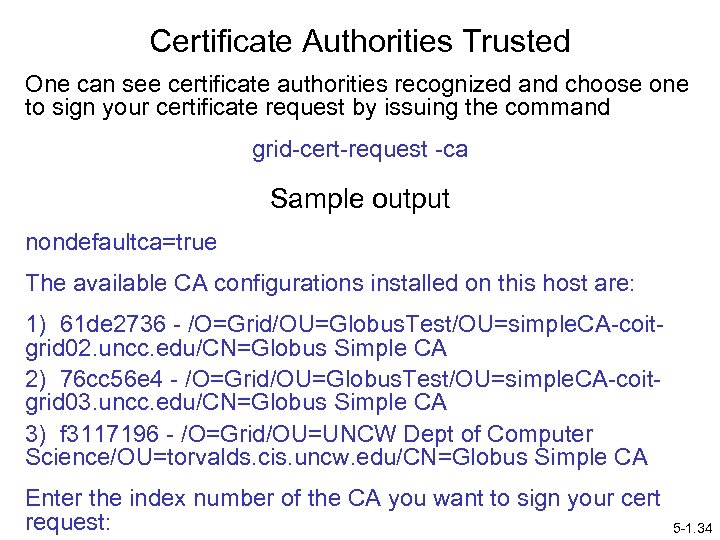 Certificate Authorities Trusted One can see certificate authorities recognized and choose one to sign your certificate request by issuing the command grid-cert-request -ca Sample output nondefaultca=true The available CA configurations installed on this host are: 1) 61 de 2736 - /O=Grid/OU=Globus. Test/OU=simple. CA-coitgrid 02. uncc. edu/CN=Globus Simple CA 2) 76 cc 56 e 4 - /O=Grid/OU=Globus. Test/OU=simple. CA-coitgrid 03. uncc. edu/CN=Globus Simple CA 3) f 3117196 - /O=Grid/OU=UNCW Dept of Computer Science/OU=torvalds. cis. uncw. edu/CN=Globus Simple CA Enter the index number of the CA you want to sign your cert request: 5 -1. 34
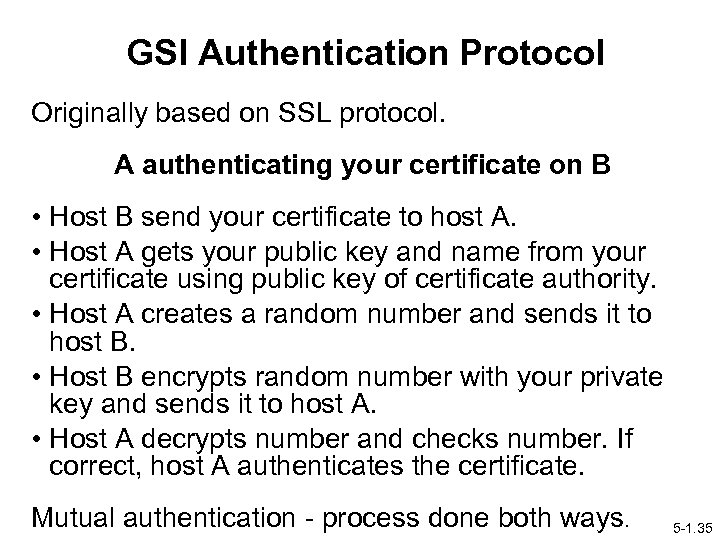 GSI Authentication Protocol Originally based on SSL protocol. A authenticating your certificate on B • Host B send your certificate to host A. • Host A gets your public key and name from your certificate using public key of certificate authority. • Host A creates a random number and sends it to host B. • Host B encrypts random number with your private key and sends it to host A. • Host A decrypts number and checks number. If correct, host A authenticates the certificate. Mutual authentication - process done both ways. 5 -1. 35
 GSI Authorization To recap, authorization is the process of deciding whether a particular identity can access a particular resource and in what fashion. Apart from users and computing resources having valid signed certificates, which provides proof of identity (authentication), users need authorization to access the resources. Currently in Globus toolkit proper, only basic access control facilities provided. (Other software packages aid process. ) Authorization to access a resource implies that user needs an account to access. 5 -1. 36
 Accounts • A mechanism for creating and managing these accounts very desirable • Use a network accessible (LDAP) database that lists users and their access privileges, and incorporates distinguished names format found in X-509 certificates. 5 -1. 37
 Mapping Distinguished Names to Account gridmap file • Very basic Globus way of mapping user’s distinguished names to their account names • Used to give access to accounts via their distinguished name found on user’s certificate. • Each user entry in list takes form: Distinguished_name local_user_account_name 5 -1. 38
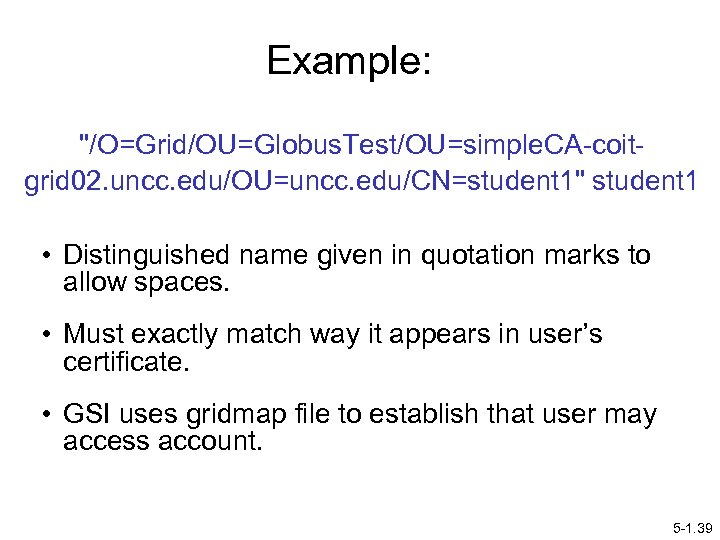 Example: "/O=Grid/OU=Globus. Test/OU=simple. CA-coitgrid 02. uncc. edu/OU=uncc. edu/CN=student 1" student 1 • Distinguished name given in quotation marks to allow spaces. • Must exactly match way it appears in user’s certificate. • GSI uses gridmap file to establish that user may access account. 5 -1. 39
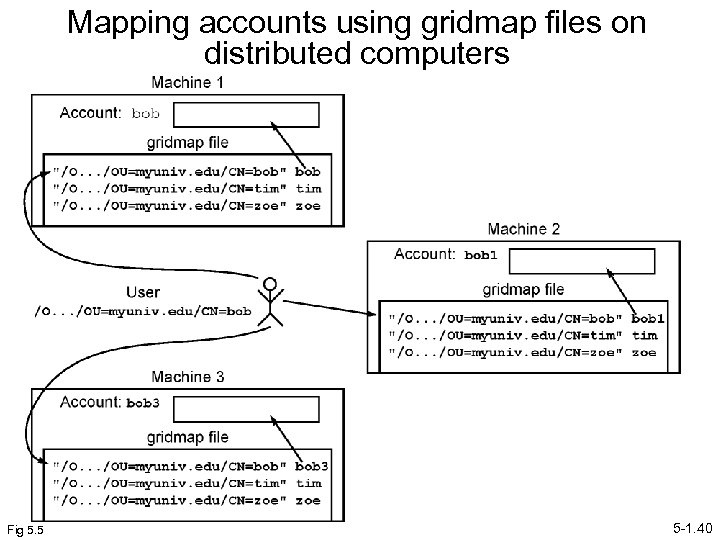 Mapping accounts using gridmap files on distributed computers Fig 5. 5 5 -1. 40
 Account Privileges • Gridmap files often compared to access control lists, but they only provide account name mapping and blanket access. • They do not provide specific types of access (levels of permissions, read/write/execute, group memberships, etc. ) • User access privileges will derive from local system access control list. • Generally, need more powerful mechanism to control type of access, see next. 5 -1. 41
 Question What is a disadvantage of using gridmap files for access control? (May be more than one) (a)It is difficult to maintain for large grids (b) It does not apply fine grain access control (c) It is difficult to verify user credentials (d) It is difficult to map distinguished names to local accounts (e) It is difficult to maintain in a dynamically changing virtual organization 5 -1. 42
 Delegation The process of giving authority to another identity (in this context, a computer) to act on your behalf. A critical requirement for Grid computing. Coupled with delegation is single sign-on, which enables a user and its agents to acquire additional resources without repeated physical authentication by the user (that is, submitting passwords/passphrases). 5 -1. 43
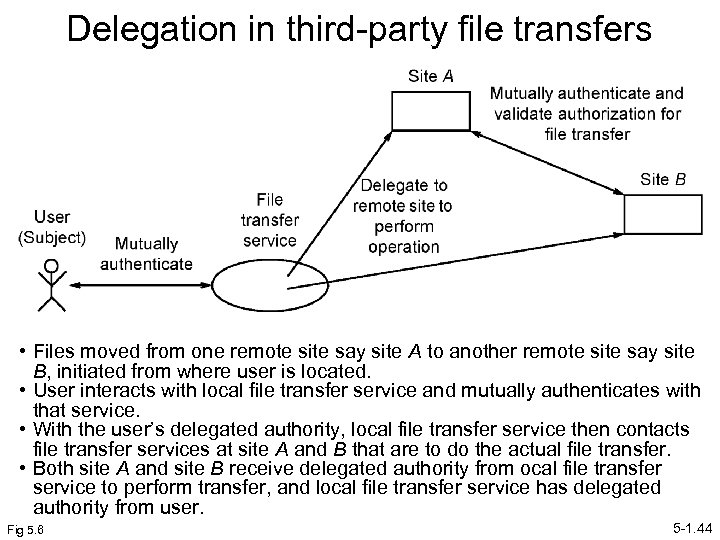 Delegation in third-party file transfers • Files moved from one remote site say site A to another remote site say site B, initiated from where user is located. • User interacts with local file transfer service and mutually authenticates with that service. • With the user’s delegated authority, local file transfer service then contacts file transfer services at site A and B that are to do the actual file transfer. • Both site A and site B receive delegated authority from ocal file transfer service to perform transfer, and local file transfer service has delegated authority from user. Fig 5. 6 5 -1. 44
 Proxy Certificates A way of implementing delegation introduced by Globus. Used extensively in GSI. Proxy certificate, (a proxy) gives resource possessing proxy the authority to act on your behalf, just as proxy vote can be used for someone to place a vote on your behalf. Proxy credentials consist of: • Proxy certificate (with its public key) and • Proxy private key. Subject of proxy certificate is identity of entity giving the proxy authority with /CN=proxy added to name to show that certificate is a proxy certificate. 5 -1. 45
 Proxy Certificates Signed by subject, not certificate authority. Can be compared to a proxy vote being signed by you but placed by someone on your behalf. Your signature should be checked. With proxy certificates, that is done by checking signature on the proxy certificate, which requires public key of user. Public key of user requires checking signature on the user’s certificate, which requires public key of certificate authority. So proxy certificate alone is not sufficient. User’s certificate and certificate of certificate authority (or at least their public keys) needed also by resource to act on your behalf—three certificates in all 5 -1. 46
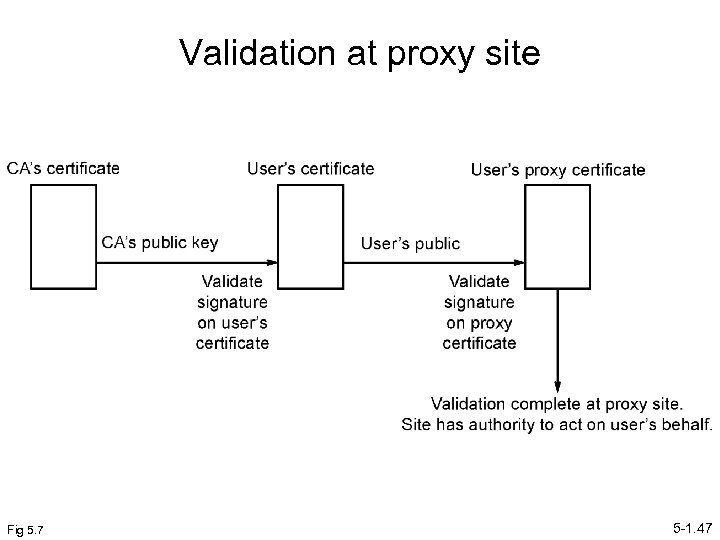 Validation at proxy site Fig 5. 7 5 -1. 47
 Proxy private key and certificate lifetime User certificates usually have long lifetimes, maybe a year. User’s private key is kept very secure in an encrypted form based upon passphrase established by user. Each time user performs a PKI authentication protocol, user’s private key must be decrypted with passphrase. At that point, brief opening for breach of security, but as soon as possible decrypted private key must be destroyed. If proxy’s private key also encrypted, would need a passphrase to decrypt it each time, which would defeat purpose of just having a single sign-on with one application of passphrase. Consequently, proxy’s private key simply protected by operating system file permissions which does not need a decrypting passphrase to access. Proxy is given a limited lifetime, say 2 hours, so that any breach of security/potential damage limited. 5 -1. 48
 Because proxy has its own subject name (user’s name plus being a proxy), it can be used in authentication and authorization mechanisms as a separate entity. Would be possible, and a good idea, for a proxy of a user not to carry the full access rights of the user. It could be limited to the type of actions contemplated. Delegation rights can be encoded into the certificate in a “Proxy. Cert. Info” X. 509 extension field - not currently standardised. 5 -1. 49
 In a Globus environment, one immediately provides delegated authority. User must create a proxy which can be done manually with the grid-proxy-init command. Its contents can be examined with grid-proxy-info. Proxy can be destroyed with grid-proxy-destroy, 5 -1. 50
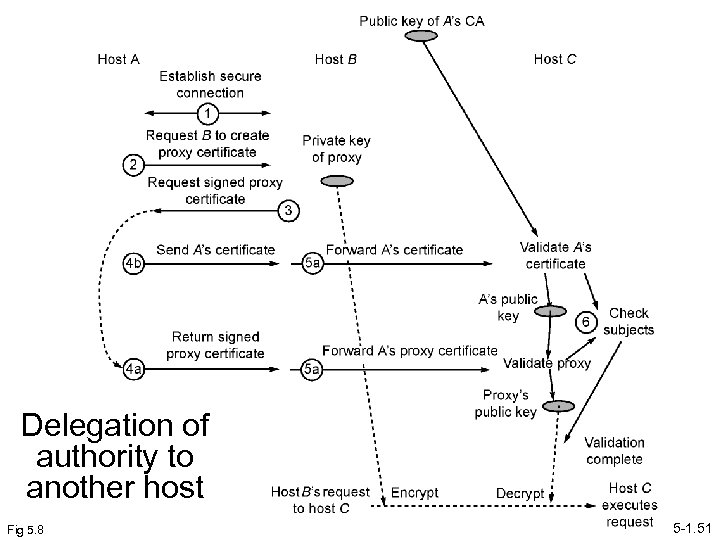 Delegation of authority to another host Fig 5. 8 5 -1. 51
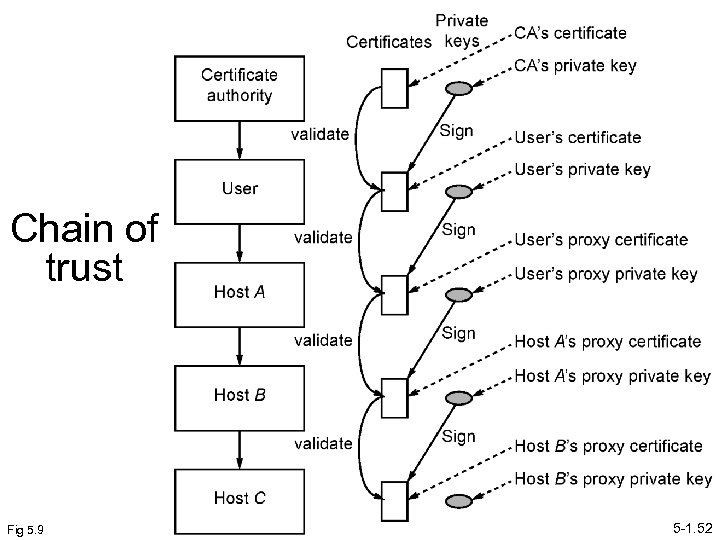 Chain of trust Fig 5. 9 5 -1. 52
 My. Proxy Grid Credential Repository A repository developed for certificates. Widely used in Grid computing. Provide short lifetime proxies upon request. Originally separate to Globus, Later incorporated into Globus 4. 0 Has become an integrated part of Globus environment especially with Grid. Sphere portal. 5 -1. 53
 My. Proxy Grid Credential Repository Two ways that My. Proxy might be used: 1. As a repository for user’s credentials or 2. As a repository for proxy credentials. 5 -1. 54
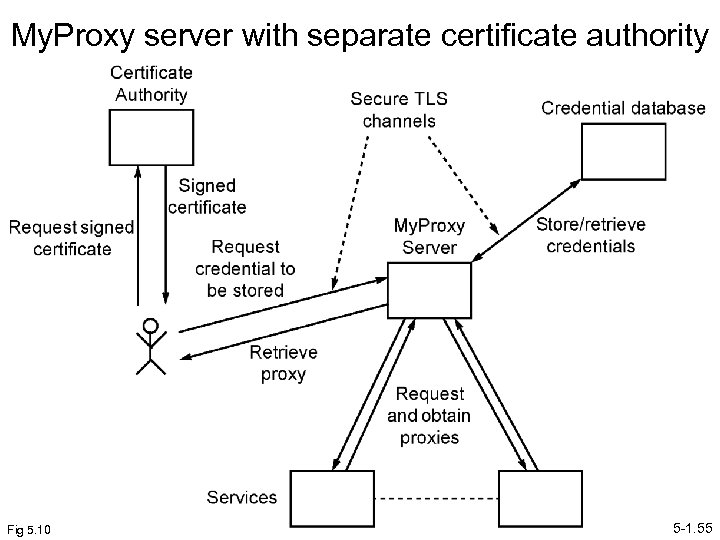 My. Proxy server with separate certificate authority Fig 5. 10 5 -1. 55
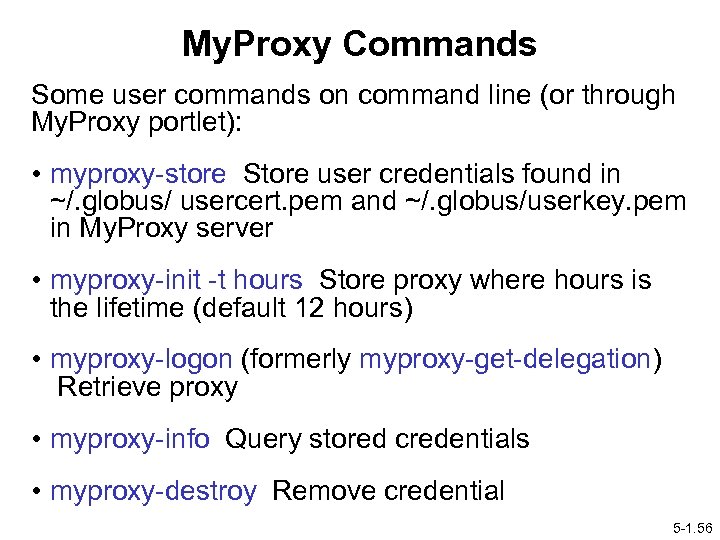 My. Proxy Commands Some user commands on command line (or through My. Proxy portlet): • myproxy-store Store user credentials found in ~/. globus/ usercert. pem and ~/. globus/userkey. pem in My. Proxy server • myproxy-init -t hours Store proxy where hours is the lifetime (default 12 hours) • myproxy-logon (formerly myproxy-get-delegation) Retrieve proxy • myproxy-info Query stored credentials • myproxy-destroy Remove credential 5 -1. 56
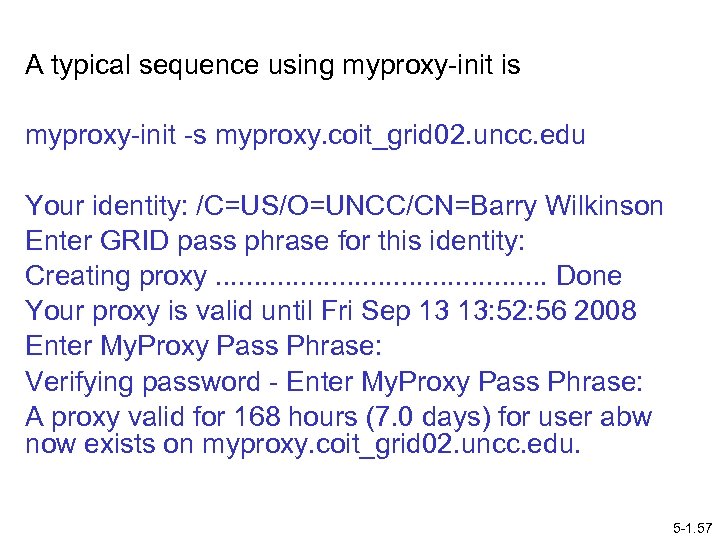 A typical sequence using myproxy-init is myproxy-init -s myproxy. coit_grid 02. uncc. edu Your identity: /C=US/O=UNCC/CN=Barry Wilkinson Enter GRID pass phrase for this identity: Creating proxy. . . Done Your proxy is valid until Fri Sep 13 13: 52: 56 2008 Enter My. Proxy Pass Phrase: Verifying password - Enter My. Proxy Pass Phrase: A proxy valid for 168 hours (7. 0 days) for user abw now exists on myproxy. coit_grid 02. uncc. edu. 5 -1. 57
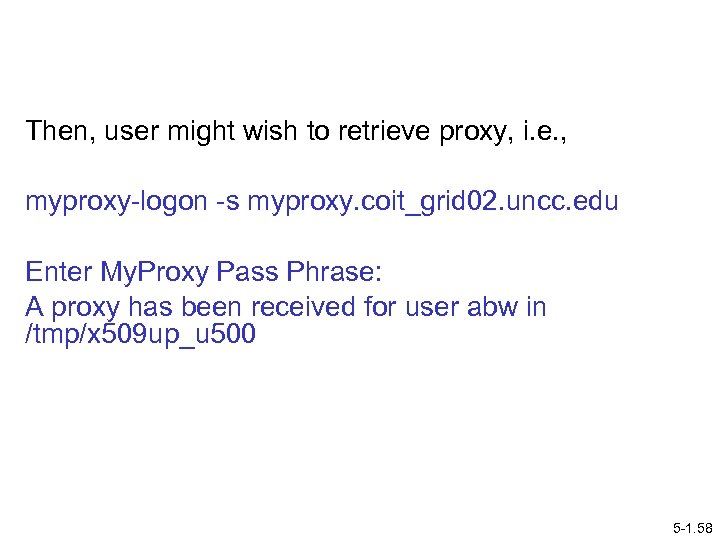 Then, user might wish to retrieve proxy, i. e. , myproxy-logon -s myproxy. coit_grid 02. uncc. edu Enter My. Proxy Pass Phrase: A proxy has been received for user abw in /tmp/x 509 up_u 500 5 -1. 58
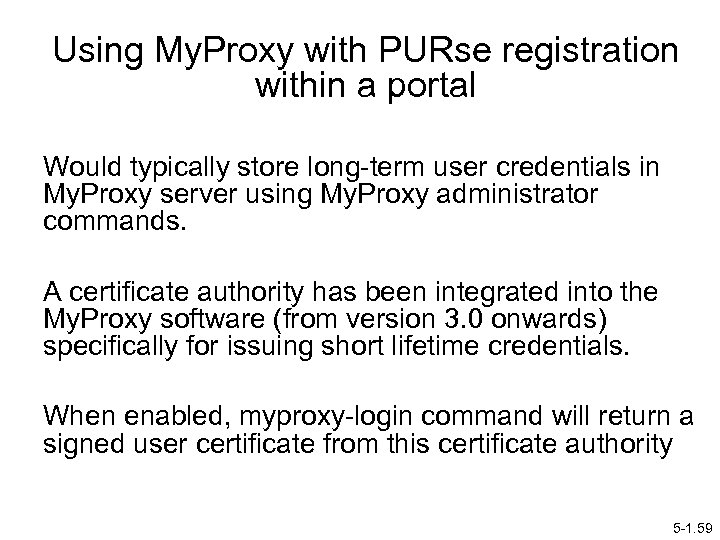 Using My. Proxy with PURse registration within a portal Would typically store long-term user credentials in My. Proxy server using My. Proxy administrator commands. A certificate authority has been integrated into the My. Proxy software (from version 3. 0 onwards) specifically for issuing short lifetime credentials. When enabled, myproxy-login command will return a signed user certificate from this certificate authority 5 -1. 59
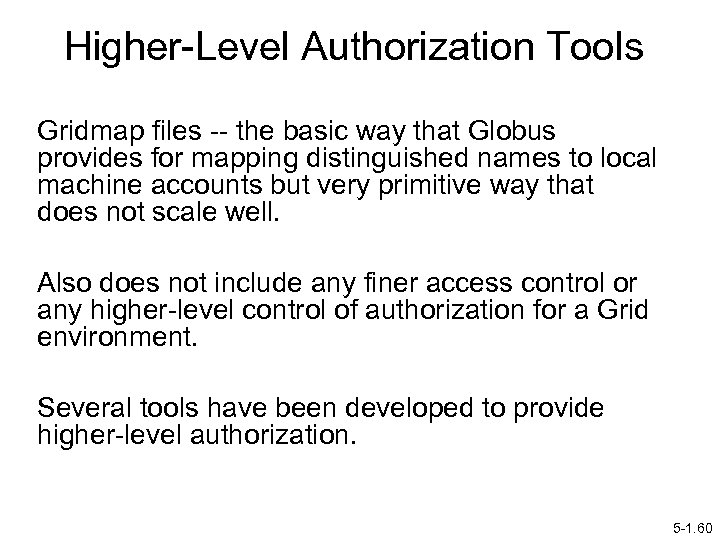 Higher-Level Authorization Tools Gridmap files -- the basic way that Globus provides for mapping distinguished names to local machine accounts but very primitive way that does not scale well. Also does not include any finer access control or any higher-level control of authorization for a Grid environment. Several tools have been developed to provide higher-level authorization. 5 -1. 60
 Security Assertion Markup Language (SAML) • XML language for making “assertions” for authentication and authorization decisions and • A request-response protocol for such assertions. • Developed by OASIS for facilitating exchange of security information between business partners, in particular to obtain single sign-on for Web users • Addresses where a user accesses a Web site that might require user’s request to be redirected to another affiliated site after being authenticated, e. g. travel bookings and automobile reservations. • Has been applied in Grid computing. 5 -1. 61
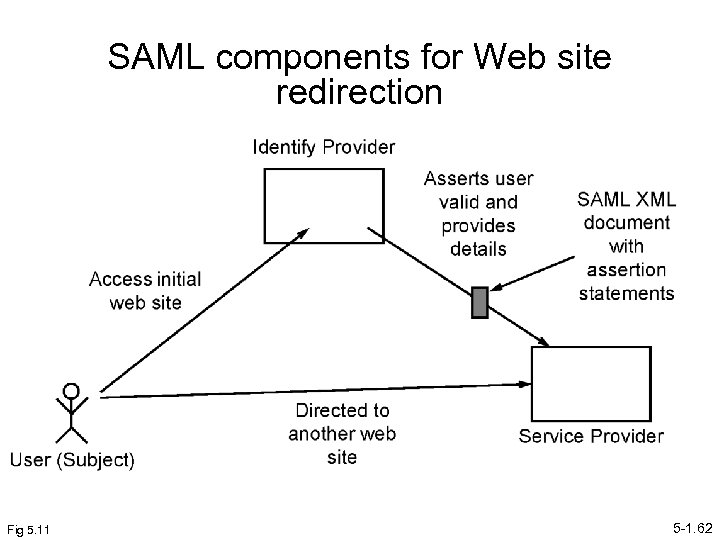 SAML components for Web site redirection Fig 5. 11 5 -1. 62
 SAML provides for communication of user authentication, authorization and attribute information. Three components: • Assertions - information being communicated • Protocol - way that message exchanges done • Binding - mapping to concrete SOAP exchanges and specific protocols (usually HTTP) Three forms of assertions: • Authentication statements • Attribute statements • Authorization decision statements 5 -1. 63
 • Authentication assertion statements – confirm to service provider the user's identity. • Attribute assertion statements – Provides specific information about user to establish access decisions. – Attributes might for example include that a users is an administrator (root privileges) or has limited user privileges. • SAML authorization decisions – e. g. might state that subject (user) is allowed to perform the specified operation on the specified resource. 5 -1. 64
 Using Certificates for Authorization Original purpose of X. 509 certificates is to prove identity (authentication). When these certificates sent to resources, both authentication and authorization decisions often made at the same time. One could additional information in certificates for authorization. X. 509 format allows additional information in noncritical X. 509 extensions enabling existing software to pass on such certificates for authorization decisions. 5 -1. 65
 Communication Authorization Service (CAS) • Developed to provide authorization service in a Globus environment of using proxy certificates. • Part of Globus 4 • CAS server issues proxy to user that includes authorization assertions inserted as non-critical X 509 extensions in certificate. • Now uses SAML assertions (not originally). • Approach enables proxy certificates to be processed by existing software. 5 -1. 66
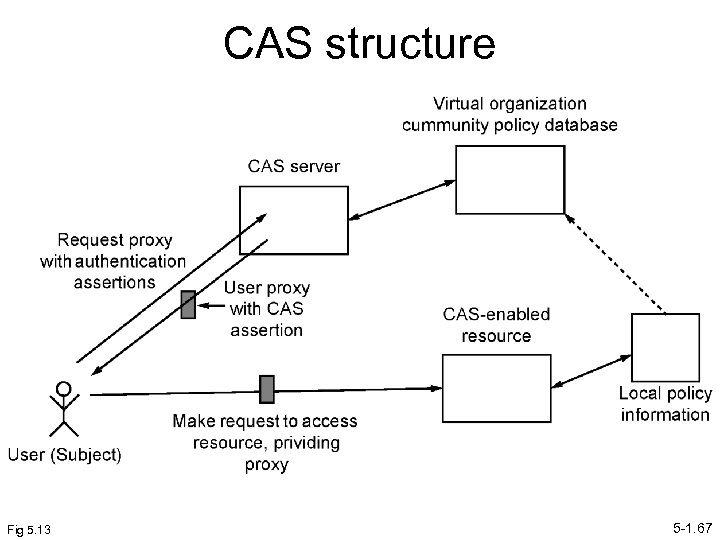 CAS structure Fig 5. 13 5 -1. 67
 Attribute (Authorization) Certificates A separate certificate in addition to X-509 certificate, just for authorization. Proposed as a standard. Attribute certificate bound to a particular identity and digitally signed to validate it. 5 -1. 68
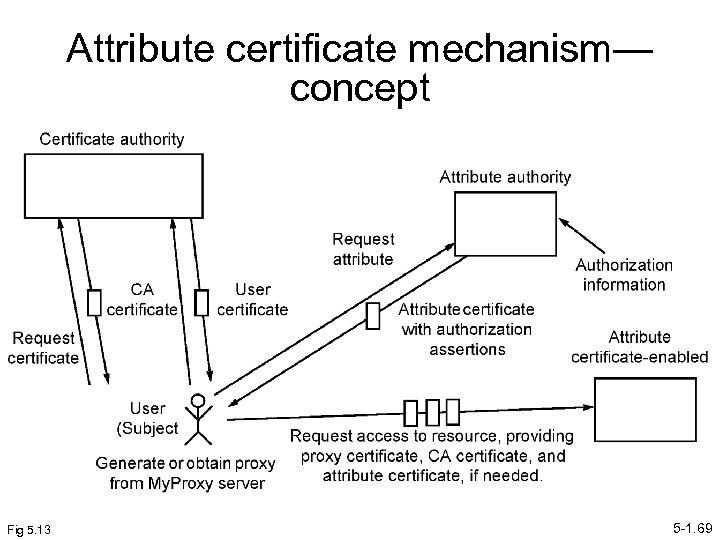 Attribute certificate mechanism— concept Fig 5. 13 5 -1. 69
 Questions 5 -1. 70
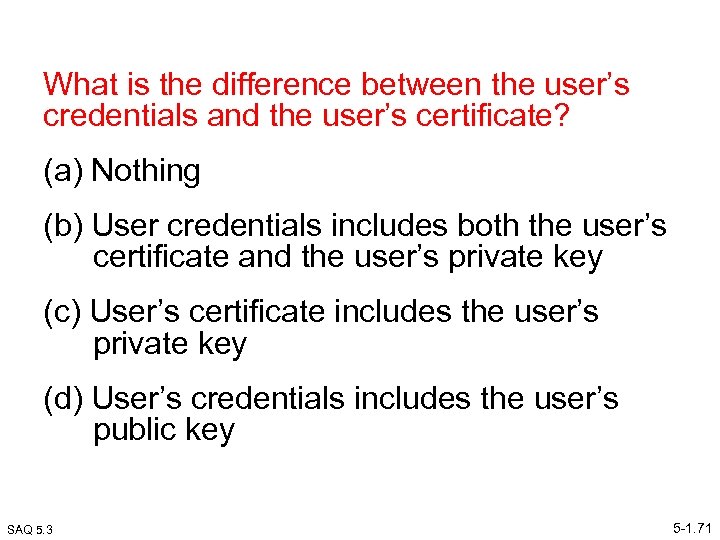 What is the difference between the user’s credentials and the user’s certificate? (a) Nothing (b) User credentials includes both the user’s certificate and the user’s private key (c) User’s certificate includes the user’s private key (d) User’s credentials includes the user’s public key SAQ 5. 3 5 -1. 71
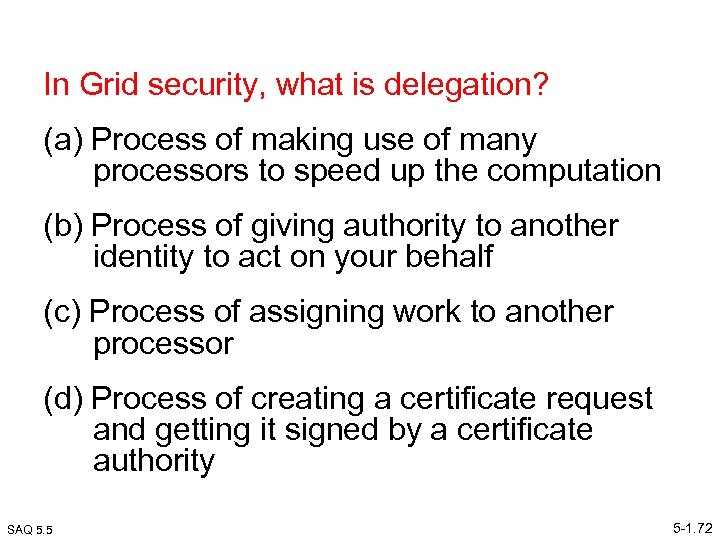 In Grid security, what is delegation? (a) Process of making use of many processors to speed up the computation (b) Process of giving authority to another identity to act on your behalf (c) Process of assigning work to another processor (d) Process of creating a certificate request and getting it signed by a certificate authority SAQ 5. 5 5 -1. 72
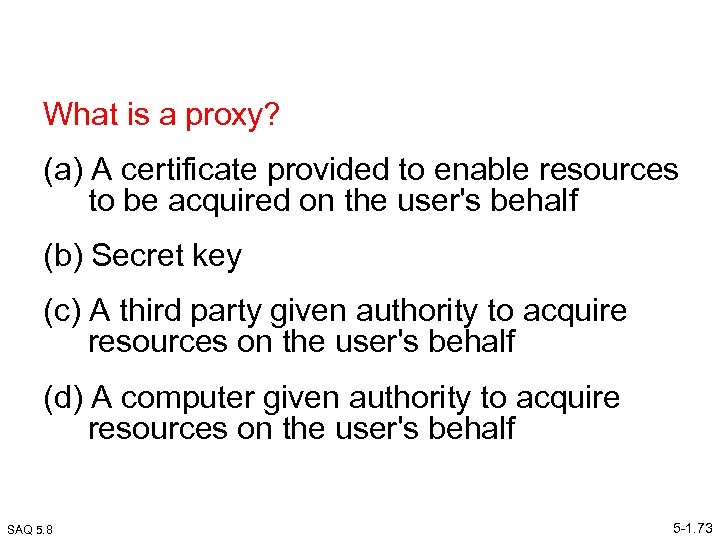 What is a proxy? (a) A certificate provided to enable resources to be acquired on the user's behalf (b) Secret key (c) A third party given authority to acquire resources on the user's behalf (d) A computer given authority to acquire resources on the user's behalf SAQ 5. 8 5 -1. 73
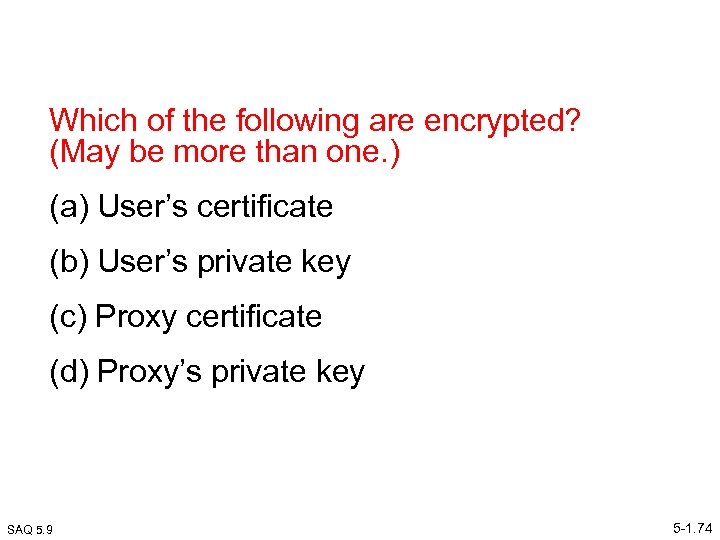 Which of the following are encrypted? (May be more than one. ) (a) User’s certificate (b) User’s private key (c) Proxy certificate (d) Proxy’s private key SAQ 5. 9 5 -1. 74
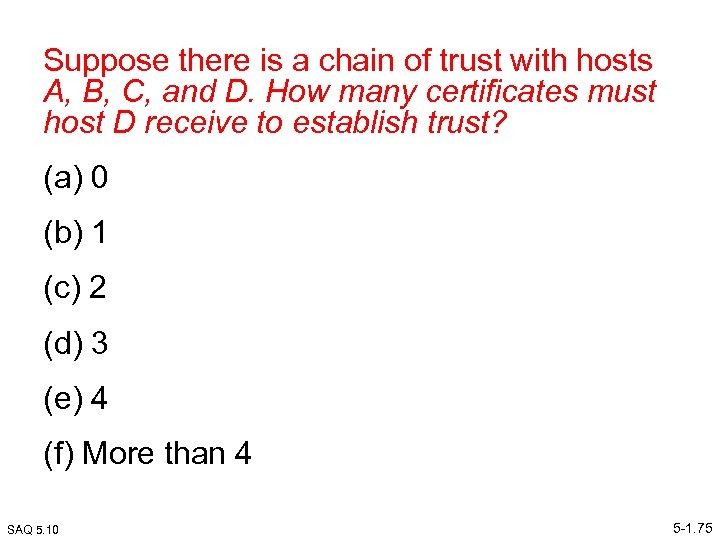 Suppose there is a chain of trust with hosts A, B, C, and D. How many certificates must host D receive to establish trust? (a) 0 (b) 1 (c) 2 (d) 3 (e) 4 (f) More than 4 SAQ 5. 10 5 -1. 75