 Скачать презентацию Grid Monitoring and Information Services Globus Toolkit MDS
051360958263229836da8390e98591f0.ppt
- Количество слайдов: 33



Grid Monitoring and Information Services: Globus Toolkit MDS 4 & Tera. Grid Inca Jennifer M. Schopf Argonne National Lab UK National e. Science Center (Ne. SC) Nov 2, 2004
Overview l l Brief overview of what I mean by “Grid monitoring” Tool for Monitoring/Discovery: – Globus Toolkit MDS 4 l Tool for Monitoring/Status Tracking – Inca from the Tera. Grid project l Nov 2, 2004 Just added: GLUE schema in a nutshell 2
What do I mean by monitoring? l l Discovery and expression of data Discovery: – Registry service – Contains descriptions of data that is available – Sometimes also where last value of data is kept (caching) l Expression of data – Access to sensors, archives, etc. – Producer (in consumer producer model) Nov 2, 2004 3
What do I mean by Grid monitoring? l Grid level monitoring concerns data that is: – – l Different levels of monitoring needed: – – l Nov 2, 2004 Shared between administrative domains For use by multiple people Often summarized (think scalability) Application specific Node level Cluster/site Level Grid level Grid monitoring may contain summaries of lower level monitoring 4
Grid Monitoring Does Not Include… l l l Nov 2, 2004 All the data about every node of every site Years of utilization logs to use for planning next hardware purchase Low-level application progress details for a single user Application debugging data (except perhaps notification of a failure of a heartbeat) Point-to-point sharing of all data over all sites 5
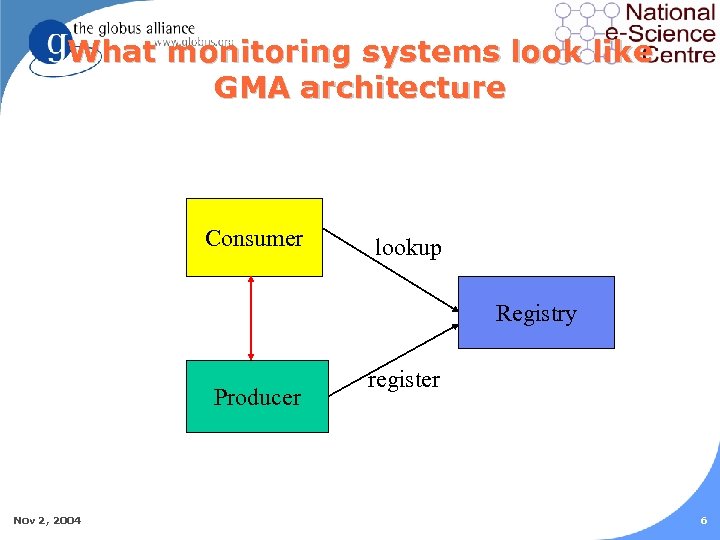
What monitoring systems look like GMA architecture Consumer lookup Registry Producer Nov 2, 2004 register 6
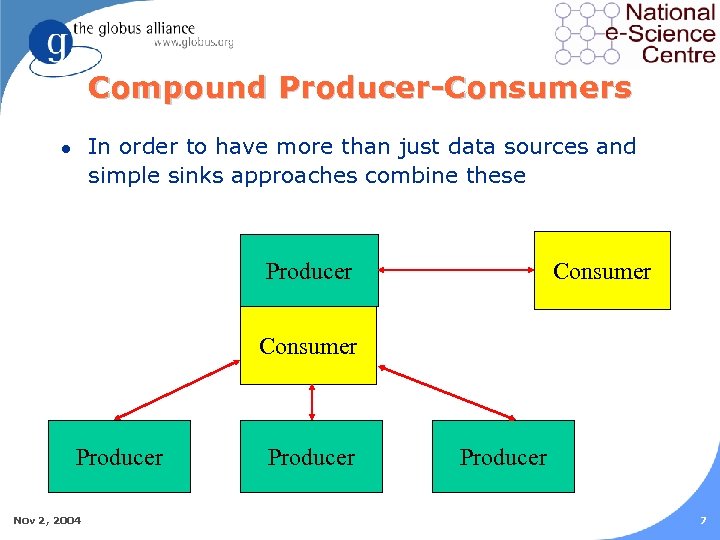
Compound Producer-Consumers In order to have more than just data sources and simple sinks approaches combine these l Producer Consumer Producer Nov 2, 2004 Producer 7
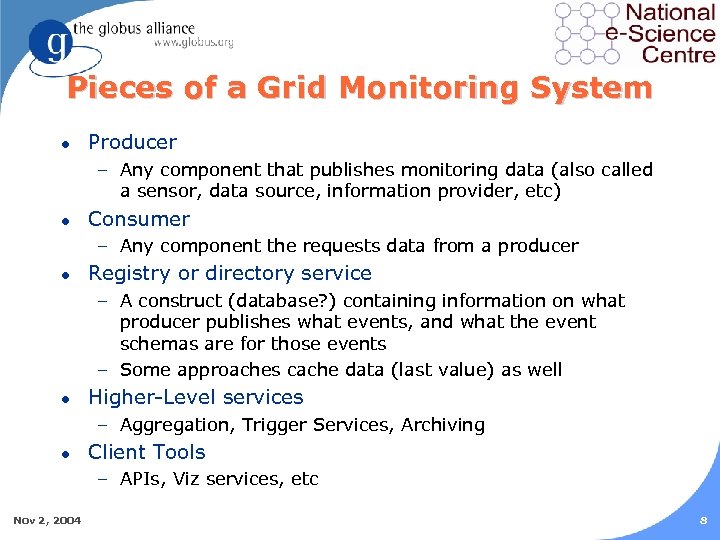
Pieces of a Grid Monitoring System l Producer – Any component that publishes monitoring data (also called a sensor, data source, information provider, etc) l Consumer – Any component the requests data from a producer l Registry or directory service – A construct (database? ) containing information on what producer publishes what events, and what the event schemas are for those events – Some approaches cache data (last value) as well l Higher-Level services – Aggregation, Trigger Services, Archiving l Client Tools – APIs, Viz services, etc Nov 2, 2004 8
PGI Monitoring Defined Usecases l l Joint PPDG, Gri. Phy. N and i. VDGL effort to define monitoring requirements http: //www. mcs. anl. gov/~jms/pgmonitoring 19 use cases from ~9 groups Roughly 4 categories – Health of system (NW, servers, cpus, etc) – System upgrade evaluation – Resource selection – Application-specific progress tracking Nov 2, 2004 9
Why So Many Monitoring Systems? l There is no ONE tool for this job – Nor would you ever get agreement between sites to all deploy it if there was l Best you can hope for is – An understanding of overlap – Standard-defined interactions when possible Nov 2, 2004 10
Things to Think About When Comparing Systems l l l l Nov 2, 2004 What is the main use case your system addresses? What are the base set of sensors given with a system? How does that set get extended? What are you doing for discovery/registry? What schema are you using (do you interact with)? Is this system meant to monitor a machine, a cluster, or send data between sites, or some combination of the above? What kind of testing has been done in terms of scalability (several pieces to this - how often is data updated, how many users, how many data sources, how many sites, etc) 11
Two Systems To Consider l Globus Toolkit Monitoring and Discovery System 4 (MDS 4) – WSRF-compatible – Resource Discovery – Service Status l Inca test harness and reporting framework – Tera. Grid project – Service agreement monitoring – software stack, service up/down, performance Nov 2, 2004 12
Monitoring and Discovery Service in GT 4 (MDS 4) l WS-RF compatible l Monitoring of basic service data l Primary use case is discovery of services l Starting to be used for up/down statistics Nov 2, 2004 13
MDS 4 Producers: Information Providers l Code that generates resource property information – Were called service data providers in GT 3 l XML Based – not LDAP l Basic cluster data – Interface to Ganglia – GLUE schema l Some service data from GT 4 services – Start, timeout, etc l Soft-state registration l Push and pull data models Nov 2, 2004 14
MDS 4 Registry: Aggregator l Aggregator is both registry and cache l Subscribes to information providers – Data, datatype, data provider information l Caches last value of all data l In memory default approach Nov 2, 2004 15
MDS 4 Trigger Service l l l Nov 2, 2004 Compound consumer-producer service Subscribe to a set of resource properties Set of tests on incoming data streams to evaluate trigger conditions When a condition matches, email is sent to pre-defined address GT 3 tech-preview version in use by ESG GT 4 version alpha is in GT 4 alpha release currently available 16
MDS 4 Archive Service l Compound consumer-producer service l Subscribe to a set of resource properties l Data put into database (Xindice) l l Nov 2, 2004 Other consumers can contact database archive interface Will be in GT 4 beta release 17
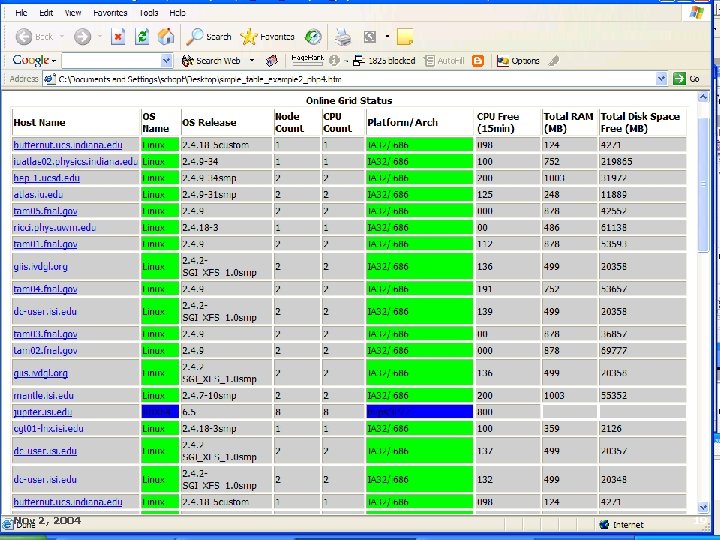
MDS 4 Clients l Command line, Java and C APIs l MDSWeb Viz service – Tech preview in current alpha (3. 9. 3 last week) Nov 2, 2004 18
Nov 2, 2004 19
Coming Up Soon… l Extend MDS 4 information providers – More data from GT 4 services (GRAM, RFT, RLS) – Interface to other tests (Inca, GRASP) – Interface to archiver (Pin. GER, Ganglia, others) l l l Nov 2, 2004 Scalability testing and development Additional clients If tracking job stats is of interest this is something we can talk about 20
Tera. Grid Inca l l l Originally developed for the Tera. Grid project to verify its software stack Now part of the NMI GRIDS center software Now performs automated verification of servicelevel agreements – Software versions – Basic software and service tests – local and crosssite – Performance benchmarks l Best use: CERTIFICATION – Is this site Project Compliant? – Have upgrades taken place in a timely fashion? Nov 2, 2004 21
Inca Producers: Reporters l Over 100 tests deployed on each TG resource (9 sites) – Load on host systems less than 0. 05% overall l Primarily specific software versions and functionality tests – Versions not functionality because functionality is an open question – Grid service capabilities cross-site – GT 2. 4. 3 GRAM jobs submission & Grid. FTP – Open. SSH – My. Proxy l Nov 2, 2004 Soon to be deployed: SRB, VMI, BONNIE benchmarks, LAPACK Benchmarks 22
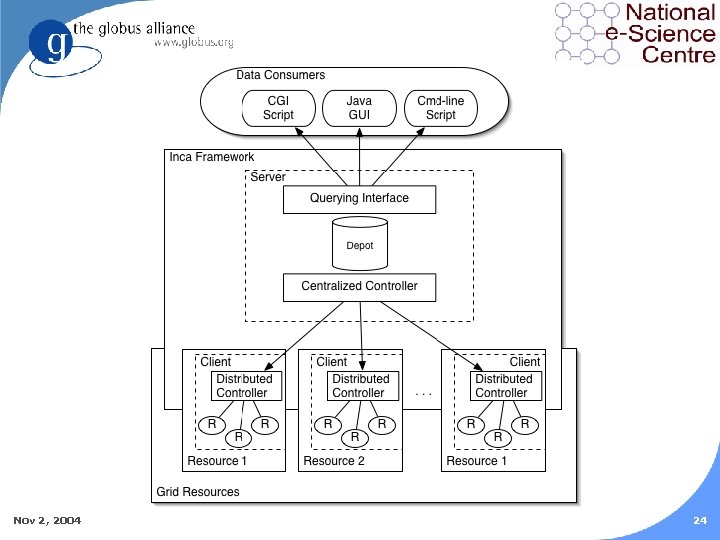
Support Services l Distributed controller – runs on each client resource – controls the local data collection through the reporters l Centralized controller – system administrators can change data collection rates and deployment of the reporters l Archive system (depot) – collects all the reporter data using a round-robin database scheme. Nov 2, 2004 23
Nov 2, 2004 24
Interfaces l Command line, C, and Perl APIs l Several GUI clients l Executive view – http: //tech. teragrid. org/inca/TG/html/exec. V iew. html l Overall Status – http: //tech. teragrid. org/inca/TG/html/stack Status. html Nov 2, 2004 25
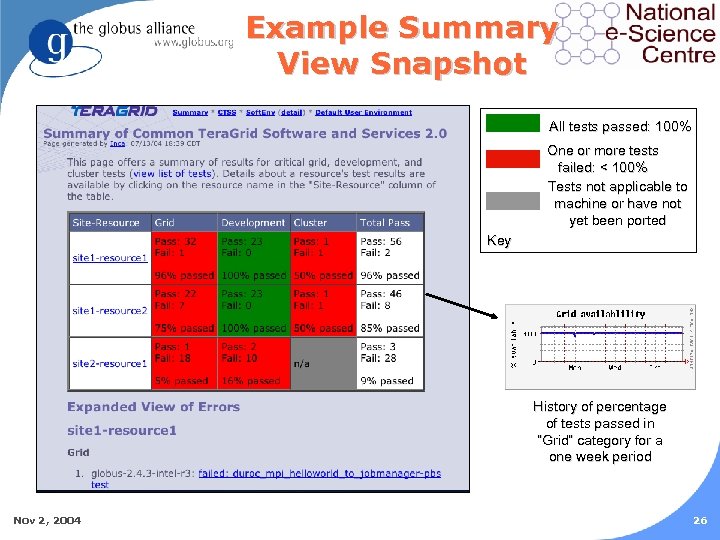
Example Summary View Snapshot All tests passed: 100% One or more tests failed: < 100% Tests not applicable to machine or have not yet been ported Key History of percentage of tests passed in “Grid” category for a one week period Nov 2, 2004 26
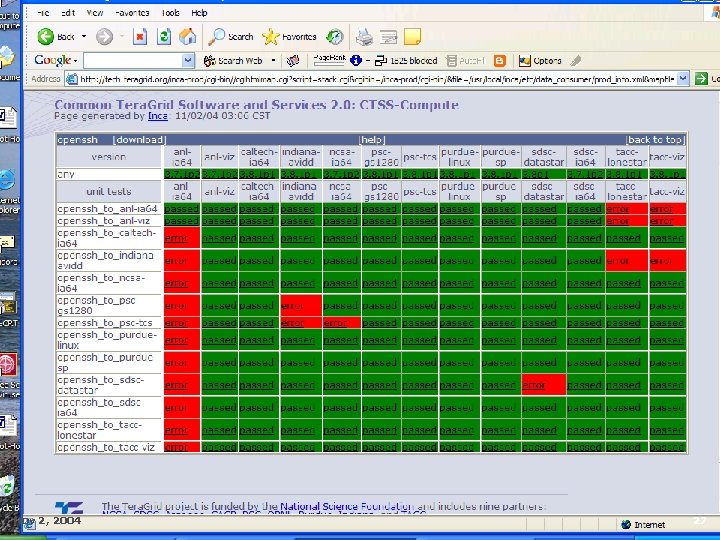
Nov 2, 2004 27
Inca Future Plans l Paper being presented at SC 04 – Scalability results (soon to be posted here) – www. mcs. anl. gov/~jms/Pubs/jmspubs. html l l Extending information and sites Restructuring depot (archiving) for added scalability (RRDB won’t meet future needs) Cascading reporters – trigger more info on failure Discussions with several groups to consider adoption/certification programs – NEES, GEON, UK NGS, others Nov 2, 2004 28
GLUE Schema l Why do we need a fixed schema? – Communication between projects l Condor doesn’t have one – why do we need one? – Condor has a defacto schema – OS won’t match to Op. Sys – major problem when matchmaking between sites l Nov 2, 2004 What about doing updates? – Schema updates should NOT be done on the fly if you want to maintain compatibility – On the other hand, they don’t need to be since by definition they include deploying new sensors to gather data – Whether or not sw has to be re-started after a deployment is an implementation issue, not a schema issue 29
Glue Schema l Does a schema have to define everything? – No – GLUE schema v 1 was in use and by plan did NOT define everything – It had extendable pieces so we could get more hands on use – This is what projects have been doing since it was defined 18 months ago Nov 2, 2004 30
Extending the GLUE Schema l Sergio Andreozzi proposed extending the GLUE schema to take into account project-specific details – We now have hands on experience – Every project has added their own extension – We need to unify them l Mailman list – www. hicb. org/mailman/listinfo/glue-schema l Bugzilla-like system for tracking the proposed changes – infnforge. cnaf. infn. it/projects/glueinfomodel/ – Currently only used by Sergio : ) l Nov 2, 2004 Mail this morning suggesting better requirement gathering and phone call/meeting to move forward 31
Ways Forward l Sharing of tests between infrastructures l Help contribute to GLUE schema l l Nov 2, 2004 Share use cases and scalability requirements Hardest thing in Grid computing isn’t technical, it’s socio-political and communication 32
For More Information l Jennifer Schopf – jms@mcs. anl. gov – http: //www. mcs. anl. gov/~jms l Globus Toolkit MDS 4 – http: //www. globus. org/mds l Inca – http: //tech. teragrid. org/inca l Scalability comparison of MDS 2, Hawkeye, R-GMA www. mcs. anl. gov/~jms/Pubs/xuehaijeff-hpdc 2003. pdf l Monitoring Clusters, Monitoring the Grid – Cluster. World – http: //www. grids-center. org/news/clusterworld/ Nov 2, 2004 33
Скачать презентацию Grid Monitoring and Information Services Globus Toolkit MDS
051360958263229836da8390e98591f0.ppt