


 Скачать презентацию Grid Computing Infrastructure Software Slides for Grid Computing
0c4c06418d52db02fae2f8a3c9653940.ppt
- Количество слайдов: 84
 Grid Computing Infrastructure Software Slides for Grid Computing: Techniques and Applications by Barry Wilkinson, Chapman & Hall/CRC press, © 2009. Chapter 7, pp. 201 -213. For educational use only. All rights reserved. Sept 13, 2009 7 -1. 1
 Grid computing software Gone through several development cycles. Started before grid computing standards became accepted. Clearly need standardized protocols and interfaces for wide adoption of grid computing. 7 -1. 2
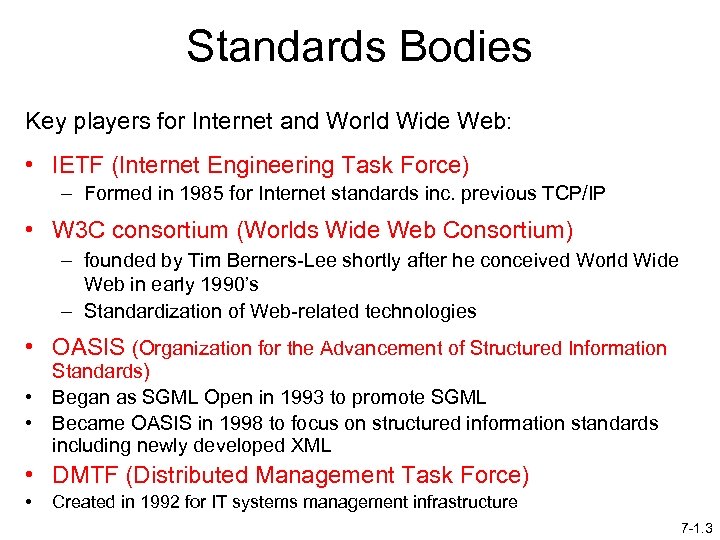 Standards Bodies Key players for Internet and World Wide Web: • IETF (Internet Engineering Task Force) – Formed in 1985 for Internet standards inc. previous TCP/IP • W 3 C consortium (Worlds Wide Web Consortium) – founded by Tim Berners-Lee shortly after he conceived World Wide Web in early 1990’s – Standardization of Web-related technologies • OASIS (Organization for the Advancement of Structured Information Standards) • Began as SGML Open in 1993 to promote SGML • Became OASIS in 1998 to focus on structured information standards including newly developed XML • DMTF (Distributed Management Task Force) • Created in 1992 for IT systems management infrastructure 7 -1. 3
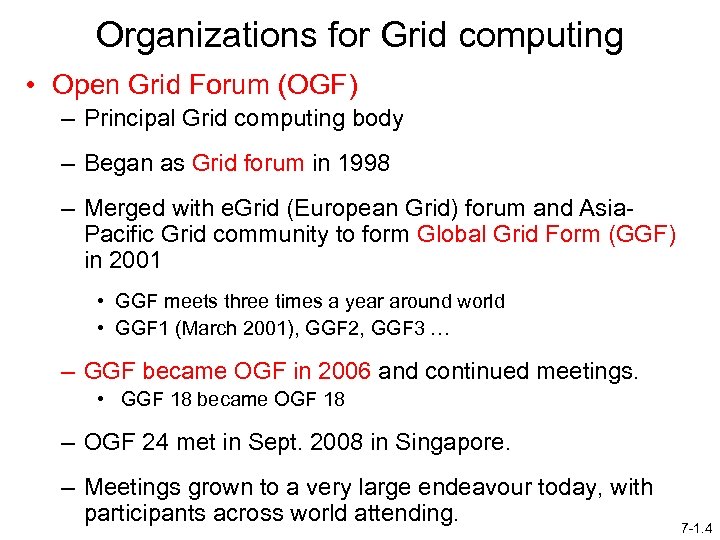 Organizations for Grid computing • Open Grid Forum (OGF) – Principal Grid computing body – Began as Grid forum in 1998 – Merged with e. Grid (European Grid) forum and Asia. Pacific Grid community to form Global Grid Form (GGF) in 2001 • GGF meets three times a year around world • GGF 1 (March 2001), GGF 2, GGF 3 … – GGF became OGF in 2006 and continued meetings. • GGF 18 became OGF 18 – OGF 24 met in Sept. 2008 in Singapore. – Meetings grown to a very large endeavour today, with participants across world attending. 7 -1. 4
 Standards in Web Services World • • XML introduced (ratified) in 1998 SOAP ratified in 2000 Web services introduced 2000 Subsequently, many standards developed: – WSDL – WS-* where * refers to names of one of many standards – Mostly by W 3 C organization 7 -1. 5
 Using web services • It would be natural to use web services for grid computing components. • Provides a easily identifiable interface through WDSL documents. • Has Internet addressing (URLs). 7 -1. 6
 (Stateless) Web Services” • “Pure” web services are stateless. • They do not remember information from one invocation to the next. • That can work fine for many web service applications. • They do not need to know what happened with a previous invocation by another client. 7 -1. 7
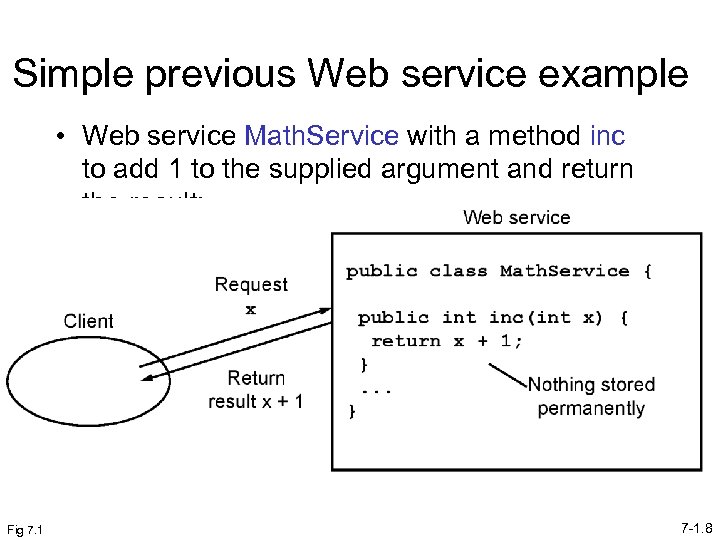 Simple previous Web service example • Web service Math. Service with a method inc to add 1 to the supplied argument and return the result: Fig 7. 1 7 -1. 8
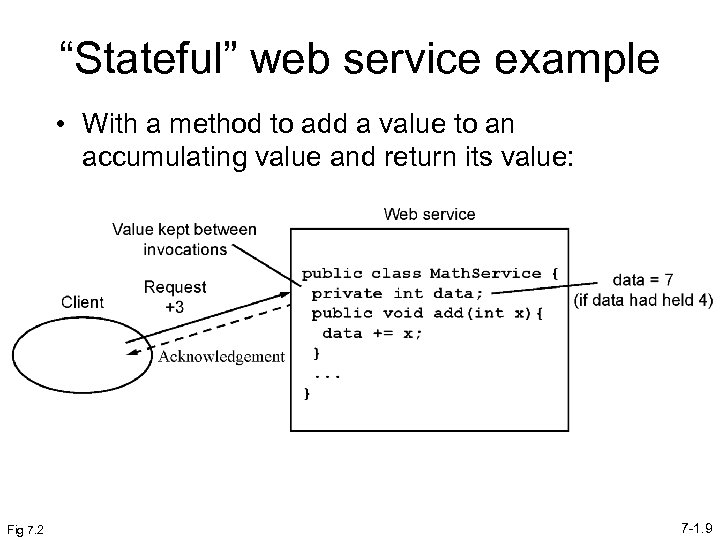 “Stateful” web service example • With a method to add a value to an accumulating value and return its value: Fig 7. 2 7 -1. 9
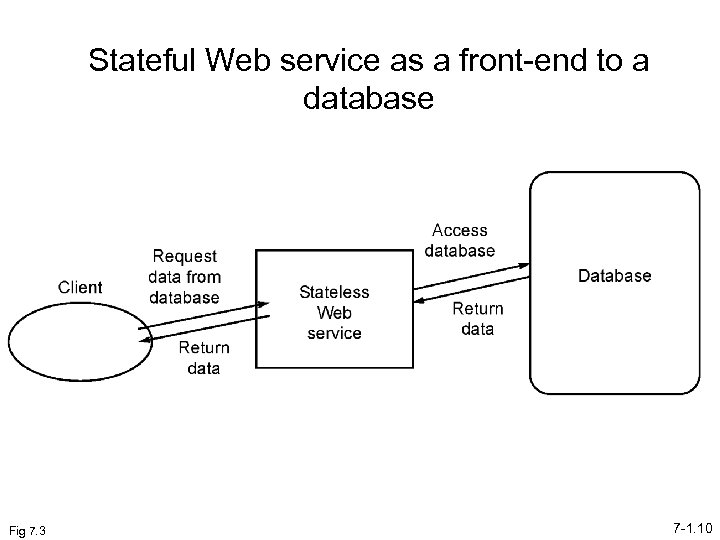 Stateful Web service as a front-end to a database Fig 7. 3 7 -1. 10
 • In this example, the client accesses a service to perform actions such as access a database. • Key aspect here is that the state is contained in a resource that can be separate from the web service. • Web service becomes a front end to the resource. • Come back to this concept later. 7 -1. 11
 Open Grid Services Architecture (OGSA) • Originally proposed by Foster et al. in paper: “The Physiology of the Grid” (see reading list) • Anounced as Grid computing standard at GGF 4 in Feb 2002. • Defines standard mechanisms for creating, naming, and discovering service instances. • Addresses architectural issues relating to interoperable services for grid computing. • Does not give details of implementation. • Requires stateful services but does not say how that will be achieved. 7 -1. 12
 Open Grid Service Infrastructure (OGSI) • Introduced in 2002 -3 (final draft June 2003). • First attempt to standardize how stateful Web services will be implemented. • Modifies WDSL to enable state to be specified, using a language called GWSDL (“Grid Web Definition Language”), • Introduced term Grid service. • OGSI included inheritance, addressing mechanism, notifications, and message passing mechanism. • Implemented in Globus toolkit version 3 (GT 3). 7 -1. 13
 Open Grid Service Infrastructure (OGSI) • Not found acceptable by community at large because: – It significantly modified pure Web service approach – Required new tools – Too object oriented in approach – Too much specified in one standard. It would be better broken down in a series of specifications 7 -1. 14
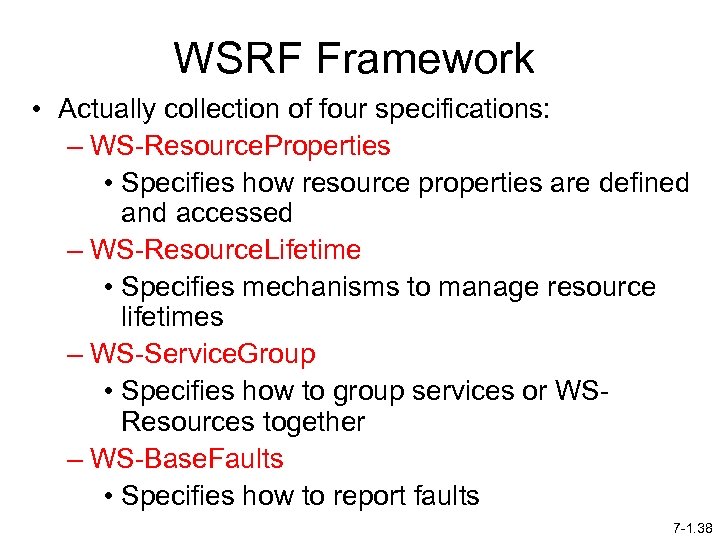
 WS-Resource Framework (WSRF) • Web service community also working on approaches to stateful Web services. • Web and Grid communities merged on WSResource Framework approach. • Specification developed by OASIS in 2004 – Replace OGSI and makes implementation of a stateful Web service acceptable. • Specifies how to make Web service stateful and other feature, without drifting from the original Web services concept. 7 -1. 15
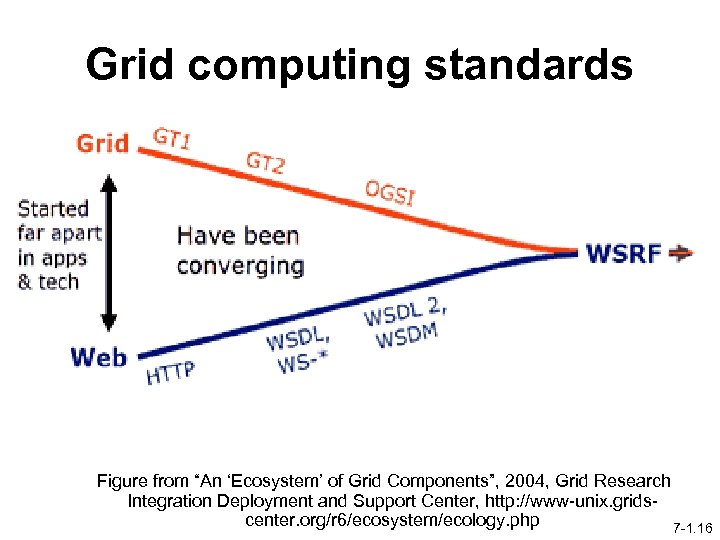 Grid computing standards Figure from “An ‘Ecosystem’ of Grid Components”, 2004, Grid Research Integration Deployment and Support Center, http: //www-unix. gridscenter. org/r 6/ecosystem/ecology. php 7 -1. 16
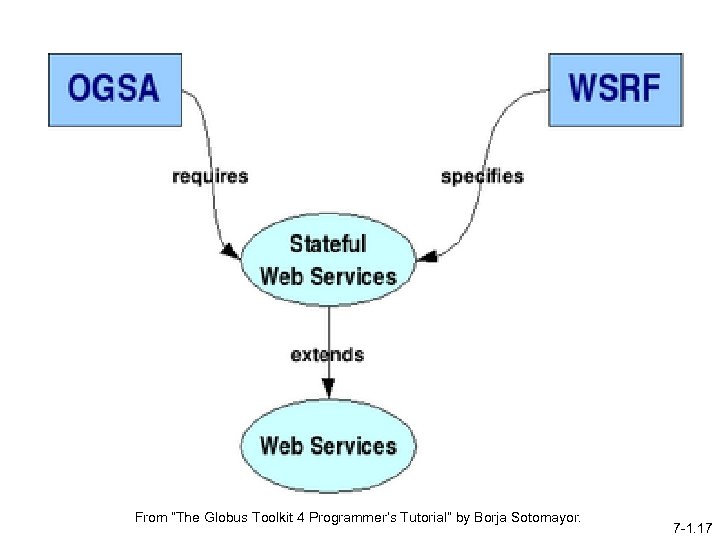 From “The Globus Toolkit 4 Programmer’s Tutorial” by Borja Sotomayor. 7 -1. 17
 Grid service • Broad meaning -- any service that conforms to interface conventions of a Grid computing infrastructure • Narrow (current) meaning -- a service that conforms to WSRF • Term seems to have lost favor – maybe because better to think of services in a Grid environment simply as regular Web services 7 -1. 18
 Stateful Web Services • Obtained in WSRF by having a web service front- end to a stateful “resource. ” 7 -1. 19
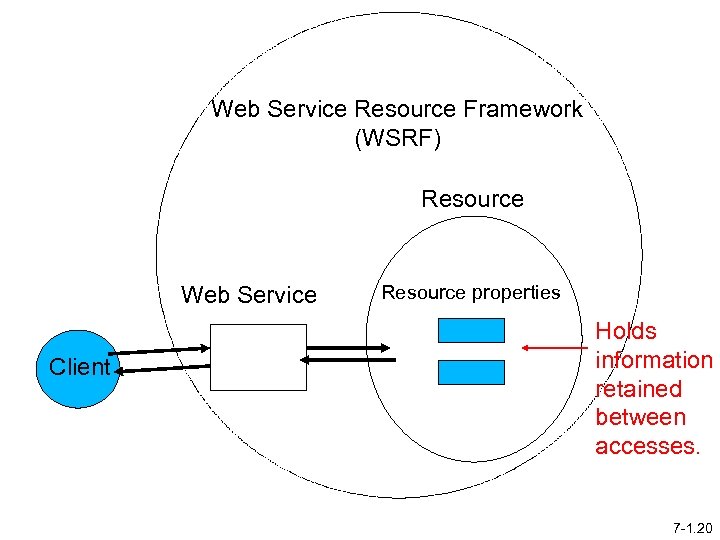 Web Service Resource Framework (WSRF) Resource Web Service Client Resource properties Holds information retained between accesses. 7 -1. 20
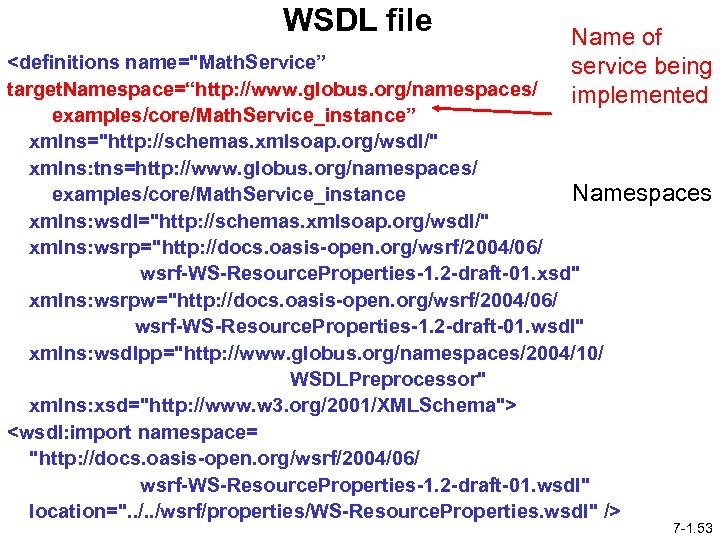
 WSDL file with WSRF • Serves same purpose as WSDL file in web services – to define the service interface. • A significant addition in the WSDL file is to specify the resource. 7 -1. 21
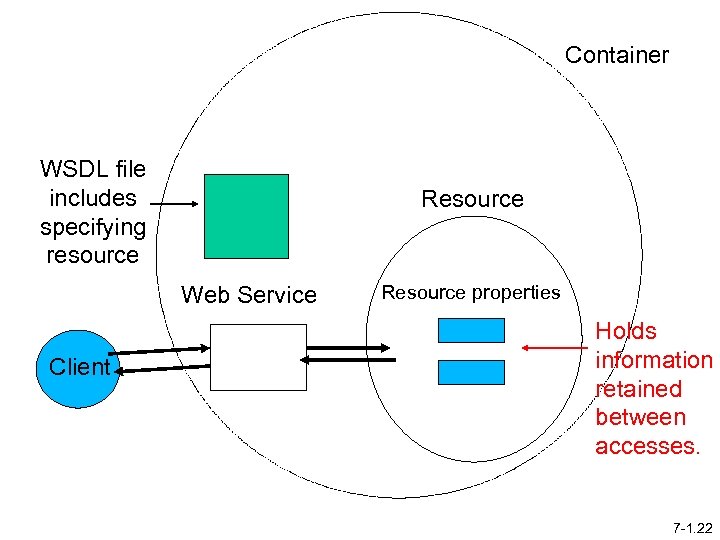 Container WSDL file includes specifying resource Resource Web Service Client Resource properties Holds information retained between accesses. 7 -1. 22
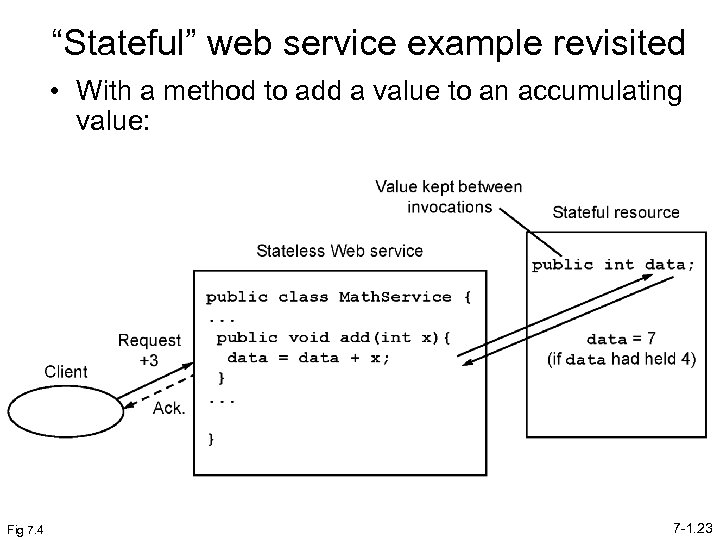 “Stateful” web service example revisited • With a method to add a value to an accumulating value: Fig 7. 4 7 -1. 23
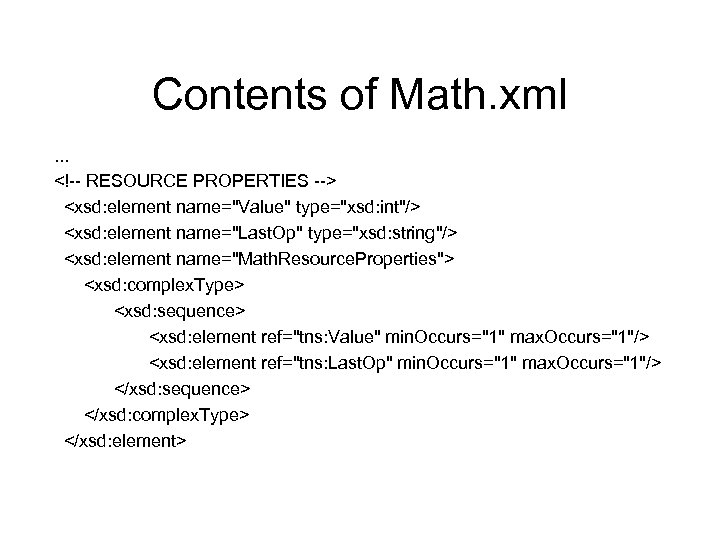
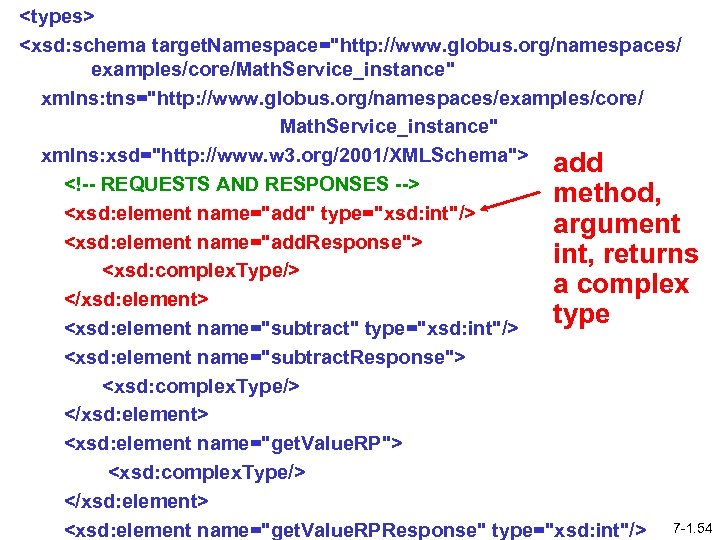
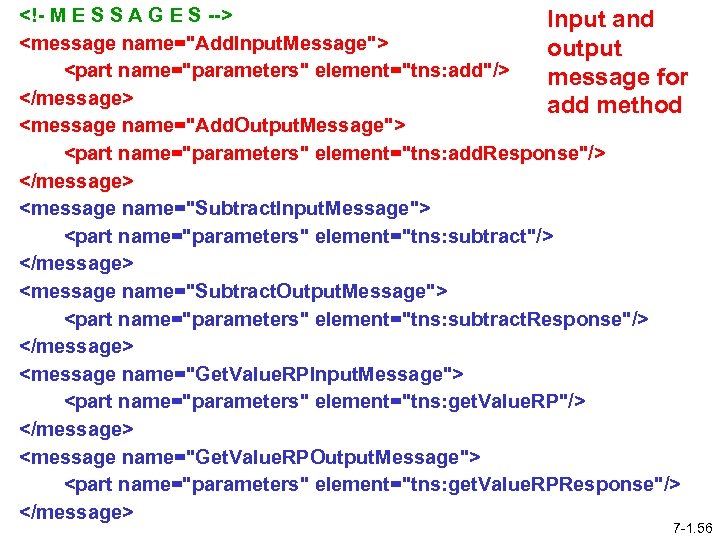
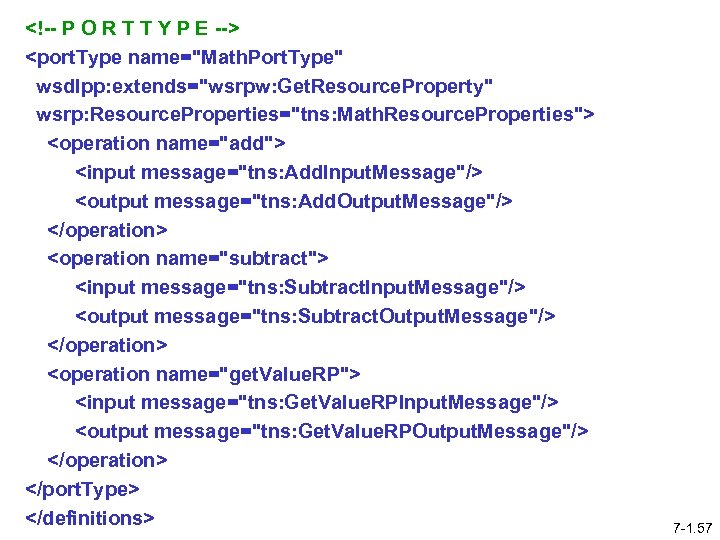
 Service Interface • If service implements operations on WSRF resource properties, WSDL will include definitions relating to resource property. • Resource Properties declared in WSDL file because it describes how the properties must be exchanged in XML (between clients, services, etc. ) 7 -1. 24
 Contents of Math. xml. . .
 Client Code Examples Math. Port. Type math = locator. get. Math. Port. Type. Port(endpoint); math. add(10); update. RP(endpoint, Math. Constanst. RP_VALUE, “ 100”); print. Resource. Properties(math);
 Client Code Examples value. RP = math. get. Resource. Property( Math. QNames. RP_VALUE); value = value. RP. get_any()[0]. get. Value(); System. out. println("Value RP: " + value);
 Resource Properties from the Command Line C: > wsrf-query -s http//localhost/wsrf/ services/examples/core/rp/Math. Service
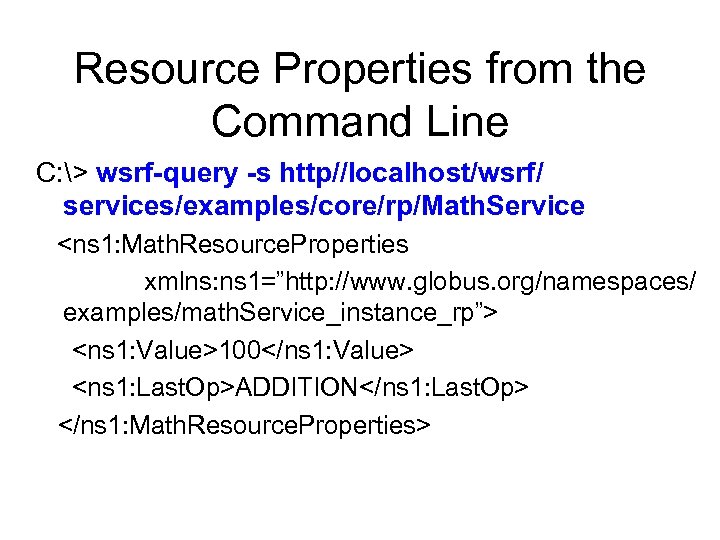
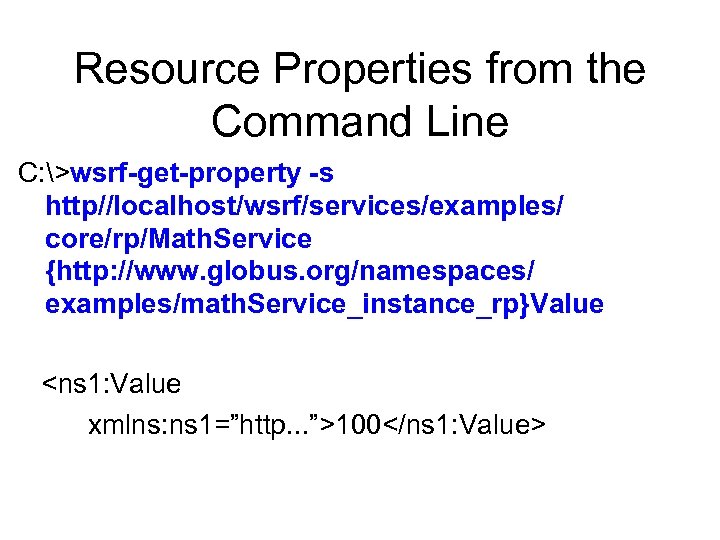 Resource Properties from the Command Line C: >wsrf-get-property -s http//localhost/wsrf/services/examples/ core/rp/Math. Service {http: //www. globus. org/namespaces/ examples/math. Service_instance_rp}Value
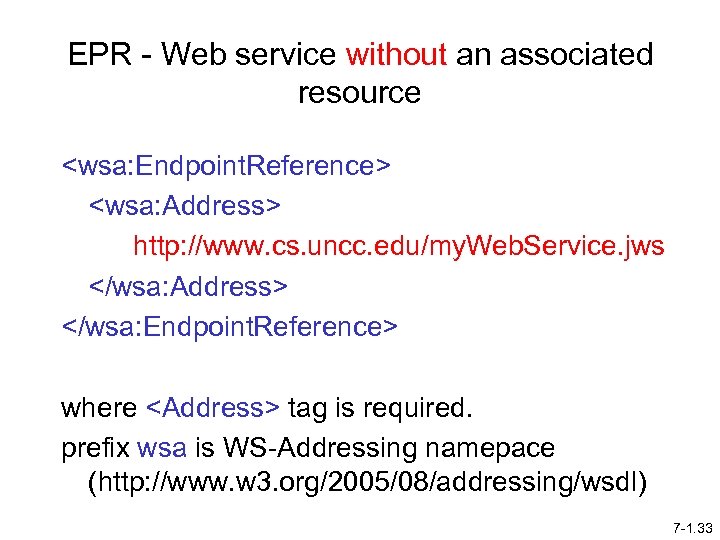
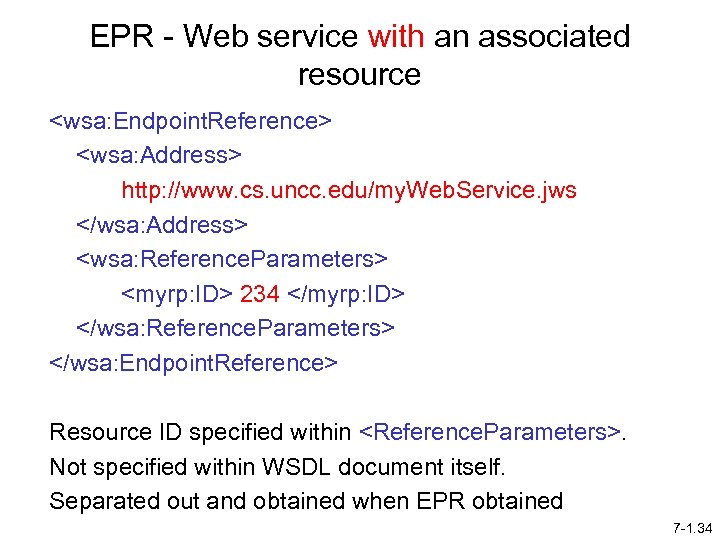
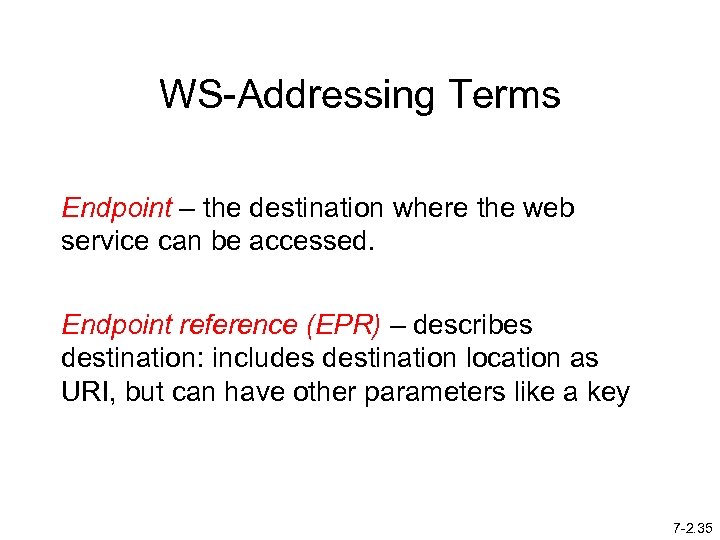
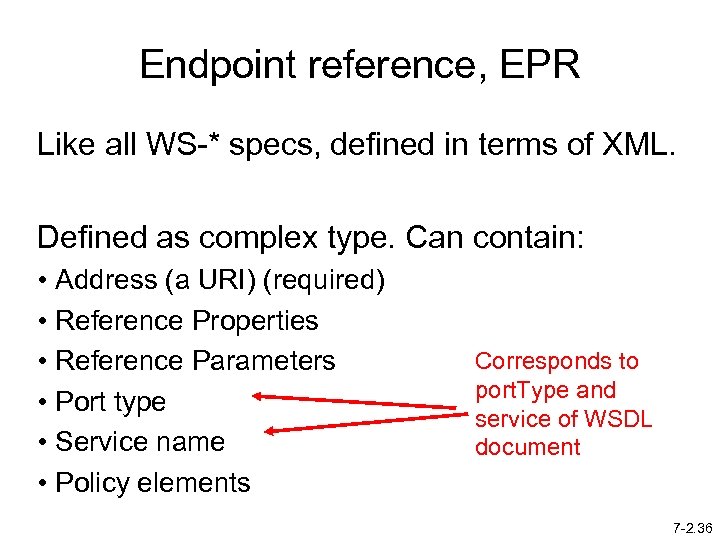
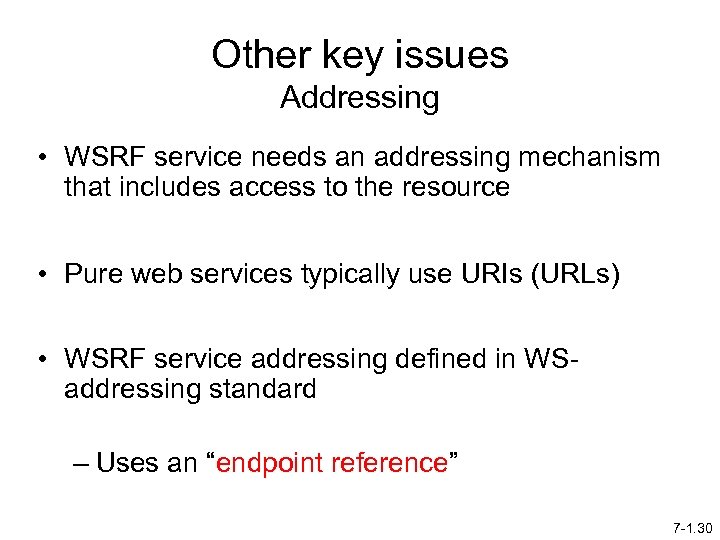 Other key issues Addressing • WSRF service needs an addressing mechanism that includes access to the resource • Pure web services typically use URIs (URLs) • WSRF service addressing defined in WSaddressing standard – Uses an “endpoint reference” 7 -1. 30
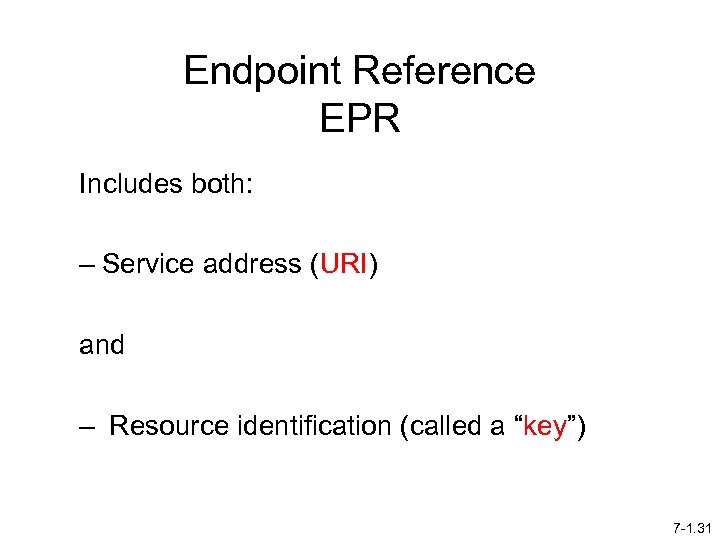 Endpoint Reference EPR Includes both: – Service address (URI) and – Resource identification (called a “key”) 7 -1. 31
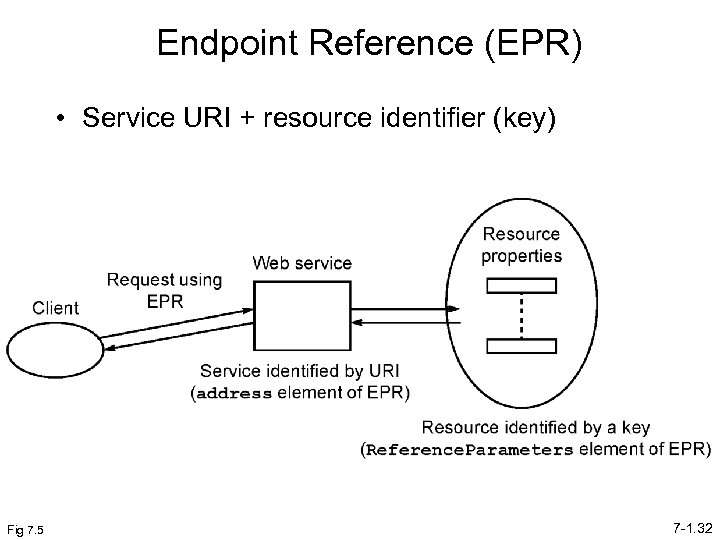 Endpoint Reference (EPR) • Service URI + resource identifier (key) Fig 7. 5 7 -1. 32
 EPR - Web service without an associated resource
 EPR - Web service with an associated resource
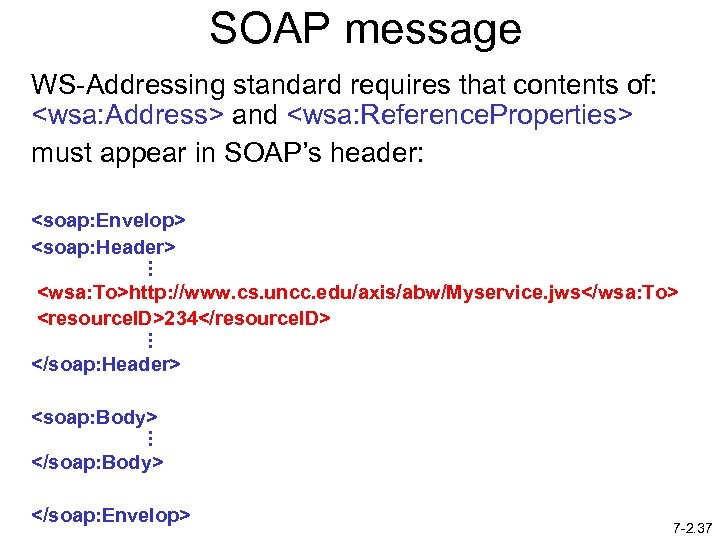
 WS-Addressing Terms Endpoint – the destination where the web service can be accessed. Endpoint reference (EPR) – describes destination: includes destination location as URI, but can have other parameters like a key 7 -2. 35
 Endpoint reference, EPR Like all WS-* specs, defined in terms of XML. Defined as complex type. Can contain: • Address (a URI) (required) • Reference Properties • Reference Parameters • Port type • Service name • Policy elements Corresponds to port. Type and service of WSDL document 7 -2. 36
 SOAP message WS-Addressing standard requires that contents of:
 WSRF Framework • Actually collection of four specifications: – WS-Resource. Properties • Specifies how resource properties are defined and accessed – WS-Resource. Lifetime • Specifies mechanisms to manage resource lifetimes – WS-Service. Group • Specifies how to group services or WSResources together – WS-Base. Faults • Specifies how to report faults 7 -1. 38
 WS-* Standards continued Also: • WS-Notification – Collection of specifications that specifies how configure services as notification producers or consumers • WS-Addressing (where EPR is defined) – Specifies how to address web services. – Provides a way to address a web service/resource pair 7 -1. 39
 Concrete example Globus 4. 0 Web Service Assignment This assignment is based upon a GT 4 service described by Sotomayor and Childers (2006). (Textbook describes a generic GT 4 service. ) 7 -1. 40
 Assignment Goals • Show stateful WSRF Web services can be created and deployed in Globus 4. 0. • Assignment is to be done on your own computer (or a lab computer). • Requires you to install Globus 4. 0 core and associated software – all available for download. 7 -1. 41
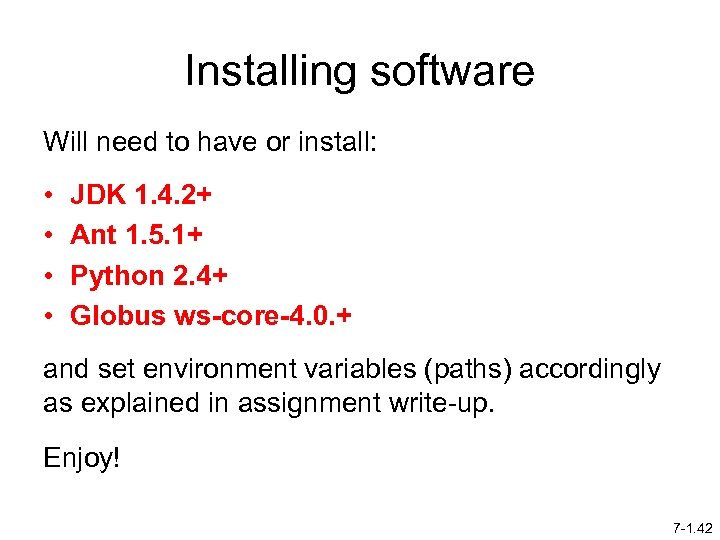 Installing software Will need to have or install: • • JDK 1. 4. 2+ Ant 1. 5. 1+ Python 2. 4+ Globus ws-core-4. 0. + and set environment variables (paths) accordingly as explained in assignment write-up. Enjoy! 7 -1. 42
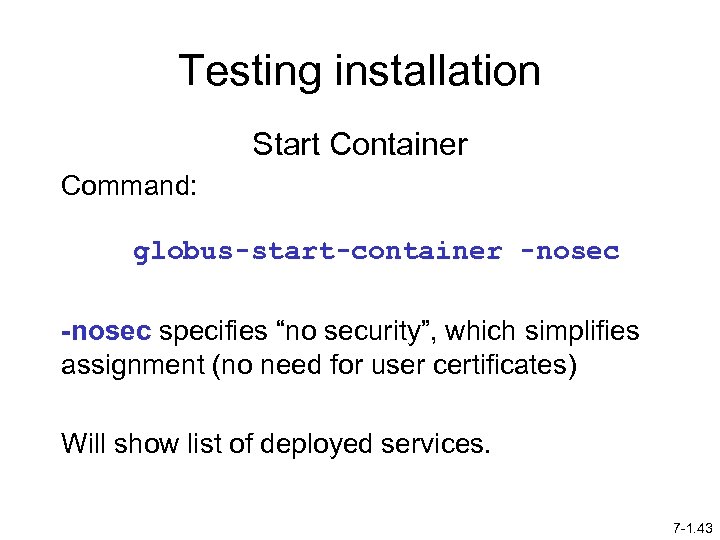 Testing installation Start Container Command: globus-start-container -nosec specifies “no security”, which simplifies assignment (no need for user certificates) Will show list of deployed services. 7 -1. 43
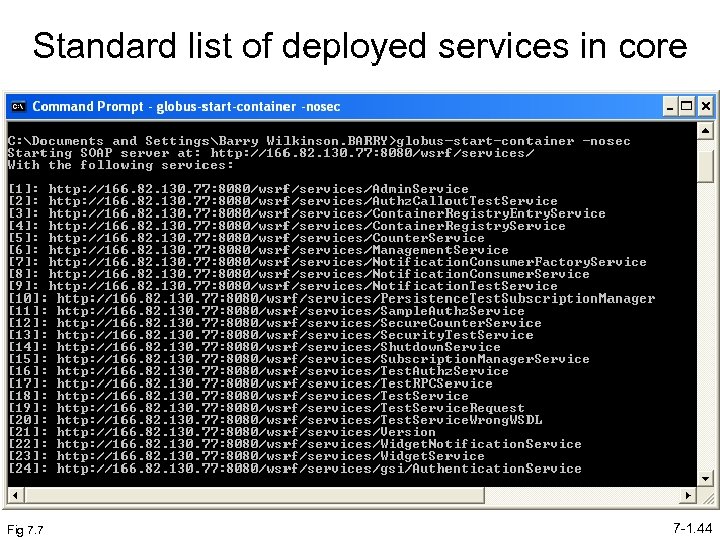 Standard list of deployed services in core Fig 7. 7 7 -1. 44
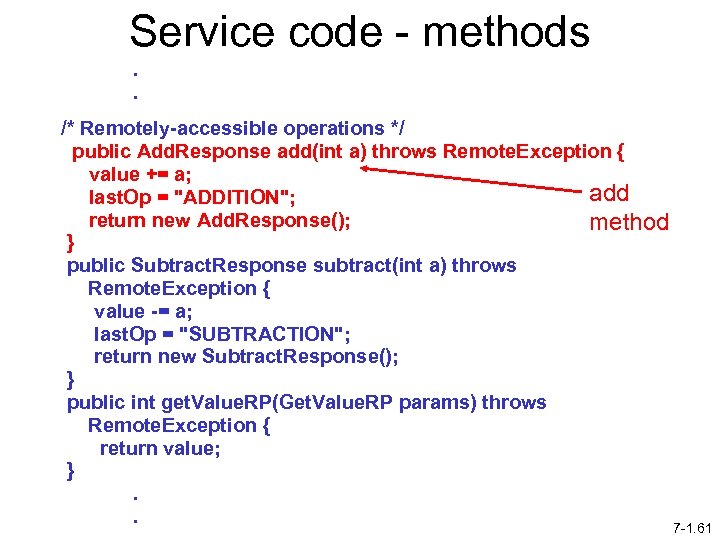
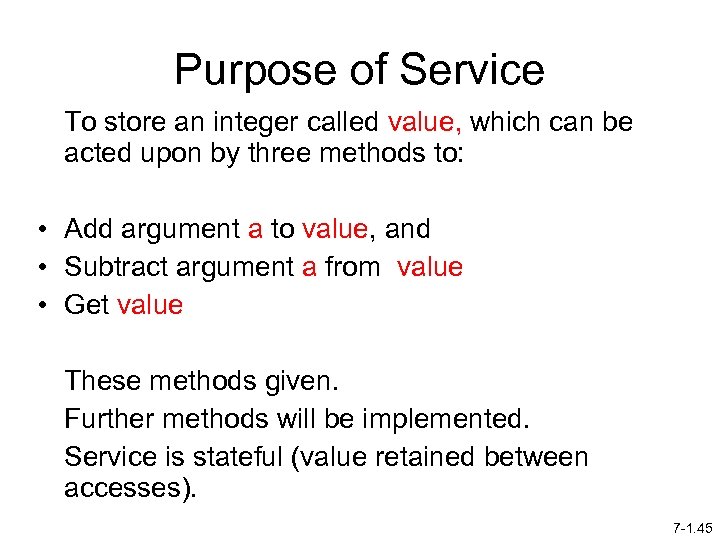 Purpose of Service To store an integer called value, which can be acted upon by three methods to: • Add argument a to value, and • Subtract argument a from value • Get value These methods given. Further methods will be implemented. Service is stateful (value retained between accesses). 7 -1. 45
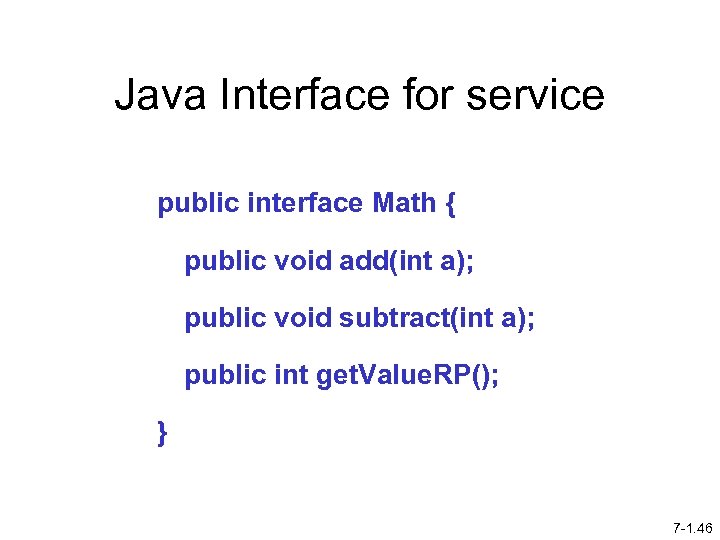 Java Interface for service public interface Math { public void add(int a); public void subtract(int a); public int get. Value. RP(); } 7 -1. 46
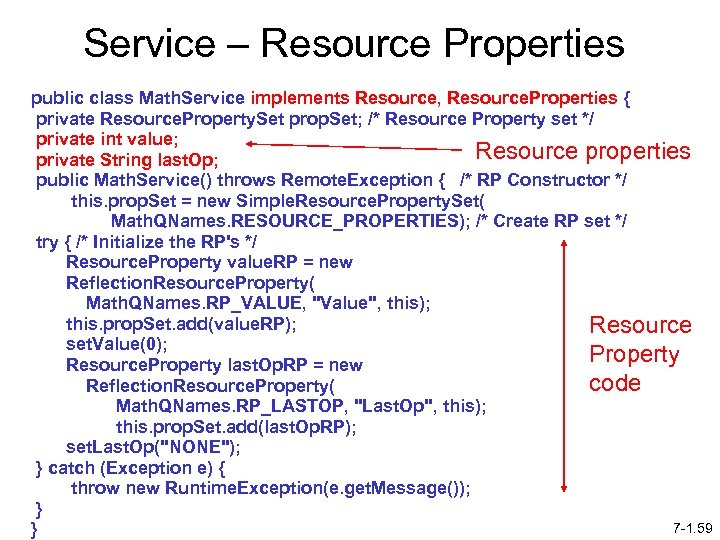
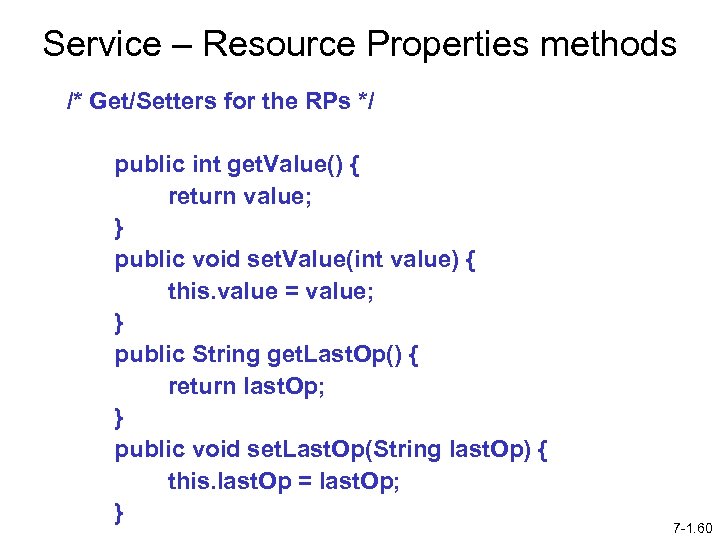
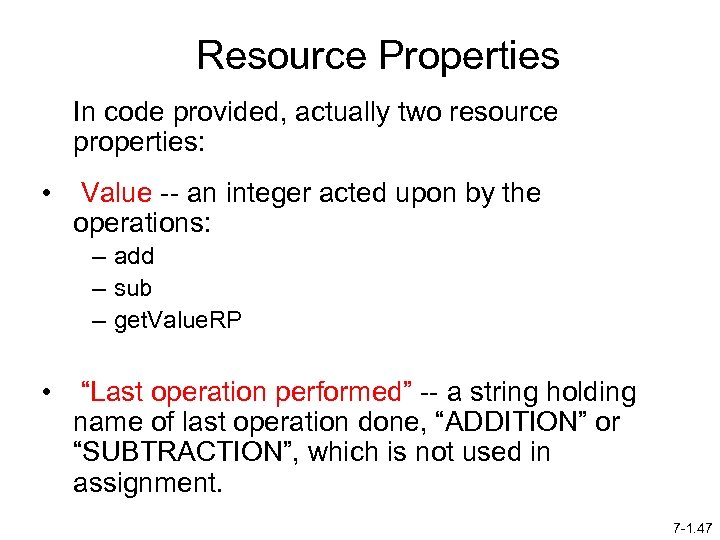 Resource Properties In code provided, actually two resource properties: • Value -- an integer acted upon by the operations: – add – sub – get. Value. RP • “Last operation performed” -- a string holding name of last operation done, “ADDITION” or “SUBTRACTION”, which is not used in assignment. 7 -1. 47
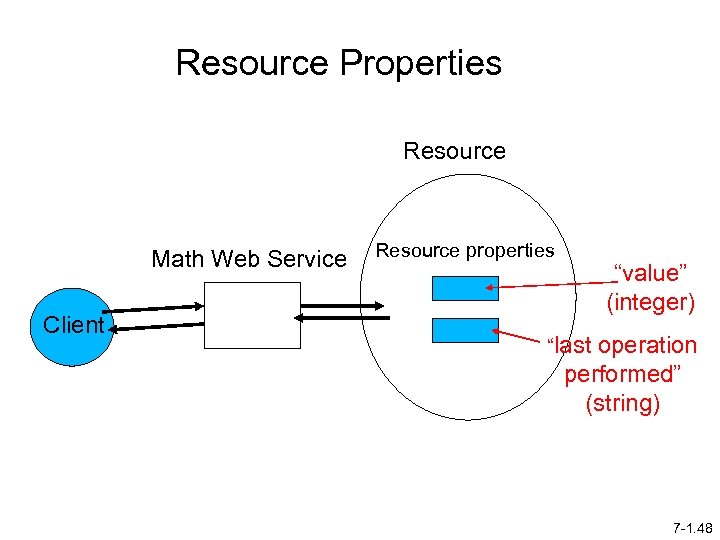 Resource Properties Resource Math Web Service Client Resource properties “value” (integer) “last operation performed” (string) 7 -1. 48
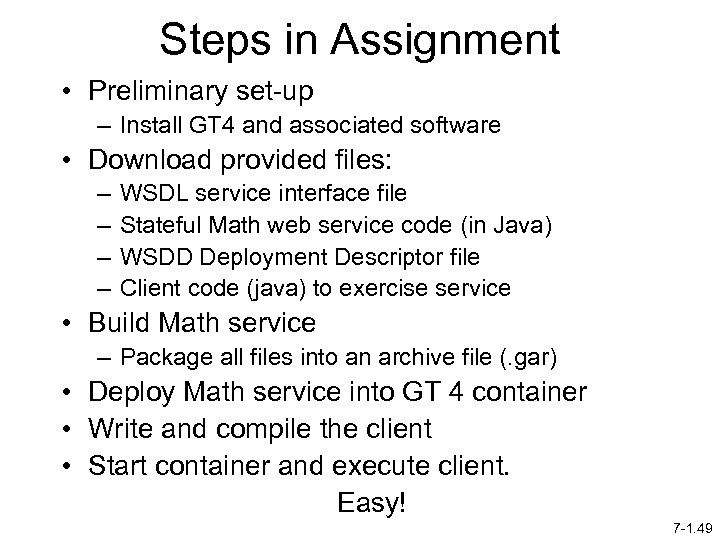 Steps in Assignment • Preliminary set-up – Install GT 4 and associated software • Download provided files: – – WSDL service interface file Stateful Math web service code (in Java) WSDD Deployment Descriptor file Client code (java) to exercise service • Build Math service – Package all files into an archive file (. gar) • Deploy Math service into GT 4 container • Write and compile the client • Start container and execute client. Easy! 7 -1. 49
 Final Step in Assignment • Add functionality to service – Add multiple operation to Math service – Requires you to modify WSDL (by hand), service code, and client code. – For that you will need to understand the files – Assignment Appendix gives details 7 -1. 50
 WSDL file • Serves same purpose as WSDL file in Web services – to define the service interface. • A significant addition in the WSDL file is to specify the resource. 7 -1. 51
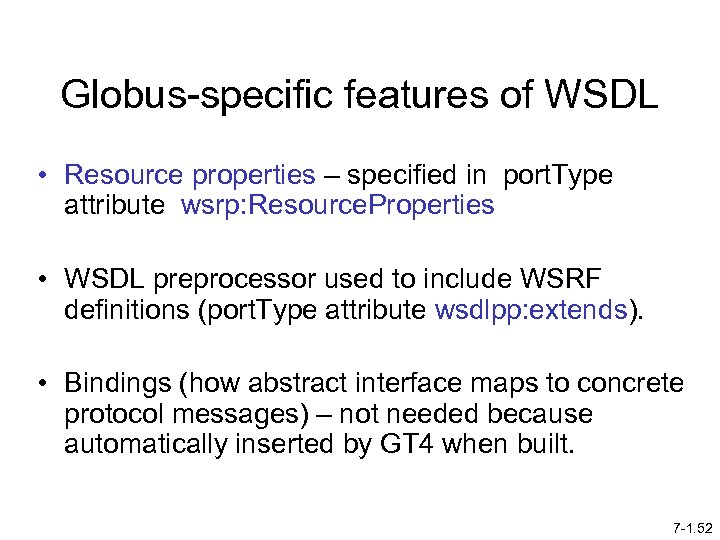 Globus-specific features of WSDL • Resource properties – specified in port. Type attribute wsrp: Resource. Properties • WSDL preprocessor used to include WSRF definitions (port. Type attribute wsdlpp: extends). • Bindings (how abstract interface maps to concrete protocol messages) – not needed because automatically inserted by GT 4 when built. 7 -1. 52
 WSDL file Name of service being implemented
 Input and
 Service Code The code has two major parts: • Resource properties • Service code (methods) which are combined into one file for this assignment. 7 -1. 58
 Service – Resource Properties public class Math. Service implements Resource, Resource. Properties { private Resource. Property. Set prop. Set; /* Resource Property set */ private int value; Resource properties private String last. Op; public Math. Service() throws Remote. Exception { /* RP Constructor */ this. prop. Set = new Simple. Resource. Property. Set( Math. QNames. RESOURCE_PROPERTIES); /* Create RP set */ try { /* Initialize the RP's */ Resource. Property value. RP = new Reflection. Resource. Property( Math. QNames. RP_VALUE, "Value", this); this. prop. Set. add(value. RP); Resource set. Value(0); Property Resource. Property last. Op. RP = new code Reflection. Resource. Property( Math. QNames. RP_LASTOP, "Last. Op", this); this. prop. Set. add(last. Op. RP); set. Last. Op("NONE"); } catch (Exception e) { throw new Runtime. Exception(e. get. Message()); } 7 -1. 59 }
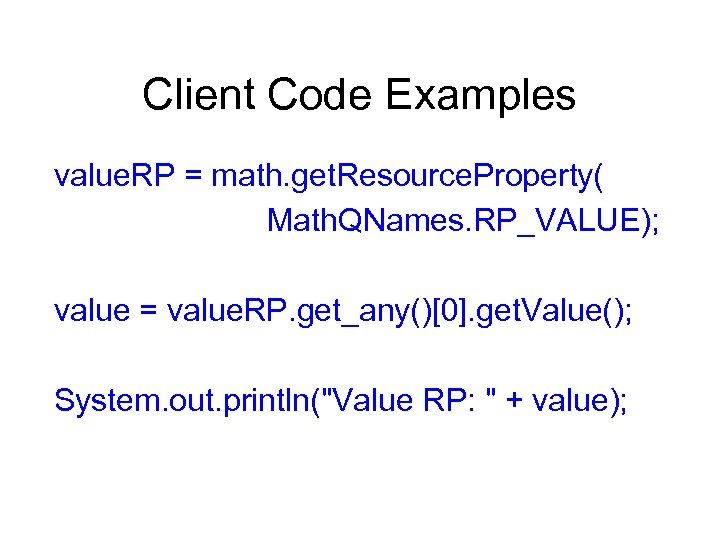
 Service – Resource Properties methods /* Get/Setters for the RPs */ public int get. Value() { return value; } public void set. Value(int value) { this. value = value; } public String get. Last. Op() { return last. Op; } public void set. Last. Op(String last. Op) { this. last. Op = last. Op; } 7 -1. 60
 Service code - methods. . /* Remotely-accessible operations */ public Add. Response add(int a) throws Remote. Exception { value += a; add last. Op = "ADDITION"; return new Add. Response(); method } public Subtract. Response subtract(int a) throws Remote. Exception { value -= a; last. Op = "SUBTRACTION"; return new Subtract. Response(); } public int get. Value. RP(Get. Value. RP params) throws Remote. Exception { return value; }. . 7 -1. 61
 Deploying a GT 4 service • GT 4 container uses Apache Axis • Basic steps for deploying a service similar in concept to that described for Apache Axis. 7 -1. 62
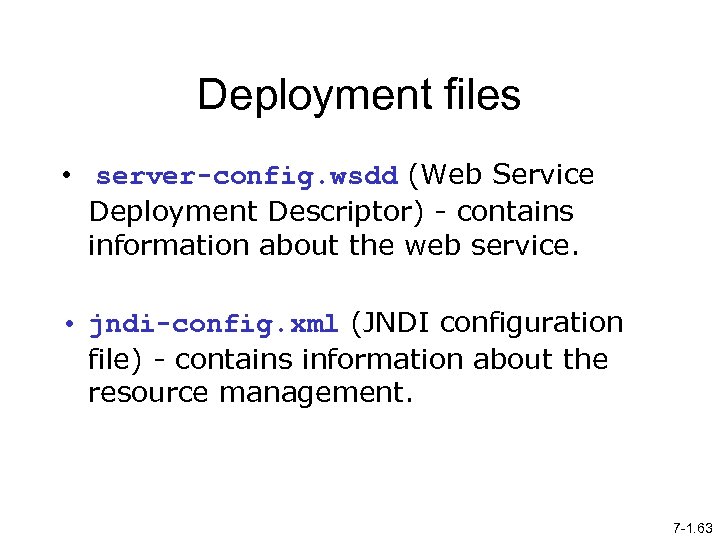 Deployment files • server-config. wsdd (Web Service Deployment Descriptor) - contains information about the web service. • jndi-config. xml (JNDI configuration file) - contains information about the resource management. 7 -1. 63
 ant (Another Neat Tool) • A build tool used for building service – forming package of files for deployment – a gar file (grid archive file) • ant similar to make program but dependencies specified using XML configuration files. • Windows version of assignment uses Python. 7 -1. 65
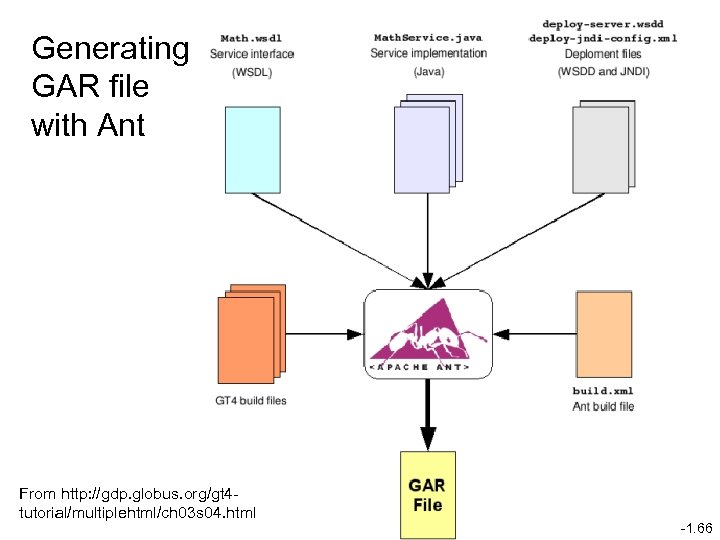 Generating GAR file with Ant From http: //gdp. globus. org/gt 4 tutorial/multiplehtml/ch 03 s 04. html 7 -1. 66
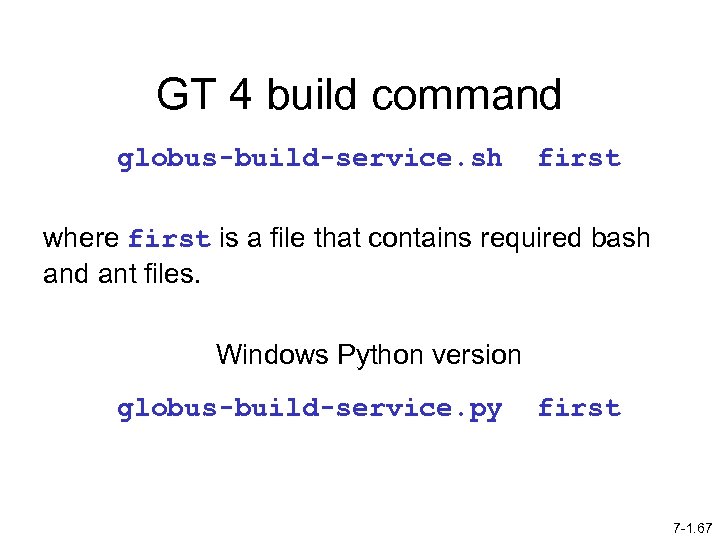 GT 4 build command globus-build-service. sh first where first is a file that contains required bash and ant files. Windows Python version globus-build-service. py first 7 -1. 67
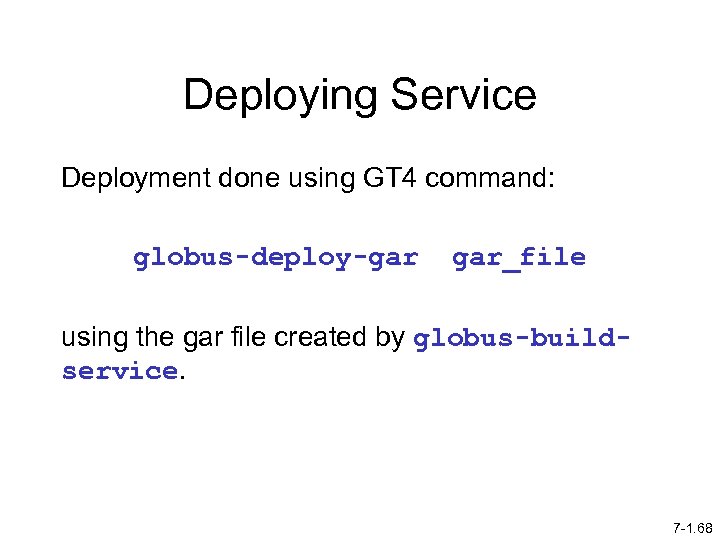 Deploying Service Deployment done using GT 4 command: globus-deploy-gar gar_file using the gar file created by globus-buildservice. 7 -1. 68
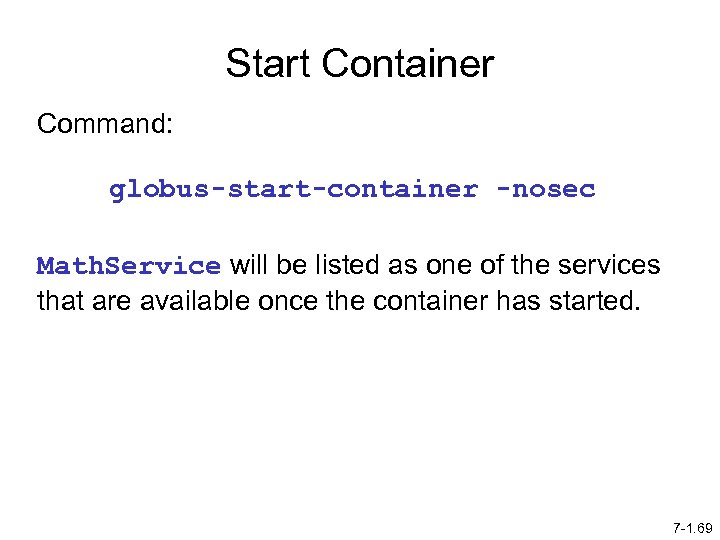 Start Container Command: globus-start-container -nosec Math. Service will be listed as one of the services that are available once the container has started. 7 -1. 69
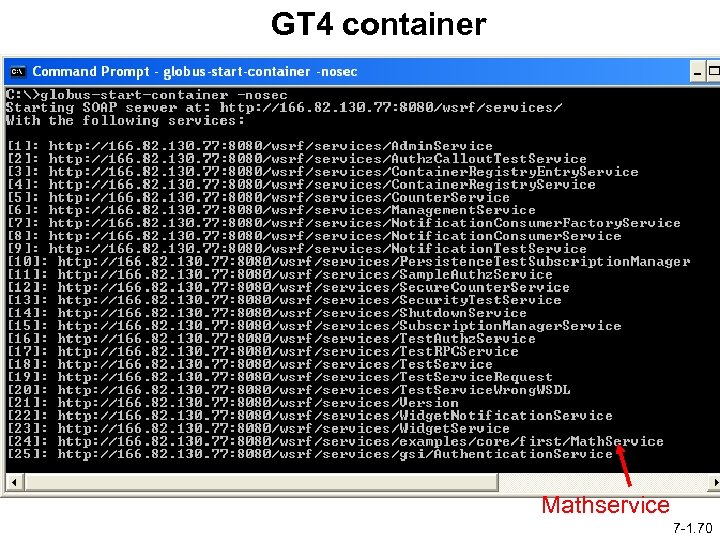 GT 4 container Mathservice 7 -1. 70
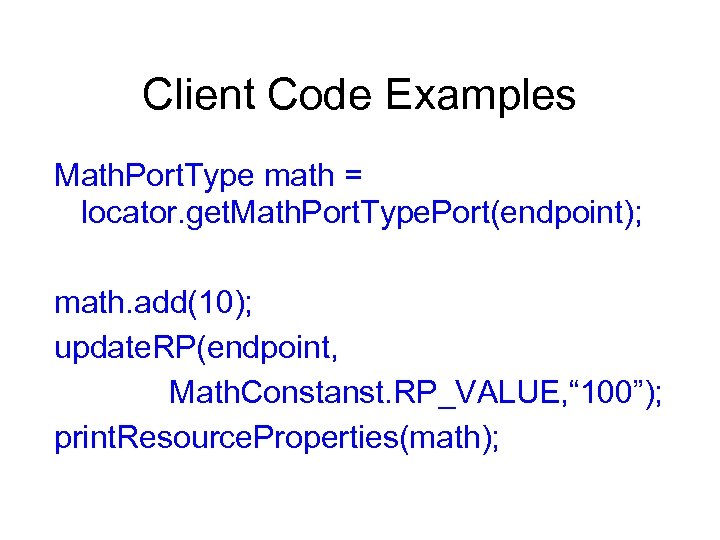
![Java client to invoke service public class Client { public static void main(String[] args)](https://present5.com/presentation/0c4c06418d52db02fae2f8a3c9653940/image-71.jpg "Java client to invoke service public class Client { public static void main(String[] args)") Java client to invoke service public class Client { public static void main(String[] args) { Math. Service. Addressing. Locator locator = new Math. Service. Addressing. Locator(); try { String service. URI = args[0]; Endpoint. Reference. Type endpoint = new Endpoint. Reference. Type(); endpoint. set. Address(new Address(service. URI)); //service endpt ref. Math. Port. Type math; math = locator. get. Math. Port. Type. Port(endpoint); // Get Port. Type math. add(10); // Perform an addition math. add(5); // Perform another addition System. out. println("Current value: " + math. get. Value. RP(new Get. Value. RP())); // Access value math. subtract(5); // Perform a subtraction System. out. println("Current value: " + math. get. Value. RP(new Get. Value. RP())); // Access value } catch (Exception e) { e. print. Stack. Trace(); } } 7 -1. 71 }
Java client to invoke service public class Client { public static void main(String[] args) { Math. Service. Addressing. Locator locator = new Math. Service. Addressing. Locator(); try { String service. URI = args[0]; Endpoint. Reference. Type endpoint = new Endpoint. Reference. Type(); endpoint. set. Address(new Address(service. URI)); //service endpt ref. Math. Port. Type math; math = locator. get. Math. Port. Type. Port(endpoint); // Get Port. Type math. add(10); // Perform an addition math. add(5); // Perform another addition System. out. println("Current value: " + math. get. Value. RP(new Get. Value. RP())); // Access value math. subtract(5); // Perform a subtraction System. out. println("Current value: " + math. get. Value. RP(new Get. Value. RP())); // Access value } catch (Exception e) { e. print. Stack. Trace(); } } 7 -1. 71 }
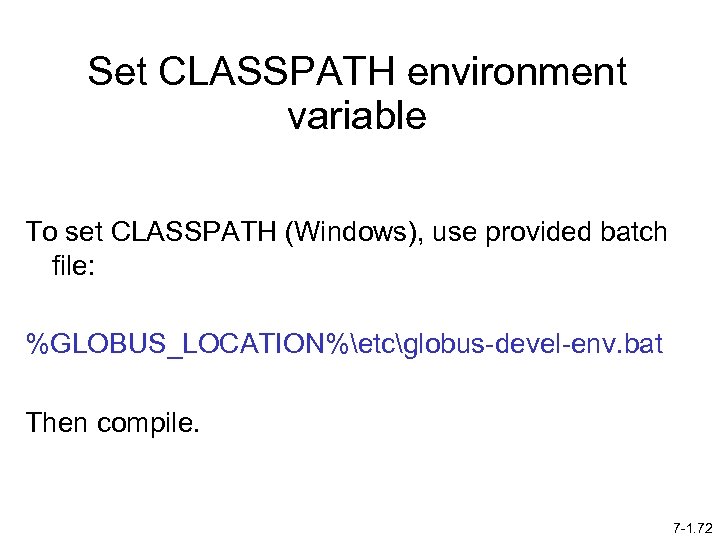 Set CLASSPATH environment variable To set CLASSPATH (Windows), use provided batch file: %GLOBUS_LOCATION%etcglobus-devel-env. bat Then compile. 7 -1. 72
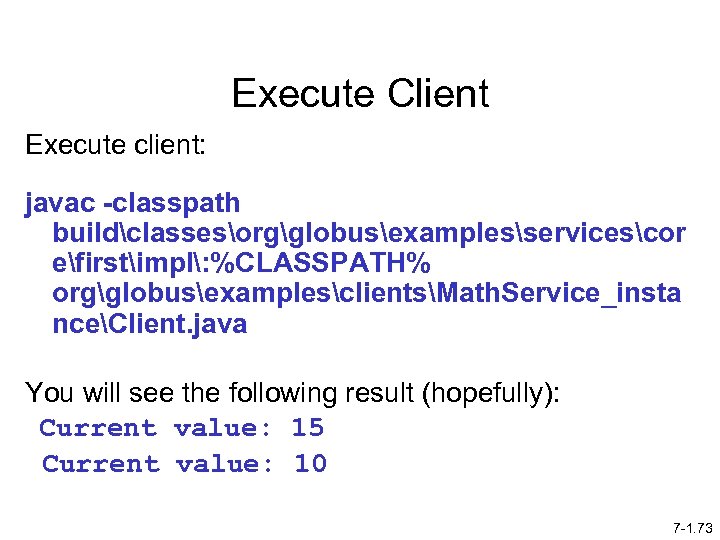 Execute Client Execute client: javac -classpath buildclassesorgglobusexamplesservicescor efirstimpl: %CLASSPATH% orgglobusexamplesclientsMath. Service_insta nceClient. java You will see the following result (hopefully): Current value: 15 Current value: 10 7 -1. 73
 Undeploy sevice Deploy service in preparation to modifying it. Command: globus-undeploy-gar with named gar file. 7 -1. 74
 Extend Functionality of Service Add a multiply method to your Math Service. Repeat all the steps to test it. 7 -1. 75
 Acknowledgment This assignment is derived from the book: “Globus Toolkit 4 Programming Java Services” by Borja Sotomayor and Lisa Childers, Morgan Kaufmann, 2006 see: http: //gdp. globus. org/gt 4 -tutorial/ for on-line version. 7 -1. 76
 Multiple-choice questions 7 -1. 77
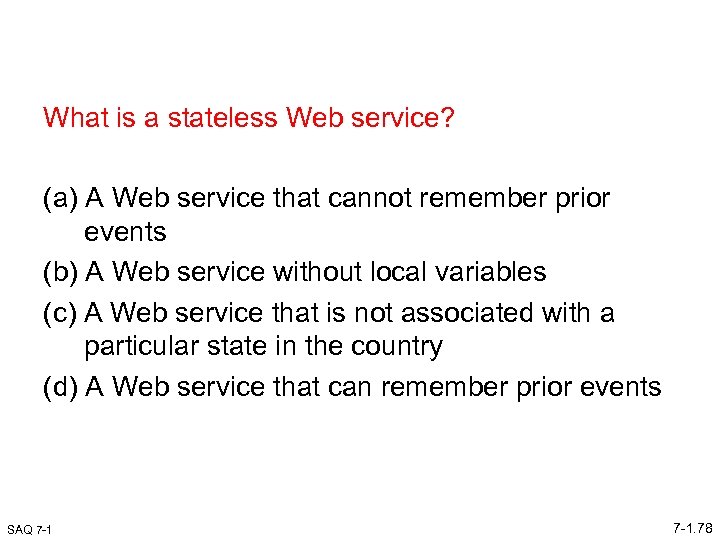 What is a stateless Web service? (a) A Web service that cannot remember prior events (b) A Web service without local variables (c) A Web service that is not associated with a particular state in the country (d) A Web service that can remember prior events SAQ 7 -1. 78
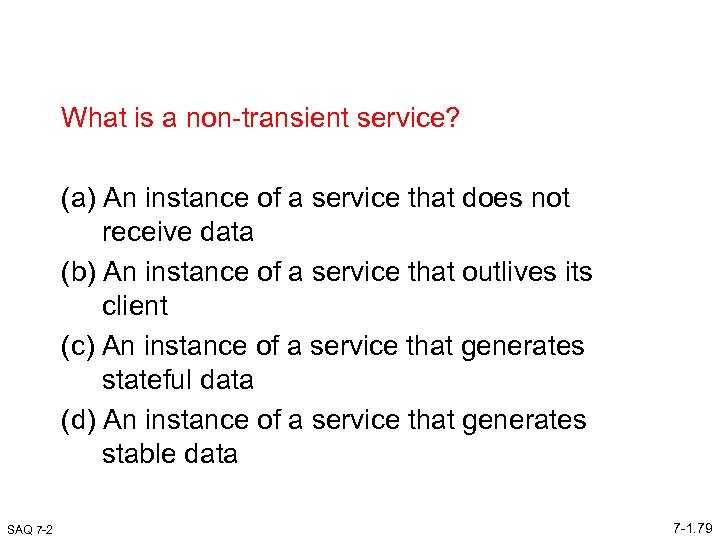 What is a non-transient service? (a) An instance of a service that does not receive data (b) An instance of a service that outlives its client (c) An instance of a service that generates stateful data (d) An instance of a service that generates stable data SAQ 7 -2 7 -1. 79
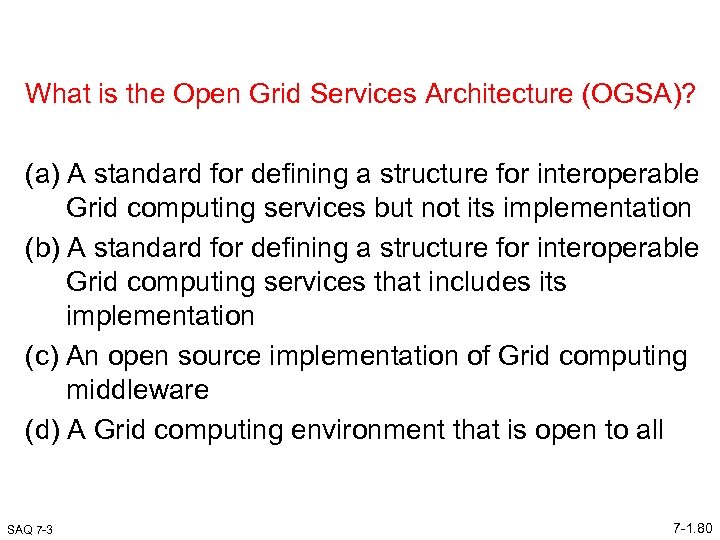 What is the Open Grid Services Architecture (OGSA)? (a) A standard for defining a structure for interoperable Grid computing services but not its implementation (b) A standard for defining a structure for interoperable Grid computing services that includes its implementation (c) An open source implementation of Grid computing middleware (d) A Grid computing environment that is open to all SAQ 7 -3 7 -1. 80
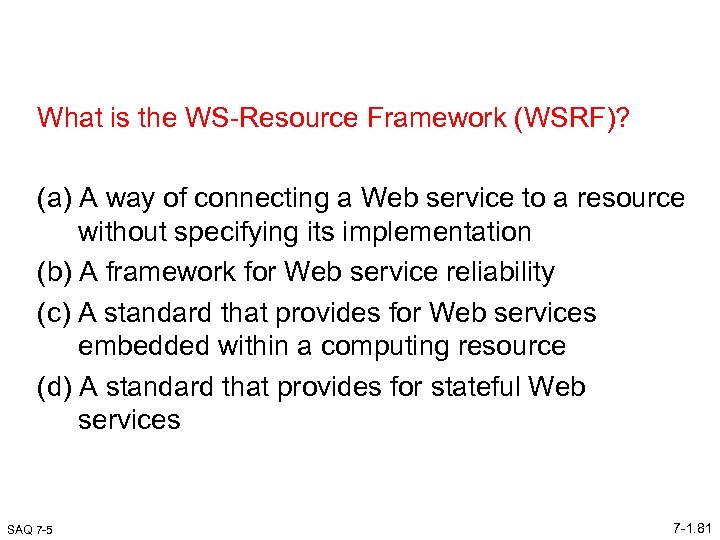 What is the WS-Resource Framework (WSRF)? (a) A way of connecting a Web service to a resource without specifying its implementation (b) A framework for Web service reliability (c) A standard that provides for Web services embedded within a computing resource (d) A standard that provides for stateful Web services SAQ 7 -5 7 -1. 81
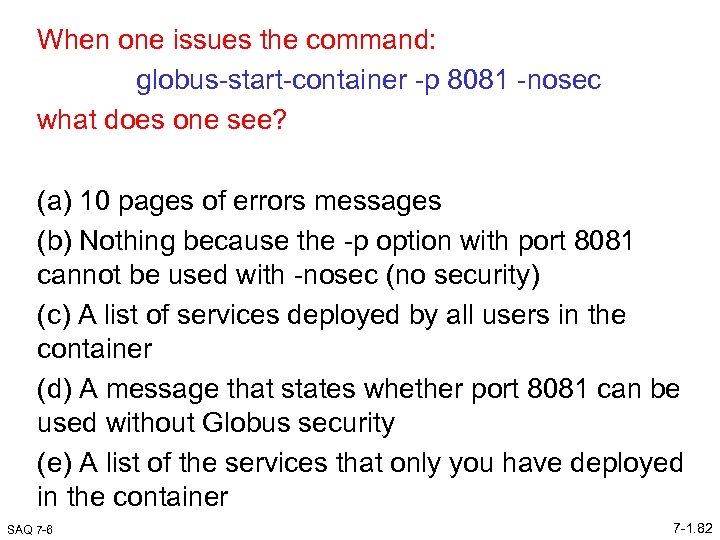 When one issues the command: globus-start-container -p 8081 -nosec what does one see? (a) 10 pages of errors messages (b) Nothing because the -p option with port 8081 cannot be used with -nosec (no security) (c) A list of services deployed by all users in the container (d) A message that states whether port 8081 can be used without Globus security (e) A list of the services that only you have deployed in the container SAQ 7 -6 7 -1. 82
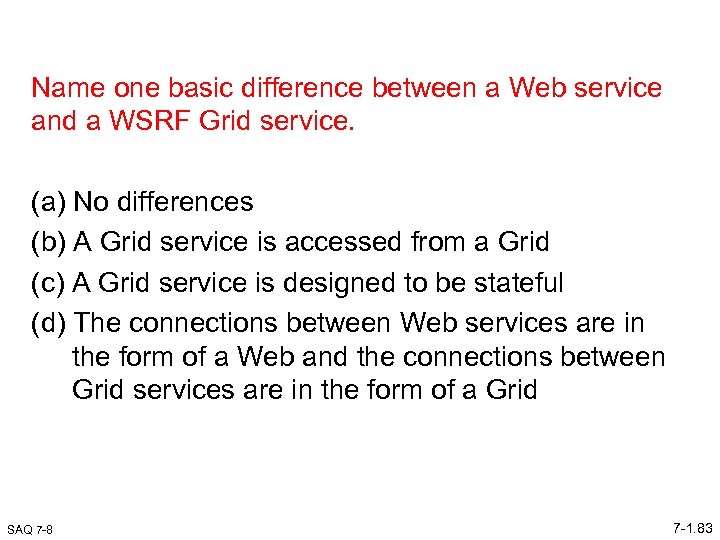 Name one basic difference between a Web service and a WSRF Grid service. (a) No differences (b) A Grid service is accessed from a Grid (c) A Grid service is designed to be stateful (d) The connections between Web services are in the form of a Web and the connections between Grid services are in the form of a Grid SAQ 7 -8 7 -1. 83
 Questions 7 -1. 84