


 Скачать презентацию Grid Computing For Scientific Discovery Lothar A T
e7024b6f95367127fef71ae0980fe17d.ppt
- Количество слайдов: 60
 Grid Computing For Scientific Discovery Lothar A. T. Bauerdick, Fermilab DESY Zeuthen Computing Seminar July 2, 2002 Lothar A T Bauerdick Fermilab 3/15/2018 1
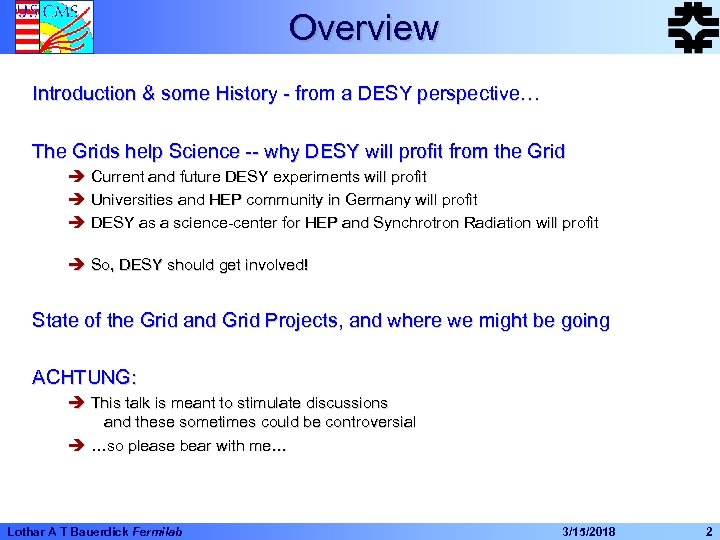 Overview Introduction & some History - from a DESY perspective… The Grids help Science -- why DESY will profit from the Grid è Current and future DESY experiments will profit è Universities and HEP community in Germany will profit è DESY as a science-center for HEP and Synchrotron Radiation will profit è So, DESY should get involved! State of the Grid and Grid Projects, and where we might be going ACHTUNG: è This talk is meant to stimulate discussions and these sometimes could be controversial è …so please bear with me… Lothar A T Bauerdick Fermilab 3/15/2018 2
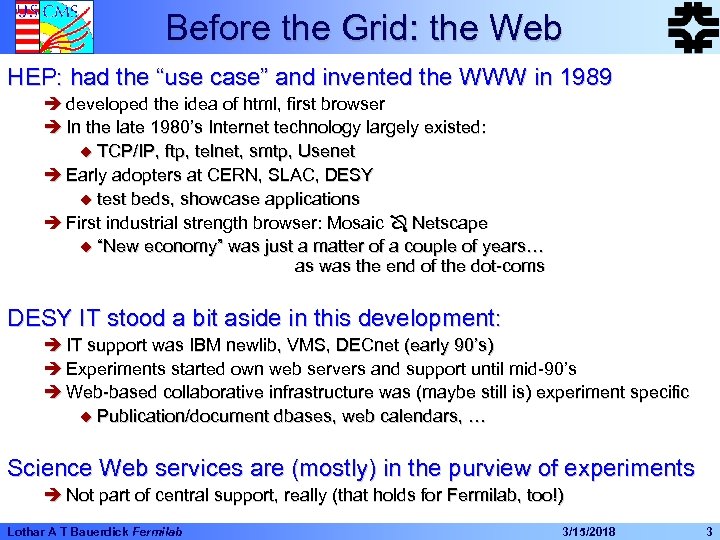 Before the Grid: the Web HEP: had the “use case” and invented the WWW in 1989 è developed the idea of html, first browser è In the late 1980’s Internet technology largely existed: u TCP/IP, ftp, telnet, smtp, Usenet è Early adopters at CERN, SLAC, DESY u test beds, showcase applications è First industrial strength browser: Mosaic Netscape u “New economy” was just a matter of a couple of years… as was the end of the dot-coms DESY IT stood a bit aside in this development: è IT support was IBM newlib, VMS, DECnet (early 90’s) è Experiments started own web servers and support until mid-90’s è Web-based collaborative infrastructure was (maybe still is) experiment specific u Publication/document dbases, web calendars, … Science Web services are (mostly) in the purview of experiments è Not part of central support, really (that holds for Fermilab, too!) Lothar A T Bauerdick Fermilab 3/15/2018 3
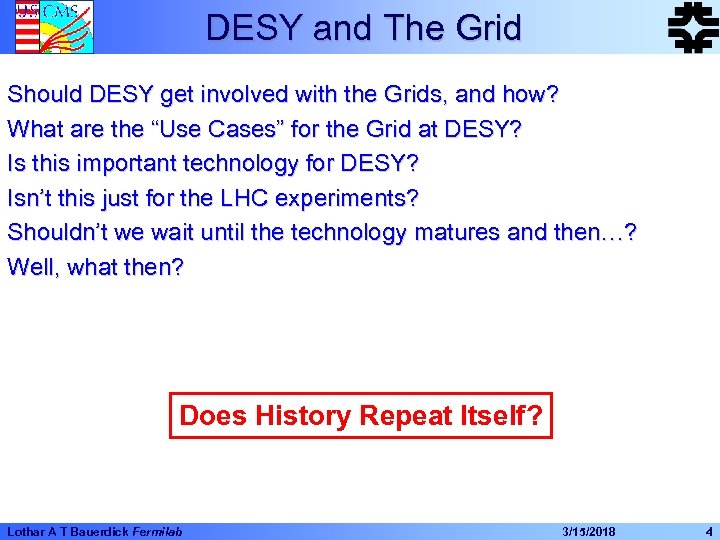 DESY and The Grid Should DESY get involved with the Grids, and how? What are the “Use Cases” for the Grid at DESY? Is this important technology for DESY? Isn’t this just for the LHC experiments? Shouldn’t we wait until the technology matures and then…? Well, what then? Does History Repeat Itself? Lothar A T Bauerdick Fermilab 3/15/2018 4
 Things Heard Recently… (Jenny Schopf) “Isn’t the Grid just a funding construct? ” “The Grid is a solution looking for a problem” “We tried to install Globus and found out that it was too hard to do. So we decided to just write our own…. ” “Cynics reckon that the Grid is merely an excuse by computer scientists to milk the political system for more research grants so they can write yet more lines of useless code. ” –Economist, June 2001 Lothar A T Bauerdick Fermilab 3/15/2018 5
 What is a Grid? Multiple sites (multiple institutions) Shared resources Coordinated problem solving Not A New Idea: èLate 70’s – Networked operating systems èLate 80’s – Distributed operating system èEarly 90’s – Heterogeneous computing èMid 90’s – Meta-computing Lothar A T Bauerdick Fermilab 3/15/2018 6
 What Are Computing and Data Grids? Grids are technology and an emerging architecture that involves several types of middleware that mediate between science portals, applications, and the underlying resources (compute resource, data resource, and instrument) Grids are persistent environments that facilitate integrating software applications with instruments, displays, computational, and information resources that are managed by diverse organizations in widespread locations Grids are tools for data intensive science that facilitate remote access to large amounts of data that is managed in remote storage resources and analyzed by remote compute resources, all of which are integrated into the scientist’s software environment. Grids are persistent environments and tools to facilitate large-scale collaboration among global collaborators. Grids are also a major international technology initiative with 450 people from 35 countries in an IETF-like standards organization: The Global Grid Forum (GGF) Bill Johnston, DOE Science Grid Lothar A T Bauerdick Fermilab 3/15/2018 7
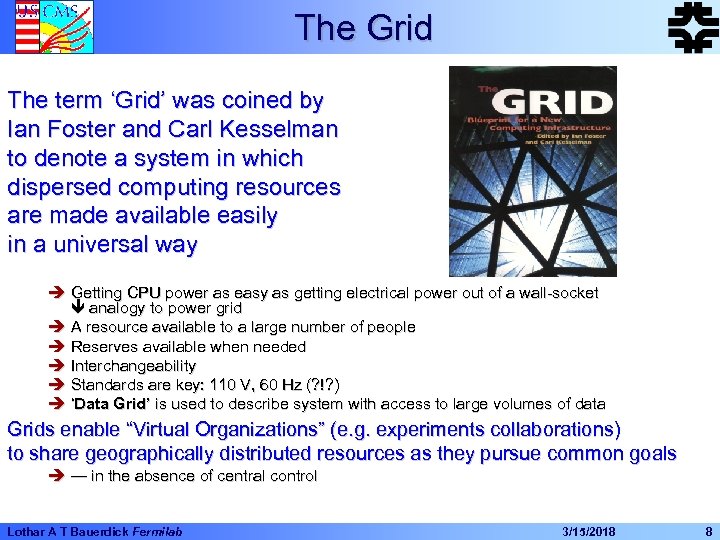 The Grid The term ‘Grid’ was coined by Ian Foster and Carl Kesselman to denote a system in which dispersed computing resources are made available easily in a universal way è Getting CPU power as easy as getting electrical power out of a wall-socket analogy to power grid è A resource available to a large number of people è Reserves available when needed è Interchangeability è Standards are key: 110 V, 60 Hz (? !? ) è ‘Data Grid’ is used to describe system with access to large volumes of data Grids enable “Virtual Organizations” (e. g. experiments collaborations) to share geographically distributed resources as they pursue common goals è — in the absence of central control Lothar A T Bauerdick Fermilab 3/15/2018 8
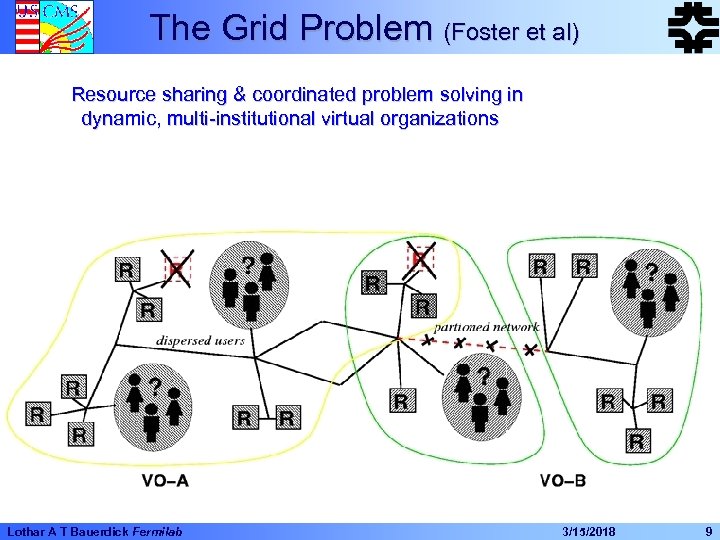 The Grid Problem (Foster et al) Resource sharing & coordinated problem solving in dynamic, multi-institutional virtual organizations Lothar A T Bauerdick Fermilab 3/15/2018 9
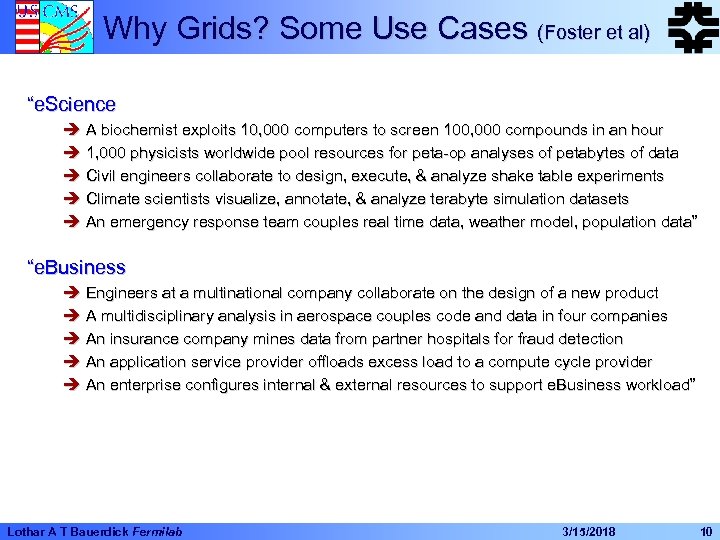 Why Grids? Some Use Cases (Foster et al) “e. Science è A biochemist exploits 10, 000 computers to screen 100, 000 compounds in an hour è 1, 000 physicists worldwide pool resources for peta-op analyses of petabytes of data è Civil engineers collaborate to design, execute, & analyze shake table experiments è Climate scientists visualize, annotate, & analyze terabyte simulation datasets è An emergency response team couples real time data, weather model, population data” “e. Business è Engineers at a multinational company collaborate on the design of a new product è A multidisciplinary analysis in aerospace couples code and data in four companies è An insurance company mines data from partner hospitals for fraud detection è An application service provider offloads excess load to a compute cycle provider è An enterprise configures internal & external resources to support e. Business workload” Lothar A T Bauerdick Fermilab 3/15/2018 10
 Grids for High Energy Physics! “Production” Environments and Data Management Lothar A T Bauerdick Fermilab 3/15/2018 11
 DESY had one of the first Grid Applications! In 1992 ZEUS developed a system to utilize Compute Resources (“unused Workstations”) distributed over the world at ZEUS institutions for large-scale production of simulated data ZEUS FUNNEL Lothar A T Bauerdick Fermilab 3/15/2018 12
 ZEUS Funnel Developed in 1992 by U Toronto students, B. Burrow et al. è Quickly became the one ZEUS MC production system Developed and refined in ZEUS over ~5 years è Development work by Funnel team, ~1. 5 FTE over several years è Integration work by ZEUS Physics Groups, MC coordinator è Deployment work at ZEUS collaborating Universities This was a many FTE-years effort sponsored by ZEUS Universities è Mostly “home-grown” technologies, but very fail-safe and robust è Published in papers and on CHEP conference è Adopted by other experiments, including L 3 ZEUS could produce 106 events/week w/o dedicated CPU farms Lothar A T Bauerdick Fermilab 3/15/2018 13
 Funnel is a Computational Grid Developed on the LAN, but was quickly moved to the WAN (high CPU, low bandwidth) è Funnel provides the “middleware” to run the ZEUS simulation/reconstruction programs and interfaces to the ZEUS data management system è Does Remote Job Execution on Grid nodes è Establishes Job Execution Environment on Grid nodes è Has Resource Management and Resource Discovery è Provides Robust File Replication and Movement è Uses File Replica Catalogs and Meta Data Catalogs è Provides to physicists Web-based User Interfaces — “Funnel Portal” Large organizational impact è Helped to organize the infrastructure around MC production è e. g. funnel data base, catalogs for MC productions è Infrastructure of organized manpower of several FTE, mostly at Universities Note: This was a purely Experiment-based effort è E. g. DESY IT not involved in R&D, nor in maintenance & operations Grid is Useful Technology for HERA Experiments Lothar A T Bauerdick Fermilab 3/15/2018 14
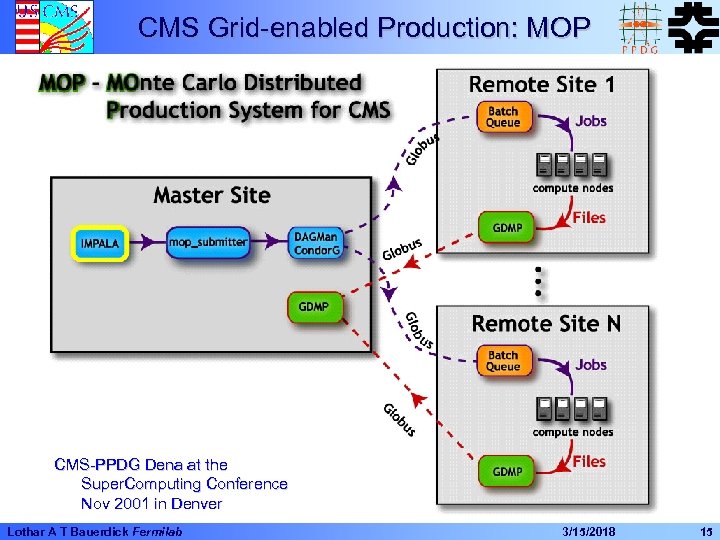 CMS Grid-enabled Production: MOP CMS-PPDG Dena at the Super. Computing Conference Nov 2001 in Denver Lothar A T Bauerdick Fermilab 3/15/2018 15
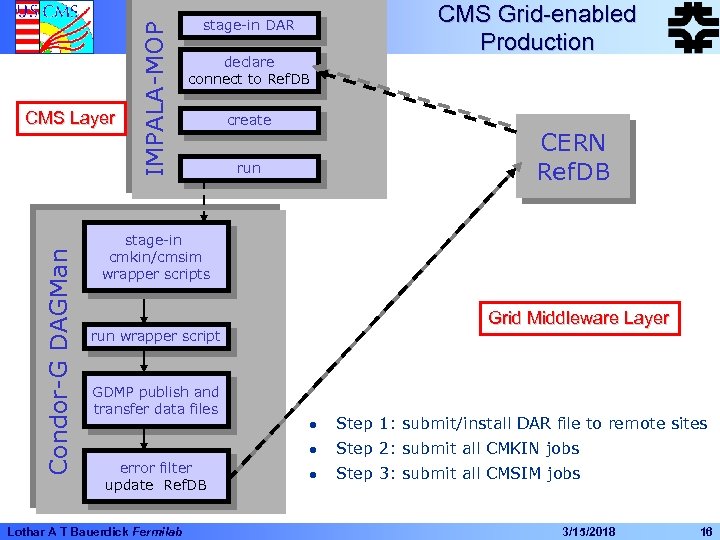 Condor-G DAGMan IMPALA-MOP CMS Layer stage-in DAR declare connect to Ref. DB create CMS Grid-enabled Production CERN Ref. DB run stage-in cmkin/cmsim wrapper scripts Grid Middleware Layer run wrapper script GDMP publish and transfer data files l l error filter update Ref. DB Lothar A T Bauerdick Fermilab Step 1: submit/install DAR file to remote sites Step 2: submit all CMKIN jobs l Step 3: submit all CMSIM jobs 3/15/2018 16
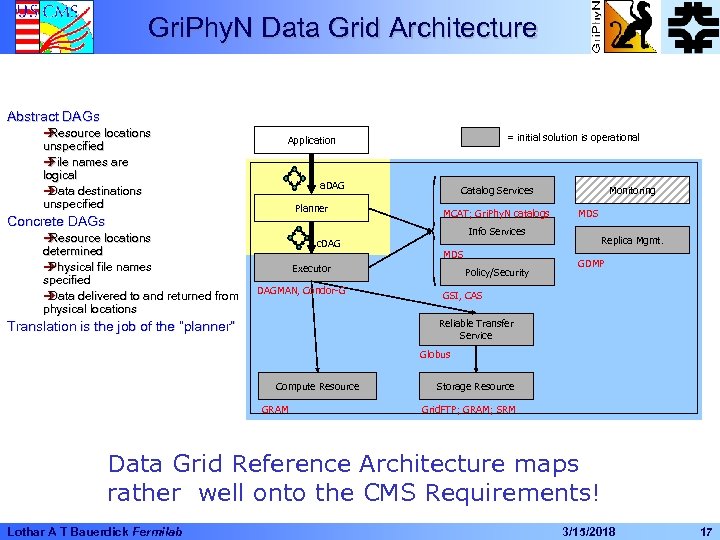 Gri. Phy. N Data Grid Architecture Abstract DAGs è Resource locations unspecified è names are File logical è Data destinations unspecified a. DAG Planner Concrete DAGs è Resource locations determined è Physical file names specified è Data delivered to and returned from physical locations = initial solution is operational Application Catalog Services MCAT; Gri. Phy. N catalogs Monitoring MDS Info Services c. DAG MDS Executor DAGMAN, Condor-G Policy/Security Replica Mgmt. GDMP GSI, CAS Reliable Transfer Service Translation is the job of the “planner” Globus Compute Resource GRAM Storage Resource Grid. FTP; GRAM; SRM Data Grid Reference Architecture maps rather well onto the CMS Requirements! Lothar A T Bauerdick Fermilab 3/15/2018 17 17
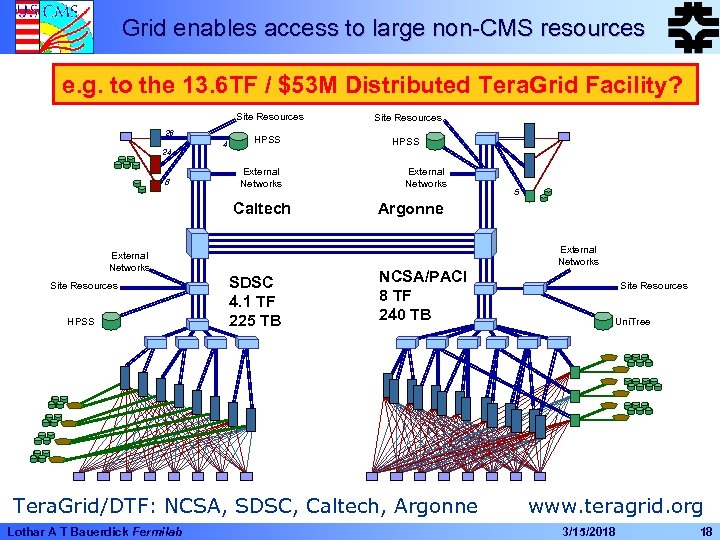 Grid enables access to large non-CMS resources e. g. to the 13. 6 TF / $53 M Distributed Tera. Grid Facility? Site Resources 26 24 8 4 Site Resources HPSS External Networks Caltech External Networks Site Resources HPSS SDSC 4. 1 TF 225 TB External Networks Argonne NCSA/PACI 8 TF 240 TB Tera. Grid/DTF: NCSA, SDSC, Caltech, Argonne Lothar A T Bauerdick Fermilab 5 External Networks Site Resources Uni. Tree www. teragrid. org 3/15/2018 18
 Grids for HEP Analysis? “Chaotic” Access to Very Large Data Samples Lothar A T Bauerdick Fermilab 3/15/2018 19
 ZEUS ZARAH vs. Grid In 1992 ZEUS also started ZARAH (high CPU, high bandwidth) è "Zentrale Analyse Rechen Anlage für HERA Physics” è SMP with storage server, later developed into a farm architecture A centralized installation at DESY è Seamless integration w/ workstation cluster (or PCs) for interactive use u Universities bring their own workstation/PC to DESY è Crucial component: job entry system that defined job execution environment on the central server, accessible from client machines around the world (including workstations/PCs at outside institutes) u jobsub, jobls, jobget, . . . è Over time it was expanded to the “local area” — PC clusters Did not address aspects of dissemination to collaborating institutes è Distribution of calibration and other data bases, software, know-how! In a world of high-speed networks the Grid advantages become feasible è seamless access to experiment data to outside—or even on-site—PCs è Integration with non-ZARAH clusters around the ZEUS institutions è Database access for physics analysis from scientists around the world Lothar A T Bauerdick Fermilab 3/15/2018 20
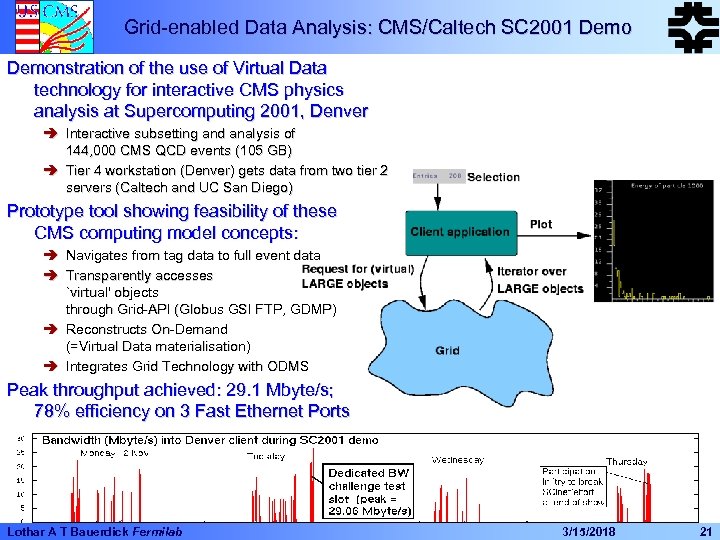 Grid-enabled Data Analysis: CMS/Caltech SC 2001 Demonstration of the use of Virtual Data technology for interactive CMS physics analysis at Supercomputing 2001, Denver è Interactive subsetting and analysis of 144, 000 CMS QCD events (105 GB) è Tier 4 workstation (Denver) gets data from two tier 2 servers (Caltech and UC San Diego) Prototype tool showing feasibility of these CMS computing model concepts: è è Navigates from tag data to full event data Transparently accesses `virtual' objects through Grid-API (Globus GSI FTP, GDMP) è Reconstructs On-Demand (=Virtual Data materialisation) è Integrates Grid Technology with ODMS Peak throughput achieved: 29. 1 Mbyte/s; 78% efficiency on 3 Fast Ethernet Ports Lothar A T Bauerdick Fermilab 3/15/2018 21
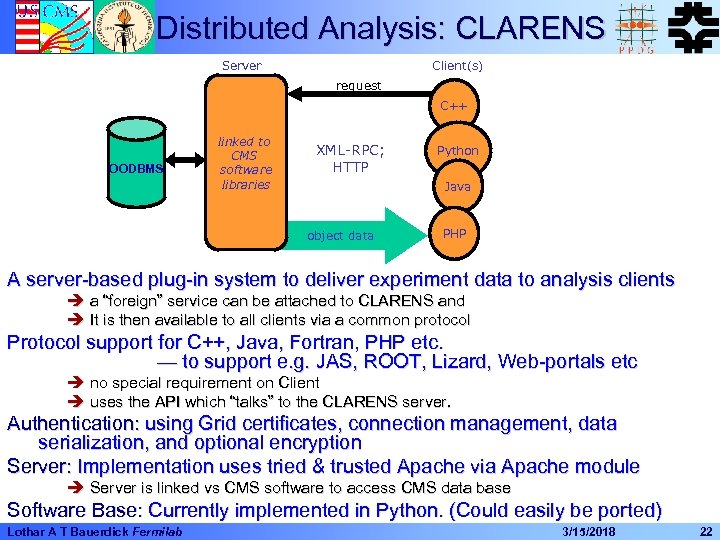 Distributed Analysis: CLARENS Server Client(s) request C++ OODBMS linked to CMS software libraries XML-RPC; HTTP Python Java object data PHP A server-based plug-in system to deliver experiment data to analysis clients è a “foreign” service can be attached to CLARENS and è It is then available to all clients via a common protocol Protocol support for C++, Java, Fortran, PHP etc. — to support e. g. JAS, ROOT, Lizard, Web-portals etc è no special requirement on Client è uses the API which “talks” to the CLARENS server. Authentication: using Grid certificates, connection management, data serialization, and optional encryption Server: Implementation uses tried & trusted Apache via Apache module è Server is linked vs CMS software to access CMS data base Software Base: Currently implemented in Python. (Could easily be ported) Lothar A T Bauerdick Fermilab 3/15/2018 22
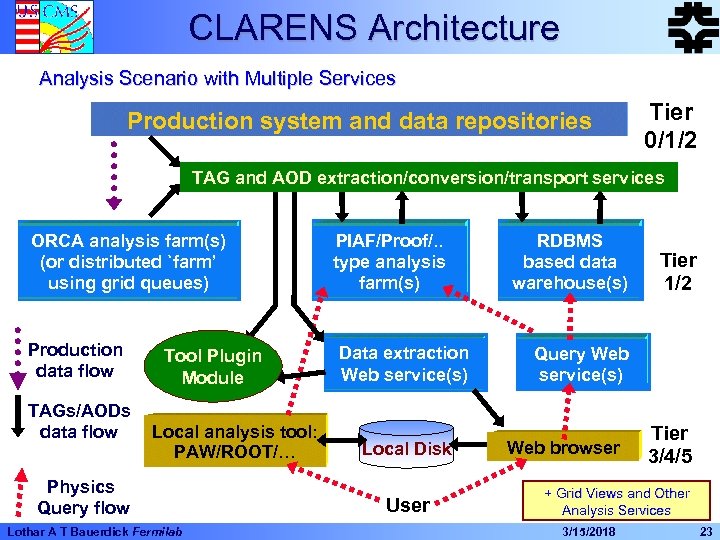 CLARENS Architecture Analysis Scenario with Multiple Services Production system and data repositories Tier 0/1/2 TAG and AOD extraction/conversion/transport services ORCA analysis farm(s) (or distributed `farm’ using grid queues) Production data flow TAGs/AODs data flow Tool Plugin Module Local analysis tool: PAW/ROOT/… Physics Query flow Lothar A T Bauerdick Fermilab PIAF/Proof/. . type analysis farm(s) Data extraction Web service(s) Local Disk User RDBMS based data warehouse(s) Tier 1/2 Query Web service(s) Web browser Tier 3/4/5 + Grid Views and Other Analysis Services 3/15/2018 23
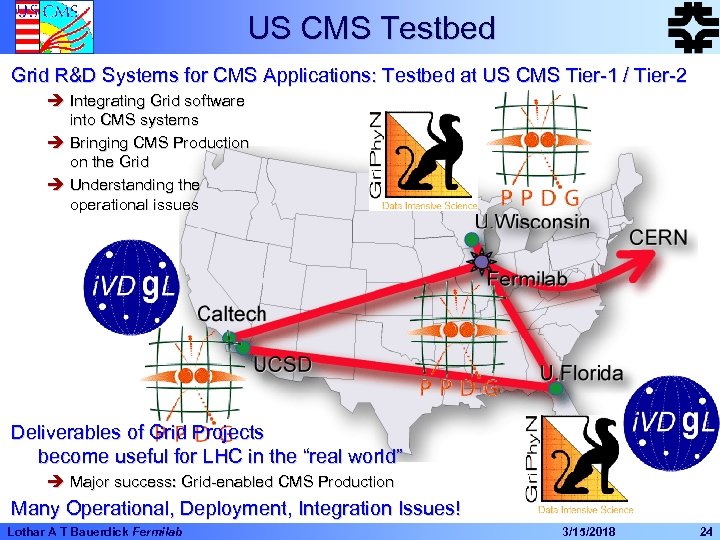 US CMS Testbed Grid R&D Systems for CMS Applications: Testbed at US CMS Tier-1 / Tier-2 è Integrating Grid software into CMS systems è Bringing CMS Production on the Grid è Understanding the operational issues Deliverables of Grid Projects become useful for LHC in the “real world” è Major success: Grid-enabled CMS Production Many Operational, Deployment, Integration Issues! Lothar A T Bauerdick Fermilab 3/15/2018 24
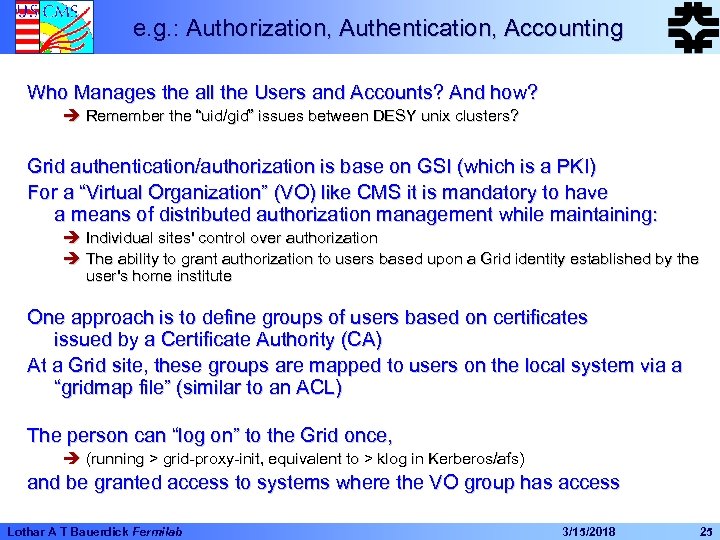 e. g. : Authorization, Authentication, Accounting Who Manages the all the Users and Accounts? And how? è Remember the “uid/gid” issues between DESY unix clusters? Grid authentication/authorization is base on GSI (which is a PKI) For a “Virtual Organization” (VO) like CMS it is mandatory to have a means of distributed authorization management while maintaining: è Individual sites' control over authorization è The ability to grant authorization to users based upon a Grid identity established by the user's home institute One approach is to define groups of users based on certificates issued by a Certificate Authority (CA) At a Grid site, these groups are mapped to users on the local system via a “gridmap file” (similar to an ACL) The person can “log on” to the Grid once, è (running > grid-proxy-init, equivalent to > klog in Kerberos/afs) and be granted access to systems where the VO group has access Lothar A T Bauerdick Fermilab 3/15/2018 25
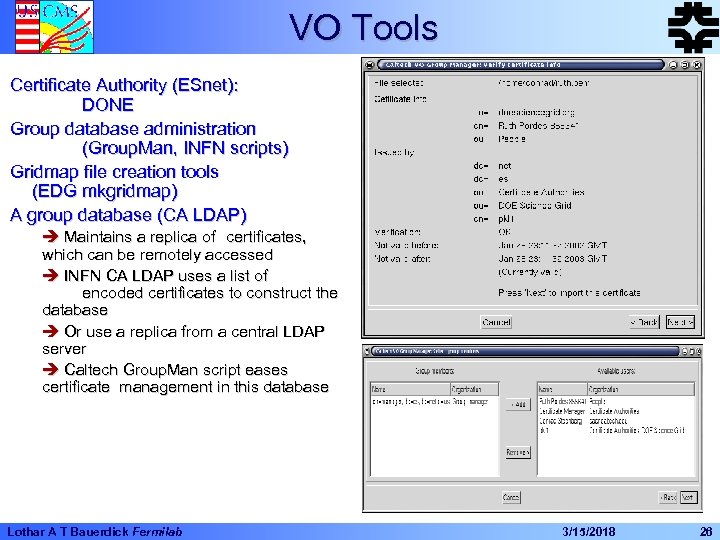 VO Tools Certificate Authority (ESnet): DONE Group database administration (Group. Man, INFN scripts) Gridmap file creation tools (EDG mkgridmap) A group database (CA LDAP) è Maintains a replica of certificates, which can be remotely accessed è INFN CA LDAP uses a list of encoded certificates to construct the database è Or use a replica from a central LDAP server è Caltech Group. Man script eases certificate management in this database Lothar A T Bauerdick Fermilab 3/15/2018 26
 Brief Tour Through Major HEP Grid Projects In Europe and in the U. S. Lothar A T Bauerdick Fermilab 3/15/2018 27
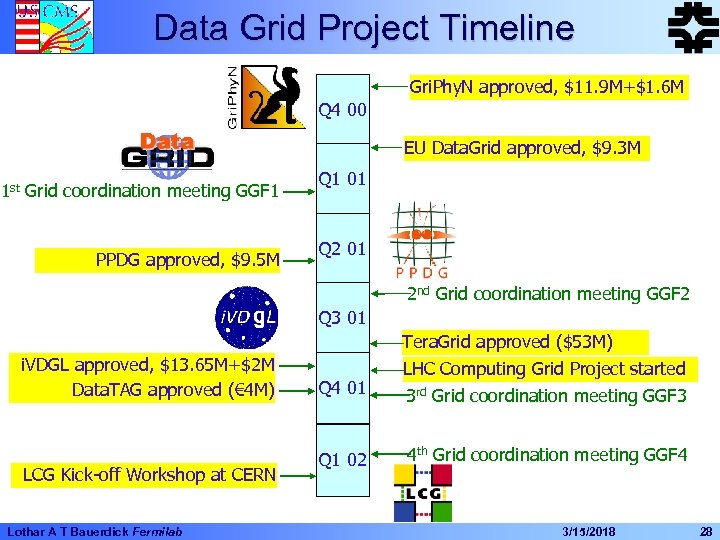 Data Grid Project Timeline Gri. Phy. N approved, $11. 9 M+$1. 6 M Q 4 00 EU Data. Grid approved, $9. 3 M 1 st Grid coordination meeting GGF 1 PPDG approved, $9. 5 M Q 1 01 Q 2 01 2 nd Grid coordination meeting GGF 2 Q 3 01 i. VDGL approved, $13. 65 M+$2 M Data. TAG approved (€ 4 M) LCG Kick-off Workshop at CERN Lothar A T Bauerdick Fermilab Q 4 01 Tera. Grid approved ($53 M) LHC Computing Grid Project started 3 rd Grid coordination meeting GGF 3 Q 1 02 4 th Grid coordination meeting GGF 4 3/15/2018 28
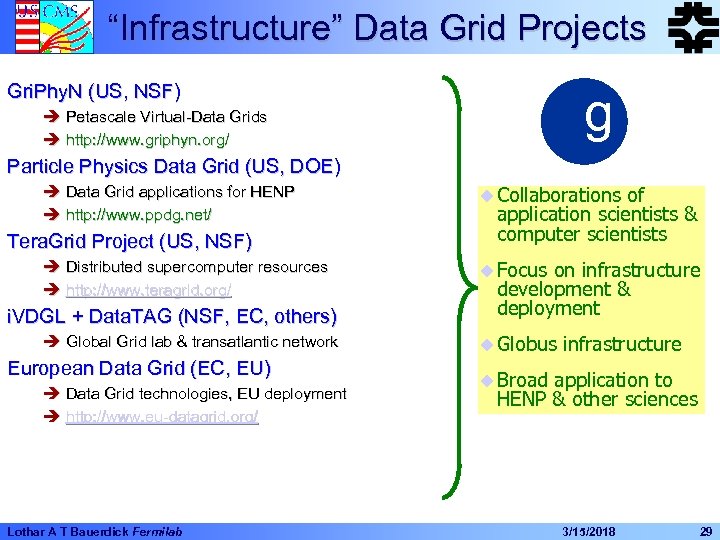 “Infrastructure” Data Grid Projects Gri. Phy. N (US, NSF) g è Petascale Virtual-Data Grids è http: //www. griphyn. org/ Particle Physics Data Grid (US, DOE) è Data Grid applications for HENP è http: //www. ppdg. net/ Tera. Grid Project (US, NSF) è Distributed supercomputer resources è http: //www. teragrid. org/ i. VDGL + Data. TAG (NSF, EC, others) è Global Grid lab & transatlantic network European Data Grid (EC, EU) è Data Grid technologies, EU deployment è http: //www. eu-datagrid. org/ Lothar A T Bauerdick Fermilab u Collaborations of application scientists & computer scientists u Focus on infrastructure development & deployment u Globus infrastructure u Broad application to HENP & other sciences 3/15/2018 29
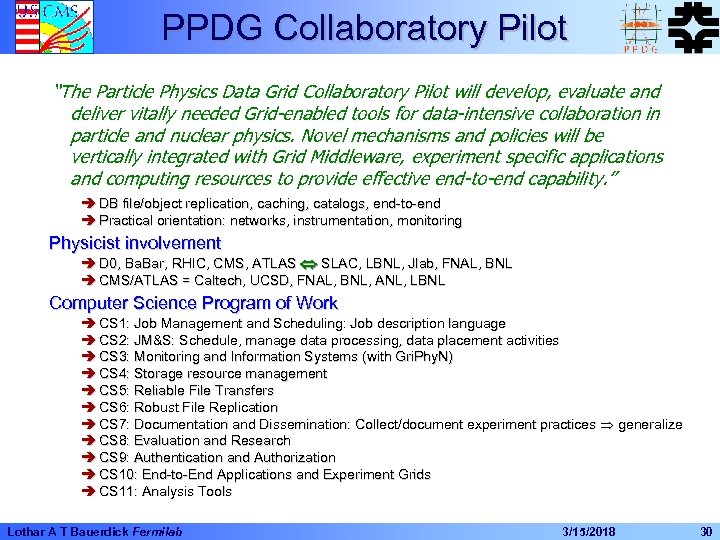 PPDG Collaboratory Pilot “The Particle Physics Data Grid Collaboratory Pilot will develop, evaluate and deliver vitally needed Grid-enabled tools for data-intensive collaboration in particle and nuclear physics. Novel mechanisms and policies will be vertically integrated with Grid Middleware, experiment specific applications and computing resources to provide effective end-to-end capability. ” è DB file/object replication, caching, catalogs, end-to-end è Practical orientation: networks, instrumentation, monitoring Physicist involvement è D 0, Ba. Bar, RHIC, CMS, ATLAS SLAC, LBNL, Jlab, FNAL, BNL è CMS/ATLAS = Caltech, UCSD, FNAL, BNL, ANL, LBNL Computer Science Program of Work è CS 1: Job Management and Scheduling: Job description language è CS 2: JM&S: Schedule, manage data processing, data placement activities è CS 3: Monitoring and Information Systems (with Gri. Phy. N) è CS 4: Storage resource management è CS 5: Reliable File Transfers è CS 6: Robust File Replication è CS 7: Documentation and Dissemination: Collect/document experiment practices generalize è CS 8: Evaluation and Research è CS 9: Authentication and Authorization è CS 10: End-to-End Applications and Experiment Grids è CS 11: Analysis Tools Lothar A T Bauerdick Fermilab 3/15/2018 30
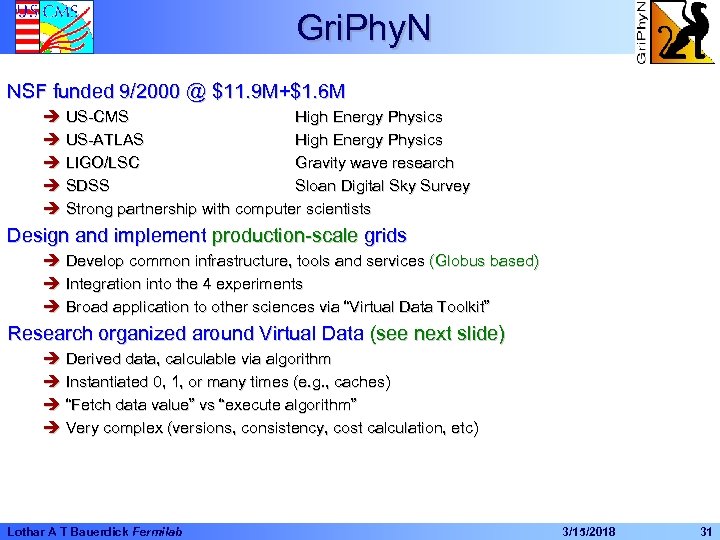 Gri. Phy. N NSF funded 9/2000 @ $11. 9 M+$1. 6 M è US-CMS High Energy Physics è US-ATLAS High Energy Physics è LIGO/LSC Gravity wave research è SDSS Sloan Digital Sky Survey è Strong partnership with computer scientists Design and implement production-scale grids è Develop common infrastructure, tools and services (Globus based) è Integration into the 4 experiments è Broad application to other sciences via “Virtual Data Toolkit” Research organized around Virtual Data (see next slide) è Derived data, calculable via algorithm è Instantiated 0, 1, or many times (e. g. , caches) è “Fetch data value” vs “execute algorithm” è Very complex (versions, consistency, cost calculation, etc) Lothar A T Bauerdick Fermilab 3/15/2018 31
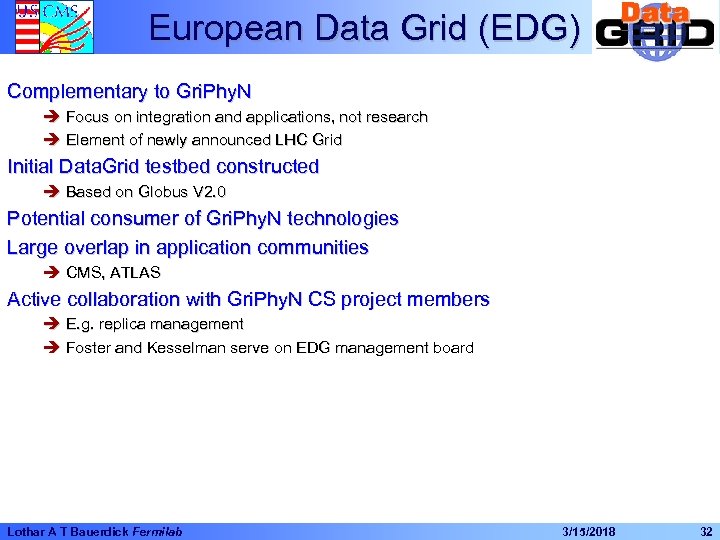 European Data Grid (EDG) Complementary to Gri. Phy. N è Focus on integration and applications, not research è Element of newly announced LHC Grid Initial Data. Grid testbed constructed è Based on Globus V 2. 0 Potential consumer of Gri. Phy. N technologies Large overlap in application communities è CMS, ATLAS Active collaboration with Gri. Phy. N CS project members è E. g. replica management è Foster and Kesselman serve on EDG management board Lothar A T Bauerdick Fermilab 3/15/2018 32
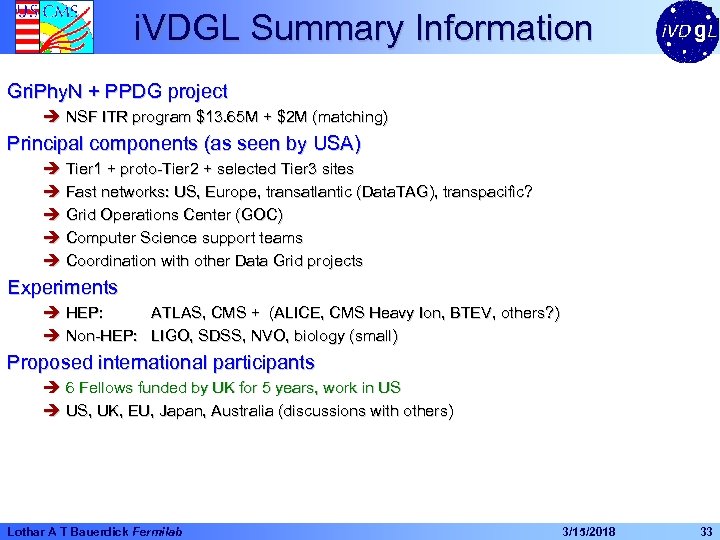 i. VDGL Summary Information Gri. Phy. N + PPDG project è NSF ITR program $13. 65 M + $2 M (matching) Principal components (as seen by USA) è Tier 1 + proto-Tier 2 + selected Tier 3 sites è Fast networks: US, Europe, transatlantic (Data. TAG), transpacific? è Grid Operations Center (GOC) è Computer Science support teams è Coordination with other Data Grid projects Experiments è HEP: ATLAS, CMS + (ALICE, CMS Heavy Ion, BTEV, others? ) è Non-HEP: LIGO, SDSS, NVO, biology (small) Proposed international participants è 6 Fellows funded by UK for 5 years, work in US è US, UK, EU, Japan, Australia (discussions with others) Lothar A T Bauerdick Fermilab 3/15/2018 33
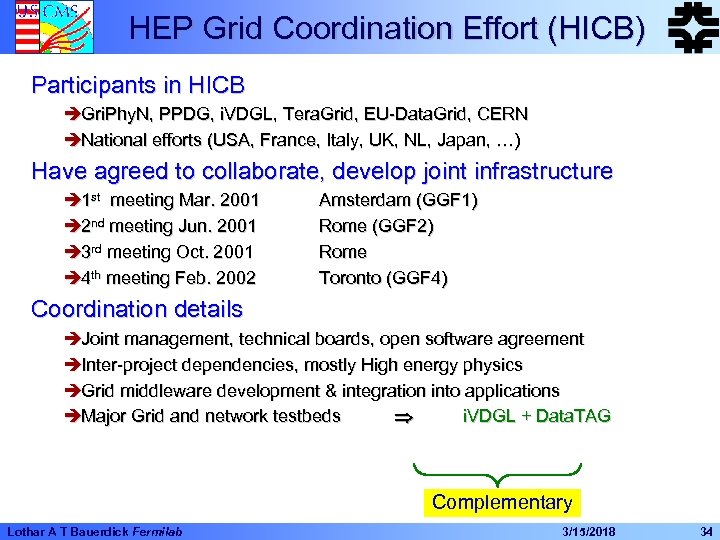 HEP Grid Coordination Effort (HICB) Participants in HICB èGri. Phy. N, PPDG, i. VDGL, Tera. Grid, EU-Data. Grid, CERN èNational efforts (USA, France, Italy, UK, NL, Japan, …) Have agreed to collaborate, develop joint infrastructure è 1 st meeting Mar. 2001 è 2 nd meeting Jun. 2001 è 3 rd meeting Oct. 2001 è 4 th meeting Feb. 2002 Amsterdam (GGF 1) Rome (GGF 2) Rome Toronto (GGF 4) Coordination details èJoint management, technical boards, open software agreement èInter-project dependencies, mostly High energy physics èGrid middleware development & integration into applications èMajor Grid and network testbeds i. VDGL + Data. TAG Complementary Lothar A T Bauerdick Fermilab 3/15/2018 34
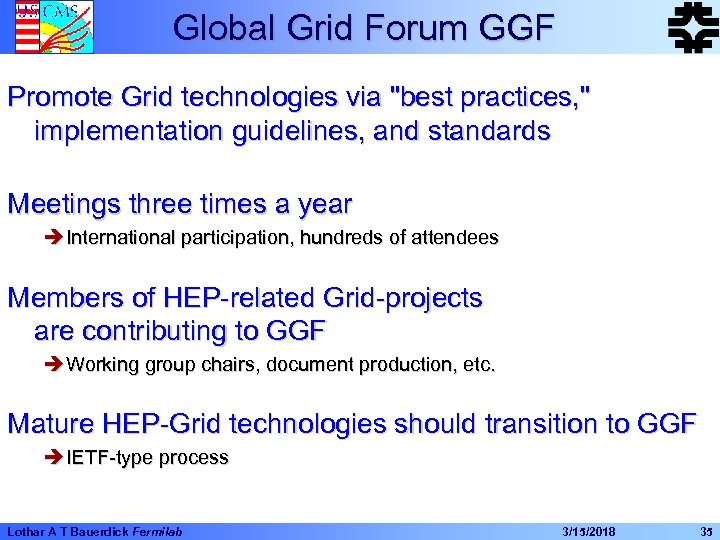 Global Grid Forum GGF Promote Grid technologies via "best practices, " implementation guidelines, and standards Meetings three times a year è International participation, hundreds of attendees Members of HEP-related Grid-projects are contributing to GGF è Working group chairs, document production, etc. Mature HEP-Grid technologies should transition to GGF è IETF-type process Lothar A T Bauerdick Fermilab 3/15/2018 35
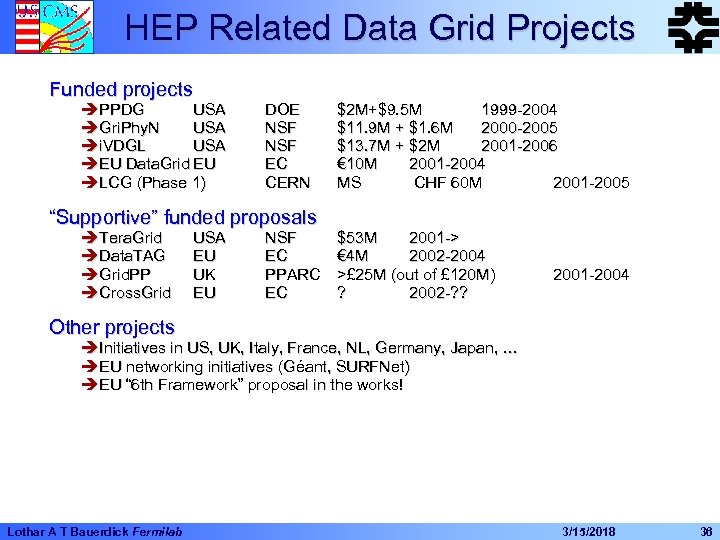 HEP Related Data Grid Projects Funded projects èPPDG USA èGri. Phy. N USA èi. VDGL USA èEU Data. Grid EU èLCG (Phase 1) DOE NSF EC CERN “Supportive” funded proposals èTera. Grid èData. TAG èGrid. PP èCross. Grid USA EU UK EU NSF EC PPARC EC $2 M+$9. 5 M 1999 -2004 $11. 9 M + $1. 6 M 2000 -2005 $13. 7 M + $2 M 2001 -2006 € 10 M 2001 -2004 MS CHF 60 M 2001 -2005 $53 M 2001 -> € 4 M 2002 -2004 >£ 25 M (out of £ 120 M) ? 2002 -? ? 2001 -2004 Other projects èInitiatives in US, UK, Italy, France, NL, Germany, Japan, … èEU networking initiatives (Géant, SURFNet) èEU “ 6 th Framework” proposal in the works! Lothar A T Bauerdick Fermilab 3/15/2018 36
 Brief Tour of the Grid World As viewed from the U. S. … Ref: Bill Johnston, LBNL & NASA Ames www-itg. lbl. gov/~johnston/ Lothar A T Bauerdick Fermilab 3/15/2018 37
 Grid Computing in the (excessively) concrete Site A wants to give Site B access to its computing resources è To which machines does B connect? è How does B authenticate? è B needs to work on files. How do the files get from B to A? è How does B create and submit jobs to A’s queue? è How does B get the results back home? è How do A and B keep track of which files are where? Lothar A T Bauerdick Fermilab 3/15/2018 38
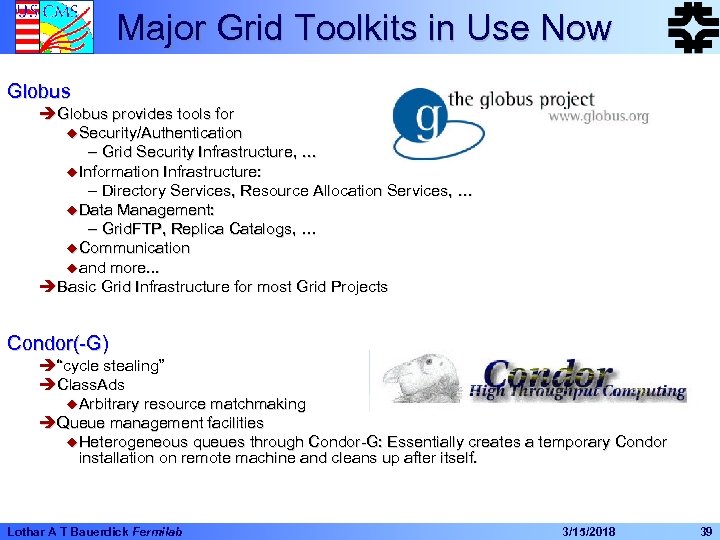 Major Grid Toolkits in Use Now Globus è Globus provides tools for u. Security/Authentication – Grid Security Infrastructure, … u. Information Infrastructure: – Directory Services, Resource Allocation Services, … u. Data Management: – Grid. FTP, Replica Catalogs, … u. Communication uand more. . . è Basic Grid Infrastructure for most Grid Projects Condor(-G) è “cycle stealing” è Class. Ads u. Arbitrary resource matchmaking è Queue management facilities u. Heterogeneous queues through Condor-G: Essentially creates a temporary Condor installation on remote machine and cleans up after itself. Lothar A T Bauerdick Fermilab 3/15/2018 39
 Grids Are Real and Useful Now Basic Grid services are being deployed to support uniform and secure access to computing, data, and instrument systems that are distributed across organizations è è è resource discovery uniform access to geographically and organizationally dispersed computing and data resources job management security, including single sign-on (users authenticate once for access to all authorized resources) secure inter-process communication Grid system management Higher level services è è Grid execution management tools (e. g. Condor-G) are being deployed Data services providing uniform access to tertiary storage systems and global metadata catalogues (e. g. Grid. FTP and SRB/MCAT) are being deployed è Web services supporting application frameworks and science portals are being prototyped Persistent infrastructure is being built è è Grid services are being maintained on the compute and data systems in prototype production Grids Cryptographic authentication supporting single sign-on is being provided through Public Key Infrastructure (PKI) è Resource discovery services are being maintained (Grid Information Service – distributed directory service) Lothar A T Bauerdick Fermilab 3/15/2018 40
 Deployment: Virtual Data Toolkit “a primary Gri. Phy. N deliverable will be a suite of virtual data services and virtual data tools designed to support a wide range of applications. The development of this Virtual Data Toolkit (VDT) will enable the real-life experimentation needed to evaluate Gri. Phy. N technologies. The VDT will also serve as a primary technology transfer mechanism to the four physics experiments and to the broader scientific community”. The US LHC projects expect that the VDT become the primary deployment and configuration mechanism for Grid Technology Adoption of VDT by Data. Tag possible Lothar A T Bauerdick Fermilab 3/15/2018 41
 VDT released 1 st version of VDT defined to include the following components: èVDT- Server Condor (version 6. 3. 1) – Local cluster management and scheduling u GDMP (version 2. 0 beta) – File replication/mirroring. u Globus Toolkit (version 2. 0 beta) – GSI, GRAM, MDS, Grid. FTP, Replica Catalog & Management all packaged with GPT. u è VDT – Client Condor-G (version 6. 3. 1) – Local management of Grid jobs. u DAGMan – Support Directed Acyclic Graphs (DAGs) of Grid jobs. u Globus Toolkit (version 2. 0 beta) – Client side of GSI, GRAM, Grid. FTP & Replica Catalog & Management all packaged with GPT. è VDT – Developer u Class. Ad (version 1. 0) – Supports collections and Matchmaking u Globus Toolkit (version 2. 0) - Grid APIs u VDT 2. 0 expected this year è Virtual Data Catalog structures and VDL engine VDL and rudimentary centralized planner / executor è Community Authorization Server è Initial Grid Policy Language è The Network Storage (Ne. ST) appliance è User login management tools è A Data Placement (Da. P) job manager Lothar A T Bauerdick Fermilab 3/15/2018 42
 The Grid World: Current Status Considerable consensus on key concepts and technologies è Open source Globus Toolkit a de facto standard for major protocols & services è Far from complete or perfect, but out there, evolving rapidly, and large tool/user base Industrial interest emerging rapidly è Opportunity: convergence of e. Science and e. Business requirements & technologies Good technical solutions for key problems, e. g. è This & good engineering is enabling progress u Good quality reference implementation, multi-language support, interfaces to many systems, large user base, industrial support u Growing community code base built on tools Globus Toolkit deficiencies è Protocol deficiencies, e. g. u Heterogeneous basis: HTTP, LDAP, FTP u No standard means of invocation, notification, error propagation, authorization, termination, … è Significant missing functionality, e. g. u Databases, sensors, instruments, workflow, … u Virtualization of end systems (hosting envs. ) è Little work on total system properties, e. g. u Dependability, end-to-end Qo. S, … u Reasoning about system properties Lothar A T Bauerdick Fermilab 3/15/2018 43
 The Evolution of Grids are currently focused on resource access and management è This is a necessary first step to provide a uniform underpinning, but is not sufficient if we want to realize the potential of Grids for facilitating science and engineering è Unless an application already has a framework that hides the use of these low level services the Grid is difficult for most users Grids are evolving to a service oriented architecture è Users are primarily interested in “services” – something that performs a useful function, such as a particular type of simulation, or a broker that finds the “best” system to run a job è Even many Grid tool developers, such as those that develop application portals, are primarily interested in services – resource discovery, event management, user security credential management, etc. This evolution is going hand-in-hand with a large IT industry push to develop an integrated framework for Web services This is also what is necessary to address some of the current user complaints Lothar A T Bauerdick Fermilab 3/15/2018 44
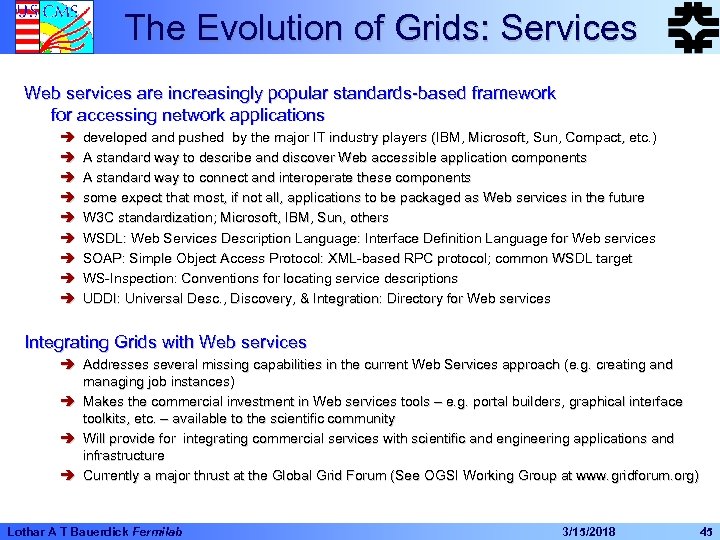 The Evolution of Grids: Services Web services are increasingly popular standards-based framework for accessing network applications è è è è è developed and pushed by the major IT industry players (IBM, Microsoft, Sun, Compact, etc. ) A standard way to describe and discover Web accessible application components A standard way to connect and interoperate these components some expect that most, if not all, applications to be packaged as Web services in the future W 3 C standardization; Microsoft, IBM, Sun, others WSDL: Web Services Description Language: Interface Definition Language for Web services SOAP: Simple Object Access Protocol: XML-based RPC protocol; common WSDL target WS-Inspection: Conventions for locating service descriptions UDDI: Universal Desc. , Discovery, & Integration: Directory for Web services Integrating Grids with Web services è Addresses several missing capabilities in the current Web Services approach (e. g. creating and managing job instances) è Makes the commercial investment in Web services tools – e. g. portal builders, graphical interface toolkits, etc. – available to the scientific community è Will provide for integrating commercial services with scientific and engineering applications and infrastructure è Currently a major thrust at the Global Grid Forum (See OGSI Working Group at www. gridforum. org) Lothar A T Bauerdick Fermilab 3/15/2018 45
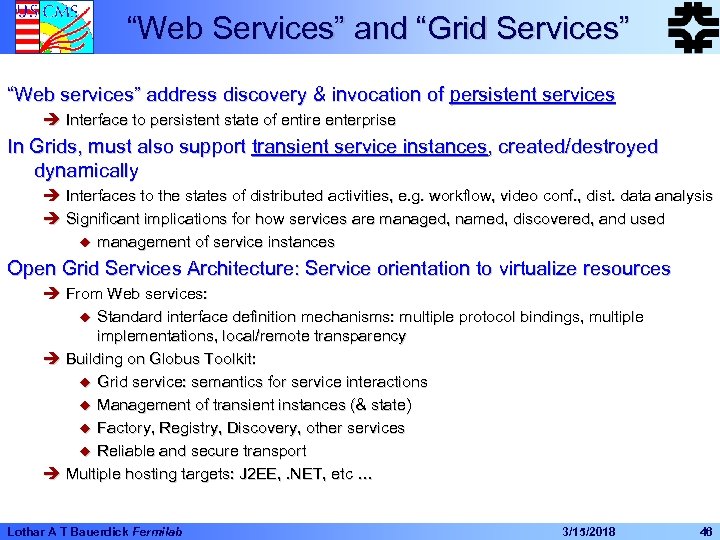 “Web Services” and “Grid Services” “Web services” address discovery & invocation of persistent services è Interface to persistent state of entire enterprise In Grids, must also support transient service instances, created/destroyed dynamically è Interfaces to the states of distributed activities, e. g. workflow, video conf. , dist. data analysis è Significant implications for how services are managed, named, discovered, and used u management of service instances Open Grid Services Architecture: Service orientation to virtualize resources è From Web services: u Standard interface definition mechanisms: multiple protocol bindings, multiple implementations, local/remote transparency è Building on Globus Toolkit: u Grid service: semantics for service interactions u Management of transient instances (& state) u Factory, Registry, Discovery, other services u Reliable and secure transport è Multiple hosting targets: J 2 EE, . NET, etc … Lothar A T Bauerdick Fermilab 3/15/2018 46
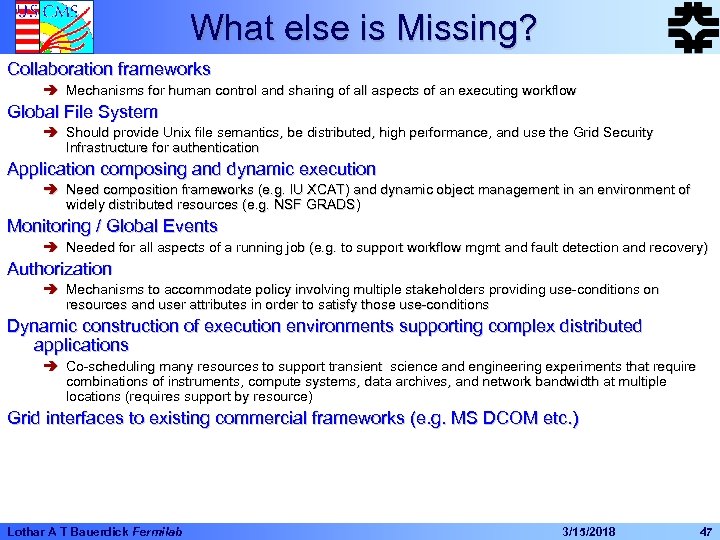 What else is Missing? Collaboration frameworks è Mechanisms for human control and sharing of all aspects of an executing workflow Global File System è Should provide Unix file semantics, be distributed, high performance, and use the Grid Security Infrastructure for authentication Application composing and dynamic execution è Need composition frameworks (e. g. IU XCAT) and dynamic object management in an environment of widely distributed resources (e. g. NSF GRADS) Monitoring / Global Events è Needed for all aspects of a running job (e. g. to support workflow mgmt and fault detection and recovery) Authorization è Mechanisms to accommodate policy involving multiple stakeholders providing use-conditions on resources and user attributes in order to satisfy those use-conditions Dynamic construction of execution environments supporting complex distributed applications è Co-scheduling many resources to support transient science and engineering experiments that require combinations of instruments, compute systems, data archives, and network bandwidth at multiple locations (requires support by resource) Grid interfaces to existing commercial frameworks (e. g. MS DCOM etc. ) Lothar A T Bauerdick Fermilab 3/15/2018 47
 Grids at the Labs Traditional Lab IT community has been maybe a bit “suspicious” (shy? ) about the Grid Activities [BTW: That might be true even at CERN ] where the Grid (e. g. testbed groups) find that CERN IT is not yet strongly represented This should significantly change with the LHC Computing Grid Project I am trying to make the point that this should change Lothar A T Bauerdick Fermilab 3/15/2018 48
 The Labs have to be involved Labs like DESY or Fermilab will be part of several Grids/VO: è LHC experiment CMS: “Tier-1” regional center for U. S. CMS, to be integrated with LHC computing grid at CERN and other Tier-1 and Tier-2 centers è Sloan Digital Sky Survey (SDSS): tight integration with other U. S. sites è Run. II experiments D 0, CDF: large computing facilities in UK, Nikhef etc (connectivity soon to be based on up to 2. 5 Gbps links!) Examples for development, integration and deployment tasks: è interface to Grid authentication/authorization to lab-specific (e. g. Kerberos) authentication è interface of Data Serving Grid services (e. g. Grid. FTP) to Lab-specific Mass Storage Systems è Diagnostics, monitoring, trouble shooting Lothar A T Bauerdick Fermilab 3/15/2018 49
 Possible role of the Labs Grid-like environments will be the future of all science experiments Specifically in HEP! The Labs should find out and provide what it takes to reliably and efficiently run such an infrastructure The Labs could become Science Centers that provide Science Portals into this infrastructure Lothar A T Bauerdick Fermilab 3/15/2018 50
 Example: Authentication/Authorization The Lab must interface, integrate and deploy its site security, i. e. Authentication and Authorization infrastructure to the Grid middleware Provide input and feedback of the requirements of sites for the Authentication, Authorization, and eventually Accounting (AAA) services from deployed data grids of their experiment users è evaluation of interfaces between "emerging" grid infrastructure and Fermilab Authentication/Authorization/Accounting infrastructure - Plan of tasks and effort required è site reference infrastructure test bed (BNL, SLAC, Fermilab, LBNL, JLAB) analysis of impact of globalization of experiments data handling and data access needs and plans on the Fermilab CD for 1/3/5 years è VO policies vs lab policies è VO policies and use of emerging Fermilab experiment data handling/access/s/w - use cases - site requirements è HEP management of global computing authentication and authorization needs - inter-lab security group (DESY is member of this) Lothar A T Bauerdick Fermilab 3/15/2018 51
 Follow Evolving Technologies and Standards Examples: è Authentication and Authorization, Certification of Systems è Resource management, implementing policies defined by VO (not the labs) è Requirements on error recovery and failsafe-ness, è Data becomes distributed which requires replica catalogs, storage managers, resource brokers, name space management è Mass Storage System catalogs, Calibration databases and other meta data catalogs become/need to be interfaced to Virtual Data Catalogs Also: evolving requirements from outside organizations, even governments è Example: è Globus certificates were not acceptable to EU è DOE Science Grid/ESNet has started a Certificate Authority to address this è Forschungszentrum Karlsruhe has now set-up a CA for German “science community” u Including for DESY? Certification Policy compatible with DESY’s approach? u FZK scope is – “HEP experiments: Alice, Atlas, Ba. Bar, CDF, CMS, COMPASS, D 0, LHCb – International projects: Cross. Grid, Data. Grid, LHC Computing Grid Project” Lothar A T Bauerdick Fermilab 3/15/2018 52
 Role of DESY IT Provider(s) is Changing All Labs IT operations will be faced with becoming only a part of a much larger computing infrastructure – That trend started on the Local Area by experiments doing their own computing on non-mainframe infrastructure It now goes beyond the Local Area, using a fabric of world-wide computing and storage resources è If DESY IT’s domain were restricted to the Local Area (including the WAN POP, obviously), è But the experiments are going global with their computing, and use their own expertise and “foreign” resources: è So what is left to do for an IT organization? è And, where do those experiment resources come from? Lothar A T Bauerdick Fermilab 3/15/2018 53
 Possible DESY Focus Develop competence targeted at communities beyond the DESY LAN è Target the HEP and Science communities at large — target University groups! Grid Infrastructure, Deployment, Integration for DESY clientele and beyond: è e. g. the HEP community at large in Germany, synchrotron radiation community è This should eventually qualify for additional funding Longer Term Vision: DESY could become one of the driving forces for a science grid in Germany! è Support Grid services providing standardized and highly capable distributed access to resources used by a science community è Support for building science portals, that support distributed collaboration, access to very large data volumes, unique instruments, incorporation of supercomputing or special computing resources è NB: HEP is taking a leadership position in providing Grid Computing for the scientific community at large: UK e-Science, CERN EDG and 6 th Framework, US Lothar A T Bauerdick Fermilab 3/15/2018 54
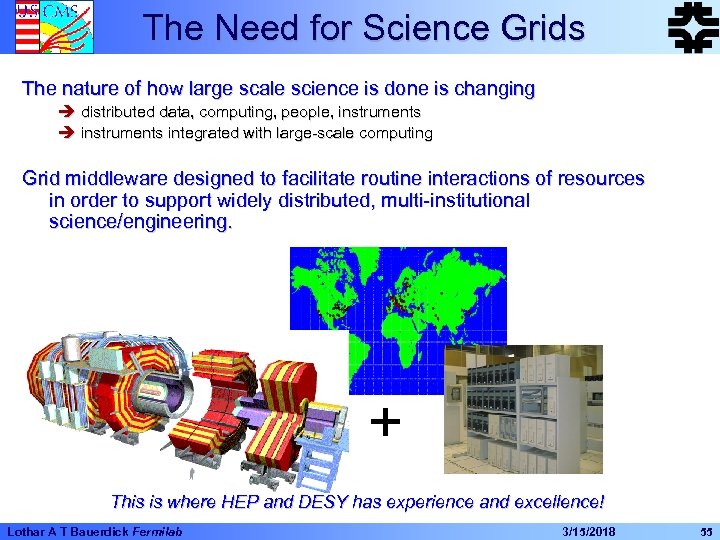 The Need for Science Grids The nature of how large scale science is done is changing è distributed data, computing, people, instruments è instruments integrated with large-scale computing Grid middleware designed to facilitate routine interactions of resources in order to support widely distributed, multi-institutional science/engineering. + This is where HEP and DESY has experience and excellence! Lothar A T Bauerdick Fermilab 3/15/2018 55
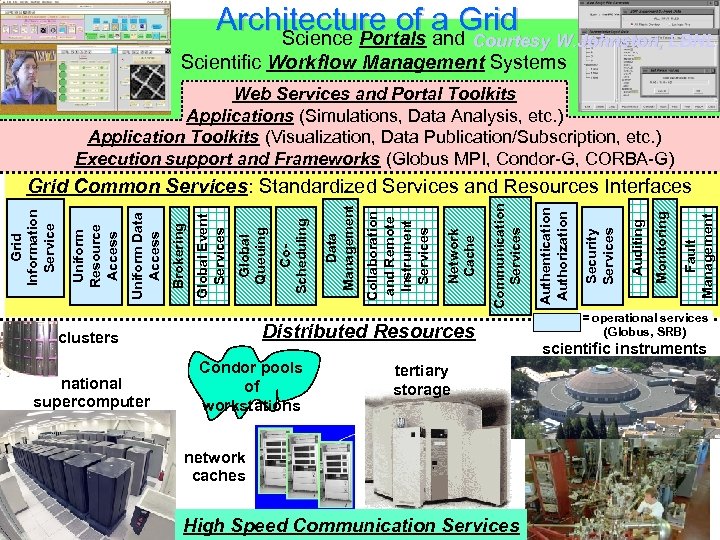 Architecture of a Grid Science Portals and Courtesy W. Johnston, LBNL Scientific Workflow Management Systems Web Services and Portal Toolkits Applications (Simulations, Data Analysis, etc. ) Application Toolkits (Visualization, Data Publication/Subscription, etc. ) Execution support and Frameworks (Globus MPI, Condor-G, CORBA-G) Condor pools of workstations tertiary storage network caches High Speed Communication Services Fault Management Monitoring Auditing Security Services Authentication Authorization Communication Services Network Cache Collaboration and Remote Instrument Services Data Management Distributed Resources clusters national supercomputer facilities Co. Scheduling Global Queuing Global Event Services Brokering Uniform Data Access Uniform Resource Access Grid Information Service Grid Common Services: Standardized Services and Resources Interfaces = operational services (Globus, SRB) scientific instruments
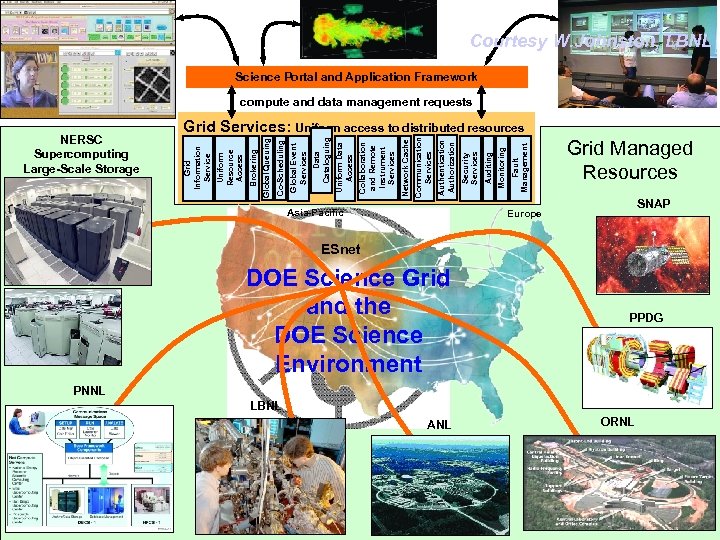 Courtesy W. Johnston, LBNL Science Portal and Application Framework compute and data management requests Asia-Pacific Fault Management Monitoring Auditing Security Services Authentication Authorization Communication Services Network Cache Collaboration and Remote Instrument Services Uniform Data Access Data Cataloguing Global Event Services Co-Scheduling Global Queuing Brokering Uniform Resource Access Grid Services: Uniform access to distributed resources Grid Information Service NERSC Supercomputing Large-Scale Storage Grid Managed Resources SNAP Europe ESnet DOE Science Grid and the DOE Science Environment ? PPDG PNNL LBNL ANL ORNL
 DESY e-Science The UK example might be very instructive Build strategic partnerships with other (CS) institutes Showcase example uses of Grid technologies è portals to large CPU resources, accessible to smaller communities (e. g. Zeuthen QCD? ) è distributed work groups between regions in Europe (e. g. HERA physics groups? Synchrotron Radiation experiments? ) Provide basic infrastructure services to “Core experiments” è e. g. CA for Hera experiments, Grid portal for Hera analysis jobs, etc? Targets and Goals: è large HEP experiments (e. g. HERA, TESLA exp) u provide expertise on APIs, middleware and infrastructure support (e. g. Grid Operations Center, Certificate Authority, … ) è “smaller” communities (SR, FEL exp) u E. g. science portals, Web interfaces to science and data services Lothar A T Bauerdick Fermilab 3/15/2018 58
 Conclusions This is obviously not nearly a thought-through “Plan” for DESY… Though some of the expected developments are easy to predict! è And other labs have succeeded in going that way, see FZK The Grid is an opportunity for DESY to expand acquire competitive competence to serve the German science community The grid is a great chance! It’s a technology, but it’s even more about making science data accessible, to the collaboration, the (smaller) groups, the public! To take this chance requires to think outside the box, possibly to re-consider and develop the role of DESY as a provider of science infrastructure for the German science community Lothar A T Bauerdick Fermilab 3/15/2018 59
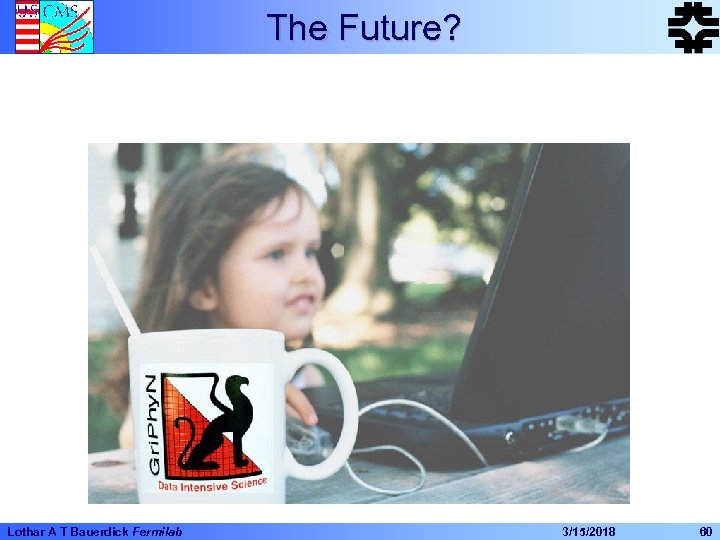 The Future? The Grid Everywhere Lothar A T Bauerdick Fermilab 3/15/2018 60