 Скачать презентацию Grid computing an introduction Lionel Brunie Institut
a1c1424d7489906b14be6f11bd87feb9.ppt
- Количество слайдов: 55



Grid computing : an introduction Lionel Brunie Institut National des Sciences Appliquées Lyon, France
Hansel and Gretel are lost in the forest of the definitions n n n n n Distributed system Parallel system Cluster computing Meta-computing Grid computing Peer to peer Global computing Internet Computing Network computing
Distributed system n n N autonomous computers (sites) : n administrators, n data/control flows an interconnection network User view : one single (virtual) system « Traditional » programmer view : client-server
Parallel System n n n 1 computer, n nodes : one administrator, one scheduler, one power source memory : it depends Programmer view : one single machine executing parallel codes. Various programming models (message passing, distributed shared memory, data parallelism…)
Cluster computing n n Use of PCs interconnected by a (high performance) network as a parallel (cheap) machine Two main approaches u u dedicated network (based on a high performance network : Myrinet, SCI, Fiber Channel. . . ) non-dedicated network (based on a (good) LAN)
Network computing n n n From LAN (cluster) computing to WAN computing Set of machines distributed over a MAN/WAN that are used to execute parallel loosely coupled codes Depending on the infrastructure (soft and hard), network computing is derived in Internet computing, P 2 P, Grid computing, etc.
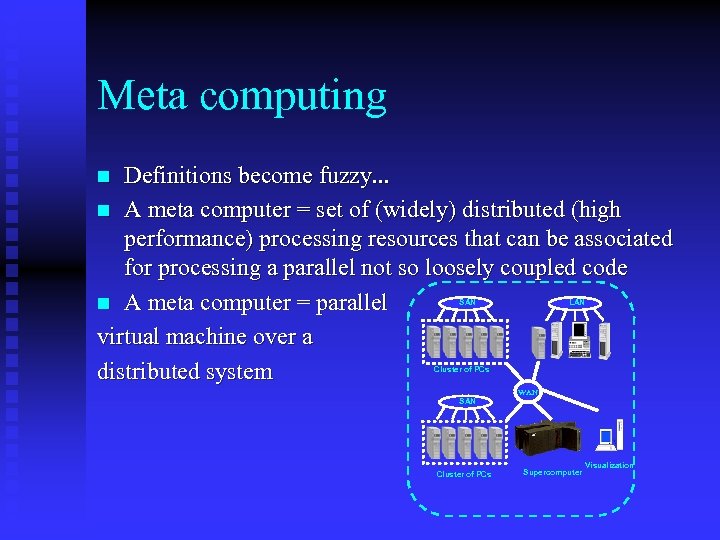
Meta computing Definitions become fuzzy. . . n A meta computer = set of (widely) distributed (high performance) processing resources that can be associated for processing a parallel not so loosely coupled code n A meta computer = parallel virtual machine over a distributed system n SAN LAN Cluster of PCs WAN SAN Cluster of PCs Supercomputer Visualization
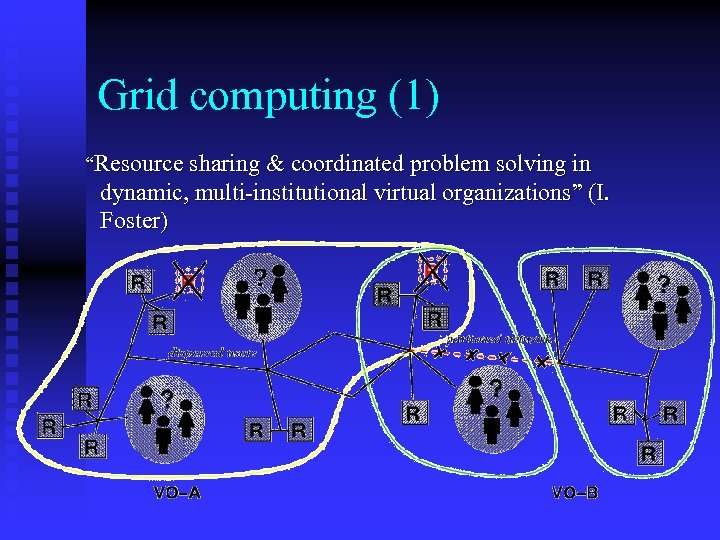
Grid computing (1) “Resource sharing & coordinated problem solving in dynamic, multi-institutional virtual organizations” (I. Foster)
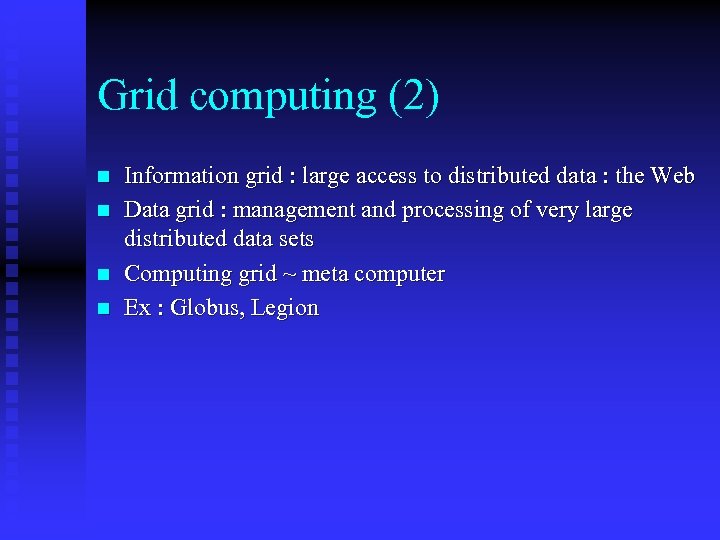
Grid computing (2) n n Information grid : large access to distributed data : the Web Data grid : management and processing of very large distributed data sets Computing grid ~ meta computer Ex : Globus, Legion
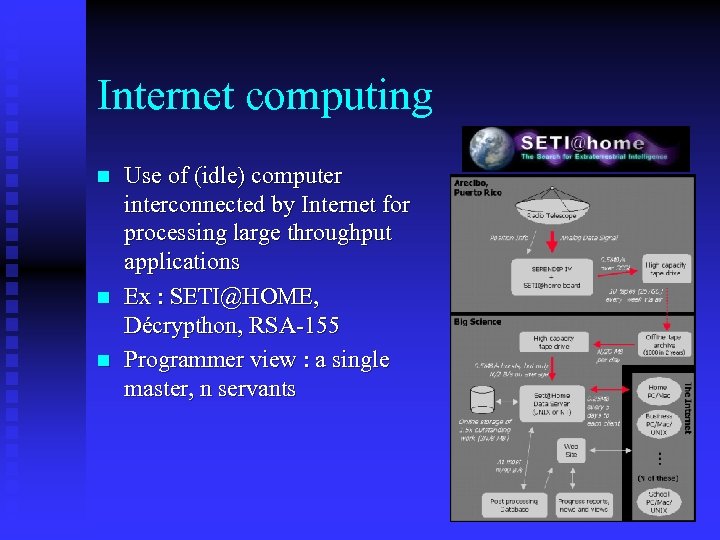
Internet computing n n n Use of (idle) computer interconnected by Internet for processing large throughput applications Ex : SETI@HOME, Décrypthon, RSA-155 Programmer view : a single master, n servants
Global computing n n Internet computing on a pool of sites Meta computing with loosely coupled codes Grid computing with poor communication facilities Ex : Condor
Peer to peer computing n n n A site is both client and server : servent Dynamic servent discovery by « contamination » 2 approaches : u u n centralized management : Napster distributed management : Gnutella, Kazaa Application : file sharing
Grid computing
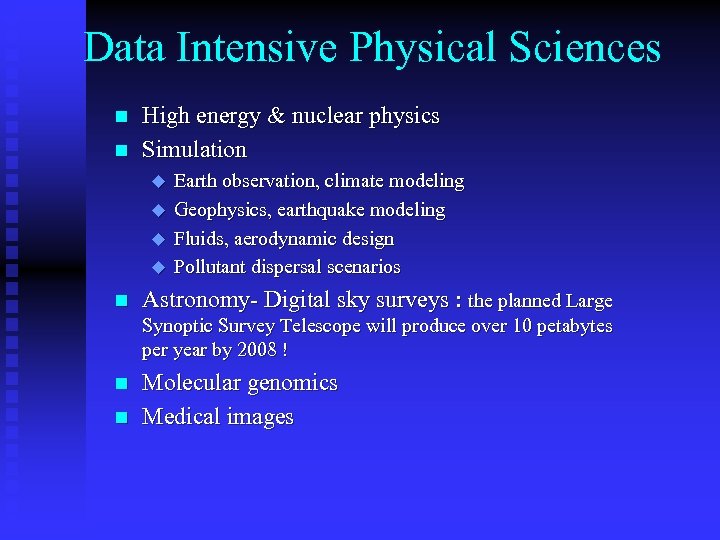
Data Intensive Physical Sciences n n High energy & nuclear physics Simulation u u n Earth observation, climate modeling Geophysics, earthquake modeling Fluids, aerodynamic design Pollutant dispersal scenarios Astronomy- Digital sky surveys : the planned Large Synoptic Survey Telescope will produce over 10 petabytes per year by 2008 ! n n Molecular genomics Medical images
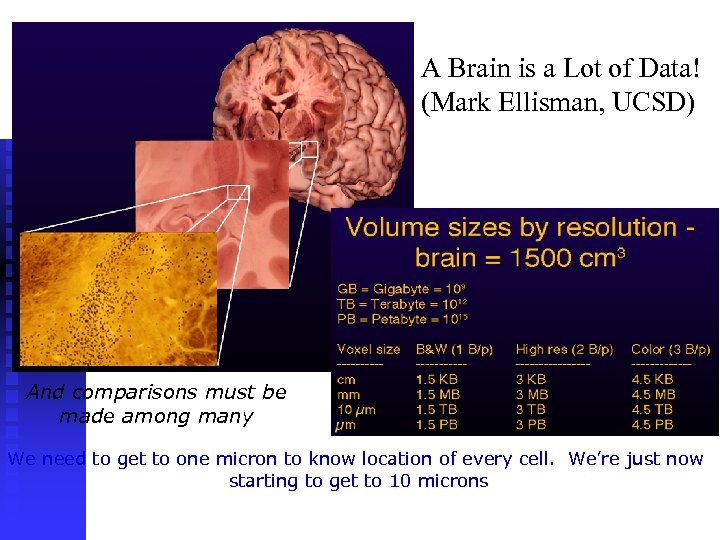
A Brain is a Lot of Data! (Mark Ellisman, UCSD) And comparisons must be made among many We need to get to one micron to know location of every cell. We’re just now starting to get to 10 microns
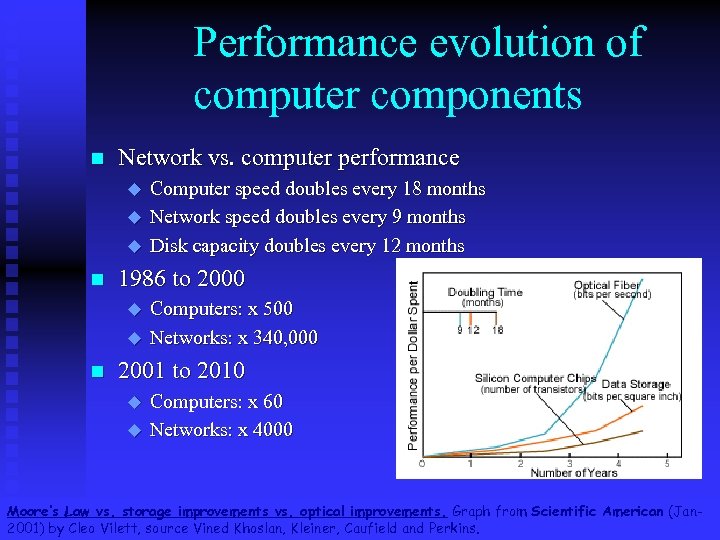
Performance evolution of computer components n Network vs. computer performance u u u n 1986 to 2000 u u n Computer speed doubles every 18 months Network speed doubles every 9 months Disk capacity doubles every 12 months Computers: x 500 Networks: x 340, 000 2001 to 2010 u u Computers: x 60 Networks: x 4000 Moore’s Law vs. storage improvements vs. optical improvements. Graph from Scientific American (Jan 2001) by Cleo Vilett, source Vined Khoslan, Kleiner, Caufield and Perkins.
Partial conclusion n It is not a phantasm ! n Real need for very high performance infrasatructures n Basic idea : share computing resources
Back to roots (routes) n n Railways, telephone, electricity, roads, bank system Complexity, standards, distribution, integration (large/small) Impact on the society : how US grown Big differences : u u clients (the citizens) are NOT providers (State or companies) small number of actors/providers small number of applications strong supervision/control
Computational grid n n « HW and SW infrastructure that provides dependable, consistent, pervasive and inexpensive access to high-end computational capabilities Performance criteria : u u u security reliability computing power latency services throughput
Applications n n n Distributed supercomputing High throughput computing On demand (real time) computing Data intensive computing Collaborative computing
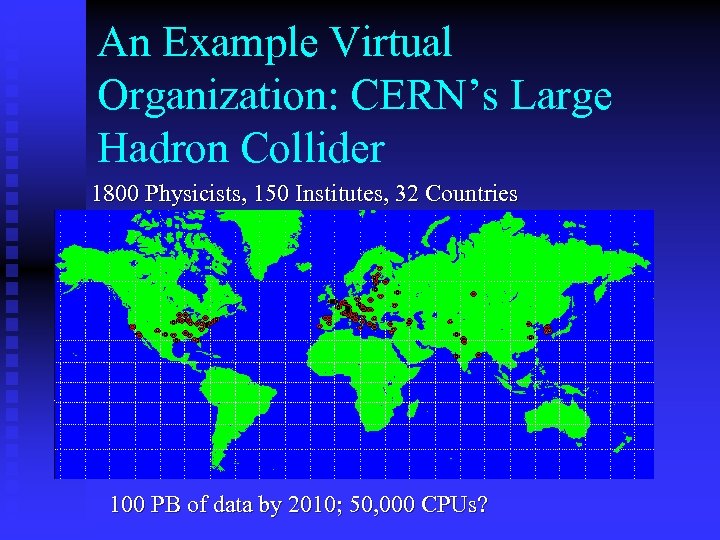
An Example Virtual Organization: CERN’s Large Hadron Collider 1800 Physicists, 150 Institutes, 32 Countries 100 PB of data by 2010; 50, 000 CPUs?
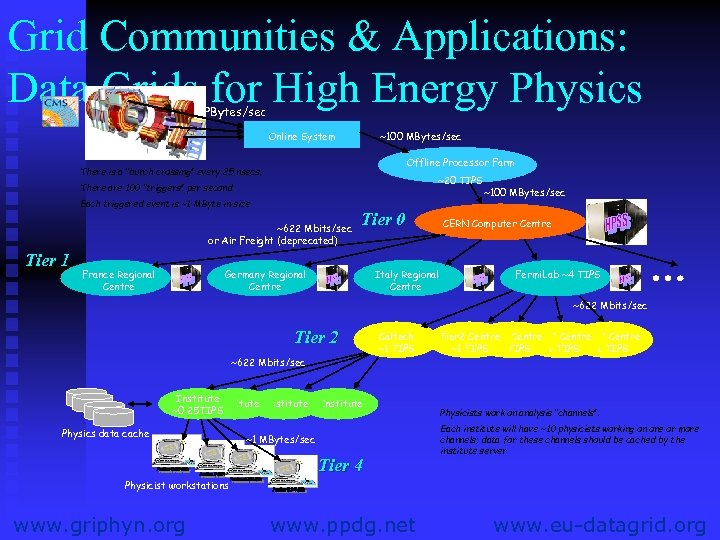
Grid Communities & Applications: Data Grids for High Energy Physics ~PBytes/sec Online System ~100 MBytes/sec Offline Processor Farm There is a “bunch crossing” every 25 nsecs. ~20 TIPS There are 100 “triggers” per second Each triggered event is ~1 MByte in size ~622 Mbits/sec or Air Freight (deprecated) Tier 1 France Regional Centre Tier 0 Germany Regional Centre Italy Regional Centre ~100 MBytes/sec CERN Computer Centre Fermi. Lab ~4 TIPS ~622 Mbits/sec Tier 2 ~622 Mbits/sec Institute ~0. 25 TIPS Physics data cache Caltech ~1 TIPS Institute ~1 MBytes/sec Tier 4 Tier 2 Centre Tier 2 Centre ~1 TIPS Physicists work on analysis “channels”. Each institute will have ~10 physicists working on one or more channels; data for these channels should be cached by the institute server Physicist workstations www. griphyn. org www. ppdg. net www. eu-datagrid. org
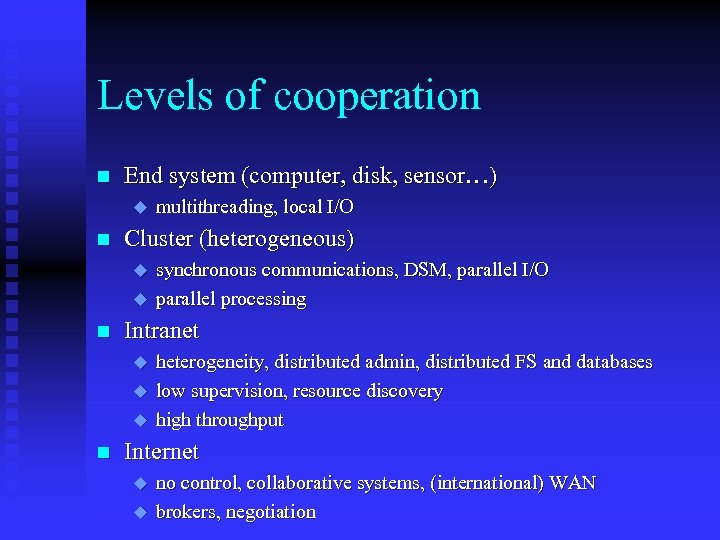
Levels of cooperation n End system (computer, disk, sensor…) u n Cluster (heterogeneous) u u n synchronous communications, DSM, parallel I/O parallel processing Intranet u u u n multithreading, local I/O heterogeneity, distributed admin, distributed FS and databases low supervision, resource discovery high throughput Internet u u no control, collaborative systems, (international) WAN brokers, negotiation
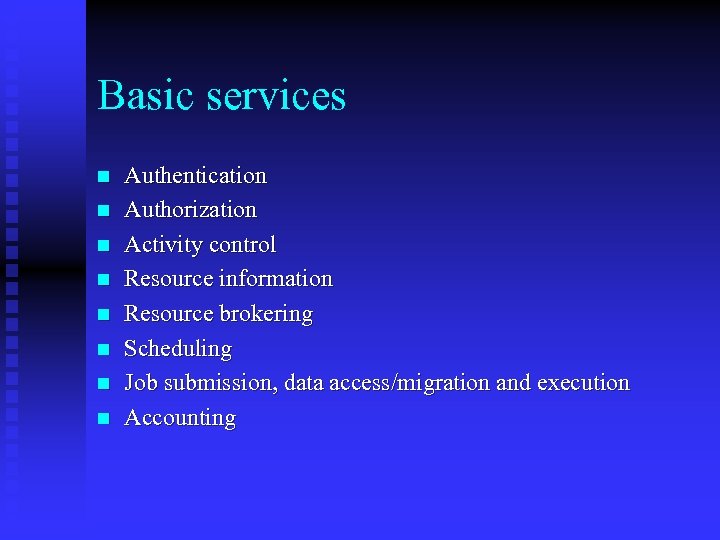
Basic services n n n n Authentication Authorization Activity control Resource information Resource brokering Scheduling Job submission, data access/migration and execution Accounting
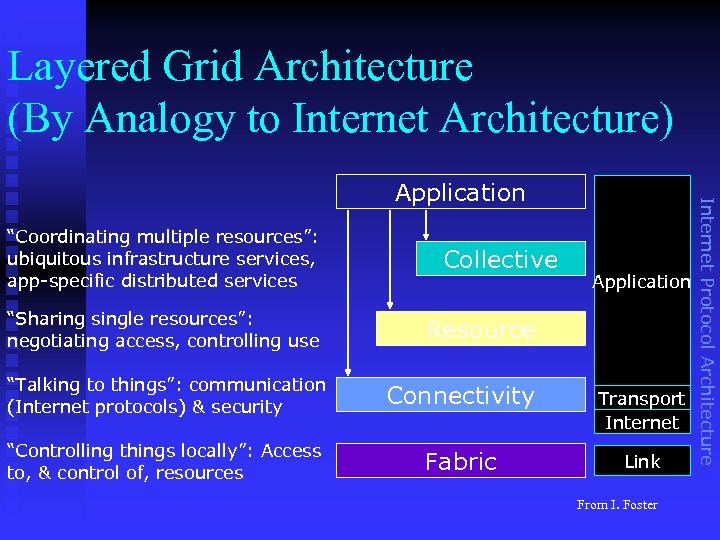
Layered Grid Architecture (By Analogy to Internet Architecture) “Coordinating multiple resources”: ubiquitous infrastructure services, app-specific distributed services “Sharing single resources”: negotiating access, controlling use Collective Application Resource “Talking to things”: communication (Internet protocols) & security Connectivity Transport Internet “Controlling things locally”: Access to, & control of, resources Fabric Link From I. Foster Internet Protocol Architecture Application
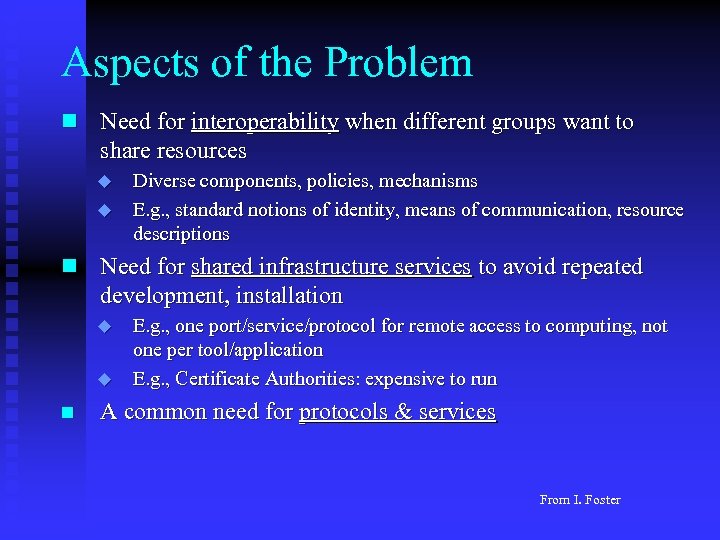
Aspects of the Problem n Need for interoperability when different groups want to share resources u u Diverse components, policies, mechanisms E. g. , standard notions of identity, means of communication, resource descriptions n Need for shared infrastructure services to avoid repeated development, installation u u n E. g. , one port/service/protocol for remote access to computing, not one per tool/application E. g. , Certificate Authorities: expensive to run A common need for protocols & services From I. Foster
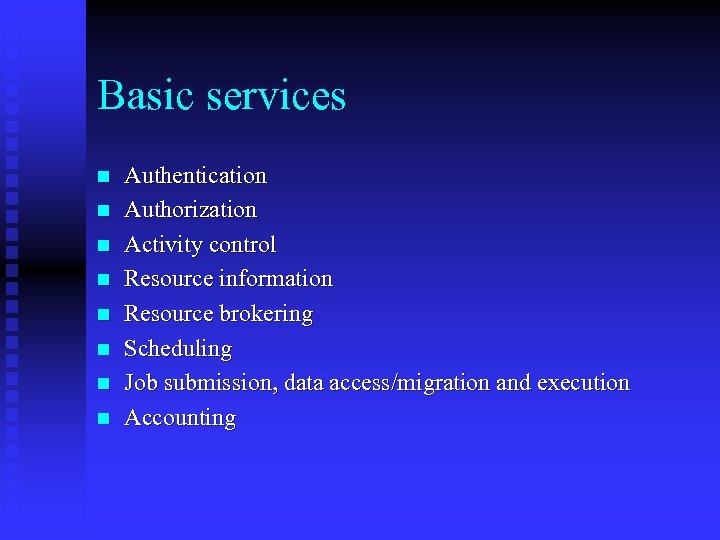
Basic services n n n n Authentication Authorization Activity control Resource information Resource brokering Scheduling Job submission, data access/migration and execution Accounting
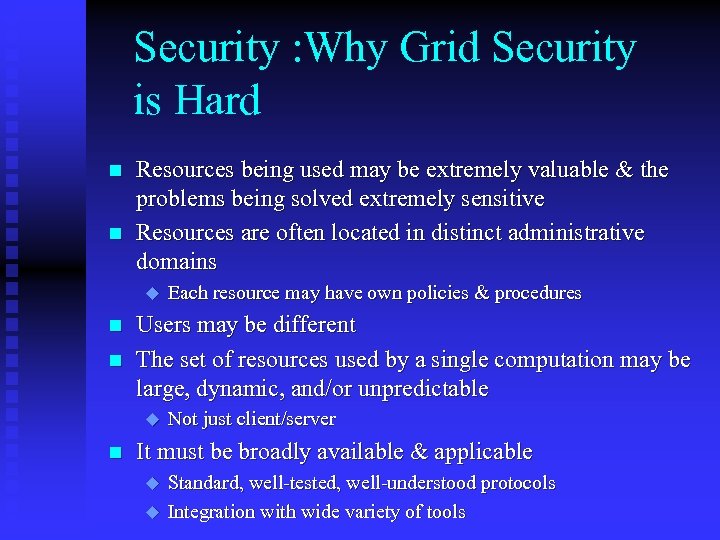
Security : Why Grid Security is Hard n n Resources being used may be extremely valuable & the problems being solved extremely sensitive Resources are often located in distinct administrative domains u n n Users may be different The set of resources used by a single computation may be large, dynamic, and/or unpredictable u n Each resource may have own policies & procedures Not just client/server It must be broadly available & applicable u u Standard, well-tested, well-understood protocols Integration with wide variety of tools
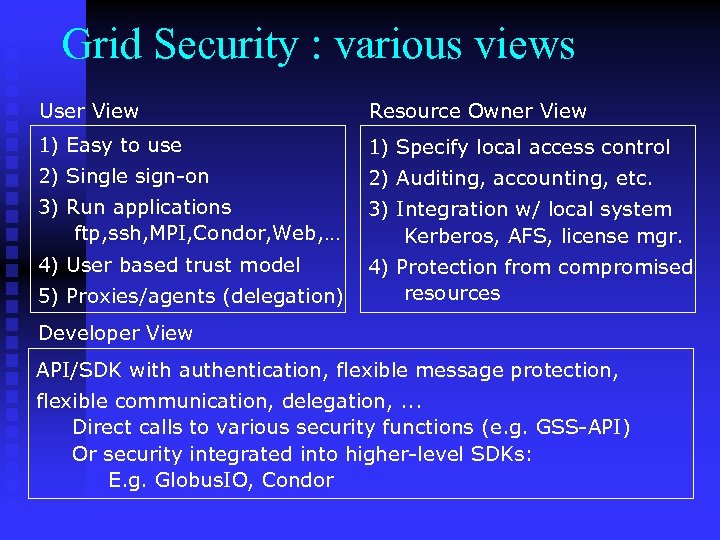
Grid Security : various views User View Resource Owner View 1) Easy to use 1) Specify local access control 2) Single sign-on 2) Auditing, accounting, etc. 3) Run applications ftp, ssh, MPI, Condor, Web, … 3) Integration w/ local system Kerberos, AFS, license mgr. 4) User based trust model 4) Protection from compromised resources 5) Proxies/agents (delegation) Developer View API/SDK with authentication, flexible message protection, flexible communication, delegation, . . . Direct calls to various security functions (e. g. GSS-API) Or security integrated into higher-level SDKs: E. g. Globus. IO, Condor
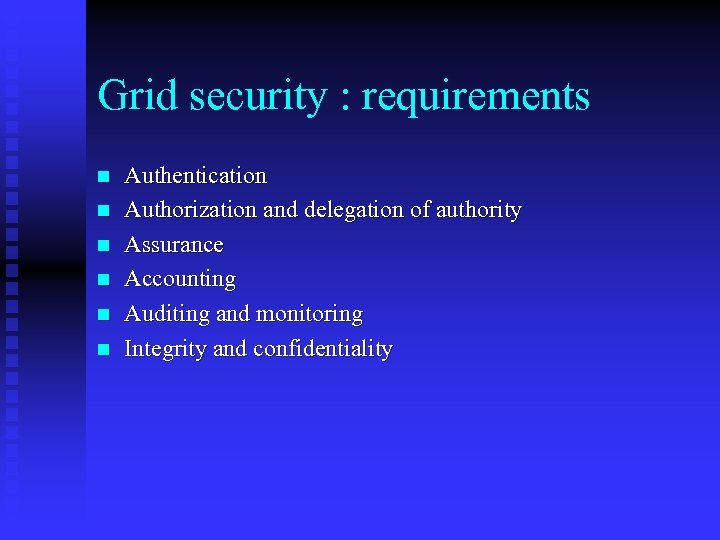
Grid security : requirements n n n Authentication Authorization and delegation of authority Assurance Accounting Auditing and monitoring Integrity and confidentiality
Resources n n n n Description Advertising Cataloging Matching Claiming Reserving Checkpointing
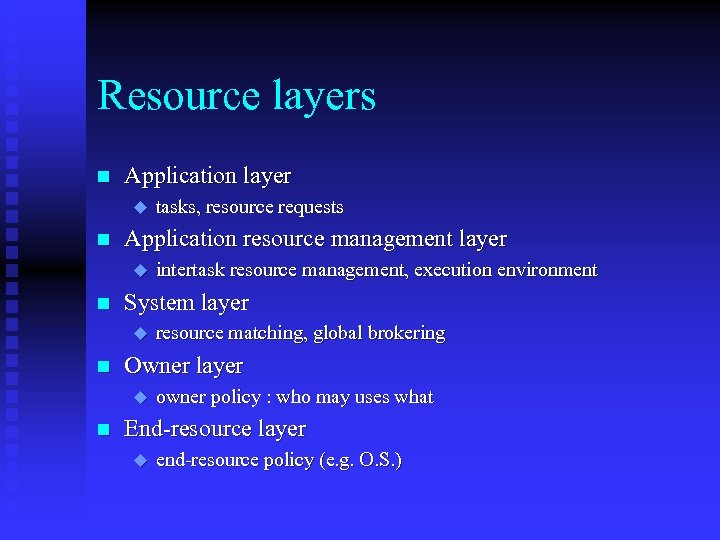
Resource layers n Application layer u n Application resource management layer u n resource matching, global brokering Owner layer u n intertask resource management, execution environment System layer u n tasks, resource requests owner policy : who may uses what End-resource layer u end-resource policy (e. g. O. S. )
Resource management (1) n n Services and protocols depend on the infrastructure Some parameters u u n stability of the infrastructure (same set of resources or not) freshness of the resource availability information reservation facilities multiple resource or single resource brokering Example request : I need from 10 to 100 CE each with at least 128 MB RAM and a computing power of 50 Mips
Resource management (2) n Figure : the structure of a RMS. . .
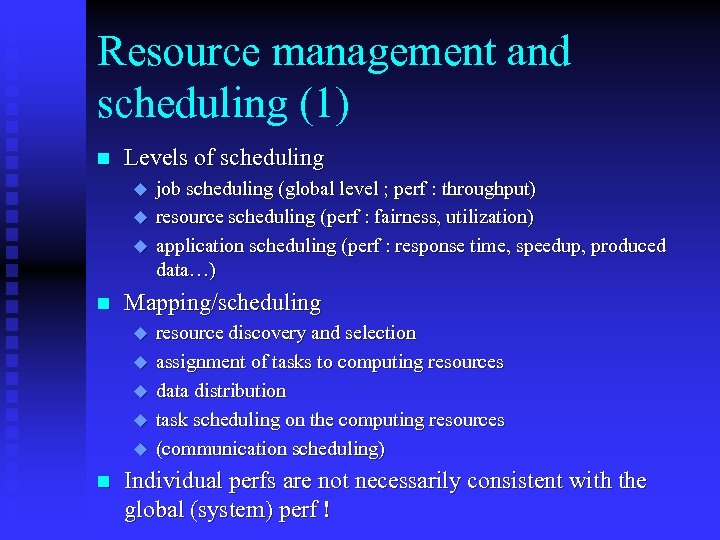
Resource management and scheduling (1) n Levels of scheduling u u u n Mapping/scheduling u u u n job scheduling (global level ; perf : throughput) resource scheduling (perf : fairness, utilization) application scheduling (perf : response time, speedup, produced data…) resource discovery and selection assignment of tasks to computing resources data distribution task scheduling on the computing resources (communication scheduling) Individual perfs are not necessarily consistent with the global (system) perf !
Resource management and scheduling (2) n Grid problems u u u predictions are not definitive : dynamicity ! Heterogeneous platforms Checkpointing and migration
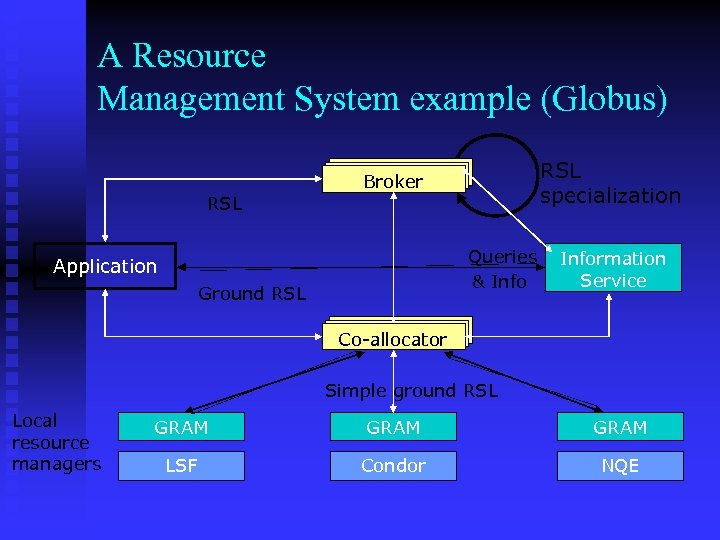
A Resource Management System example (Globus) RSL specialization Broker RSL Queries & Info Application Ground RSL Information Service Co-allocator Simple ground RSL Local resource managers GRAM LSF Condor NQE
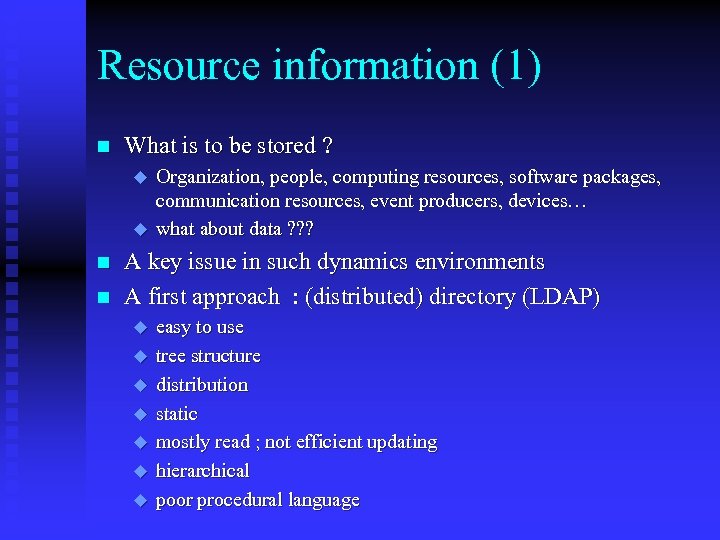
Resource information (1) n What is to be stored ? u u n n Organization, people, computing resources, software packages, communication resources, event producers, devices… what about data ? ? ? A key issue in such dynamics environments A first approach : (distributed) directory (LDAP) u u u u easy to use tree structure distribution static mostly read ; not efficient updating hierarchical poor procedural language
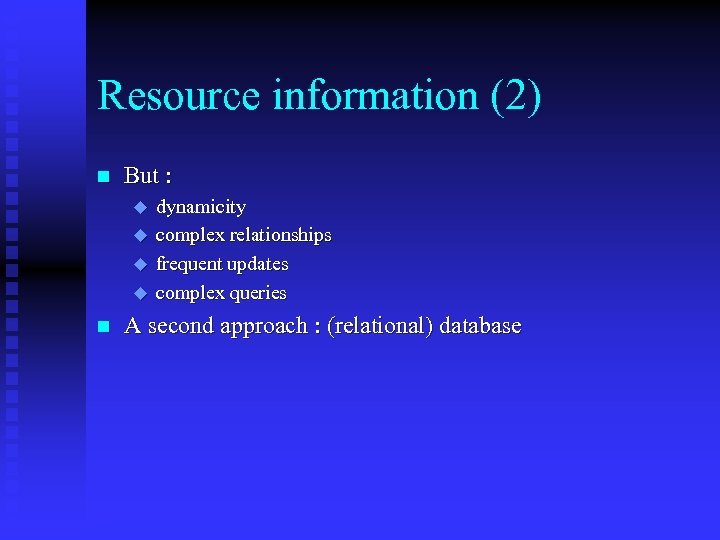
Resource information (2) n But : u u n dynamicity complex relationships frequent updates complex queries A second approach : (relational) database
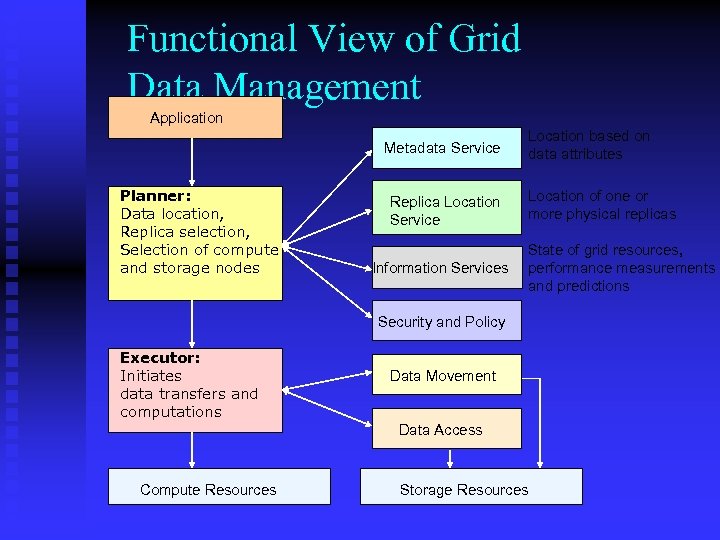
Data management n n n It was long forgotten !!! Though it is a key issue ! Issues : u u u n indexing retrieval replication caching traceability (auditing) And security !!!
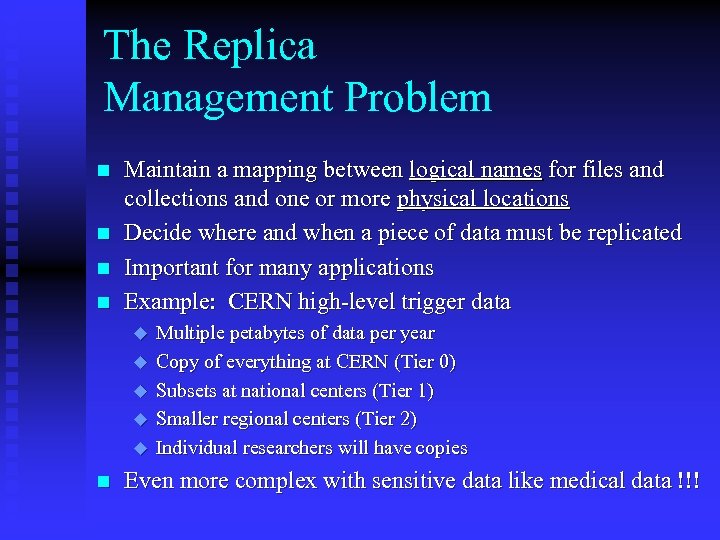
The Replica Management Problem n n Maintain a mapping between logical names for files and collections and one or more physical locations Decide where and when a piece of data must be replicated Important for many applications Example: CERN high-level trigger data u u u n Multiple petabytes of data per year Copy of everything at CERN (Tier 0) Subsets at national centers (Tier 1) Smaller regional centers (Tier 2) Individual researchers will have copies Even more complex with sensitive data like medical data !!!
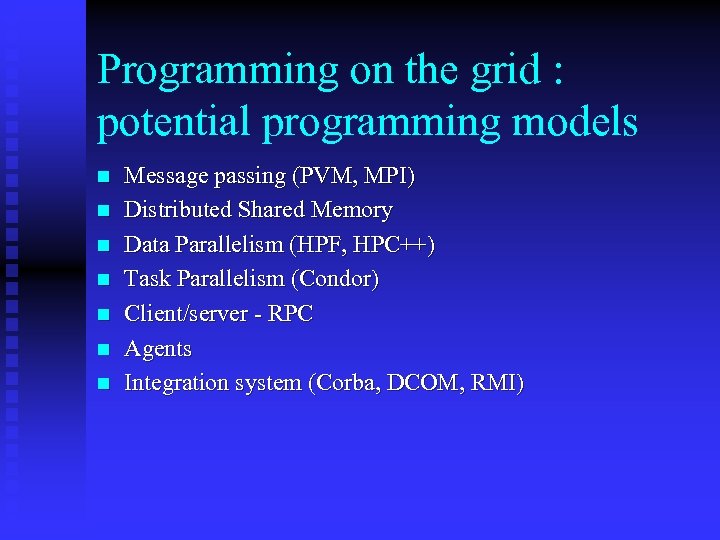
Programming on the grid : potential programming models n n n n Message passing (PVM, MPI) Distributed Shared Memory Data Parallelism (HPF, HPC++) Task Parallelism (Condor) Client/server - RPC Agents Integration system (Corba, DCOM, RMI)
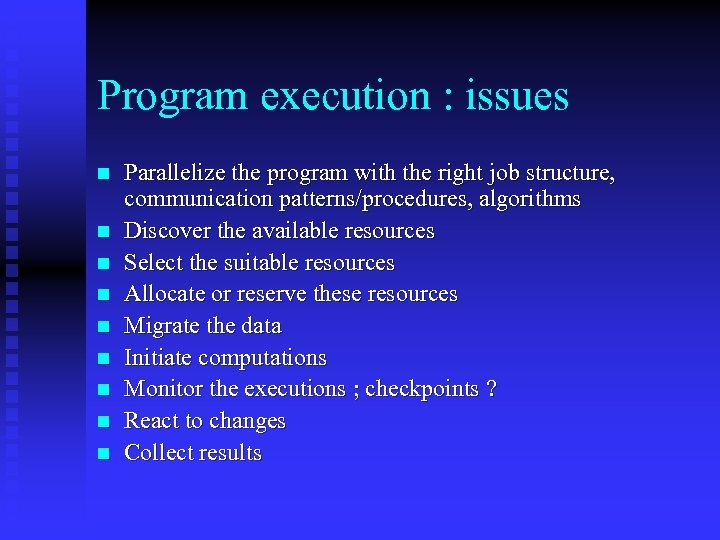
Program execution : issues n n n n n Parallelize the program with the right job structure, communication patterns/procedures, algorithms Discover the available resources Select the suitable resources Allocate or reserve these resources Migrate the data Initiate computations Monitor the executions ; checkpoints ? React to changes Collect results
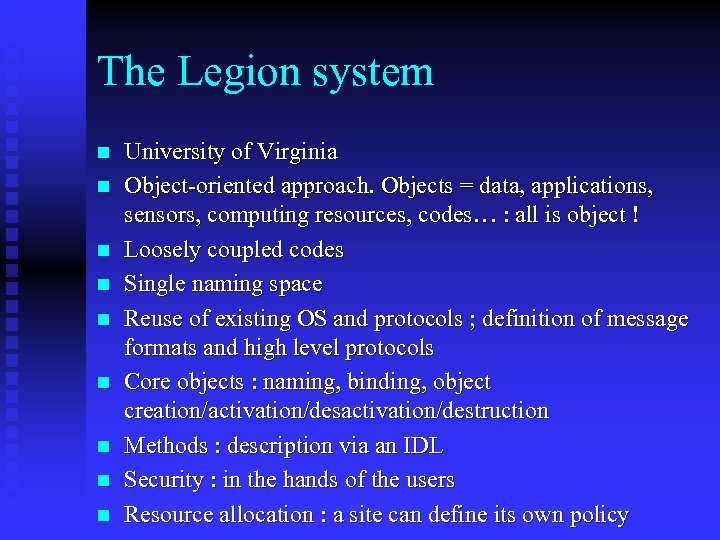
The Legion system n n n n n University of Virginia Object-oriented approach. Objects = data, applications, sensors, computing resources, codes… : all is object ! Loosely coupled codes Single naming space Reuse of existing OS and protocols ; definition of message formats and high level protocols Core objects : naming, binding, object creation/activation/destruction Methods : description via an IDL Security : in the hands of the users Resource allocation : a site can define its own policy
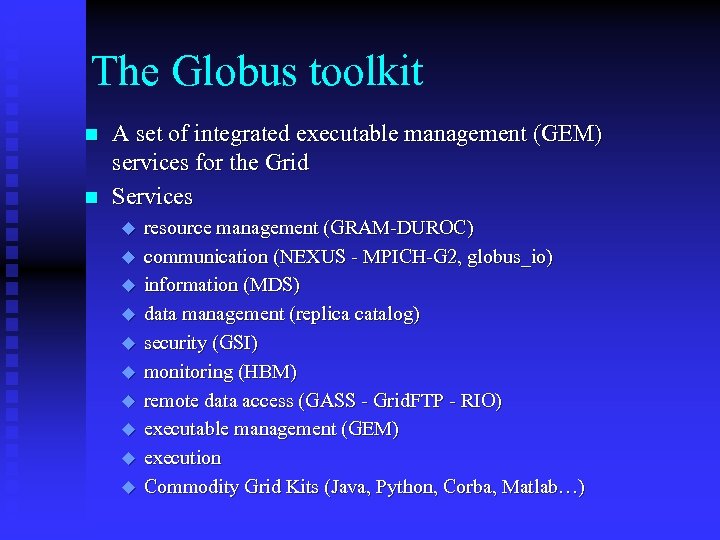
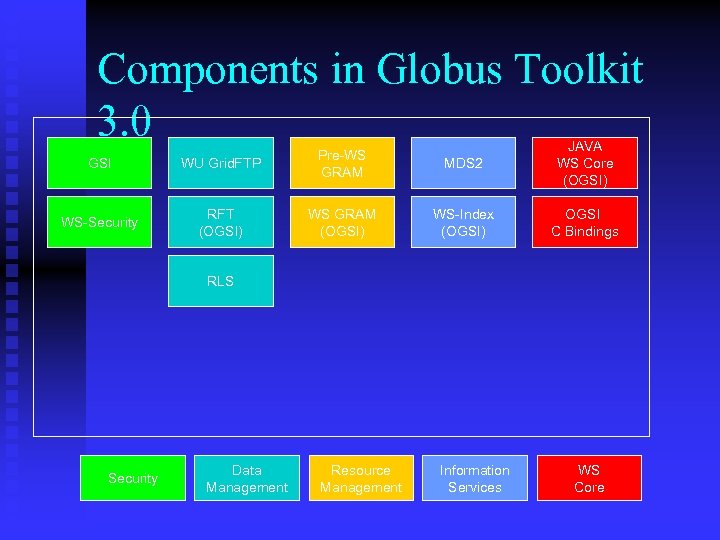
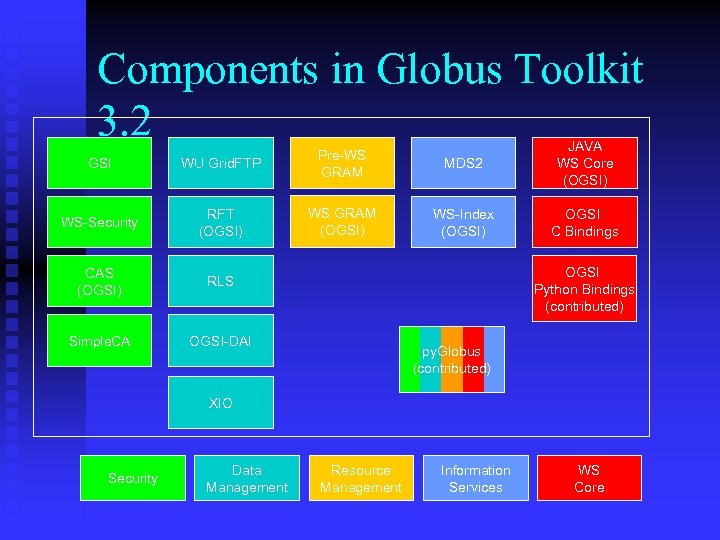
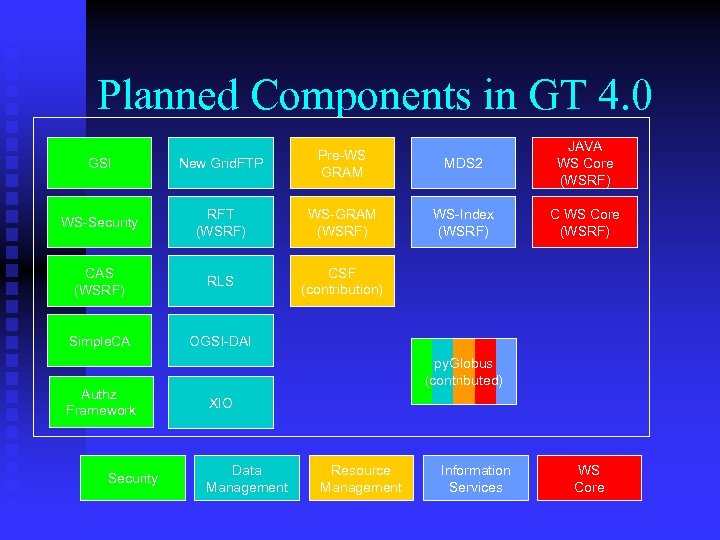
The Globus toolkit n n A set of integrated executable management (GEM) services for the Grid Services u u u u u resource management (GRAM-DUROC) communication (NEXUS - MPICH-G 2, globus_io) information (MDS) data management (replica catalog) security (GSI) monitoring (HBM) remote data access (GASS - Grid. FTP - RIO) executable management (GEM) execution Commodity Grid Kits (Java, Python, Corba, Matlab…)
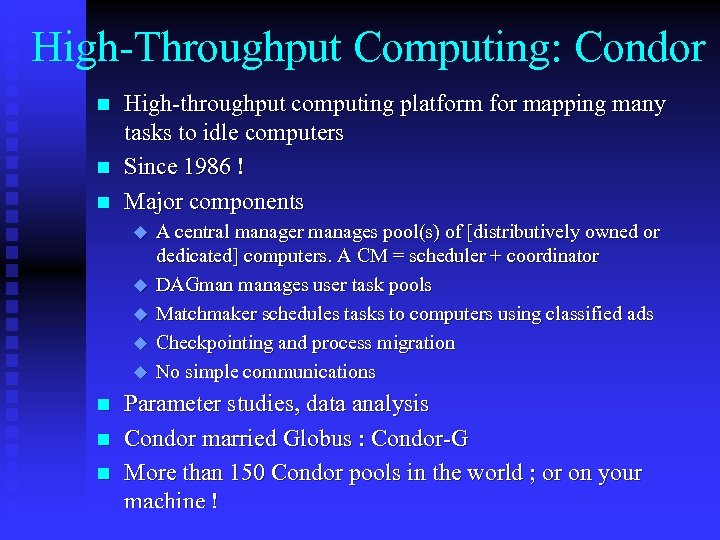
High-Throughput Computing: Condor n n n High-throughput computing platform for mapping many tasks to idle computers Since 1986 ! Major components u u u n n n A central manager manages pool(s) of [distributively owned or dedicated] computers. A CM = scheduler + coordinator DAGman manages user task pools Matchmaker schedules tasks to computers using classified ads Checkpointing and process migration No simple communications Parameter studies, data analysis Condor married Globus : Condor-G More than 150 Condor pools in the world ; or on your machine !
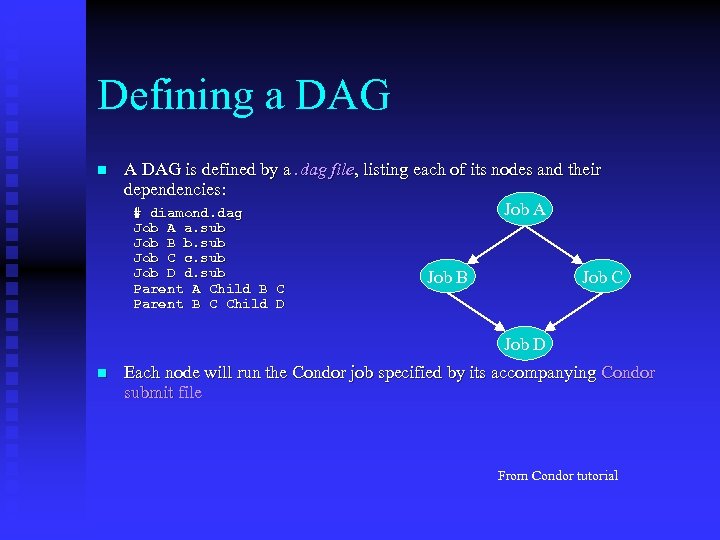
Defining a DAG n A DAG is defined by a. dag file, listing each of its nodes and their dependencies: Job A # diamond. dag Job A a. sub Job B b. sub Job C c. sub Job D d. sub Parent A Child B C Parent B C Child D Job B Job C Job D n Each node will run the Condor job specified by its accompanying Condor submit file From Condor tutorial
Conclusion n Just a new toy for scientists or a revolution ? Complexity from heterogeneity, wide distribution, security, dynamicity Many approaches n Still much work to do !!! n A global framework for grid computing, pervasive computing and Web services ? n n
Functional View of Grid Data Management Application Metadata Service Planner: Data location, Replica selection, Selection of compute and storage nodes Replica Location Service Information Services Location based on data attributes Location of one or more physical replicas State of grid resources, performance measurements and predictions Security and Policy Executor: Initiates data transfers and computations Data Movement Data Access Compute Resources Storage Resources
Components in Globus Toolkit 3. 0 GSI WU Grid. FTP Pre-WS GRAM WS-Security RFT (OGSI) WS GRAM (OGSI) MDS 2 JAVA WS Core (OGSI) WS-Index (OGSI) OGSI C Bindings RLS Security Data Management Resource Management Information Services WS Core
Components in Globus Toolkit 3. 2 GSI WU Grid. FTP Pre-WS GRAM WS-Security RFT (OGSI) WS GRAM (OGSI) CAS (OGSI) OGSI-DAI WS-Index (OGSI) OGSI C Bindings RLS Simple. CA MDS 2 JAVA WS Core (OGSI) OGSI Python Bindings (contributed) py. Globus (contributed) XIO Security Data Management Resource Management Information Services WS Core
Planned Components in GT 4. 0 GSI New Grid. FTP Pre-WS GRAM WS-Security RFT (WSRF) WS-GRAM (WSRF) CAS (WSRF) RLS WS-Index (WSRF) C WS Core (WSRF) CSF (contribution) Simple. CA MDS 2 JAVA WS Core (WSRF) OGSI-DAI Authz Framework Security py. Globus (contributed) XIO Data Management Resource Management Information Services WS Core
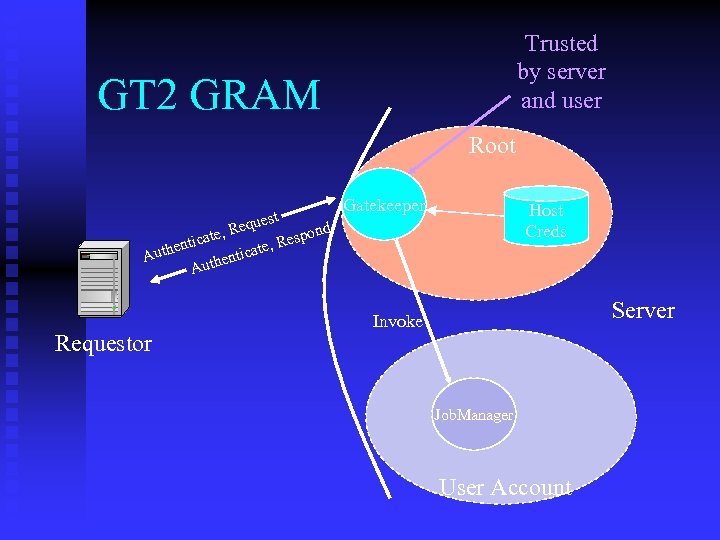
Trusted by server and user GT 2 GRAM Root est Requ nd e, espo ticat en te, R Auth ntica e Auth Requestor Gatekeeper Host Creds Server Invoke Job. Manager User Account
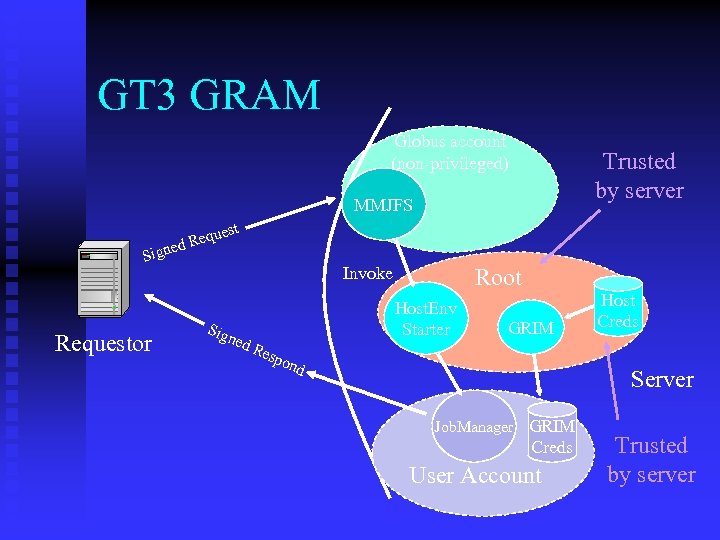
GT 3 GRAM Globus account (non-privileged) Trusted by server MMJFS est qu d Re ne Sig Requestor Invoke Sig ned Root Re Host. Env Starter GRIM spo nd Host Creds Server Job. Manager GRIM Creds User Account Trusted by server
GT 4 GRAM n http: //wwwunix. globus. org/toolkit/docs/3. 2/gram/ws/developer/archite cture. html
Скачать презентацию Grid computing an introduction Lionel Brunie Institut
a1c1424d7489906b14be6f11bd87feb9.ppt