


 Скачать презентацию Grid Computing 3 Special Topics in Computer Engineering
67dc843300268c7ebf1fb709ce638998.ppt
- Количество слайдов: 73
 Grid Computing (3) (Special Topics in Computer Engineering) Veera Muangsin 13 February 200 4 1
 Outline • • High-Performance Computing Grid Applications Grid Architecture • Grid Middleware • Grid Services 2
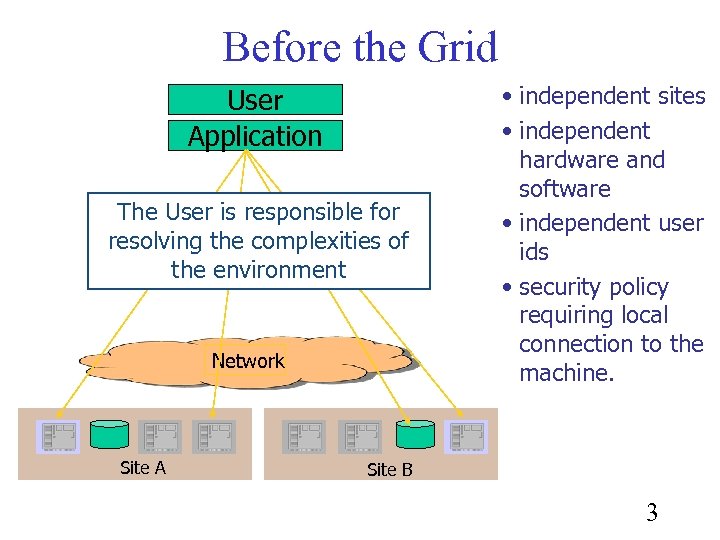 Before the Grid User Application The User is responsible for resolving the complexities of the environment Network Site A • independent sites • independent hardware and software • independent user ids • security policy requiring local connection to the machine. Site B 3
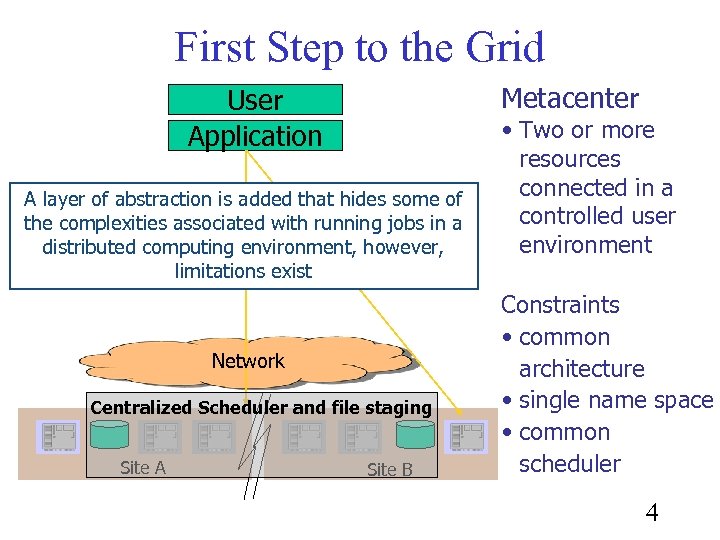 First Step to the Grid Metacenter User Application A layer of abstraction is added that hides some of the complexities associated with running jobs in a distributed computing environment, however, limitations exist Network Centralized Scheduler and file staging Site A Site B • Two or more resources connected in a controlled user environment Constraints • common architecture • single name space • common scheduler 4
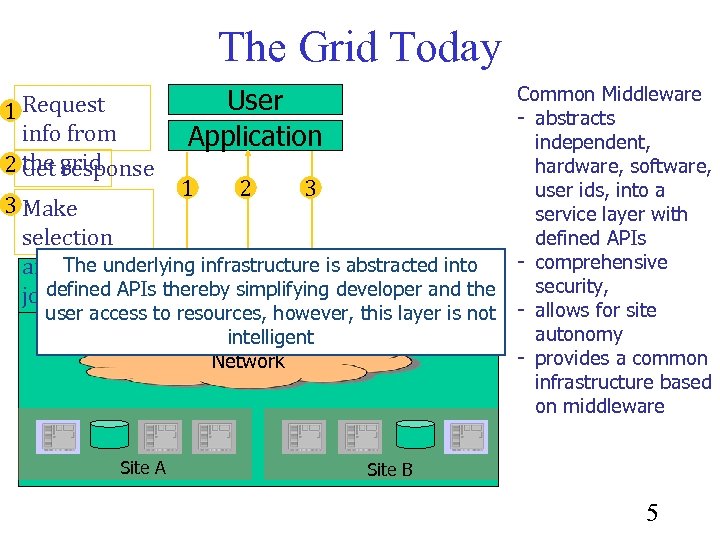 The Grid Today 1 Request info from the response 2 Get grid User Application 1 2 3 3 Make selection and The underlying infrastructure is abstracted into submit defined APIs. Grid Middleware thereby simplifying developer and the job user access to resources, however, this layer is not Infrastructure intelligent Network Site A Common Middleware - abstracts independent, hardware, software, user ids, into a service layer with defined APIs - comprehensive security, - allows for site autonomy - provides a common infrastructure based on middleware Site B 5
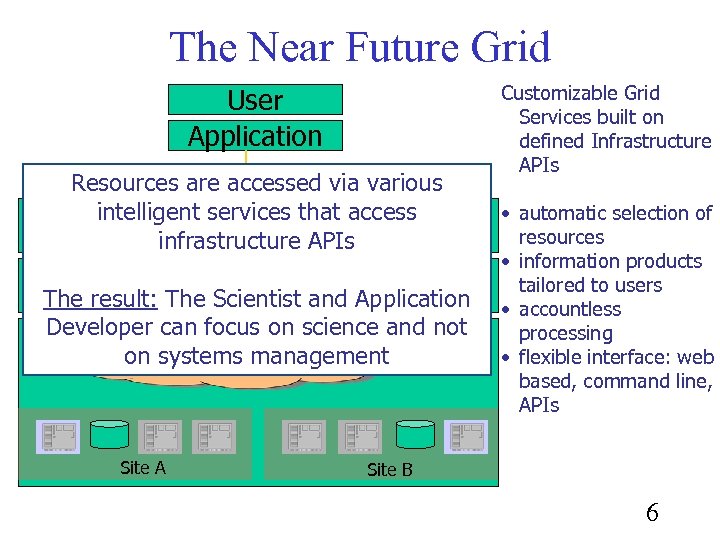 The Near Future Grid User Application Resources are accessed via various intelligent services that access Intelligent, Customized Middleware infrastructure APIs Grid Middleware - Infrastructure APIs The result: The (service oriented) and Application Scientist Developer can Infrastructure focus on science and not on systems management Network Site A Customizable Grid Services built on defined Infrastructure APIs • automatic selection of resources • information products tailored to users • accountless processing • flexible interface: web based, command line, APIs Site B 6
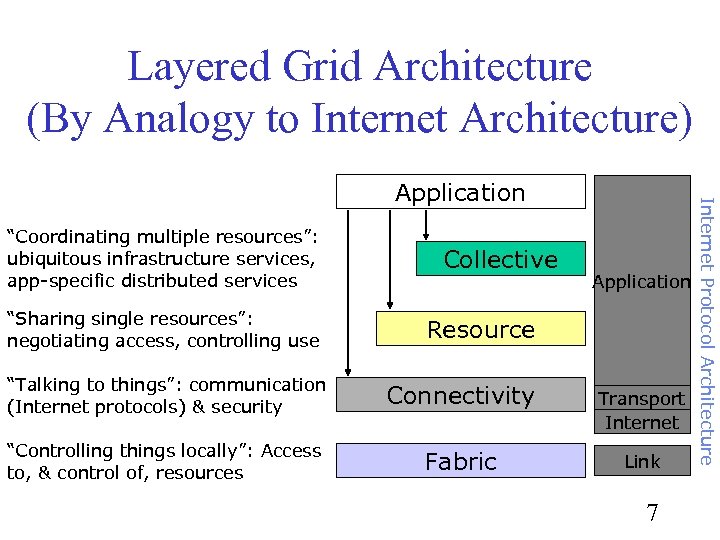 Layered Grid Architecture (By Analogy to Internet Architecture) “Coordinating multiple resources”: ubiquitous infrastructure services, app-specific distributed services “Sharing single resources”: negotiating access, controlling use Collective Application Resource “Talking to things”: communication (Internet protocols) & security Connectivity Transport Internet “Controlling things locally”: Access to, & control of, resources Fabric Link 7 Internet Protocol Architecture Application
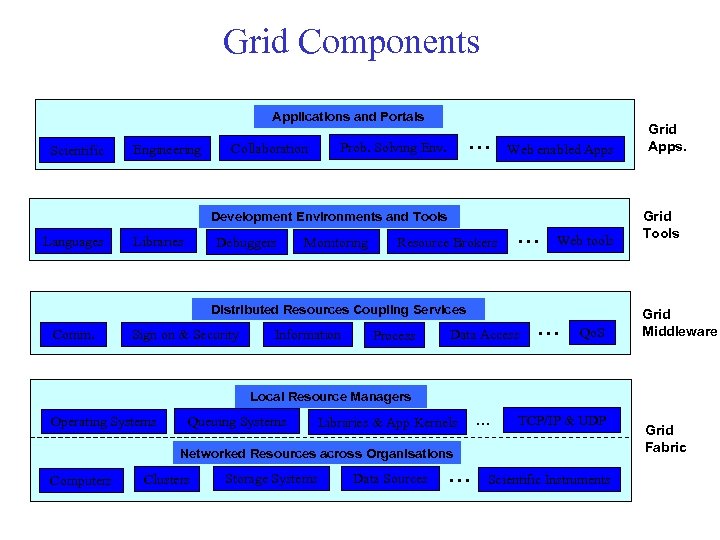 Grid Components Applications and Portals Scientific Engineering … Prob. Solving Env. Collaboration Development Environments and Tools Languages Libraries Debuggers Monitoring Resource Brokers Web enabled Apps … Distributed Resources Coupling Services Comm. Sign on & Security Information Process Data Access Web tools … Qo. S Grid Apps. Grid Tools Grid Middleware Local Resource Managers Operating Systems Queuing Systems Libraries & App Kernels … TCP/IP & UDP Networked Resources across Organisations Computers Clusters Storage Systems Data Sources … Scientific Instruments Grid Fabric
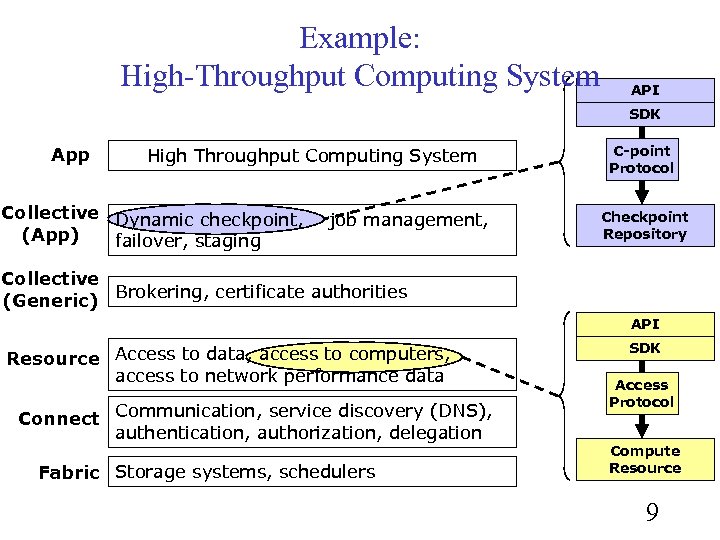 Example: High-Throughput Computing System API SDK App High Throughput Computing System Collective Dynamic checkpoint, (App) failover, staging job management, C-point Protocol Checkpoint Repository Collective Brokering, certificate authorities (Generic) API Resource Access to data, access to computers, access to network performance data Connect Communication, service discovery (DNS), authentication, authorization, delegation Fabric Storage systems, schedulers SDK Access Protocol Compute Resource 9
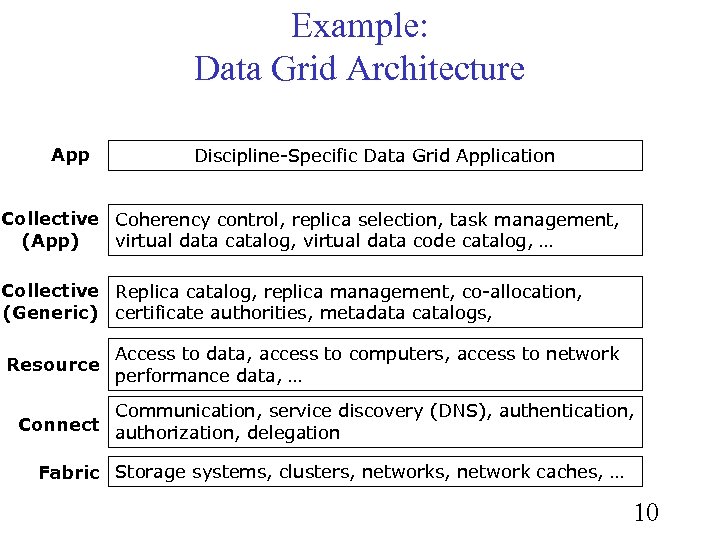 Example: Data Grid Architecture App Discipline-Specific Data Grid Application Collective Coherency control, replica selection, task management, (App) virtual data catalog, virtual data code catalog, … Collective Replica catalog, replica management, co-allocation, (Generic) certificate authorities, metadata catalogs, Resource Access to data, access to computers, access to network performance data, … Communication, service discovery (DNS), authentication, Connect authorization, delegation Fabric Storage systems, clusters, network caches, … 10
 Globus Toolkit • Grid computing middleware – Software between the hardware and high-level services – Basic libraries, services, command-line programs • Most common middleware used in grids • Integrated with Web Service 11
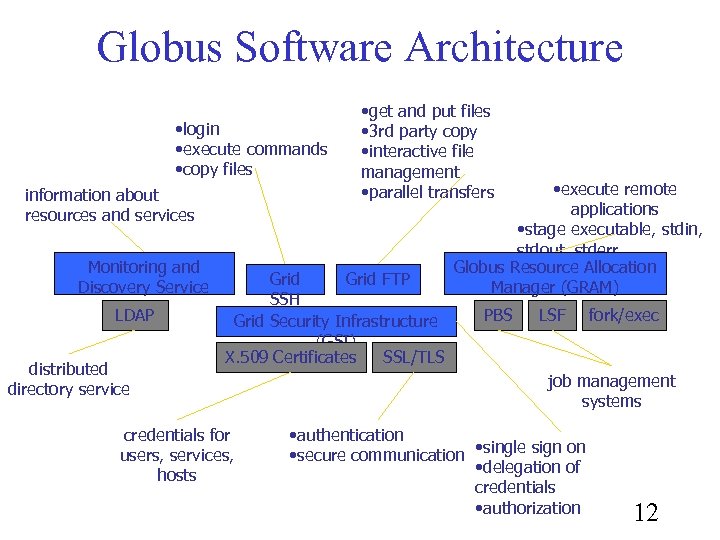 Globus Software Architecture • login • execute commands • copy files information about resources and services Monitoring and Discovery Service (MDS) LDAP distributed directory service • get and put files • 3 rd party copy • interactive file management • parallel transfers Grid FTP SSH Grid Security Infrastructure (GSI) X. 509 Certificates SSL/TLS credentials for users, services, hosts • execute remote applications • stage executable, stdin, stdout, stderr Globus Resource Allocation Manager (GRAM) PBS LSF fork/exec job management systems • authentication • secure communication • single sign on • delegation of credentials • authorization 12
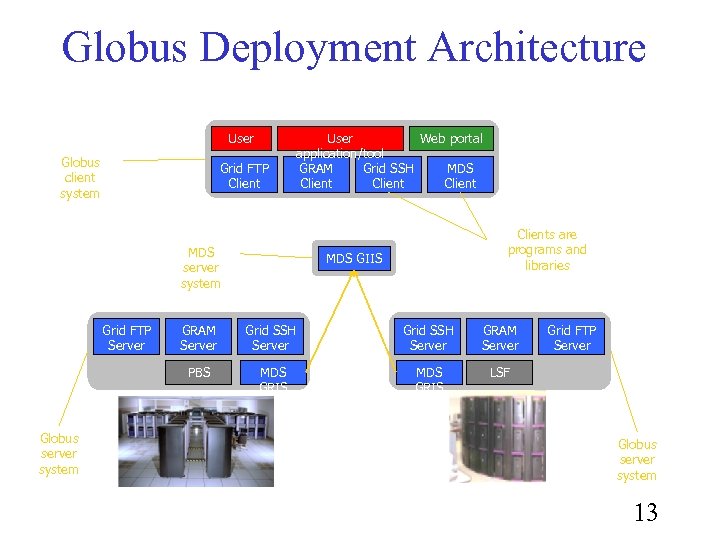 Globus Deployment Architecture User Globus client system Grid FTP Client User Web portal application/tool GRAM Grid SSH MDS Client MDS server system Grid FTP Server Clients are programs and libraries MDS GIIS Grid SSH Server GRAM Server PBS Globus server system GRAM Server MDS GRIS Grid FTP Server LSF Globus server system 13
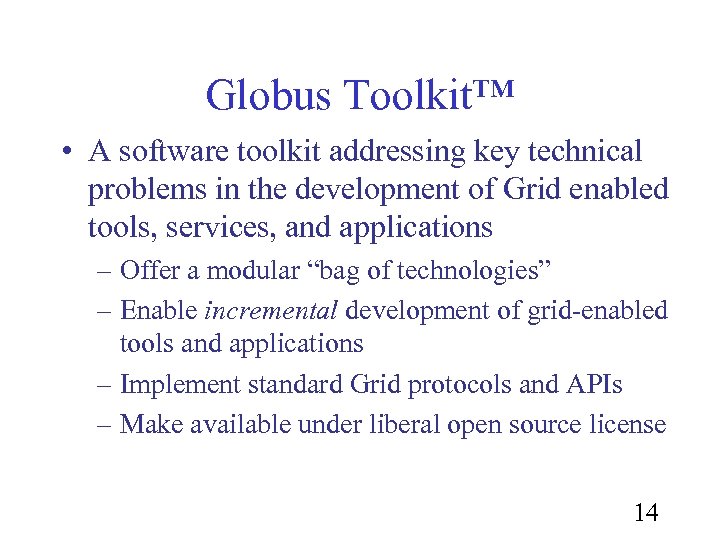 Globus Toolkit™ • A software toolkit addressing key technical problems in the development of Grid enabled tools, services, and applications – Offer a modular “bag of technologies” – Enable incremental development of grid-enabled tools and applications – Implement standard Grid protocols and APIs – Make available under liberal open source license 14
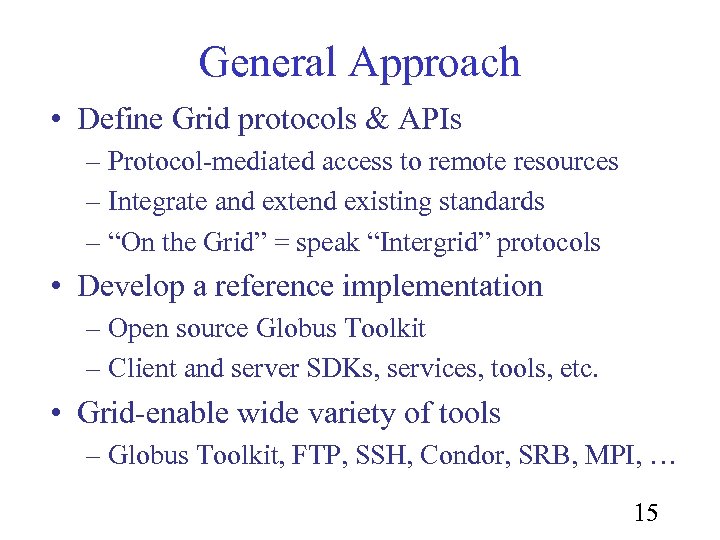 General Approach • Define Grid protocols & APIs – Protocol-mediated access to remote resources – Integrate and extend existing standards – “On the Grid” = speak “Intergrid” protocols • Develop a reference implementation – Open source Globus Toolkit – Client and server SDKs, services, tools, etc. • Grid-enable wide variety of tools – Globus Toolkit, FTP, SSH, Condor, SRB, MPI, … 15
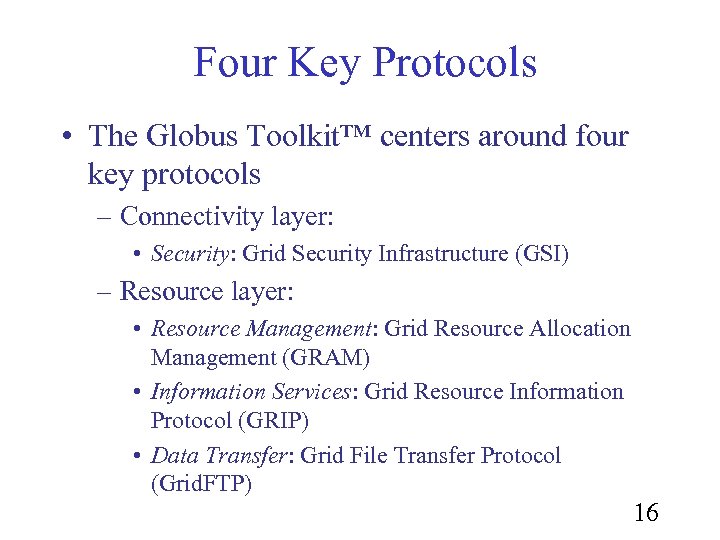 Four Key Protocols • The Globus Toolkit™ centers around four key protocols – Connectivity layer: • Security: Grid Security Infrastructure (GSI) – Resource layer: • Resource Management: Grid Resource Allocation Management (GRAM) • Information Services: Grid Resource Information Protocol (GRIP) • Data Transfer: Grid File Transfer Protocol (Grid. FTP) 16
 The Globus Toolkit™: Security Services The Globus Project™ Argonne National Laboratory USC Information Sciences Institute http: //www. globus. org 17
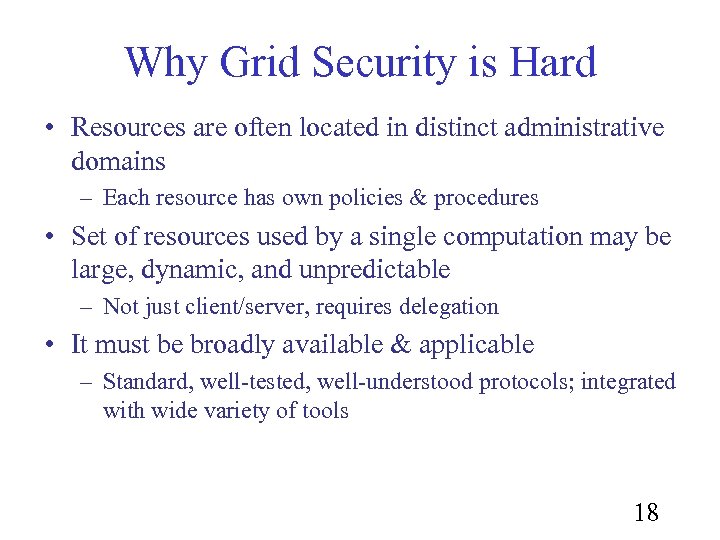 Why Grid Security is Hard • Resources are often located in distinct administrative domains – Each resource has own policies & procedures • Set of resources used by a single computation may be large, dynamic, and unpredictable – Not just client/server, requires delegation • It must be broadly available & applicable – Standard, well-tested, well-understood protocols; integrated with wide variety of tools 18
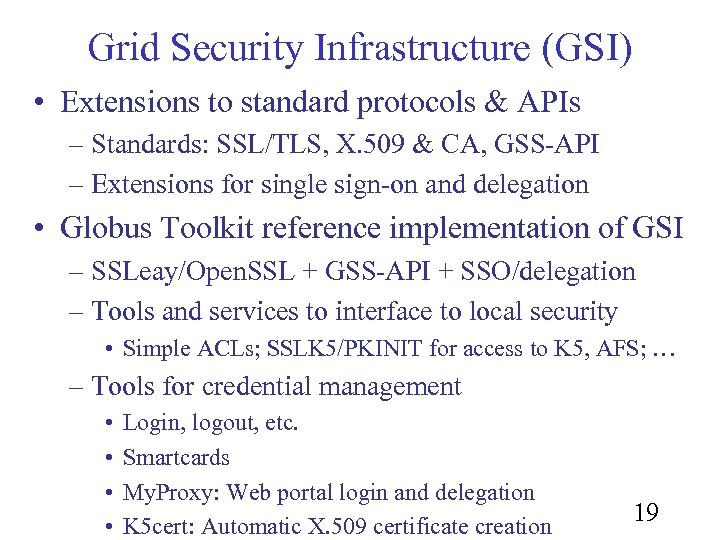 Grid Security Infrastructure (GSI) • Extensions to standard protocols & APIs – Standards: SSL/TLS, X. 509 & CA, GSS-API – Extensions for single sign-on and delegation • Globus Toolkit reference implementation of GSI – SSLeay/Open. SSL + GSS-API + SSO/delegation – Tools and services to interface to local security • Simple ACLs; SSLK 5/PKINIT for access to K 5, AFS; … – Tools for credential management • • Login, logout, etc. Smartcards My. Proxy: Web portal login and delegation K 5 cert: Automatic X. 509 certificate creation 19
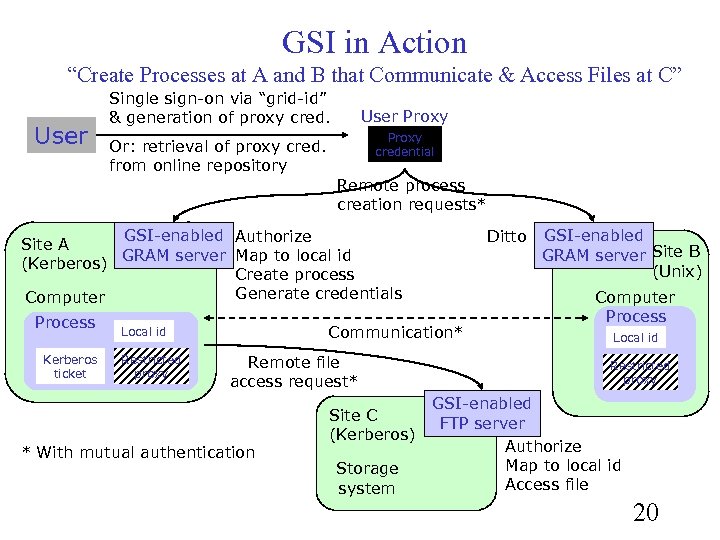 GSI in Action “Create Processes at A and B that Communicate & Access Files at C” User Single sign-on via “grid-id” & generation of proxy cred. User Proxy credential Or: retrieval of proxy cred. from online repository Remote process creation requests* GSI-enabled Authorize Site A GRAM server Map to local id (Kerberos) Create process Generate credentials Computer Process Kerberos ticket Communication* Local id Restricted proxy Ditto Remote file access request* * With mutual authentication Site C (Kerberos) Storage system GSI-enabled GRAM server Site B (Unix) Computer Process Local id Restricted proxy GSI-enabled FTP server Authorize Map to local id Access file 20
 Review of Public Key Cryptography • Asymmetric keys – A private key is used to encrypt data. – A public key can decrypt data encrypted with the private key. • An X. 509 certificate includes… – Someone’s subject name (user ID) – Their public key – A “signature” from a Certificate Authority (CA) that: • Proves that the certificate came from the CA. • Vouches for the subject name • Vouches for the binding of the public key to the subject 21
 Public Key Based Authentication • User sends certificate over the wire. • Other end sends user a challenge string. • User encodes the challenge string with private key – Possession of private key means you can authenticate as subject in certificate • Public key is used to decode the challenge. – If you can decode it, you know the subject • Treat your private key carefully!! – Private key is stored only in well-guarded places, and only in encrypted form 22
 User Proxies • Minimize exposure of user’s private key • A temporary, X. 509 proxy credential for use by our computations – We call this a user proxy certificate – Allows process to act on behalf of user – User-signed user proxy cert stored in local file – Created via “grid-proxy-init” command • Proxy’s private key is not encrypted – Rely on file system security, proxy certificate file must be readable only by the owner 23
 Delegation • Remote creation of a user proxy • Results in a new private key and X. 509 proxy certificate, signed by the original key • Allows remote process to act on behalf of the user • Avoids sending passwords or private keys across the network 24
 GSI Applications • Globus Toolkit™ uses GSI for authentication • Many Grid tools, directly or indirectly, e. g. – Condor-G, SRB, MPICH-G 2, Cactus, GDMP, … • Commercial and open source tools, e. g. – ssh, ftp, cvs, Open. LDAP, Open. AFS – Secure. CRT (Win 32 ssh client) • And since we use standard X. 509 certificates, they can also be used for – Web access, LDAP server access, etc. 25
 The Globus Toolkit™: Resource Management Services The Globus Project™ Argonne National Laboratory USC Information Sciences Institute http: //www. globus. org 26
 The Challenge • Enabling secure, controlled remote access to heterogeneous computational resources and management of remote computation – – Authentication and authorization Resource discovery & characterization Reservation and allocation Computation monitoring and control • Addressed by new protocols & services – GRAM protocol as a basic building block – Resource brokering & co-allocation services – GSI for security, MDS for discovery 27
 Resource Management • The Grid Resource Allocation Management (GRAM) protocol and client API allows programs to be started on remote resources, despite local heterogeneity • Resource Specification Language (RSL) is used to communicate requirements • A layered architecture allows applicationspecific resource brokers and co-allocators to be defined in terms of GRAM services – Integrated with Condor, PBS, MPICH-G 2, … 28
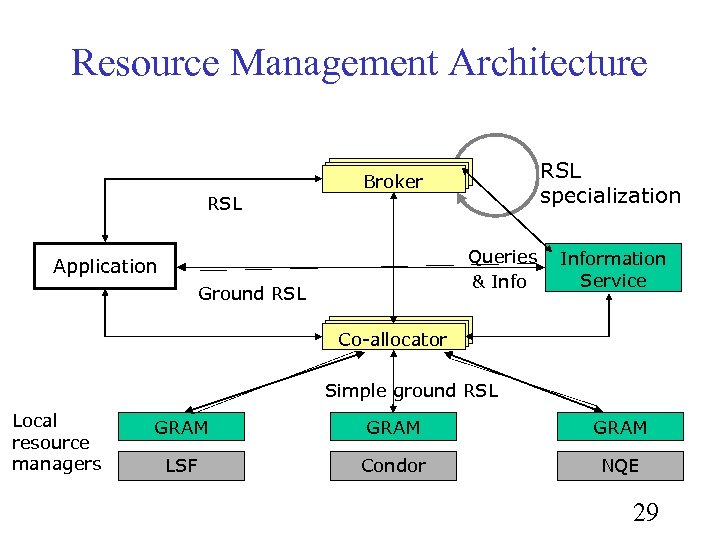 Resource Management Architecture RSL specialization Broker RSL Queries & Info Application Ground RSL Information Service Co-allocator Simple ground RSL Local resource managers GRAM LSF Condor NQE 29
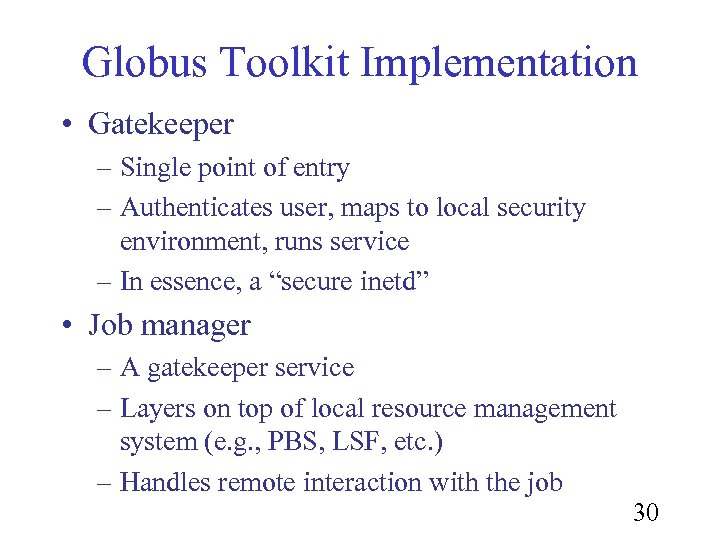 Globus Toolkit Implementation • Gatekeeper – Single point of entry – Authenticates user, maps to local security environment, runs service – In essence, a “secure inetd” • Job manager – A gatekeeper service – Layers on top of local resource management system (e. g. , PBS, LSF, etc. ) – Handles remote interaction with the job 30
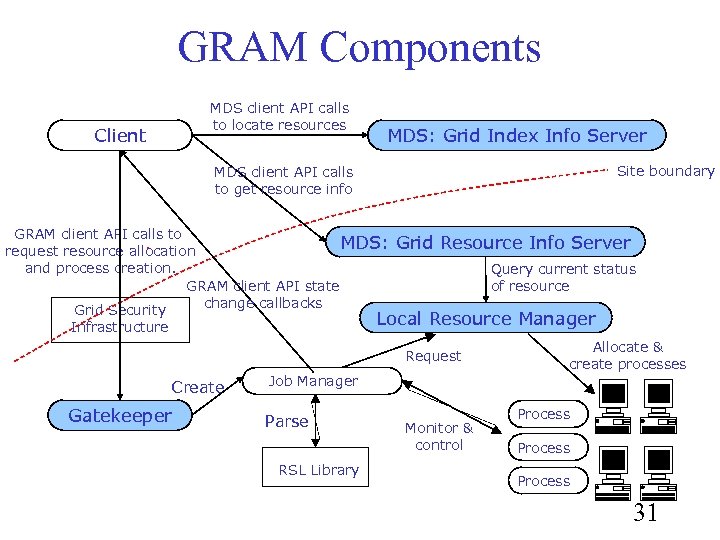 GRAM Components MDS client API calls to locate resources Client MDS: Grid Index Info Server Site boundary MDS client API calls to get resource info GRAM client API calls to MDS: request resource allocation and process creation. GRAM client API state change callbacks Grid Security Grid Resource Info Server Query current status of resource Local Resource Manager Infrastructure Request Create Gatekeeper Job Manager Parse RSL Library Monitor & control Allocate & create processes Process 31
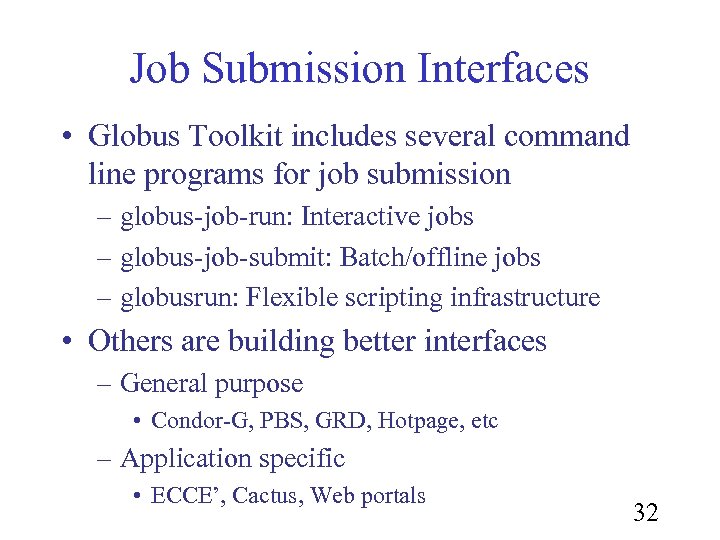 Job Submission Interfaces • Globus Toolkit includes several command line programs for job submission – globus-job-run: Interactive jobs – globus-job-submit: Batch/offline jobs – globusrun: Flexible scripting infrastructure • Others are building better interfaces – General purpose • Condor-G, PBS, GRD, Hotpage, etc – Application specific • ECCE’, Cactus, Web portals 32
 The Globus Toolkit™: Information Services The Globus Project™ Argonne National Laboratory USC Information Sciences Institute http: //www. globus. org 33
 Grid Information Services • System information is critical to operation of the grid and construction of applications – What resources are available? • Resource discovery – What is the “state” of the grid? • Resource selection – How to optimize resource use • Application configuration and adaptation? • We need a general information infrastructure to answer these questions 34
 Examples of Useful Information • Characteristics of a compute resource – IP address, software available, system administrator, networks connected to, OS version, load • Characteristics of a network – Bandwidth and latency, protocols, logical topology • Characteristics of the Globus infrastructure – Hosts, resource managers 35
 Grid Information: Facts of Life • Information is always old – Time of flight, changing system state – Need to provide quality metrics • Distributed state hard to obtain – Complexity of global snapshot • Component will fail • Scalability and overhead • Many different usage scenarios – Heterogeneous policy, different information organizations, etc. 36
 Grid Information Service • Provide access to static and dynamic information regarding system components • A basis for configuration and adaptation in heterogeneous, dynamic environments • Requirements and characteristics – Uniform, flexible access to information – Scalable, efficient access to dynamic data – Access to multiple information sources – Decentralized maintenance 37
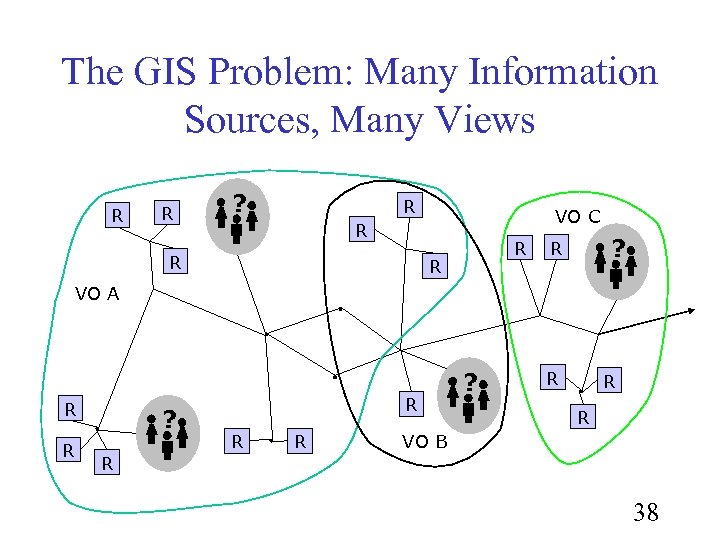 The GIS Problem: Many Information Sources, Many Views R R ? R VO C R R ? R VO A R R ? R R R VO B 38
 Information Protocols • Grid Resource Registration Protocol – Support information/resource discovery – Designed to support machine/network failure • Grid Resource Inquiry Protocol – Query resource description server for information – Query aggregate server for information – LDAP V 3. 0 in Globus 1. 1. 3 39
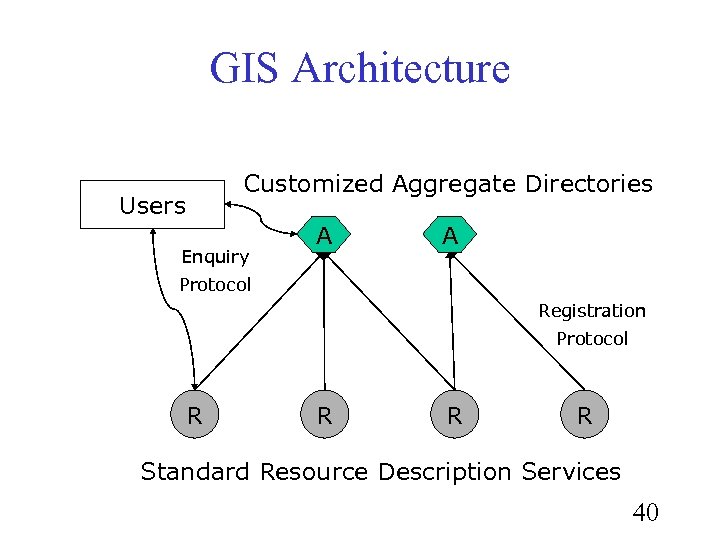 GIS Architecture Customized Aggregate Directories Users Enquiry A A Protocol Registration Protocol R R Standard Resource Description Services 40
 Metacomputing Directory Service • Use LDAP as Inquiry • Access information in a distributed directory – Directory represented by collection of LDAP servers – Each server optimized for particular function • Directory can be updated by: – Information providers and tools – Applications (i. e. , users) – Backend tools which generate info on demand • Information dynamically available to tools and applications 41
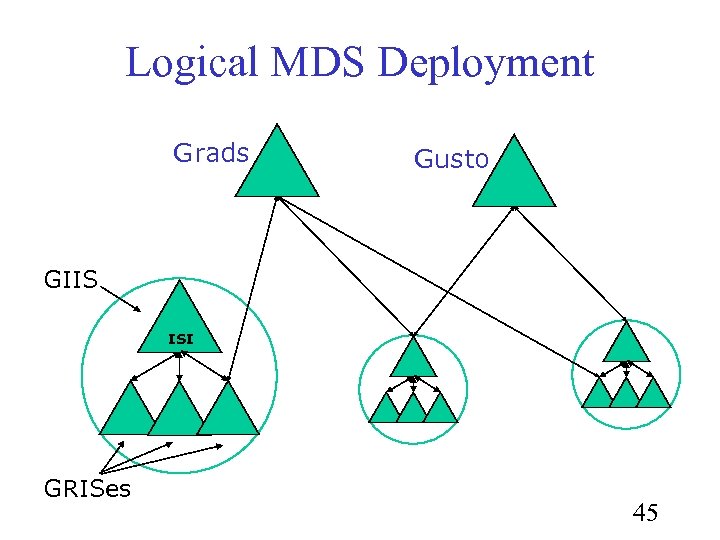
 Two Classes Of MDS Servers • Grid Resource Information Service (GRIS) – Supplies information about a specific resource – Configurable to support multiple information providers – LDAP as inquiry protocol • Grid Index Information Service (GIIS) – Supplies collection of information which was gathered from multiple GRIS servers – Supports efficient queries against information which is spread across multiple GRIS server – LDAP as inquiry protocol 42
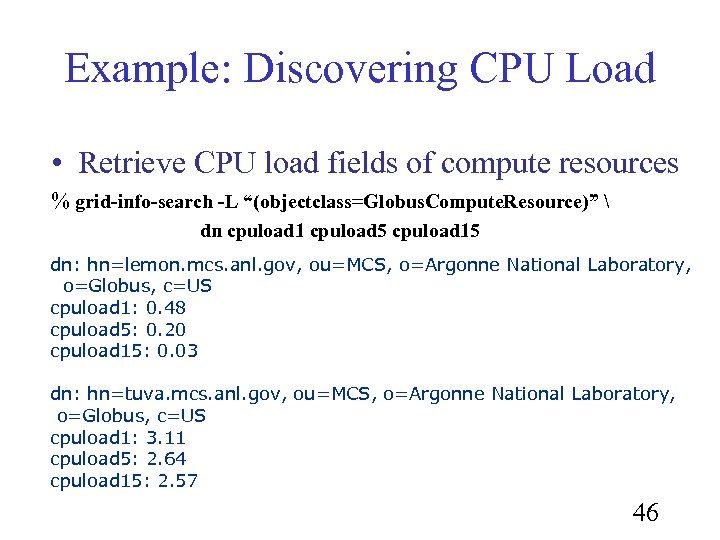
 Grid Resource Information Service • Server which runs on each resource – Given the resource DNS name, you can find the GRIS server (well known port = 2135) • Provides resource specific information – Much of this information may be dynamic • Load, process information, storage information, etc. • GRIS gathers this information on demand • “White pages” lookup of resource information – Ex: How much memory does machine have? • “Yellow pages” lookup of resource options – Ex: Which queues on machine allows large jobs? 43
 Grid Index Information Service • GIIS describes a class of servers – Gathers information from multiple GRIS servers – Each GIIS is optimized for particular queries • Ex 1: Which Alliance machines are >16 process SGIs? • Ex 2: Which Alliance storage servers have >100 Mbps bandwidth to host X? – Akin to web search engines • Organization GIIS – The Globus Toolkit ships with one GIIS – Caches GRIS info with long update frequency • Useful for queries across an organization that rely on relatively static information (Ex 1 above) • Can be merged into GRIS 44
 Logical MDS Deployment Grads Gusto GIIS ISI GRISes 45
 Example: Discovering CPU Load • Retrieve CPU load fields of compute resources % grid-info-search -L “(objectclass=Globus. Compute. Resource)” dn cpuload 1 cpuload 5 cpuload 15 dn: hn=lemon. mcs. anl. gov, ou=MCS, o=Argonne National Laboratory, o=Globus, c=US cpuload 1: 0. 48 cpuload 5: 0. 20 cpuload 15: 0. 03 dn: hn=tuva. mcs. anl. gov, ou=MCS, o=Argonne National Laboratory, o=Globus, c=US cpuload 1: 3. 11 cpuload 5: 2. 64 cpuload 15: 2. 57 46
 The Globus Toolkit™: Data Management Services The Globus Project™ Argonne National Laboratory USC Information Sciences Institute http: //www. globus. org 47
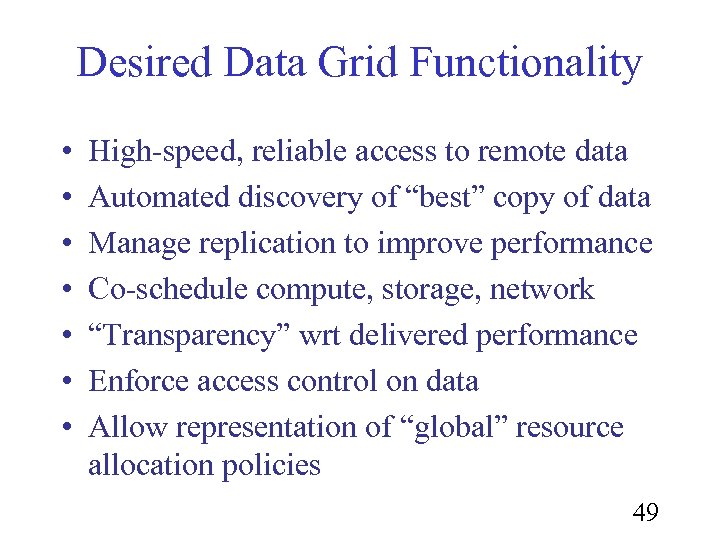
![Data Intensive Issues Include … • Harness [potentially large numbers of] data, storage, network](https://present5.com/presentation/67dc843300268c7ebf1fb709ce638998/image-48.jpg "Data Intensive Issues Include … • Harness [potentially large numbers of] data, storage, network") Data Intensive Issues Include … • Harness [potentially large numbers of] data, storage, network resources located in distinct administrative domains • Respect local and global policies governing what can be used for what • Schedule resources efficiently, again subject to local and global constraints • Achieve high performance, with respect to both speed and reliability • Catalog software and virtual data 48
Data Intensive Issues Include … • Harness [potentially large numbers of] data, storage, network resources located in distinct administrative domains • Respect local and global policies governing what can be used for what • Schedule resources efficiently, again subject to local and global constraints • Achieve high performance, with respect to both speed and reliability • Catalog software and virtual data 48
 Desired Data Grid Functionality • • High-speed, reliable access to remote data Automated discovery of “best” copy of data Manage replication to improve performance Co-schedule compute, storage, network “Transparency” wrt delivered performance Enforce access control on data Allow representation of “global” resource allocation policies 49
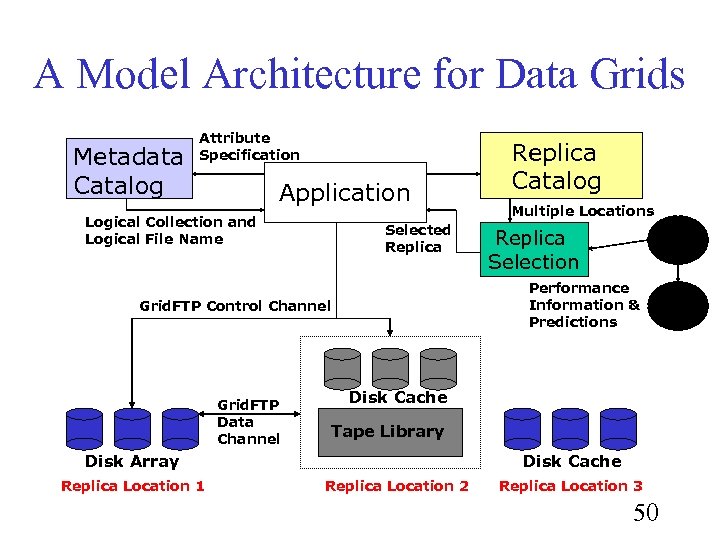 A Model Architecture for Data Grids Metadata Catalog Attribute Specification Application Logical Collection and Logical File Name Selected Replica Selection MDS NWS Disk Cache Tape Library Disk Array Replica Location 1 Multiple Locations Performance Information & Predictions Grid. FTP Control Channel Grid. FTP Data Channel Replica Catalog Disk Cache Replica Location 2 Replica Location 3 50
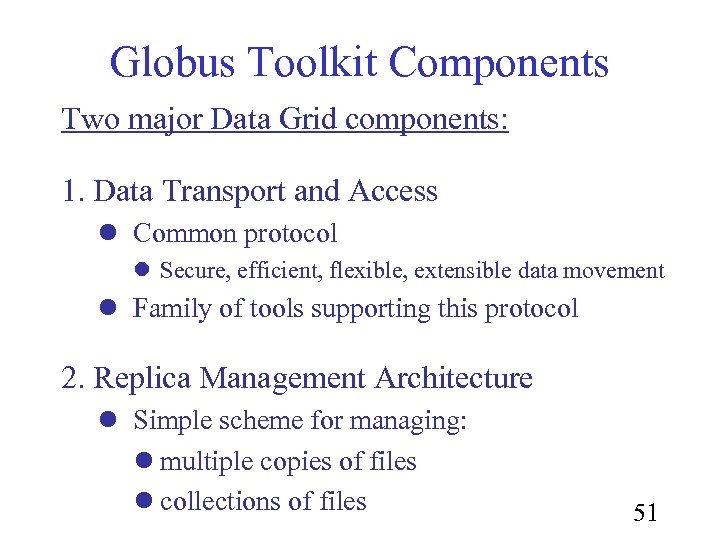 Globus Toolkit Components Two major Data Grid components: 1. Data Transport and Access l Common protocol l Secure, efficient, flexible, extensible data movement l Family of tools supporting this protocol 2. Replica Management Architecture l Simple scheme for managing: l multiple copies of files l collections of files 51
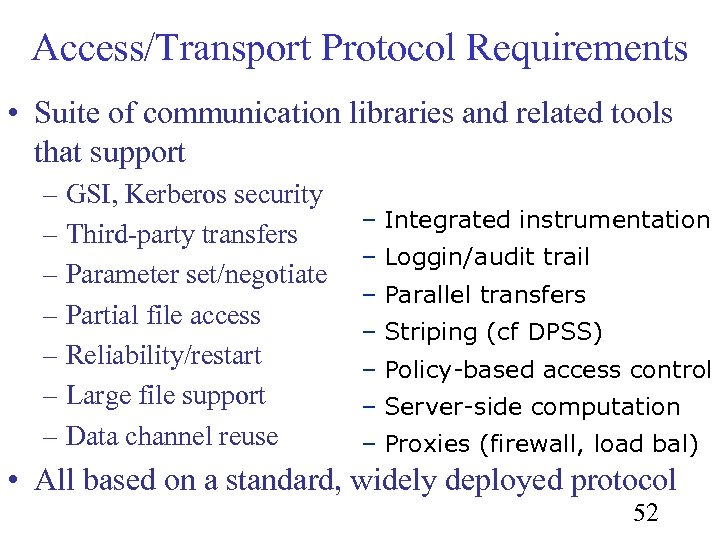 Access/Transport Protocol Requirements • Suite of communication libraries and related tools that support – GSI, Kerberos security – Third-party transfers – Parameter set/negotiate – Partial file access – Reliability/restart – Large file support – Data channel reuse – Integrated instrumentation – Loggin/audit trail – Parallel transfers – Striping (cf DPSS) – Policy-based access control – Server-side computation – Proxies (firewall, load bal) • All based on a standard, widely deployed protocol 52
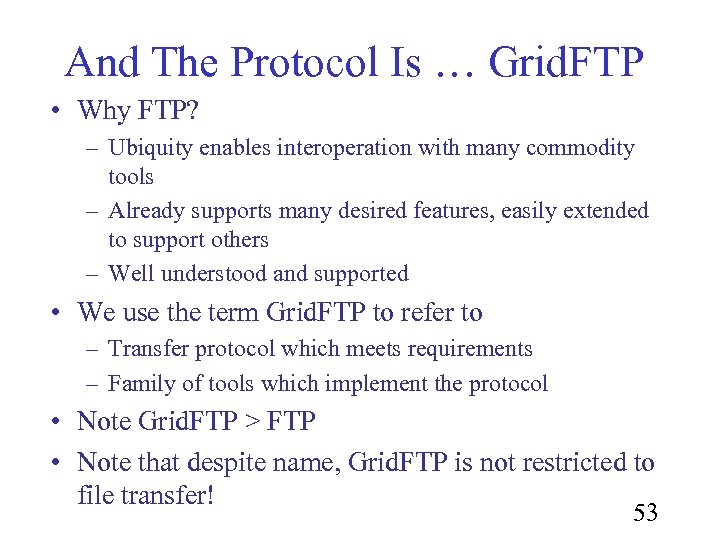 And The Protocol Is … Grid. FTP • Why FTP? – Ubiquity enables interoperation with many commodity tools – Already supports many desired features, easily extended to support others – Well understood and supported • We use the term Grid. FTP to refer to – Transfer protocol which meets requirements – Family of tools which implement the protocol • Note Grid. FTP > FTP • Note that despite name, Grid. FTP is not restricted to file transfer! 53
 Grid. FTP: Basic Approach • FTP protocol is defined by several IETF RFCs • Start with most commonly used subset – Standard FTP: get/put etc. , 3 rd-party transfer • Implement standard but often unused features – GSS binding, extended directory listing, simple restart • Extend in various ways, while preserving interoperability with existing servers – Striped/parallel data channels, partial file, automatic & manual TCP buffer setting, progress monitoring, 54 extended restart
 Replica Management • Maintain a mapping between logical names for files and collections and one or more physical locations • Important for many applications – Example: CERN HLT data • • • Multiple petabytes of data per year Copy of everything at CERN (Tier 0) Subsets at national centers (Tier 1) Smaller regional centers (Tier 2) Individual researchers will have copies 55
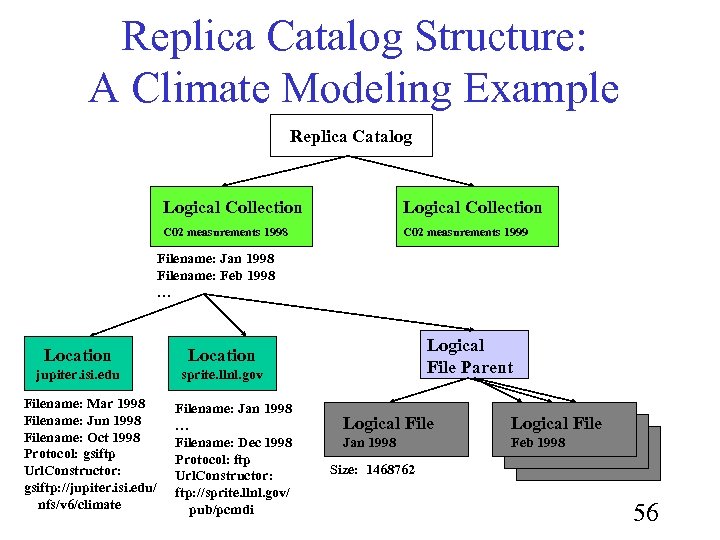 Replica Catalog Structure: A Climate Modeling Example Replica Catalog Logical Collection C 02 measurements 1998 C 02 measurements 1999 Filename: Jan 1998 Filename: Feb 1998 … Location jupiter. isi. edu Logical File Parent Location sprite. llnl. gov Filename: Mar 1998 Filename: Jun 1998 Filename: Oct 1998 Protocol: gsiftp Url. Constructor: gsiftp: //jupiter. isi. edu/ nfs/v 6/climate Filename: Jan 1998 … Filename: Dec 1998 Protocol: ftp Url. Constructor: ftp: //sprite. llnl. gov/ pub/pcmdi Logical File Jan 1998 Feb 1998 Size: 1468762 56
 Replica Catalog Services as Building Blocks: Examples • Combine with information service to build replica selection services – E. g. “find best replica” using performance info from NWS and MDS – Use of LDAP as common protocol for info and replica services makes this easier • Combine with application managers to build data distribution services – E. g. , build new replicas in response to frequent accesses 57
 Replica Catalog Directions • Many data grid applications do not require tight consistency semantics – At any given time, you may not be able to discover all copies – When a new copy is made, it may not be immediately recognized as available • Allows for much more scalable design – Distributed catalogs: local catalogs which maintain their own LFN -> PFN mapping – Soft-state updates as basis for building various 58 configurations of global catalogs
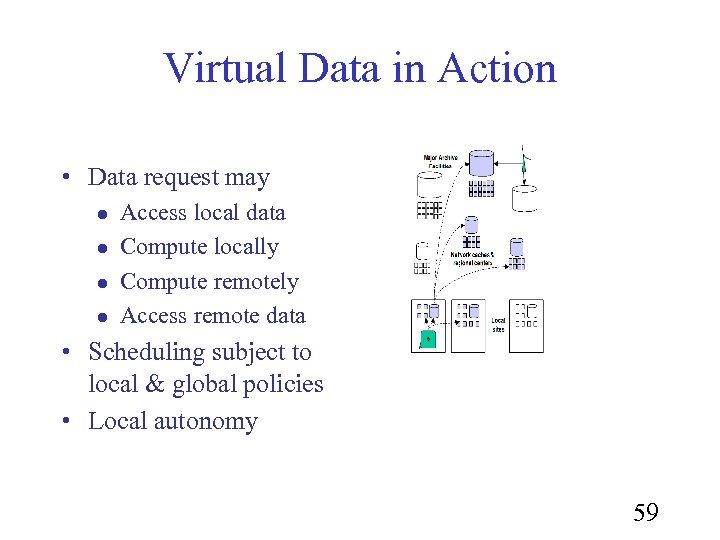 Virtual Data in Action • Data request may l l Access local data Compute locally Compute remotely Access remote data • Scheduling subject to local & global policies • Local autonomy 59
 Evolution of Grid Technologies • Initial exploration (1996 -1999; Globus 1. 0) – Extensive appln experiments; core protocols • Data Grids (1999 -? ? ; Globus 2. 0+) – Large-scale data management and analysis • Open Grid Services Architecture (2001 -? ? , Globus 3. 0) – Integration w/ Web services, hosting environments, resource virtualization – Databases, higher-level services • Radically scalable systems (2003 -? ? ) – Sensors, wireless, ubiquitous computing 60
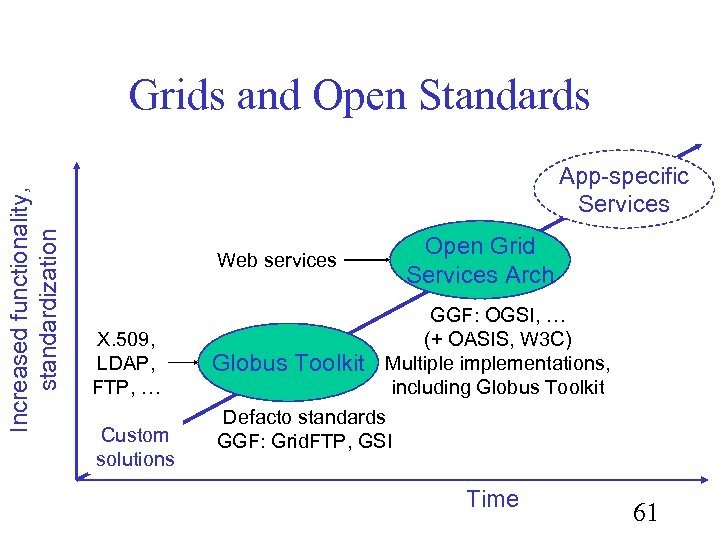 Increased functionality, standardization Grids and Open Standards App-specific Services Open Grid Services Arch Web services X. 509, LDAP, FTP, … Custom solutions Globus Toolkit GGF: OGSI, … (+ OASIS, W 3 C) Multiple implementations, including Globus Toolkit Defacto standards GGF: Grid. FTP, GSI Time 61
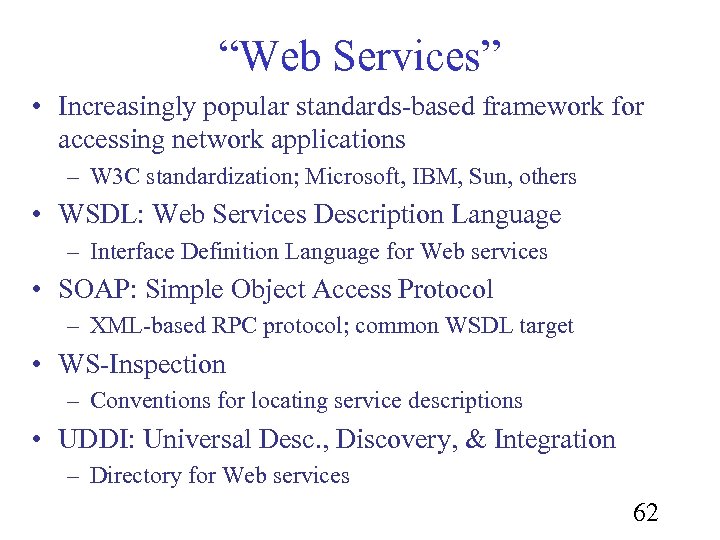 “Web Services” • Increasingly popular standards-based framework for accessing network applications – W 3 C standardization; Microsoft, IBM, Sun, others • WSDL: Web Services Description Language – Interface Definition Language for Web services • SOAP: Simple Object Access Protocol – XML-based RPC protocol; common WSDL target • WS-Inspection – Conventions for locating service descriptions • UDDI: Universal Desc. , Discovery, & Integration – Directory for Web services 62
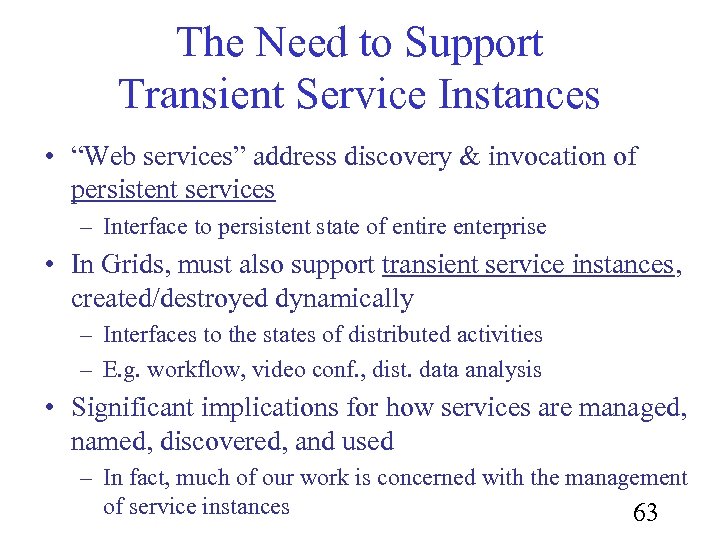 The Need to Support Transient Service Instances • “Web services” address discovery & invocation of persistent services – Interface to persistent state of entire enterprise • In Grids, must also support transient service instances, created/destroyed dynamically – Interfaces to the states of distributed activities – E. g. workflow, video conf. , dist. data analysis • Significant implications for how services are managed, named, discovered, and used – In fact, much of our work is concerned with the management of service instances 63
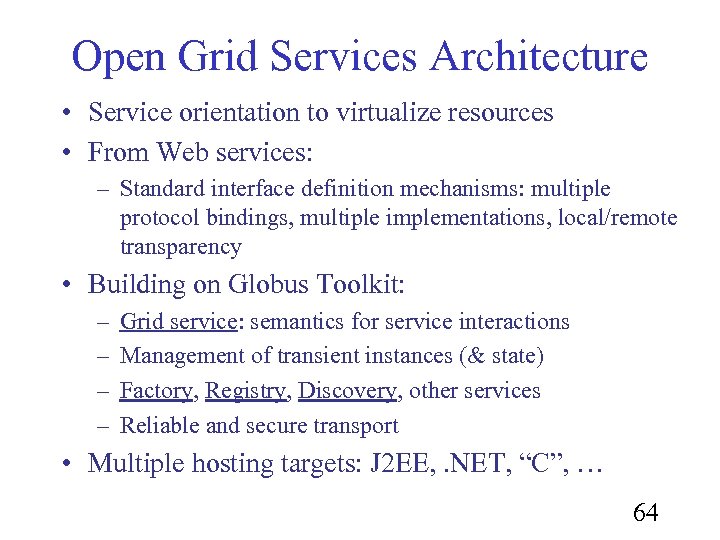 Open Grid Services Architecture • Service orientation to virtualize resources • From Web services: – Standard interface definition mechanisms: multiple protocol bindings, multiple implementations, local/remote transparency • Building on Globus Toolkit: – – Grid service: semantics for service interactions Management of transient instances (& state) Factory, Registry, Discovery, other services Reliable and secure transport • Multiple hosting targets: J 2 EE, . NET, “C”, … 64
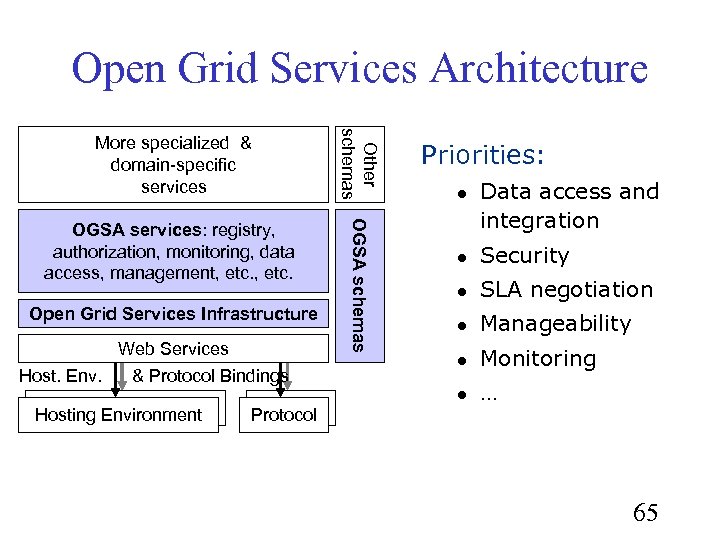 Open Grid Services Architecture More specialized & domain-specific services Other schemas OGSA services: registry, authorization, monitoring, data access, management, etc. OGSA schemas Open Grid Services Infrastructure Web Services Host. Env. & Protocol Bindings Hosting Environment Transport Protocol Priorities: l Data access and integration l Security l SLA negotiation l Manageability l Monitoring l … 65
 OGSA Service Model • System comprises (a typically few) persistent services & (potentially many) transient services • All services adhere to specified Grid service interfaces and behaviors – Reliable invocation, lifetime management, discovery, authorization, notification, upgradeability, concurrency, manageability • Interfaces for managing Grid service instances – Factory, registry, discovery, lifetime, etc. => Reliable, secure mgmt of distributed state 66
 The Grid Service • A (potentially transient) Web service with specified interfaces & behaviors, including – Creation (Factory) – Global naming (GSH) & references (GSR) – Lifetime management – Registration & Discovery – Authorization – Notification – Concurrency – Manageability 67
 Use of Web Services (1) • A Grid service interface is a WSDL port. Type • A Grid service definition is a WSDL extension (service. Type) containing: – A set of one or more port. Types supported by the service – port. Type & service. Type compatibility statements, to support upgradability • For discovery of compatible services when interfaces are upgraded – Implementation version information 68
 Use of Web Services (2) • A GSR is a WSDL document with extensions: – Extension to service element to reference service. Type – Service element extensions to carry the GSH, and the expiration time of the GSR • A GSH is an URL, with the following properties: – Globally unique for all time – http get on GSH + “. wsdl” returns GSR – Can derive GSH to Mapper from it • Registry returns WS-Inspection documents 69
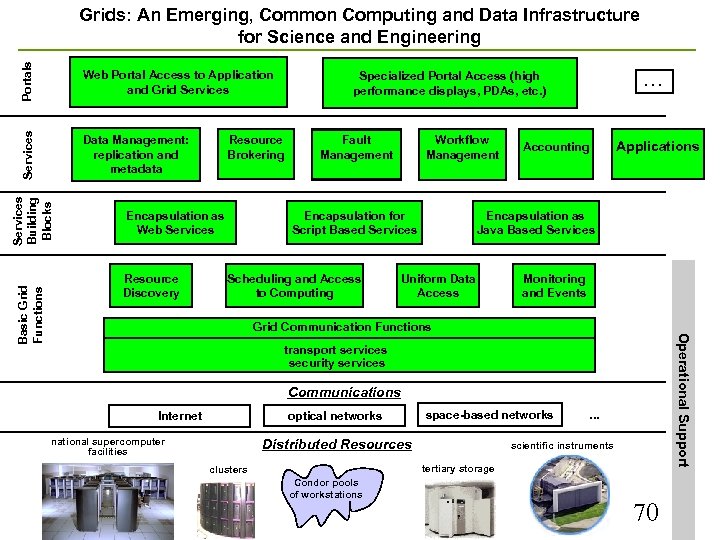 Portals Data Management: replication and metadata Resource Brokering Encapsulation as Web Services Resource Discovery Specialized Portal Access (high performance displays, PDAs, etc. ) Fault Management Workflow Management Encapsulation for Script Based Services Scheduling and Access to Computing . . . Applications Accounting Encapsulation as Java Based Services Uniform Data Access Monitoring and Events Grid Communication Functions Operational Support Basic Grid Functions Services Building Blocks Web Portal Access to Application and Grid Services Grids: An Emerging, Common Computing and Data Infrastructure for Science and Engineering transport services security services Communications optical networks Internet national supercomputer facilities space-based networks Distributed Resources . . . scientific instruments tertiary storage clusters Condor pools of workstations 70
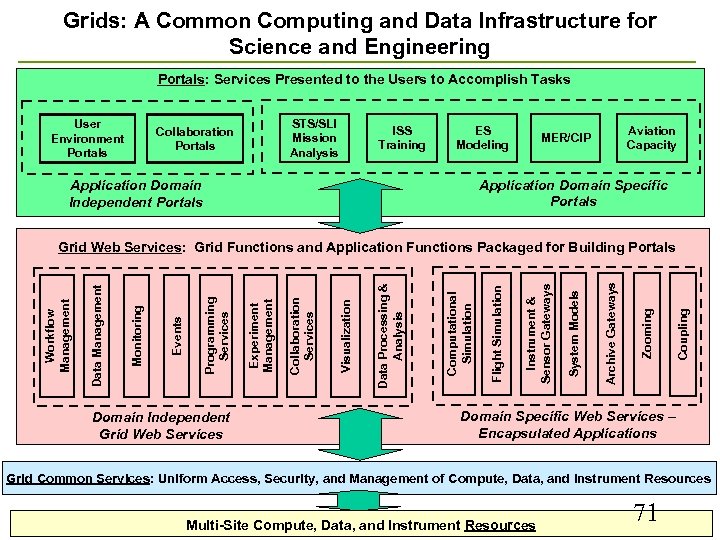 Grids: A Common Computing and Data Infrastructure for Science and Engineering Portals: Services Presented to the Users to Accomplish Tasks User Environment Portals STS/SLI Mission Analysis Collaboration Portals ISS Training ES Modeling Aviation Capacity MER/CIP Application Domain Specific Portals Application Domain Independent Portals Domain Independent Grid Web Services Coupling Zooming Archive Gateways System Models Instrument & Sensor Gateways Flight Simulation Computational Simulation Data Processing & Analysis Visualization Collaboration Services Experiment Management Programming Services Events Monitoring Data Management Workflow Management Grid Web Services: Grid Functions and Application Functions Packaged for Building Portals Domain Specific Web Services – Encapsulated Applications Grid Common Services: Uniform Access, Security, and Management of Compute, Data, and Instrument Resources Multi-Site Compute, Data, and Instrument Resources 71
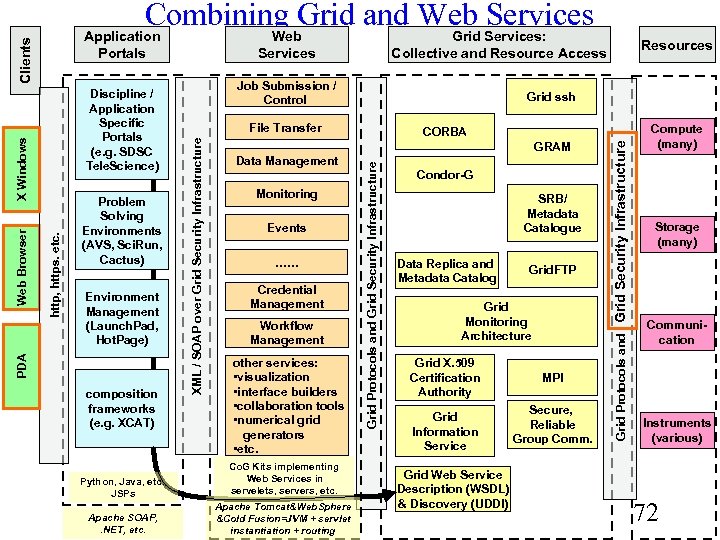 Combining Grid and Web Services composition frameworks (e. g. XCAT) Job Submission / Control Grid ssh File Transfer CORBA GRAM Data Management Monitoring Events …… Credential Management Workflow Management other services: • visualization • interface builders • collaboration tools • numerical grid generators • etc. Python, Java, etc. , JSPs Co. G Kits implementing Web Services in servelets, servers, etc. Apache SOAP, . NET, etc. Apache Tomcat&Web. Sphere &Cold Fusion=JVM + servlet instantiation + routing Resources Condor-G SRB/ Metadata Catalogue Data Replica and Metadata Catalog Grid. FTP Grid Monitoring Architecture Grid X. 509 Certification Authority Grid Information Service Grid Web Service Description (WSDL) & Discovery (UDDI) MPI Secure, Reliable Group Comm. Grid Protocols and Grid Security Infrastructure Environment Management (Launch. Pad, Hot. Page) Grid Services: Collective and Resource Access Grid Protocols and Grid Security Infrastructure http, https. etc. Problem Solving Environments (AVS, Sci. Run, Cactus) PDA Web Browser X Windows Discipline / Application Specific Portals (e. g. SDSC Tele. Science) Web Services XML / SOAP over Grid Security Infrastructure Clients Application Portals Compute (many) Storage (many) Communication Instruments (various) 72
 For More Information • Globus Project™ – www. globus. org • Grid Forum – www. gridforum. org • Book (Morgan Kaufman) – www. mkp. com/grids 73