


 Скачать презентацию Greening Your Church and School Energy and Climate
7fc3f510e4b6f8be69b48f894ddbc0bc.ppt
- Количество слайдов: 34
 Greening Your Church and School: Energy and Climate Change What you can do in your Parish, School, and also in your home to provide a secure, sustainable, low carbon future for our children to inherit? But what of our future in 10 years? Recipient of James Watt Gold Medal Keith Tovey (杜伟贤 ) Н. К. Тови M. A. , Ph. D, CEng, MICE, CEnv Energy Science Director: Low Carbon Innovation Centre School of Environmental Sciences, UEA. Lay Chair: Norwich East Deanery 1
 Greening Your Church and School and Home: Energy and Climate Change • For the average family where are the largest uses of energy? • Which activities in our lives cause the greatest emission of carbon dioxide? • What should we do first? • Will we save money? 2
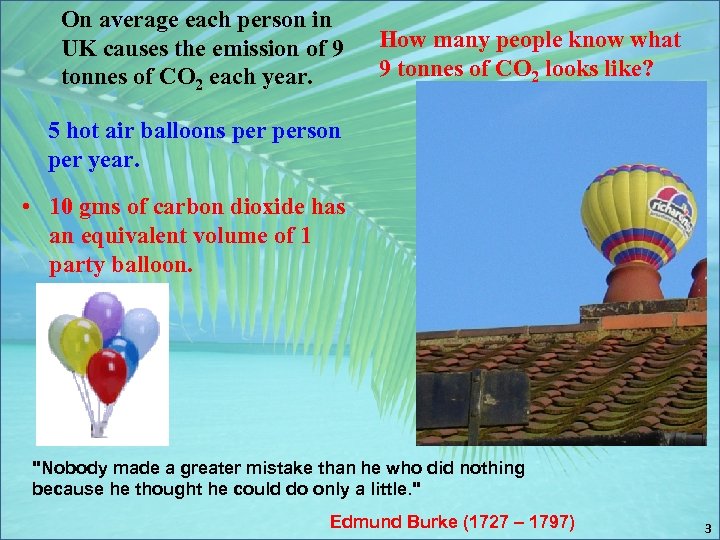 On average each person in UK causes the emission of 9 tonnes of CO 2 each year. How many people know what 9 tonnes of CO 2 looks like? 5 hot air balloons person per year. • 10 gms of carbon dioxide has an equivalent volume of 1 party balloon. "Nobody made a greater mistake than he who did nothing because he thought he could do only a little. " Edmund Burke (1727 – 1797) 3
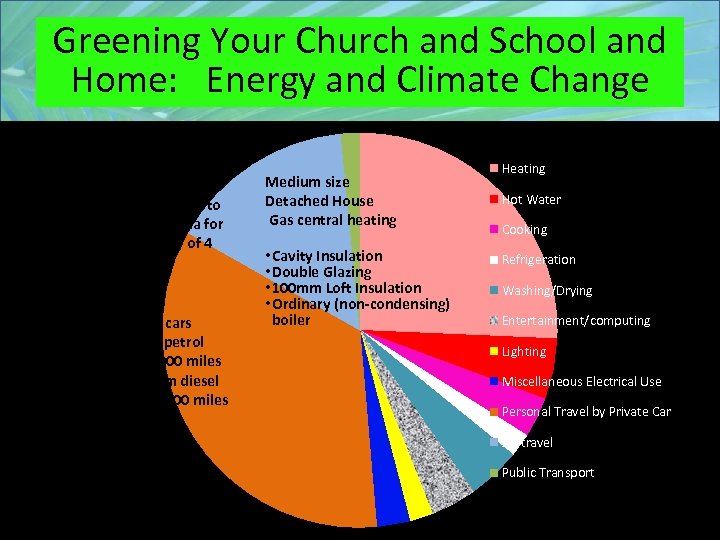 Greening Your Church and School and Home: Energy and Climate Change 1 holiday to Mallorca for family of 4 2 family cars • small petrol ~ 10000 miles • medium diesel ~ 12000 miles Medium size Detached House Gas central heating • Cavity Insulation • Double Glazing • 100 mm Loft Insulation • Ordinary (non-condensing) boiler Heating Hot Water Cooking Refrigeration Washing/Drying Entertainment/computing Lighting Miscellaneous Electrical Use Personal Travel by Private Car Air travel Public Transport 4
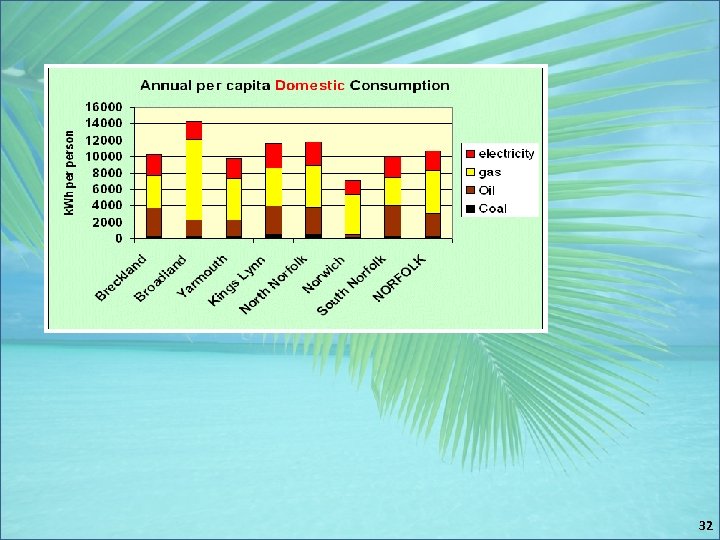
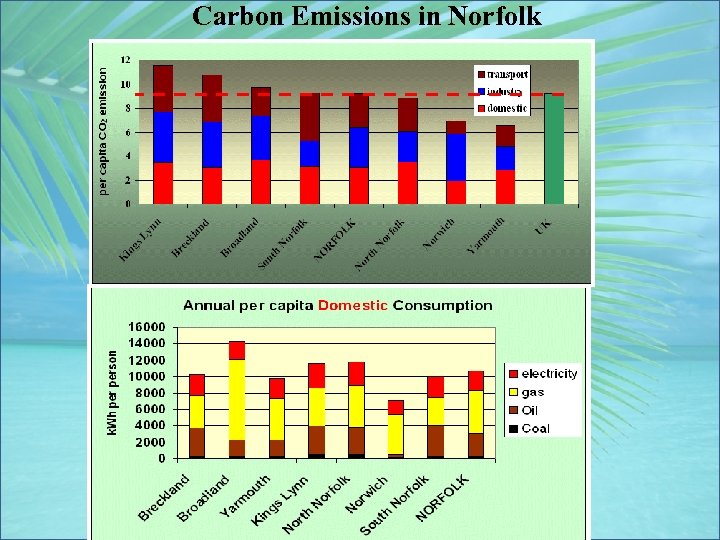 Carbon Emissions in Norfolk
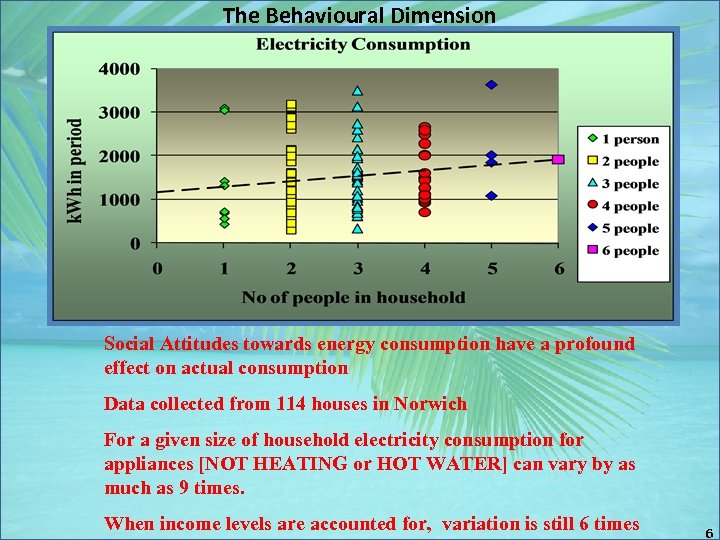 The Behavioural Dimension Social Attitudes towards energy consumption have a profound effect on actual consumption Data collected from 114 houses in Norwich For a given size of household electricity consumption for appliances [NOT HEATING or HOT WATER] can vary by as much as 9 times. When income levels are accounted for, variation is still 6 times 6
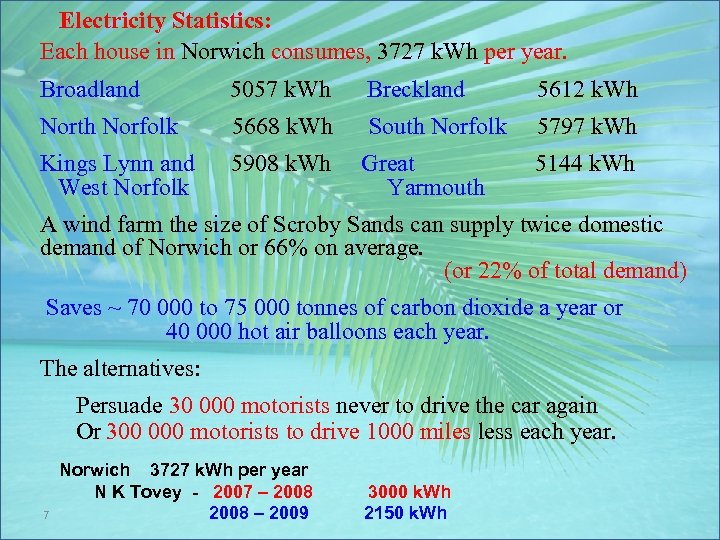 Electricity Statistics: Each house in Norwich consumes, 3727 k. Wh per year. Broadland 5057 k. Wh Breckland 5612 k. Wh North Norfolk 5668 k. Wh South Norfolk 5797 k. Wh Kings Lynn and 5908 k. Wh Great 5144 k. Wh West Norfolk Yarmouth A wind farm the size of Scroby Sands can supply twice domestic demand of Norwich or 66% on average. (or 22% of total demand) Saves ~ 70 000 to 75 000 tonnes of carbon dioxide a year or 40 000 hot air balloons each year. The alternatives: Persuade 30 000 motorists never to drive the car again Or 300 000 motorists to drive 1000 miles less each year. 7 Norwich 3727 k. Wh per year N K Tovey - 2007 – 2008 – 2009 3000 k. Wh 2150 k. Wh
 Energy use in your Church/ School/Home and our moral responsibilities Monitoring your use of energy. Do you know where the meter(s) is (are)? Do you know how to read them? Do you check that your energy company is charging you for the correct amount of energy? • Can you identify areas where you can cut carbon emissions and save money at the same time. • • The Hard Choices affecting us • Not only Climate Change • But also Energy Security • We need to be acting now 8
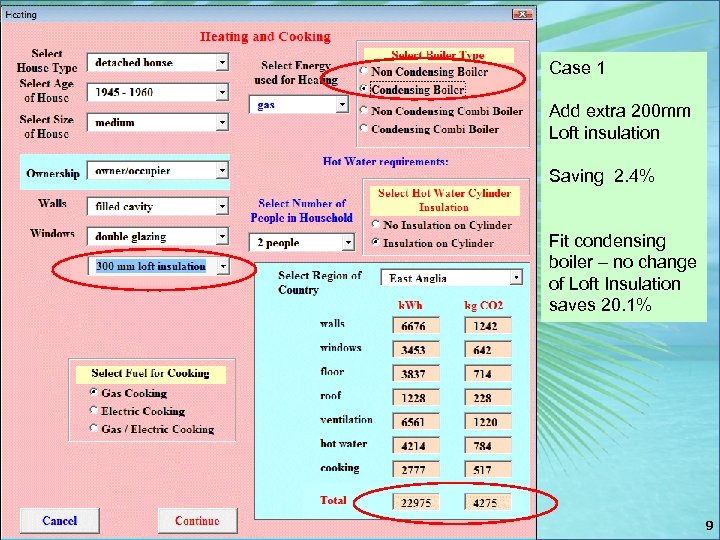 Case 1 Add extra 200 mm Loft insulation Saving 2. 4% Fit condensing boiler – no change of Loft Insulation saves 20. 1% 9
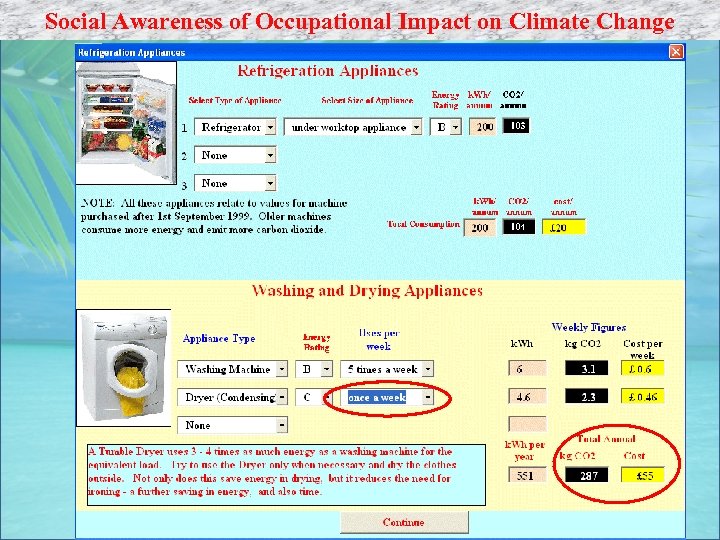 Social Awareness of Occupational Impact on Climate Change 10
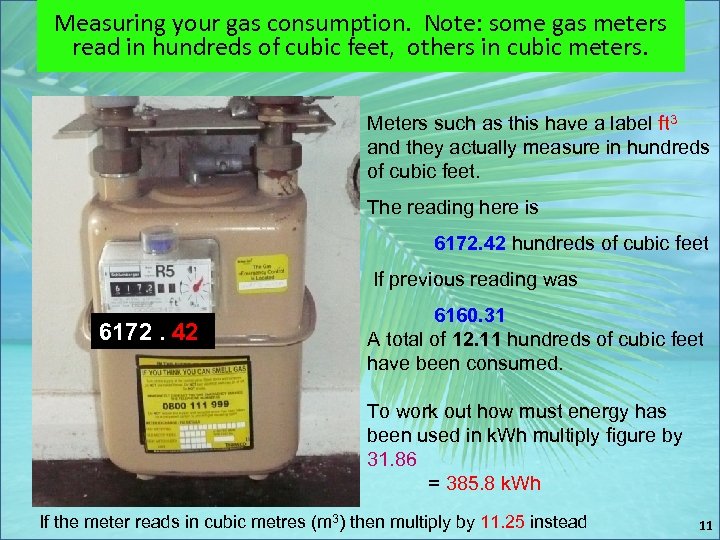 Measuring your gas consumption. Note: some gas meters read in hundreds of cubic feet, others in cubic meters. Meters such as this have a label ft 3 and they actually measure in hundreds of cubic feet. The reading here is 6172. 42 hundreds of cubic feet If previous reading was 6172. 42 6160. 31 A total of 12. 11 hundreds of cubic feet have been consumed. To work out how must energy has been used in k. Wh multiply figure by 31. 86 = 385. 8 k. Wh If the meter reads in cubic metres (m 3) then multiply by 11. 25 instead 11
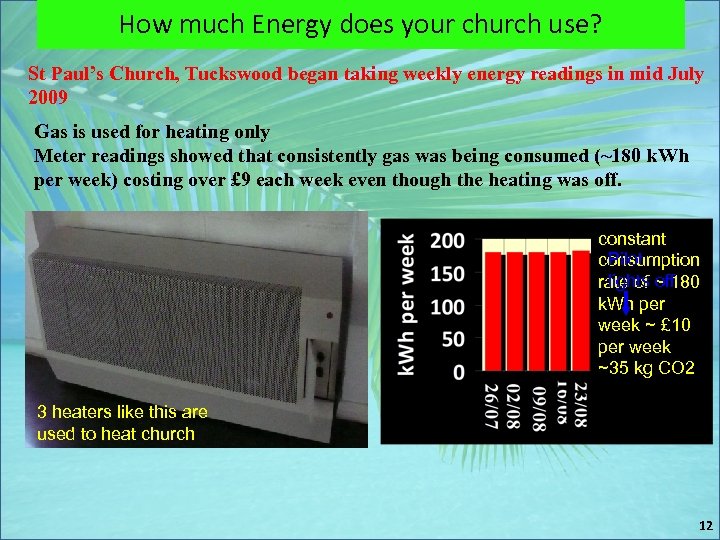 How much Energy does your church use? St Paul’s Church, Tuckswood began taking weekly energy readings in mid July 2009 Gas is used for heating only Meter readings showed that consistently gas was being consumed (~180 k. Wh per week) costing over £ 9 each week even though the heating was off. No data constant Pilot consumption lights off rate of ~ 180 k. Wh per week ~ £ 10 per week ~35 kg CO 2 3 heaters like this are used to heat church 12
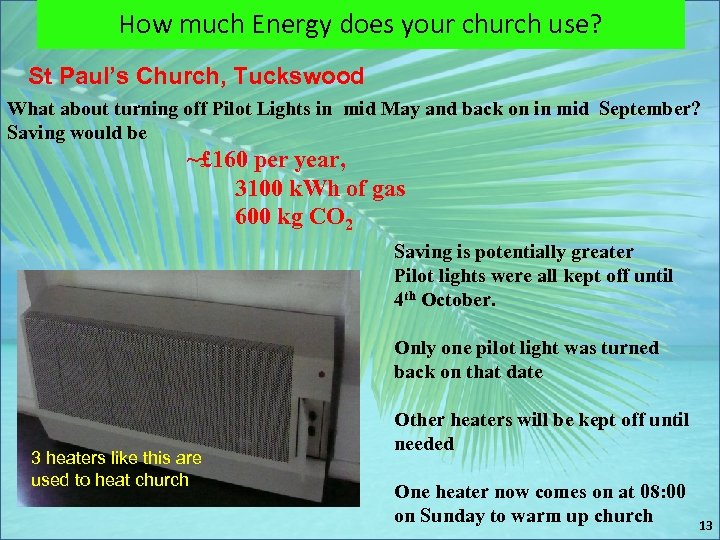 How much Energy does your church use? St Paul’s Church, Tuckswood What about turning off Pilot Lights in mid May and back on in mid September? Saving would be ~£ 160 per year, 3100 k. Wh of gas 600 kg CO 2 Saving is potentially greater Pilot lights were all kept off until 4 th October. Only one pilot light was turned back on that date 3 heaters like this are used to heat church Other heaters will be kept off until needed One heater now comes on at 08: 00 on Sunday to warm up church 13
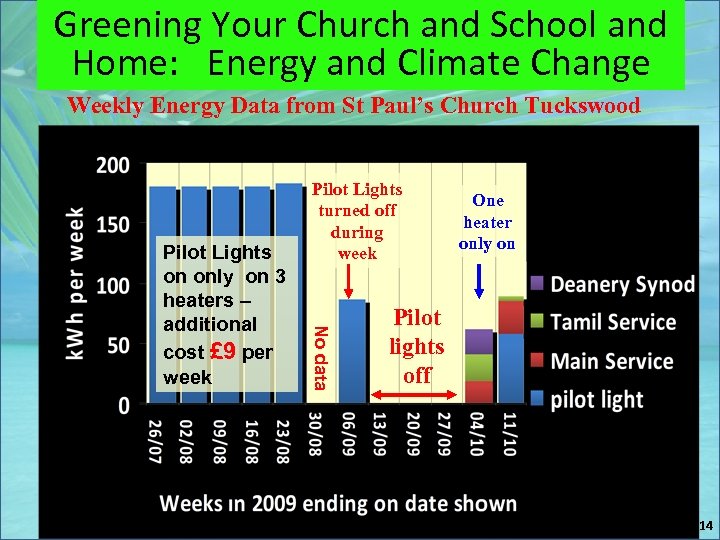 Greening Your Church and School and Home: Energy and Climate Change Weekly Energy Data from St Paul’s Church Tuckswood No data Pilot Lights on only on 3 heaters – additional cost £ 9 per week Pilot Lights turned off during week One heater only on Pilot lights off 14
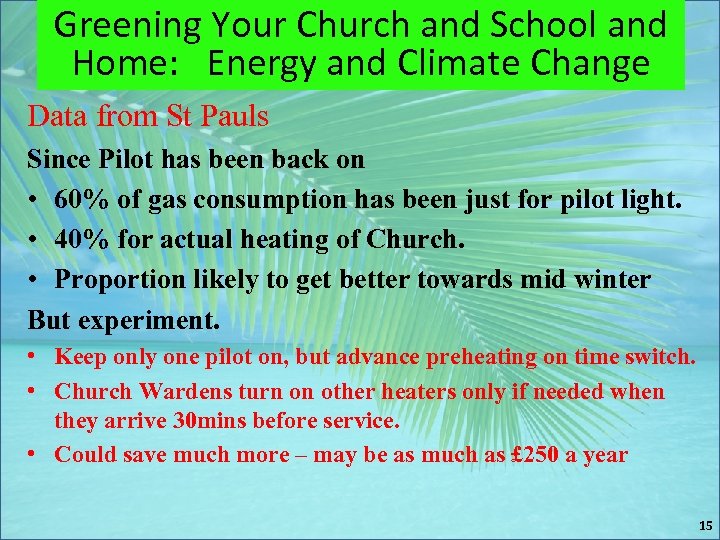 Greening Your Church and School and Home: Energy and Climate Change Data from St Pauls Since Pilot has been back on • 60% of gas consumption has been just for pilot light. • 40% for actual heating of Church. • Proportion likely to get better towards mid winter But experiment. • Keep only one pilot on, but advance preheating on time switch. • Church Wardens turn on other heaters only if needed when they arrive 30 mins before service. • Could save much more – may be as much as £ 250 a year 15
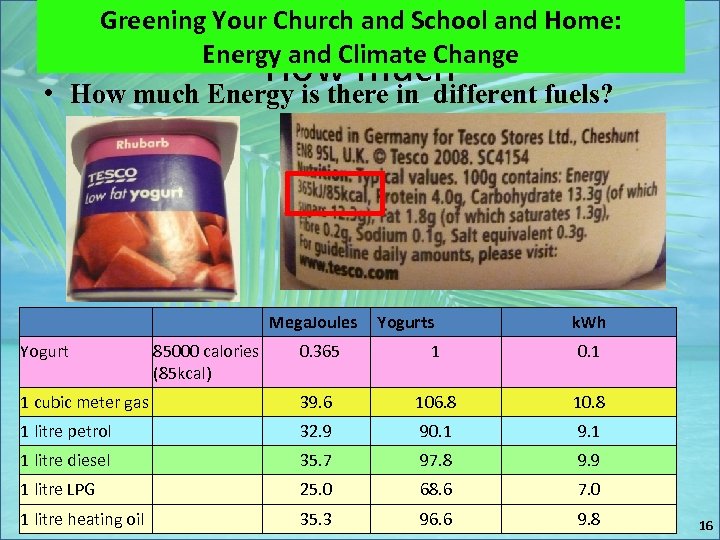 Greening Your Church and School and Home: Energy and Climate Change How much • How much Energy is there in different fuels? Mega. Joules Yogurt 85000 calories (85 kcal) Yogurts k. Wh 0. 365 1 0. 1 1 cubic meter gas 39. 6 106. 8 10. 8 1 litre petrol 32. 9 90. 1 9. 1 1 litre diesel 35. 7 97. 8 9. 9 1 litre LPG 25. 0 68. 6 7. 0 1 litre heating oil 35. 3 96. 6 9. 8 16
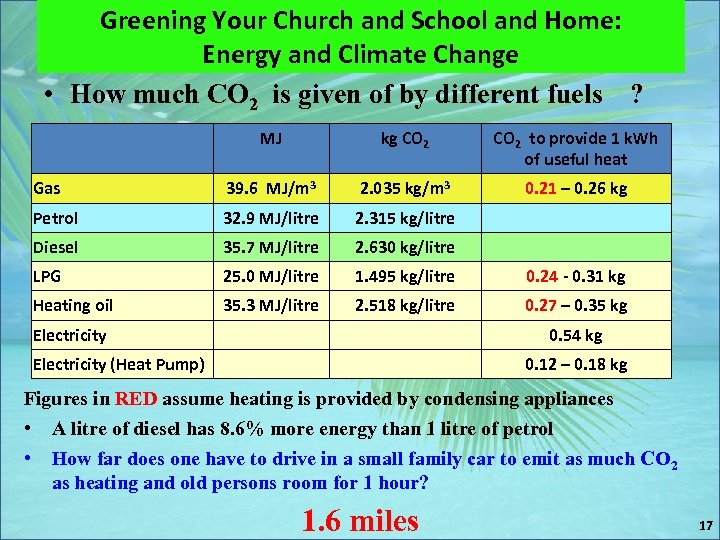 Greening Your Church and School and Home: Energy and Climate Change • How much CO 2 is given of by different fuels ? MJ kg CO 2 to provide 1 k. Wh of useful heat Gas 39. 6 MJ/m 3 2. 035 kg/m 3 0. 21 – 0. 26 kg Petrol 32. 9 MJ/litre 2. 315 kg/litre Diesel 35. 7 MJ/litre 2. 630 kg/litre LPG 25. 0 MJ/litre 1. 495 kg/litre 0. 24 - 0. 31 kg Heating oil 35. 3 MJ/litre 2. 518 kg/litre 0. 27 – 0. 35 kg Electricity 0. 54 kg Electricity (Heat Pump) 0. 12 – 0. 18 kg Figures in RED assume heating is provided by condensing appliances • A litre of diesel has 8. 6% more energy than 1 litre of petrol • How far does one have to drive in a small family car to emit as much CO 2 as heating and old persons room for 1 hour? 1. 6 miles 17
 Our responsibility for future generations AND our OWN FUTURE • It is not just Climate Change affecting others • Energy Security issues will affect us in UK in next 10 years.
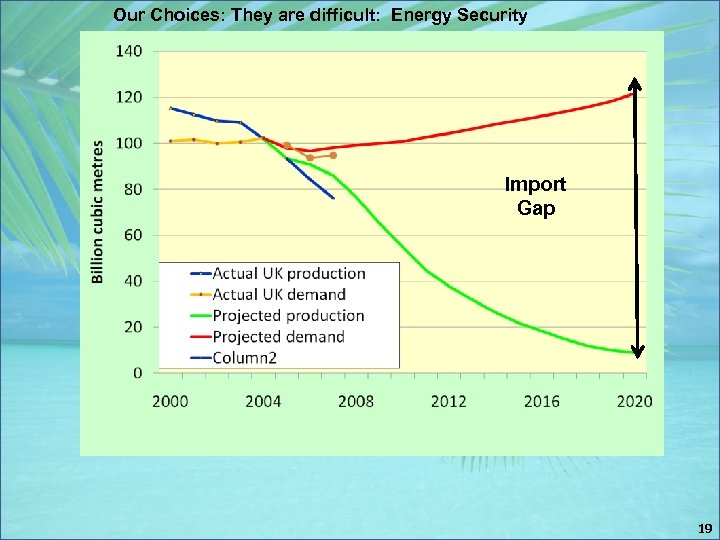 Our Choices: They are difficult: Energy Security Import Gap 19
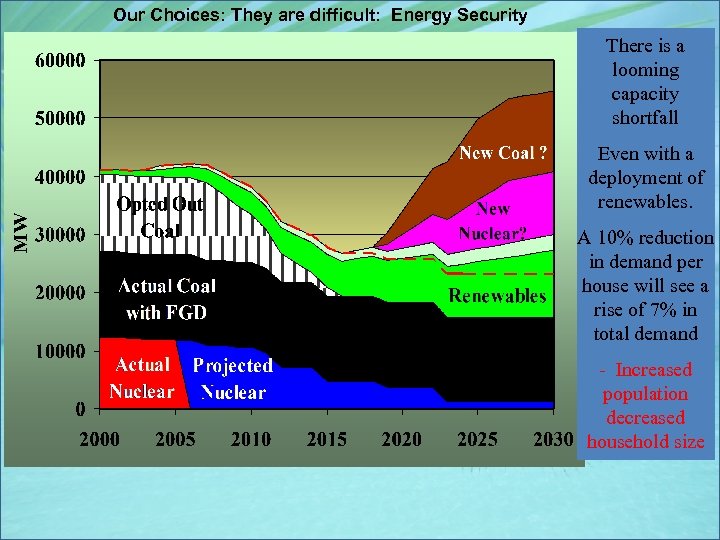 Our Choices: They are difficult: Energy Security There is a looming capacity shortfall Even with a deployment of renewables. A 10% reduction in demand per house will see a rise of 7% in total demand - Increased population decreased household size
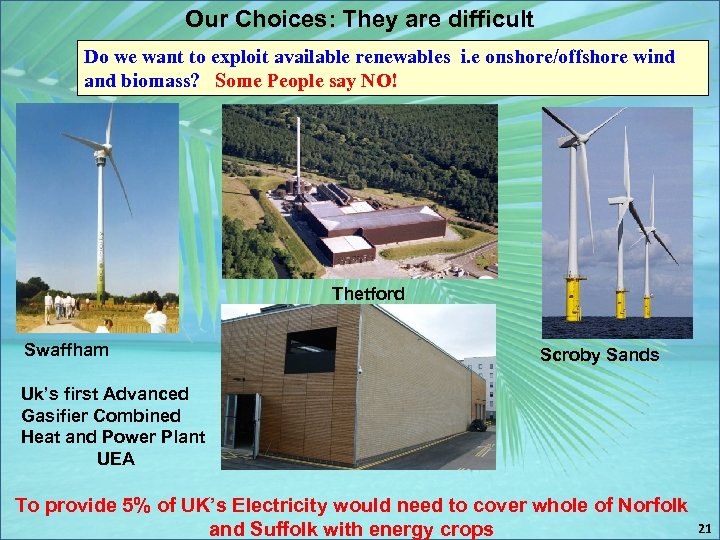 Our Choices: They are difficult Do we want to exploit available renewables i. e onshore/offshore wind and biomass? Some People say NO! Thetford Swaffham Scroby Sands Uk’s first Advanced Gasifier Combined Heat and Power Plant UEA To provide 5% of UK’s Electricity would need to cover whole of Norfolk and Suffolk with energy crops 21
 Our Choices: They are difficult Do we want to exploit available renewables i. e onshore/offshore wind and biomass? • Hydro potential in UK is limited • Photovoltaics, much more expensive than wind/ biomass AND has a much higher embedded carbon than wind, nuclear, etc. Small scale hydro – Itteringham Mill 34 k. W array - ZICER Building UEA Provides electricity for about 5 houses - Cost £ 500 000 22
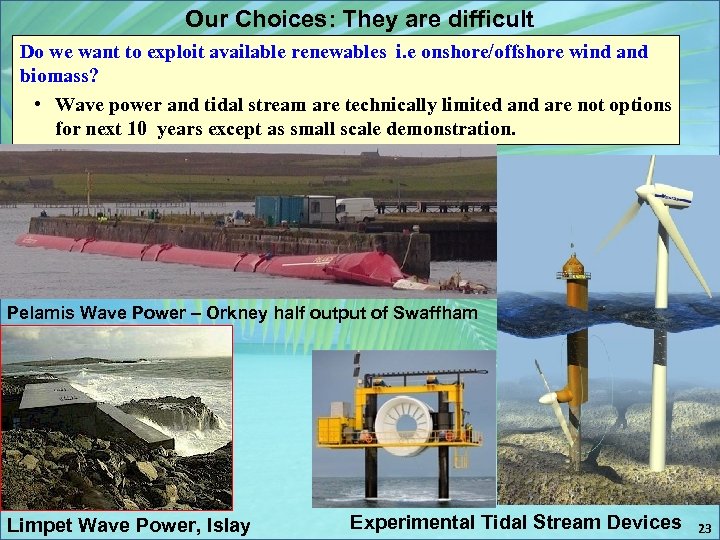 Our Choices: They are difficult Do we want to exploit available renewables i. e onshore/offshore wind and biomass? • Wave power and tidal stream are technically limited and are not options for next 10 years except as small scale demonstration. Pelamis Wave Power – Orkney half output of Swaffham Limpet Wave Power, Islay Experimental Tidal Stream Devices 23
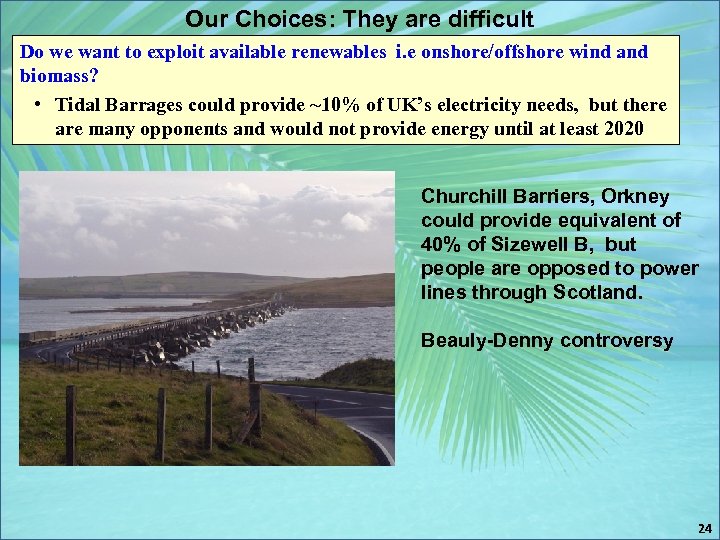 Our Choices: They are difficult Do we want to exploit available renewables i. e onshore/offshore wind and biomass? • Tidal Barrages could provide ~10% of UK’s electricity needs, but there are many opponents and would not provide energy until at least 2020 Churchill Barriers, Orkney could provide equivalent of 40% of Sizewell B, but people are opposed to power lines through Scotland. Beauly-Denny controversy 24
 Our Choices: They are difficult Do we want to exploit available renewables i. e onshore/offshore wind and biomass? . Photovoltaics, tidal, wave are not options for next 20 years. If our answer is NO Do we want to see a renewal of nuclear power ? Are we happy on this and the other attendant risks? If our answer is NO Do we want to return to using coal? • then carbon dioxide emissions will rise significantly • unless we can develop carbon sequestration within 10 years UNLIKELY If our answer to coal is NO Do we want to leave things are they are and see continued exploitation of gas for both heating and electricity generation? >>>>>> 25
 Our Choices: They are difficult If our answer is YES By 2020 • we will be dependent on GAS for around 70% of our heating and electricity imported from countries like Russia, Iran, Iraq, Libya, Algeria Are we happy with this prospect? >>>>>> If not: We need even more substantial cuts in energy use. Or are we prepared to sacrifice our future to effects of Global Warming? - the North Norfolk Coal Field? Aylsham Colliery, North Walsham Pit? ? Do we wish to reconsider our stance on renewables? Inaction or delays in decision making will lead us down the GAS option route and all the attendant Security issues that raises. Through inaction and a coherent energy policy the UK Government is taking us down the Gas Route. 26
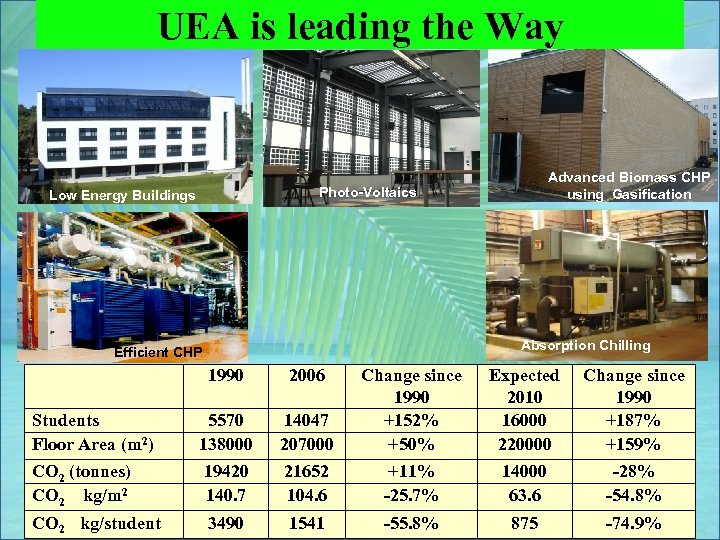 UEA is leading the Way Advanced Biomass CHP using Gasification Photo-Voltaics Low Energy Buildings Absorption Chilling Efficient CHP 1990 2006 14047 207000 Change since 1990 +152% +50% Expected 2010 16000 220000 Change since 1990 +187% +159% Students Floor Area (m 2) 5570 138000 CO 2 (tonnes) CO 2 kg/m 2 19420 140. 7 21652 104. 6 +11% -25. 7% 14000 63. 6 -28% -54. 8% CO 2 kg/student 3490 1541 -55. 8% 875 -74. 9%
 The Unbalanced Triangular Trade 0. 94 billion people Raw materials Aid 1. 33 billion people n tio ca du &E CO s 2 e nn o Mt 5) 8 47 02 -0 : cts (20 u rod ease P r inc 1. 03 billion people Each person in Developed Countries has been responsible for an extra 463 kg of CO 2 emissions in goods imported from China in just 3 years (2002 – 2005) 28
 And Finally • Need to act now otherwise we might have to make choice of whether we drive 1. 6 miles or heat an old person’s room WEBSITE www. cred-uk. org This presentation will be on WEB from this evening >follow Academic Resources Link Are you up to the Challenge? : Will you make a pledge? “If you do not change direction, you may end up where you are heading. ” (直译):“如果你不改变,你将止步于原地。” 29 Lao Tzu (604 -531 BC) Chinese Artist and Taoist philosopher 老子 (604 -531 BC)中国古代思想家、哲学家
 30
30
 31
31
 32
32
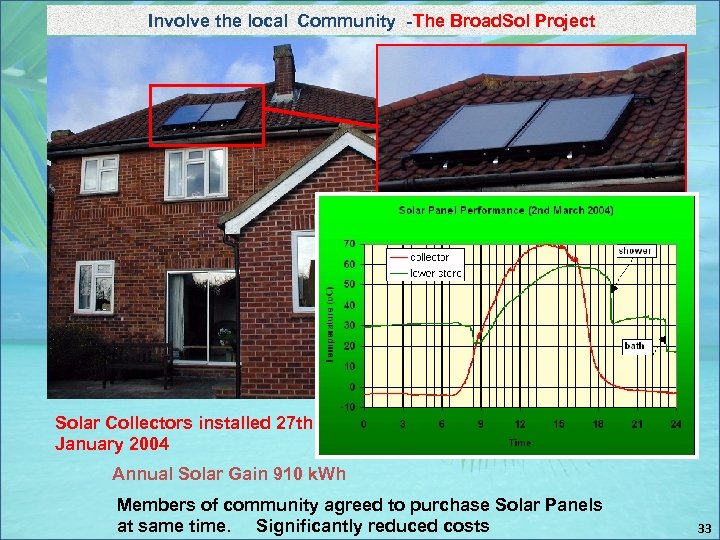 Involve the local Community -The Broad. Sol Project Solar Collectors installed 27 th January 2004 Annual Solar Gain 910 k. Wh Members of community agreed to purchase Solar Panels at same time. Significantly reduced costs 33
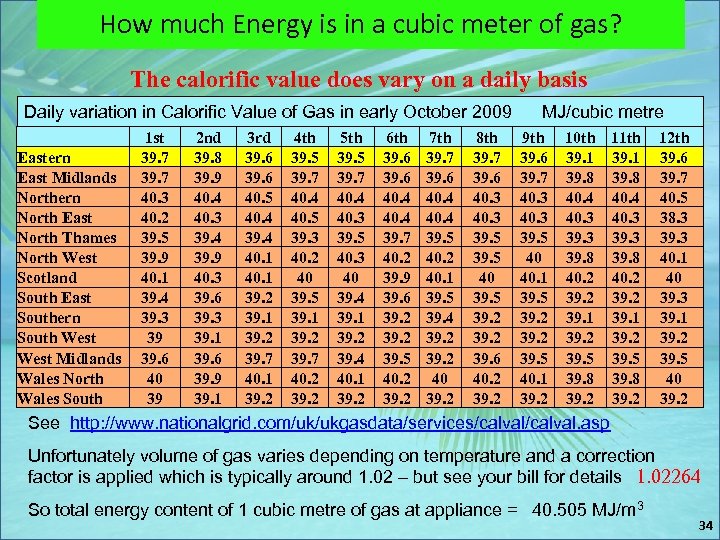 How much Energy is in a cubic meter of gas? The calorific value does vary on a daily basis Daily variation in Calorific Value of Gas in early October 2009 Eastern East Midlands Northern North East North Thames North West Scotland South East Southern South West Midlands Wales North Wales South 1 st 39. 7 40. 3 40. 2 39. 5 39. 9 40. 1 39. 4 39. 3 39 39. 6 40 39 2 nd 39. 8 39. 9 40. 4 40. 3 39. 4 39. 9 40. 3 39. 6 39. 3 39. 1 39. 6 39. 9 39. 1 3 rd 39. 6 40. 5 40. 4 39. 4 40. 1 39. 2 39. 7 40. 1 39. 2 4 th 39. 5 39. 7 40. 4 40. 5 39. 3 40. 2 40 39. 5 39. 1 39. 2 39. 7 40. 2 39. 2 5 th 39. 5 39. 7 40. 4 40. 3 39. 5 40. 3 40 39. 4 39. 1 39. 2 39. 4 40. 1 39. 2 6 th 39. 6 40. 4 39. 7 40. 2 39. 9 39. 6 39. 2 39. 5 40. 2 39. 2 7 th 39. 7 39. 6 40. 4 39. 5 40. 2 40. 1 39. 5 39. 4 39. 2 40 39. 2 8 th 39. 7 39. 6 40. 3 39. 5 40 39. 5 39. 2 39. 6 40. 2 39. 2 MJ/cubic metre 9 th 39. 6 39. 7 40. 3 39. 5 40 40. 1 39. 5 39. 2 39. 5 40. 1 39. 2 10 th 11 th 39. 1 39. 8 40. 4 40. 3 39. 8 40. 2 39. 1 39. 2 39. 5 39. 8 39. 2 12 th 39. 6 39. 7 40. 5 38. 3 39. 3 40. 1 40 39. 3 39. 1 39. 2 39. 5 40 39. 2 See http: //www. nationalgrid. com/uk/ukgasdata/services/calval. asp Unfortunately volume of gas varies depending on temperature and a correction factor is applied which is typically around 1. 02 – but see your bill for details 1. 02264 So total energy content of 1 cubic metre of gas at appliance = 40. 505 MJ/m 3 34