 Скачать презентацию Greening Economies in the Eastern Neighbourhood A means
6c5b370399cbb65c6fe603873ab67a9e.ppt
- Количество слайдов: 13



Greening Economies in the Eastern Neighbourhood A means for Ea. P countries to progress faster on their path to green economy.
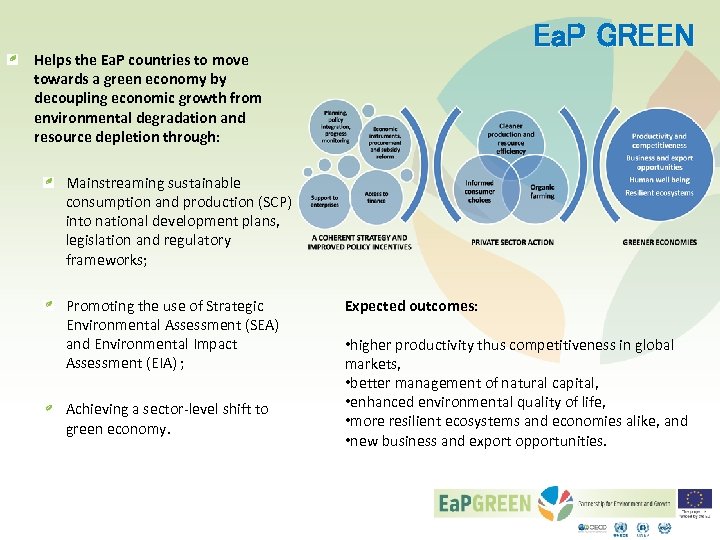
Ea. P GREEN Helps the Ea. P countries to move towards a green economy by decoupling economic growth from environmental degradation and resource depletion through: Mainstreaming sustainable consumption and production (SCP) into national development plans, legislation and regulatory frameworks; Promoting the use of Strategic Environmental Assessment (SEA) and Environmental Impact Assessment (EIA) ; Achieving a sector-level shift to green economy. Expected outcomes: • higher productivity thus competitiveness in global markets, • better management of natural capital, • enhanced environmental quality of life, • more resilient ecosystems and economies alike, and • new business and export opportunities.
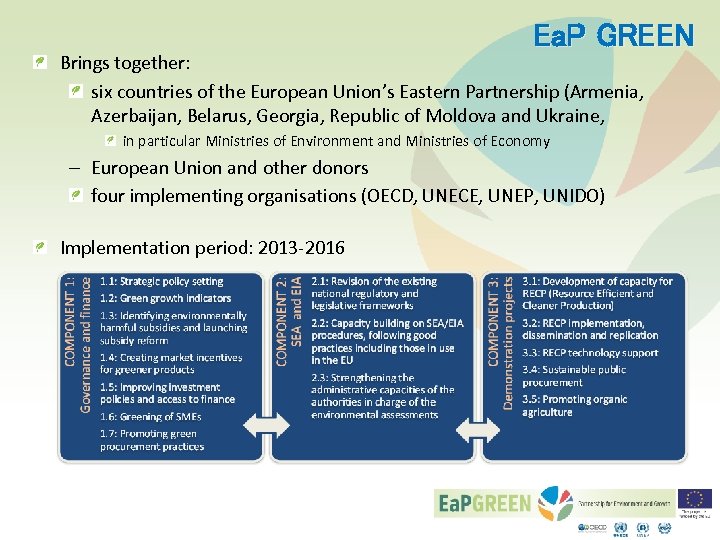
Ea. P GREEN Brings together: six countries of the European Union’s Eastern Partnership (Armenia, Azerbaijan, Belarus, Georgia, Republic of Moldova and Ukraine, in particular Ministries of Environment and Ministries of Economy – European Union and other donors four implementing organisations (OECD, UNECE, UNEP, UNIDO) Implementation period: 2013 -2016
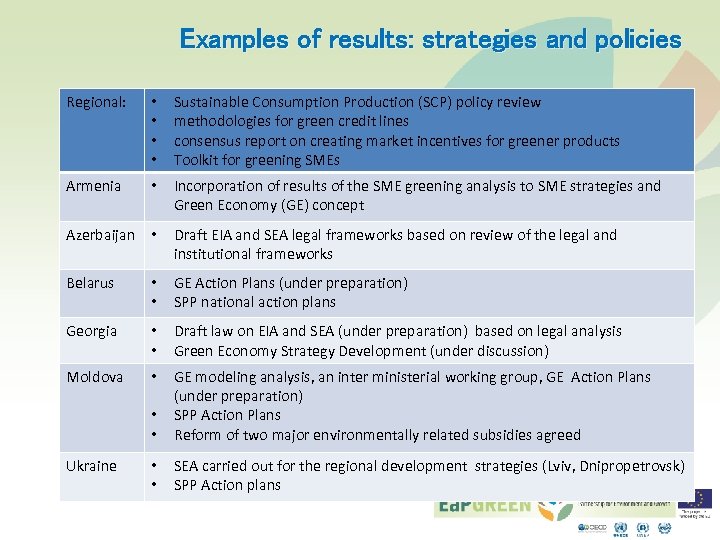
Examples of results: strategies and policies Regional: • • Sustainable Consumption Production (SCP) policy review methodologies for green credit lines consensus report on creating market incentives for greener products Toolkit for greening SMEs Armenia • Incorporation of results of the SME greening analysis to SME strategies and Green Economy (GE) concept Azerbaijan • Draft EIA and SEA legal frameworks based on review of the legal and institutional frameworks Belarus • • GE Action Plans (under preparation) SPP national action plans Georgia • • Draft law on EIA and SEA (under preparation) based on legal analysis Green Economy Strategy Development (under discussion) Moldova • • • GE modeling analysis, an inter ministerial working group, GE Action Plans (under preparation) SPP Action Plans Reform of two major environmentally related subsidies agreed • • SEA carried out for the regional development strategies (Lviv, Dnipropetrovsk) SPP Action plans Ukraine
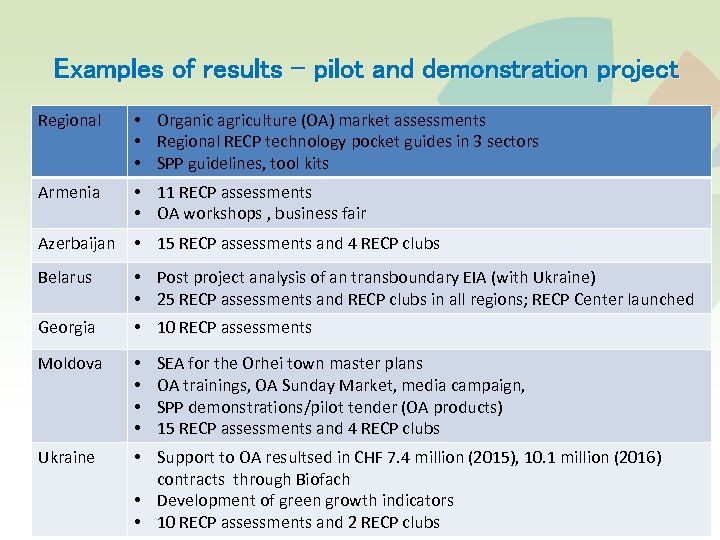
Examples of results – pilot and demonstration project Regional • Organic agriculture (OA) market assessments • Regional RECP technology pocket guides in 3 sectors • SPP guidelines, tool kits Armenia • 11 RECP assessments • OA workshops , business fair Azerbaijan • 15 RECP assessments and 4 RECP clubs Belarus • Post project analysis of an transboundary EIA (with Ukraine) • 25 RECP assessments and RECP clubs in all regions; RECP Center launched Georgia • 10 RECP assessments Moldova • • Ukraine • Support to OA resultsed in CHF 7. 4 million (2015), 10. 1 million (2016) contracts through Biofach • Development of green growth indicators • 10 RECP assessments and 2 RECP clubs SEA for the Orhei town master plans OA trainings, OA Sunday Market, media campaign, SPP demonstrations/pilot tender (OA products) 15 RECP assessments and 4 RECP clubs
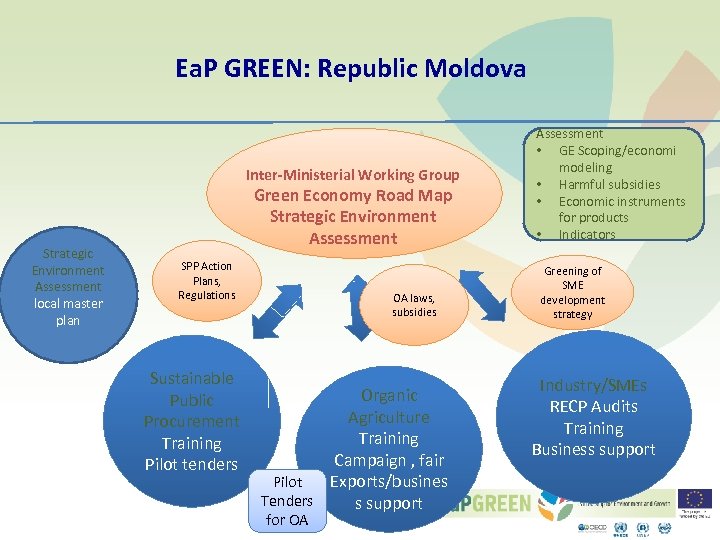
Ea. P GREEN: Republic Moldova Inter-Ministerial Working Group Strategic Environment Assessment local master plan Green Economy Road Map Strategic Environment Assessment SPP Action Plans, Regulations Sustainable Public Procurement Training Pilot tenders OA laws, subsidies Organic Agriculture Training Campaign , fair Pilot Exports/busines Tenders s support for OA Assessment • GE Scoping/economi modeling • Harmful subsidies • Economic instruments for products • Indicators Greening of SME development strategy Industry/SMEs RECP Audits Training Business support
Switch. Med SCP-NAP process and outputs SWITCH-Med Programme is funded by the European Union 7
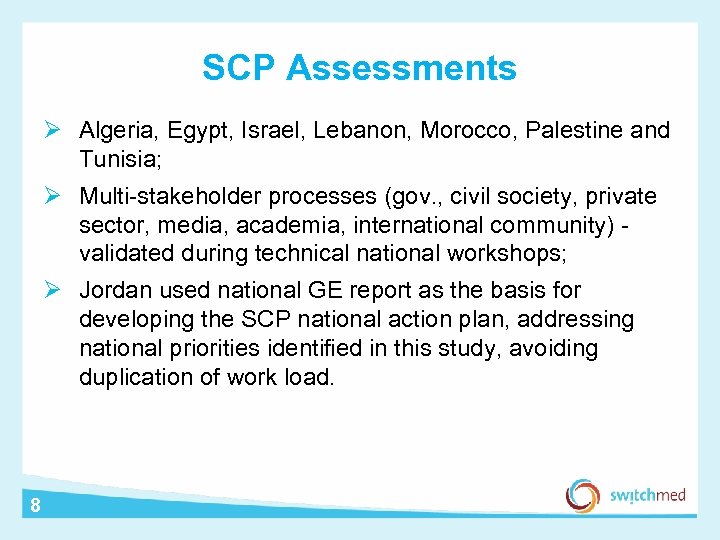
SCP Assessments Ø Algeria, Egypt, Israel, Lebanon, Morocco, Palestine and Tunisia; Ø Multi-stakeholder processes (gov. , civil society, private sector, media, academia, international community) - validated during technical national workshops; Ø Jordan used national GE report as the basis for developing the SCP national action plan, addressing national priorities identified in this study, avoiding duplication of work load. 8
SCP- National Action Plans: Ø SCP assessments are integral part of the SCP-NAP process; Ø The stakeholders involved in the SCP assessment process are also involved in designing the SCP-NAP, enabling some overlap of these processes to save time; Ø SCP-NAPs have been developed and validated in Algeria, Egypt, Israel, Jordan, Lebanon, Morocco, Tunisia and Palestine. 9
Outputs: Ø SCP-NAPs based on assessments; Ø More than 25 multi-stakeholder national SCP workshops and roundtables organized; Ø National capacity on SCP reinforced, engaging over 1500 participants from different ministries, public and private sector, civil society, academia, media, international organizations and bi-lateral partners; Ø High-level political support for the process resulting in endorsement of the SCP-NAP output. 10
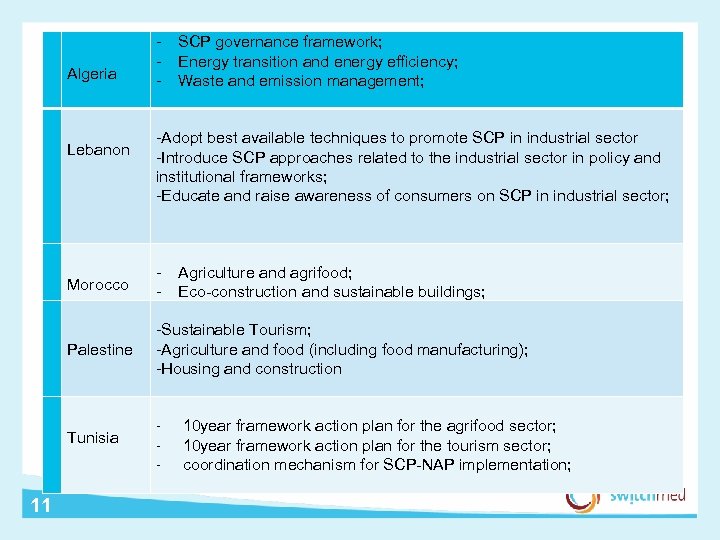
Algeria SCP governance framework; Energy transition and energy efficiency; Waste and emission management; Lebanon -Adopt best available techniques to promote SCP in industrial sector -Introduce SCP approaches related to the industrial sector in policy and institutional frameworks; -Educate and raise awareness of consumers on SCP in industrial sector; Morocco - Palestine -Sustainable Tourism; -Agriculture and food (including food manufacturing); -Housing and construction Agriculture and agrifood; Eco-construction and sustainable buildings; Tunisia 11 10 year framework action plan for the agrifood sector; 10 year framework action plan for the tourism sector; coordination mechanism for SCP-NAP implementation;
Egypt • National Green Economy report as the basis; • outcomes of the economic modelling for the GE assessment developed and adapted to become the foundation for SCP-NAP; • SCP-NAP identified the main elements for each of the four priority sectors (agriculture, energy, water and municipal solid waste), strategic directions and proposed activities; • 28 projects presented by 13 different entities and presented in details in the SCP-NAP; • as demonstration project Egypt has decided to implement an adapted version of a Public Procurement Project that was developed as a response to the 10 YFP trust fund. 12
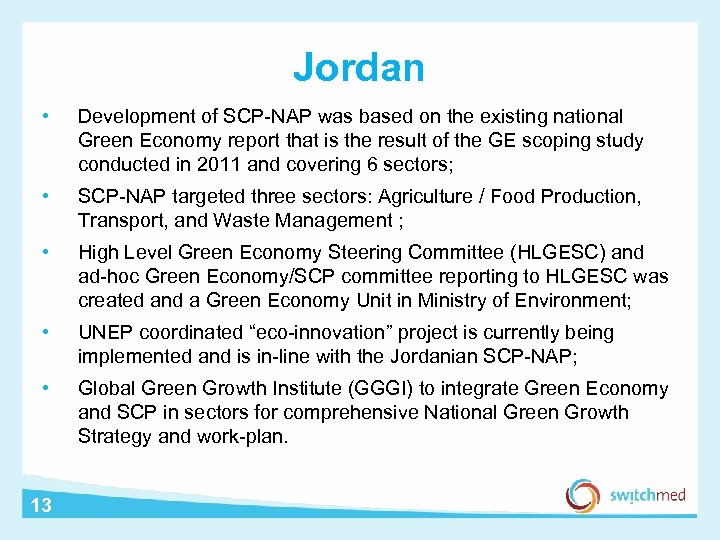
Jordan • Development of SCP-NAP was based on the existing national Green Economy report that is the result of the GE scoping study conducted in 2011 and covering 6 sectors; • SCP-NAP targeted three sectors: Agriculture / Food Production, Transport, and Waste Management ; • High Level Green Economy Steering Committee (HLGESC) and ad-hoc Green Economy/SCP committee reporting to HLGESC was created and a Green Economy Unit in Ministry of Environment; • UNEP coordinated “eco-innovation” project is currently being implemented and is in-line with the Jordanian SCP-NAP; • Global Green Growth Institute (GGGI) to integrate Green Economy and SCP in sectors for comprehensive National Green Growth Strategy and work-plan. 13
Скачать презентацию Greening Economies in the Eastern Neighbourhood A means
6c5b370399cbb65c6fe603873ab67a9e.ppt