


 Скачать презентацию Greening Development Integrating environment and climate change into
f92139dacad54c442499358a92db50b1.ppt
- Количество слайдов: 40
 Greening Development Integrating environment and climate change into development cooperation A sustainability primer for non-specialists – module 0 1
 Objectives You are more: Ø Aware of linkagess between environment, climate change & development Ø Aware of the benefits and challenges of integrating environment and climate change in development cooperation Ø Confident and familiar with the concepts and tools for integrating environment and climate change Ø Motivated and equipped to integrate environment and climate change in your work And, you have: Ø Shared your views, knowledge and experiences Ø Contributed by providing feedback and insights on integration in practice Linked to earlier course and EU guidelines on integration of environment and climate change in development No. 4 2009 2
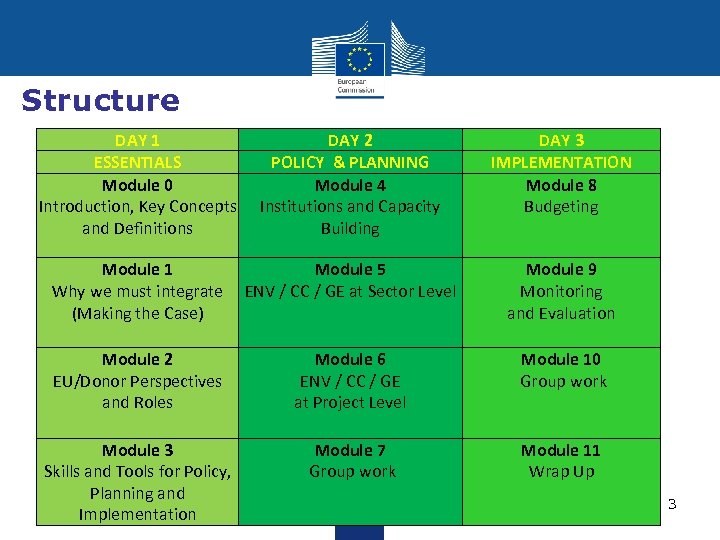 Structure DAY 1 ESSENTIALS Module 0 Introduction, Key Concepts and Definitions DAY 2 POLICY & PLANNING Module 4 Institutions and Capacity Building DAY 3 IMPLEMENTATION Module 8 Budgeting Module 1 Why we must integrate (Making the Case) Module 5 ENV / CC / GE at Sector Level Module 9 Monitoring and Evaluation Module 2 EU/Donor Perspectives and Roles Module 6 ENV / CC / GE at Project Level Module 10 Group work Module 3 Skills and Tools for Policy, Planning and Implementation Module 7 Group work Module 11 Wrap Up 3
 Introduction, Key Concepts & Definitions 4
 Definitions: Integration/ Mainstreaming The process of systematically integrating a selected value/idea/theme into all domains of development co-operation. A process aimed at transforming ideas and practices (EC) The informed inclusion of relevant environmental concerns into the decisions and institutions that drive national and sectoral development policy, rules, plans, investment and action (IIED) 5
 Definitions: Green Economy Transition to a green economy is a process of reconfiguring businesses and infrastructure to deliver better returns on natural, human, & economic capital investments while at the same time reducing green house gas emissions, extracting and using less natural resources, creating less waste and reducing social disparities - OECD A green economy is one that results in “improved human well-being and social equity, while significantly reducing environmental risks and ecological scarcities” - UNEP 2010 Perhaps also refer to Rio outcome document – the Future We Want 6
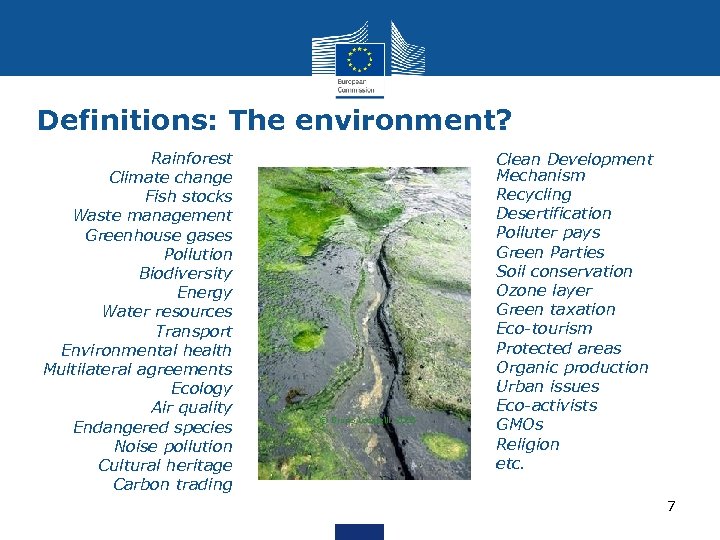 Definitions: The environment? • Rainforest • Climate change • Fish stocks • Waste management • Greenhouse gases • Pollution • Biodiversity • Energy • Water resources • Transport • Environmental health • Multilateral agreements • Ecology • Air quality • Endangered species • Noise pollution • Cultural heritage • Carbon trading • © Bruno Locatelli, 2005 • • • • Clean Development Mechanism Recycling Desertification Polluter pays Green Parties Soil conservation Ozone layer Green taxation Eco-tourism Protected areas Organic production Urban issues Eco-activists GMOs Religion etc. 7
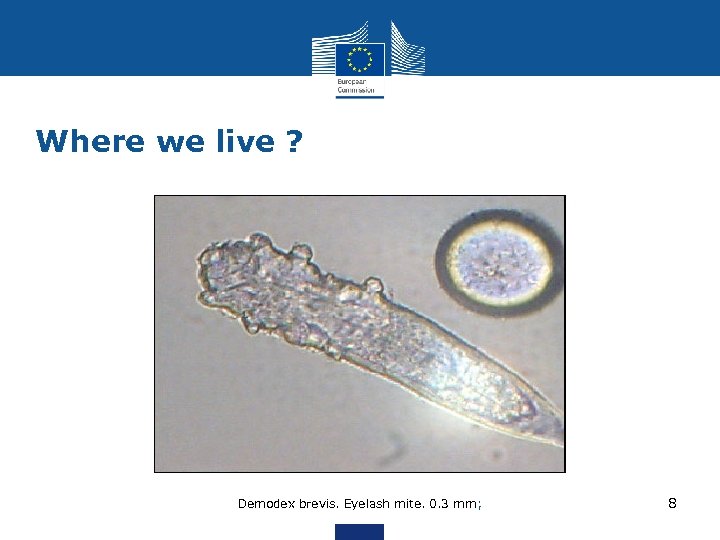 Where we live ? Demodex brevis. Eyelash mite. 0. 3 mm; 8
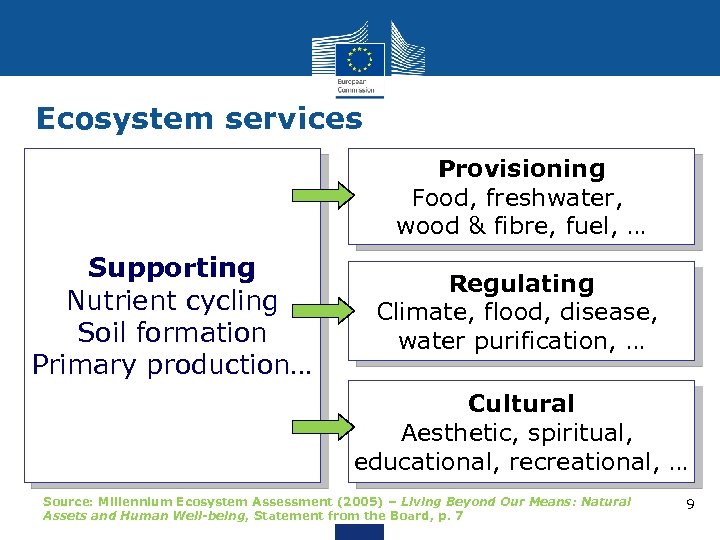 Ecosystem services Provisioning Food, freshwater, wood & fibre, fuel, … Supporting Nutrient cycling Soil formation Primary production… Regulating Climate, flood, disease, water purification, … Cultural Aesthetic, spiritual, educational, recreational, … Source: Millennium Ecosystem Assessment (2005) – Living Beyond Our Means: Natural Assets and Human Well-being, Statement from the Board, p. 7 9
 Definitions: Climate change is ‘a change of climate which is attributed directly or indirectly to human activity that alters the composition of the global atmosphere and which is in addition to natural climate variability observed over comparable time periods’ - UNFCC 10
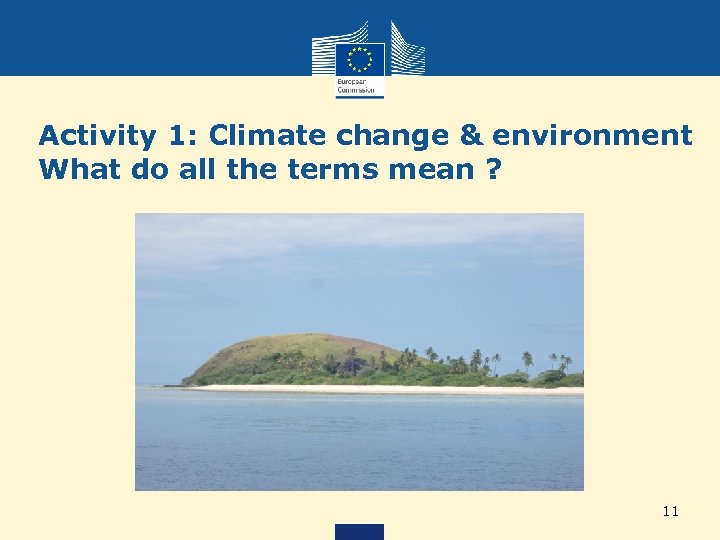 Activity 1: Climate change & environment What do all the terms mean ? 11
 12
12
 Concepts – Integration/mainstreaming • Unpacking what we mean by integration / mainstreaming what we have learnt so far about applying these concepts drivers and barriers to integration what it means for organisations, (do you need this one? Or maybe we should stress for organisations both in recipient and donor countries)) • the UNDP/UNEP model of integration/ mainstreaming ( - in the comments i. e. there is good guidance out there – both 13 ours and others. . ) • •
 Concepts – integration/ mainstreaming … “the process of systematically integrating a selected value/idea/theme into all domains of EC development co-operation” into: • Country, regional and multi-country programmes • At all stages in the cycle of operations • With all aid delivery methods using: • Environmental and Climate integration tools 14
 Concepts – integration/ mainstreaming • … ”the informed inclusion of relevant environmental concerns into the decisions • of institutions that drive national, local and sectoral development policy, rules, plans, investments and actions” • • (Dalal-Clayton and Bass, 2009) – do you need this when you already have IIED and EC interpretations 15
 What have we learnt so far? • Integration is not an easy concept to grasp • A focus on ”tools” alone does not suffice • Political economy, drivers of change, incentives & the institutional context is crucial • Despite some major successes progress is [painfully] slow • Integration is a long term and continuing process • Integration can be upstream (awareness, policy and planning) as well as downstream (implementation) • Reacting to opportunities is as important as overcoming challenges 16
 Different views on integration Integration can mean: • Box-ticking – tools used without understanding • Giving lip service – greenwash • Informing– contributing to better informed decisions • Scaling up – replicating successes by policy change • Changing the power balance – imposing conditions/raise concerns • Changing value systems - civil society, public & private sector The first two are superficial, the last two are radical and potentially lasting Adapted from IIED Experience of integrating enviroment into development institutions and decisions, 2009 17
 Integration – drivers - incentives - not sure if it makes sense to have hereor in a later module – but a good slide • National Policy(ies), legislation and regulations • Planning processes e. g. NAPA • International committments • Stakeholder demand – often led by a charismatic leader ("champion") • Consumer behaviour – throughout the value chain (BMW) – eg EU for illegal timber • Cultural and traditional norms • Disasters – highly visible (Nairobi river/ trade villages VN) • Self evident and self realised awareness of the need/benefits • Climate – environmental funding • Budget allocation and targets 18
 Integration – barriers - disincentives • Data – poor information base for decisions • Capacity – knowledge and skills – complexity and time • Cultural and traditional norms • Political & institutional acceptance/mandate (political economy) • Disconnect between losers and gainers • Vested interests – gains 19
 Integration and organisations • Integration requires collaboration. It will often be as much a political and institutional change process as a technical one. • Integration depends upon leadership to forge the necessary links and processes, and needs to be a continuing and long-term process, not a one-off project – no quick fix • Integration is effective when it uses an array of tactics, approaches, hard and soft tools and goes beyond procedural assessment 20
 Effective integration & organisations The usual application of a safeguard mechanism – a ‘tool’ – needs to be complemented by an integrated and systematic institutional development approach that realises the potential of environmental assets and recognises [think we should stay with UK English ; -)] the limits. But before we get that far… What about the EU and EU Delegations themselves? Is there: Clear environmental vision and leadership? Strategy and systems for environmental mainstreaming? 21
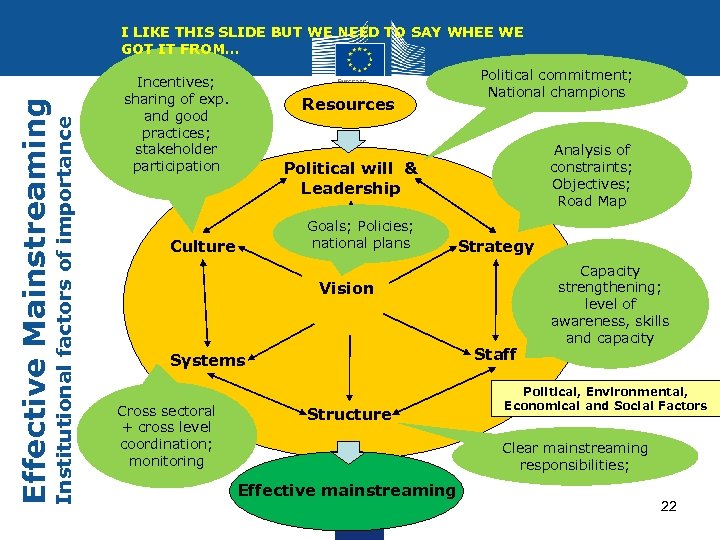 Institutional factors of importance Effective Mainstreaming I LIKE THIS SLIDE BUT WE NEED TO SAY WHEE WE GOT IT FROM… Incentives; sharing of exp. and good practices; stakeholder participation Resources Political commitment; National champions Analysis of constraints; Objectives; Road Map Political will & Leadership Goals; Policies; national plans Culture Strategy Vision Staff Systems Cross sectoral + cross level coordination; monitoring Structure Capacity strengthening; level of awareness, skills and capacity Political, Environmental, Economical and Social Factors Clear mainstreaming responsibilities; Effective mainstreaming 22
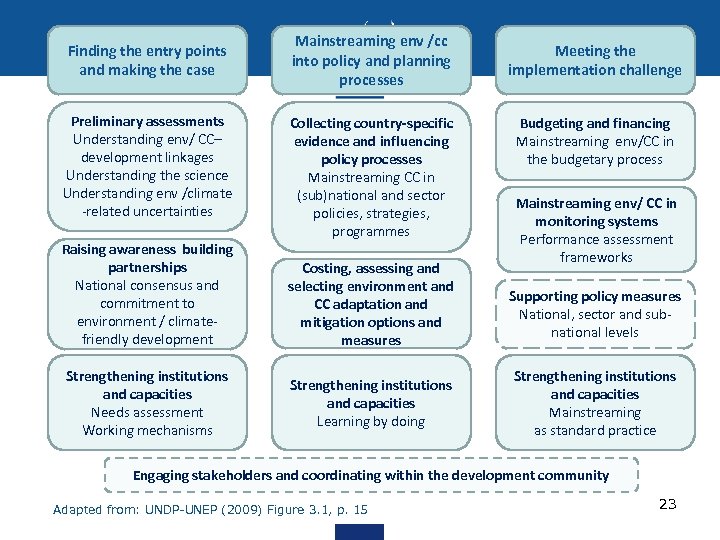 Finding the entry points and making the case Preliminary assessments Understanding env/ CC– development linkages Understanding the science Understanding env /climate -related uncertainties Raising awareness building partnerships National consensus and commitment to environment / climatefriendly development Strengthening institutions and capacities Needs assessment Working mechanisms Mainstreaming env /cc into policy and planning processes Collecting country-specific evidence and influencing policy processes Mainstreaming CC in (sub)national and sector policies, strategies, programmes Costing, assessing and selecting environment and CC adaptation and mitigation options and measures Strengthening institutions and capacities Learning by doing Meeting the implementation challenge Budgeting and financing Mainstreaming env/CC in the budgetary process Mainstreaming env/ CC in monitoring systems Performance assessment frameworks Supporting policy measures National, sector and subnational levels Strengthening institutions and capacities Mainstreaming as standard practice Engaging stakeholders and coordinating within the development community Adapted from: UNDP-UNEP (2009) Figure 3. 1, p. 15 23
 Concepts – climate change • Unpacking • what we mean by climate change , • the consequences and how to address them, • working out where we stand, • Concepts (or science? ) behind some of the terminology. 24
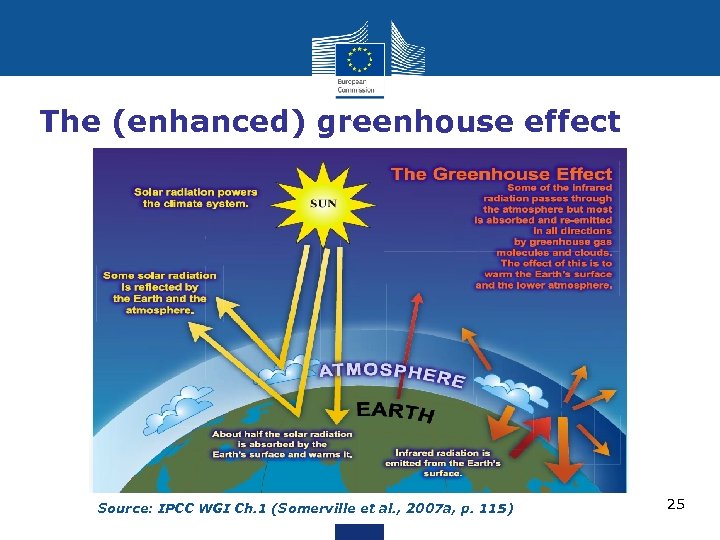 The (enhanced) greenhouse effect Source: IPCC WGI Ch. 1 (Somerville et al. , 2007 a, p. 115) 25
 Consequences – need to mention "uncertainty"(!) • • Changes in average conditions Warmer, wetter, drier, higher sea levels - changes in growing seasons, viable ranges of crops, ecosystems, pests, diseases; greater evaporation, changes in water availability, land loss Changes in climatic extremes Heat waves, droughts, precipitation, floods, storm surges, fires; changes in storm tracks & behaviour - changes in disaster risks “Abrupt” changes and “singular” hazards • • Circulation changes, ecosystem collapse, glacial lake outbursts, aridhumid transitions - rapid & slow onset disasters Impacts on Water, food security, health, infrastructure, energy, natural resources, livelihoods, migration, conflict, growth, trade etc 26
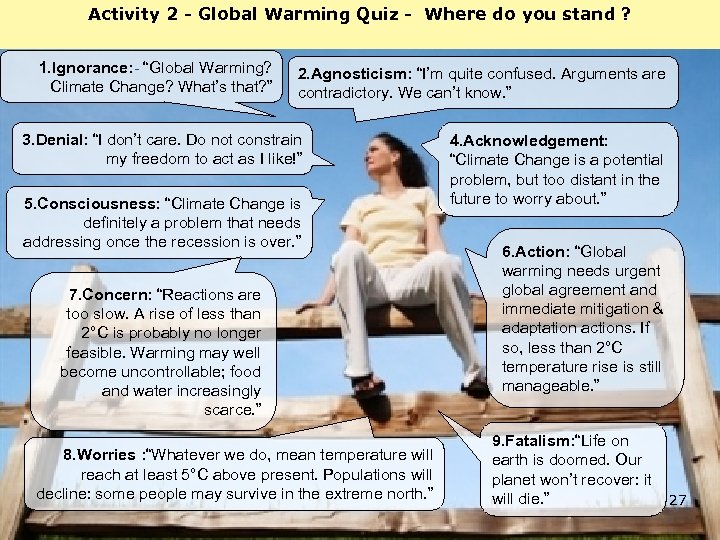 Activity 2 - Global Warming Quiz - Where do you stand ? 1. Ignorance: - “Global Warming? Climate Change? What’s that? ” 2. Agnosticism: “I’m quite confused. Arguments are contradictory. We can’t know. ” 3. Denial: “I don’t care. Do not constrain my freedom to act as I like!” 5. Consciousness: “Climate Change is definitely a problem that needs addressing once the recession is over. ” 7. Concern: “Reactions are too slow. A rise of less than 2°C is probably no longer feasible. Warming may well become uncontrollable; food and water increasingly scarce. ” 8. Worries : “Whatever we do, mean temperature will reach at least 5°C above present. Populations will decline: some people may survive in the extreme north. ” 4. Acknowledgement: “Climate Change is a potential problem, but too distant in the future to worry about. ” 6. Action: “Global warming needs urgent global agreement and immediate mitigation & adaptation actions. If so, less than 2°C temperature rise is still manageable. ” 9. Fatalism: “Life on earth is doomed. Our planet won’t recover: it will die. ” 27
 Addressing climate change • • • Mitigation Reducing emissions that drive climate change Industrialised & rapidly industrialising country focus Transition to low carbon economy, CDM, REDD, etc • • • Adaptation Improving resilience to climate change & its impacts All countries, particularly poor, vulnerable, LDCs etc Mainstreaming, emerging funds (e. g. adaptation fund, GCCA) • • (Geoengineering) – would not mention here…. Compensate for emissions - carbon removal, solar radiation management Speculative, untested, potential impacts, longer term 28
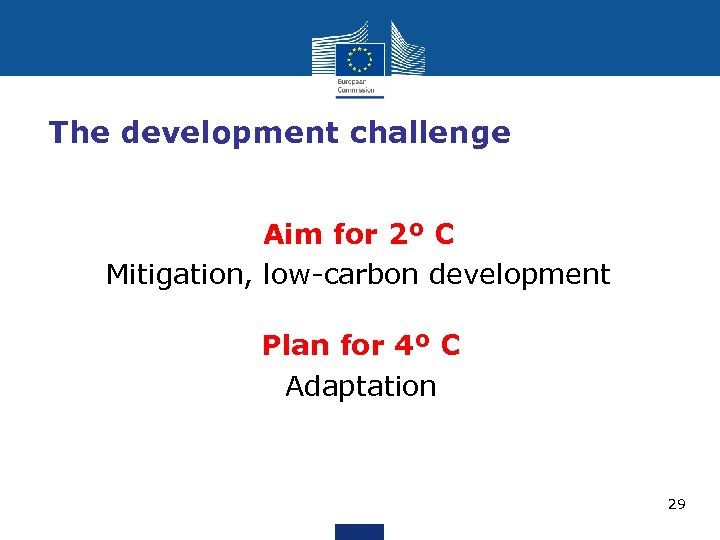 The development challenge Aim for 2º C Mitigation, low-carbon development Plan for 4º C Adaptation 29
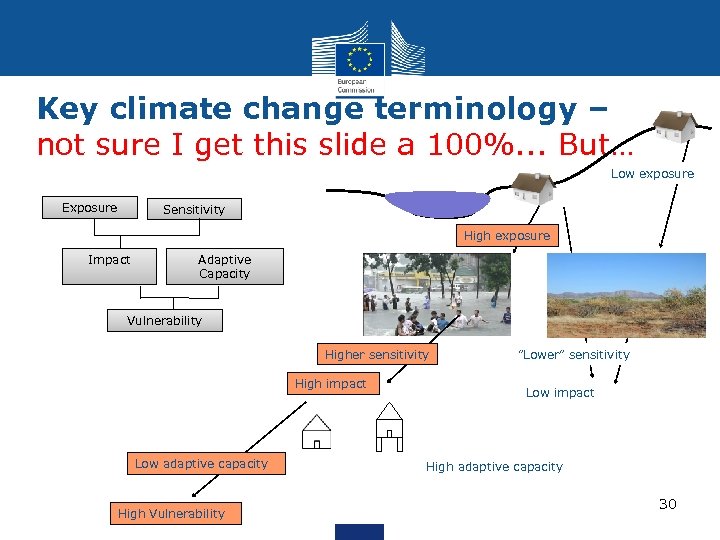 Key climate change terminology – not sure I get this slide a 100%. . . But… Low exposure Exposure Sensitivity High exposure Impact Adaptive Capacity Vulnerability Higher sensitivity High impact Low adaptive capacity High Vulnerability ”Lower” sensitivity Low impact High adaptive capacity 30
 Concepts – green economy • Unpacking • what we mean by the green economy • the links with integration of environment and climate change 31
 Green economy – revisit of definition Transition to a green economy is a process of reconfiguring businesses and infrastructure to deliver better returns on natural, human, & economic capital investments while at the same time reducing green house gas emissions, extracting and using less natural resources, creating less waste and reducing social disparities - OECD A green economy is one that results in “improved human well-being and social equity, while significantly reducing environmental risks and ecological scarcities” - UNEP 2010 32
 Green economy – types of intevention • Investing in natural capital such as land water through increasing incentives for efficient use e. g. water tariffs, introducing technologies and practices that turn waste to economic resources such as sludge to biogas; • Investing in people by building social capital e. g. around community based water resource management and providing skills and opportunities for the private sector to respond to new incentives; • Improving governance to overcome market failings and improve the environment for collective action e. g. by setting up water user groups for sharing irrigation water. (examples perhaps a little heavy on the water side) 33
 Green economy – sector examples • Energy • Water • Land • Waste • Buildings • Transport • Tourism Renewable and energy efficiency Recyling Soil conservation – organic agriculture Waste to energy, packaging Low carbon, low energy, energy neutral Public systems, electric/hybrid, informhation technology Eco-tourism 34
 Green Economy - examples • Costa Rica – tourism (need to elaborate) • Uganda – organic farming 35
 Green economy transition • Mounting evidence (which? ) suggests that transitioning to a green economy has sound economic and social justification – environment sector and integration of environment and climate change can be an engine for growth and jobs. What role could others have ? Consumers Private sector others Int. community • For governments, this would include • leveling the playing field for greener products by phasing out antiquated subsidies, • reforming policies and providing new incentives, • strengthening market infrastructure and market-based mechanisms, redirecting public investment, and • greening public procurement. 36
 Green economy transition • Rio de Janeiro 2012 (Rio+20) (you mean the outcome document – The Future We Want? ) includes the agenda item “Green • Economy in the Context of Sustainable Development and Poverty Eradication” • Enabling conditions for a green economy • national regulations, • policies, • subsidies and incentives, • international market and legal infrastructure, • trade and • technical assistance. • Currently, enabling conditions encourage the prevailing brown economy that depends on fossil fuels, resource depletion and 37
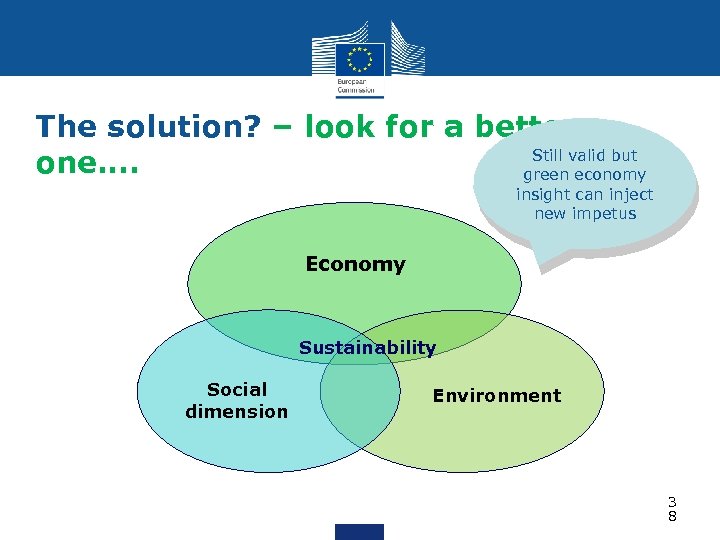 The solution? – look for a better Still valid but one…. green economy insight can inject new impetus Economy Sustainability Social dimension Environment 3 8
 Module 0 -definitions & concepts recap • Introduction to the course: • Day 1 the essentials; • Day 2 tools and skills for policy and planning; • Day 3 tools and skills for implementation • • Definitions: Integration / Green Economy/ Environment/ Climate change Why are environment and climate change important? : • Concepts – unpacking the issues • Integration /mainstreaming • Climate change • Green Economy • Activites: 1)Climate change and environment: What do all the terms mean? 2)Global Warming Quiz: Where do you stand? 39
 Resources Integration and mainstreaming • • • A web site (IIED) dedicated to environmental mainstreaming Policy Guidance on Integrating CC Adaptation Into Dev. Co-operation , OECD 2009 UNDP- UNEP Poverty and Environment Initiative - PEI Climate change • • • EU Guidelines on integration of environment and climate change in development cooperation , 2009 Climate change sector scripts / Sector guidance notes (under preparation) A map of EU climate change actions EU capacity 4 DEV website on climate and environment Briefing for non-experts on climate change – It’s a mad world Green economy • • • The UNEP report on Green Economy, 2011 - website on green economy OECD and World Bank - Green Growth knowledge platform The economics of climate change – reshaping thinking on climate resilient development, 2009 40