


 Скачать презентацию Greenhouse Gas Emission Reduction and Industry The World
32b3af5a79eb609a11e6a95410fb6242.ppt
- Количество слайдов: 18
 Greenhouse Gas Emission Reduction and Industry The World Bank February 2007
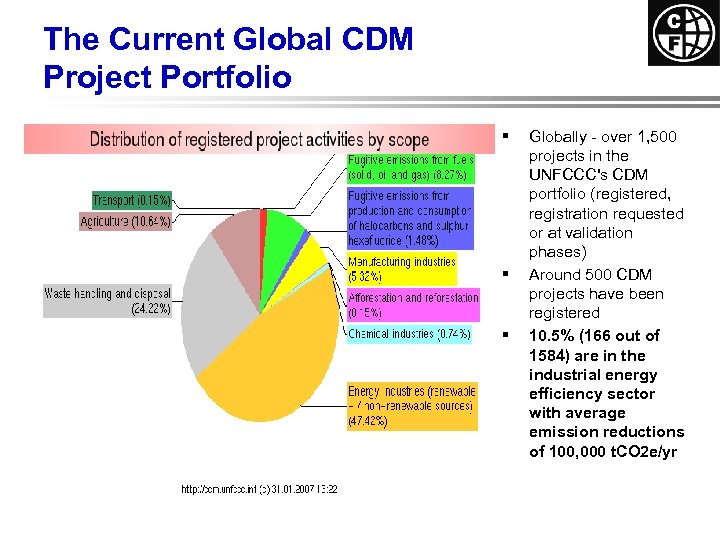 The Current Global CDM Project Portfolio § § § Globally - over 1, 500 projects in the UNFCCC's CDM portfolio (registered, registration requested or at validation phases) Around 500 CDM projects have been registered 10. 5% (166 out of 1584) are in the industrial energy efficiency sector with average emission reductions of 100, 000 t. CO 2 e/yr
 Energy Use and Sustainable Development in Industry § Challenge - scaling up industrial activities in an economically, socially and environmentally sustainable way § Improving the efficiency of industrial energy systems can reduce the GHG emissions for which industries are responsible § Good potential for energy efficiency in the industrial subsectors in ECA (UNDP World Energy Assessment): • about 40% for the building materials industry • 25 to 30 percent for chemicals, aluminum and food industries § Implementation of energy efficiency projects in industry are usually associated with increased productivity and greater access to global markets
 Reducing GHG Emissions in Industry § Reducing the energy intensity of existing industrial production, for example: • Replace outdated plant and equipment with modern energyefficient equivalent • Use more efficient motors and boilers, optimize pipe diameters; insulate pipes • Use waste heat to generate power, avoid radiation losses • Improve housekeeping procedures; maintenance • Introduce/ improve process control and automation • Make use of cleaner fuels, increase share of renewables • Promote long-term energy management, improve insulation of buildings, and/ or install meters
 Example - Water Pumping Efficiency, Georgia § Up to 40 % losses in water supply system due to bad quality pipes and inefficient pumps. § Replace pipes and install more efficient pumps at 100 stations • reduce GHG emissions by reducing the amount of energy required to deliver a unit of water to end users in municipal water utilities • improve energy efficiency in water pumping by 15% or average reduction in energy consumption of 50 000 k. Wh/year at each station § AM 0020 ”Baseline methodology for water pumping efficiency improvements”
 Example - Installation of Modified CO 2 Removal System in Ammonia Plant, India § Energy Efficiency • installation of modified CO 2 removal system in Ammonia Plant to reduce steam consumption • Reducing the energy required for steam generation • Reduction of ca. 96 GWh/year • Total reduction: ca. 245, 000 tons CO 2 e over 10 years § Additionality - No legal act for steam optimization in India § Project complies with all good and safe engineering practices
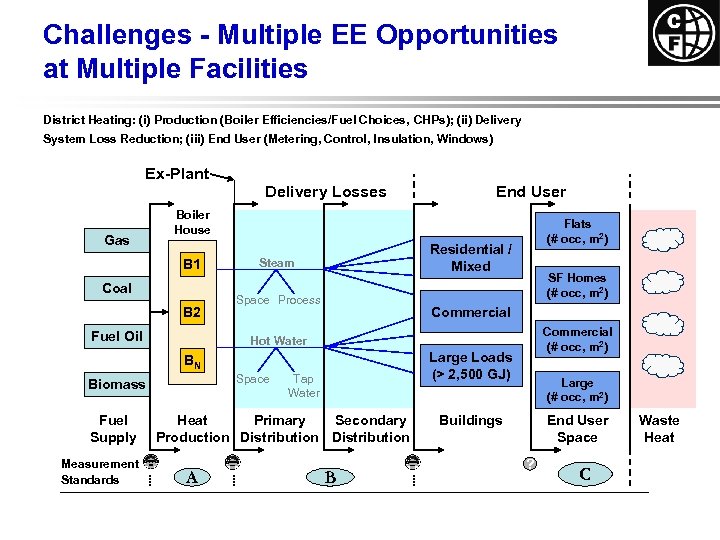 Challenges - Multiple EE Opportunities at Multiple Facilities District Heating: (i) Production (Boiler Efficiencies/Fuel Choices, CHPs); (ii) Delivery System Loss Reduction; (iii) End User (Metering, Control, Insulation, Windows) Ex-Plant Delivery Losses Gas Boiler House B 1 Coal B 2 Fuel Oil Space Process SF Homes (# occ, m 2) Commercial (# occ, m 2) Hot Water Space Biomass Measurement Standards Flats (# occ, m 2) Residential / Mixed Steam Large Loads (> 2, 500 GJ) BN Fuel Supply End User Tap Water Heat Primary Secondary Production Distribution A B Large (# occ, m 2) Buildings End User Space ? C Waste Heat
 Challenges - continued § Inadequate incentives • Heat or electric supply companies do not want to invest and lose sales revenue • End users may face subsidized energy prices – inadequate incentive to conserve energy § Additionality • Many low cost measures may not be additional • Aggressive efficiency standards may crowd out CDM role § Uncertainty • Multiple decision-makers are often involved § Cost • Investment financing is often very limited • Viable higher cost projects may face financing constraints • CDM Transactions costs can be high – need bundling mechanisms or programmatic approach
 Managing Challenges - Bundling and Programmatic Approaches § Bundling CDM Activities • “A group of things fastened together for convenient handling. ” • Combine small but similar projects to reduce transaction costs (all entities must be known at time of registration) • Standardize baselines and additionality tests • Local agency alliance to aggregate projects • Eliminate redundant elements of project processing • Present carbon buyer with attractive deal size § Programmatic CDM • deliberate program put in place to reduce GHG emissions • E. g. grant or soft loan programs, testing and labeling programs to promote a large number of small activities
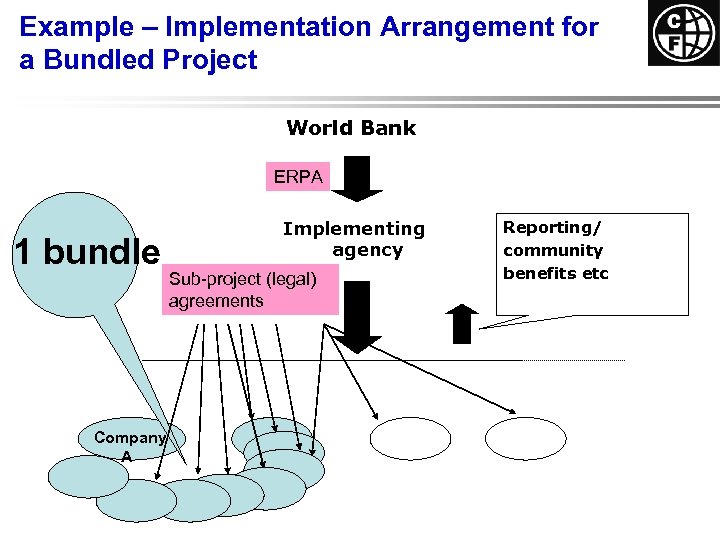 Example – Implementation Arrangement for a Bundled Project World Bank ERPA 1 bundle Company A Implementing agency Sub-project (legal) agreements Reporting/ community benefits etc
 Questions to Keep in Mind § Who is the bundling agency? • Financier/technology provider/private company/1 of the companies/entrepreneurs/NGO/other? • Are risks and benefits understood by all parties? § Title and authorization to emission reductions, Letter of Intent signing? § Are legal arrangements secure, adequate? § Capacity as counterpart? § Appraisal issues?
 Example - Czech Umbrella Project § Umbrella Concept • Czech Energy Agency is the intermediary • CEA to aggregate similar projects • Bundled Program For 16 Small Hydro Projects – Evaluated individually using common methodology § Role of CEA • Active support programs and Energy Audit Programs – Future State funding on year to year basis • Trained to screen and monitor projects and provide limited support § Developed validated standard baselines – • Czech Electric Sector • District Heating Projects • Campus Type EE Projects
 Example – Vertical Shaft Brick Kiln Industry (VSKB), India § Improve thermal performance of brick manufacturing through: • Replace conventional technologies (like clamp) with VSKB technology • Bundle 14 projects with energy savings - 23 GWhth per year, less than 50, 000 CO 2 e per year • Bundling Agency - Technology and Action for Rural Development (TARA) institution § Methodology “Energy Efficiency and Fuel Switching Measures for Industrial Facilities” AMS II. d § PDD Ready when enough VSBKs implemented. Crediting period limitations, since all must have the same length and start date: • Critical mass/ number of kilns needed to justify CDM costs • OK if – kilns identified, reasonably short time span between first and last
 Reducing GHG Emissions in Industry § Decrease production of industrial gases, such as: • CO 2 generation in cement production, • N 2 O emissions at fertilizer facilities, • CH 4 emissions in oil and gas production and mining § Structural shifts to new, less energy-intensive industrial products
 Example – Indocement Sustainable Cement Production, Indonesia § The project bundles two sub-projects: (1) Blended Cement - Reduce the clinker content by introducing limestone and other materials such as fly-ash in the finish grinding process. About 60 % of ERs are attributed to process changes for producing blended cement. (2) Fuel Switch - Use alternative fuels (such as rice husk, coconut and palm oil waste) instead of coal, oil, and gas. § Benefits: • 10 -12 million tonnes CO 2 emission reductions (10 -year crediting period) • IRR expected to increase from 7 % without CDM to 11. 2 % with CDM § Timing - less than 15 months PIN to ERPA negotiations § A new methodology was required.
 Example – Danilovsk Associated Gas Production § Oil production yields Associated Petroleum Gas (APG) • Vented as methane (21 time GWP of CO 2) • Flared as CO 2 and methane if combustion is not complete § Danilovsk use of APG that would otherwise be flared to produce electricity used for re-injection pumping in oil fields • • ERs around 163, 000 t. CO 2 e per year Sale 70% expected ERs (2008 -12 vintage) @ $6. 6 t. CO 2 e Returns > 12% total investment cost Post 2012 sales not clear but validated project could qualify for another 15 years of sales – return would then be around 50% of investment cost
 Summary § EE opportunities are large but often underdeveloped § Good Energy Audits are an effective way to find targets § EE standards can be complimentary or competitive with carbon financing § Bundling can help to manage transaction costs for smaller projects § Carbon finance can help but not eliminate financing barriers
 Thank you www. carbonfinance. org