


 Скачать презентацию Green Remediation Opening the Door to Field Use
32d61d5042c0918d8a22360b86f9dad5.ppt
- Количество слайдов: 56
 Green Remediation: Opening the Door to Field Use Session B (Green Remediation Tools and Examples) December 16, 2008 Carlos Pachon U. S. EPA Superfund Program pachon. carlos@epa. gov 1
 What is Green Remediation? The practice of considering all environmental effects of a cleanup during each phase of the process, and incorporating strategies to maximize net environmental benefit of the cleanup. Focus is on remedy implementation vs. remedy selection 2
 Is it Our Job? u Executive Order 13423, January 26, 2007 -Strengthening Federal Environmental, Energy, and Transportation Management » Section 1. Policy. It is the policy of the United States that Federal agencies conduct their environmental, transportation, and energyrelated activities under the law in support of their respective missions in an environmentally, economically and fiscally sound, integrated, continuously improving, efficient, and sustainable manner. u EPA Strategic Plan Goal 1: Clean Air and Global Climate Change » Protect and improve the air so it is healthy to breathe and risks to human health and the environment are reduced. Reduce greenhouse gas intensity by enhancing partnerships with businesses and other sectors. u EPA Strategic Plan Goal 5: Compliance and Environmental Stewardship » Stewards of the environment recycle wastes to the greatest extent possible, minimize or eliminate pollution at its source, conserve natural resources, and use energy efficiently to prevent harm to the environment or human health. 3
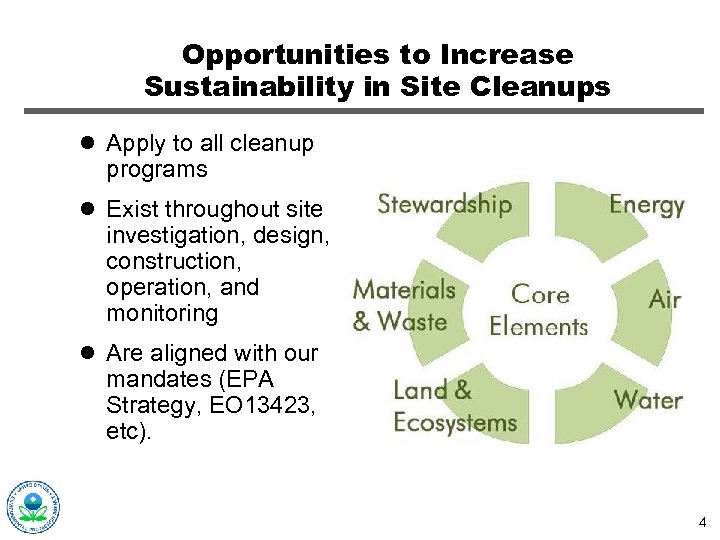 Opportunities to Increase Sustainability in Site Cleanups l Apply to all cleanup programs l Exist throughout site investigation, design, construction, operation, and monitoring l Are aligned with our mandates (EPA Strategy, EO 13423, etc). 4
 Core Elements: Energy Requirements u Energy efficient equipment operating at peak performance u Periodic evaluation and optimization of equipment with high energy demand u Renewable energy systems to replace or offset grid electricity u Managed demand to leverage low peak capacity and rates 5
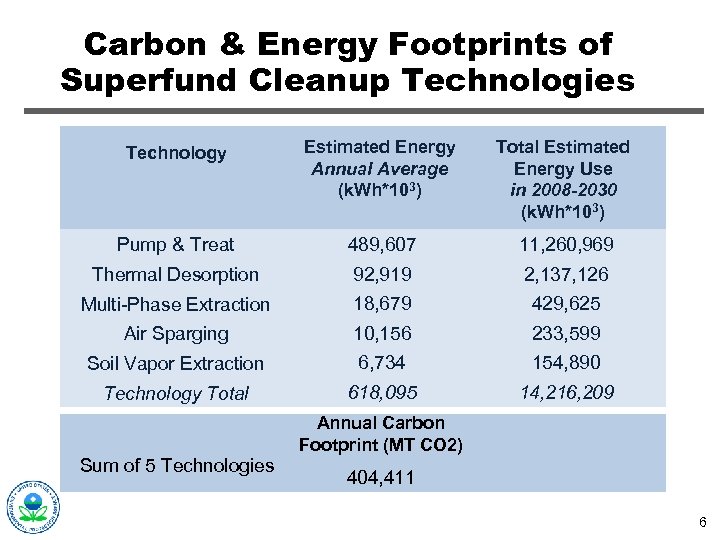 Carbon & Energy Footprints of Superfund Cleanup Technologies Technology Estimated Energy Annual Average (k. Wh*103) Total Estimated Energy Use in 2008 -2030 (k. Wh*103) Pump & Treat 489, 607 11, 260, 969 Thermal Desorption 92, 919 2, 137, 126 Multi-Phase Extraction 18, 679 429, 625 Air Sparging 10, 156 233, 599 Soil Vapor Extraction 6, 734 154, 890 Technology Total 618, 095 14, 216, 209 Annual Carbon Footprint (MT CO 2) Sum of 5 Technologies 404, 411 6
 Recap on Energy & Carbon Footprint Strategy u Optimize systems to maximize efficiency and return per unit energy invested u Build renewable energy capacity at contaminated sites to power remedies u Tap into grid renewable energy portfolios u Leverage carbon sequestration from soil amendment treatment (policy vacuum) 7
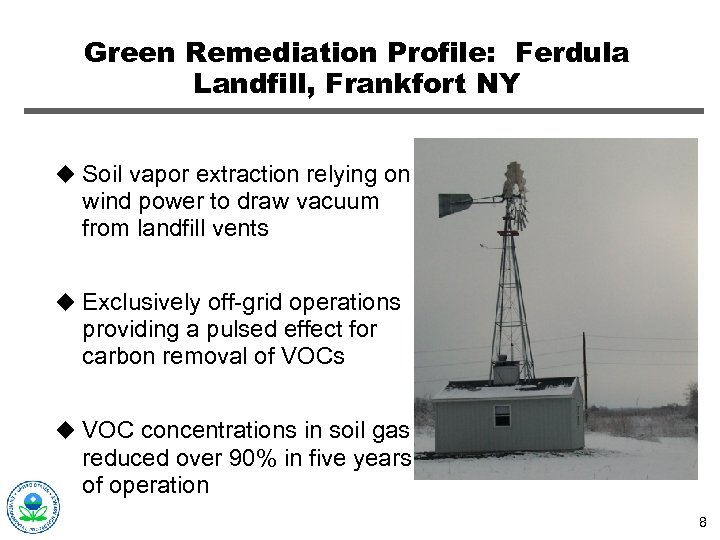 Green Remediation Profile: Ferdula Landfill, Frankfort NY u Soil vapor extraction relying on wind power to draw vacuum from landfill vents u Exclusively off-grid operations providing a pulsed effect for carbon removal of VOCs u VOC concentrations in soil gas reduced over 90% in five years of operation 8
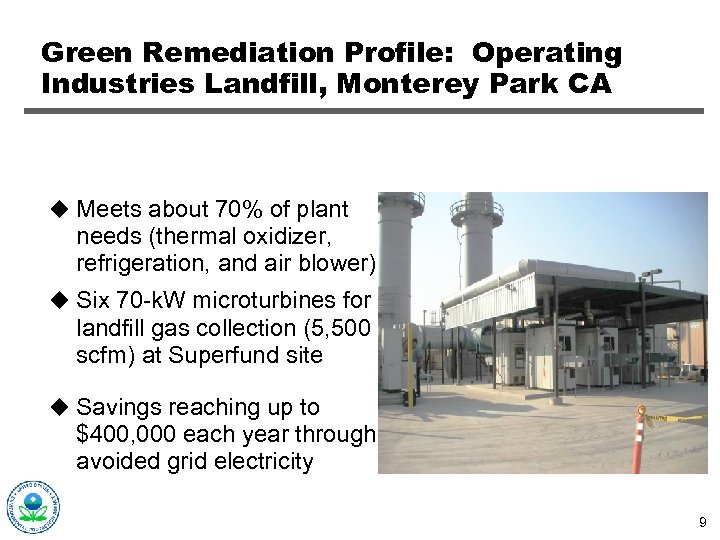 Green Remediation Profile: Operating Industries Landfill, Monterey Park CA u Meets about 70% of plant needs (thermal oxidizer, refrigeration, and air blower) u Six 70 -k. W microturbines for landfill gas collection (5, 500 scfm) at Superfund site u Savings reaching up to $400, 000 each year through avoided grid electricity 9
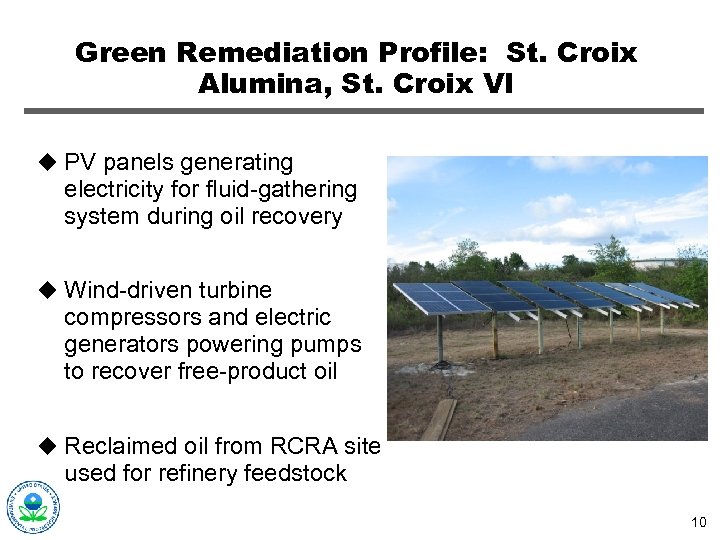 Green Remediation Profile: St. Croix Alumina, St. Croix VI u PV panels generating electricity for fluid-gathering system during oil recovery u Wind-driven turbine compressors and electric generators powering pumps to recover free-product oil u Reclaimed oil from RCRA site used for refinery feedstock 10
 “OSWER” Green Remediation Strategy For the purpose of advancing green remediation best practices across cleanup programs OSWER seeks to: » Benchmark and document GR best management practices » Assemble a toolkit of enablers » Build networks of practitioners » Develop performance metrics and tracking mechanisms 11
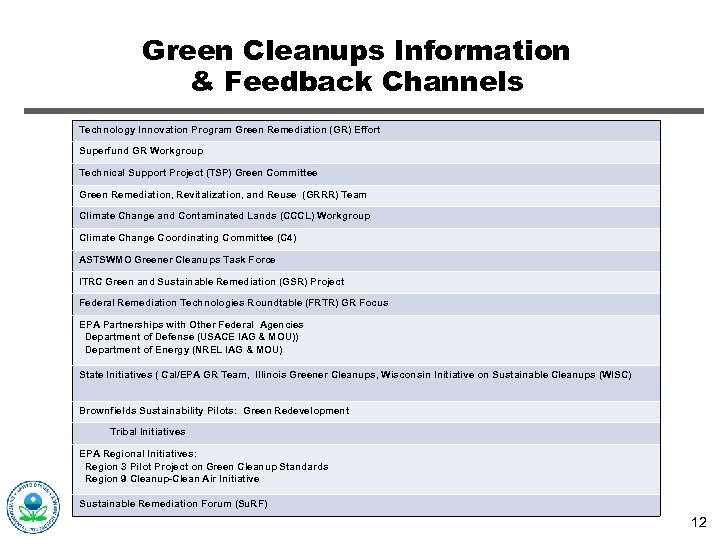 Green Cleanups Information & Feedback Channels Technology Innovation Program Green Remediation (GR) Effort Superfund GR Workgroup Technical Support Project (TSP) Green Committee Green Remediation, Revitalization, and Reuse (GRRR) Team Climate Change and Contaminated Lands (CCCL) Workgroup Climate Change Coordinating Committee (C 4) ASTSWMO Greener Cleanups Task Force ITRC Green and Sustainable Remediation (GSR) Project Federal Remediation Technologies Roundtable (FRTR) GR Focus EPA Partnerships with Other Federal Agencies Department of Defense (USACE IAG & MOU)) Department of Energy (NREL IAG & MOU) State Initiatives ( Cal/EPA GR Team, Illinois Greener Cleanups, Wisconsin Initiative on Sustainable Cleanups (WISC) Brownfields Sustainability Pilots: Green Redevelopment Tribal Initiatives EPA Regional Initiatives: Region 3 Pilot Project on Green Cleanup Standards Region 9 Cleanup-Clean Air Initiative Sustainable Remediation Forum (Su. RF) 12
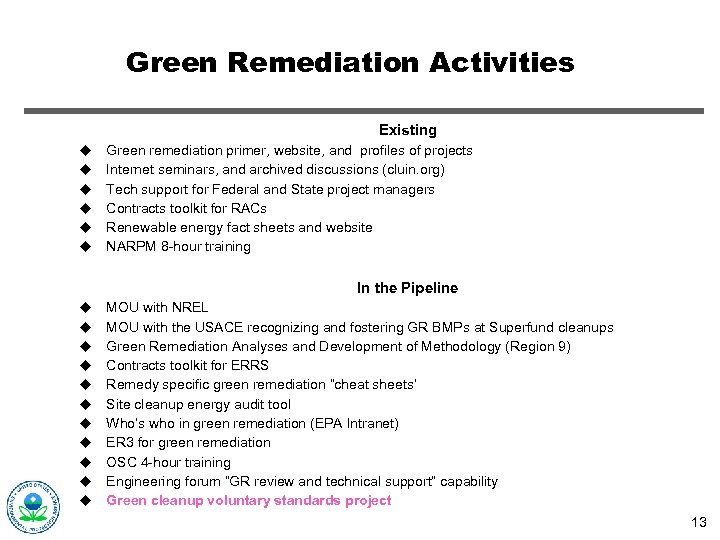 Green Remediation Activities Existing u u u Green remediation primer, website, and profiles of projects Internet seminars, and archived discussions (cluin. org) Tech support for Federal and State project managers Contracts toolkit for RACs Renewable energy fact sheets and website NARPM 8 -hour training In the Pipeline u u u MOU with NREL MOU with the USACE recognizing and fostering GR BMPs at Superfund cleanups Green Remediation Analyses and Development of Methodology (Region 9) Contracts toolkit for ERRS Remedy specific green remediation “cheat sheets’ Site cleanup energy audit tool Who’s who in green remediation (EPA Intranet) ER 3 for green remediation OSC 4 -hour training Engineering forum “GR review and technical support” capability Green cleanup voluntary standards project 13
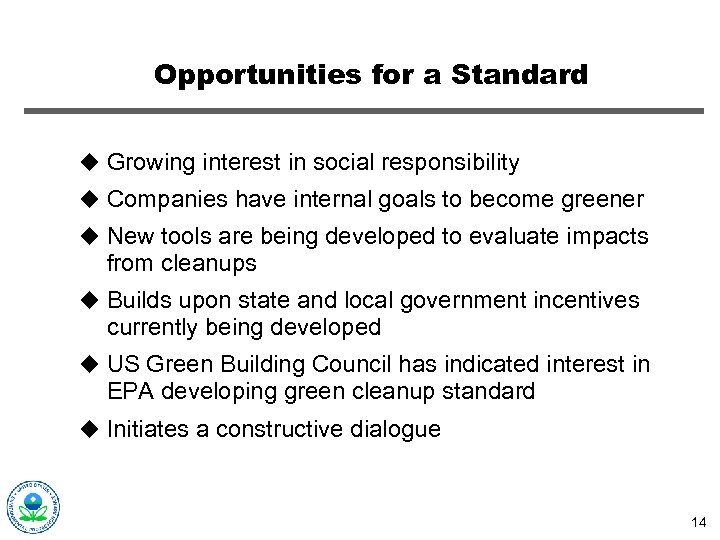 Opportunities for a Standard u Growing interest in social responsibility u Companies have internal goals to become greener u New tools are being developed to evaluate impacts from cleanups u Builds upon state and local government incentives currently being developed u US Green Building Council has indicated interest in EPA developing green cleanup standard u Initiates a constructive dialogue 14
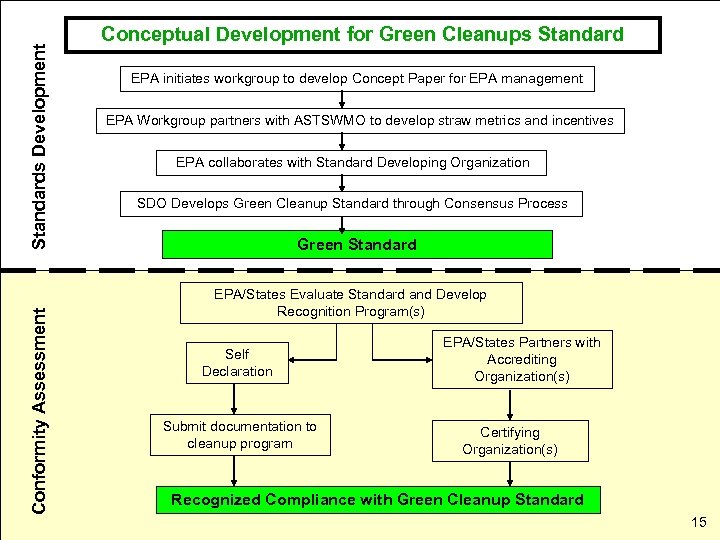 Standards Development Conformity Assessment Conceptual Development for Green Cleanups Standard EPA initiates workgroup to develop Concept Paper for EPA management EPA Workgroup partners with ASTSWMO to develop straw metrics and incentives EPA collaborates with Standard Developing Organization SDO Develops Green Cleanup Standard through Consensus Process Green Standard EPA/States Evaluate Standard and Develop Recognition Program(s) Self Declaration Submit documentation to cleanup program EPA/States Partners with Accrediting Organization(s) Certifying Organization(s) Recognized Compliance with Green Cleanup Standard 15
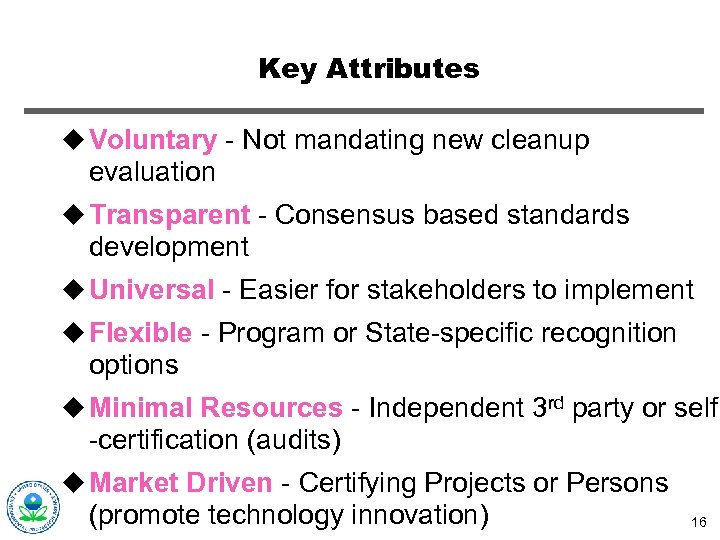 Key Attributes u Voluntary - Not mandating new cleanup evaluation u Transparent - Consensus based standards development u Universal - Easier for stakeholders to implement u Flexible - Program or State-specific recognition options u Minimal Resources - Independent 3 rd party or self -certification (audits) u Market Driven - Certifying Projects or Persons (promote technology innovation) 16
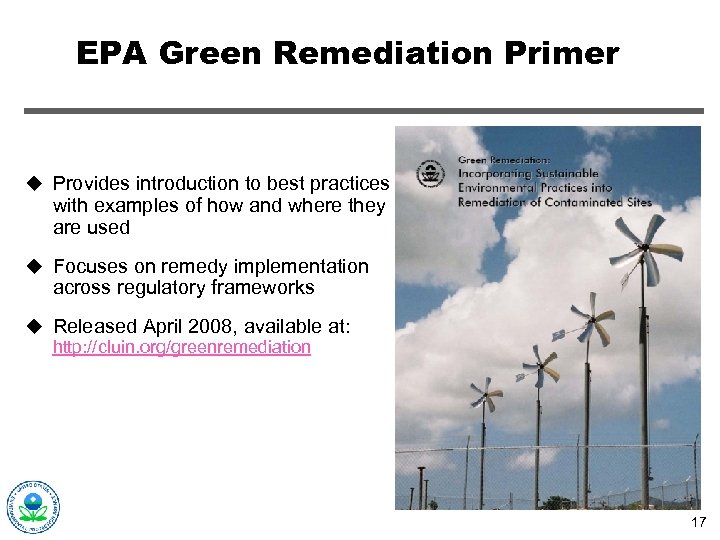 EPA Green Remediation Primer u Provides introduction to best practices with examples of how and where they are used u Focuses on remedy implementation across regulatory frameworks u Released April 2008, available at: http: //cluin. org/greenremediation 17
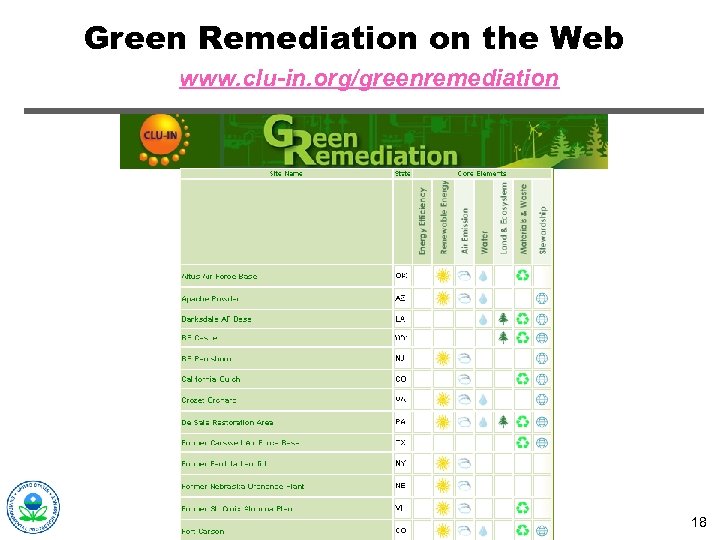 Green Remediation on the Web www. clu-in. org/greenremediation 18
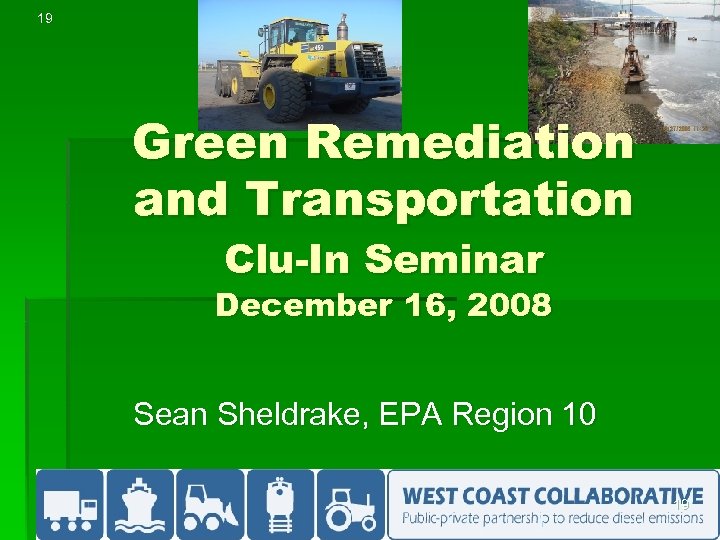 19 Green Remediation and Transportation Clu-In Seminar December 16, 2008 Sean Sheldrake, EPA Region 10 19
 Why Transportation? § Transportation is often the biggest energy consumer for site cleanups. § Transportation and other vehicles used can be the biggest polluters for each unit of energy required to do the cleanup at your site, increasing short term risks. 20
 West Coast Collaborative Goals § Protect/Improve Public Health by: § Helping to meet National Ambient Air Quality Standards (PM 2. 5, Ozone) § Meeting air toxics goals (both federal and state/local partners) § Support Energy Security and Green House Gas Reductions by: § Using cleaner fuels (biodiesel, biogas/natural gas, electric …) relative to total diesel fuel § Advance regional/local production of renewable fuels supporting local agriculture and forestry sectors § Utilize Smart. Way and other programs to virtually eliminate onroad, locomotive, and non-road HDD idling (ports, corridors, distribution locations) 21
 Why is Reducing Emissions Important? Degrades Air Quality § Particulate Matter (PM) § Ozone precursors Energy and Climate Change § Over 40% of green house gas emissions from mobile sources § Over 90% of fuel imported petroleum Serious Health Effects § Diesel exhaust is a “likely human carcinogen” and respiratory irritant § Harmful diesel PM § Diesel exhaust contains “likely” and “known” (e. g. , benzene) human carcinogens, and also have respiratory, neurological, developmental, and immunological health effects. 22
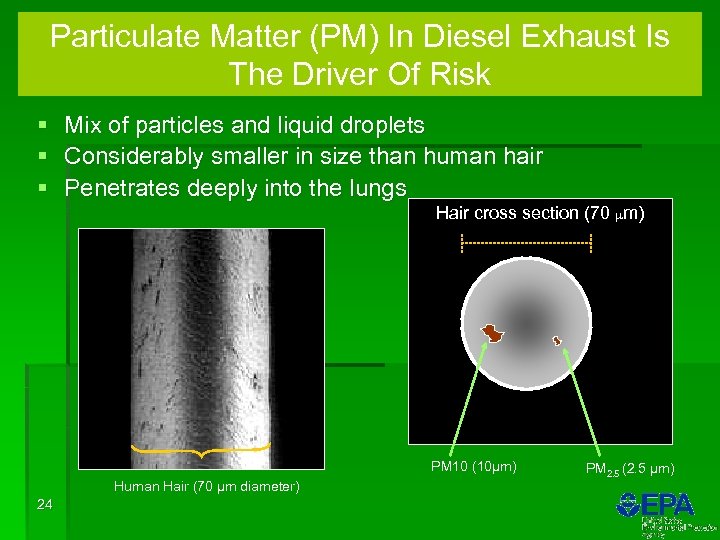 Particulate Matter (PM) In Diesel Exhaust Is The Driver Of Risk § § § Mix of particles and liquid droplets Considerably smaller in size than human hair Penetrates deeply into the lungs Hair cross section (70 mm) PM 10 (10µm) Human Hair (70 µm diameter) 24 PM 2. 5 (2. 5 µm)
 Avoiding Or Substantially Reducing Emissions § § § 25 Switch from truck to rail transport Investigate on-site disposal options Integrate diesel emissions into short term impact analyses to allow for lower impact technology to be identified during FS analysis
 What If Rail Transport Isn’t Practical? What Now? § Diesel emissions controls may be a viable and cost effective option at your site. 26
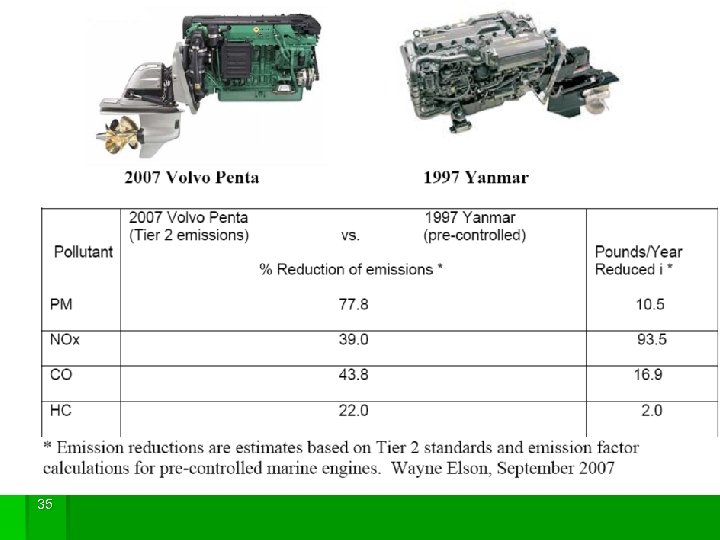
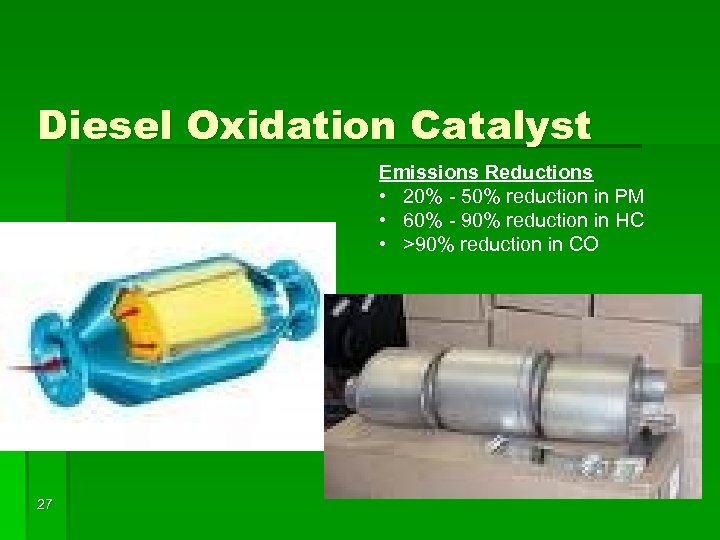 Diesel Oxidation Catalyst Emissions Reductions • 20% - 50% reduction in PM • 60% - 90% reduction in HC • >90% reduction in CO 27
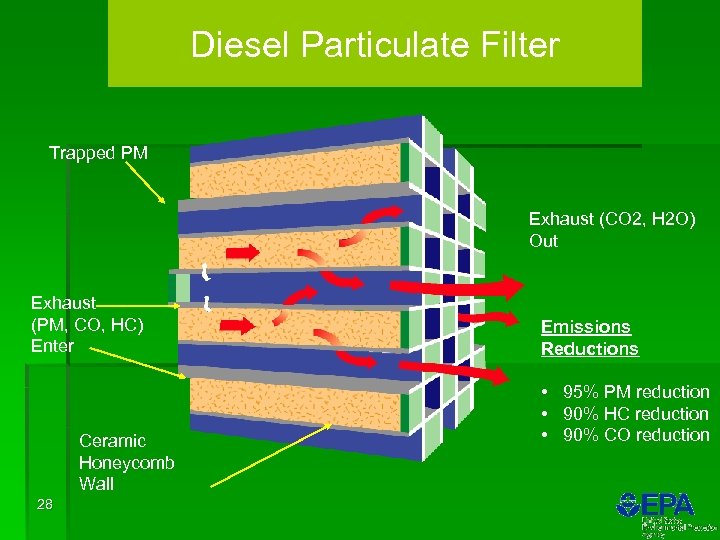 Diesel Particulate Filter Trapped PM Exhaust (CO 2, H 2 O) Out Exhaust (PM, CO, HC) Enter Ceramic Honeycomb Wall 28 Emissions Reductions • 95% PM reduction • 90% HC reduction • 90% CO reduction
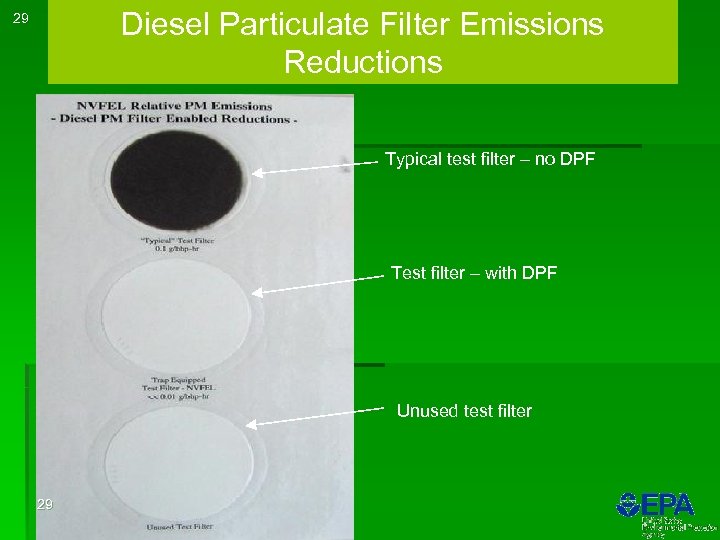 Diesel Particulate Filter Emissions Reductions 29 Typical test filter – no DPF Test filter – with DPF Unused test filter 29
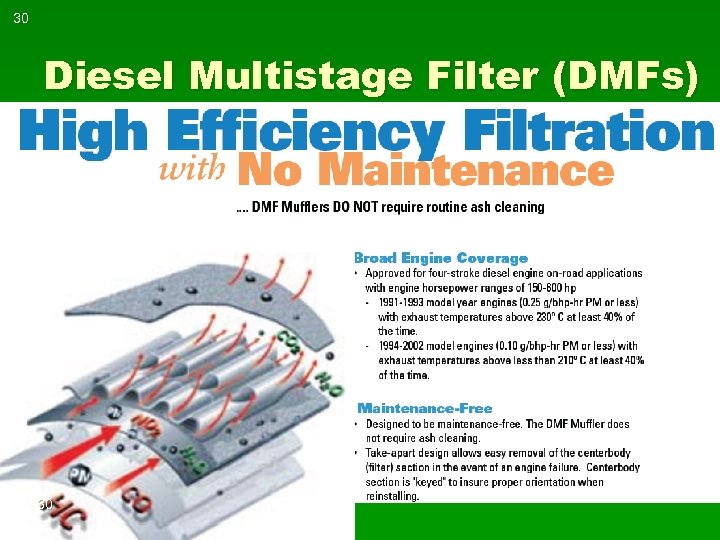 30 Diesel Multistage Filter (DMFs) 30
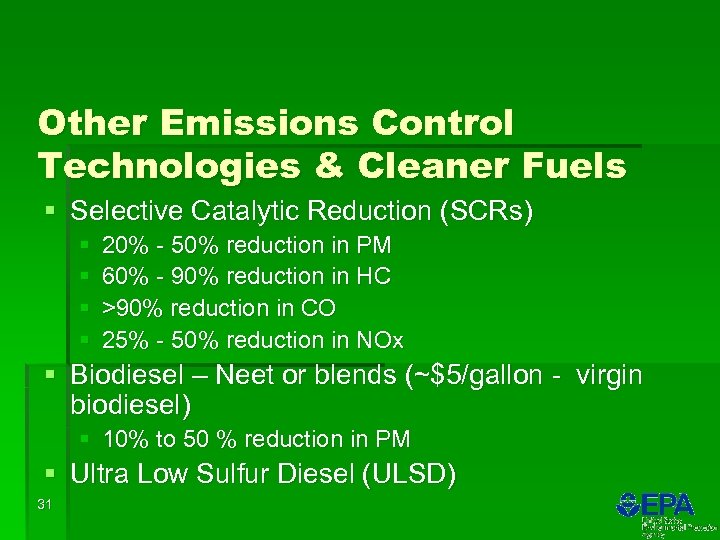 Other Emissions Control Technologies & Cleaner Fuels § Selective Catalytic Reduction (SCRs) § § 20% - 50% reduction in PM 60% - 90% reduction in HC >90% reduction in CO 25% - 50% reduction in NOx § Biodiesel – Neet or blends (~$5/gallon - virgin biodiesel) § 10% to 50 % reduction in PM § Ultra Low Sulfur Diesel (ULSD) 31
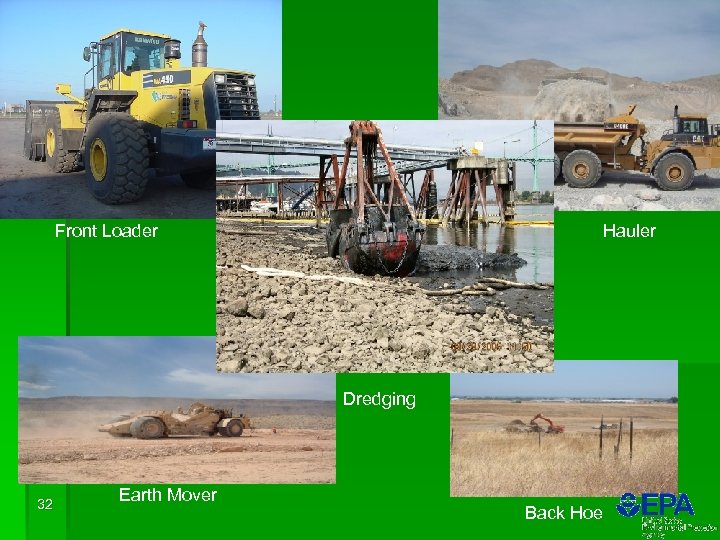 Front Loader Hauler Dredging 32 Earth Mover Back Hoe
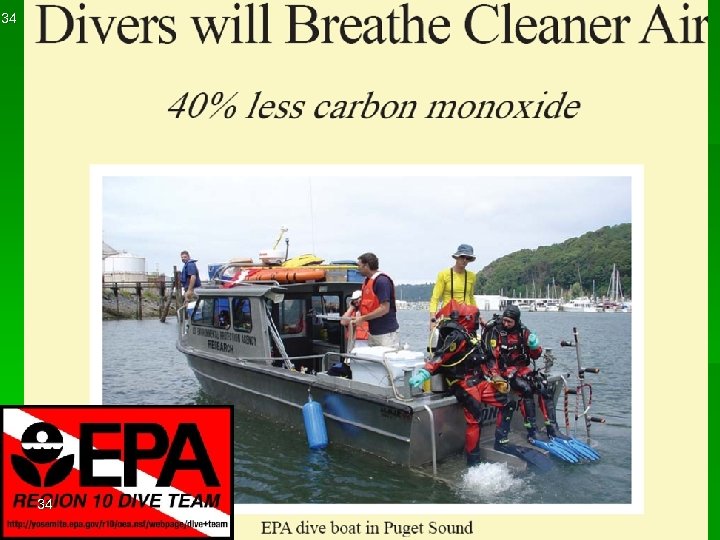
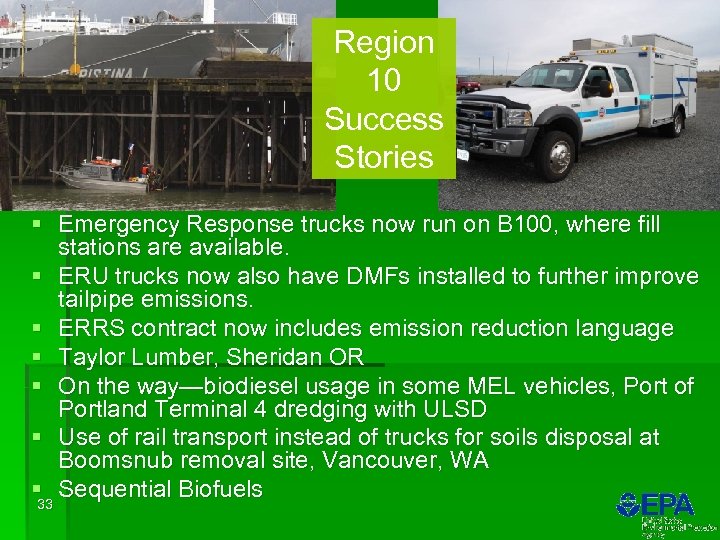 Region 10 Success Stories § Emergency Response trucks now run on B 100, where fill stations are available. § ERU trucks now also have DMFs installed to further improve tailpipe emissions. § ERRS contract now includes emission reduction language § Taylor Lumber, Sheridan OR § On the way—biodiesel usage in some MEL vehicles, Port of Portland Terminal 4 dredging with ULSD § Use of rail transport instead of trucks for soils disposal at Boomsnub removal site, Vancouver, WA § Sequential Biofuels 33
 34 34
34 34
 35
35
 Example Contract Language From Taylor Lumber, Sheridan, OR 36
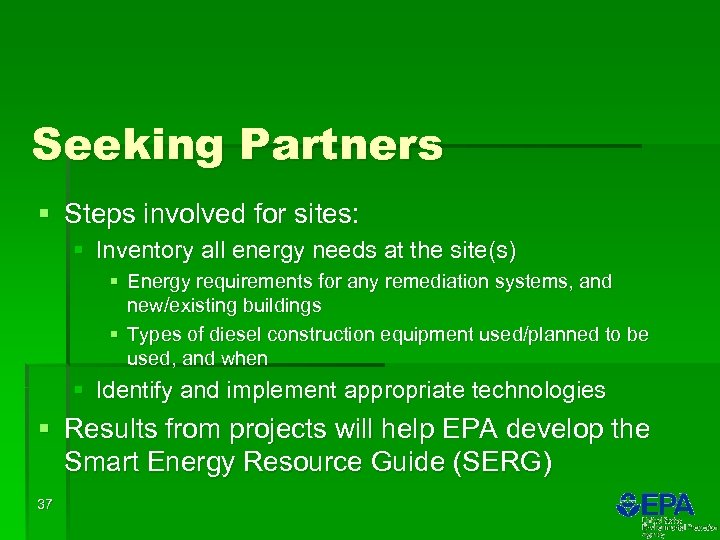 Seeking Partners § Steps involved for sites: § Inventory all energy needs at the site(s) § Energy requirements for any remediation systems, and new/existing buildings § Types of diesel construction equipment used/planned to be used, and when § Identify and implement appropriate technologies § Results from projects will help EPA develop the Smart Energy Resource Guide (SERG) 37
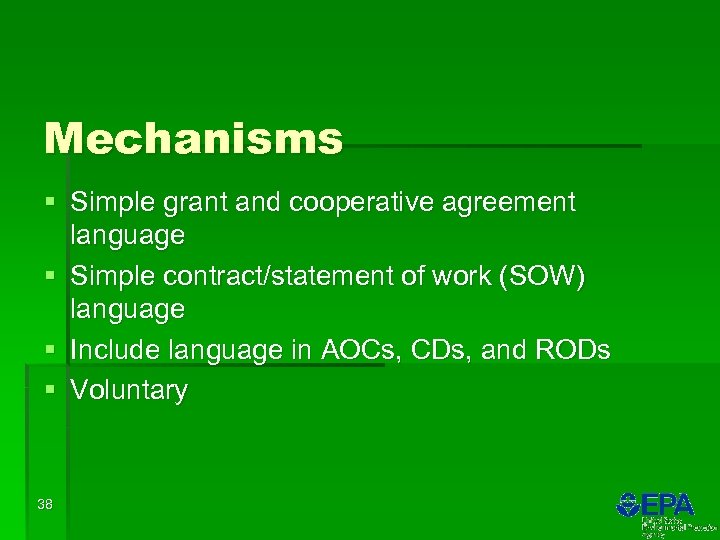 Mechanisms § Simple grant and cooperative agreement language § Simple contract/statement of work (SOW) language § Include language in AOCs, CDs, and RODs § Voluntary 38
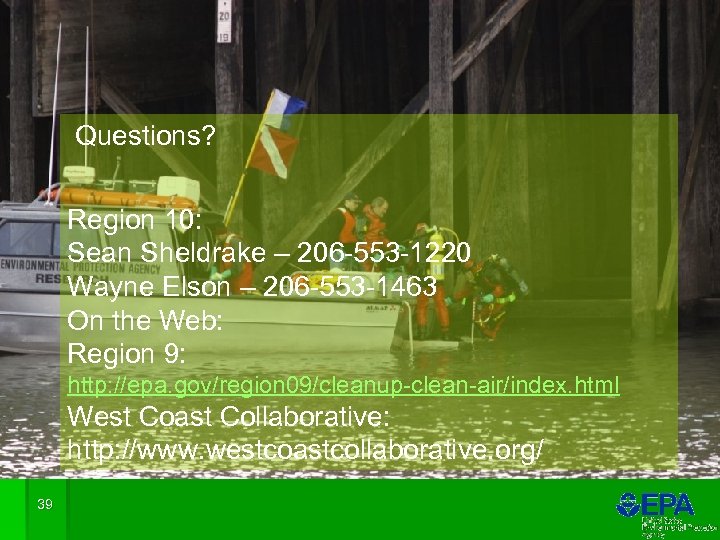 Questions? Region 10: Sean Sheldrake – 206 -553 -1220 Wayne Elson – 206 -553 -1463 On the Web: Region 9: http: //epa. gov/region 09/cleanup-clean-air/index. html West Coast Collaborative: http: //www. westcoastcollaborative. org/ 39
 “Smart Energy Resources Guide” Michael D. Gill Region 9, San Francisco 40 Green Remediation Seminar Series Session B December 16, 2008
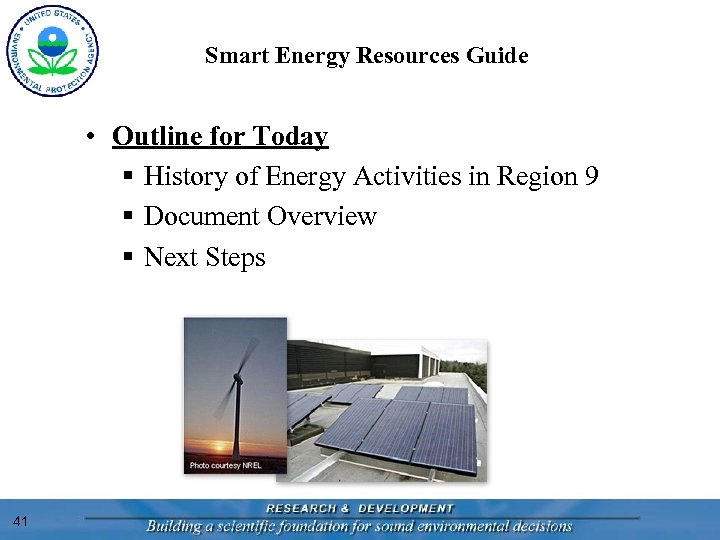 Smart Energy Resources Guide • Outline for Today § History of Energy Activities in Region 9 § Document Overview § Next Steps 41
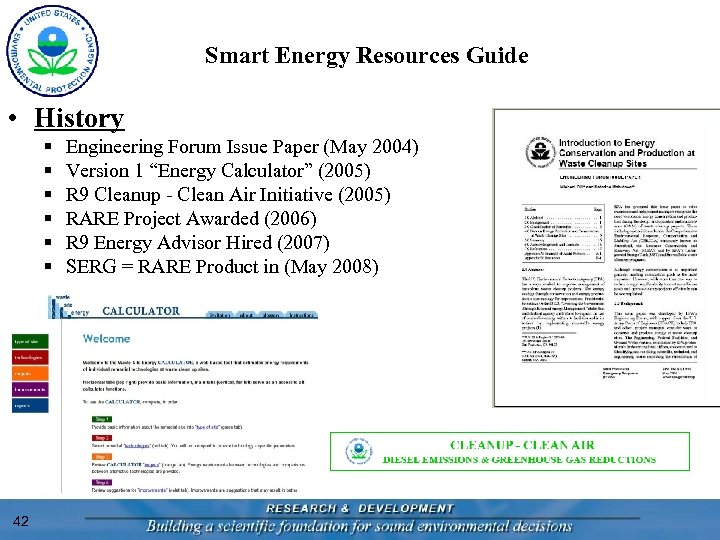 Smart Energy Resources Guide • History § § § 42 Engineering Forum Issue Paper (May 2004) Version 1 “Energy Calculator” (2005) R 9 Cleanup - Clean Air Initiative (2005) RARE Project Awarded (2006) R 9 Energy Advisor Hired (2007) SERG = RARE Product in (May 2008)
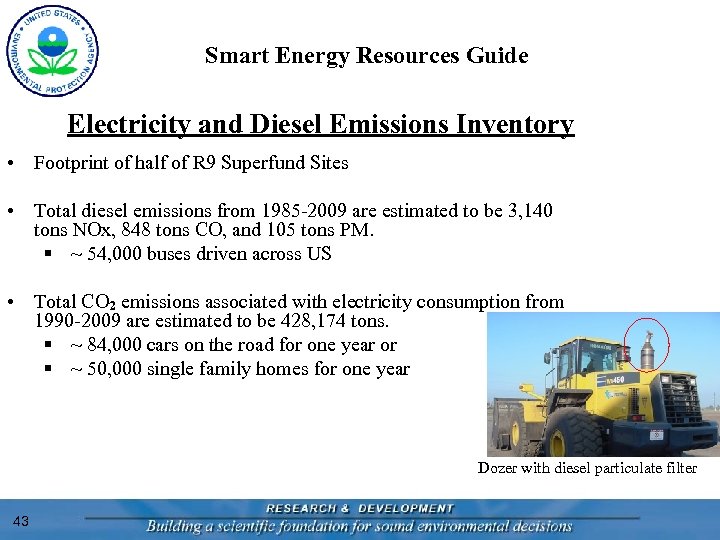 Smart Energy Resources Guide Electricity and Diesel Emissions Inventory • Footprint of half of R 9 Superfund Sites • Total diesel emissions from 1985 -2009 are estimated to be 3, 140 tons NOx, 848 tons CO, and 105 tons PM. § ~ 54, 000 buses driven across US • Total CO 2 emissions associated with electricity consumption from 1990 -2009 are estimated to be 428, 174 tons. § ~ 84, 000 cars on the road for one year or § ~ 50, 000 single family homes for one year Dozer with diesel particulate filter 43
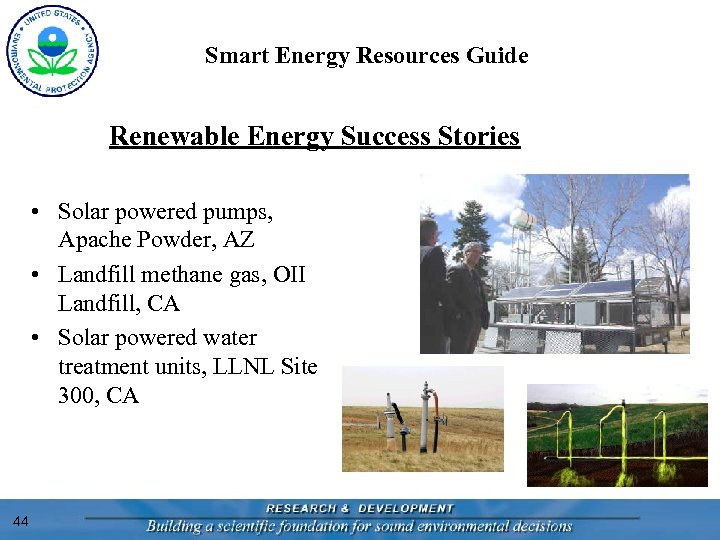 Smart Energy Resources Guide Renewable Energy Success Stories • Solar powered pumps, Apache Powder, AZ • Landfill methane gas, OII Landfill, CA • Solar powered water treatment units, LLNL Site 300, CA 44
 Green Remediation – An EPA Perspective 45
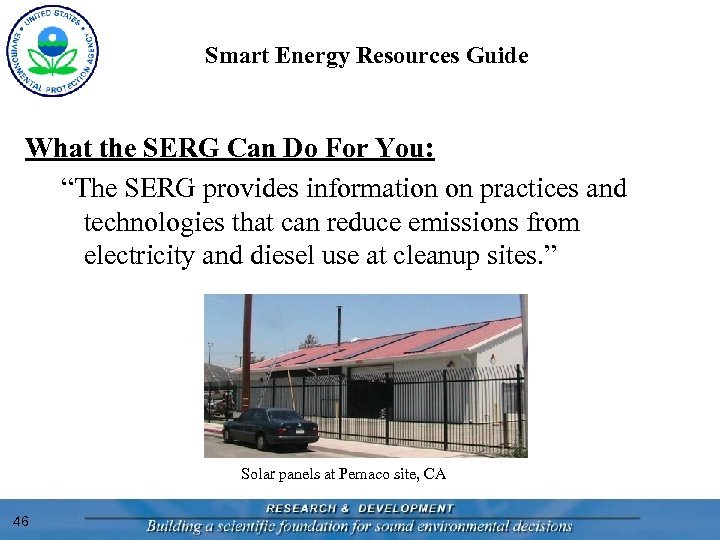 Smart Energy Resources Guide What the SERG Can Do For You: “The SERG provides information on practices and technologies that can reduce emissions from electricity and diesel use at cleanup sites. ” Solar panels at Pemaco site, CA 46
 Smart Energy Resources Guide What is Our Goal? Implement Renewable Energy • Reduce the significant, long-term energy demands typical for Superfund site cleanup operations • Reduce greenhouse gas emissions and air pollutants • Demonstrate progressive environmental leadership Reduce Diesel Emissions • Diesel exhaust contains harmful particulate matter (PM) • Diesel exhaust is a “likely human carcinogen” and respiratory irritant 47
 Smart Energy Resources Guide • SERG Outline § Renewable Technologies (basics, assessments, costs, success stories) • • • LFG flares at OII site, CA 48 Solar Wind Landfill Gas-to-Energy Anaerobic Digestion Biomass Gasification Cleaner Diesel § Funding Resources and Opportunities
 Smart Energy Resources Guide • SERG Outline (continued) § Tools – Calculators, References, Programs § Appendices • • More on Technologies Contract Language Federal Regulations Utility Programs Gasifier fueled with poultry waste, WV 49
 Smart Energy Resources Guide Example of Chapter Detail • Solar Power § § § § 50 Solar Power Terminology Technology Basics Assessing Solar Power Potential and Size of a PV System Grid-Tied or Stand-Alone System Capital Cost, O&M, Installers and Warranties Permits and Environmental Concerns Success Stories
 Smart Energy Resources Guide Example of Chapter Detail (cont) • Tools § § 51 Energy Efficiency Calculators Purchasing Clean Energy Informational Resources Renewable Energy Economic Calculators Solar Power, Wind Power, etc. Tools
 Smart Energy Resources Guide • How RPMs Can Use the SERG § § § 52 Assess possibilities for your project Info for better communication with developers/contractors Provide starting point to implement clean energy projects Reference for funding resources Quick tools for costs and emissions reduction estimates
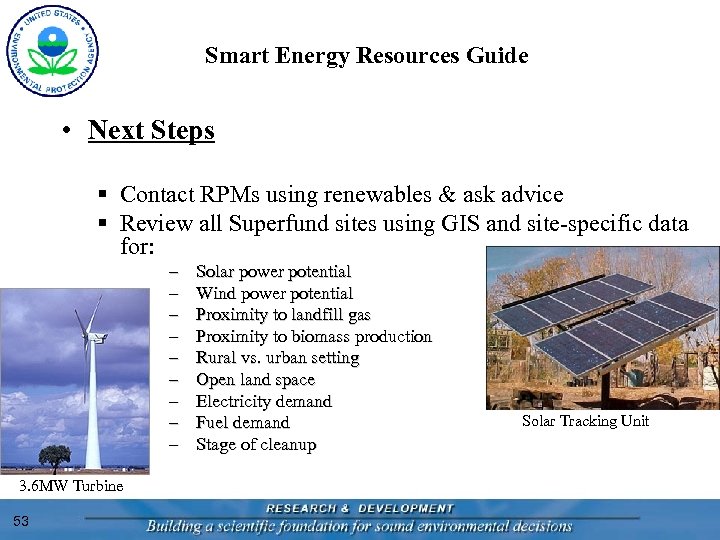 Smart Energy Resources Guide • Next Steps § Contact RPMs using renewables & ask advice § Review all Superfund sites using GIS and site-specific data for: – – – – – 3. 6 MW Turbine 53 Solar power potential Wind power potential Proximity to landfill gas Proximity to biomass production Rural vs. urban setting Open land space Electricity demand Fuel demand Stage of cleanup Solar Tracking Unit
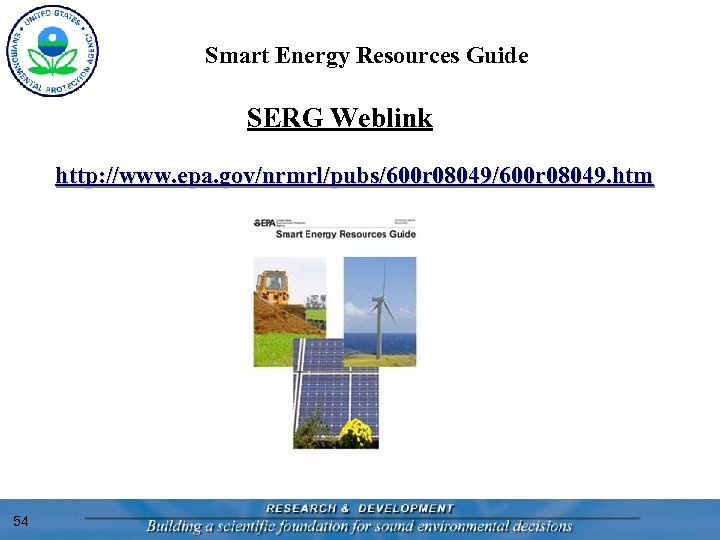 Smart Energy Resources Guide SERG Weblink http: //www. epa. gov/nrmrl/pubs/600 r 08049. htm 54
 Smart Energy Resources Guide • Acknowledgements § § § 55 Jennifer Wang (now with Energy Solutions, Inc. , Oakland, CA) Penny Mc. Daniel (Region 9) Steve Rock (ORD, Cincinnati) Engineering Forum Thanks to numerous peer reviewers! SERG for photo credits
 Smart Energy Resources Guide Gill. Michael@epa. gov 415 -972 -3054 56
 After viewing the links to additional resources, please complete our online feedback form. Thank You Links to Additional Resources Feedback Form 57