


 Скачать презентацию Green Procurement Survey Standardization JGPSSI Activities Update Oct
00af70c38fe550d3e5b3a9adfbab846c.ppt
- Количество слайдов: 18
 Green Procurement Survey Standardization JGPSSI Activities Update Oct. 14. 2005 Japan Green Procurement Survey Standardization Initiative Atsushi Tajima (JGPSSI : Secretariat)
 Contents ◆ The Joint industry Guide (JIG) and Actions to be taken by the JGPSSI ・ About JGPSSI Format corresponding to the JIG of the “Guidelines for the Management of Chemical Substances in products” ・ Action Items List and Self-Declaration of Conformance ◆ Issue ◆ Conclusion ・ JGPSSI activities and stance
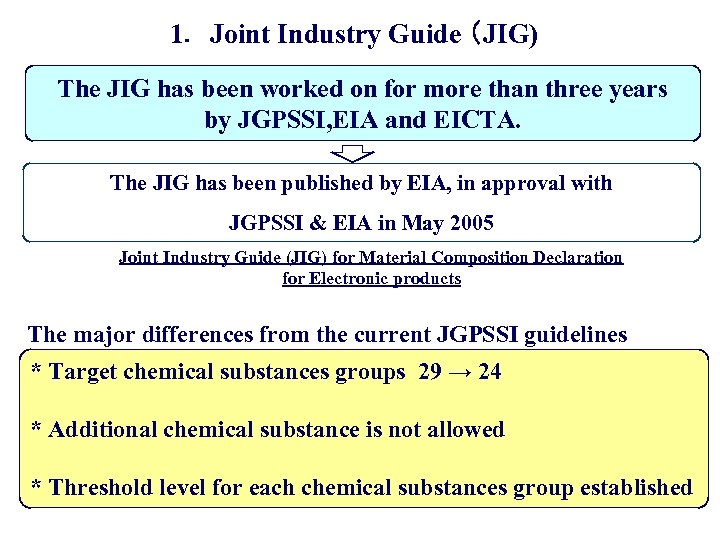 1. Joint Industry Guide (JIG) The JIG has been worked on for more than three years by JGPSSI, EIA and EICTA. The JIG has been published by EIA, in approval with JGPSSI & EIA in May 2005 Joint Industry Guide (JIG) for Material Composition Declaration for Electronic products The major differences from the current JGPSSI guidelines * Target chemical substances groups 29 → 24 * Additional chemical substance is not allowed * Threshold level for each chemical substances group established
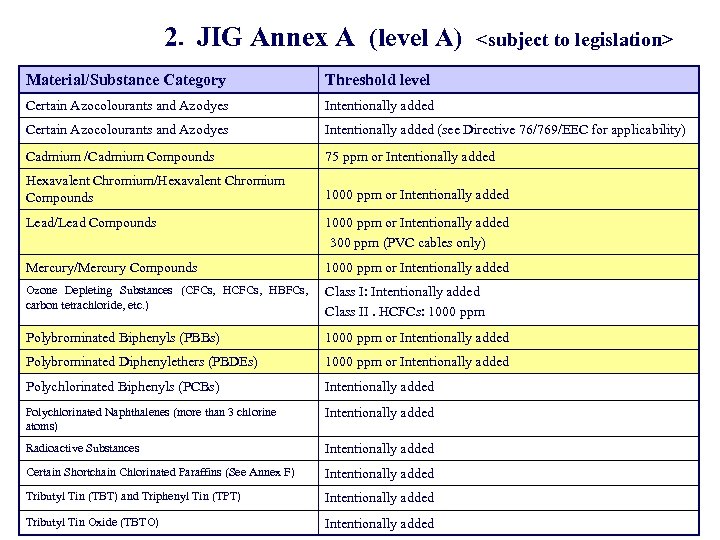 2.JIG Annex A (level A)
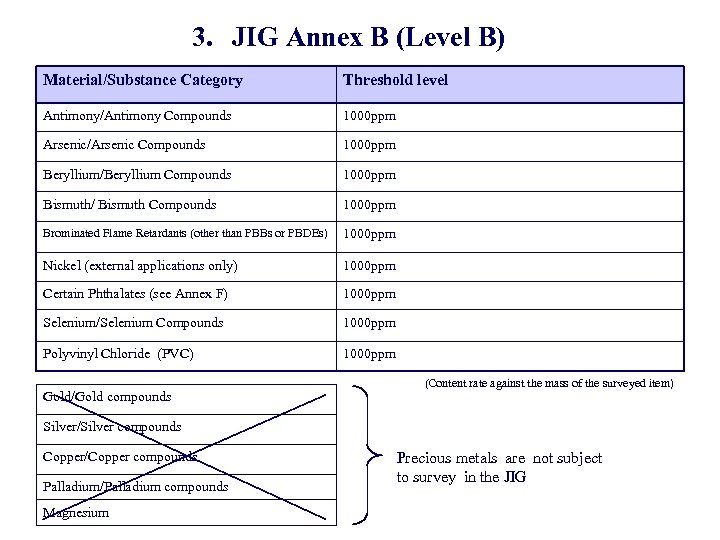 3. JIG Annex B (Level B) Material/Substance Category Threshold level Antimony/Antimony Compounds 1000 ppm Arsenic/Arsenic Compounds 1000 ppm Beryllium/Beryllium Compounds 1000 ppm Bismuth/ Bismuth Compounds 1000 ppm Brominated Flame Retardants (other than PBBs or PBDEs) 1000 ppm Nickel (external applications only) 1000 ppm Certain Phthalates (see Annex F) 1000 ppm Selenium/Selenium Compounds 1000 ppm Polyvinyl Chloride (PVC) 1000 ppm Gold/Gold compounds (Content rate against the mass of the surveyed item) Silver/Silver compounds Copper/Copper compounds Palladium/Palladium compounds Magnesium Precious metals are not subject to survey in the JIG
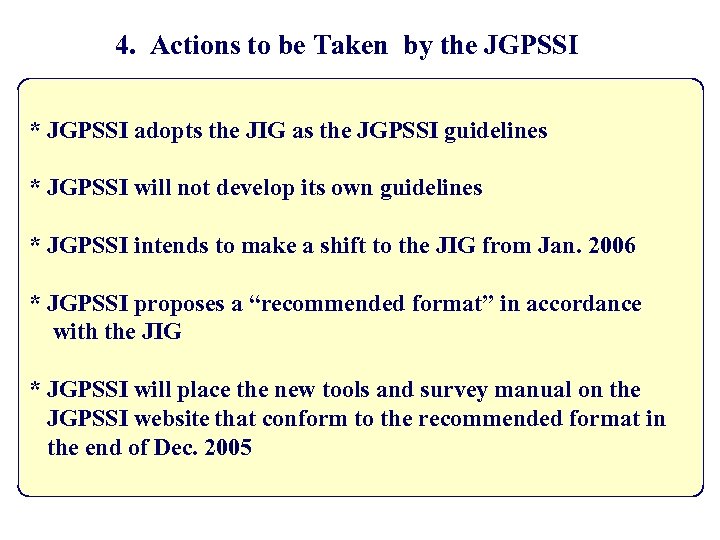 4. Actions to be Taken by the JGPSSI * JGPSSI adopts the JIG as the JGPSSI guidelines * JGPSSI will not develop its own guidelines * JGPSSI intends to make a shift to the JIG from Jan. 2006 * JGPSSI proposes a “recommended format” in accordance with the JIG * JGPSSI will place the new tools and survey manual on the JGPSSI website that conform to the recommended format in the end of Dec. 2005
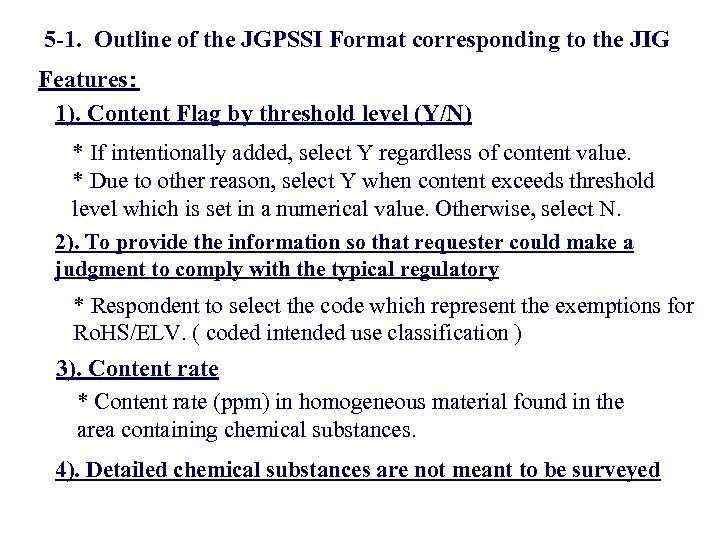 5 -1. Outline of the JGPSSI Format corresponding to the JIG Features: 1). Content Flag by threshold level (Y/N) * If intentionally added, select Y regardless of content value. * Due to other reason, select Y when content exceeds threshold level which is set in a numerical value. Otherwise, select N. 2). To provide the information so that requester could make a judgment to comply with the typical regulatory * Respondent to select the code which represent the exemptions for Ro. HS/ELV. ( coded intended use classification ) 3). Content rate * Content rate (ppm) in homogeneous material found in the area containing chemical substances. 4). Detailed chemical substances are not meant to be surveyed
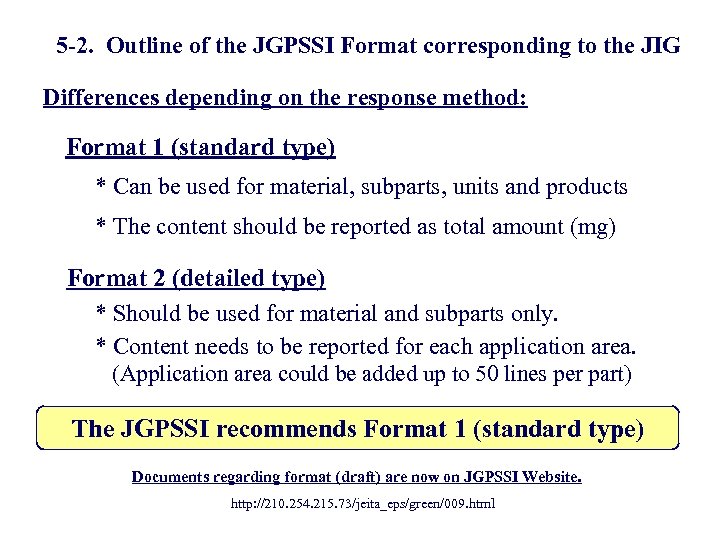 5 -2. Outline of the JGPSSI Format corresponding to the JIG Differences depending on the response method: Format 1 (standard type) * Can be used for material, subparts, units and products * The content should be reported as total amount (mg) Format 2 (detailed type) * Should be used for material and subparts only. * Content needs to be reported for each application area. (Application area could be added up to 50 lines per part) The JGPSSI recommends Format 1 (standard type) Documents regarding format (draft) are now on JGPSSI Website. http: //210. 254. 215. 73/jeita_eps/green/009. html
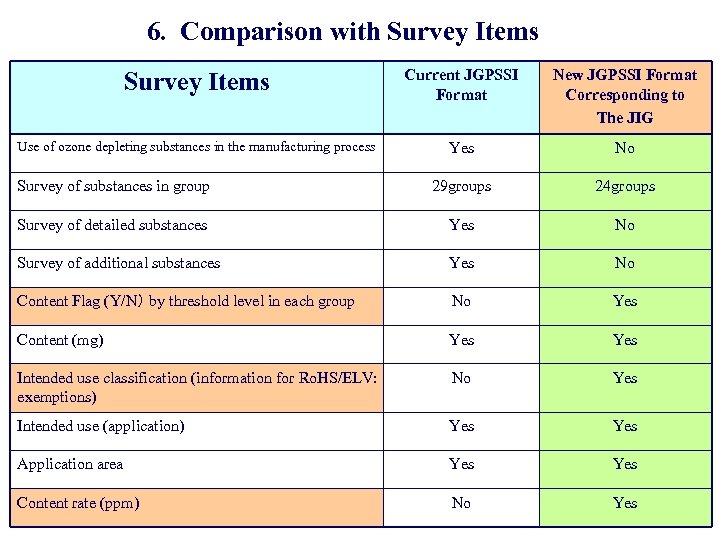 6. Comparison with Survey Items Current JGPSSI Format New JGPSSI Format Corresponding to The JIG Use of ozone depleting substances in the manufacturing process Yes No Survey of substances in group 29 groups 24 groups Survey of detailed substances Yes No Survey of additional substances Yes No Content Flag (Y/N) by threshold level in each group No Yes Content (mg) Yes Intended use classification (information for Ro. HS/ELV: exemptions) No Yes Intended use (application) Yes Application area Yes Content rate (ppm) No Yes
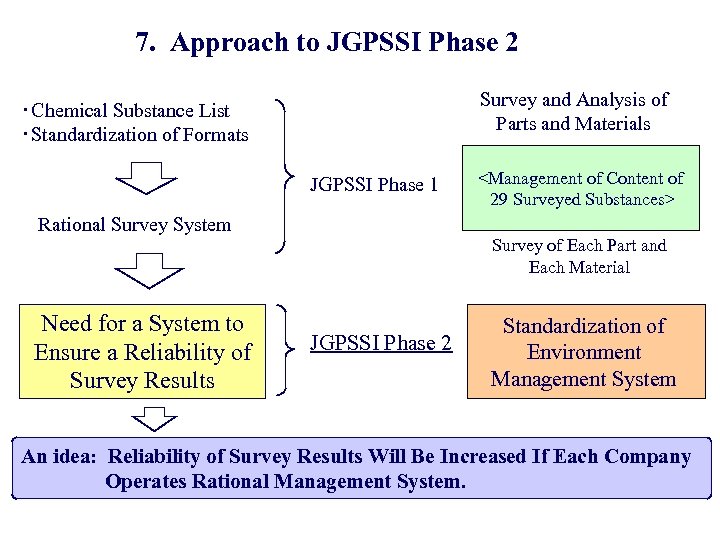 7. Approach to JGPSSI Phase 2 Survey and Analysis of Parts and Materials ・Chemical Substance List ・Standardization of Formats JGPSSI Phase 1
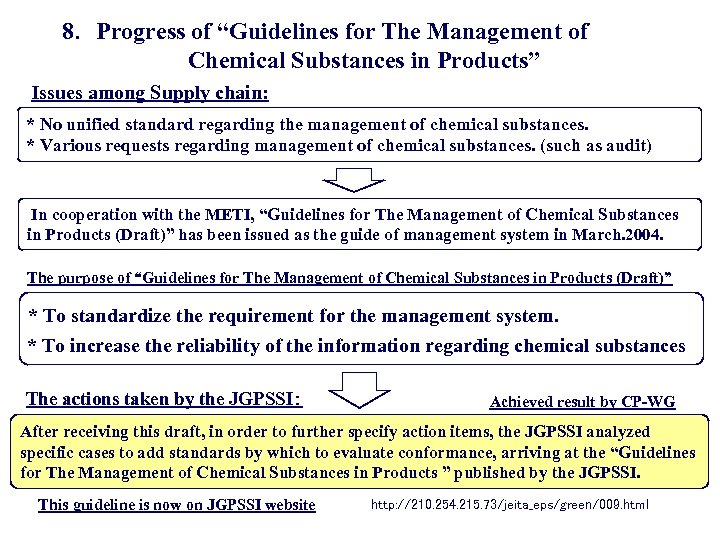 8. Progress of “Guidelines for The Management of Chemical Substances in Products” Issues among Supply chain: * No unified standard regarding the management of chemical substances. * Various requests regarding management of chemical substances. (such as audit) In cooperation with the METI, “Guidelines for The Management of Chemical Substances in Products (Draft)” has been issued as the guide of management system in March. 2004. The purpose of “Guidelines for The Management of Chemical Substances in Products (Draft)” * To standardize the requirement for the management system. * To increase the reliability of the information regarding chemical substances The actions taken by the JGPSSI: Achieved result by CP-WG After receiving this draft, in order to further specify action items, the JGPSSI analyzed specific cases to add standards by which to evaluate conformance, arriving at the “Guidelines for The Management of Chemical Substances in Products ” published by the JGPSSI. This guideline is now on JGPSSI website http: //210. 254. 215. 73/jeita_eps/green/009. html
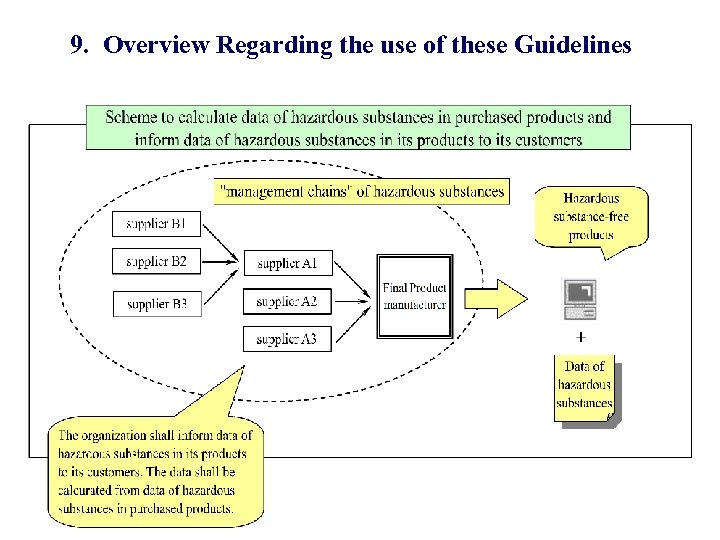 9. Overview Regarding the use of these Guidelines
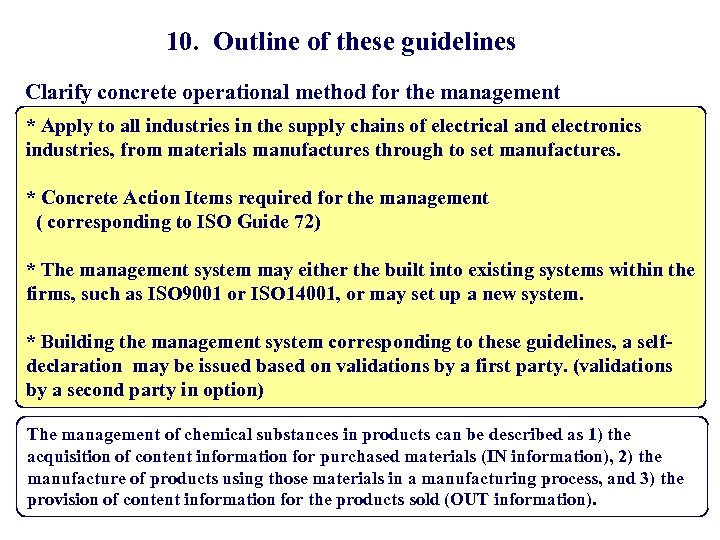 10. Outline of these guidelines Clarify concrete operational method for the management * Apply to all industries in the supply chains of electrical and electronics industries, from materials manufactures through to set manufactures. * Concrete Action Items required for the management ( corresponding to ISO Guide 72) * The management system may either the built into existing systems within the firms, such as ISO 9001 or ISO 14001, or may set up a new system. * Building the management system corresponding to these guidelines, a selfdeclaration may be issued based on validations by a first party. (validations by a second party in option) The management of chemical substances in products can be described as 1) the acquisition of content information for purchased materials (IN information), 2) the manufacture of products using those materials in a manufacturing process, and 3) the provision of content information for the products sold (OUT information).
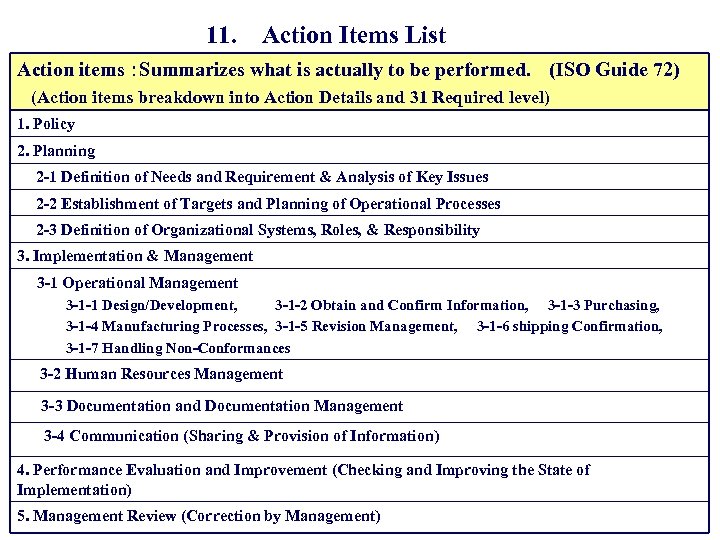 11. Action Items List Action items :Summarizes what is actually to be performed. (ISO Guide 72) (Action items breakdown into Action Details and 31 Required level) 1. Policy 2. Planning 2 -1 Definition of Needs and Requirement & Analysis of Key Issues 2 -2 Establishment of Targets and Planning of Operational Processes 2 -3 Definition of Organizational Systems, Roles, & Responsibility 3. Implementation & Management 3 -1 Operational Management 3 -1 -1 Design/Development, 3 -1 -2 Obtain and Confirm Information, 3 -1 -3 Purchasing, 3 -1 -4 Manufacturing Processes, 3 -1 -5 Revision Management, 3 -1 -6 shipping Confirmation, 3 -1 -7 Handling Non-Conformances 3 -2 Human Resources Management 3 -3 Documentation and Documentation Management 3 -4 Communication (Sharing & Provision of Information) 4. Performance Evaluation and Improvement (Checking and Improving the State of Implementation) 5. Management Review (Correction by Management)
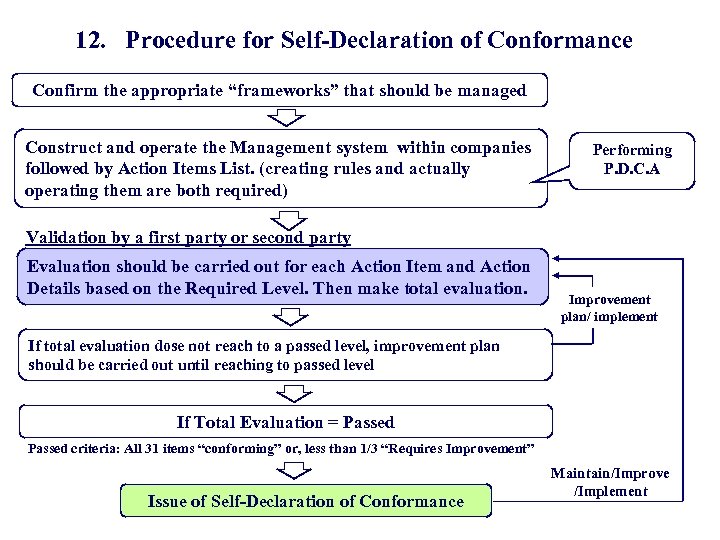 12. Procedure for Self-Declaration of Conformance Confirm the appropriate “frameworks” that should be managed Construct and operate the Management system within companies followed by Action Items List. (creating rules and actually operating them are both required) Performing P. D. C. A Validation by a first party or second party Evaluation should be carried out for each Action Item and Action Details based on the Required Level. Then make total evaluation. Improvement plan/ implement If total evaluation dose not reach to a passed level, improvement plan should be carried out until reaching to passed level If Total Evaluation = Passed criteria: All 31 items “conforming” or, less than 1/3 “Requires Improvement” Issue of Self-Declaration of Conformance Maintain/Improve /Implement
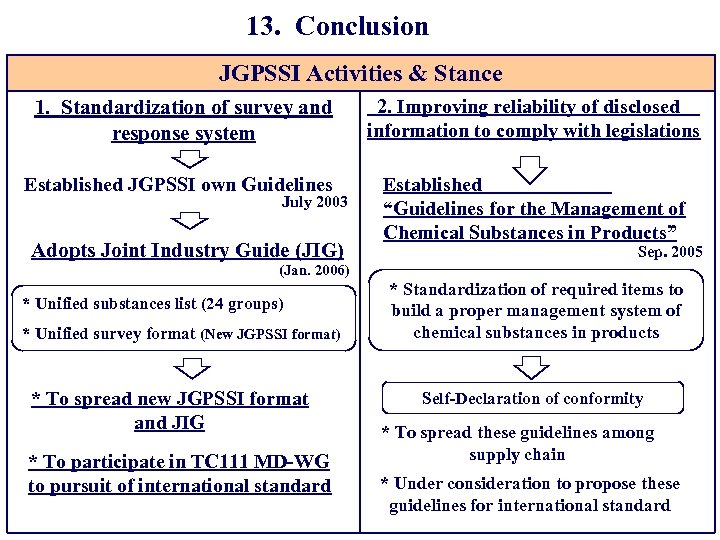 13. Conclusion JGPSSI Activities & Stance 1. Standardization of survey and response system 2. Improving reliability of disclosed information to comply with legislations Established JGPSSI own Guidelines Established “Guidelines for the Management of Chemical Substances in Products” July 2003 Adopts Joint Industry Guide (JIG) Sep. 2005 (Jan. 2006) * Unified substances list (24 groups) * Unified survey format (New JGPSSI format) * To spread new JGPSSI format and JIG * To participate in TC 111 MD-WG to pursuit of international standard * Standardization of required items to build a proper management system of chemical substances in products Self-Declaration of conformity * To spread these guidelines among supply chain * Under consideration to propose these guidelines for international standard
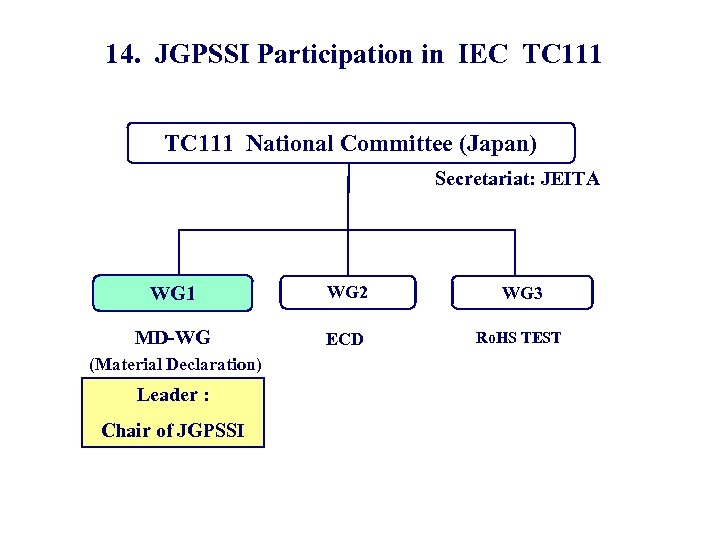 14. JGPSSI Participation in IEC TC 111 National Committee (Japan) Secretariat: JEITA WG 1 WG 2 WG 3 MD-WG ECD Ro. HS TEST (Material Declaration) Leader : Chair of JGPSSI
 END Thank you for listening