


 Скачать презентацию Green MIP Reduction The Destination and the Way
826b3ef9c8562510505f3822c43ac05c.ppt
- Количество слайдов: 22
 Green MIP Reduction The Destination, and the Way to Get There HUD-FHA MF Production Webinar, 8/25/2016
 A Simple Formula: Green Recognition + Energy Performance = MIP Reduction Green Recognition Energy Performance (aka “certification” per Earthcraft, LEED, National Green Building Standard, etc) (annual ENERGY STAR score of 75+)
 Green MIP Reduction Green Recognition + Energy Performance = MIP Reduction First let’s talk Energy Performance, because that’s HUD’s goal How do we measure Energy Performance? With An ENERGY STAR score: A 1 -100 index score created by EPA Obtained from EPA’s Portfolio Manager benchmarking software Reported in a standard form called a “Statement of Energy Performance” (SEP) 75 is the minimum score for MIP Reduction, meaning the property must perform in the top quartile of its peers among a reference group of 500 properties separately surveyed by EPA.
 A Statement of Energy Performance (SEP) IS IS NOT ABOUT PAST PERFORMANCE Available in several file formats, including. pdf and. xls. The pdf is standard and sufficient to prove Energy Performance for MIP reduction. But the CNA e Tool will require the machine readable xls. Results of a recent period of 12 consecutive, whole months of metered energy consumption. A modeling tool or predictor of construction results A diagnosis of performance, analysis of equipment or report of use by function (cooking, heating, cooling, etc. ) Evidence of any Green Recognition RELIABLE UNLESS CREATED FROM VERIFIED, QUALITY DATA. Given time a toddler can enter random #s yielding a score, but HUD requires an Energy Professional.
 What Does an ENERGY STAR Score Do? The score does: Does not: Evaluate actual metered energy use Compare a property to others in Portfolio Manager Normalize for selected characteristics: size, # units, # floors, # units by floor level, climate. Normalize for equipment choices or quality or pricing of energy Normalize for socio-economic factors (affordable, market rate, senior housing) Compare a property to its peers as described by a survey of a 500 property national sample
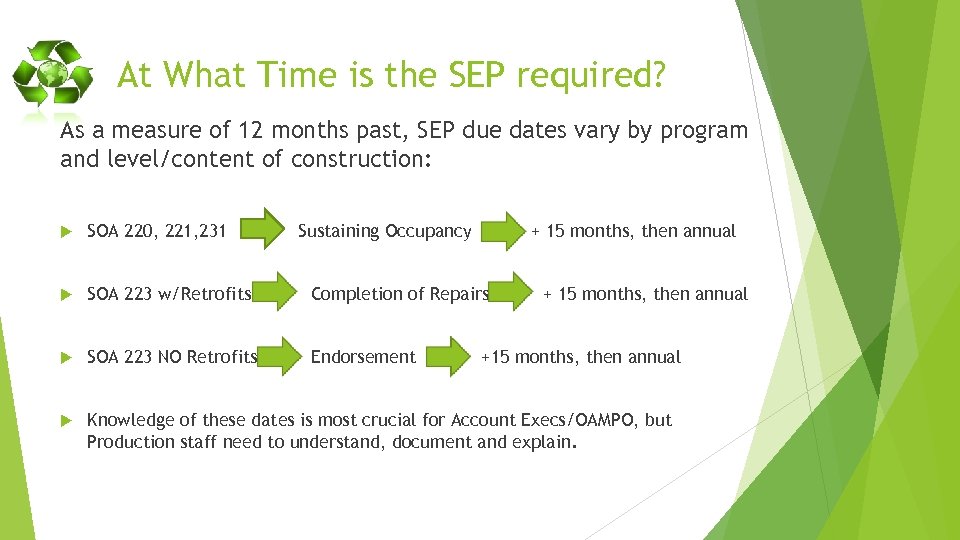 At What Time is the SEP required? As a measure of 12 months past, SEP due dates vary by program and level/content of construction: SOA 220, 221, 231 Sustaining Occupancy + 15 months, then annual SOA 223 w/Retrofits Completion of Repairs SOA 223 NO Retrofits Endorsement Knowledge of these dates is most crucial for Account Execs/OAMPO, but Production staff need to understand, document and explain. + 15 months, then annual +15 months, then annual
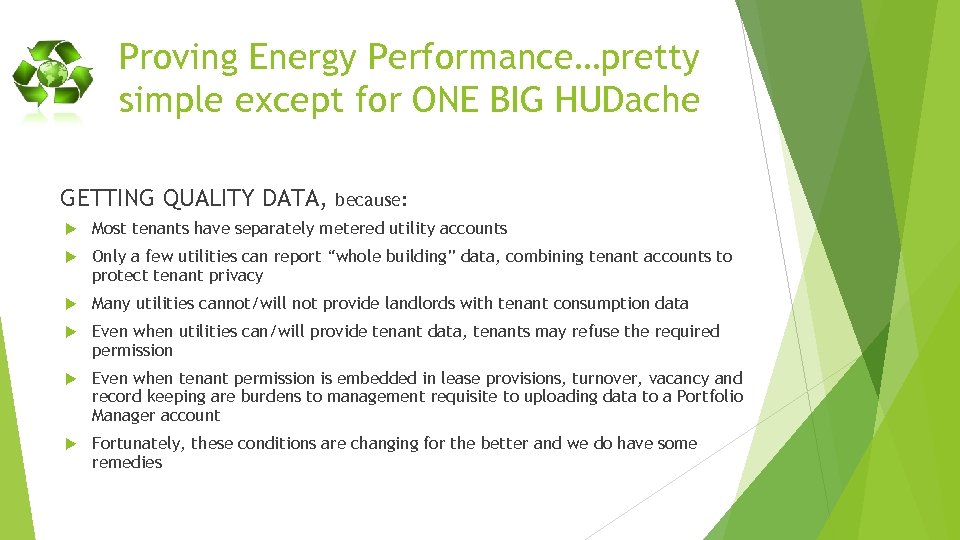 Proving Energy Performance…pretty simple except for ONE BIG HUDache GETTING QUALITY DATA, because: Most tenants have separately metered utility accounts Only a few utilities can report “whole building” data, combining tenant accounts to protect tenant privacy Many utilities cannot/will not provide landlords with tenant consumption data Even when utilities can/will provide tenant data, tenants may refuse the required permission Even when tenant permission is embedded in lease provisions, turnover, vacancy and record keeping are burdens to management requisite to uploading data to a Portfolio Manager account Fortunately, these conditions are changing for the better and we do have some remedies
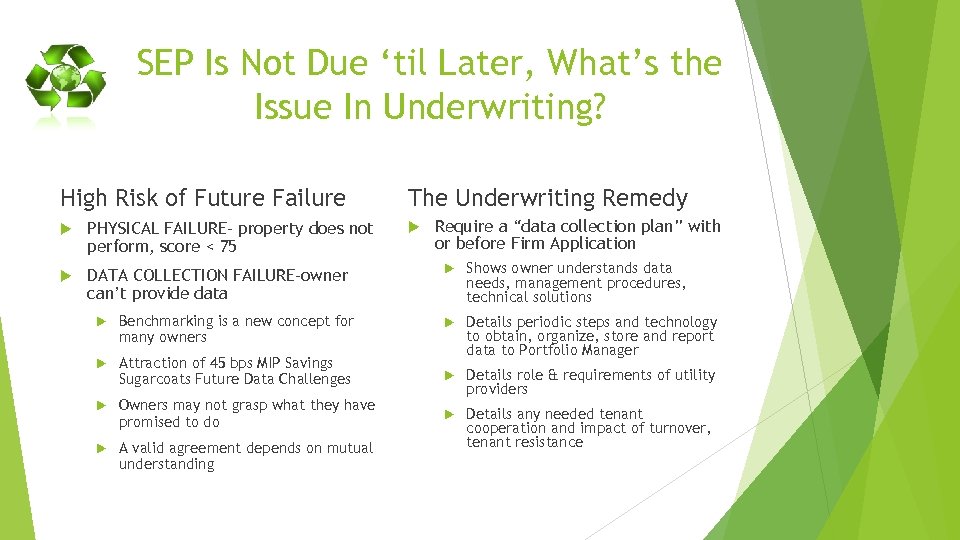 SEP Is Not Due ‘til Later, What’s the Issue In Underwriting? High Risk of Future Failure PHYSICAL FAILURE- property does not perform, score < 75 DATA COLLECTION FAILURE-owner can’t provide data The Underwriting Remedy Require a “data collection plan” with or before Firm Application Shows owner understands data needs, management procedures, technical solutions Details periodic steps and technology to obtain, organize, store and report data to Portfolio Manager Benchmarking is a new concept for many owners Attraction of 45 bps MIP Savings Sugarcoats Future Data Challenges Owners may not grasp what they have promised to do Details role & requirements of utility providers A valid agreement depends on mutual understanding Details any needed tenant cooperation and impact of turnover, tenant resistance
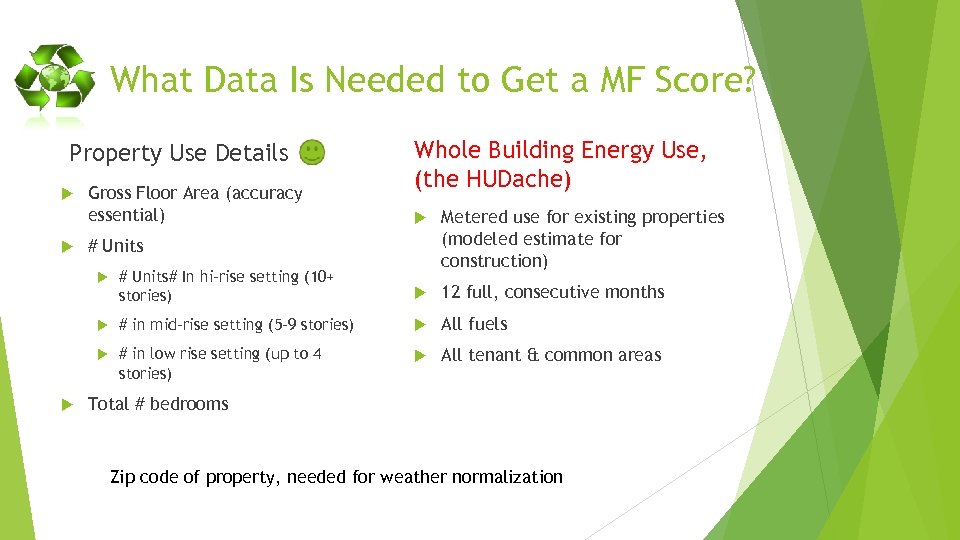 What Data Is Needed to Get a MF Score? Property Use Details Gross Floor Area (accuracy essential) Whole Building Energy Use, (the HUDache) Metered use for existing properties (modeled estimate for construction) # Units 12 full, consecutive months # in mid-rise setting (5 -9 stories) All fuels # Units# In hi-rise setting (10+ stories) # in low rise setting (up to 4 stories) All tenant & common areas Total # bedrooms Zip code of property, needed for weather normalization
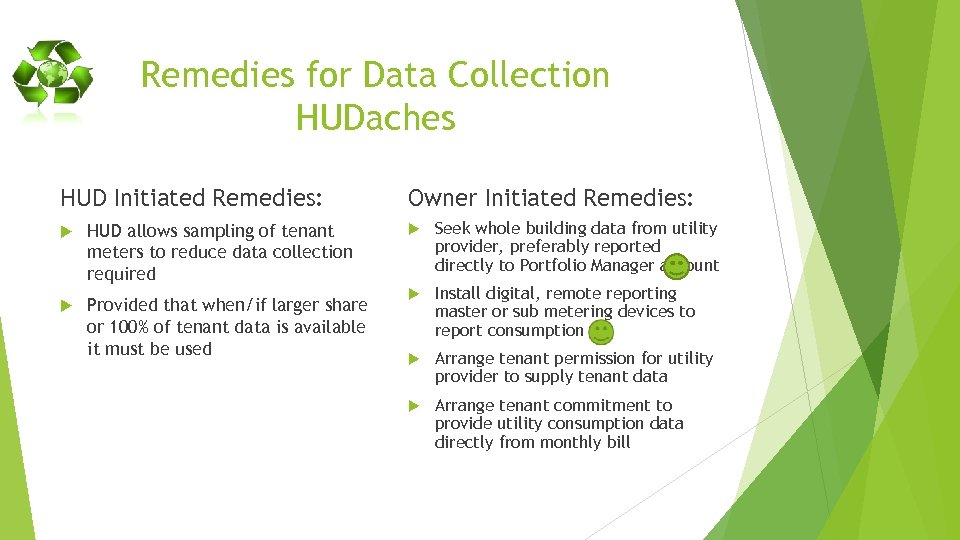 Remedies for Data Collection HUDaches HUD Initiated Remedies: HUD allows sampling of tenant meters to reduce data collection required Provided that when/if larger share or 100% of tenant data is available it must be used Owner Initiated Remedies: Seek whole building data from utility provider, preferably reported directly to Portfolio Manager account Install digital, remote reporting master or sub metering devices to report consumption Arrange tenant permission for utility provider to supply tenant data Arrange tenant commitment to provide utility consumption data directly from monthly bill
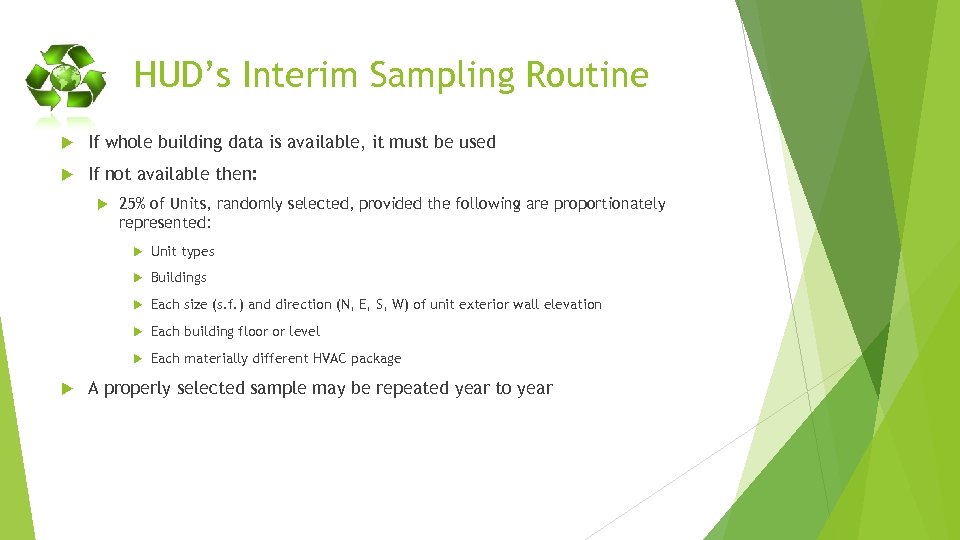 HUD’s Interim Sampling Routine If whole building data is available, it must be used If not available then: 25% of Units, randomly selected, provided the following are proportionately represented: Unit types Buildings Each size (s. f. ) and direction (N, E, S, W) of unit exterior wall elevation Each building floor or level Each materially different HVAC package A properly selected sample may be repeated year to year
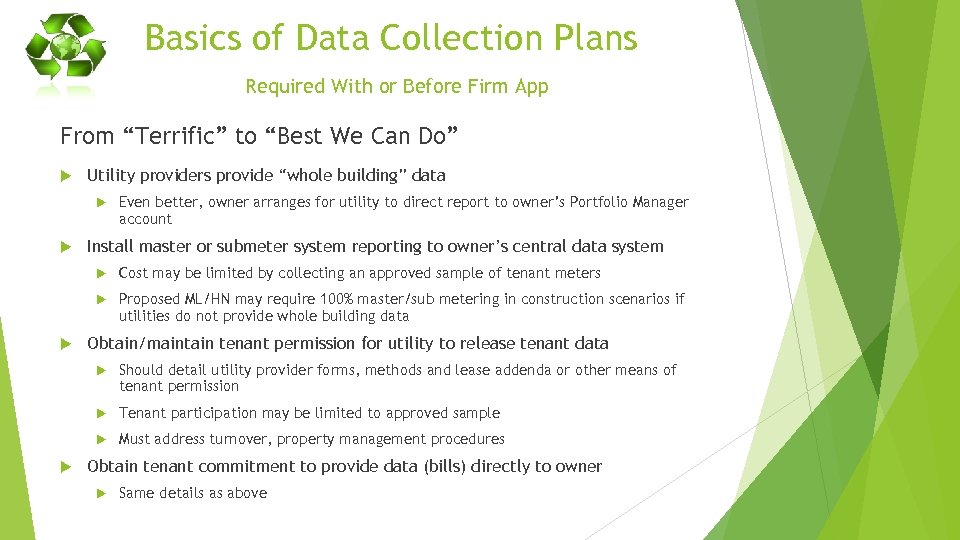 Basics of Data Collection Plans Required With or Before Firm App From “Terrific” to “Best We Can Do” Utility providers provide “whole building” data Even better, owner arranges for utility to direct report to owner’s Portfolio Manager account Install master or submeter system reporting to owner’s central data system Cost may be limited by collecting an approved sample of tenant meters Proposed ML/HN may require 100% master/sub metering in construction scenarios if utilities do not provide whole building data Obtain/maintain tenant permission for utility to release tenant data Tenant participation may be limited to approved sample Should detail utility provider forms, methods and lease addenda or other means of tenant permission Must address turnover, property management procedures Obtain tenant commitment to provide data (bills) directly to owner Same details as above
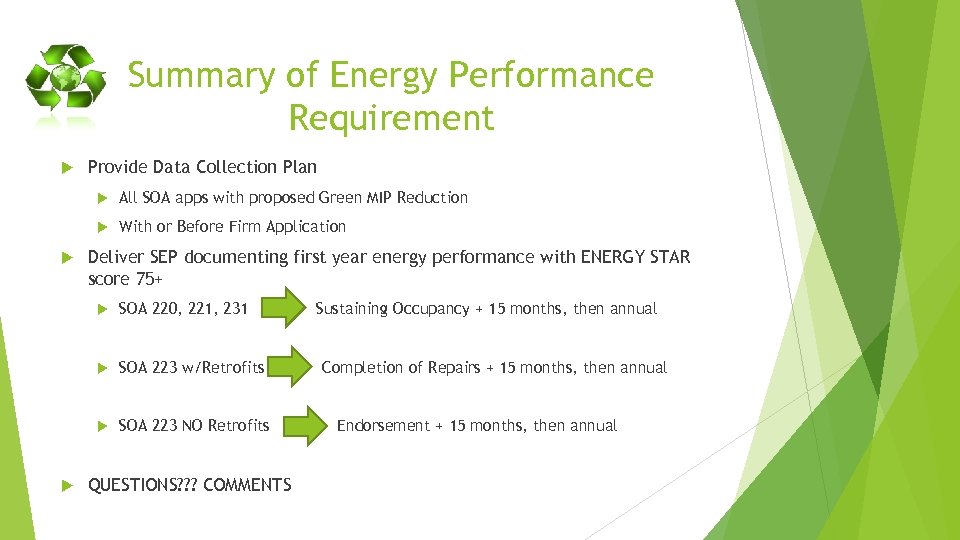 Summary of Energy Performance Requirement Provide Data Collection Plan All SOA apps with proposed Green MIP Reduction With or Before Firm Application Deliver SEP documenting first year energy performance with ENERGY STAR score 75+ SOA 223 w/Retrofits SOA 220, 221, 231 SOA 223 NO Retrofits QUESTIONS? ? ? COMMENTS Sustaining Occupancy + 15 months, then annual Completion of Repairs + 15 months, then annual Endorsement + 15 months, then annual
 Green MIP Reduction Green Recognition + Energy Performance = MIP Reduction Now let’s talk about the other MIP Reduction requirement: GREEN RECOGNITION Owner selects a “Green Standard” Owner plans construction to achieve GREEN RECOGNITION, Owner evidences prior achievement of GREEN RECOGNITION or
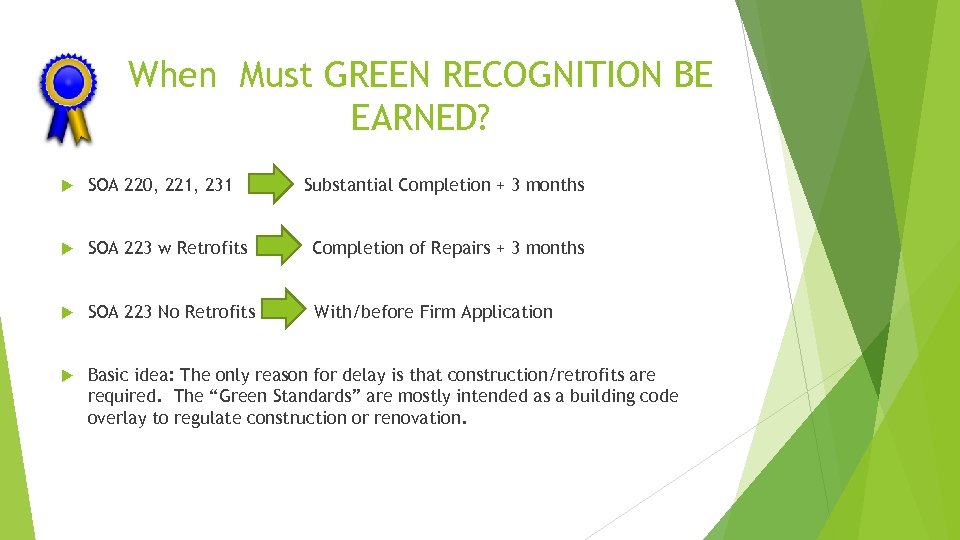 When Must GREEN RECOGNITION BE EARNED? SOA 220, 221, 231 Substantial Completion + 3 months SOA 223 w Retrofits Completion of Repairs + 3 months SOA 223 No Retrofits With/before Firm Application Basic idea: The only reason for delay is that construction/retrofits are required. The “Green Standards” are mostly intended as a building code overlay to regulate construction or renovation.
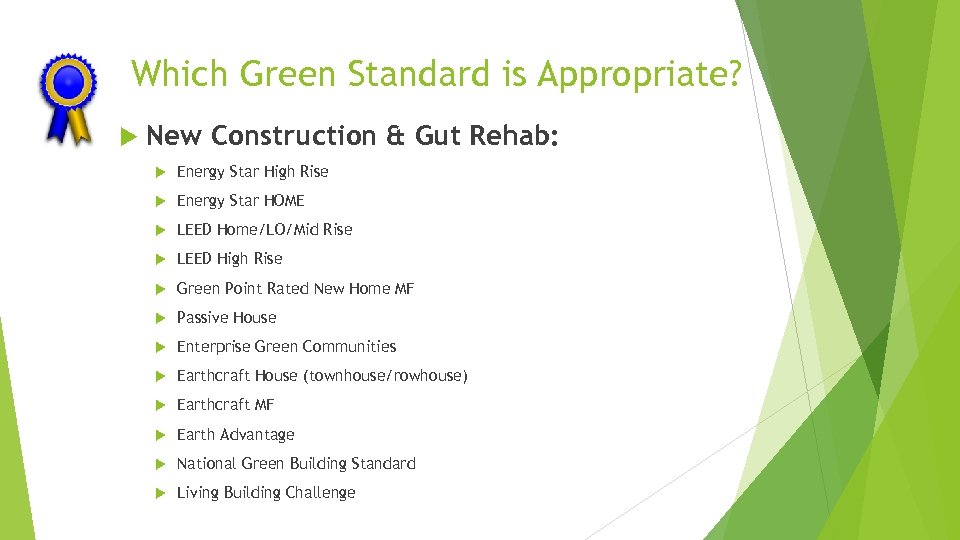 Which Green Standard is Appropriate? New Construction & Gut Rehab: Energy Star High Rise Energy Star HOME LEED Home/LO/Mid Rise LEED High Rise Green Point Rated New Home MF Passive House Enterprise Green Communities Earthcraft House (townhouse/rowhouse) Earthcraft MF Earth Advantage National Green Building Standard Living Building Challenge
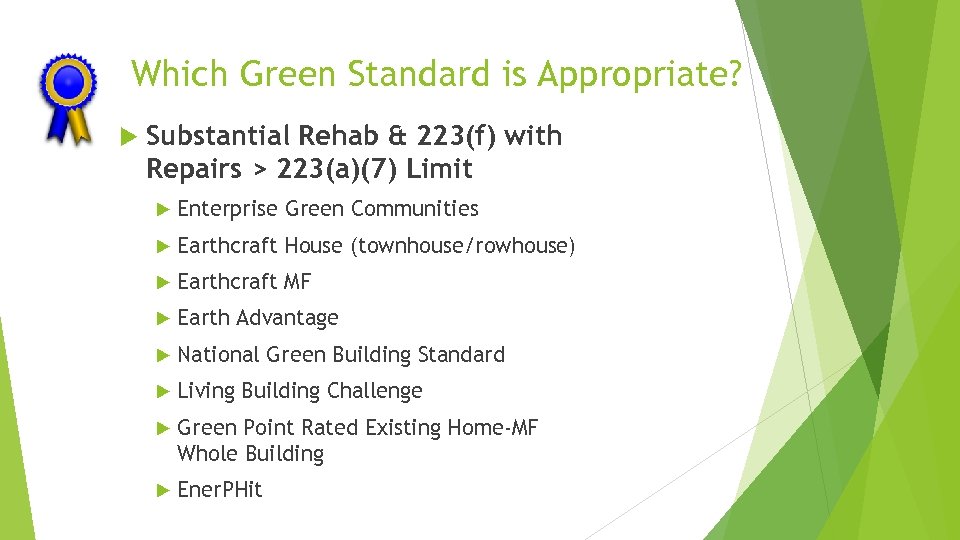 Which Green Standard is Appropriate? Substantial Rehab & 223(f) with Repairs > 223(a)(7) Limit Enterprise Green Communities Earthcraft House (townhouse/rowhouse) Earthcraft MF Earth Advantage National Green Building Standard Living Building Challenge Green Point Rated Existing Home-MF Whole Building Ener. PHit
 Which Green Standard is Appropriate? 223(f) w Repairs<= 223(a)(7) limits & All 223(a)(7) Green Point Rated Existing Home-MF Whole Building Energy LEED NOTE: Star Existing Buildings for Existing (EBOM) Properties with no Retrofits must have earned GREEN RECOGNITION prior to Firm Application
 Some Green Standards Only Recognize Certain Building Types, Categories, Locations Regional standards, location Green Point Rated Existing Home – MF Whole Building, California Earthcraft House (Townhouse or Rowhouse) Southeast, hot, humid zone Earthcraft MF, Southeast, hot, humid zone Earth Advantage, Oregon, Washington Building Type, usually evident in the Standard name Low rise, high rise, number of stories Property Use, e. g. Enterprise Green (affordable housing) Owner’s selection must be appropriate
 Underwriting Issues for Concept Meeting (SOA 220, 221, 231) What Green Recognition will be earned? Does it fit the circumstances? Who is on the Design Team? Architect, Energy Professional, Standard Keeper or verifier Experience with proposed Green Recognition
 Underwriting Issues for Pre-app (SOA 220, 221, 231) What Are the Design & Construction Milestones for Green Recognition? Expected Dates? If renovation, who will conduct energy audit and when? What modeling procedure & software will be used? Anticipated scope of work, and if renovation, key retrofits Plan to meter all spaces/uses to support future data collection
 Underwriting Issues for Firm Confirm requirements for GREEN RECOGNITION are included, acknowledged, in construction documents Drawings, Plans, Specifications Architect’s Certification Energy Professional (for lesser retrofits) Evidence of Standard keeper review/approval/acceptance Describe construction progress QA milestones and incorporate these in Construction Schedule To be built/retrofitted property should be modeled to estimate energy consumption Modeling results must be scored, Portfolio Manager, ENERGY STAR Score Plans/retrofits should score successfully with a margin for error Methods & plan for future data collection