


 Скачать презентацию Green Investment Schemes — Concepts Ideas Challenges Jari
dd388c9170f3cd3aca81ab790d9dc6cd.ppt
- Количество слайдов: 17
 Green Investment Schemes - Concepts, Ideas, Challenges Jari Vayrynen Operations Team Leader, Europe and Central Asia 14 February, Bonn UNFCCC Workshop
 What is a GIS? A mechanism established by the selling country to assure buyers that proceeds from AAU trades will finance bilaterally agreed environmental projects and programs through and beyond 2012.
 Demand Supply? n n CDM and JI not expected to deliver all compliance needs Demand for 400 -2000 million AAUs • If Canada remains out of the international market, likely in lower end of range n n Supply: at least 3 times larger Implications: • Likely to be a buyers’ market • Sellers may have to be price takers • BUT, sellers can limit the supply or not sell at all unless acceptable conditions met • Early movers could have advantage
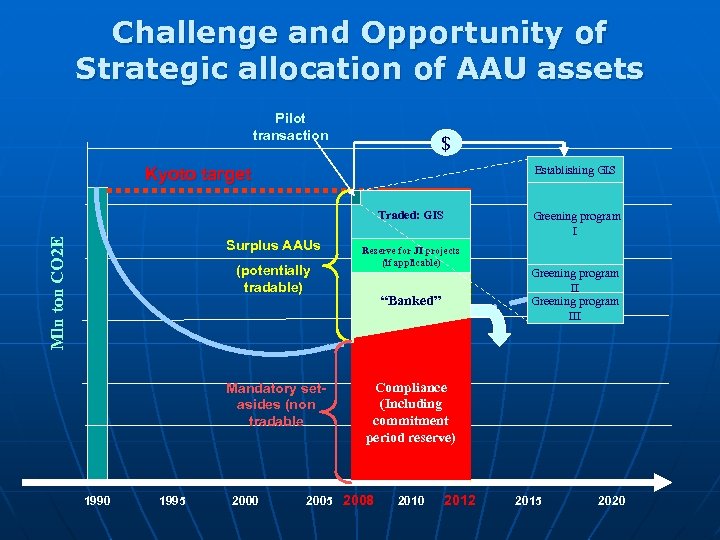 Challenge and Opportunity of Strategic allocation of AAU assets Pilot transaction $ Establishing GIS Kyoto target Mln ton CO 2 E Traded: GIS Surplus AAUs (potentially tradable) Mandatory setasides (non tradable 1990 1995 2000 Greening program I Reserve for JI projects (if applicable) “Banked” Greening program III Compliance (Including commitment period reserve) 2005 2008 2010 2012 2015 2020
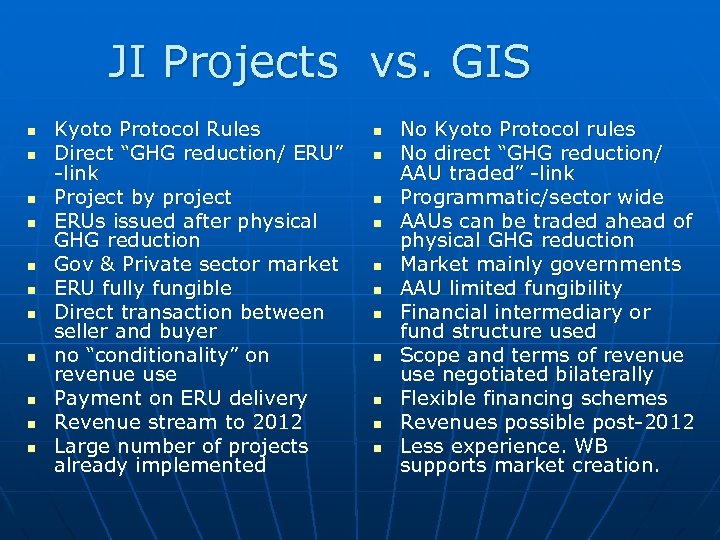 JI Projects vs. GIS n n n Kyoto Protocol Rules Direct “GHG reduction/ ERU” -link Project by project ERUs issued after physical GHG reduction Gov & Private sector market ERU fully fungible Direct transaction between seller and buyer no “conditionality” on revenue use Payment on ERU delivery Revenue stream to 2012 Large number of projects already implemented n n n No Kyoto Protocol rules No direct “GHG reduction/ AAU traded” -link Programmatic/sector wide AAUs can be traded ahead of physical GHG reduction Market mainly governments AAU limited fungibility Financial intermediary or fund structure used Scope and terms of revenue use negotiated bilaterally Flexible financing schemes Revenues possible post-2012 Less experience. WB supports market creation.
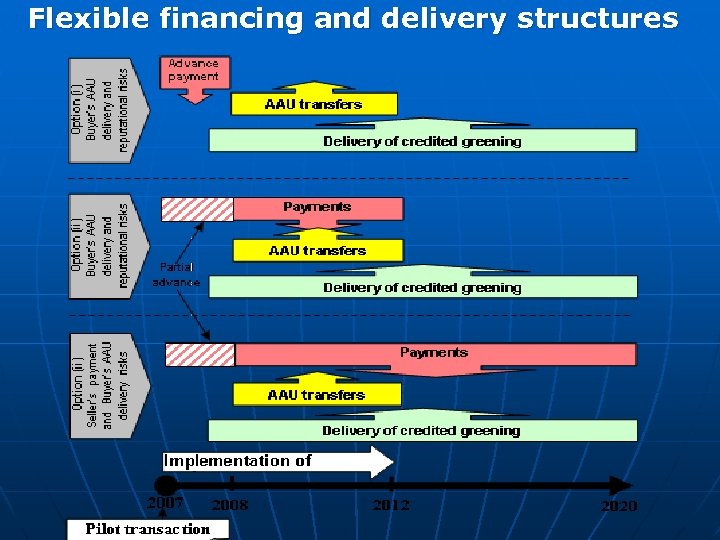 Flexible financing and delivery structures
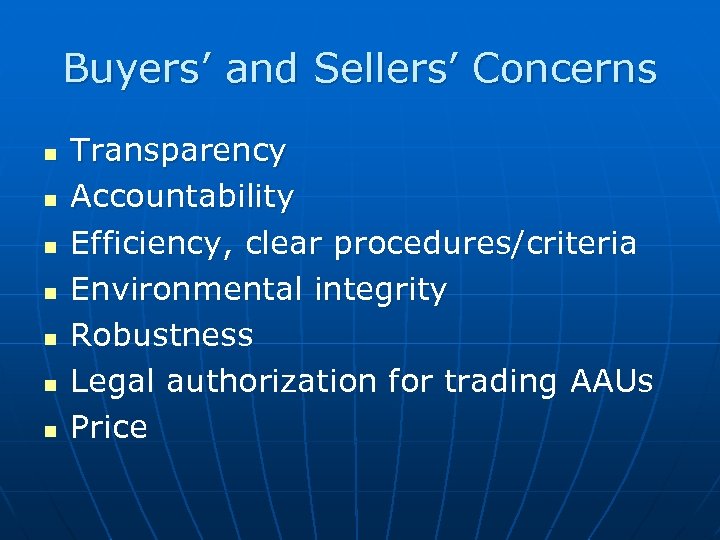 Buyers’ and Sellers’ Concerns n n n n Transparency Accountability Efficiency, clear procedures/criteria Environmental integrity Robustness Legal authorization for trading AAUs Price
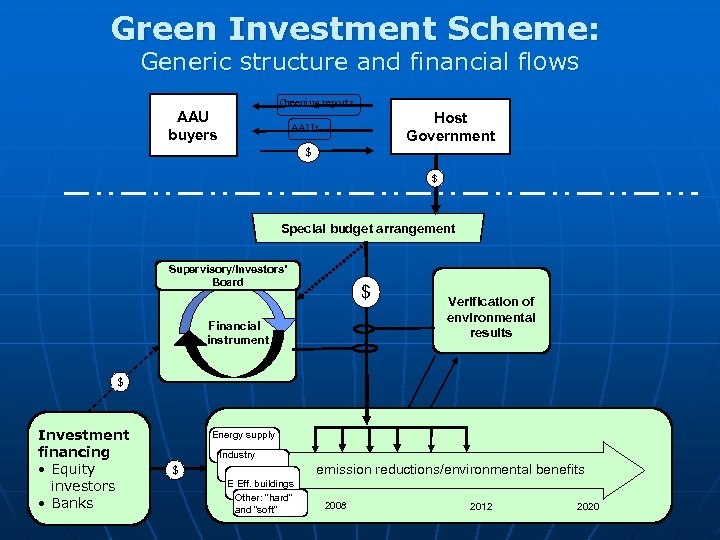 Green Investment Scheme: Generic structure and financial flows Greening reports AAU buyers Host Government AAUs $ $ Special budget arrangement Supervisory/Investors’ Board $ Financial instrument Verification of environmental results $ Investment financing • Equity investors • Banks Energy supply Industry emission reductions/environmental benefits $ E Eff. buildings Other: “hard” and “soft” 2008 2012 2020
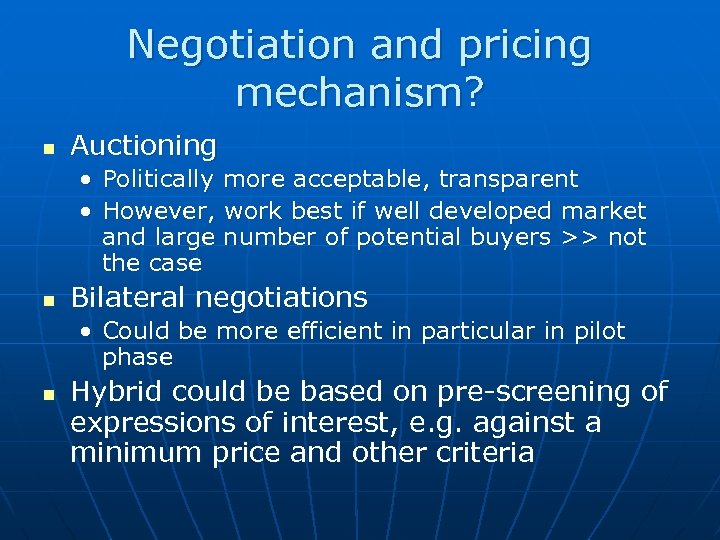 Negotiation and pricing mechanism? n Auctioning • Politically more acceptable, transparent • However, work best if well developed market and large number of potential buyers >> not the case n Bilateral negotiations • Could be more efficient in particular in pilot phase n Hybrid could be based on pre-screening of expressions of interest, e. g. against a minimum price and other criteria
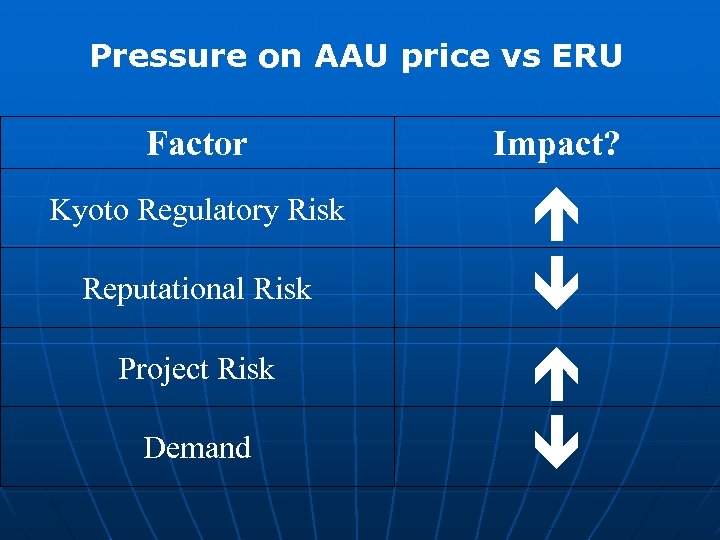 Pressure on AAU price vs ERU Factor Impact? Kyoto Regulatory Risk Reputational Risk Project Risk Demand
![Categories of revenue use n n n n GHG reductions, [avoidance? ] Reduction of](https://present5.com/presentation/dd388c9170f3cd3aca81ab790d9dc6cd/image-11.jpg "Categories of revenue use n n n n GHG reductions, [avoidance? ] Reduction of") Categories of revenue use n n n n GHG reductions, [avoidance? ] Reduction of local/regional pollutants GIS management, monitoring, verification, reporting Technical support to project developers Policy development? Adaptation? Biodiversity?
Categories of revenue use n n n n GHG reductions, [avoidance? ] Reduction of local/regional pollutants GIS management, monitoring, verification, reporting Technical support to project developers Policy development? Adaptation? Biodiversity?
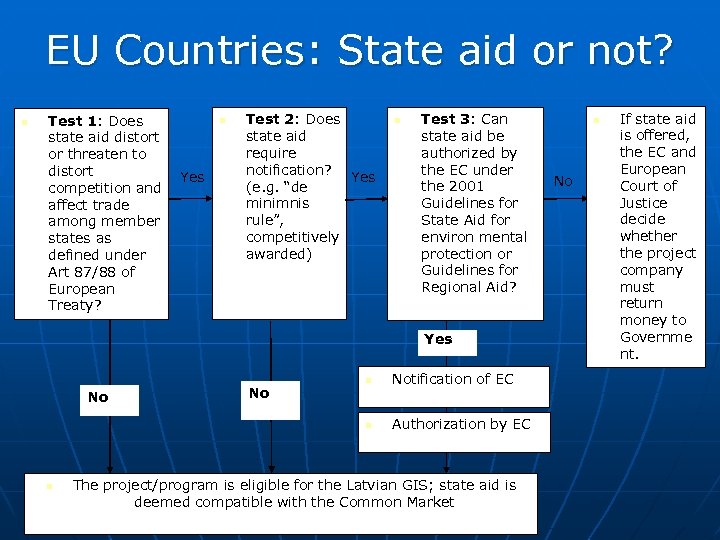 EU Countries: State aid or not? n Test 1: Does state aid distort or threaten to distort competition and affect trade among member states as defined under Art 87/88 of European Treaty? n Yes Test 2: Does state aid require notification? Yes (e. g. “de minimnis rule”, competitively awarded) n Test 3: Can state aid be authorized by the EC under the 2001 Guidelines for State Aid for environ mental protection or Guidelines for Regional Aid? Yes n No Notification of EC n No n Authorization by EC The project/program is eligible for the Latvian GIS; state aid is deemed compatible with the Common Market n No If state aid is offered, the EC and European Court of Justice decide whether the project company must return money to Governme nt.
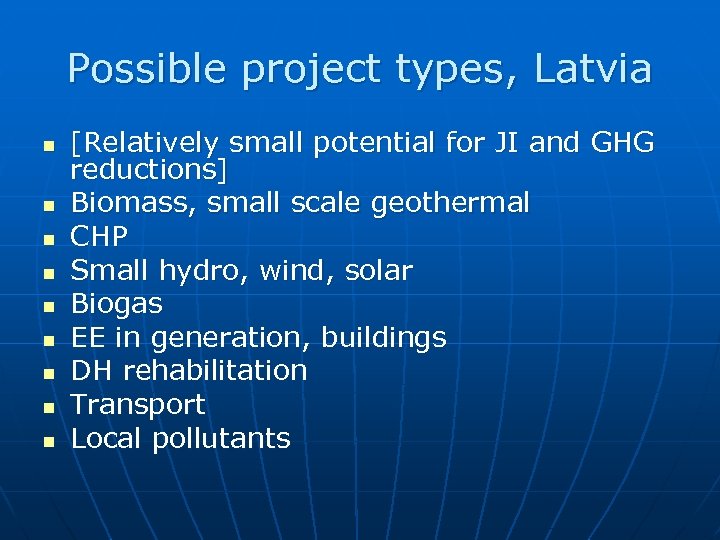 Possible project types, Latvia n n n n n [Relatively small potential for JI and GHG reductions] Biomass, small scale geothermal CHP Small hydro, wind, solar Biogas EE in generation, buildings DH rehabilitation Transport Local pollutants
![Possible project types, Ukraine n n [Large potential for JI and GHG reductions] Sectors](https://present5.com/presentation/dd388c9170f3cd3aca81ab790d9dc6cd/image-14.jpg "Possible project types, Ukraine n n [Large potential for JI and GHG reductions] Sectors") Possible project types, Ukraine n n [Large potential for JI and GHG reductions] Sectors with large GHG emissions and a large reduction potential: • • n Fuel extraction, transport and processing Iron and steel production Power and heat production Industrial energy use Opportunities are also with end-users: • Residential sector • Transport sector n Forestry?
Possible project types, Ukraine n n [Large potential for JI and GHG reductions] Sectors with large GHG emissions and a large reduction potential: • • n Fuel extraction, transport and processing Iron and steel production Power and heat production Industrial energy use Opportunities are also with end-users: • Residential sector • Transport sector n Forestry?
 World Bank support to GIS (1) n Bulgaria: • GIS Options study finalized in 2004 • Next steps expected to be agreed later in 2007 n Russia • Recent Government resolution to approve a WB PHRD Grant for JI/EIT/GIS n Ukraine: • International Emission Trading Options Study completed. • Technical assistance to support IET institutions and preparation of a pilot GIS program initiated
 World Bank support to GIS (2) n Latvia • Options Study completed (de facto pre-feasibility study) • A number of promising project ideas identified (support by Finland) • Technical Assistance for implementation/detailed design started n GIS roundtables • Two roundtables were arranged for buyers and sellers in 2006 n World Bank could be made available to other countries
 Thank You! Jari Vayrynen Operations Team Leader, Europe and Central Asia Word Bank Carbon Finance Unit