 Скачать презентацию Green Chemical Process Primary Categories Sub-Categories Definitions Techniques
019037be05f5412ec6f37bda03ea4547.ppt
- Количество слайдов: 24



Green Chemical Process Primary Categories Sub-Categories Definitions Techniques (where applicable) Metrics R. Paulson 9 -22 -09
OUTLINE • Existing Categories • General Categories For Organization that Incorporate Existing Categories for Discussion
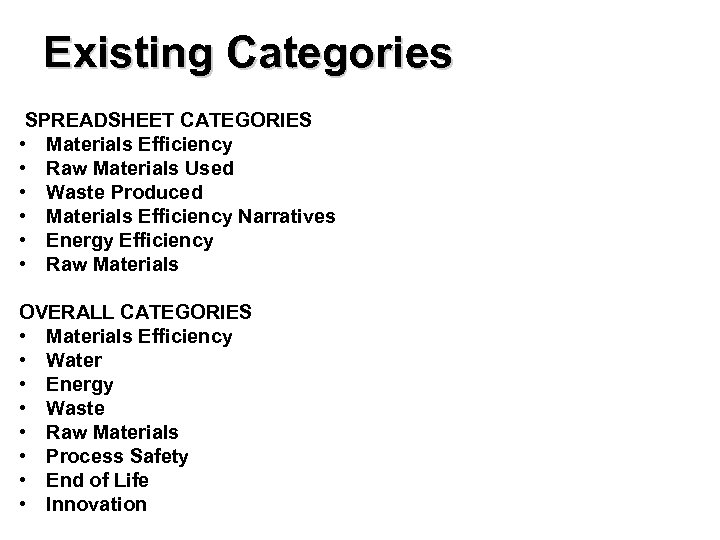
Existing Categories SPREADSHEET CATEGORIES • Materials Efficiency • Raw Materials Used • Waste Produced • Materials Efficiency Narratives • Energy Efficiency • Raw Materials OVERALL CATEGORIES • Materials Efficiency • Water • Energy • Waste • Raw Materials • Process Safety • End of Life • Innovation
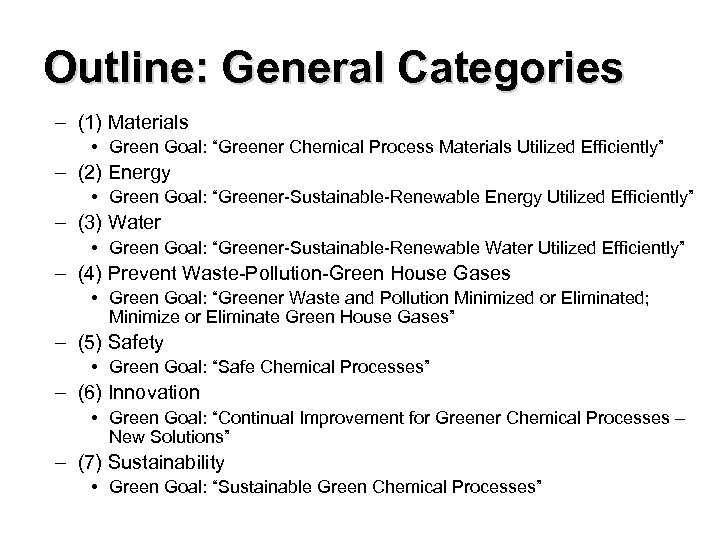
Outline: General Categories – (1) Materials • Green Goal: “Greener Chemical Process Materials Utilized Efficiently” – (2) Energy • Green Goal: “Greener-Sustainable-Renewable Energy Utilized Efficiently” – (3) Water • Green Goal: “Greener-Sustainable-Renewable Water Utilized Efficiently” – (4) Prevent Waste-Pollution-Green House Gases • Green Goal: “Greener Waste and Pollution Minimized or Eliminated; Minimize or Eliminate Green House Gases” – (5) Safety • Green Goal: “Safe Chemical Processes” – (6) Innovation • Green Goal: “Continual Improvement for Greener Chemical Processes – New Solutions” – (7) Sustainability • Green Goal: “Sustainable Green Chemical Processes”
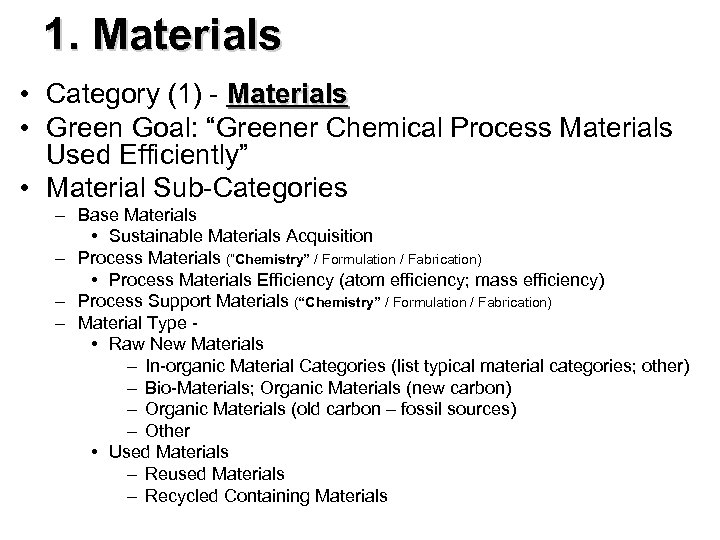
1. Materials • Category (1) - Materials • Green Goal: “Greener Chemical Process Materials Used Efficiently” • Material Sub-Categories – Base Materials • Sustainable Materials Acquisition – Process Materials (“Chemistry” / Formulation / Fabrication) • Process Materials Efficiency (atom efficiency; mass efficiency) – Process Support Materials (“Chemistry” / Formulation / Fabrication) – Material Type • Raw New Materials – In-organic Material Categories (list typical material categories; other) – Bio-Materials; Organic Materials (new carbon) – Organic Materials (old carbon – fossil sources) – Other • Used Materials – Reused Materials – Recycled Containing Materials
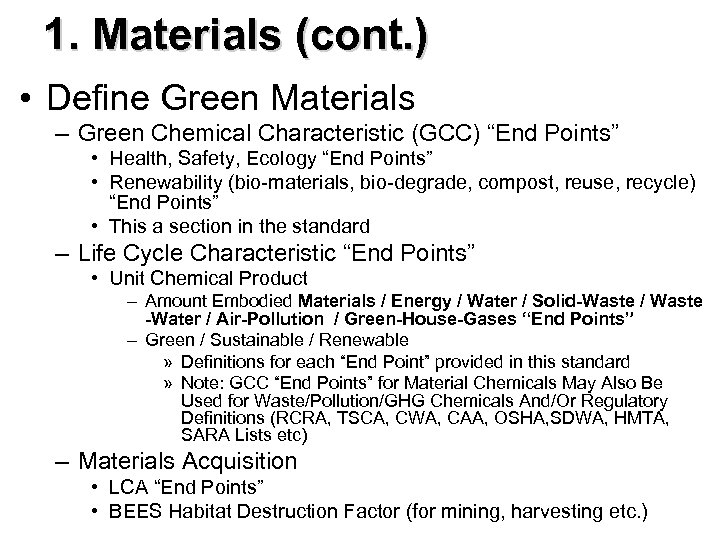
1. Materials (cont. ) • Define Green Materials – Green Chemical Characteristic (GCC) “End Points” • Health, Safety, Ecology “End Points” • Renewability (bio-materials, bio-degrade, compost, reuse, recycle) “End Points” • This a section in the standard – Life Cycle Characteristic “End Points” • Unit Chemical Product – Amount Embodied Materials / Energy / Water / Solid-Waste / Waste -Water / Air-Pollution / Green-House-Gases “End Points” – Green / Sustainable / Renewable » Definitions for each “End Point” provided in this standard » Note: GCC “End Points” for Material Chemicals May Also Be Used for Waste/Pollution/GHG Chemicals And/Or Regulatory Definitions (RCRA, TSCA, CWA, CAA, OSHA, SDWA, HMTA, SARA Lists etc) – Materials Acquisition • LCA “End Points” • BEES Habitat Destruction Factor (for mining, harvesting etc. )
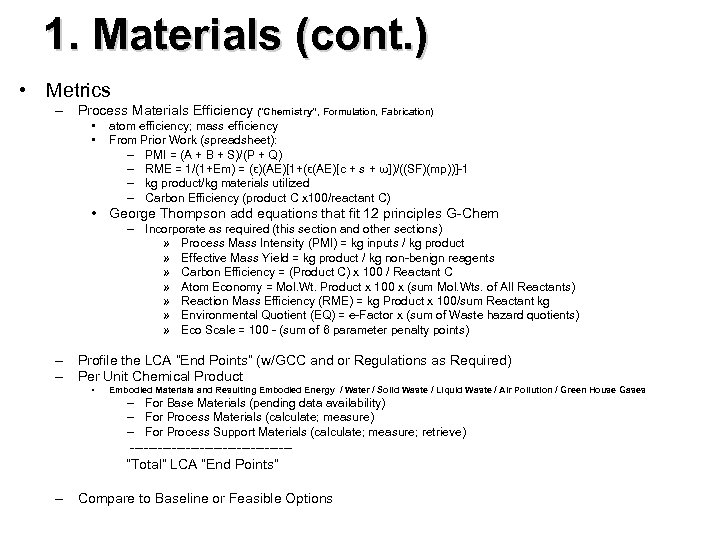
1. Materials (cont. ) • Metrics – Process Materials Efficiency (“Chemistry”, Formulation, Fabrication) • • atom efficiency; mass efficiency From Prior Work (spreadsheet): – PMI = (A + B + S)/(P + Q) – RME = 1/(1+Em) = (ε)(AE)[1+(ε(AE)[c + s + ω])/((SF)(mp))]-1 – kg product/kg materials utilized – Carbon Efficiency (product C x 100/reactant C) • George Thompson add equations that fit 12 principles G-Chem – Incorporate as required (this section and other sections) » Process Mass Intensity (PMI) = kg inputs / kg product » Effective Mass Yield = kg product / kg non-benign reagents » Carbon Efficiency = (Product C) x 100 / Reactant C » Atom Economy = Mol. Wt. Product x 100 x (sum Mol. Wts. of All Reactants) » Reaction Mass Efficiency (RME) = kg Product x 100/sum Reactant kg » Environmental Quotient (EQ) = e-Factor x (sum of Waste hazard quotients) » Eco Scale = 100 - (sum of 6 parameter penalty points) – Profile the LCA “End Points” (w/GCC and or Regulations as Required) – Per Unit Chemical Product • Embodied Materials and Resulting Embodied Energy / Water / Solid Waste / Liquid Waste / Air Pollution / Green House Gases – For Base Materials (pending data availability) – For Process Materials (calculate; measure) – For Process Support Materials (calculate; measure; retrieve) -----------------“Total” LCA “End Points” – Compare to Baseline or Feasible Options
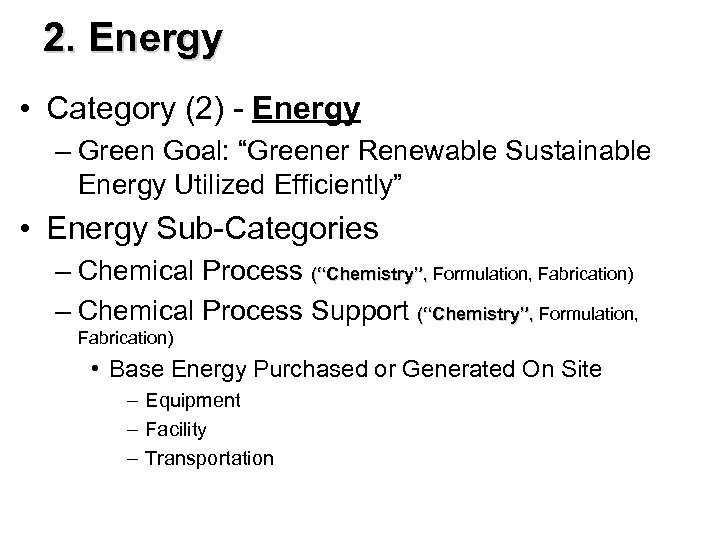
2. Energy • Category (2) - Energy – Green Goal: “Greener Renewable Sustainable Energy Utilized Efficiently” • Energy Sub-Categories – Chemical Process (“Chemistry”, Formulation, Fabrication) – Chemical Process Support (“Chemistry”, Formulation, Fabrication) • Base Energy Purchased or Generated On Site – Equipment – Facility – Transportation
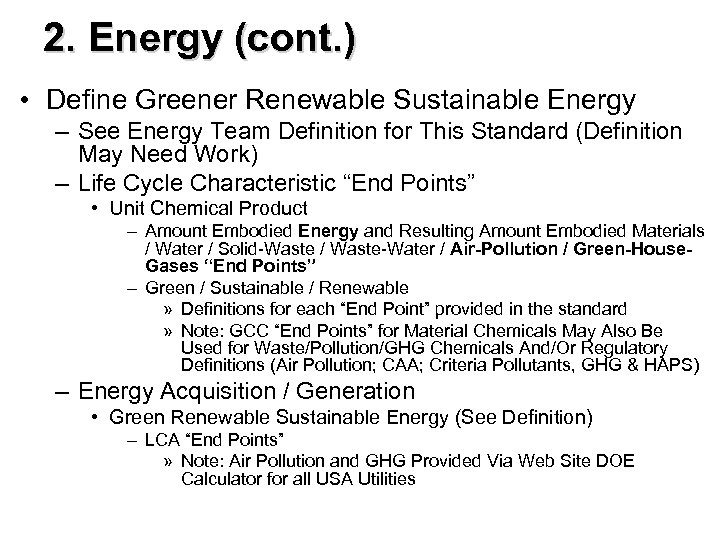
2. Energy (cont. ) • Define Greener Renewable Sustainable Energy – See Energy Team Definition for This Standard (Definition May Need Work) – Life Cycle Characteristic “End Points” • Unit Chemical Product – Amount Embodied Energy and Resulting Amount Embodied Materials / Water / Solid-Waste / Waste-Water / Air-Pollution / Green-House. Gases “End Points” – Green / Sustainable / Renewable » Definitions for each “End Point” provided in the standard » Note: GCC “End Points” for Material Chemicals May Also Be Used for Waste/Pollution/GHG Chemicals And/Or Regulatory Definitions (Air Pollution; CAA; Criteria Pollutants, GHG & HAPS) – Energy Acquisition / Generation • Green Renewable Sustainable Energy (See Definition) – LCA “End Points” » Note: Air Pollution and GHG Provided Via Web Site DOE Calculator for all USA Utilities
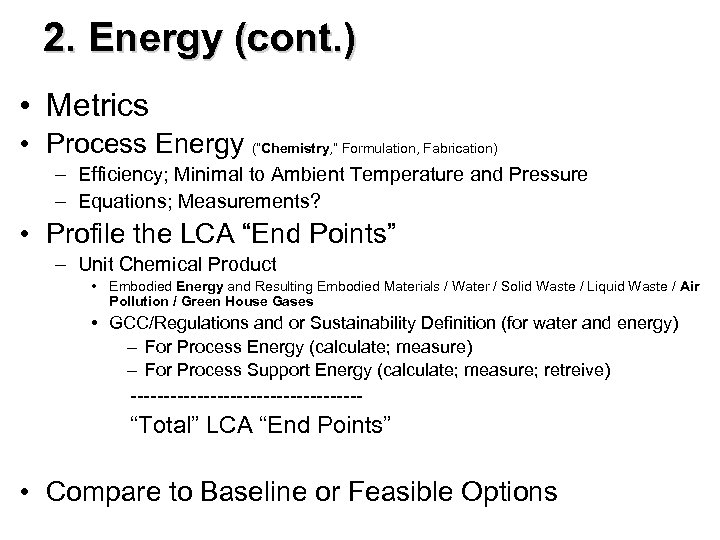
2. Energy (cont. ) • Metrics • Process Energy (“Chemistry, ” Formulation, Fabrication) – Efficiency; Minimal to Ambient Temperature and Pressure – Equations; Measurements? • Profile the LCA “End Points” – Unit Chemical Product • Embodied Energy and Resulting Embodied Materials / Water / Solid Waste / Liquid Waste / Air Pollution / Green House Gases • GCC/Regulations and or Sustainability Definition (for water and energy) – For Process Energy (calculate; measure) – For Process Support Energy (calculate; measure; retreive) ------------------ “Total” LCA “End Points” • Compare to Baseline or Feasible Options
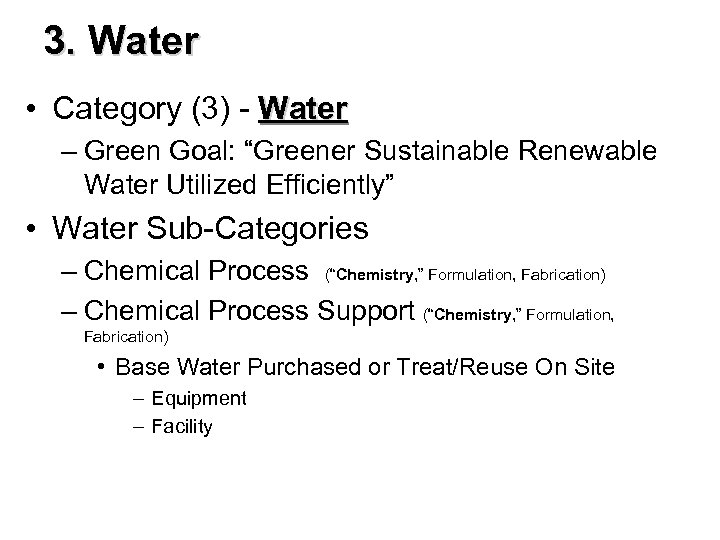
3. Water • Category (3) - Water – Green Goal: “Greener Sustainable Renewable Water Utilized Efficiently” • Water Sub-Categories – Chemical Process (“Chemistry, ” Formulation, Fabrication) – Chemical Process Support (“Chemistry, ” Formulation, Fabrication) • Base Water Purchased or Treat/Reuse On Site – Equipment – Facility
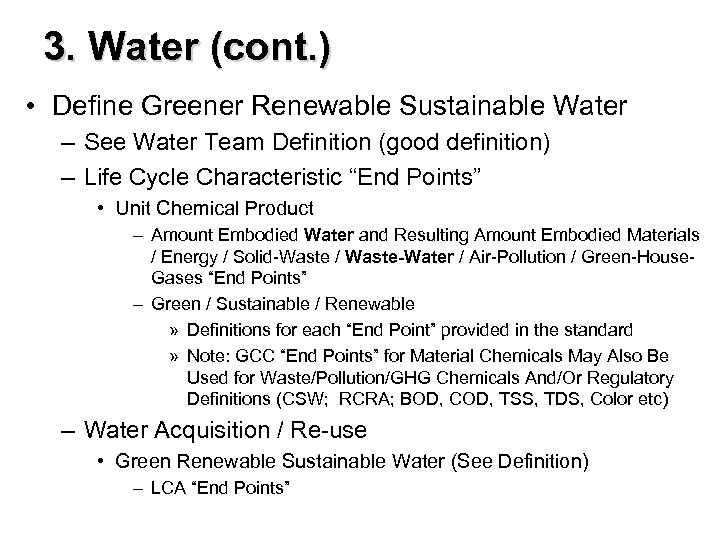
3. Water (cont. ) • Define Greener Renewable Sustainable Water – See Water Team Definition (good definition) – Life Cycle Characteristic “End Points” • Unit Chemical Product – Amount Embodied Water and Resulting Amount Embodied Materials / Energy / Solid-Waste / Waste-Water / Air-Pollution / Green-House. Gases “End Points” – Green / Sustainable / Renewable » Definitions for each “End Point” provided in the standard » Note: GCC “End Points” for Material Chemicals May Also Be Used for Waste/Pollution/GHG Chemicals And/Or Regulatory Definitions (CSW; RCRA; BOD, COD, TSS, TDS, Color etc) – Water Acquisition / Re-use • Green Renewable Sustainable Water (See Definition) – LCA “End Points”
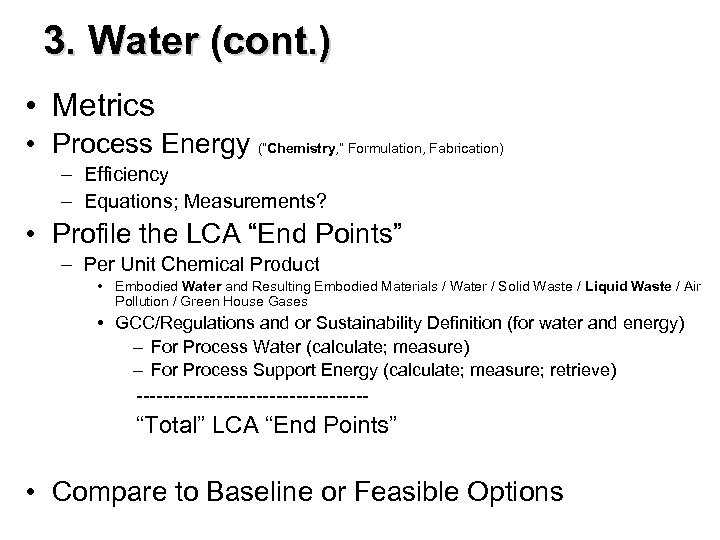
3. Water (cont. ) • Metrics • Process Energy (“Chemistry, ” Formulation, Fabrication) – Efficiency – Equations; Measurements? • Profile the LCA “End Points” – Per Unit Chemical Product • Embodied Water and Resulting Embodied Materials / Water / Solid Waste / Liquid Waste / Air Pollution / Green House Gases • GCC/Regulations and or Sustainability Definition (for water and energy) – For Process Water (calculate; measure) – For Process Support Energy (calculate; measure; retrieve) ------------------ “Total” LCA “End Points” • Compare to Baseline or Feasible Options
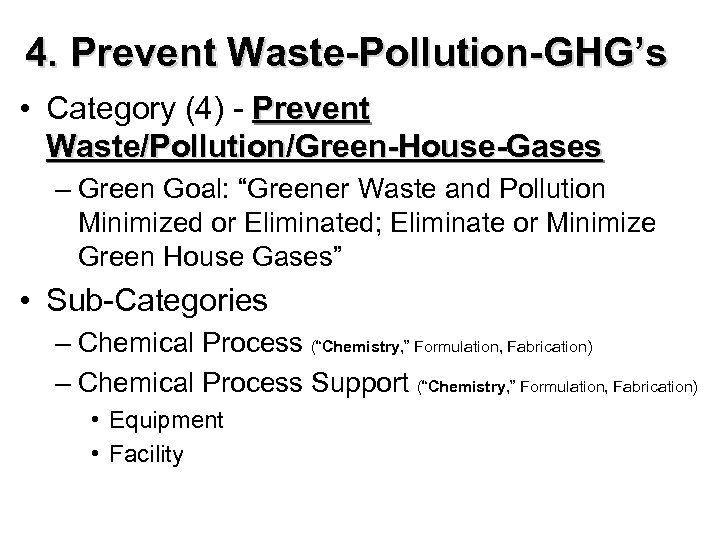
4. Prevent Waste-Pollution-GHG’s • Category (4) - Prevent Waste/Pollution/Green-House-Gases – Green Goal: “Greener Waste and Pollution Minimized or Eliminated; Eliminate or Minimize Green House Gases” • Sub-Categories – Chemical Process (“Chemistry, ” Formulation, Fabrication) – Chemical Process Support (“Chemistry, ” Formulation, Fabrication) • Equipment • Facility
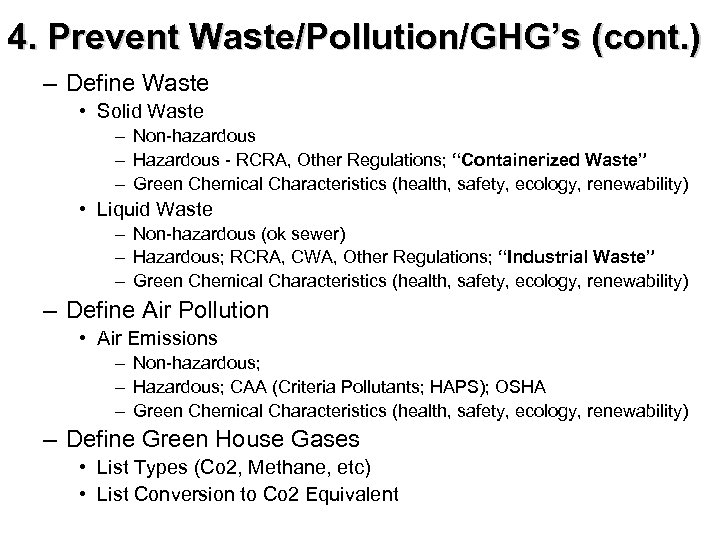
4. Prevent Waste/Pollution/GHG’s (cont. ) – Define Waste • Solid Waste – Non-hazardous – Hazardous - RCRA, Other Regulations; “Containerized Waste” – Green Chemical Characteristics (health, safety, ecology, renewability) • Liquid Waste – Non-hazardous (ok sewer) – Hazardous; RCRA, CWA, Other Regulations; “Industrial Waste” – Green Chemical Characteristics (health, safety, ecology, renewability) – Define Air Pollution • Air Emissions – Non-hazardous; – Hazardous; CAA (Criteria Pollutants; HAPS); OSHA – Green Chemical Characteristics (health, safety, ecology, renewability) – Define Green House Gases • List Types (Co 2, Methane, etc) • List Conversion to Co 2 Equivalent
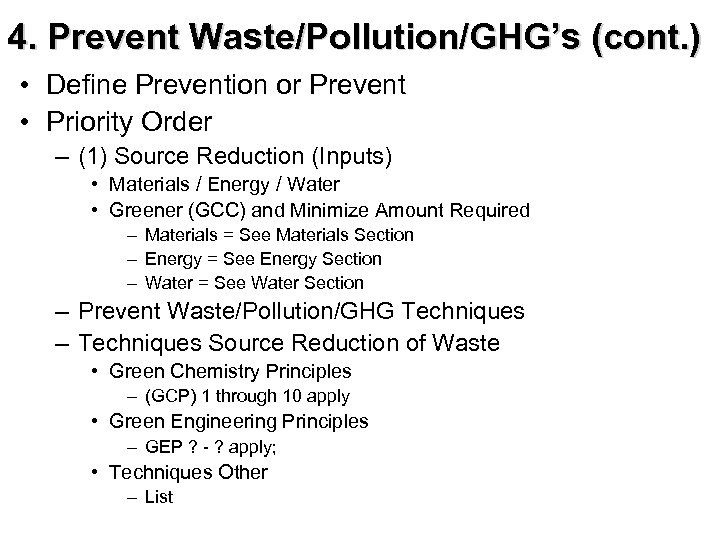
4. Prevent Waste/Pollution/GHG’s (cont. ) • Define Prevention or Prevent • Priority Order – (1) Source Reduction (Inputs) • Materials / Energy / Water • Greener (GCC) and Minimize Amount Required – Materials = See Materials Section – Energy = See Energy Section – Water = See Water Section – Prevent Waste/Pollution/GHG Techniques – Techniques Source Reduction of Waste • Green Chemistry Principles – (GCP) 1 through 10 apply • Green Engineering Principles – GEP ? - ? apply; • Techniques Other – List
4. Prevent Waste/Pollution/GHG’s (cont. ) • (2 a) Re-use and Recycle (output) – Greener and Minimize/Eliminate Through Reuse and Recycling • Greener (GCC (Health, Safety, Ecology, Renewability) ) • Minimize Via Reuse and Recycle – Solid Waste (see definition) – Liquid Waste (see definition) – Air Pollution / Green House Gases (see definition) » Not Typical to Reuse or Recycle – Techniques Reuse and or Recycle of Waste • Green Chemistry Principles – GCP ? • Green Engineering Principles – GEP ? • Other
4. Prevent Waste/Pollution/GHG’s (cont. ) • (2 b) Biodegrade/Compost (output) – Greener and Minimize/Eliminate Through Bio-degrade and Compost • Greener (GCC (Health, Safety, Ecology, Renewability) ) • Minimize Via Bio-degrade and Compost – Solid Waste (see definition) – Liquid Waste (see definition) – Air Pollution / Green House Gases (see definition) » Not Typical to Bio-degrade or Compost – Techniques Bio-degrade or Compost of Waste • Green Chemistry Principles – GCP ? • Green Engineering Principles – GEP ? • Other
4. Prevent Waste/Pollution/GHG’s (cont. ) • (3 a) Air Controls and or Offsets (output) – Greener and Minimize/Eliminate Through Air Controls and or Offsets • Greener (GCC (Health, Safety, Ecology, Renewability) ) • Minimize Via Air Controls or Offsets – Air Pollution – Green House Gases (see definition) – Doesn’t Apply to Solid and Liquid Waste – Techniques Air Controls and Offsets • Green Chemistry Principles – GCP ? • Green Engineering Principles – GEP ? • Other
4. Prevent Waste/Pollution/GHG’s (cont. ) • (3 b) Treatment/ Disposal (output) – Greener and Minimize/Eliminate Through Treatment and Disposal • Greener (GCC (Health, Safety, Ecology, Renewability) ) • Minimize Via Treatment and Disposal – Solid Waste (see definition) – Liquid Waste (see definition) – Techniques Treatment and Disposal • Green Chemistry Principles – GCP ? • Green Engineering Principles – GEP ? • Other
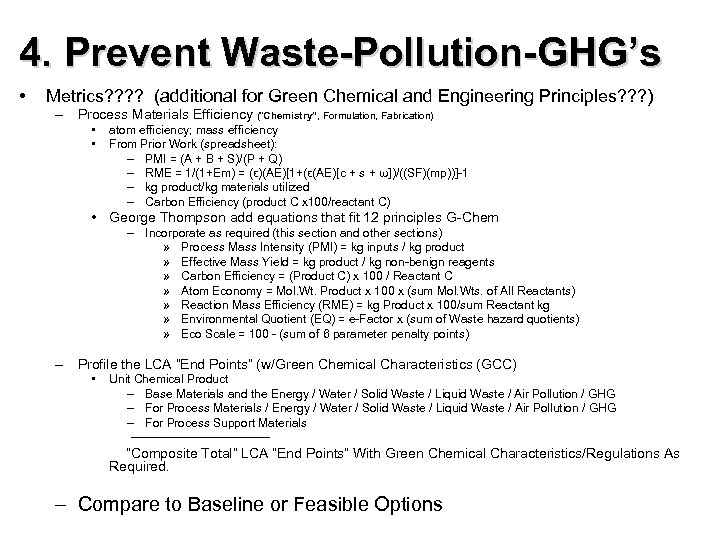
4. Prevent Waste-Pollution-GHG’s • Metrics? ? (additional for Green Chemical and Engineering Principles? ? ? ) – Process Materials Efficiency (“Chemistry”, Formulation, Fabrication) • • atom efficiency; mass efficiency From Prior Work (spreadsheet): – PMI = (A + B + S)/(P + Q) – RME = 1/(1+Em) = (ε)(AE)[1+(ε(AE)[c + s + ω])/((SF)(mp))]-1 – kg product/kg materials utilized – Carbon Efficiency (product C x 100/reactant C) • George Thompson add equations that fit 12 principles G-Chem – Incorporate as required (this section and other sections) » Process Mass Intensity (PMI) = kg inputs / kg product » Effective Mass Yield = kg product / kg non-benign reagents » Carbon Efficiency = (Product C) x 100 / Reactant C » Atom Economy = Mol. Wt. Product x 100 x (sum Mol. Wts. of All Reactants) » Reaction Mass Efficiency (RME) = kg Product x 100/sum Reactant kg » Environmental Quotient (EQ) = e-Factor x (sum of Waste hazard quotients) » Eco Scale = 100 - (sum of 6 parameter penalty points) – Profile the LCA “End Points” (w/Green Chemical Characteristics (GCC) • Unit Chemical Product – Base Materials and the Energy / Water / Solid Waste / Liquid Waste / Air Pollution / GHG – For Process Materials / Energy / Water / Solid Waste / Liquid Waste / Air Pollution / GHG – For Process Support Materials ------------------ “Composite Total” LCA “End Points” With Green Chemical Characteristics/Regulations As Required. – Compare to Baseline or Feasible Options
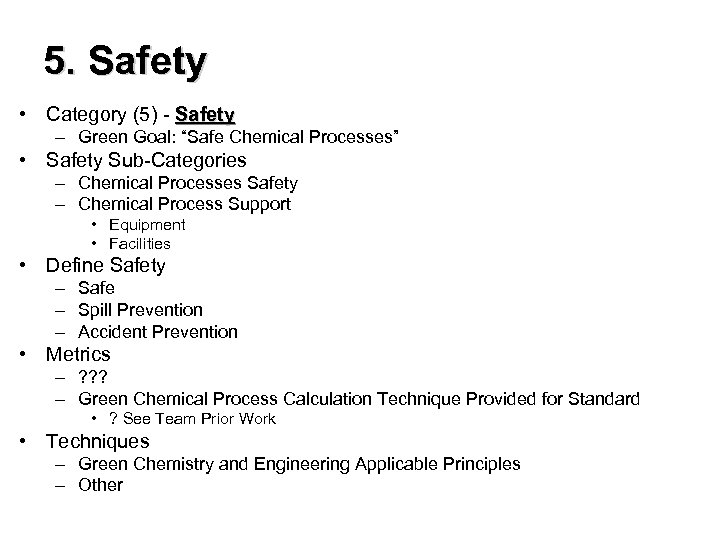
5. Safety • Category (5) - Safety – Green Goal: “Safe Chemical Processes” • Safety Sub-Categories – Chemical Processes Safety – Chemical Process Support • Equipment • Facilities • Define Safety – Safe – Spill Prevention – Accident Prevention • Metrics – ? ? ? – Green Chemical Process Calculation Technique Provided for Standard • ? See Team Prior Work • Techniques – Green Chemistry and Engineering Applicable Principles – Other
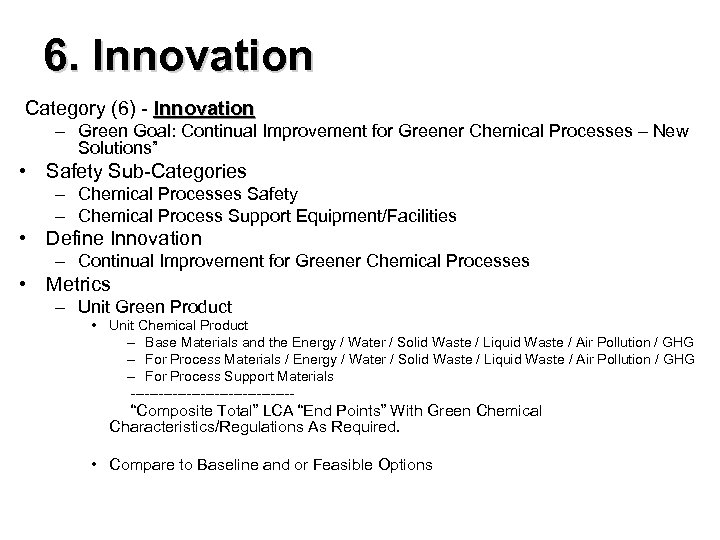
6. Innovation Category (6) - Innovation – Green Goal: Continual Improvement for Greener Chemical Processes – New Solutions” • Safety Sub-Categories – Chemical Processes Safety – Chemical Process Support Equipment/Facilities • Define Innovation – Continual Improvement for Greener Chemical Processes • Metrics – Unit Green Product • Unit Chemical Product – Base Materials and the Energy / Water / Solid Waste / Liquid Waste / Air Pollution / GHG – For Process Materials / Energy / Water / Solid Waste / Liquid Waste / Air Pollution / GHG – For Process Support Materials ------------------ “Composite Total” LCA “End Points” With Green Chemical Characteristics/Regulations As Required. • Compare to Baseline and or Feasible Options
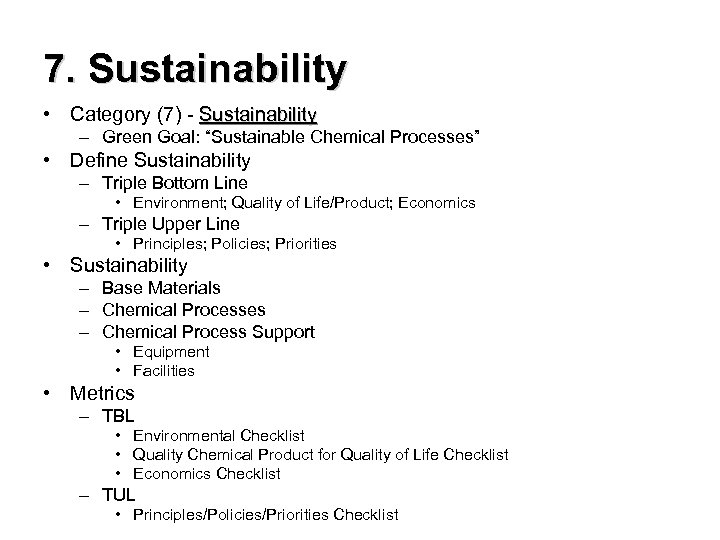
7. Sustainability • Category (7) - Sustainability – Green Goal: “Sustainable Chemical Processes” • Define Sustainability – Triple Bottom Line • Environment; Quality of Life/Product; Economics – Triple Upper Line • Principles; Policies; Priorities • Sustainability – Base Materials – Chemical Processes – Chemical Process Support • Equipment • Facilities • Metrics – TBL • Environmental Checklist • Quality Chemical Product for Quality of Life Checklist • Economics Checklist – TUL • Principles/Policies/Priorities Checklist
Скачать презентацию Green Chemical Process Primary Categories Sub-Categories Definitions Techniques
019037be05f5412ec6f37bda03ea4547.ppt