 Скачать презентацию Greek borrowings The History of Greek borrowings
Greek_borrowings.ppt
- Количество слайдов: 27




Greek borrowings
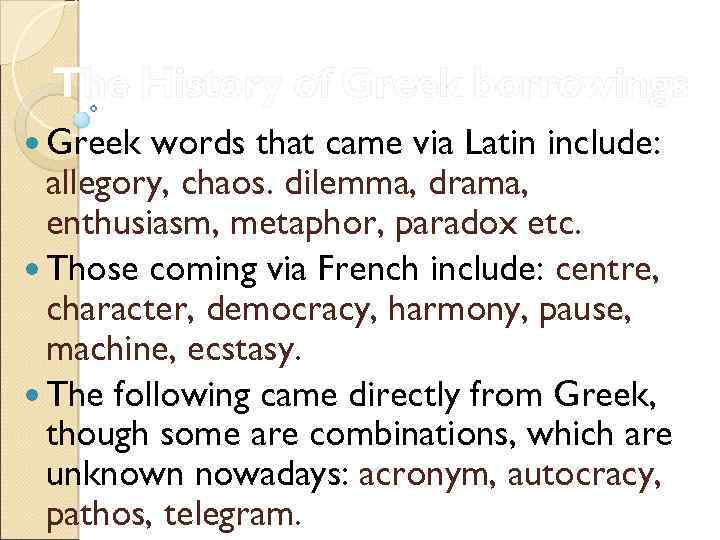
The History of Greek borrowings Greek words that came via Latin include: allegory, chaos. dilemma, drama, enthusiasm, metaphor, paradox etc. Those coming via French include: centre, character, democracy, harmony, pause, machine, ecstasy. The following came directly from Greek, though some are combinations, which are unknown nowadays: acronym, autocracy, pathos, telegram.
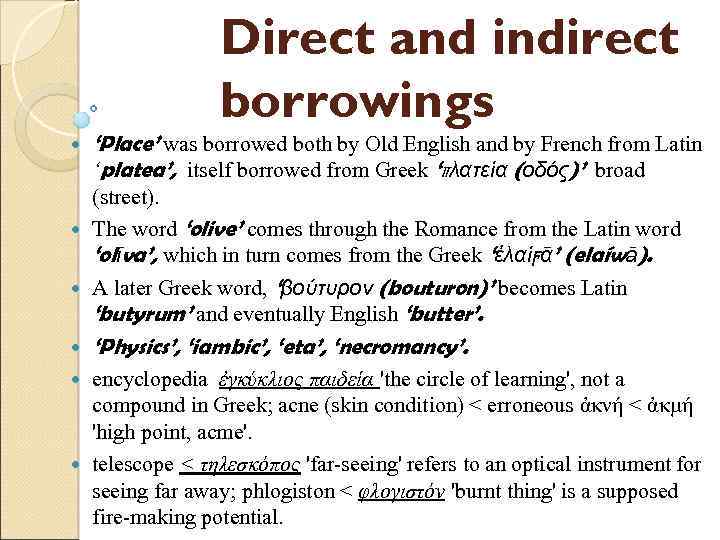
Direct and indirect borrowings ‘Place’ was borrowed both by Old English and by French from Latin ‘platea’, itself borrowed from Greek ‘πλατεία (οδός)’ broad (street). The word ‘olive’ comes through the Romance from the Latin word ‘olīva’, which in turn comes from the Greek ‘ἐλαίϝᾱ’ (elaíwā). A later Greek word, ‘βούτυρον (bouturon)’ becomes Latin ‘butyrum’ and eventually English ‘butter’. ‘Physics’, ‘iambic’, ‘eta’, ‘necromancy’. encyclopedia ἐγκύκλιος παιδεία 'the circle of learning', not a compound in Greek; acne (skin condition) < erroneous ἀκνή < ἀκμή 'high point, acme'. telescope < τηλεσκόπος 'far-seeing' refers to an optical instrument for seeing far away; phlogiston < φλογιστόν 'burnt thing' is a supposed fire-making potential.
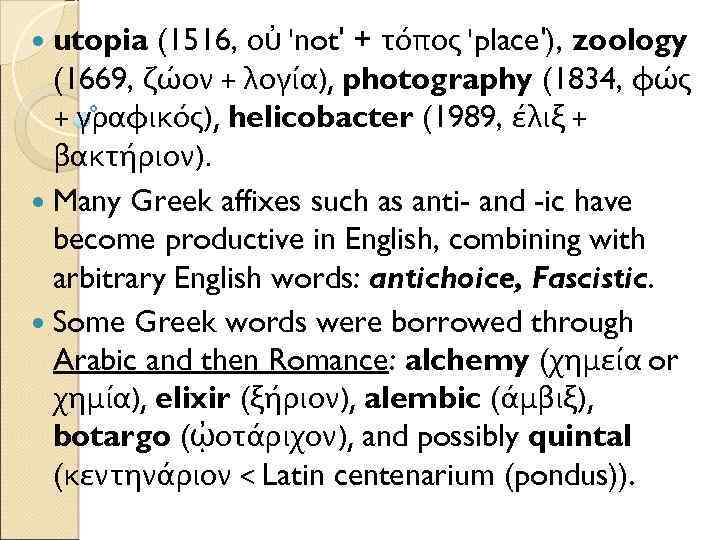
(1516, οὐ 'not' + τόπος 'place'), zoology (1669, ζώον + λογία), photography (1834, φώς + γραφικός), helicobacter (1989, έλιξ + βακτήριον). Many Greek affixes such as anti- and -ic have become productive in English, combining with arbitrary English words: antichoice, Fascistic. Some Greek words were borrowed through Arabic and then Romance: alchemy (χημεία or χημία), elixir (ξήριον), alembic (άμβιξ), botargo (ᾠοτάριχον), and possibly quintal (κεντηνάριον < Latin centenarium (pondus)). utopia
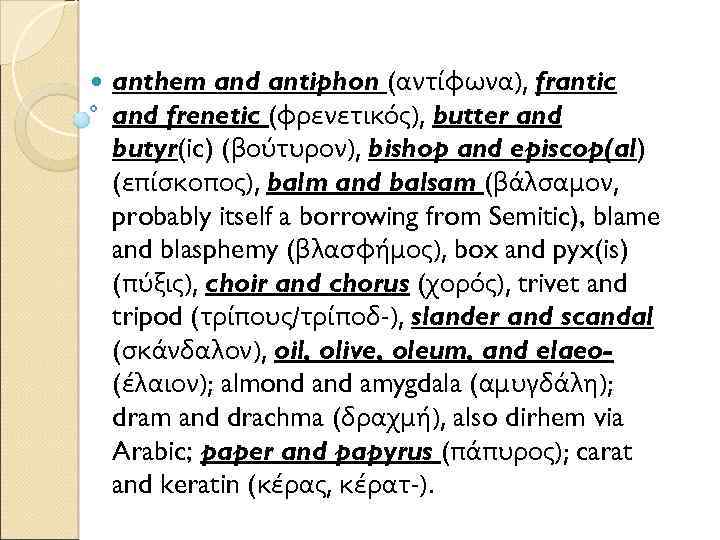
anthem and antiphon (αντίφωνα), frantic and frenetic (φρενετικός), butter and butyr(ic) (βούτυρον), bishop and episcop(al) (επίσκοπος), balm and balsam (βάλσαμον, probably itself a borrowing from Semitic), blame and blasphemy (βλασφήμος), box and pyx(is) (πύξις), choir and chorus (χορός), trivet and tripod (τρίπους/τρίποδ-), slander and scandal (σκάνδαλον), oil, olive, oleum, and elaeo(έλαιον); almond amygdala (αμυγδάλη); dram and drachma (δραχμή), also dirhem via Arabic; paper and papyrus (πάπυρος); carat and keratin (κέρας, κέρατ-).
the greek language has contributed to the english vocabulary in five main ways: 1) vernacular borrowings, transmitted through Vulgar Latin directly into Old English e. g. 'butter' (Old English butere < Latin butyrum < βούτυρον), or through French, e. g. 'ochre'.
2)learned borrowings from classical Greek e. g. 'physics' (< Latin physica < Greek τα φυσικά); 3) a few borrowings via Arabic scientific and philosophical writing, e. g. alchemy (< χημεία);
4) coinages in post-classical Latin or modern languages using classical Greek roots e. g. 'telephone' (< τῆλε + φωνή) or a mixture of Greek and other roots, e. g. 'television' (< Greek τῆλε + English vision < Latin visio); these are often shared among the modern European languages; 4)direct borrowings from Modern Greek, e. g. bouzouki.
foreign loanwords in the english language Mc. Whorter goes on to argue that the “Latinate” layer came aftert he withdrawal of the French, with the increasing use of English as language of learning- hence client, legal, intellect, pulpit, exclude, necessary, interest, et alia. Mc. Whorter states that the English vocabulary is so shot through with foreign loanwords on all levels that there is no language whose basic vocabulary is mostly akin to ours. He states that there is an analogy between biology and language: plants derive crucial nutrients from the fungi in their roots that process nitrogen for them, for example. Thus life itself, as we know it, is thriving, evolving variations of symbiotic, rather than individual, life forms.
anatomy agonist, from Gk agōnistēs, “contestant”, from agōn “contest”; nephron, 1930 s: from Gk nephros “kidney” archaeology Chalcolithic, C 20, from Gk khalkos ”copper” + lithos ”stone”+ - IC; orthostat, C 20, from Gk orthostatēs, from orthos “straight or right”+statos “standing”.
biology bacteriostat, C 20, from bacterium+Gk statos “standing” botany apomixis, C 20, from APO-(from Gk apo “from, away”)+Gk mixis “mingling” chemistry actinium, C 20, from Gk aktis, aktin- “ray”+IUM
cosmology anthropic principle, 1970 s, anthropic from Gk anthrōpikos, anthrōpos “human being”. ecology allelopathy, 1950 s, from Gk allēl- “one another”+PATHY (from Gk patheia “suffering, feeling”) electronics dynode, 1930 s, from Gk dunamis ”power”+ODE (from Gk hodos “way”)
linguistics-grammarphonetics allophone, 1930 s, from ALLO-(from Gk allos “other”)+PHONEME (from Gk phōnē, “sound, voice”) medicine cardiomegaly, 1960 s, from CARDIO-(from Gk kardia “heart”)+Gk megas, megal-“great”
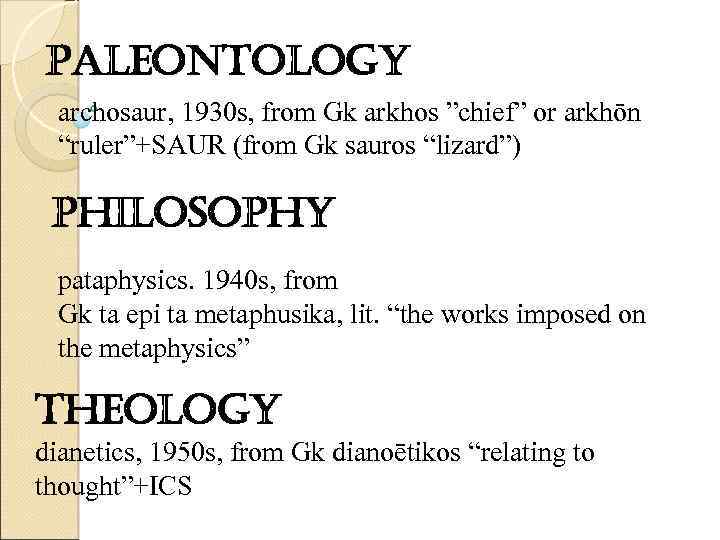
paleontology archosaur, 1930 s, from Gk arkhos ”chief” or arkhōn “ruler”+SAUR (from Gk sauros “lizard”) philosophy pataphysics. 1940 s, from Gk ta epi ta metaphusika, lit. “the works imposed on the metaphysics” theology dianetics, 1950 s, from Gk dianoētikos “relating to thought”+ICS

Zoology protostome, 1950 s, from PROTO-(from Gk prōtos “first”)+Gk stoma “mouth”
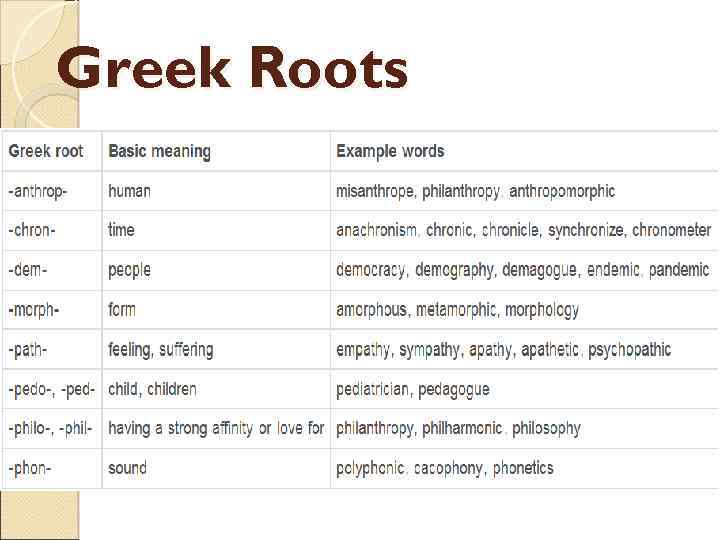
Greek Roots
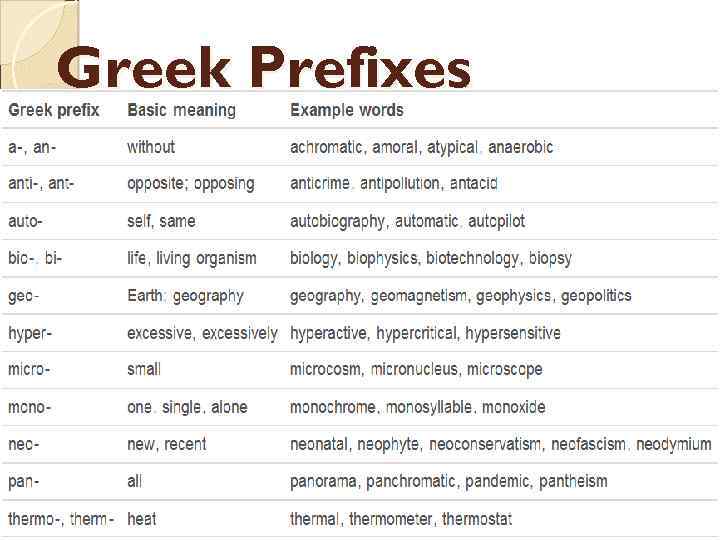
Greek Prefixes
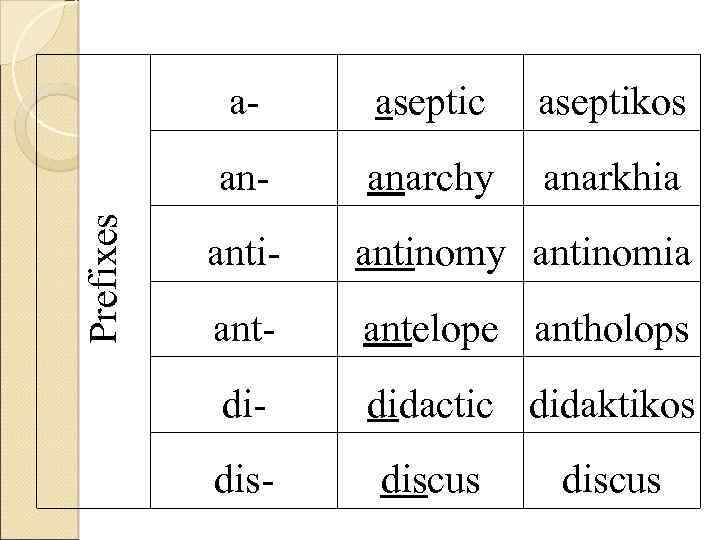
aseptic aseptikos an. Prefixes a- anarchy anarkhia anti- antinomy antinomia ant- antelope antholops di- didactic didaktikos dis- discus
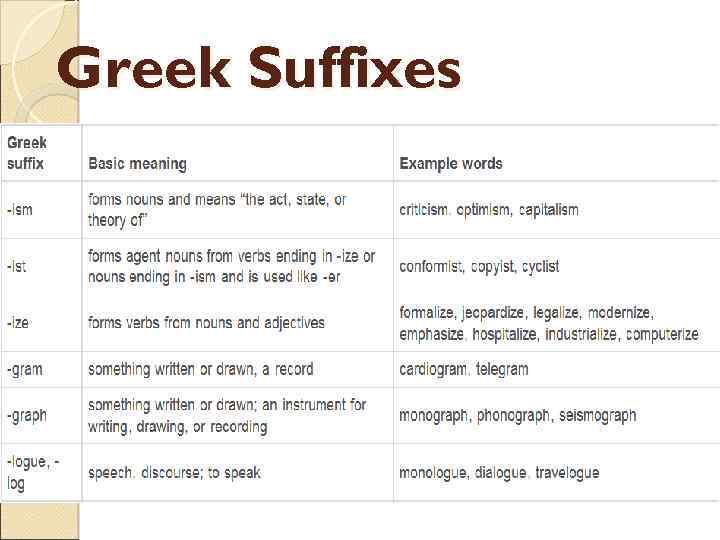
Greek Suffixes
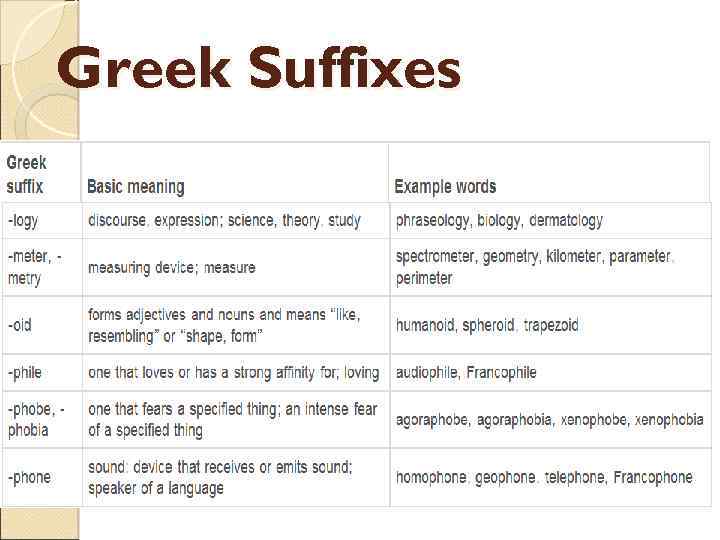
Greek Suffixes
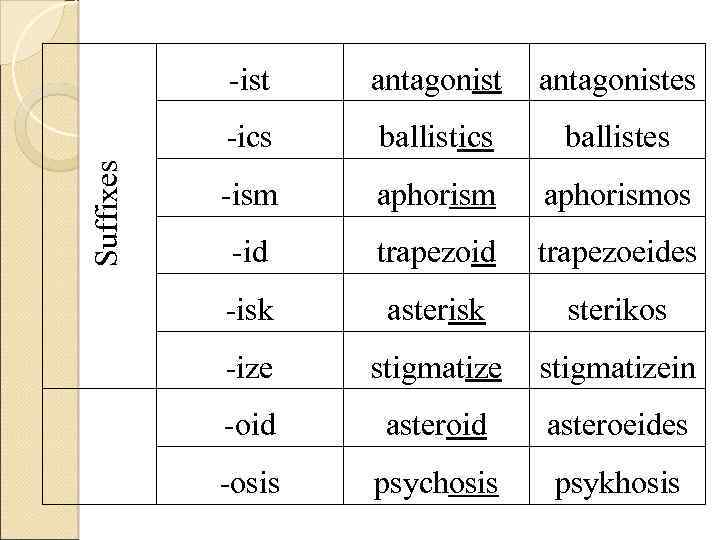
antagonistes -ics Suffixes -ist ballistics ballistes -ism aphorismos -id trapezoeides -isk asterisk sterikos -ize stigmatizein -oid asteroeides -osis psychosis psykhosis
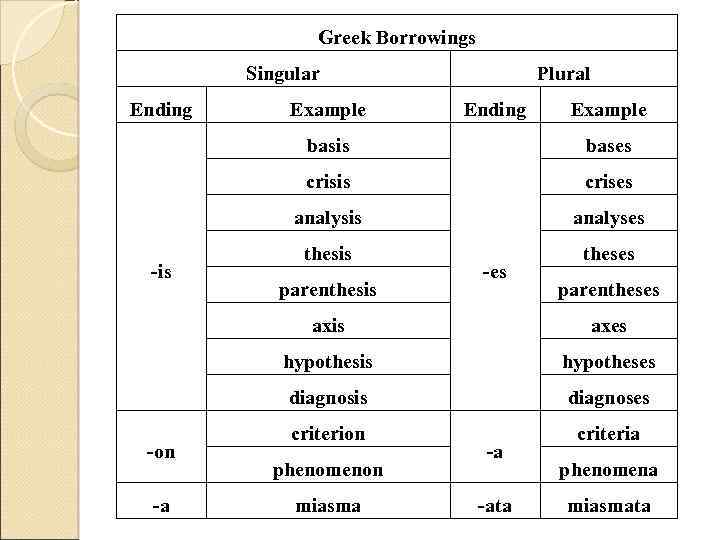
Greek Borrowings Singular Ending Example Plural Ending Example basis crises analysis -is bases analyses thesis theses parenthesis -es parentheses axis hypothesis -a hypotheses diagnosis -on axes diagnoses criterion criteria phenomenon miasma -a -ata phenomena miasmata
Indexes (lat. ) an alphabetical list, such as one printed at the back of a book showing which page a subject, name, etc. is found on. indices maths term.
![Indicators ch x [ tʃ ] – English cheese [ ʃ ] – French](https://present5.com/presentation/73347299_188004574/image-24.jpg "Indicators ch x [ tʃ ] – English cheese [ ʃ ] – French")
Indicators ch x [ tʃ ] – English cheese [ ʃ ] – French chef [ k ] – Greek character [ z ] Alexander rh rhythm
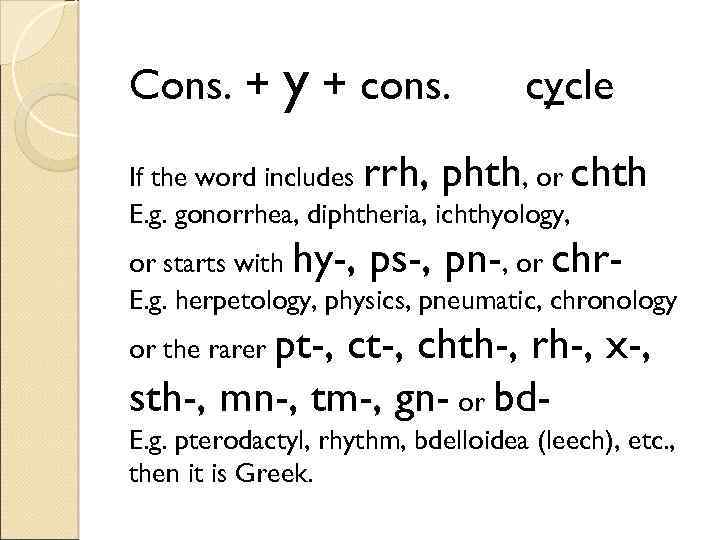
Cons. + y + cons. cycle If the word includes rrh, phth, or chth E. g. gonorrhea, diphtheria, ichthyology, or starts with hy-, ps-, pn-, or chr. E. g. herpetology, physics, pneumatic, chronology or the rarer pt-, ct-, chth-, rh-, x-, sth-, mn-, tm-, gn- or bd. E. g. pterodactyl, rhythm, bdelloidea (leech), etc. , then it is Greek.
![pn pneumatic [njuːˈmæt. ɪk] ps psychology [saɪˈkɒl. ə. dʒi] gn gnostic [ˈnɒs. tɪk] BUT](https://present5.com/presentation/73347299_188004574/image-26.jpg "pn pneumatic [njuːˈmæt. ɪk] ps psychology [saɪˈkɒl. ə. dʒi] gn gnostic [ˈnɒs. tɪk] BUT")
pn pneumatic [njuːˈmæt. ɪk] ps psychology [saɪˈkɒl. ə. dʒi] gn gnostic [ˈnɒs. tɪk] BUT agnostic [ægˈnɒs. tɪk ]
Consecutive vowels are often pronounced separately rather than forming a single vowel sound or one of them becoming silent (e. g. "theatre" vs. "feat").
Скачать презентацию Greek borrowings The History of Greek borrowings
Greek_borrowings.ppt