


 Скачать презентацию Great Theoretical Ideas In Computer Science Anupam Gupta
dfe39e4ecf0de934f244edc4fa9efb3a.ppt
- Количество слайдов: 90
 Great Theoretical Ideas In Computer Science Anupam Gupta Lecture 4 CS 15 -251 Sept 7, 2006 Fall 2006 Carnegie Mellon University Unary and Binary
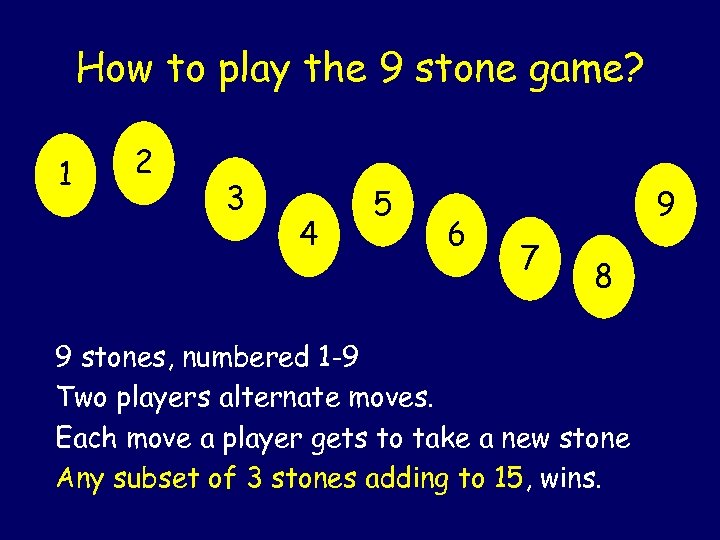 How to play the 9 stone game? 1 2 3 4 5 6 9 7 8 9 stones, numbered 1 -9 Two players alternate moves. Each move a player gets to take a new stone Any subset of 3 stones adding to 15, wins.
 For enlightenment, let’s look to ancient China in the days of Emperor Yu. A tortoise emerged from the river Lo…
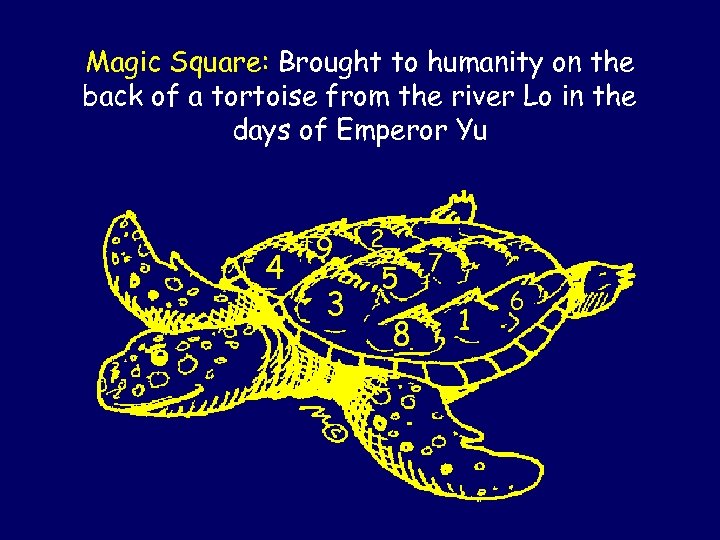 Magic Square: Brought to humanity on the back of a tortoise from the river Lo in the days of Emperor Yu 4 9 3 2 5 8 7 1 6
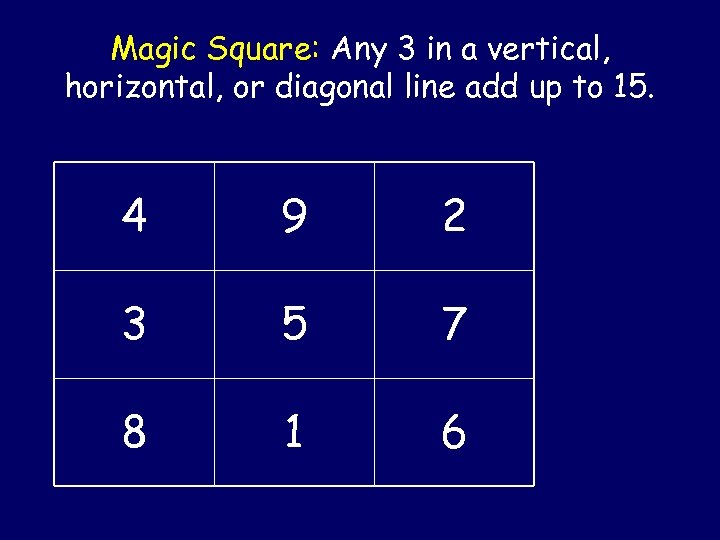 Magic Square: Any 3 in a vertical, horizontal, or diagonal line add up to 15. 4 9 2 3 5 7 8 1 6
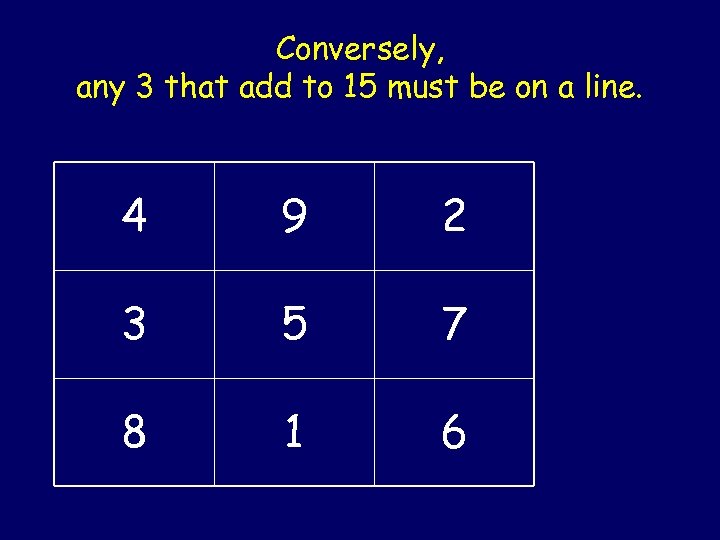 Conversely, any 3 that add to 15 must be on a line. 4 9 2 3 5 7 8 1 6
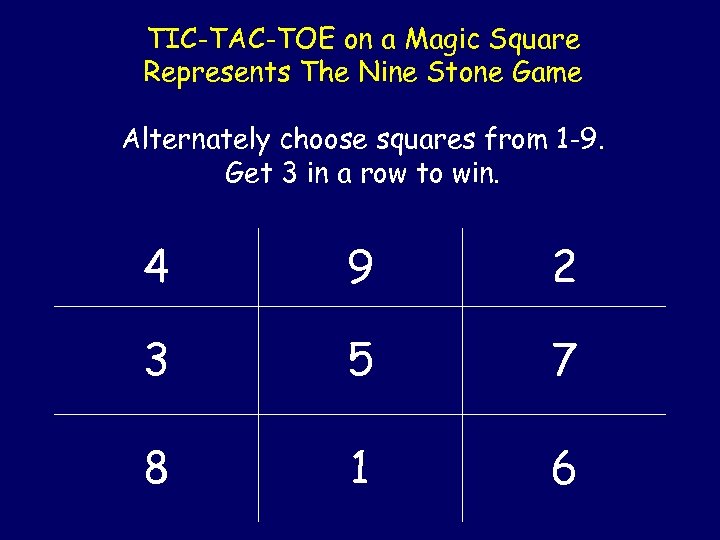 TIC-TAC-TOE on a Magic Square Represents The Nine Stone Game Alternately choose squares from 1 -9. Get 3 in a row to win. 4 9 2 3 5 7 8 1 6
 BIG IDEA! Don’t stick with the representation in which you encounter problems, always seek the more useful one!
 This IDEA takes practice, practice to understand use.
 Your Ancient Heritage Let’s take a historical view on abstract representations
 Mathematical Prehistory 30, 000 BC Paleolithic peoples in Europe record unary numbers on bones 1 represented by 1 mark 2 represented by 2 marks 3 represented by 3 marks. . .
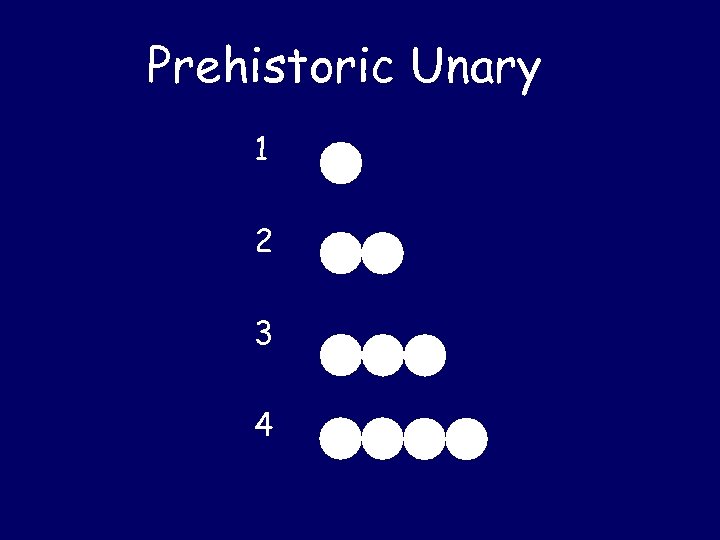 Prehistoric Unary 1 2 3 4
 Hang on a minute! Isn’t unary too literal as a representation? Does it deserve to be an “abstract” representation?
 It’s important to respect each representation, no matter how primitive Unary is a perfect example
 Consider the problem of finding a formula for the sum of the first n numbers You already used induction to verify that the answer is ½n(n+1)
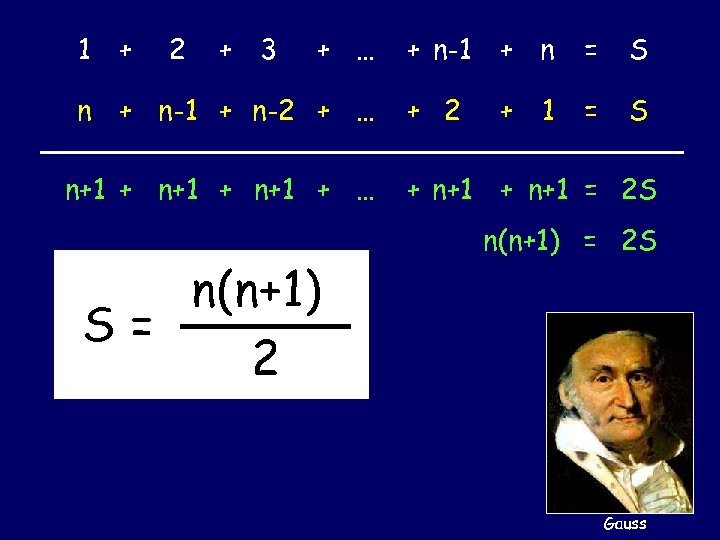 1 + 2 + 3 + … n + n-1 + n-2 + … n+1 + … n(n+1) S= 2 + n-1 + n = S + 2 + = S 1 + n+1 = 2 S n(n+1) = 2 S Gauss
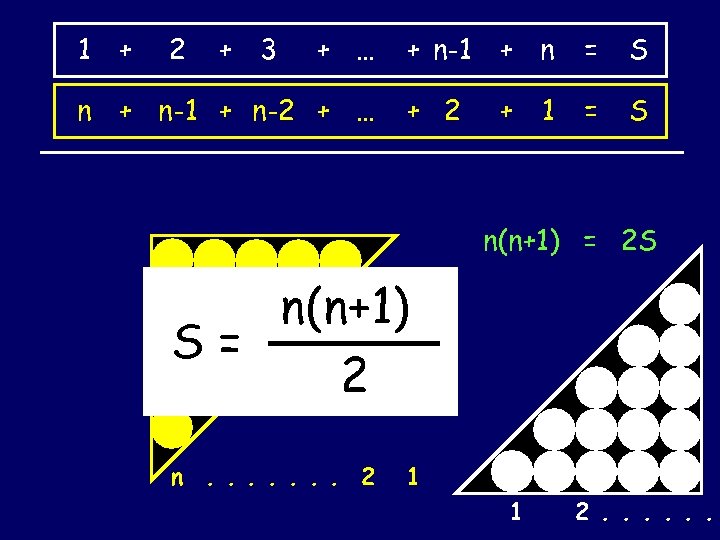 1 + 2 + 3 + … n + n-1 + n-2 + … + n-1 + n = S + 2 + = S 1 n(n+1) = 2 S n(n+1) S= 2 There are n(n+1) dots in the grid! n. . . . 2 1 1 2. . .
 Very convincing! Unary brings out the geometry of the problem and makes each step look natural By the way, my name is Bonzo. And you are?
 Odette Yes, Bonzo. Let’s take it even further…
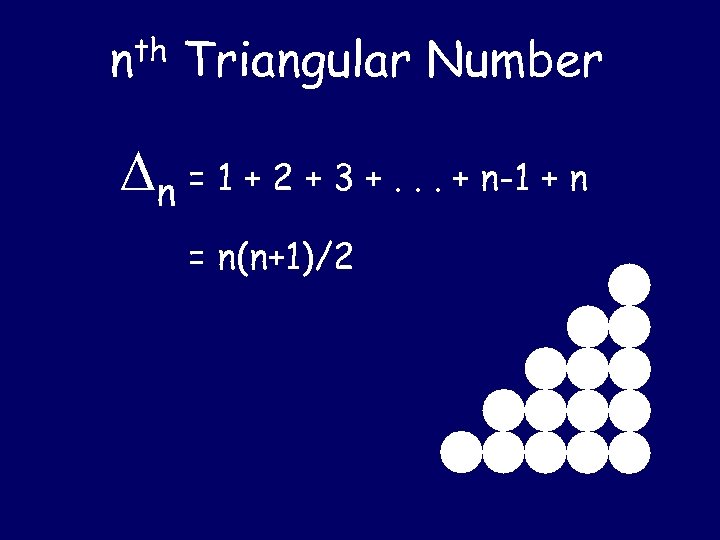 nth Triangular Number n = 1 + 2 + 3 +. . . + n-1 + n = n(n+1)/2
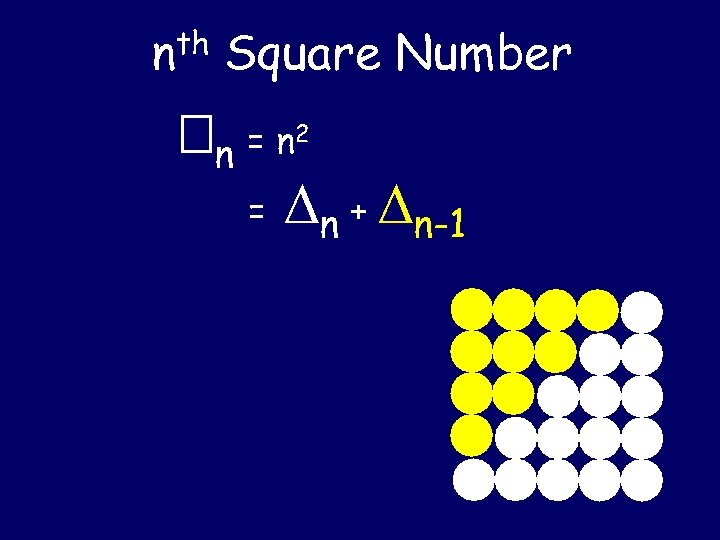 th n Square Number n = n 2 = n + n-1
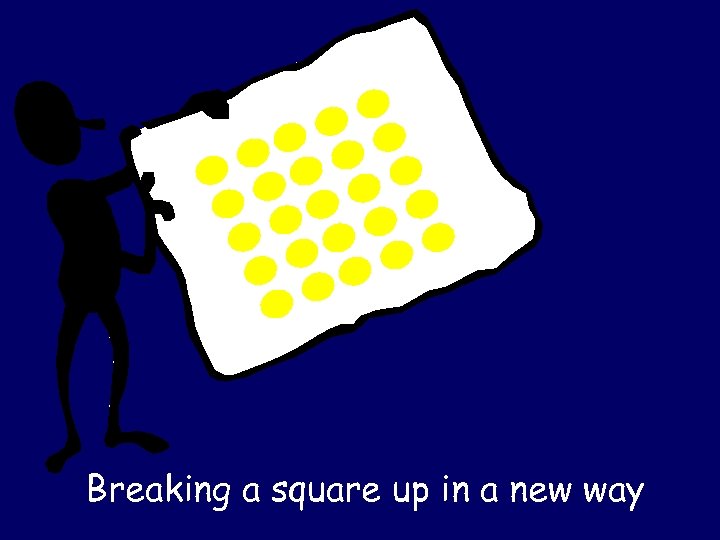 Breaking a square up in a new way
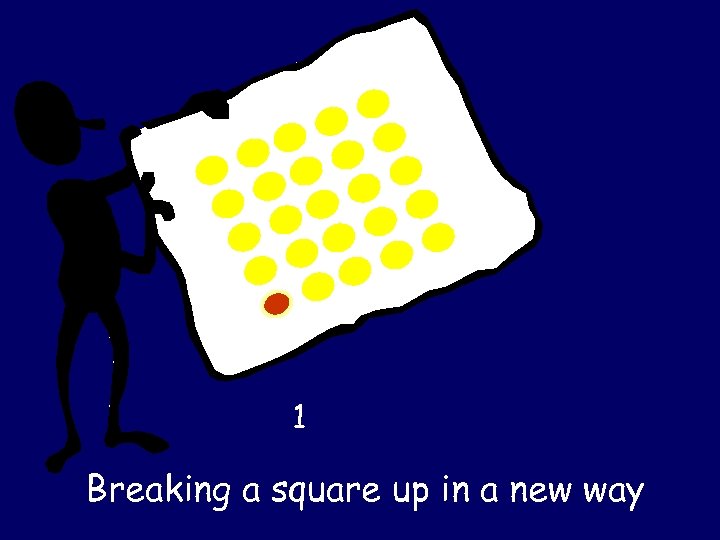 1 Breaking a square up in a new way
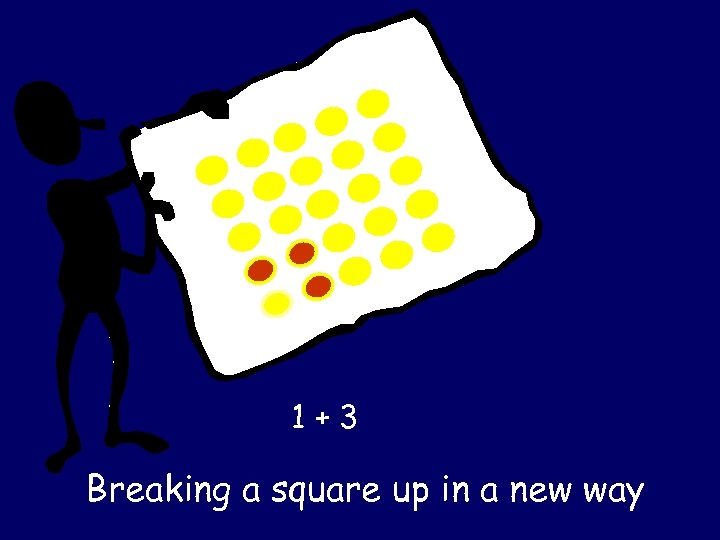 1+3 Breaking a square up in a new way
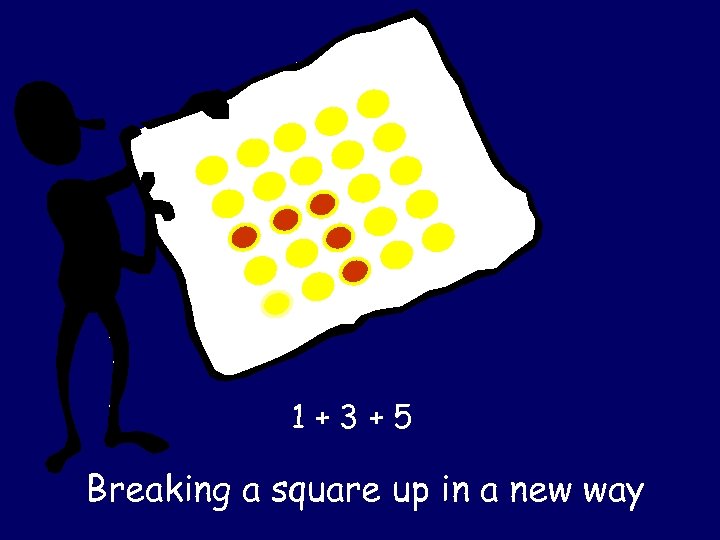 1+3+5 Breaking a square up in a new way
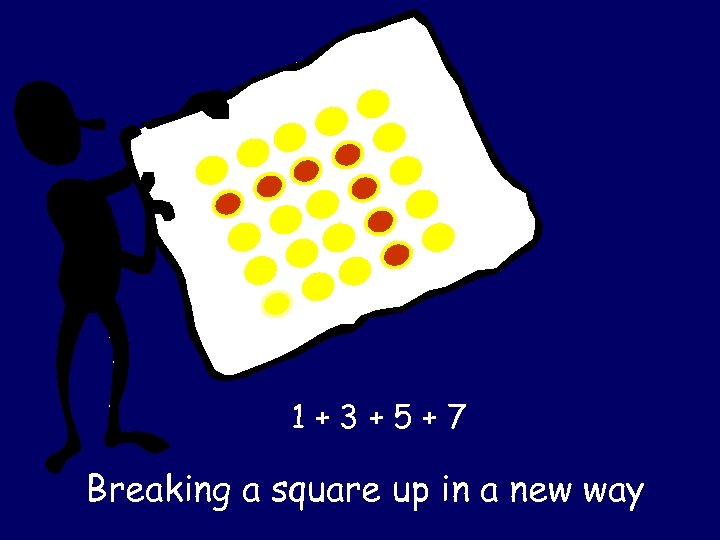 1+3+5+7 Breaking a square up in a new way
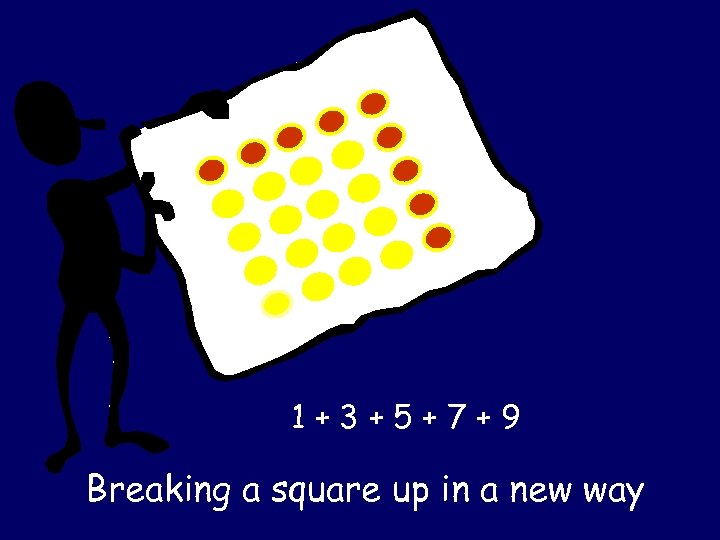 1+3+5+7+9 Breaking a square up in a new way
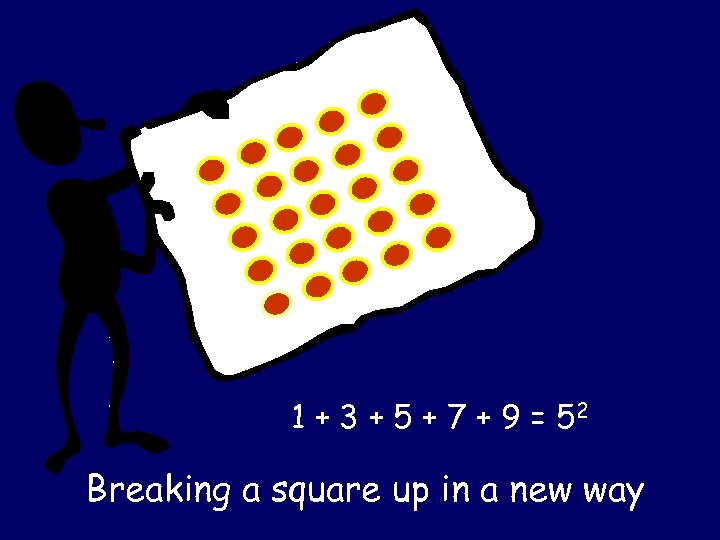 1 + 3 + 5 + 7 + 9 = 52 Breaking a square up in a new way
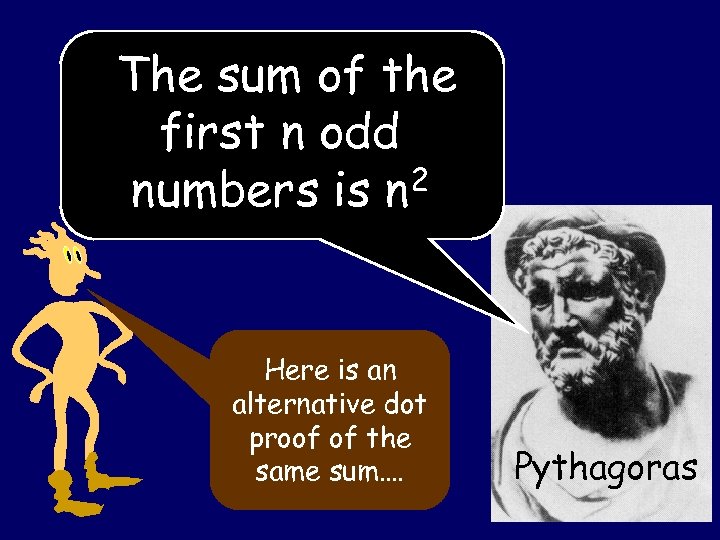 The sum of the first n odd 2 numbers is n Here is an alternative dot proof of the same sum…. Pythagoras
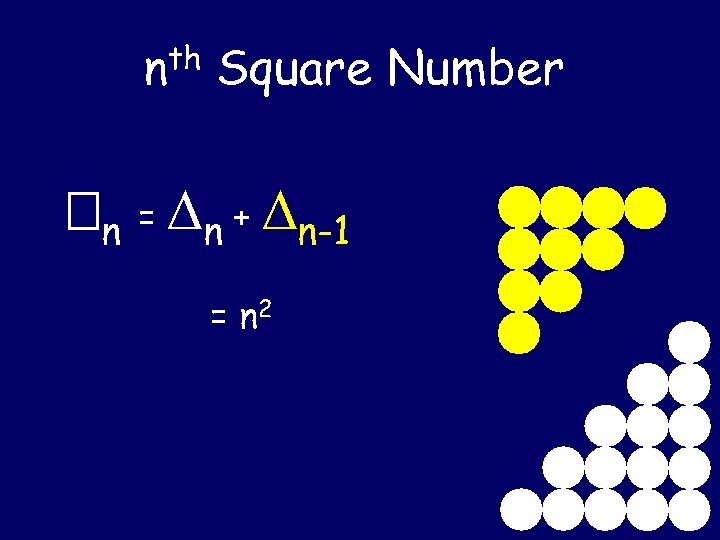 nth Square Number n = n + n-1 = n 2
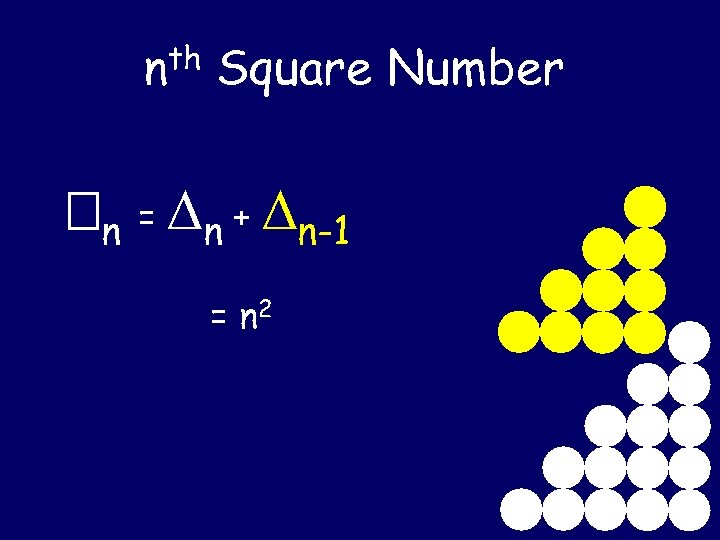 nth Square Number n = n + n-1 = n 2
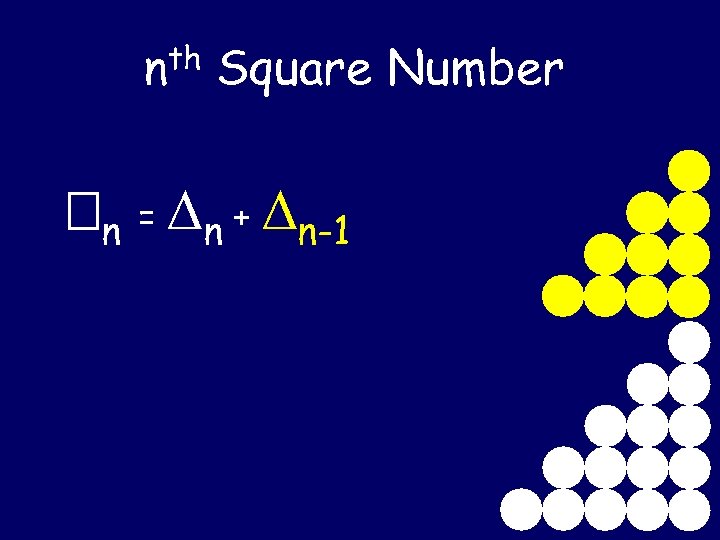 nth Square Number n = n + n-1
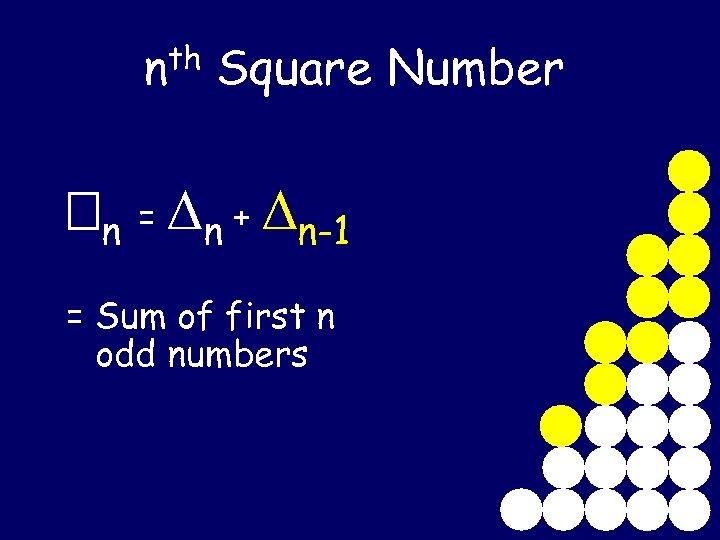 nth Square Number n = n + n-1 = Sum of first n odd numbers
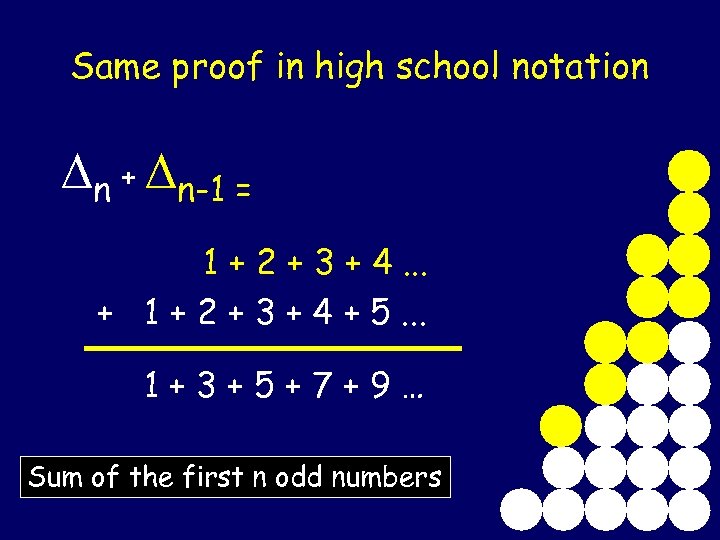 Same proof in high school notation n + n-1 = 1 + 2 + 3 + 4. . . + 1 + 2 + 3 + 4 + 5. . . 1+3+5+7+9… Sum of the first n odd numbers
 Check the next one out…
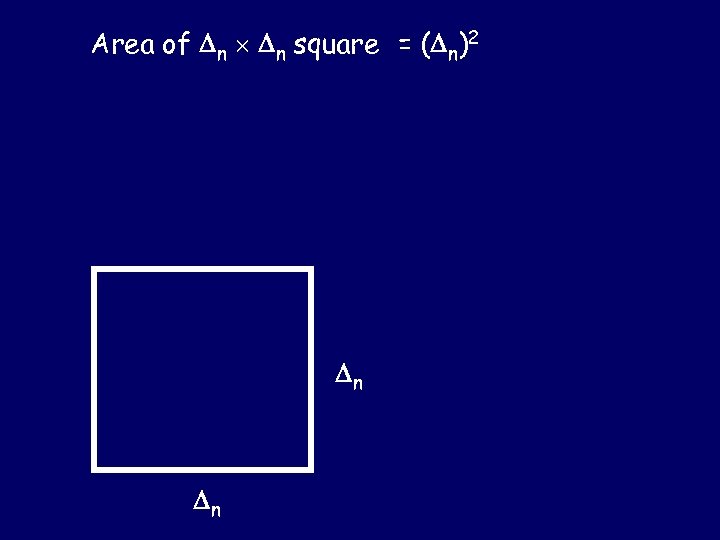 Area of n n square = ( n)2 n n
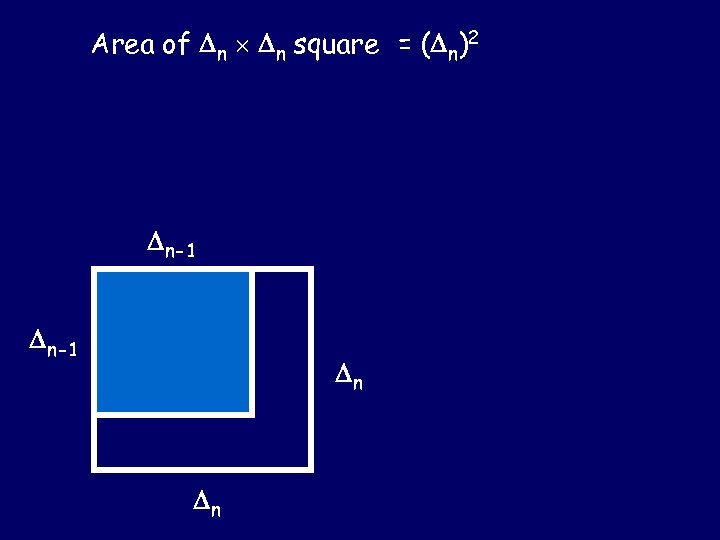 Area of n n square = ( n)2 n-1 n n
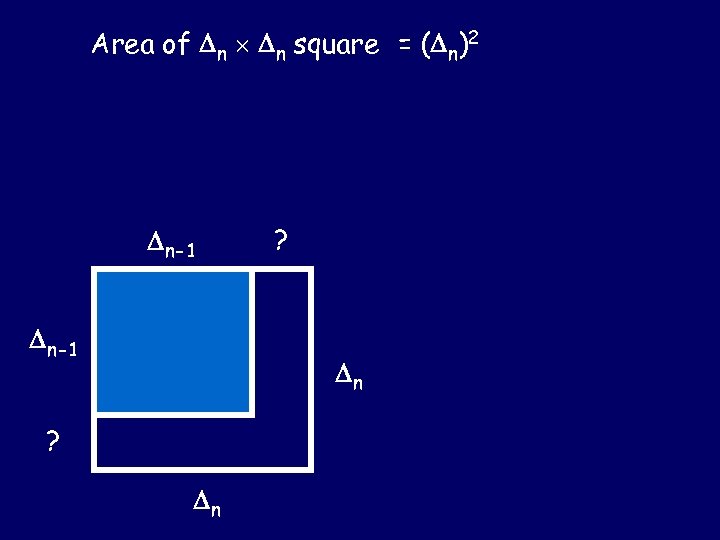 Area of n n square = ( n)2 n-1 ? n
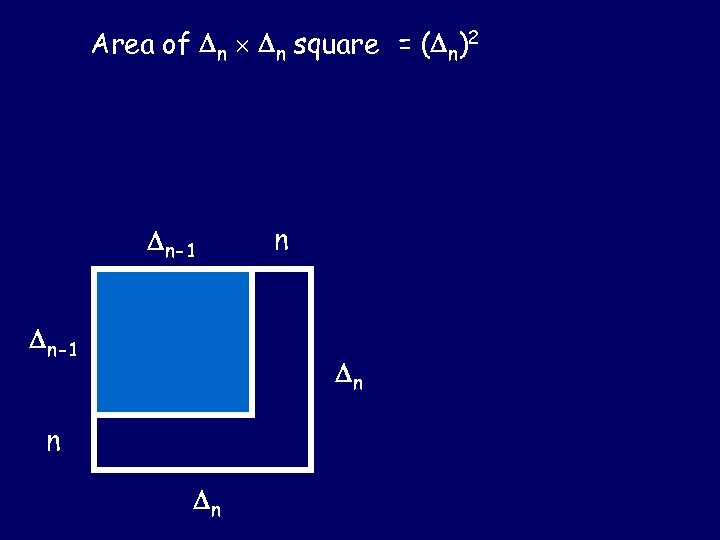 Area of n n square = ( n)2 n-1 n n n n
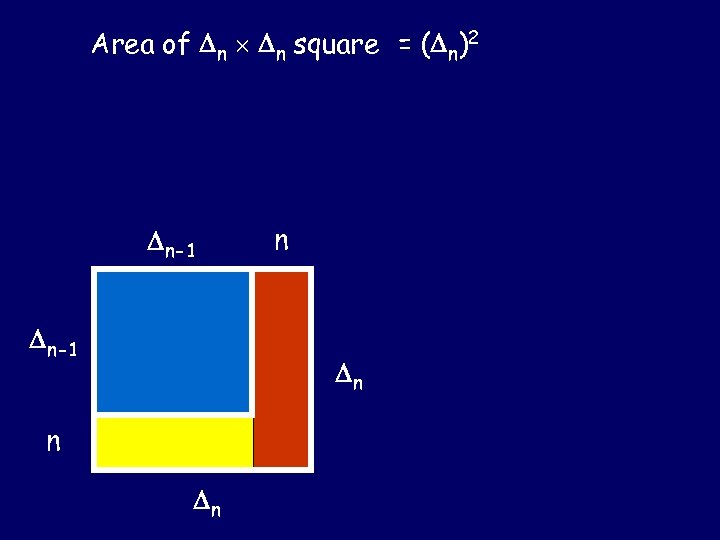 Area of n n square = ( n)2 n-1 n n n n
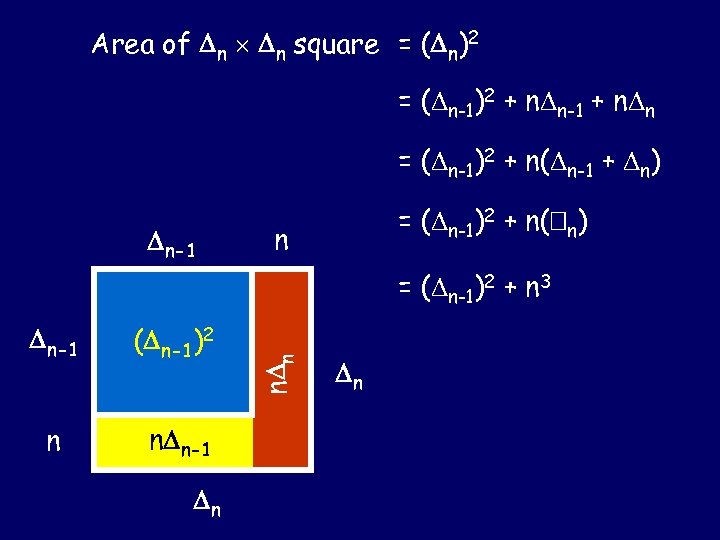 Area of n n square = ( n)2 = ( n-1)2 + n n-1 + n n = ( n-1)2 + n( n-1 + n) n-1 = ( n-1)2 + n( n) n n-1 ( n-1)2 n n n-1 n n n = ( n-1)2 + n 3 n
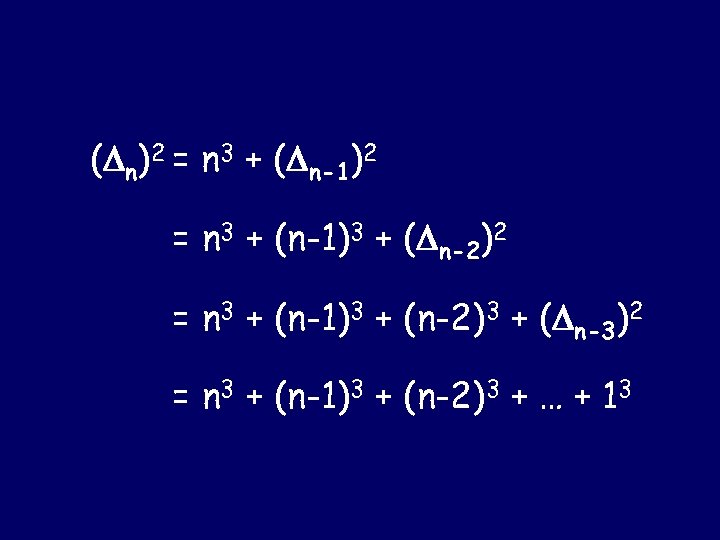 ( n)2 = n 3 + ( n-1)2 = n 3 + (n-1)3 + ( n-2)2 = n 3 + (n-1)3 + (n-2)3 + ( n-3)2 = n 3 + (n-1)3 + (n-2)3 + … + 13
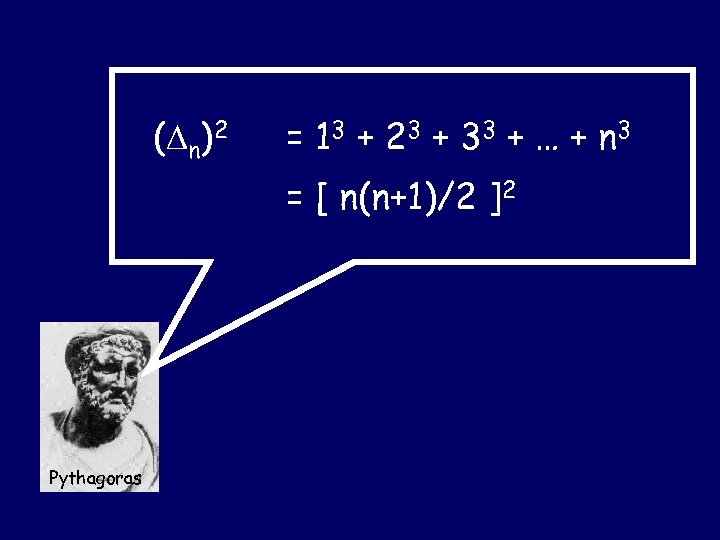 ( n)2 = 13 + 2 3 + 3 3 + … + n 3 = [ n(n+1)/2 ]2 Pythagoras
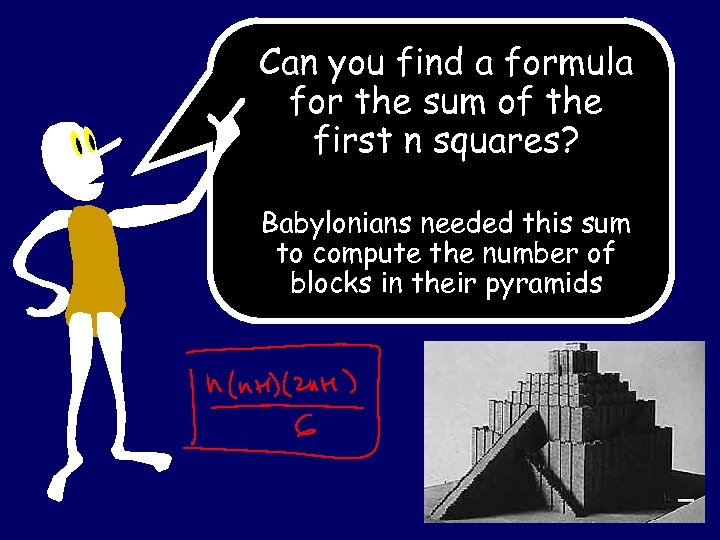 Can you find a formula for the sum of the first n squares? Babylonians needed this sum to compute the number of blocks in their pyramids
 Ancients grappled with abstraction in representation Let’s look back to the dawn of symbols…
![Sumerians [modern Iraq]](https://present5.com/presentation/dfe39e4ecf0de934f244edc4fa9efb3a/image-46.jpg "Sumerians [modern Iraq]") Sumerians [modern Iraq]
Sumerians [modern Iraq]
![Sumerians [modern Iraq] 8000 BC Sumerian tokens use multiple symbols to represent numbers 3100](https://present5.com/presentation/dfe39e4ecf0de934f244edc4fa9efb3a/image-47.jpg "Sumerians [modern Iraq] 8000 BC Sumerian tokens use multiple symbols to represent numbers 3100") Sumerians [modern Iraq] 8000 BC Sumerian tokens use multiple symbols to represent numbers 3100 BC Develop Cuneiform writing 2000 BC Sumerian tablet demonstrates base 10 notation (no zero), solving linear equations, simple quadratic equations Biblical timing: Abraham born in the Sumerian city of Ur in 2000 BC
Sumerians [modern Iraq] 8000 BC Sumerian tokens use multiple symbols to represent numbers 3100 BC Develop Cuneiform writing 2000 BC Sumerian tablet demonstrates base 10 notation (no zero), solving linear equations, simple quadratic equations Biblical timing: Abraham born in the Sumerian city of Ur in 2000 BC
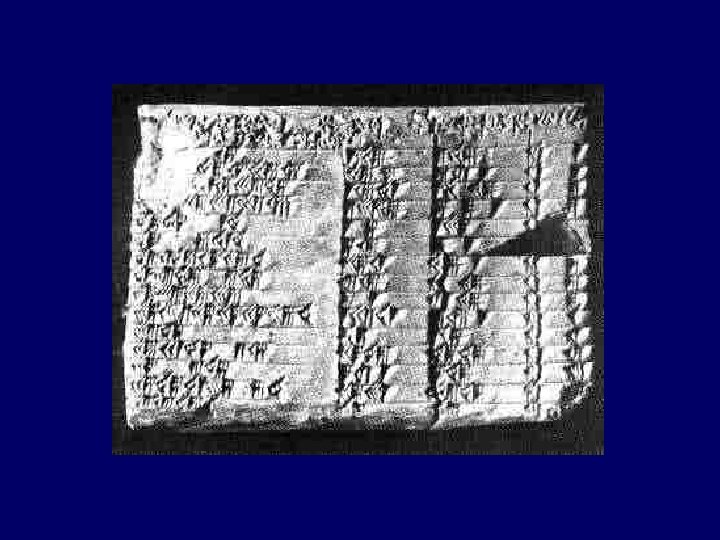
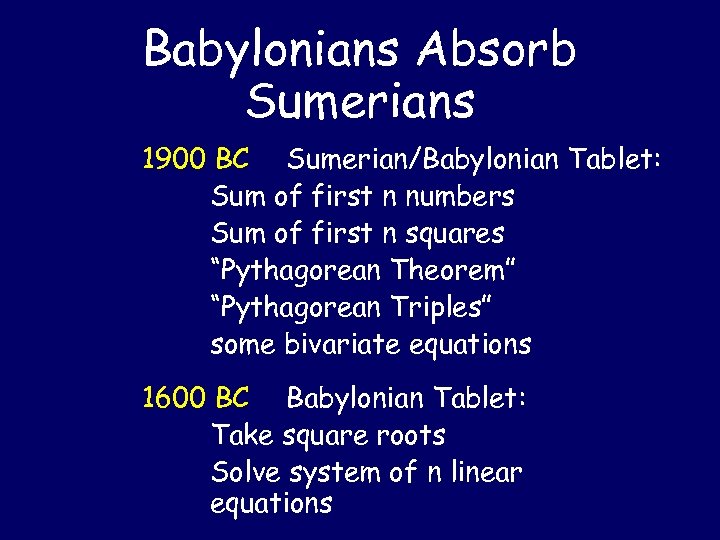 Babylonians Absorb Sumerians 1900 BC Sumerian/Babylonian Tablet: Sum of first n numbers Sum of first n squares “Pythagorean Theorem” “Pythagorean Triples” some bivariate equations 1600 BC Babylonian Tablet: Take square roots Solve system of n linear equations
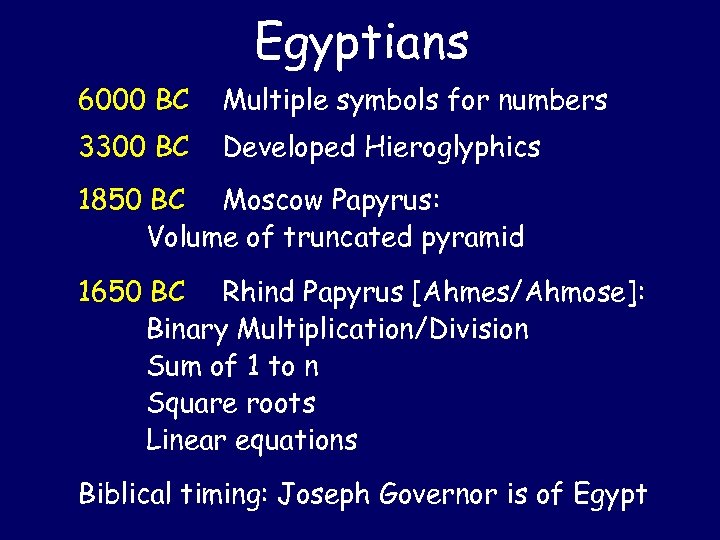 Egyptians 6000 BC Multiple symbols for numbers 3300 BC Developed Hieroglyphics 1850 BC Moscow Papyrus: Volume of truncated pyramid 1650 BC Rhind Papyrus [Ahmes/Ahmose]: Binary Multiplication/Division Sum of 1 to n Square roots Linear equations Biblical timing: Joseph Governor is of Egypt
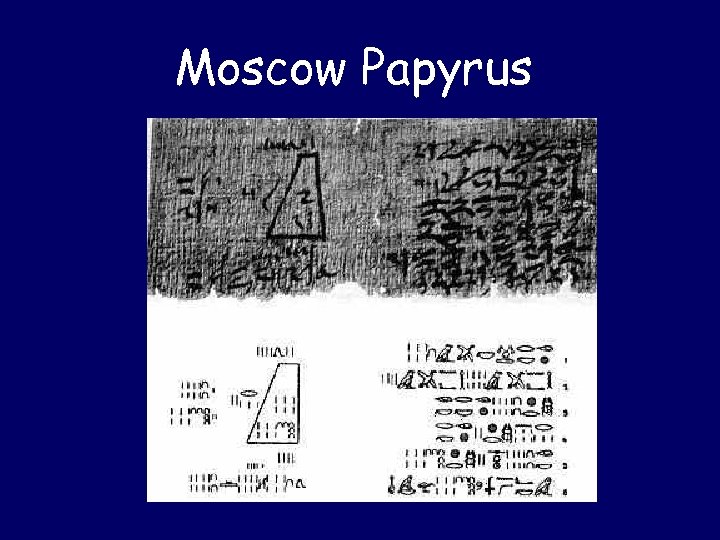 Moscow Papyrus
![Harrappans [Indus Valley Culture] Pakistan/India 3500 BC Perhaps the first writing system? ! 2000](https://present5.com/presentation/dfe39e4ecf0de934f244edc4fa9efb3a/image-52.jpg "Harrappans [Indus Valley Culture] Pakistan/India 3500 BC Perhaps the first writing system? ! 2000") Harrappans [Indus Valley Culture] Pakistan/India 3500 BC Perhaps the first writing system? ! 2000 BC Had a uniform decimal system of weights and measures
Harrappans [Indus Valley Culture] Pakistan/India 3500 BC Perhaps the first writing system? ! 2000 BC Had a uniform decimal system of weights and measures
 China 1200 BC Independent writing system (Surprisingly late) 1200 BC I Ching [Book of changes]: Binary system developed to do numerology
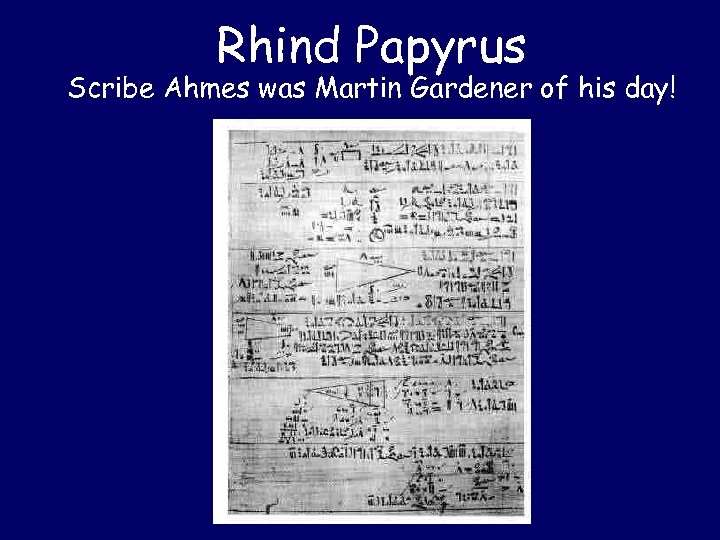 Rhind Papyrus Scribe Ahmes was Martin Gardener of his day!
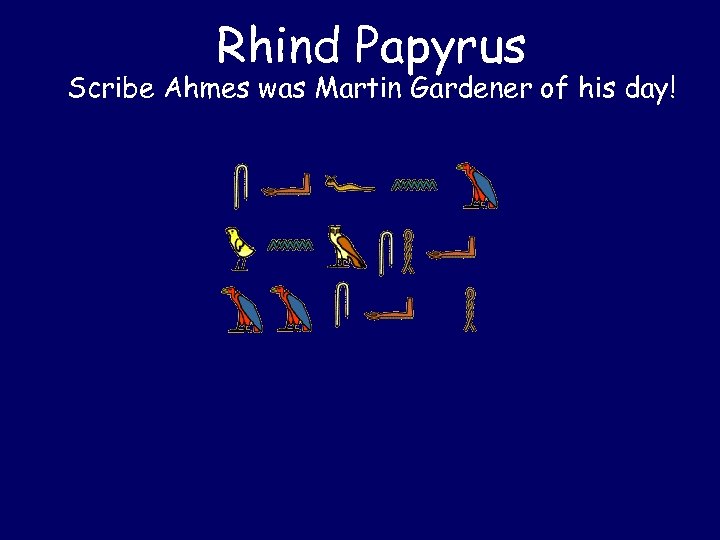 Rhind Papyrus Scribe Ahmes was Martin Gardener of his day!
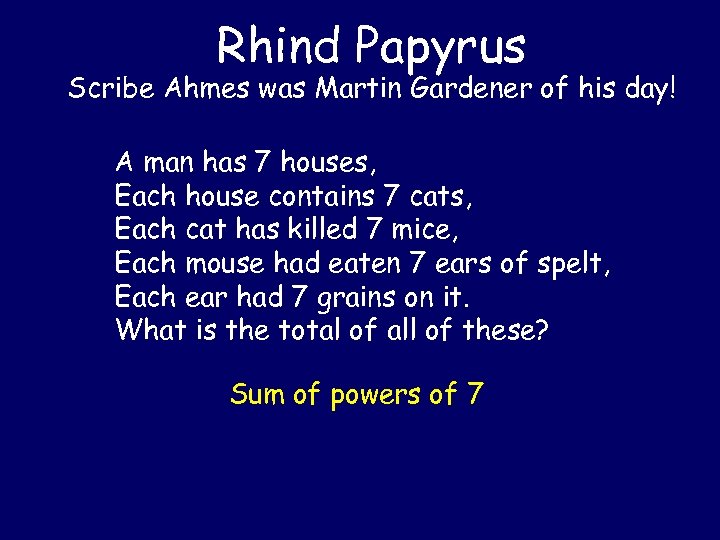 Rhind Papyrus Scribe Ahmes was Martin Gardener of his day! A man has 7 houses, Each house contains 7 cats, Each cat has killed 7 mice, Each mouse had eaten 7 ears of spelt, Each ear had 7 grains on it. What is the total of all of these? Sum of powers of 7
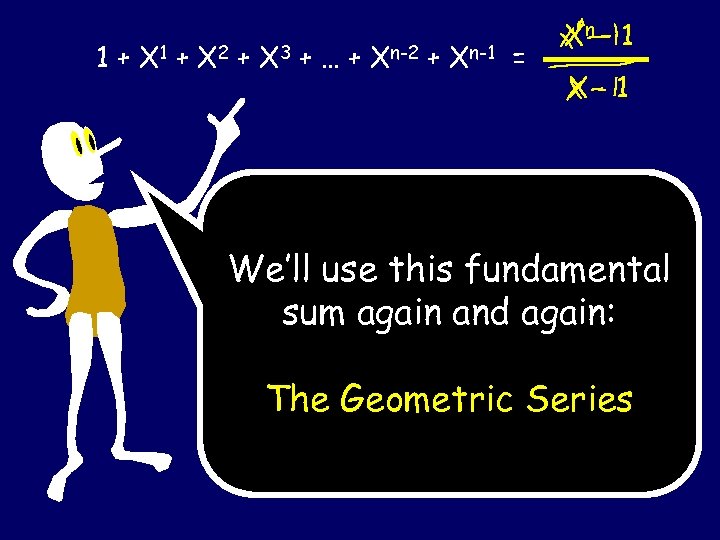 1 + X 2 + X 3 + … + Xn-2 + Xn-1 = Xn – 1 X-1 We’ll use this fundamental sum again and again: The Geometric Series
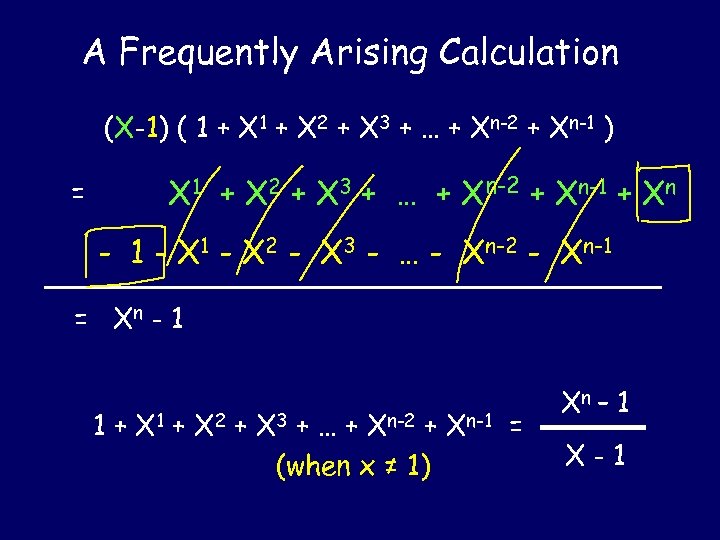 A Frequently Arising Calculation (X-1) ( 1 + X 2 + X 3 + … + Xn-2 + Xn-1 ) = X 1 + X 2 + X 3 + … + Xn-2 + Xn-1 + Xn - 1 - X 2 - X 3 - … - Xn-2 - Xn-1 = Xn - 1 1 + X 2 + X 3 + … + Xn-2 + Xn-1 = (when x ≠ 1) Xn – 1 X-1
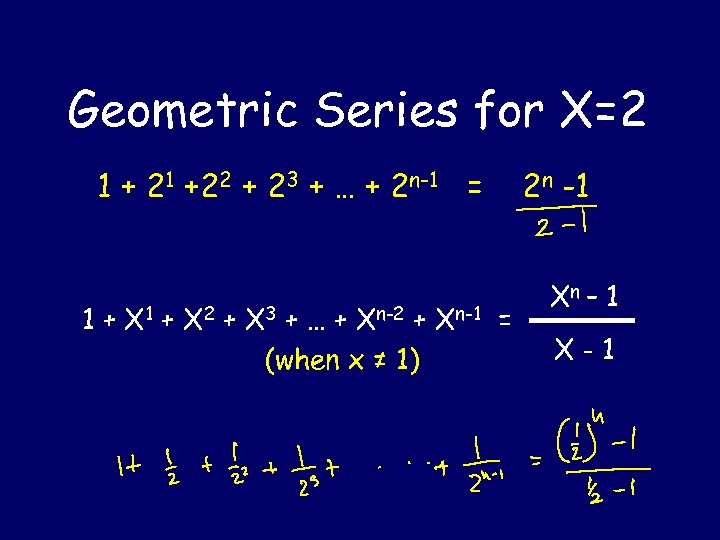 Geometric Series for X=2 1 + 21 +22 + 23 + … + 2 n-1 = 1 + X 2 + X 3 + … + Xn-2 + Xn-1 = (when x ≠ 1) 2 n -1 Xn – 1 X-1
 Numbers and their properties can be represented as strings of symbols
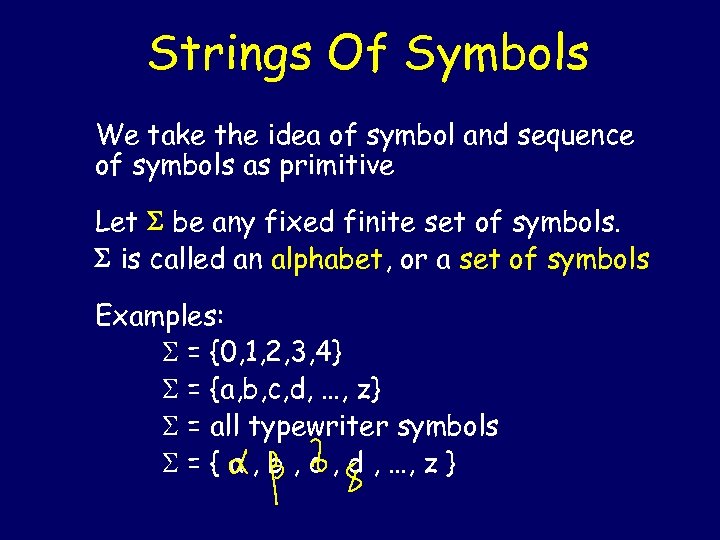 Strings Of Symbols We take the idea of symbol and sequence of symbols as primitive Let be any fixed finite set of symbols. is called an alphabet, or a set of symbols Examples: = {0, 1, 2, 3, 4} = {a, b, c, d, …, z} = all typewriter symbols = { a , b , c , d , …, z }
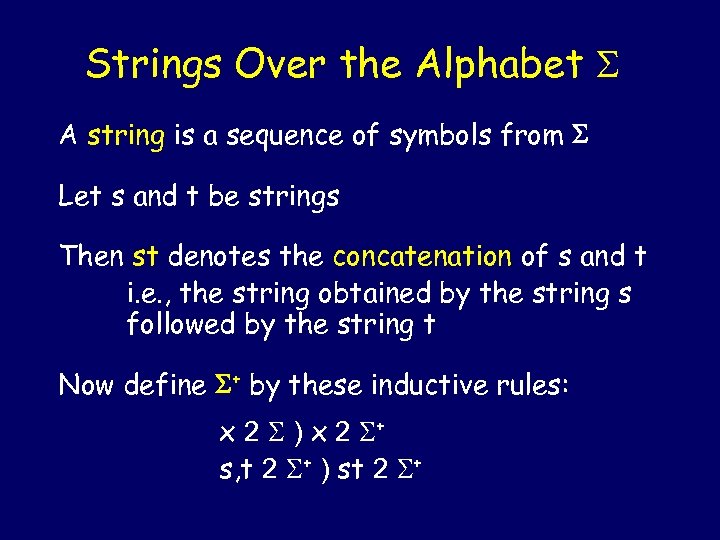 Strings Over the Alphabet A string is a sequence of symbols from Let s and t be strings Then st denotes the concatenation of s and t i. e. , the string obtained by the string s followed by the string t Now define + by these inductive rules: x 2 ) x 2 + s, t 2 + ) st 2 +
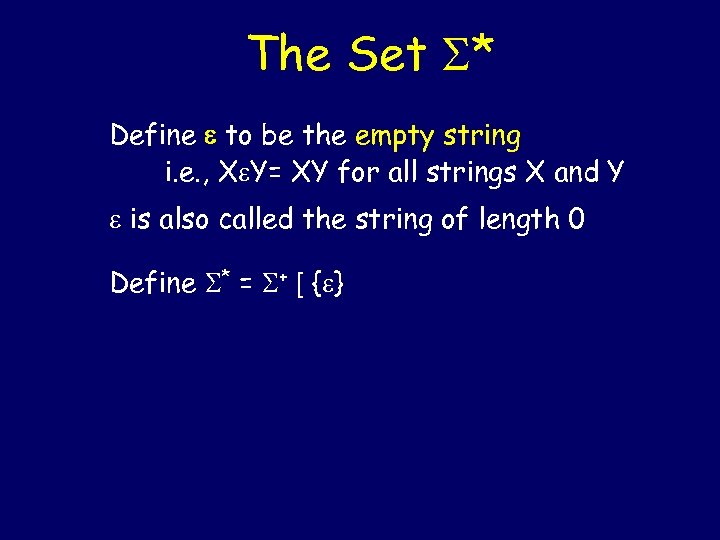 The Set * Define to be the empty string i. e. , X Y= XY for all strings X and Y is also called the string of length 0 Define * = + [ { }
 + is set of all finite strings that we can make using (at least one) letters from * is the set of all finite strings that we can make using letters from , including the empty string.
 Let DIGITS = {0, 1, 2, 3, 4, 5, 6, 7, 8, 9} be a symbol alphabet Any string in DIGITS+ will be called a decimal number
 Let BITS = {0, 1} be a symbol alphabet Any string in BITS+ will be called a binary number
 Let ROCK = { } be a symbol alphabet Any string in ROCK+ will be called a unary number
 Let BASE-X = {0, 1, 2, …, X-1} be a symbol alphabet Any string in BASEX+ will be called a base-X number
 Each of these sets of sequences can represent numbers. We just need to specify the correct map between sets of sequences and numbers
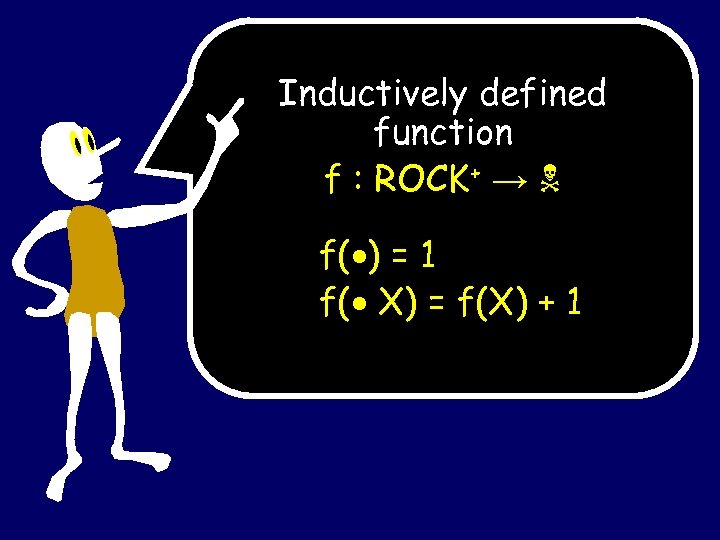 Inductively defined function f : ROCK+ → f( ) = 1 f( X) = f(X) + 1
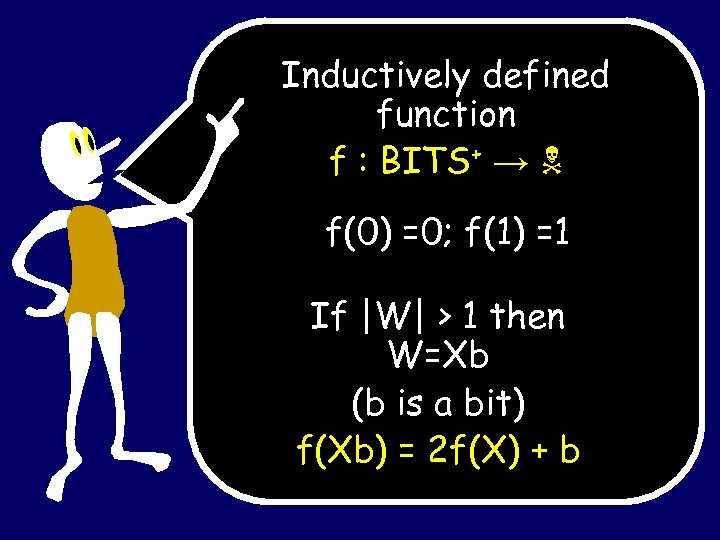 Inductively defined function f : BITS+ → f(0) =0; f(1) =1 If |W| > 1 then W=Xb (b is a bit) f(Xb) = 2 f(X) + b
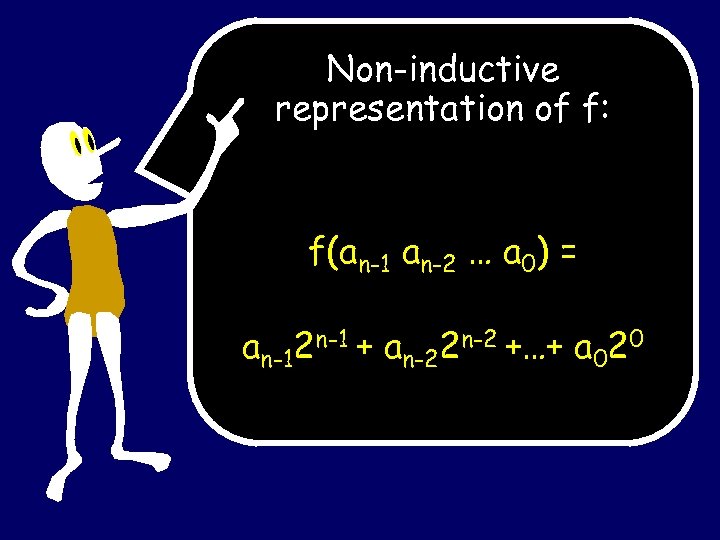 Non-inductive representation of f: f(an-1 an-2 … a 0) = an-12 n-1 + an-22 n-2 +…+ a 020
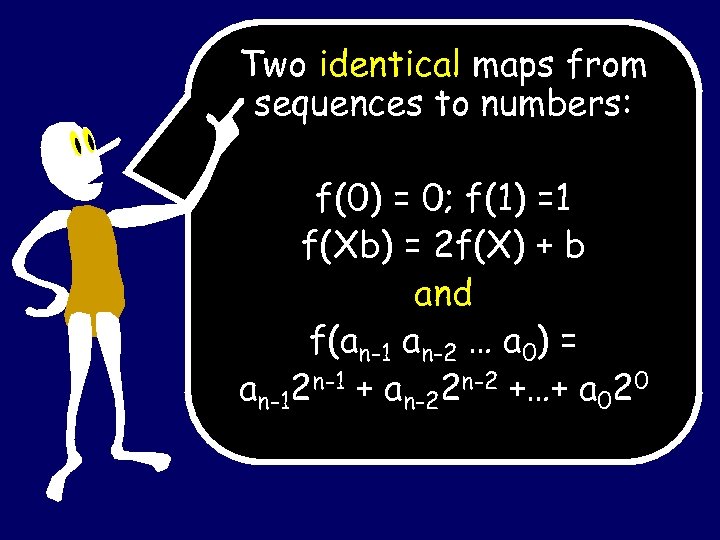 Two identical maps from sequences to numbers: f(0) = 0; f(1) =1 f(Xb) = 2 f(X) + b and f(an-1 an-2 … a 0) = an-12 n-1 + an-22 n-2 +…+ a 020
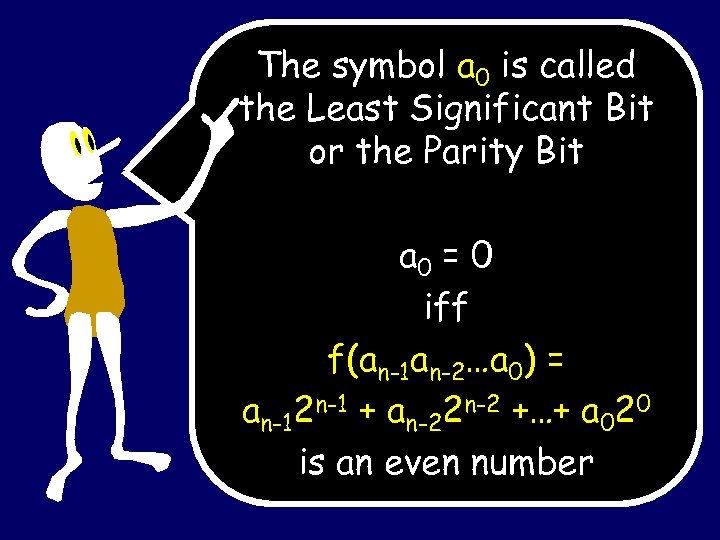 The symbol a 0 is called the Least Significant Bit or the Parity Bit a 0 = 0 iff f(an-1 an-2…a 0) = an-12 n-1 + an-22 n-2 +…+ a 020 is an even number
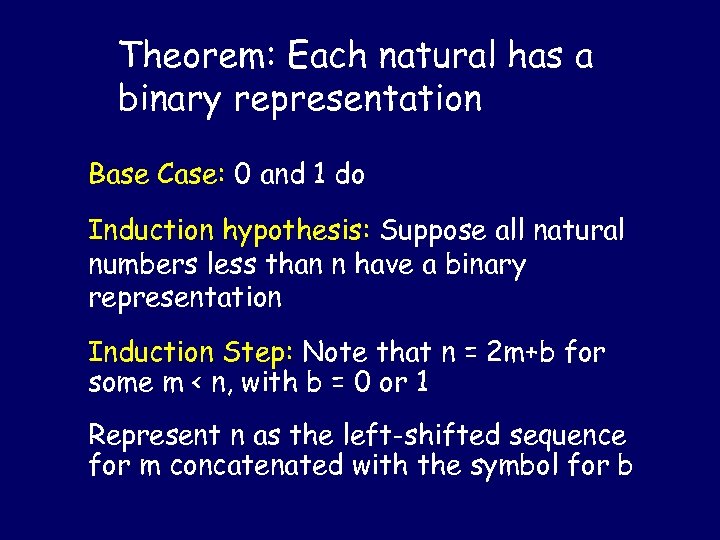 Theorem: Each natural has a binary representation Base Case: 0 and 1 do Induction hypothesis: Suppose all natural numbers less than n have a binary representation Induction Step: Note that n = 2 m+b for some m < n, with b = 0 or 1 Represent n as the left-shifted sequence for m concatenated with the symbol for b
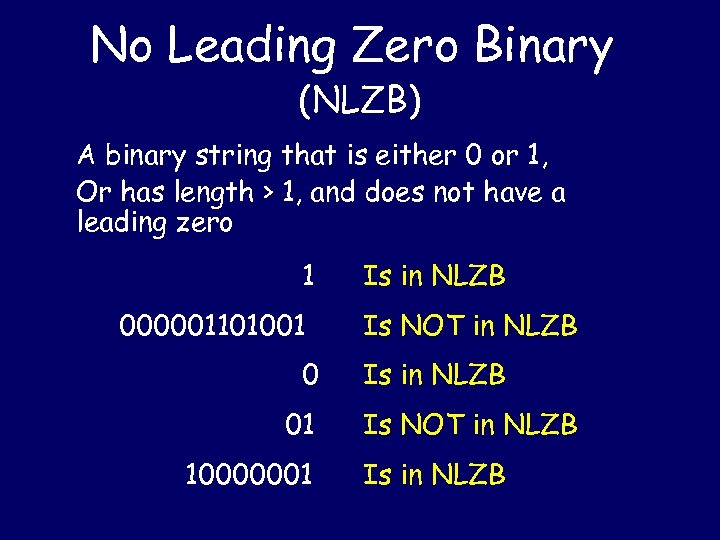 No Leading Zero Binary (NLZB) A binary string that is either 0 or 1, Or has length > 1, and does not have a leading zero 1 000001101001 0 01 10000001 Is in NLZB Is NOT in NLZB Is in NLZB
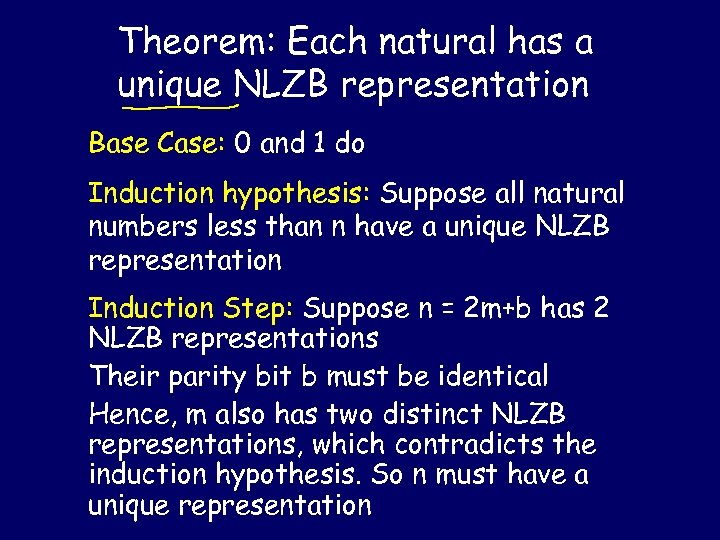 Theorem: Each natural has a unique NLZB representation Base Case: 0 and 1 do Induction hypothesis: Suppose all natural numbers less than n have a unique NLZB representation Induction Step: Suppose n = 2 m+b has 2 NLZB representations Their parity bit b must be identical Hence, m also has two distinct NLZB representations, which contradicts the induction hypothesis. So n must have a unique representation
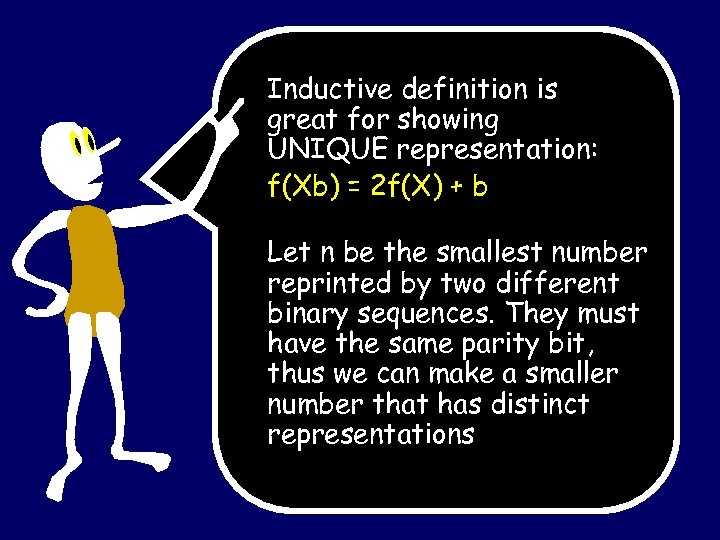 Inductive definition is great for showing UNIQUE representation: f(Xb) = 2 f(X) + b Let n be the smallest number reprinted by two different binary sequences. They must have the same parity bit, thus we can make a smaller number that has distinct representations
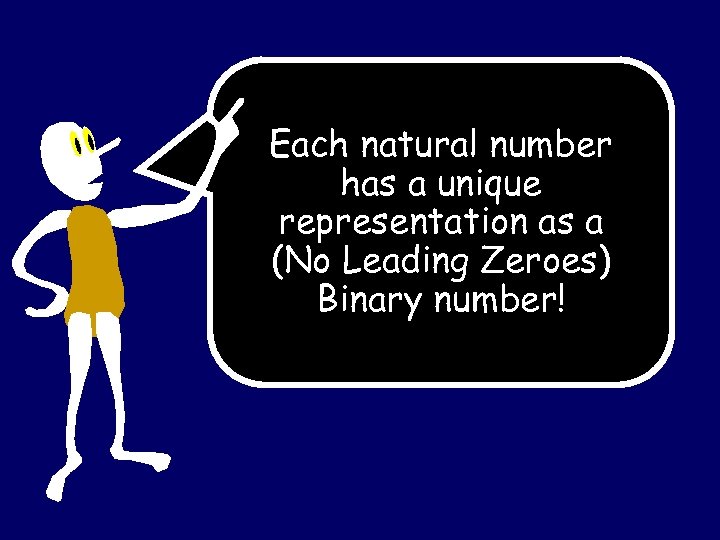 Each natural number has a unique representation as a (No Leading Zeroes) Binary number!
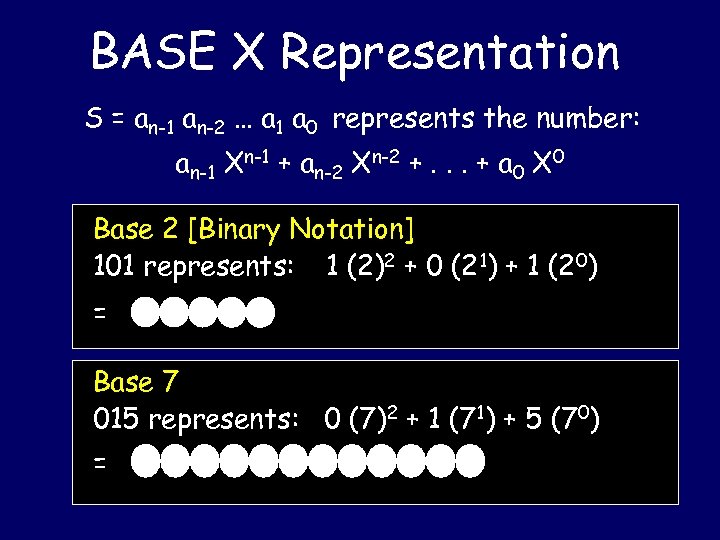 BASE X Representation S = an-1 an-2 … a 1 a 0 represents the number: an-1 Xn-1 + an-2 Xn-2 +. . . + a 0 X 0 Base 2 [Binary Notation] 101 represents: 1 (2)2 + 0 (21) + 1 (20) = Base 7 015 represents: 0 (7)2 + 1 (71) + 5 (70) =
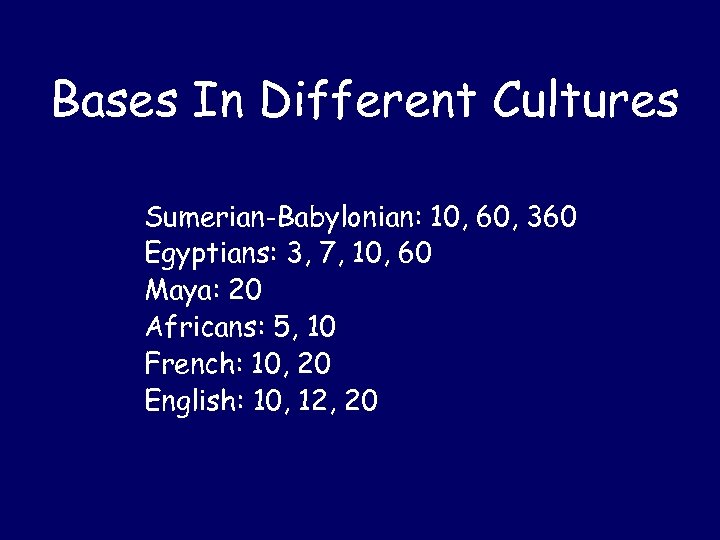 Bases In Different Cultures Sumerian-Babylonian: 10, 60, 360 Egyptians: 3, 7, 10, 60 Maya: 20 Africans: 5, 10 French: 10, 20 English: 10, 12, 20
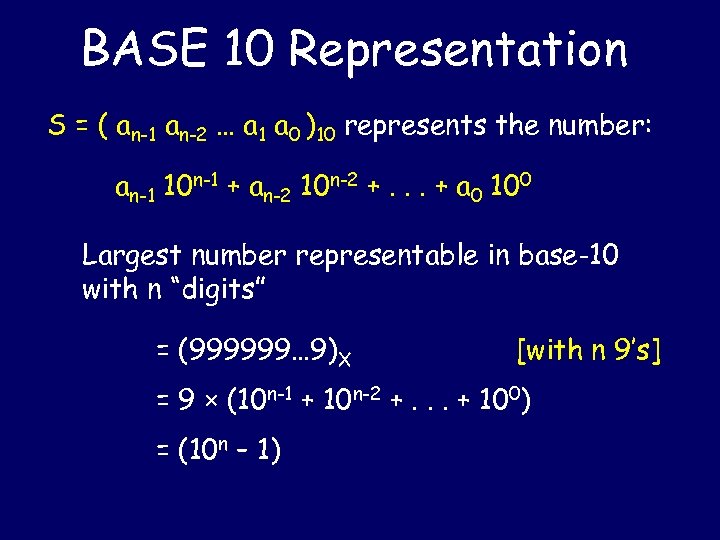 BASE 10 Representation S = ( an-1 an-2 … a 1 a 0 )10 represents the number: an-1 10 n-1 + an-2 10 n-2 +. . . + a 0 100 Largest number representable in base-10 with n “digits” = (999999… 9)X [with n 9’s] = 9 × (10 n-1 + 10 n-2 +. . . + 100) = (10 n – 1)
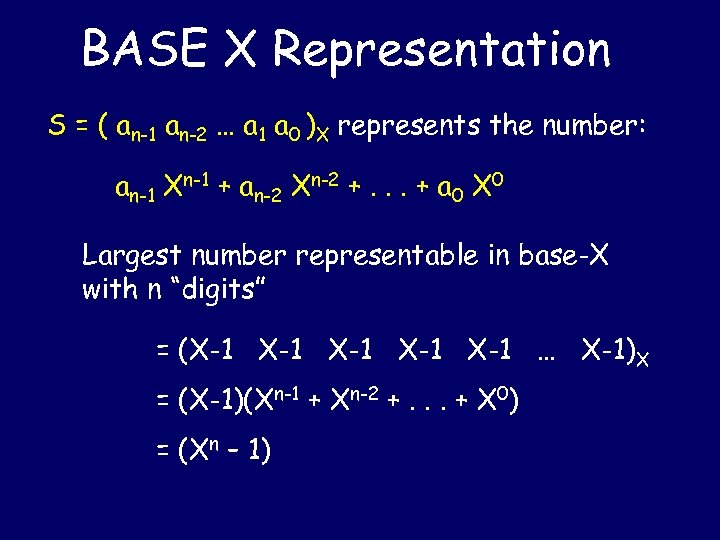 BASE X Representation S = ( an-1 an-2 … a 1 a 0 )X represents the number: an-1 Xn-1 + an-2 Xn-2 +. . . + a 0 X 0 Largest number representable in base-X with n “digits” = (X-1 X-1 X-1 … X-1)X = (X-1)(Xn-1 + Xn-2 +. . . + X 0) = (Xn – 1)
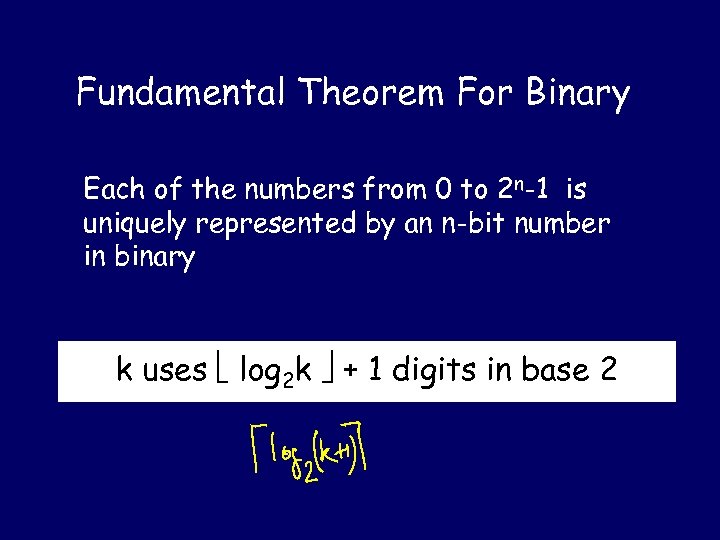 Fundamental Theorem For Binary Each of the numbers from 0 to 2 n-1 is uniquely represented by an n-bit number in binary k uses log 2 k + 1 digits in base 2
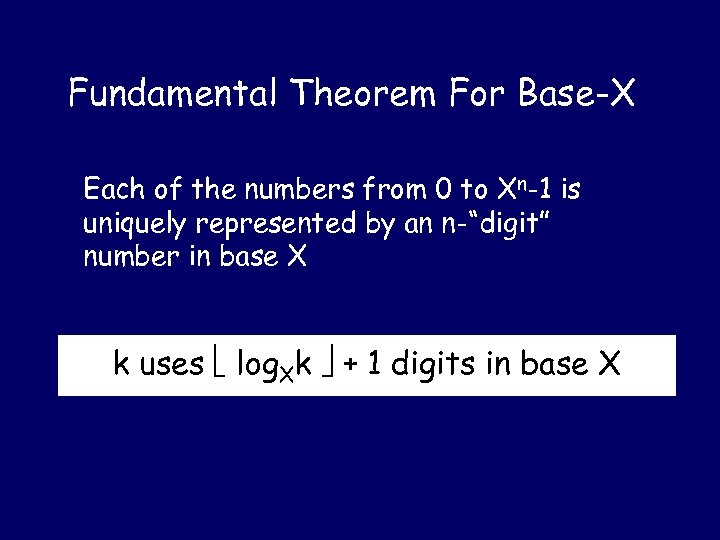 Fundamental Theorem For Base-X Each of the numbers from 0 to Xn-1 is uniquely represented by an n-“digit” number in base X k uses log. Xk + 1 digits in base X
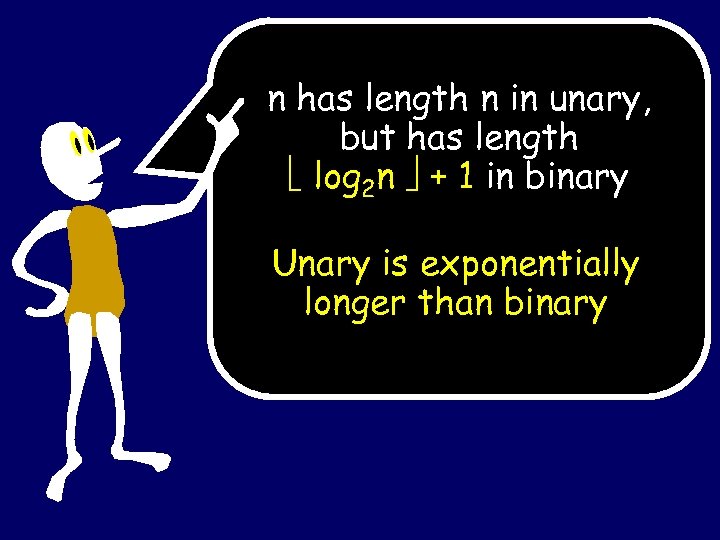 n has length n in unary, but has length log 2 n + 1 in binary Unary is exponentially longer than binary
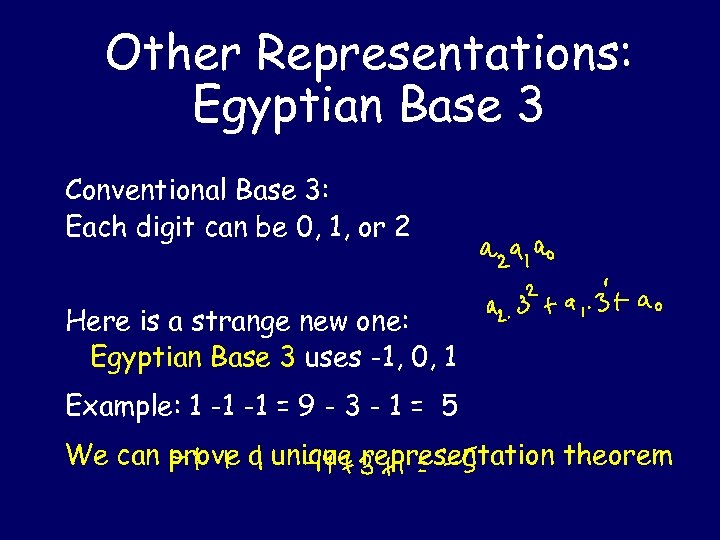 Other Representations: Egyptian Base 3 Conventional Base 3: Each digit can be 0, 1, or 2 Here is a strange new one: Egyptian Base 3 uses -1, 0, 1 Example: 1 -1 -1 = 9 - 3 - 1 = 5 We can prove a unique representation theorem
 How could this be Egyptian? Historically, negative numbers first appear in the writings of the Indian mathematician Brahmagupta (628 AD)
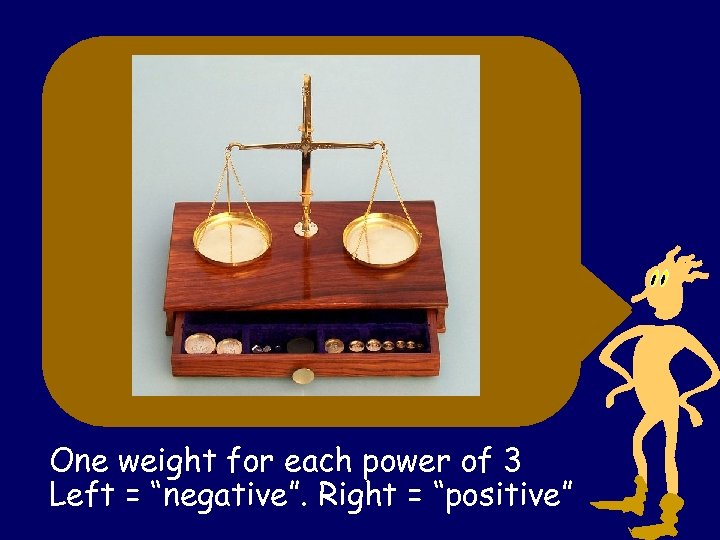 One weight for each power of 3 Left = “negative”. Right = “positive”
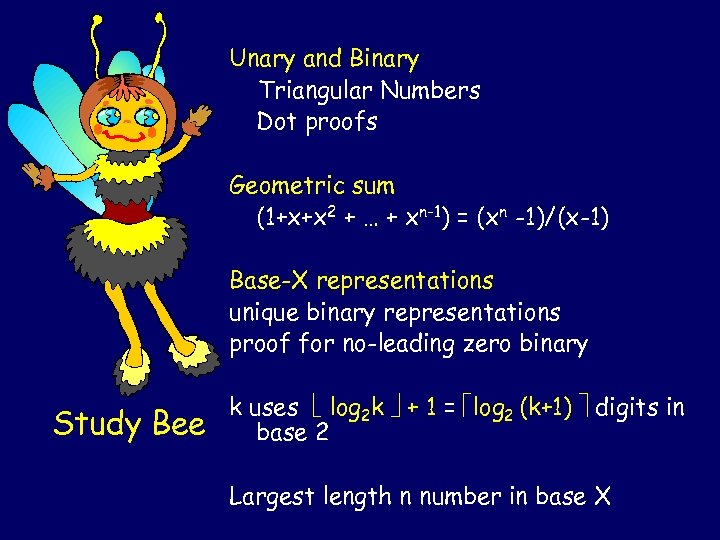 Unary and Binary Triangular Numbers Dot proofs Geometric sum (1+x+x 2 + … + xn-1) = (xn -1)/(x-1) Base-X representations unique binary representations proof for no-leading zero binary Study Bee k uses log 2 k + 1 = log 2 (k+1) digits in base 2 Largest length n number in base X