 Скачать презентацию Great people of Britain Isambard Kingdom Brunel 1806
Great people of Britain Заборский.pptx
- Количество слайдов: 12



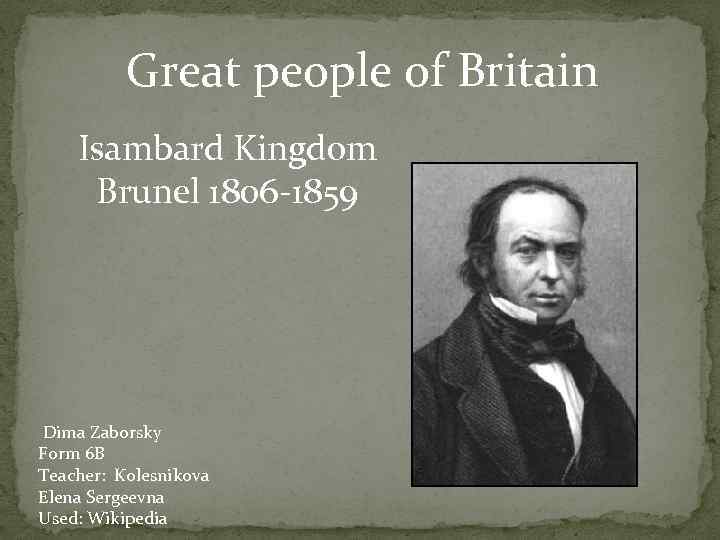
Great people of Britain Isambard Kingdom Brunel 1806 -1859 Dima Zaborsky Form 6 B Teacher: Kolesnikova Elena Sergeevna Used: Wikipedia
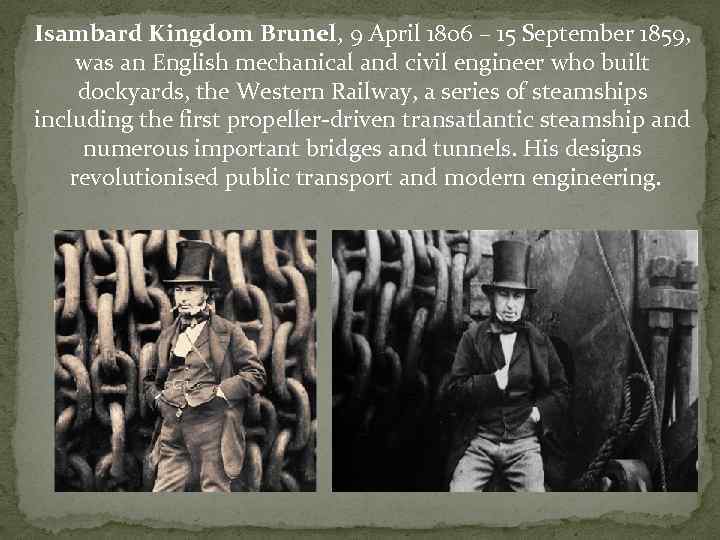
Isambard Kingdom Brunel, 9 April 1806 – 15 September 1859, was an English mechanical and civil engineer who built dockyards, the Western Railway, a series of steamships including the first propeller-driven transatlantic steamship and numerous important bridges and tunnels. His designs revolutionised public transport and modern engineering.
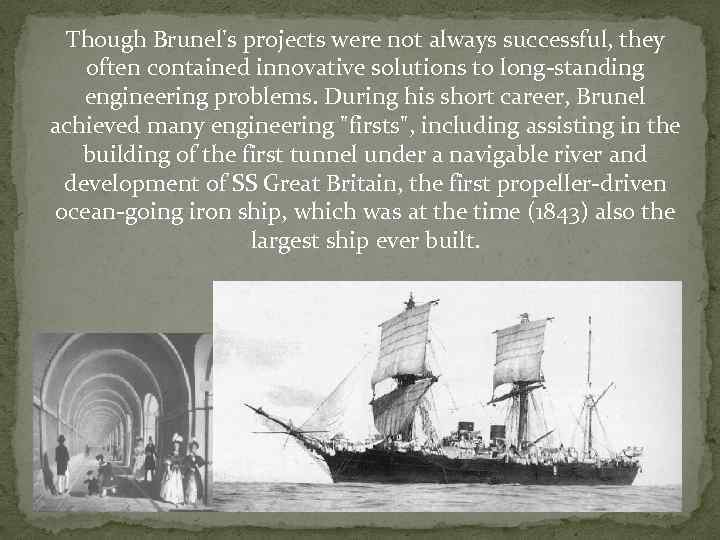
Though Brunel's projects were not always successful, they often contained innovative solutions to long-standing engineering problems. During his short career, Brunel achieved many engineering "firsts", including assisting in the building of the first tunnel under a navigable river and development of SS Great Britain, the first propeller-driven ocean-going iron ship, which was at the time (1843) also the largest ship ever built.
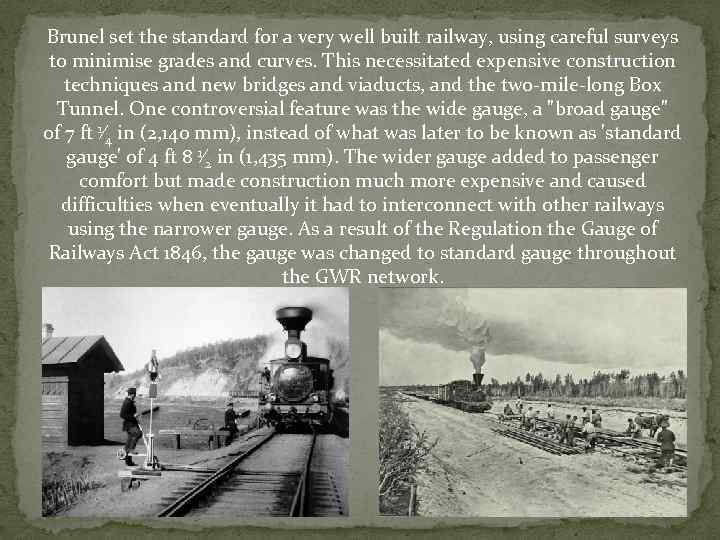
Brunel set the standard for a very well built railway, using careful surveys to minimise grades and curves. This necessitated expensive construction techniques and new bridges and viaducts, and the two-mile-long Box Tunnel. One controversial feature was the wide gauge, a "broad gauge" of 7 ft 1⁄4 in (2, 140 mm), instead of what was later to be known as 'standard gauge' of 4 ft 8 1⁄2 in (1, 435 mm). The wider gauge added to passenger comfort but made construction much more expensive and caused difficulties when eventually it had to interconnect with other railways using the narrower gauge. As a result of the Regulation the Gauge of Railways Act 1846, the gauge was changed to standard gauge throughout the GWR network.
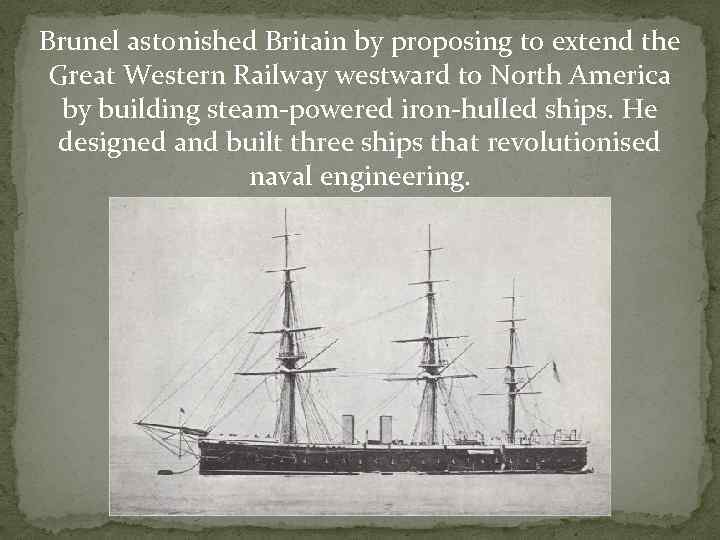
Brunel astonished Britain by proposing to extend the Great Western Railway westward to North America by building steam-powered iron-hulled ships. He designed and built three ships that revolutionised naval engineering.
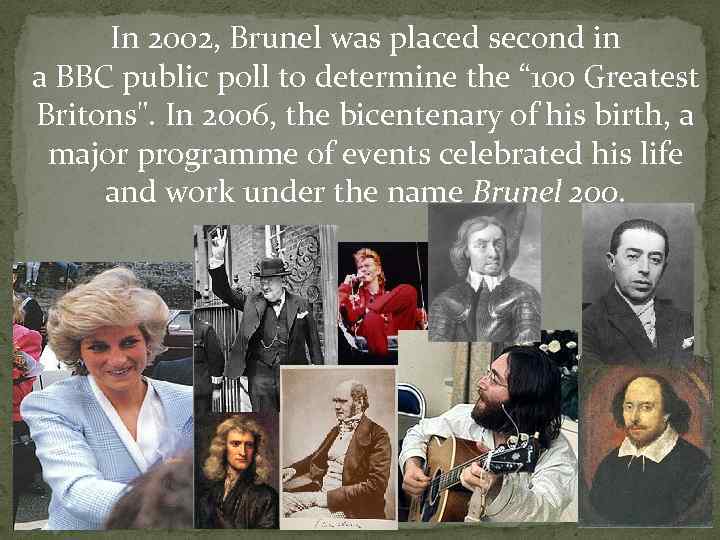
In 2002, Brunel was placed second in a BBC public poll to determine the “ 100 Greatest Britons". In 2006, the bicentenary of his birth, a major programme of events celebrated his life and work under the name Brunel 200.
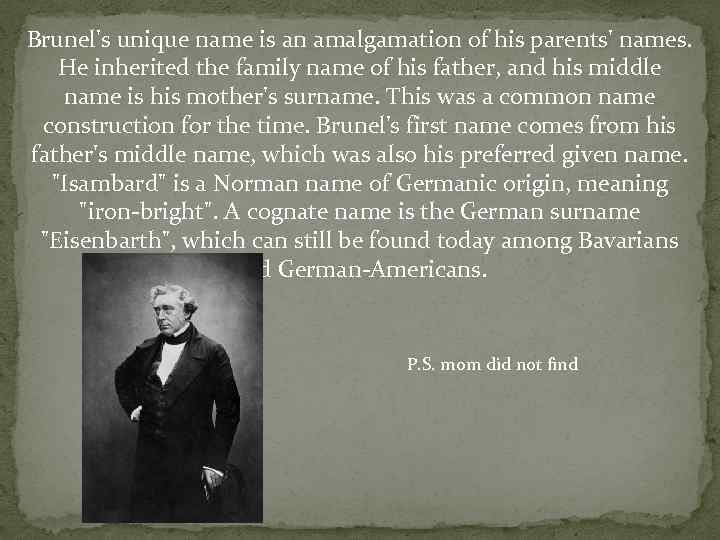
Brunel's unique name is an amalgamation of his parents' names. He inherited the family name of his father, and his middle name is his mother's surname. This was a common name construction for the time. Brunel's first name comes from his father's middle name, which was also his preferred given name. "Isambard" is a Norman name of Germanic origin, meaning "iron-bright". A cognate name is the German surname "Eisenbarth", which can still be found today among Bavarians and German-Americans. P. S. mom did not find
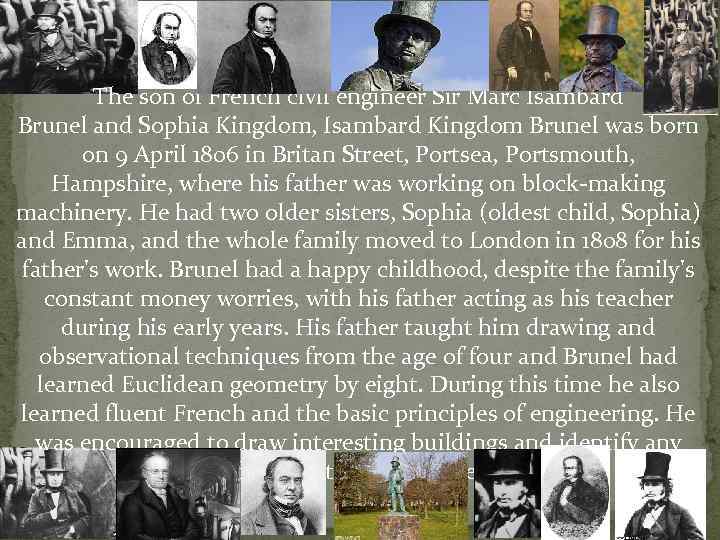
The son of French civil engineer Sir Marc Isambard Brunel and Sophia Kingdom, Isambard Kingdom Brunel was born on 9 April 1806 in Britan Street, Portsea, Portsmouth, Hampshire, where his father was working on block-making machinery. He had two older sisters, Sophia (oldest child, Sophia) and Emma, and the whole family moved to London in 1808 for his father's work. Brunel had a happy childhood, despite the family's constant money worries, with his father acting as his teacher during his early years. His father taught him drawing and observational techniques from the age of four and Brunel had learned Euclidean geometry by eight. During this time he also learned fluent French and the basic principles of engineering. He was encouraged to draw interesting buildings and identify any faults in their structure.
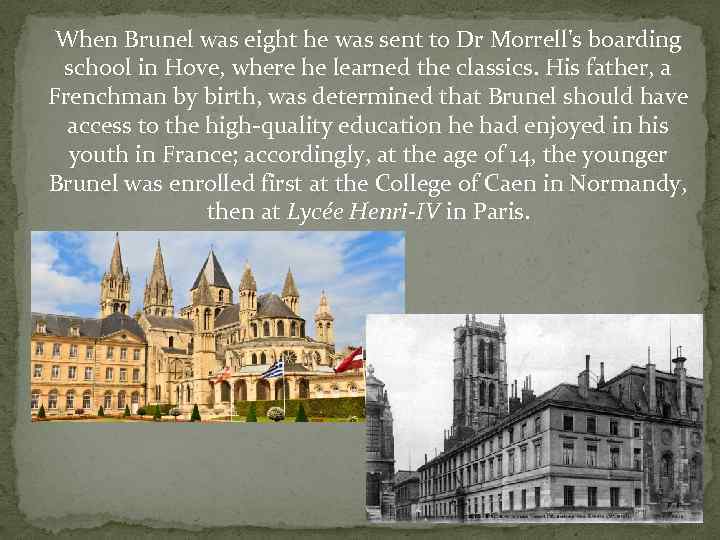
When Brunel was eight he was sent to Dr Morrell's boarding school in Hove, where he learned the classics. His father, a Frenchman by birth, was determined that Brunel should have access to the high-quality education he had enjoyed in his youth in France; accordingly, at the age of 14, the younger Brunel was enrolled first at the College of Caen in Normandy, then at Lycée Henri-IV in Paris.
When Brunel was 15, his father, who had accumulated debts of over £ 5, 000, was sent to a debtors' prison. After three months went by with no prospect of release, Marc let it be known that he was considering an offer from the Tsar of Russia. In August 1821, facing the prospect of losing a prominent engineer, the government relented and issued Marc £ 5, 000 to clear his debts in exchange for his promise to remain in Britain.
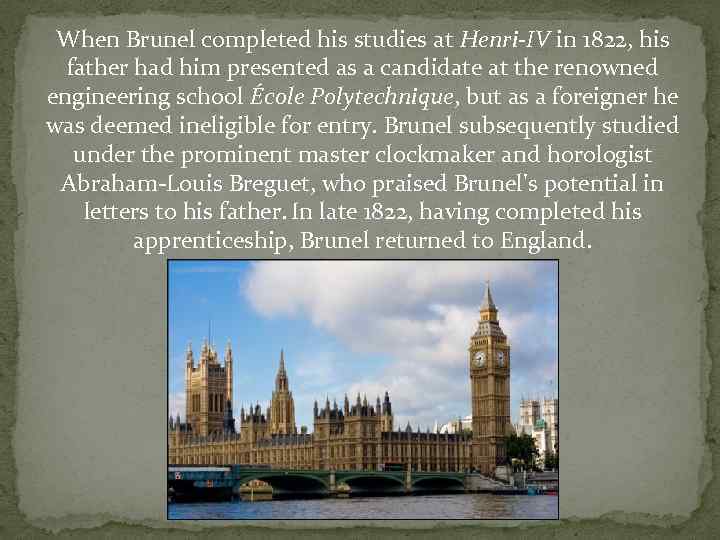
When Brunel completed his studies at Henri-IV in 1822, his father had him presented as a candidate at the renowned engineering school École Polytechnique, but as a foreigner he was deemed ineligible for entry. Brunel subsequently studied under the prominent master clockmaker and horologist Abraham-Louis Breguet, who praised Brunel's potential in letters to his father. In late 1822, having completed his apprenticeship, Brunel returned to England.
The End Thanks for watching.
Скачать презентацию Great people of Britain Isambard Kingdom Brunel 1806
Great people of Britain Заборский.pptx