



 Great fire of London
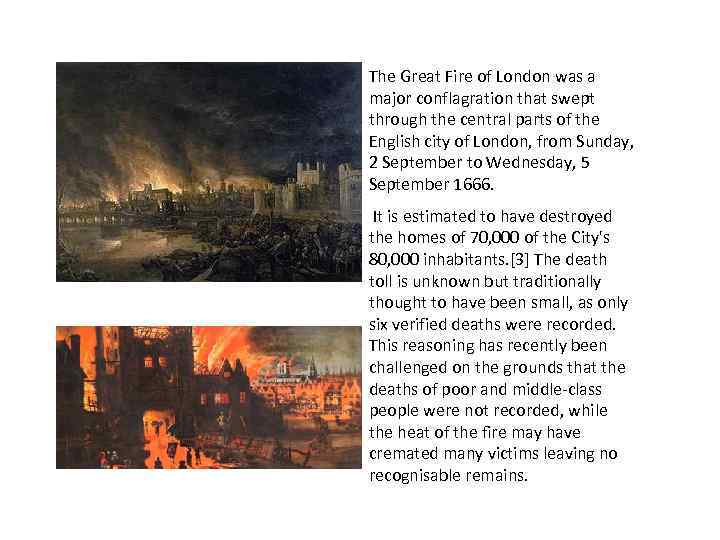 The Great Fire of London was a major conflagration that swept through the central parts of the English city of London, from Sunday, 2 September to Wednesday, 5 September 1666. It is estimated to have destroyed the homes of 70, 000 of the City's 80, 000 inhabitants. [3] The death toll is unknown but traditionally thought to have been small, as only six verified deaths were recorded. This reasoning has recently been challenged on the grounds that the deaths of poor and middle-class people were not recorded, while the heat of the fire may have cremated many victims leaving no recognisable remains.
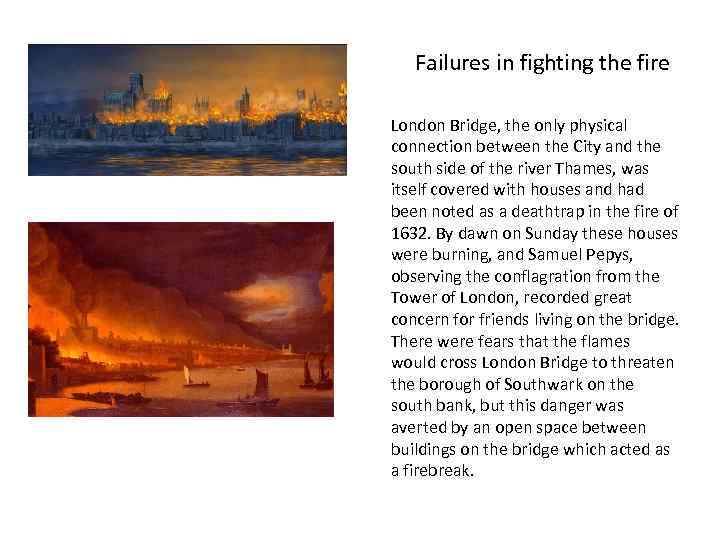 Failures in fighting the fire London Bridge, the only physical connection between the City and the south side of the river Thames, was itself covered with houses and had been noted as a deathtrap in the fire of 1632. By dawn on Sunday these houses were burning, and Samuel Pepys, observing the conflagration from the Tower of London, recorded great concern for friends living on the bridge. There were fears that the flames would cross London Bridge to threaten the borough of Southwark on the south bank, but this danger was averted by an open space between buildings on the bridge which acted as a firebreak.
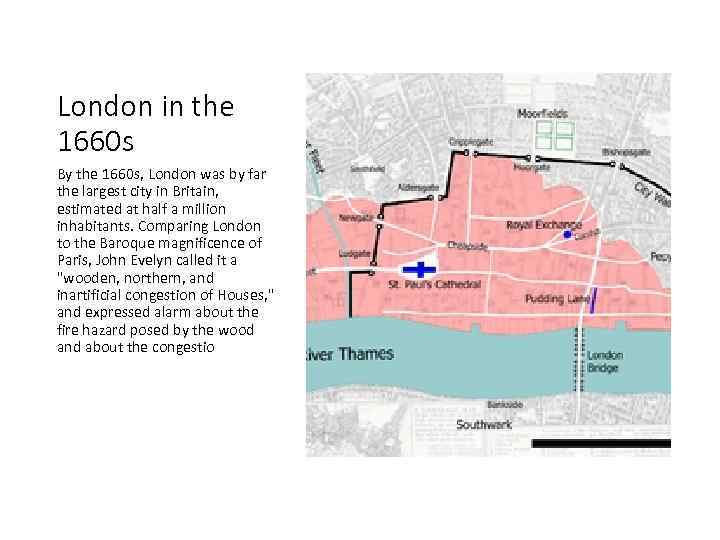 London in the 1660 s By the 1660 s, London was by far the largest city in Britain, estimated at half a million inhabitants. Comparing London to the Baroque magnificence of Paris, John Evelyn called it a "wooden, northern, and inartificial congestion of Houses, " and expressed alarm about the fire hazard posed by the wood and about the congestio
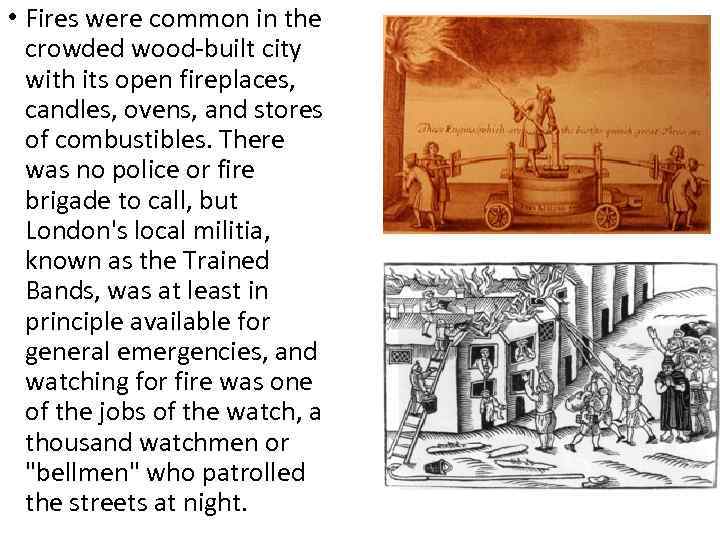 • Fires were common in the crowded wood-built city with its open fireplaces, candles, ovens, and stores of combustibles. There was no police or fire brigade to call, but London's local militia, known as the Trained Bands, was at least in principle available for general emergencies, and watching for fire was one of the jobs of the watch, a thousand watchmen or "bellmen" who patrolled the streets at night.
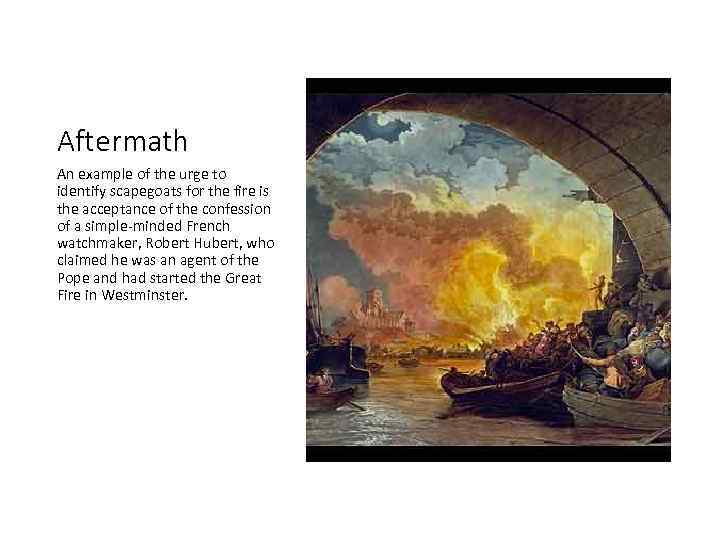 Aftermath An example of the urge to identify scapegoats for the fire is the acceptance of the confession of a simple-minded French watchmaker, Robert Hubert, who claimed he was an agent of the Pope and had started the Great Fire in Westminster.
 Great Plague of London
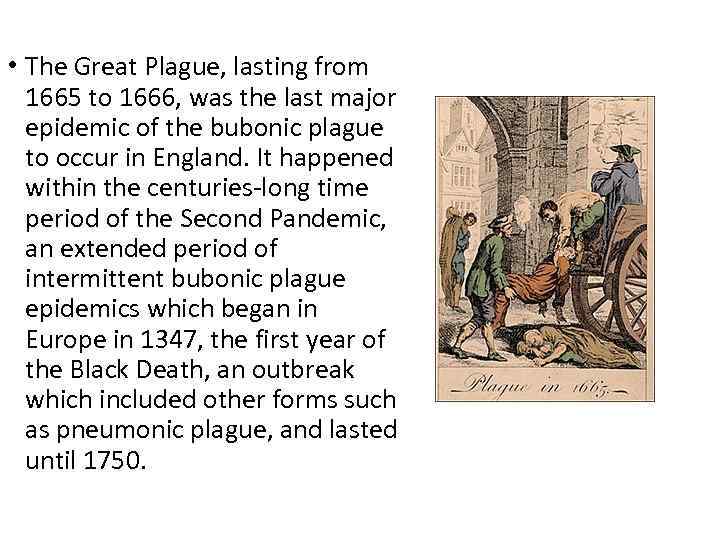 • The Great Plague, lasting from 1665 to 1666, was the last major epidemic of the bubonic plague to occur in England. It happened within the centuries-long time period of the Second Pandemic, an extended period of intermittent bubonic plague epidemics which began in Europe in 1347, the first year of the Black Death, an outbreak which included other forms such as pneumonic plague, and lasted until 1750.
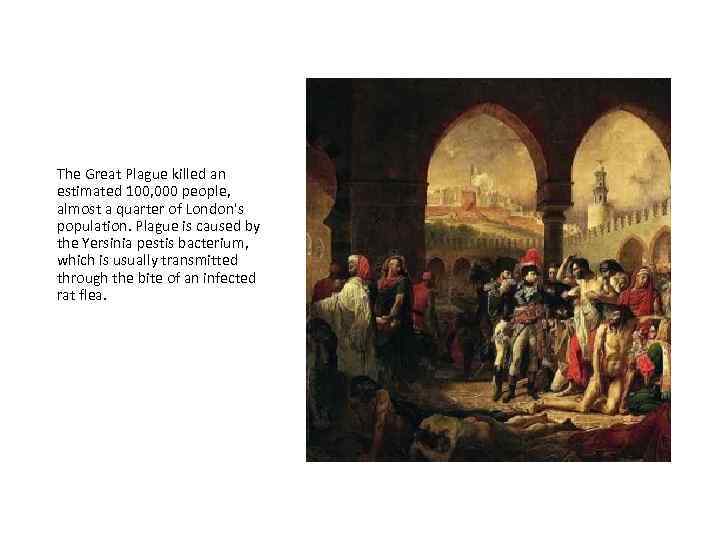 The Great Plague killed an estimated 100, 000 people, almost a quarter of London's population. Plague is caused by the Yersinia pestis bacterium, which is usually transmitted through the bite of an infected rat flea.
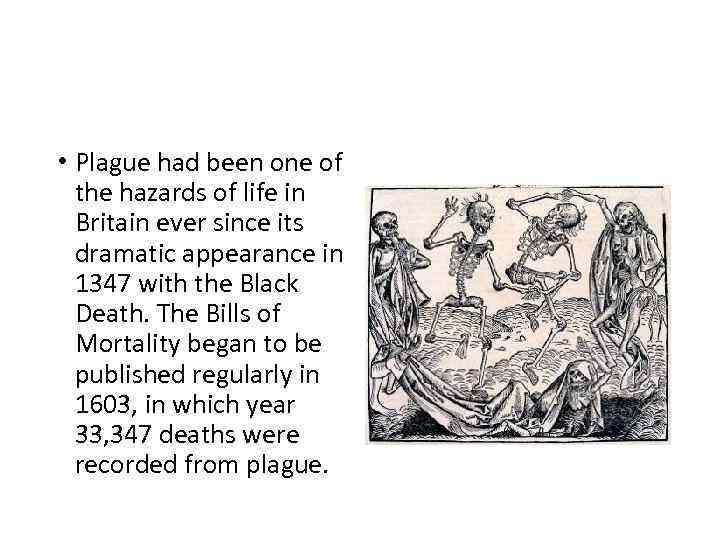 • Plague had been one of the hazards of life in Britain ever since its dramatic appearance in 1347 with the Black Death. The Bills of Mortality began to be published regularly in 1603, in which year 33, 347 deaths were recorded from plague.