 Скачать презентацию Great Expectations Building Healthy Communities and Homes for
208fa00266eba6a7f18639da57e3b028.ppt
- Количество слайдов: 37



Great Expectations: Building Healthy Communities and Homes for our Ageing Society
Public health and housing Dr Jenny Harries – Regional Director South Public Health England
A conversation about …. 1. Why we are interested in housing, health and wellbeing 2. Who we are and how we fit in 3. How we can help you achieve shared ambitions
Public Health & PHE “The science and art of preventing disease, prolonging life, and promoting health through the organised efforts of society” [Acheson 1988] Our mission is “To protect and improve the nation’s health and address inequalities”
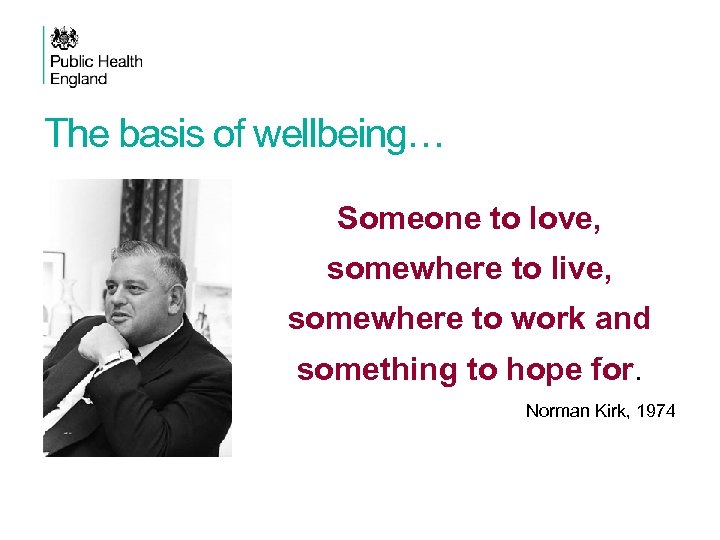
The basis of wellbeing… Someone to love, somewhere to live, somewhere to work and something to hope for. Norman Kirk, 1974
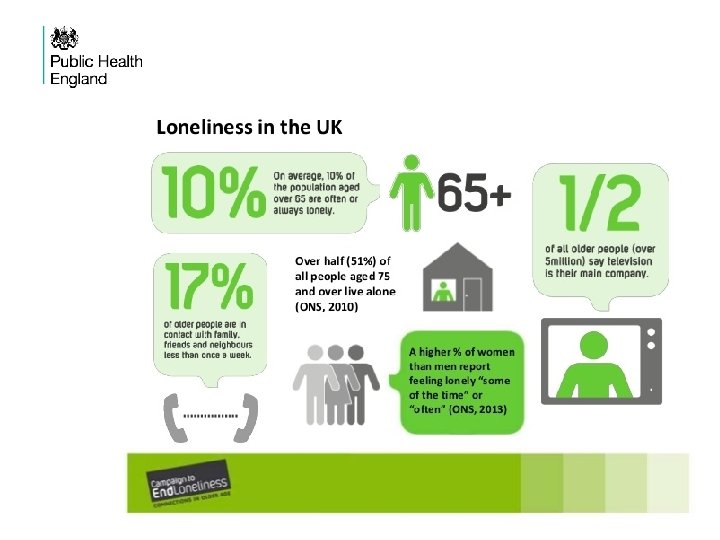
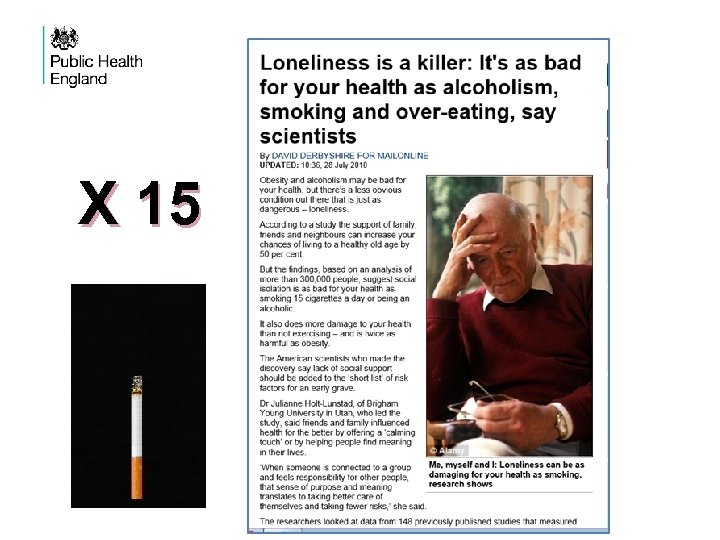
X 15
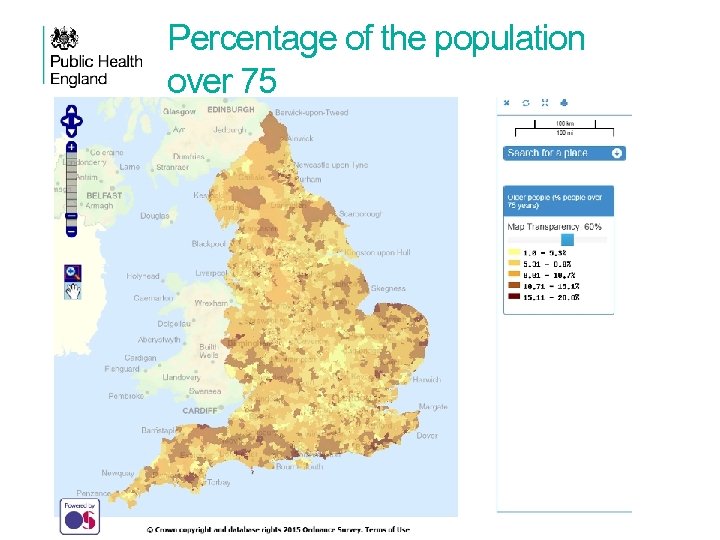
Percentage of the population over 75
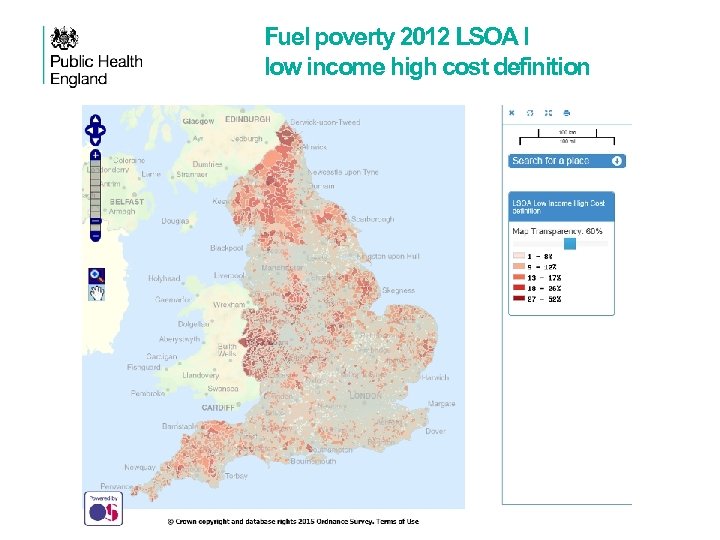
Fuel poverty 2012 LSOA l low income high cost definition
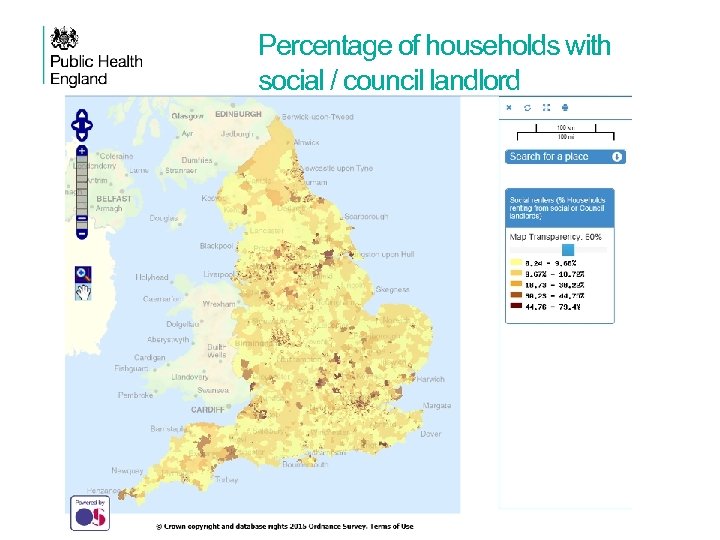
Percentage of households with social / council landlord
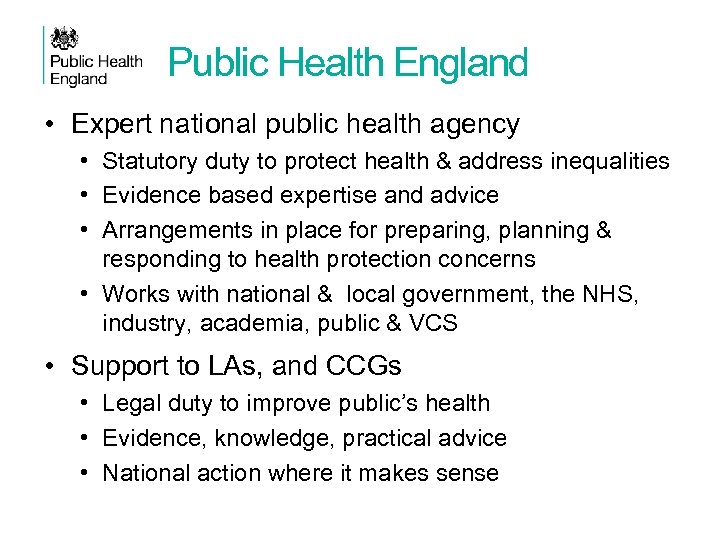
Public Health England • Expert national public health agency • Statutory duty to protect health & address inequalities • Evidence based expertise and advice • Arrangements in place for preparing, planning & responding to health protection concerns • Works with national & local government, the NHS, industry, academia, public & VCS • Support to LAs, and CCGs • Legal duty to improve public’s health • Evidence, knowledge, practical advice • National action where it makes sense
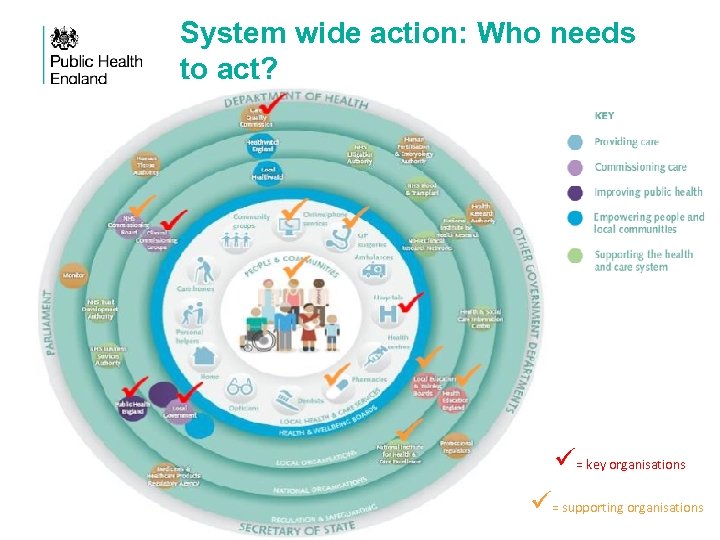
System wide action: Who needs to act? = key organisations = supporting organisations
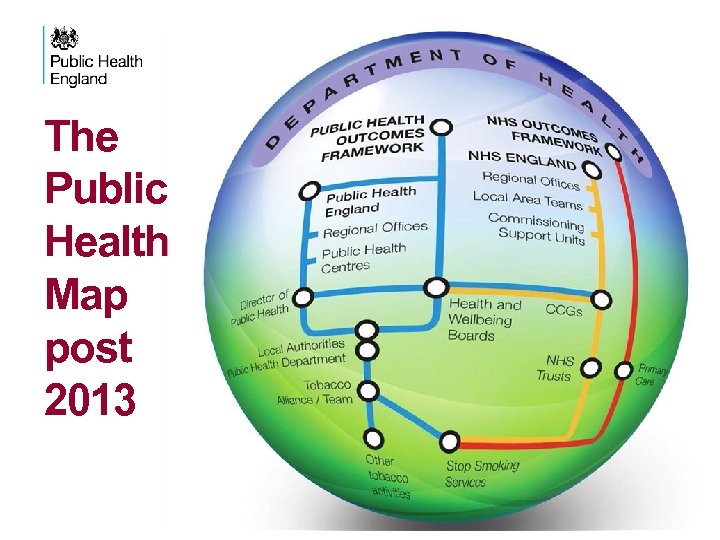
The Public Health Map post 2013
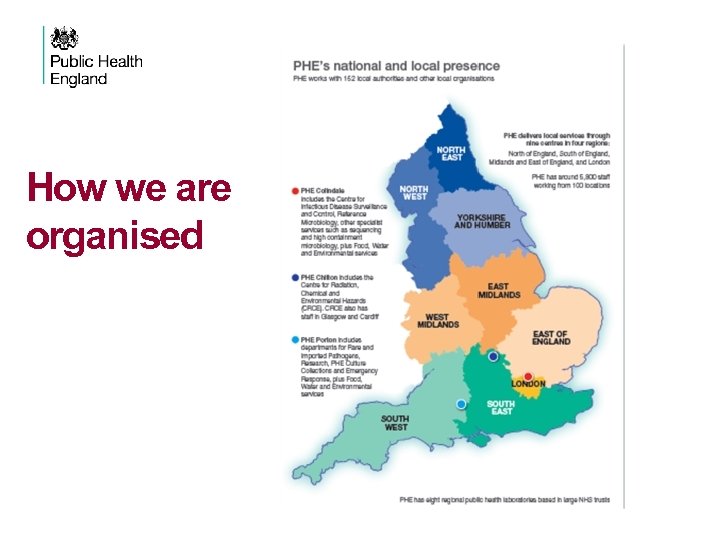
How we are organised
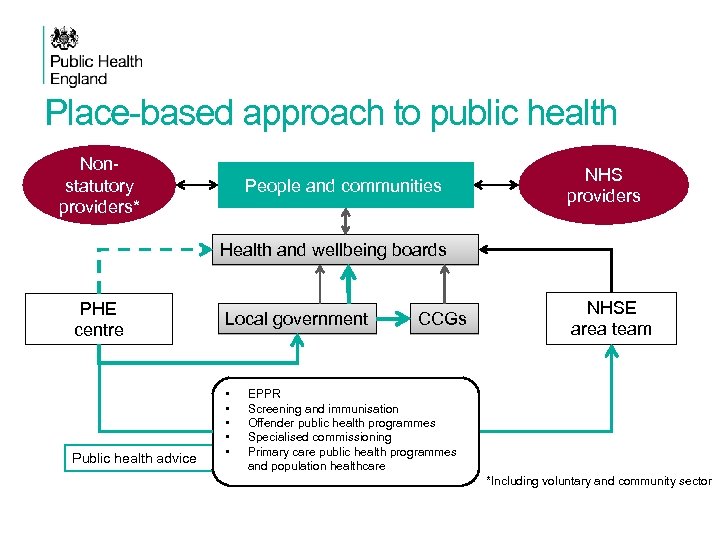
Place-based approach to public health Nonstatutory providers* People and communities NHS providers Health and wellbeing boards PHE centre Public health advice Local government • • • CCGs NHSE area team EPPR Screening and immunisation Offender public health programmes Specialised commissioning Primary care public health programmes and population healthcare *Including voluntary and community sector
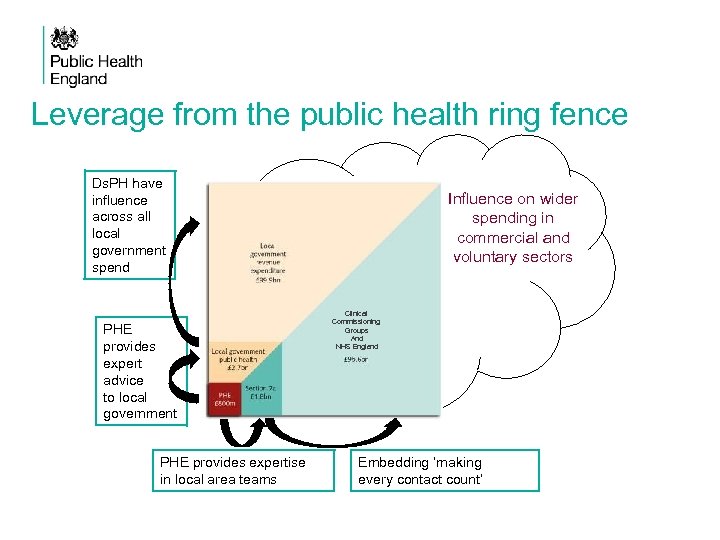
Leverage from the public health ring fence Ds. PH have influence across all local government spend PHE provides expert advice to local government PHE provides expertise in local area teams Influence on wider spending in commercial and voluntary sectors Clinical Commissioning Groups And NHS England Embedding ‘making every contact count’
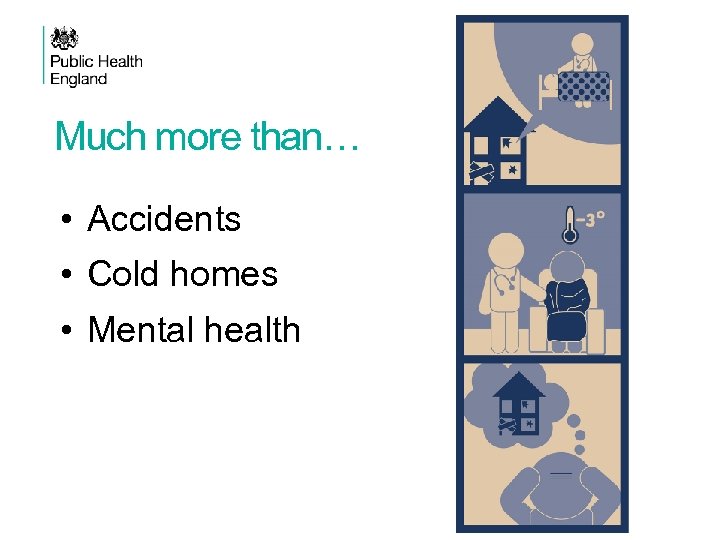
Much more than… • Accidents • Cold homes • Mental health
Housing to public health? • A challenge • A wider determinant of health (Marmot 2010) • The ‘bricks and mortar’ house – – – • 21% (4. 8 m) homes are hazardous to health – 88% private sector Costs NHS up to £ 2 bn p. a. (BRE, 2015) Replacing homes at a rate of 0. 5% of stock p. a. Homelessness – – A consequence and cause of health inequality Over 90, 000 children in temporary accommodation in Dec 2014 Rough sleeping increased 55% between 2010 and 2014 Single homelessness costs NHS over £ 85 m p. a. (Crisis, 2010)
Housing to public health? • A solution • Home is the ‘health setting’ for most people throughout life • An opportunity to intervene at points where the home environment or housing circumstances are most likely to make a difference • Housing-related services • Enable people to remain independent in their own home for as long as they choose, or to move from crisis into their own home • A priority workforce (RSPH, 2015) of c. 250 k people who are in a position to contribute to improved health outcomes • Regular contacts with households facing some of the greatest inequalities, living in the most deprived communities
The right home environment • Evidence suggests it can: • • Improve health & wellbeing & prevent ill-health Enable people to manage their health and care needs Allow people to remain in their own home for as long as they choose Ensure positive care experiences • It contributes to: • • • Delayed & reduced need for primary care & social care interventions, including admission to long-term care Timely discharge & reduced hospital re-admissions Rapid recovery from periods of ill-health or planned admissions
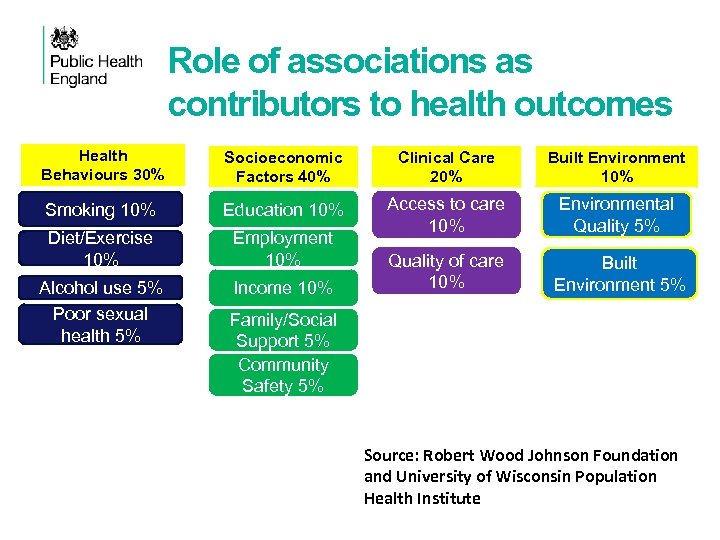
Role of associations as contributors to health outcomes Health Behaviours 30% Socioeconomic Factors 40% Clinical Care 20% Built Environment 10% Smoking 10% Education 10% Diet/Exercise 10% Employment 10% Access to care 10% Environmental Quality 5% Alcohol use 5% Poor sexual health 5% Income 10% Quality of care 10% Built Environment 5% Family/Social Support 5% Community Safety 5% Source: Robert Wood Johnson Foundation and University of Wisconsin Population Health Institute
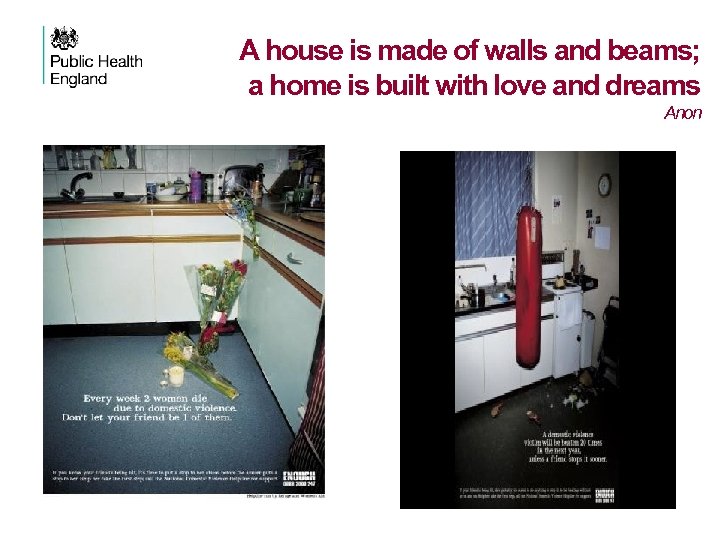
A house is made of walls and beams; a home is built with love and dreams Anon
Priorities and links
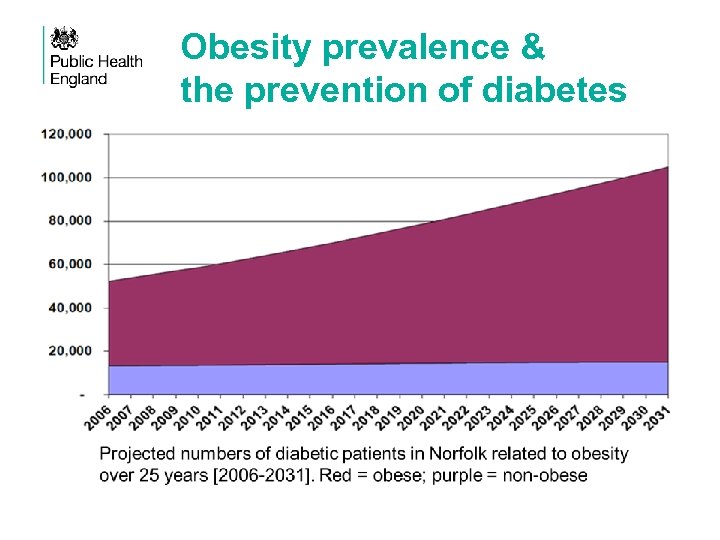
Obesity prevalence & the prevention of diabetes
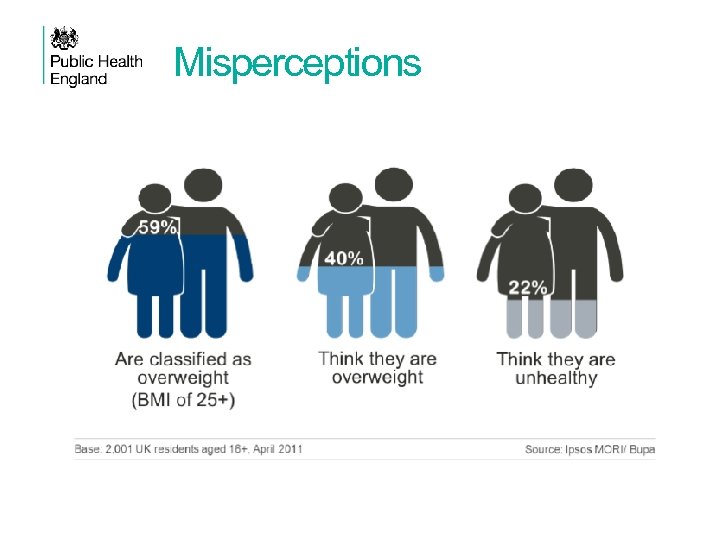
Misperceptions SERTUC Conference – What is happening in Public Health in the South East?
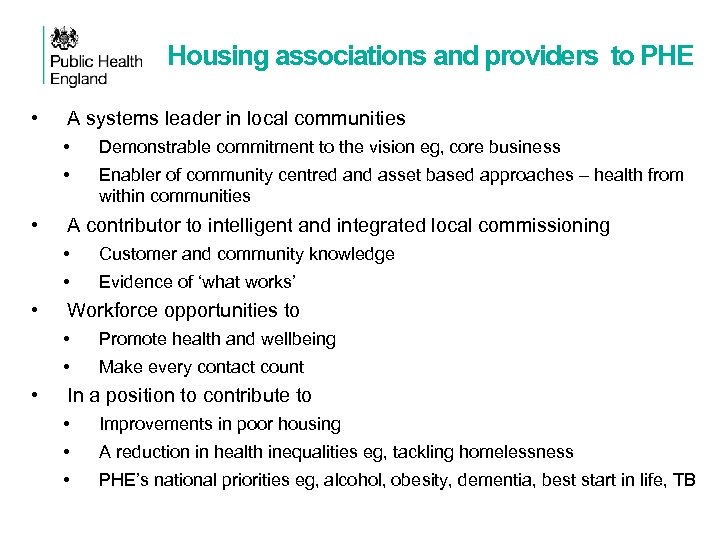
Housing associations and providers to PHE • A systems leader in local communities • • • Customer and community knowledge Evidence of ‘what works’ Workforce opportunities to • • • Enabler of community centred and asset based approaches – health from within communities A contributor to intelligent and integrated local commissioning • • • Demonstrable commitment to the vision eg, core business Promote health and wellbeing Make every contact count In a position to contribute to • • • Improvements in poor housing A reduction in health inequalities eg, tackling homelessness PHE’s national priorities eg, alcohol, obesity, dementia, best start in life, TB
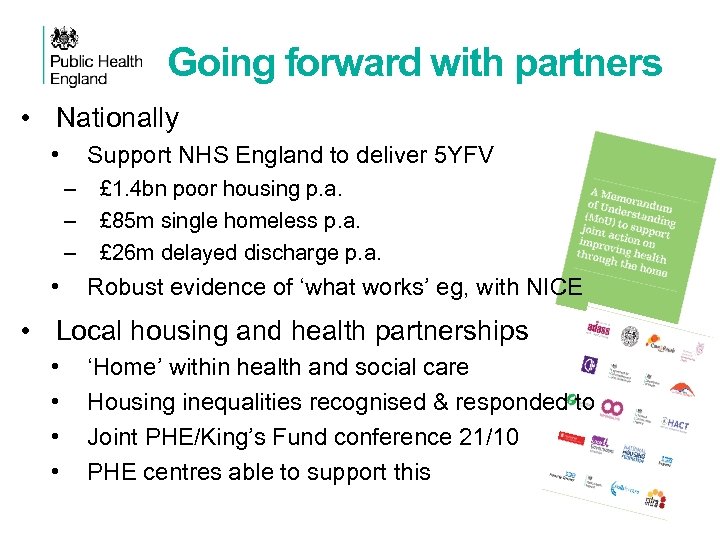
Going forward with partners • Nationally • Support NHS England to deliver 5 YFV – – – • £ 1. 4 bn poor housing p. a. £ 85 m single homeless p. a. £ 26 m delayed discharge p. a. Robust evidence of ‘what works’ eg, with NICE • Local housing and health partnerships • • ‘Home’ within health and social care Housing inequalities recognised & responded to Joint PHE/King’s Fund conference 21/10 PHE centres able to support this
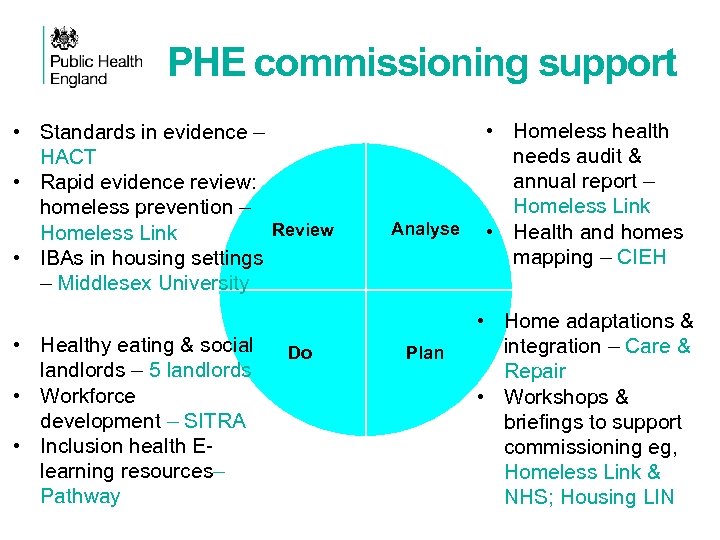
PHE commissioning support • Standards in evidence – HACT • Rapid evidence review: homeless prevention – Review Homeless Link • IBAs in housing settings – Middlesex University • Healthy eating & social landlords – 5 landlords • Workforce development – SITRA • Inclusion health Elearning resources– Pathway Do Analyse Plan • Homeless health needs audit & annual report – Homeless Link • Health and homes mapping – CIEH • Home adaptations & integration – Care & Repair • Workshops & briefings to support commissioning eg, Homeless Link & NHS; Housing LIN
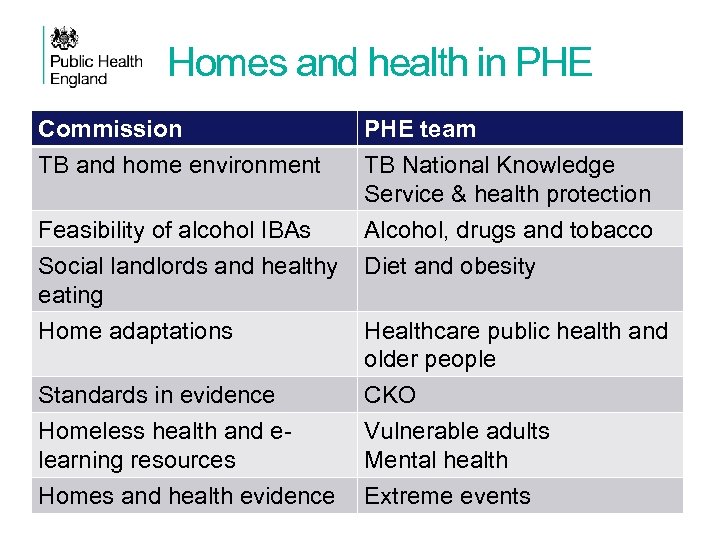
Homes and health in PHE Commission PHE team TB and home environment TB National Knowledge Service & health protection Feasibility of alcohol IBAs Alcohol, drugs and tobacco Social landlords and healthy eating Diet and obesity Home adaptations Healthcare public health and older people Standards in evidence CKO Homeless health and elearning resources Vulnerable adults Mental health Homes and health evidence Extreme events
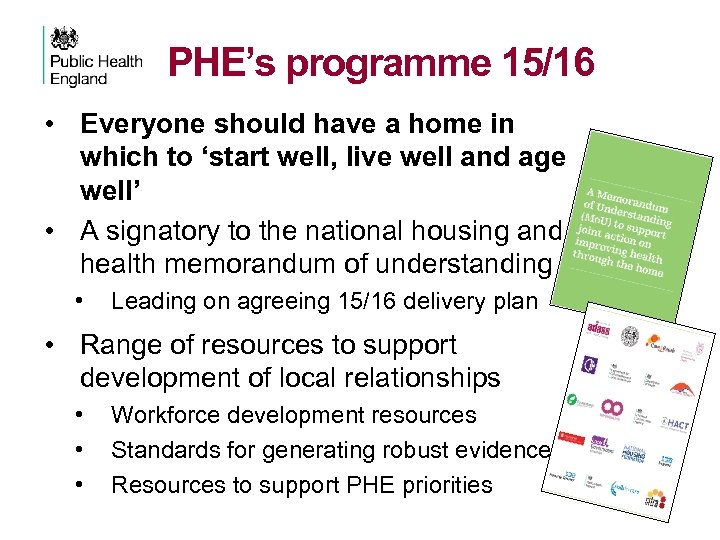
PHE’s programme 15/16 • Everyone should have a home in which to ‘start well, live well and age well’ • A signatory to the national housing and health memorandum of understanding • Leading on agreeing 15/16 delivery plan • Range of resources to support development of local relationships • • • Workforce development resources Standards for generating robust evidence Resources to support PHE priorities
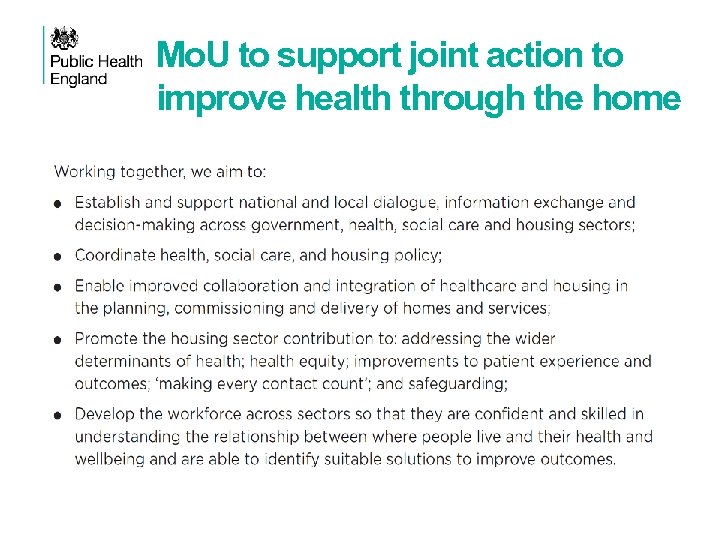
Mo. U to support joint action to improve health through the home
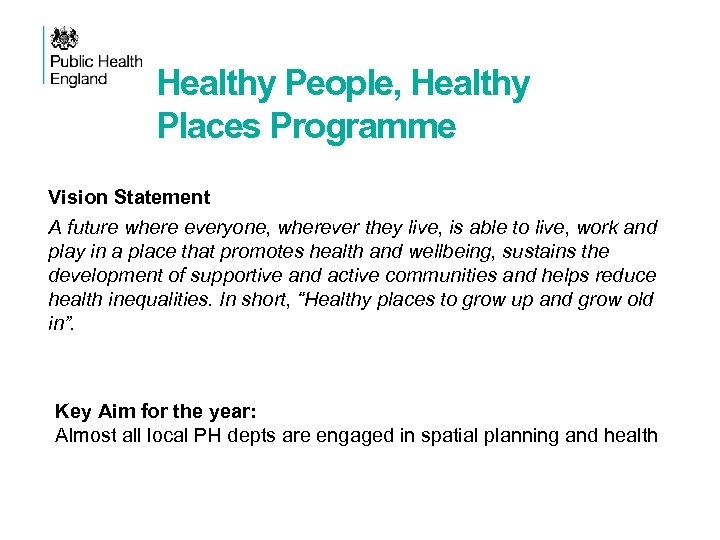
Healthy People, Healthy Places Programme Vision Statement A future where everyone, wherever they live, is able to live, work and play in a place that promotes health and wellbeing, sustains the development of supportive and active communities and helps reduce health inequalities. In short, “Healthy places to grow up and grow old in”. Key Aim for the year: Almost all local PH depts are engaged in spatial planning and health
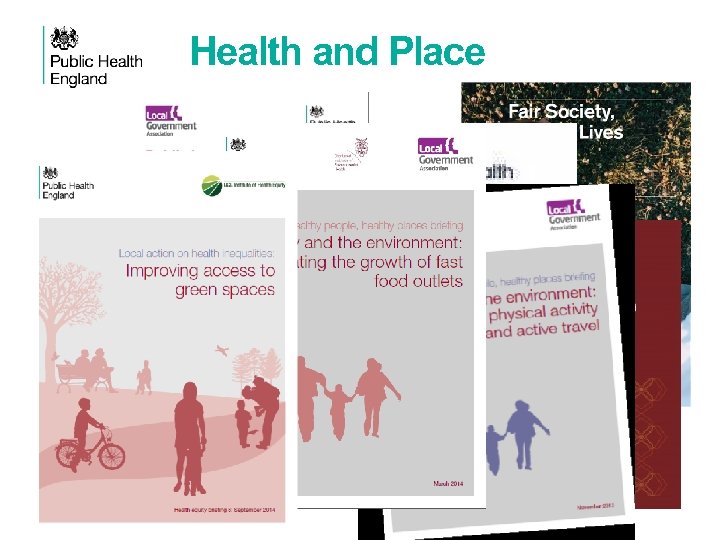
Health and Place
Contact details Jenny. Harries@phe. gov. uk Dr Jenny Harries – Bristol/London Regional Director South Gill. Leng@phe. gov. uk Gill Leng – Manchester National PHE Lead for Housing and Homelessness
National commissioning framework • • No targets or outcomes framework DCLG policy lead but cross-government interest eg, • • DWP: welfare policy BIS: housing market & economy DECC: climate change & fuel poverty DH: health and wellbeing Home Office: reducing re-offending Legislation spans many Acts, very little regulation National housing sector bodies • • No single organisation & can be competition Chartered Institutes: CIH and CIEH Membership bodies eg, Homeless Link, SITRA LGA: reflects elected members interests (see national!)
Local commissioning framework • No duty to commission right home environment • Localism Act 2011 devolved most policy making • Overall reduction in capital & revenue expenditure • Greater role of private, voluntary & community sectors • To achieve ambitions have to look to • • Existing housing specific duties eg, homelessness Existing and emerging related duties eg, Health & Social Care Act 2012, Care Act & Children and Families Act 2014 Policy ‘opportunities’ (wide national interest) New relationships: use of combined intelligence & assets • Complicated - must have a strategy but most don’t
PHE approach to date • Want to set an example • ‘science and art’ and ‘organised efforts of society’ • Listening to national partners & local areas, life course approach • National housing & health memorandum of understanding • Examples of systems-wide support • • Single homeless population healthcare – Homeless Link Resources to support ‘right home’ pathway for TB patients – Our Life • Examples of commissioning support
Скачать презентацию Great Expectations Building Healthy Communities and Homes for
208fa00266eba6a7f18639da57e3b028.ppt