


Great Britain
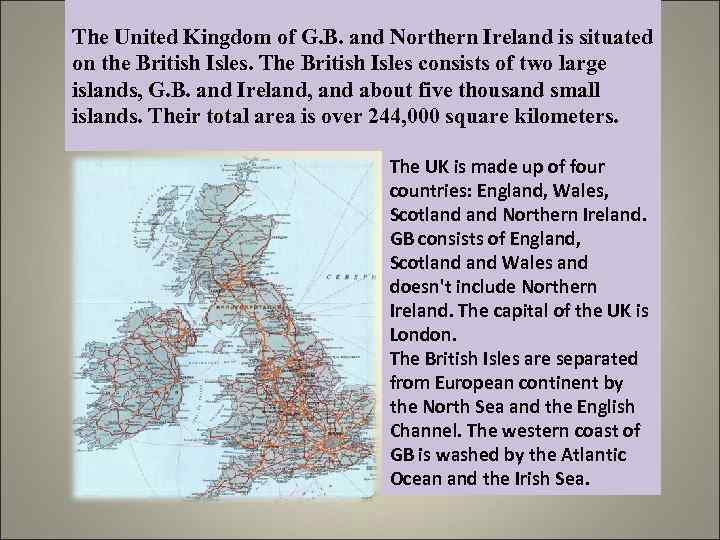
The United Kingdom of G. B. and Northern Ireland is situated on the British Isles. The British Isles consists of two large islands, G. B. and Ireland, and about five thousand small islands. Their total area is over 244, 000 square kilometers. The UK is made up of four countries: England, Wales, Scotland Northern Ireland. GB consists of England, Scotland Wales and doesn't include Northern Ireland. The capital of the UK is London. The British Isles are separated from European continent by the North Sea and the English Channel. The western coast of GB is washed by the Atlantic Ocean and the Irish Sea.
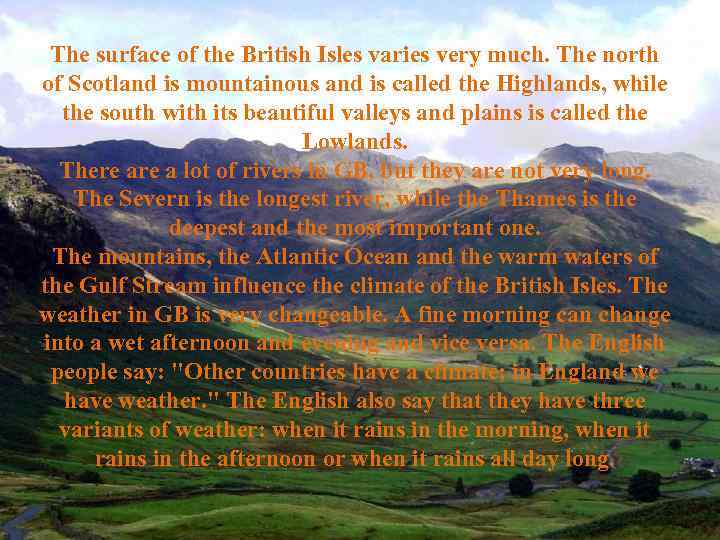
The surface of the British Isles varies very much. The north of Scotland is mountainous and is called the Highlands, while the south with its beautiful valleys and plains is called the Lowlands. There a lot of rivers in GB, but they are not very long. The Severn is the longest river, while the Thames is the deepest and the most important one. The mountains, the Atlantic Ocean and the warm waters of the Gulf Stream influence the climate of the British Isles. The weather in GB is very changeable. A fine morning can change into a wet afternoon and evening and vice versa. The English people say: "Other countries have a climate; in England we have weather. " The English also say that they have three variants of weather: when it rains in the morning, when it rains in the afternoon or when it rains all day long.
Political System of Great Britain
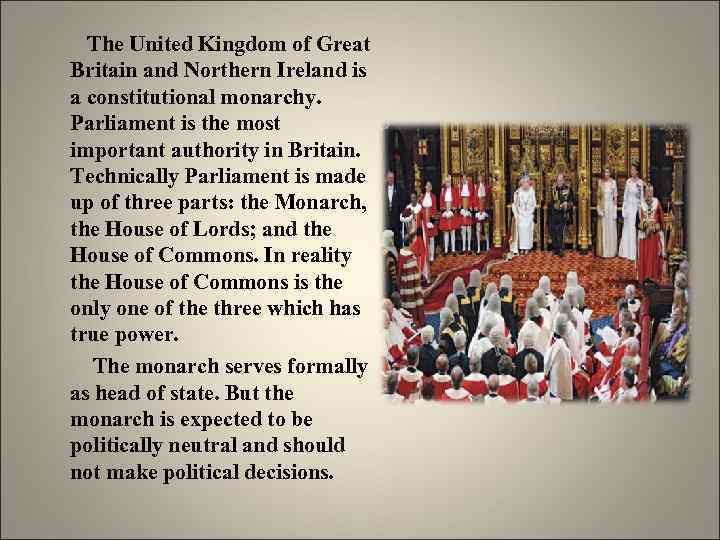
The United Kingdom of Great Britain and Northern Ireland is a constitutional monarchy. Parliament is the most important authority in Britain. Technically Parliament is made up of three parts: the Monarch, the House of Lords; and the House of Commons. In reality the House of Commons is the only one of the three which has true power. The monarch serves formally as head of state. But the monarch is expected to be politically neutral and should not make political decisions.
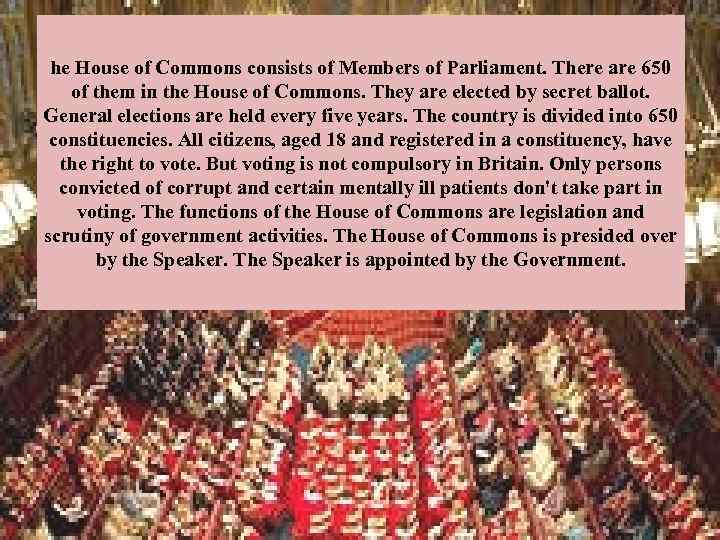
he House of Commons consists of Members of Parliament. There are 650 of them in the House of Commons. They are elected by secret ballot. General elections are held every five years. The country is divided into 650 constituencies. All citizens, aged 18 and registered in a constituency, have the right to vote. But voting is not compulsory in Britain. Only persons convicted of corrupt and certain mentally ill patients don't take part in voting. The functions of the House of Commons are legislation and scrutiny of government activities. The House of Commons is presided over by the Speaker. The Speaker is appointed by the Government.
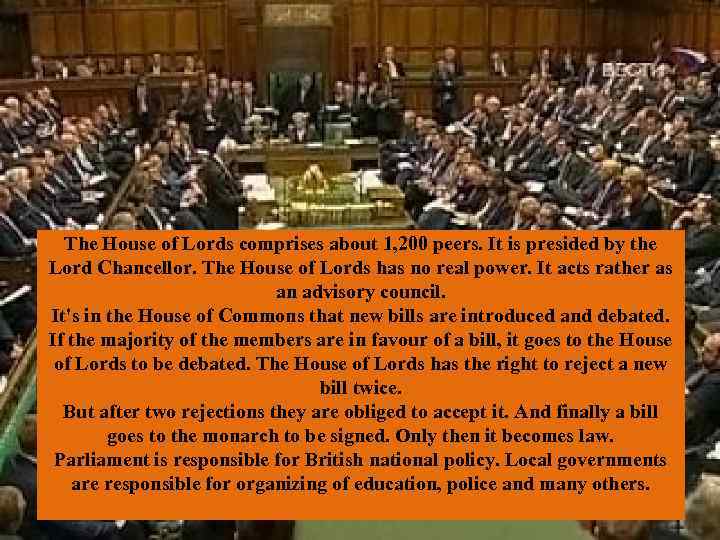
The House of Lords comprises about 1, 200 peers. It is presided by the Lord Chancellor. The House of Lords has no real power. It acts rather as an advisory council. It's in the House of Commons that new bills are introduced and debated. If the majority of the members are in favour of a bill, it goes to the House of Lords to be debated. The House of Lords has the right to reject a new bill twice. But after two rejections they are obliged to accept it. And finally a bill goes to the monarch to be signed. Only then it becomes law. Parliament is responsible for British national policy. Local governments are responsible for organizing of education, police and many others.
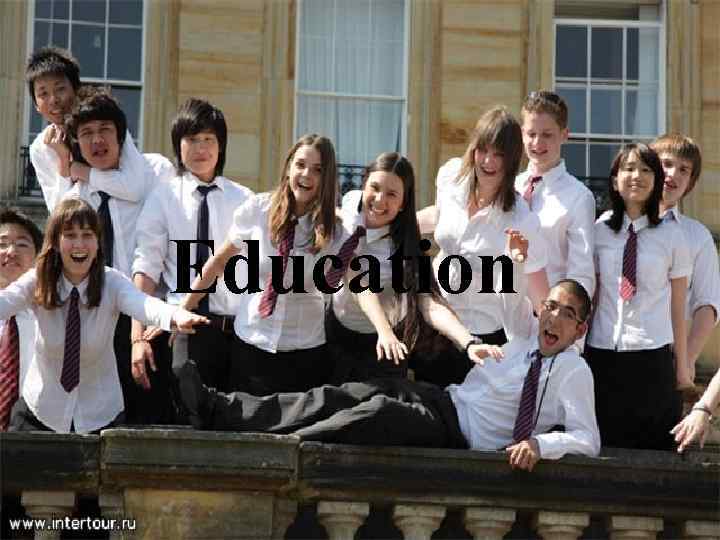
Education
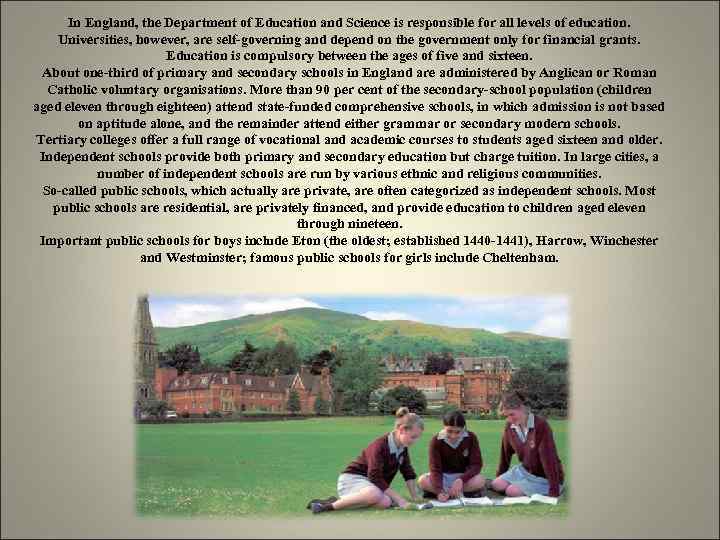
In England, the Department of Education and Science is responsible for all levels of education. Universities, however, are self-governing and depend on the government only for financial grants. Education is compulsory between the ages of five and sixteen. About one-third of primary and secondary schools in England are administered by Anglican or Roman Catholic voluntary organisations. More than 90 per cent of the secondary-school population (children aged eleven through eighteen) attend state-funded comprehensive schools, in which admission is not based on aptitude alone, and the remainder attend either grammar or secondary modern schools. Tertiary colleges offer a full range of vocational and academic courses to students aged sixteen and older. Independent schools provide both primary and secondary education but charge tuition. In large cities, a number of independent schools are run by various ethnic and religious communities. So-called public schools, which actually are private, are often categorized as independent schools. Most public schools are residential, are privately financed, and provide education to children aged eleven through nineteen. Important public schools for boys include Eton (the oldest; established 1440 -1441), Harrow, Winchester and Westminster; famous public schools for girls include Cheltenham.
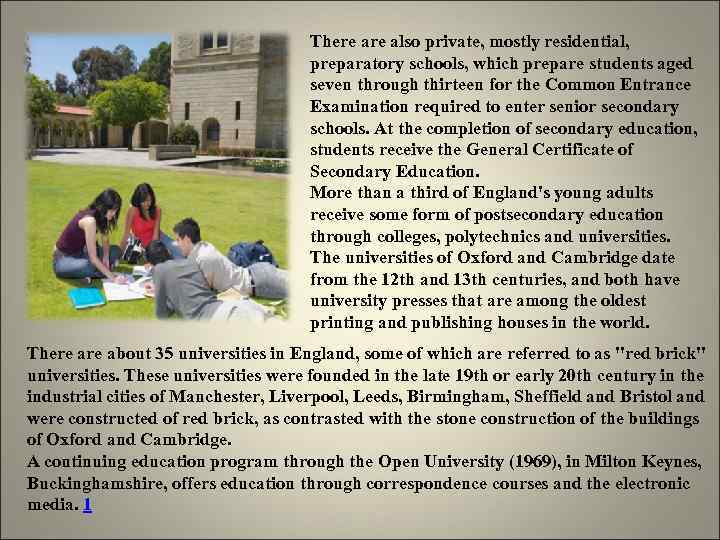
There also private, mostly residential, preparatory schools, which prepare students aged seven through thirteen for the Common Entrance Examination required to enter senior secondary schools. At the completion of secondary education, students receive the General Certificate of Secondary Education. More than a third of England's young adults receive some form of postsecondary education through colleges, polytechnics and universities. The universities of Oxford and Cambridge date from the 12 th and 13 th centuries, and both have university presses that are among the oldest printing and publishing houses in the world. There about 35 universities in England, some of which are referred to as "red brick" universities. These universities were founded in the late 19 th or early 20 th century in the industrial cities of Manchester, Liverpool, Leeds, Birmingham, Sheffield and Bristol and were constructed of red brick, as contrasted with the stone construction of the buildings of Oxford and Cambridge. A continuing education program through the Open University (1969), in Milton Keynes, Buckinghamshire, offers education through correspondence courses and the electronic media. 1
• • • Образование В Англии Министерство образования и науки отвечает за все уровни образования. Однако университетам дается право на самоуправление, и они зависят от центрального правительства только в финансовом отношении. Образование является обязательным с пяти до шестнадцати лет. Около трети начальных и средних школ в Англии управляются добровольными организациями англиканской или римско-католической церквей. Более 90 процентов учеников средней школы (дети в возрасте от одиннадцати до восемнадцати лет) посещают финансируемые государством общеобразовательные школы, куда принимают независимо от способностей, а другие посещают или специализированные школы, или средние современные школы. Училища предлагают студентам в возрасте от шестнадцати лет полный спектр профессионально-технических и академических курсов. Независимые школы дают начальное и среднее образование, но по другой системе. В больших городах некоторое количество независимых школ управляется разными этническими и религиозными общинами. Так называемые публичные школы, которые на самом деле являются частными, часто классифицируют как независимые школы. В большинстве публичных школ предусмотрено проживание, они финансируются из частных средств и предоставляют образование детям в возрасте от одиннадцати до девятнадцати лет. В числе наиболее значительных школ для мальчиков — Итонский колледж (самый старый; основанный в 1440 -1441 гг. ), колледжи в Харроу, Винчестере и Вестминстере; среди известных привилегированных школ для девочек — школа в Челтенхеме. Существуют также частные, в основном — с предусмотренным проживанием, подготовительные школы, которые занимаются подготовкой учеников семи-тринадцати лет к сдаче общего вступительного экзамена, необходимого для того, чтобы попасть в старшие классы средней школы. По окончании среднего образования студенты получают аттестат об общем среднем образовании. Более трети молодых людей Англии получает дополнительное образование в колледжах, институтах и университетах. Университеты в Оксфорде и Кембридже известны с XII и XIII в. , в обоих заведениях издается университетская пресса, они входят в число самых старых издательских домов в мире. В Англии около 35 университетов, некоторые из них называют «краснокирпичными» университетами. Эти университеты были основаны в конце Х 1 Х-начале XX в. в промышленных городах, таких как Манчестер, Ливерпуль, Лидс, Бирмингем, Шеффилд и Бристоль, и были построены из красного кирпича, в отличие от каменных зданий Оксфорда и Кембриджа. Действующая образовательная программа заочного университета (1969), в Милтон Кейнис, Букингемшире, предлагает получить образование заочно через переписку и электронные средства информации.
