 Скачать презентацию GREAT BRITAIN The Union Jack Flag The United
435e06f7d8a68a8802700726581ff2a0.ppt
- Количество слайдов: 167



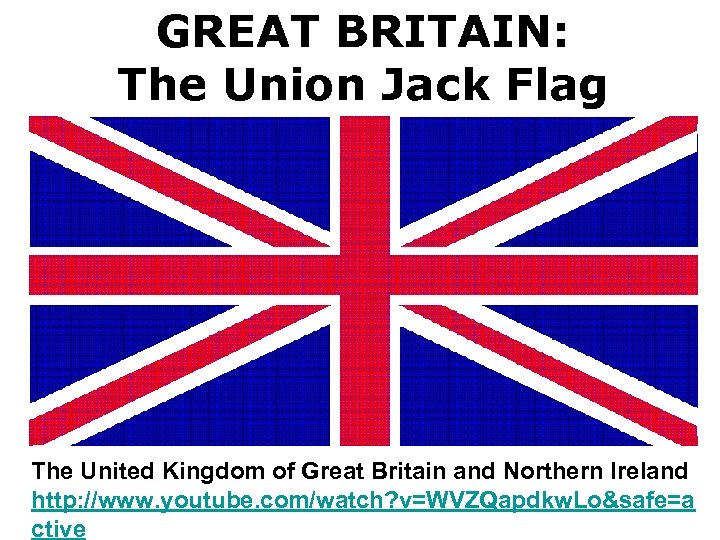
GREAT BRITAIN: The Union Jack Flag The United Kingdom of Great Britain and Northern Ireland http: //www. youtube. com/watch? v=WVZQapdkw. Lo&safe=a ctive
On England William Shakespeare: "Richard II" Act 2, Scene 1, 32~48 "This royal throne of Kings, this scepter'd isle, This Earth of majesty, this seat of Mars, This other Eden, demi~paradise, This fortress built by Nature for herself, Against infection and the hand of war, This happy breed of men, this little world, This precious stone set in the silver sea, Which serves it in the office of a wall, Or as a moat defensive to a house, Against the envy of less happier lands, This blessed plot, this Earth, this Realm, this England. "
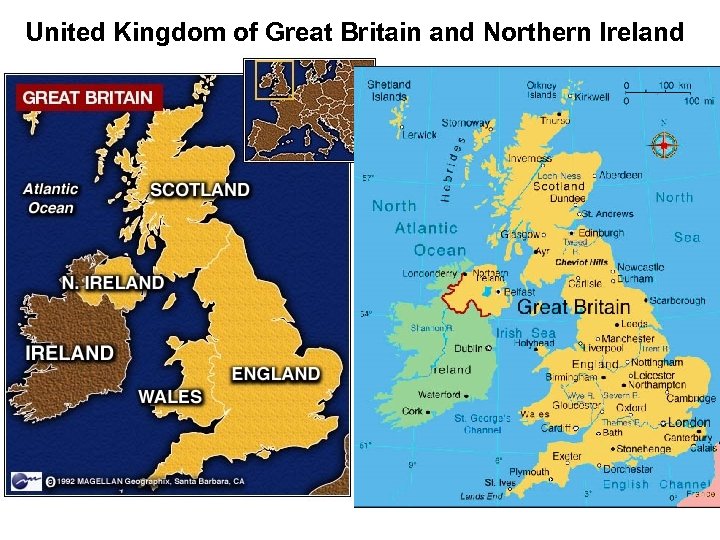
United Kingdom of Great Britain and Northern Ireland
The Difference between the United Kingdom, Great Britain and England Explained • http: //www. youtube. com/watch? v=r. Nu 8 XD BSn 10&safe=active
Great Britain or Little England? Is the UK a nation, a state, and/ or a nation state?
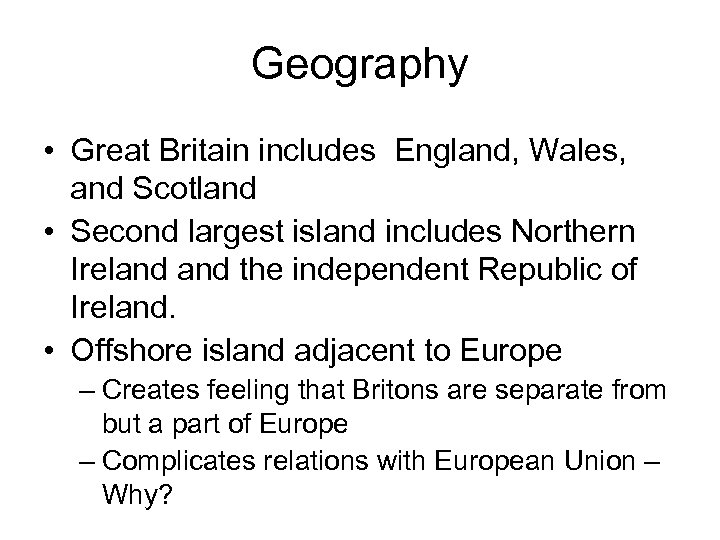
Geography • Great Britain includes England, Wales, and Scotland • Second largest island includes Northern Ireland the independent Republic of Ireland. • Offshore island adjacent to Europe – Creates feeling that Britons are separate from but a part of Europe – Complicates relations with European Union – Why?
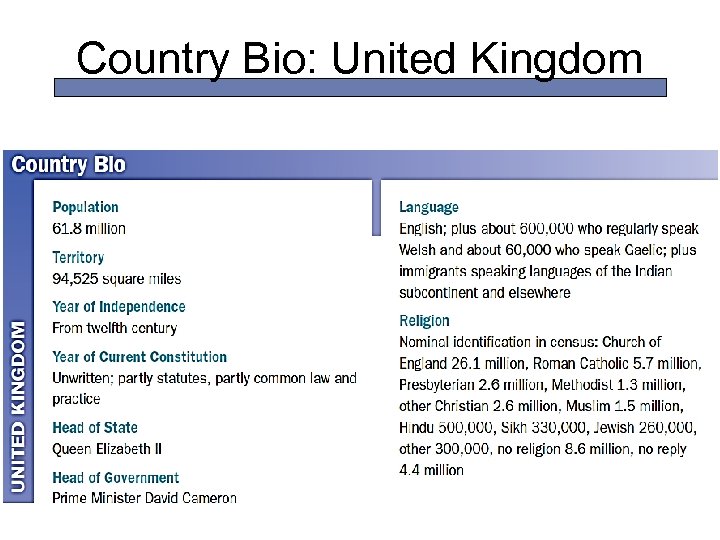
Country Bio: United Kingdom
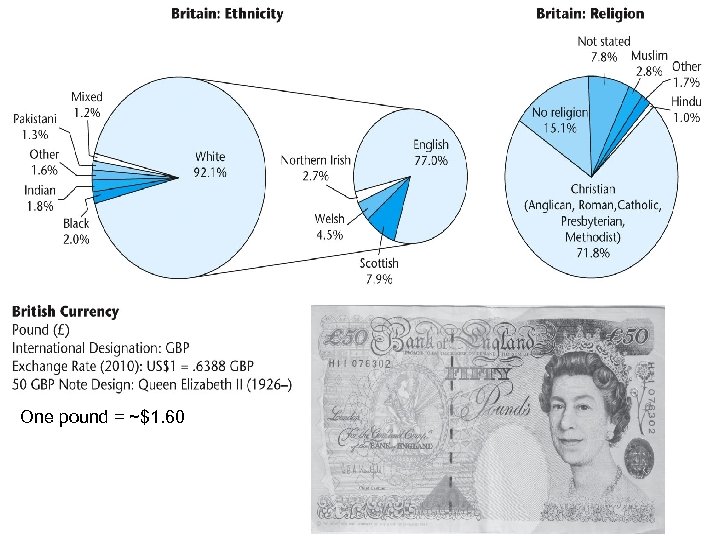
One pound = ~$1. 60
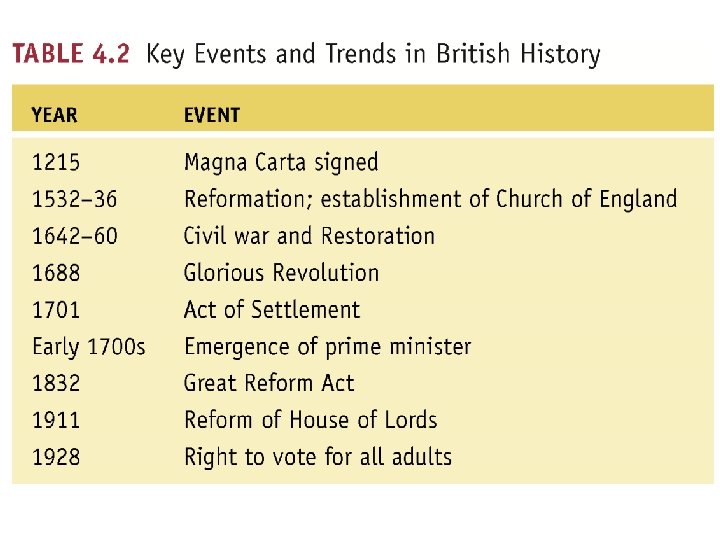
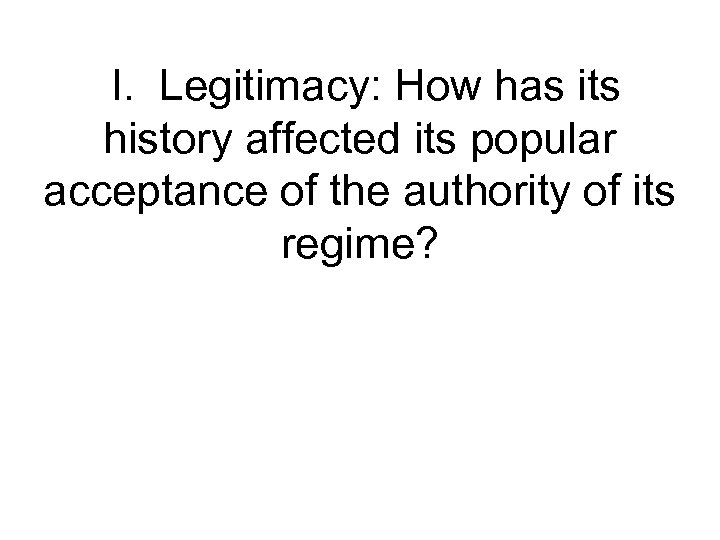
I. Legitimacy: How has its history affected its popular acceptance of the authority of its regime?
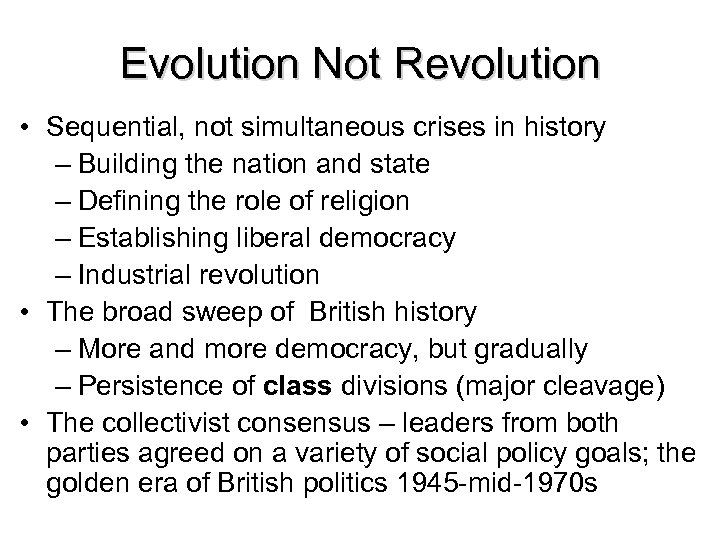
Evolution Not Revolution • Sequential, not simultaneous crises in history – Building the nation and state – Defining the role of religion – Establishing liberal democracy – Industrial revolution • The broad sweep of British history – More and more democracy, but gradually – Persistence of class divisions (major cleavage) • The collectivist consensus – leaders from both parties agreed on a variety of social policy goals; the golden era of British politics 1945 -mid-1970 s
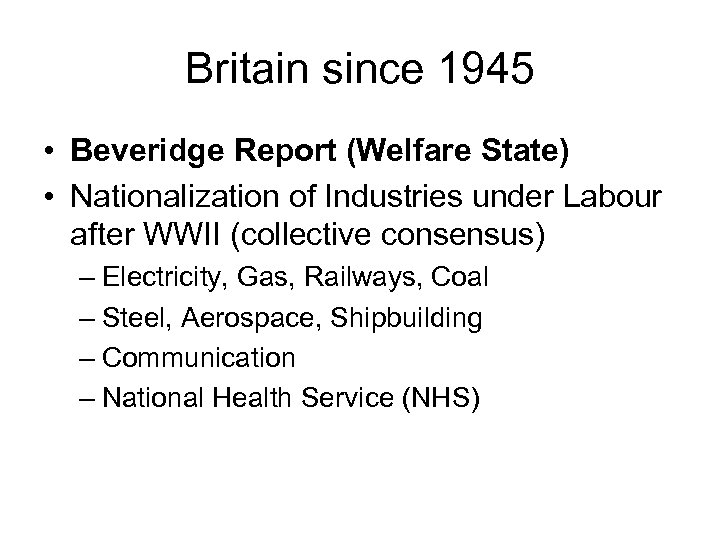
Britain since 1945 • Beveridge Report (Welfare State) • Nationalization of Industries under Labour after WWII (collective consensus) – Electricity, Gas, Railways, Coal – Steel, Aerospace, Shipbuilding – Communication – National Health Service (NHS)
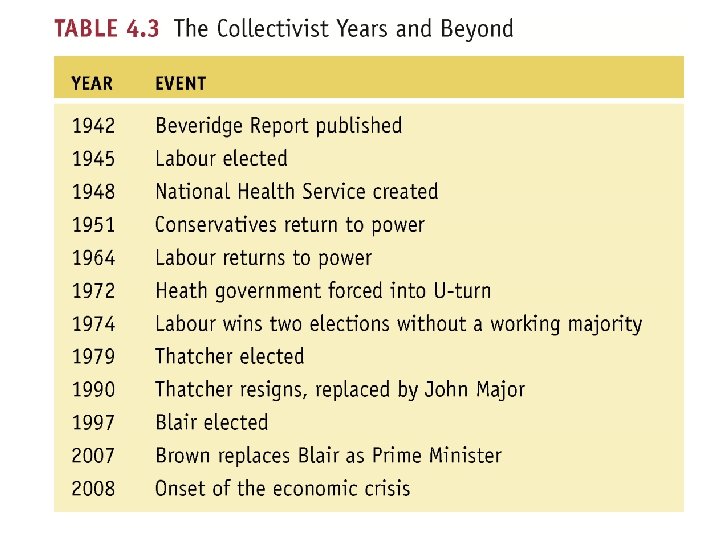
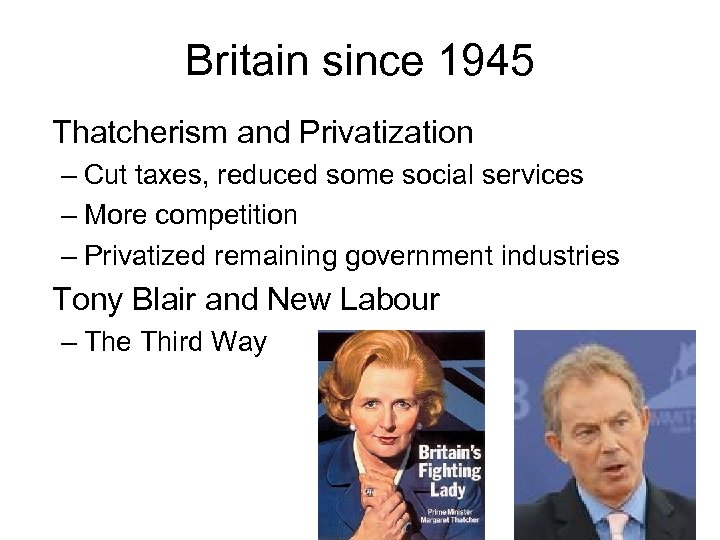
Britain since 1945 Thatcherism and Privatization – Cut taxes, reduced some social services – More competition – Privatized remaining government industries Tony Blair and New Labour – The Third Way
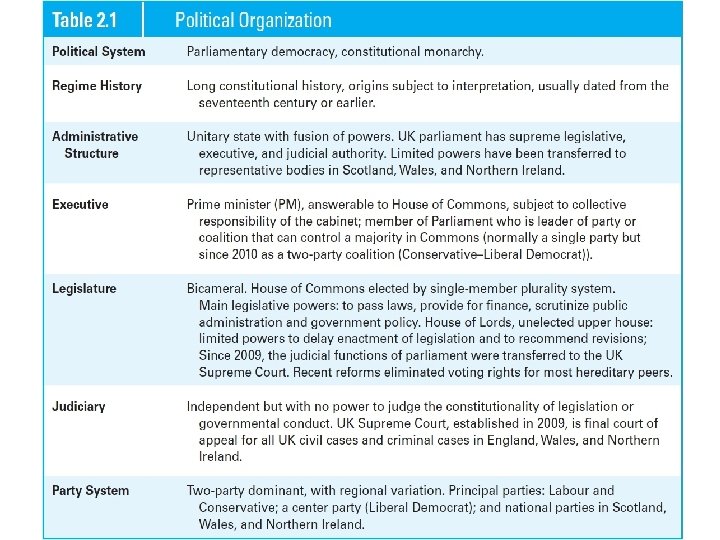
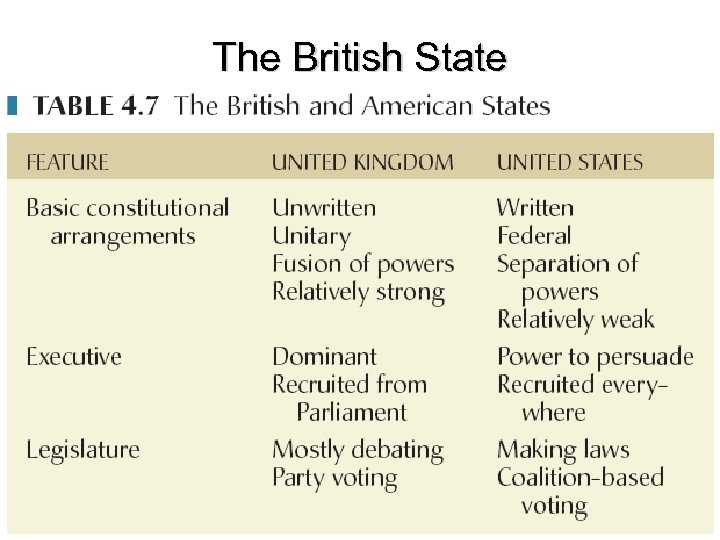
The Structure of Government • Constitutional Monarchy – Crown passes by hereditary succession, but powers constrained • Crown rather than a constitution symbolizes the authority of government. – Monarch only ceremonial head of state. • What constitutes the Crown? – Government – Whitehall – (Home of government officials, the bureaucracy) – 10 Downing Street – home of the PM (White House) – Westminster- Home of Parliament (Congress) – Buckingham Palace (London home of the royals)
The Structure of Government – Unwritten constitution: • Acts Of Parliament • Judicial Pronouncements (common law) • Customs and Conventions • Few constraints in unwritten constitution: – Vagueness makes it flexible – Can be changed by majority vote in Parliament or by government choosing to act in unprecedented manner – English courts claim no power to declare act of Parliament unconstitutional
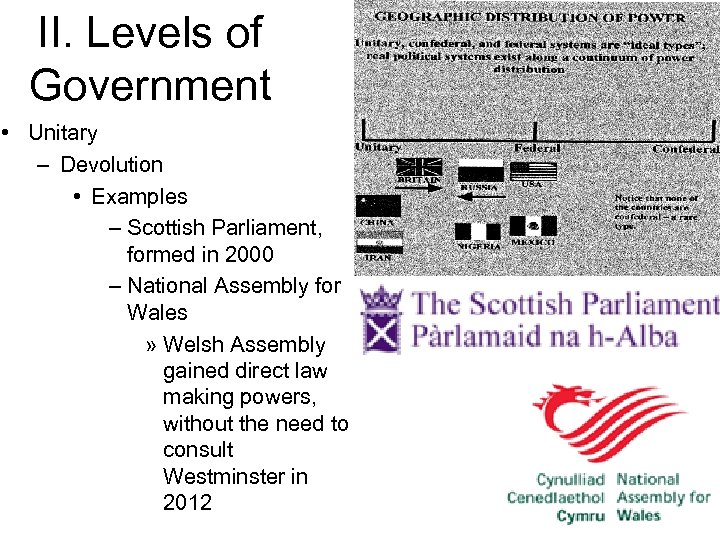
II. Levels of Government • Unitary – Devolution • Examples – Scottish Parliament, formed in 2000 – National Assembly for Wales » Welsh Assembly gained direct law making powers, without the need to consult Westminster in 2012
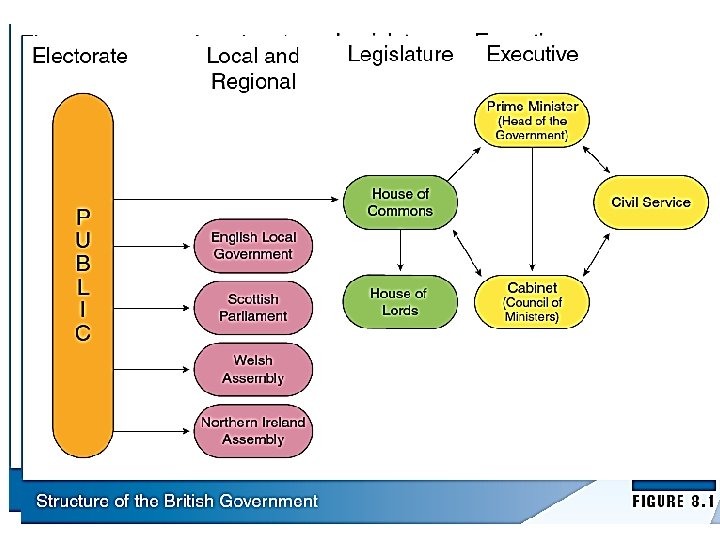
Crown
Central Authority and Decentralized Delivery of Policies § Unitary state, political authority is centralized § Decisions are binding on public agencies through Acts of Parliament and regulations § Treasury must authorize expenditures before bill can be put to Parliament § Minister must pilot bill through Parliament § Minister may also negotiate agreement with public agencies outside and with affected interest groups § Seems obvious…
Decentralized Delivery of Policies – Examples of Devolution § Local government is subordinate to central government § Scotland Wales now have representative assemblies § Local council elections fought on party lines § Local government divided into two tiers of county, district councils, each with responsibility for local services § Central government grants are largest source of local government revenue – how can this affect devolution?
Central Authority and Decentralized Delivery of Policies § Nonelected Institutions: § Executive agencies § National Health Service (NHS) § Quasi-Autonomous Nongovernmental Organizations – (see next slide) • Regional Development Agencies (RDAs) were introduced in 1999 to facilitate economic development at the regional level. • May 2000, reforms led to the election of mayors and decentralizing of power
Devolution § Nondepartmental Public Bodies (NDPBs)— receive government funding, function, and appointment of staff but do not operate under direct control of ministers. § Also known as quasi-nongovernmental organizations (quangos) quangos § Increasing policy influence and political advantages – Why? § Combine government and private expertise § Allows ministers distance from controversial policy
Scottish Referendum for Independence, 2014 § "Should Scotland be an independent country? " § Failed § 45% Yes § 55% No § 85% voter turnout § 16 year-olds could vote § Would have been legally binding § 3 major parties campaigned against it § Will not be held again, a one-time deal
democratic deficit § Occurs when ostensibly democratic organizations or institutions (particularly governments) fall short of fulfilling the principles of democracy in their practices or operation where representative and linked parliamentary integrity becomes widely discussed § The perceived democratic deficit arises in Scotland when the UK political system returns a government that doesn't reflect the decisions of the electorate in Scotland. § From 1979 until 1997 general election, the Conservative Government appeared to have little political mandate in Scotland. § The Conservative party have led a coalition government despite only having 1 of the 59 MPs for Scotland. § Scottish independence is partially motivated by this perceived deficit which, by May 2013, can be viewed as arising 62% of the time since May 1979 (21 years from the last 34).
§ http: //www. theguardian. com/politics/vi deo/2014/sep/17/scottish-referendumexplained-for-non-brits-video
Party in the UK- Miley § https: //www. youtube. com/watch? v=Ee esj 8 HI 5 Ho
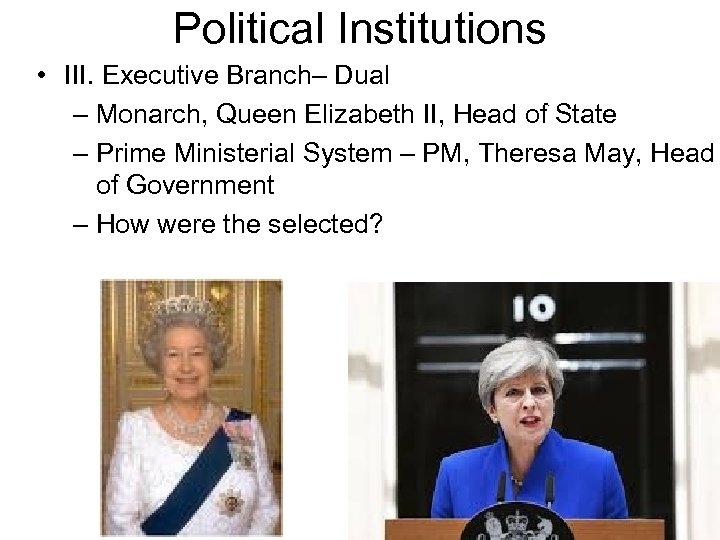
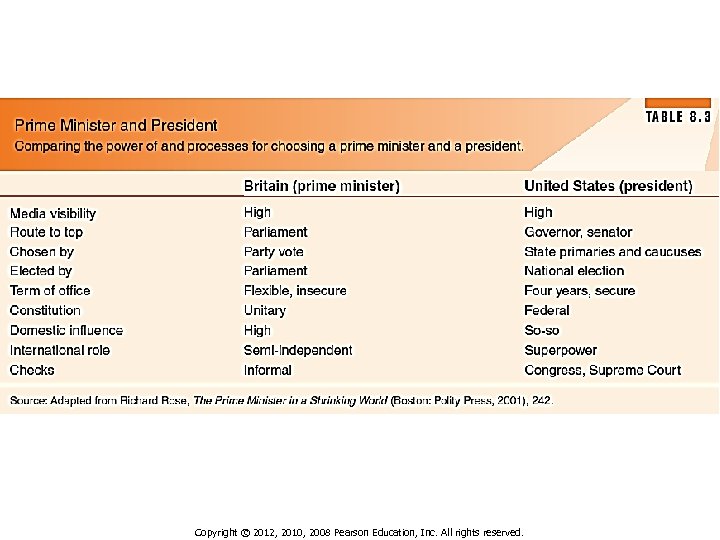
Political Institutions • III. Executive Branch– Dual – Monarch, Queen Elizabeth II, Head of State – Prime Ministerial System – PM, Theresa May, Head of Government – How were the selected?
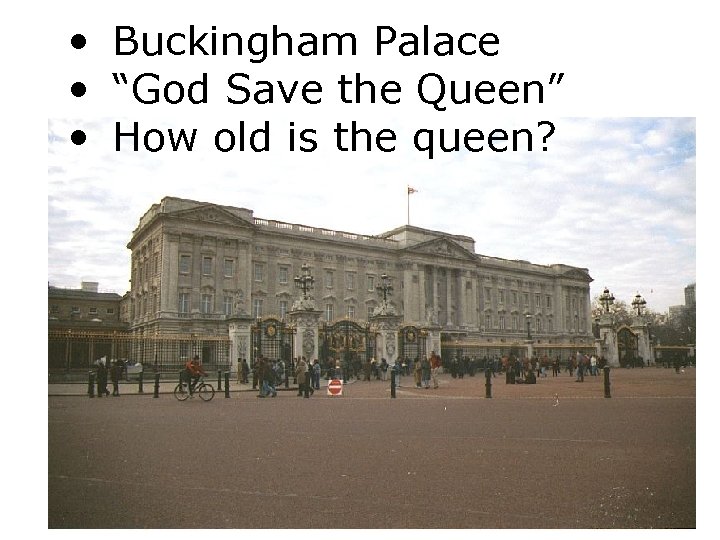
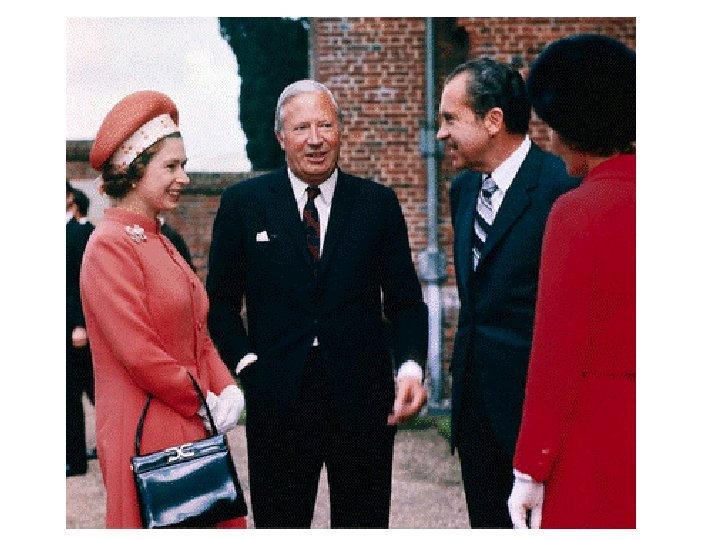
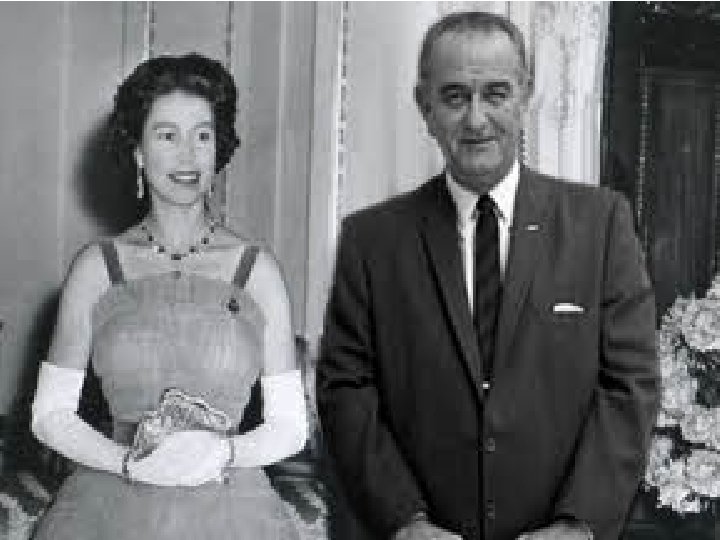
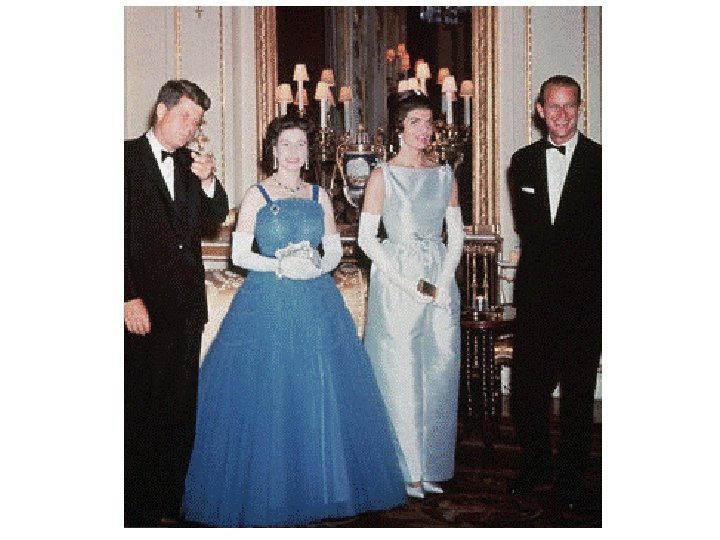
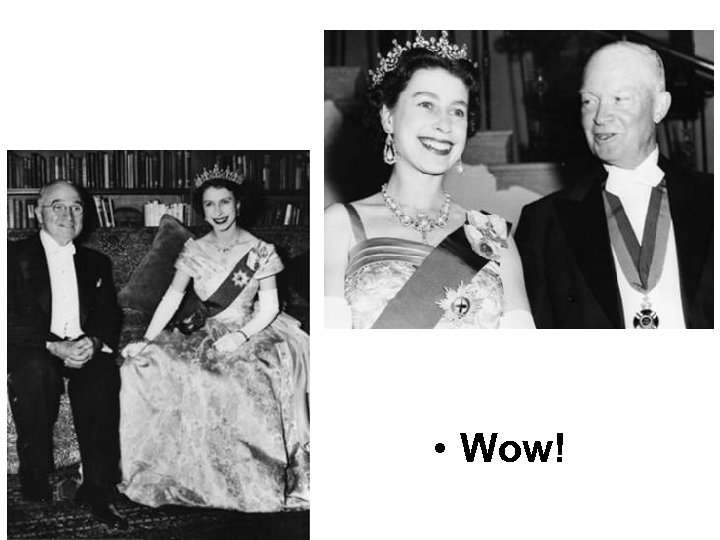
• Buckingham Palace • “God Save the Queen” • How old is the queen?
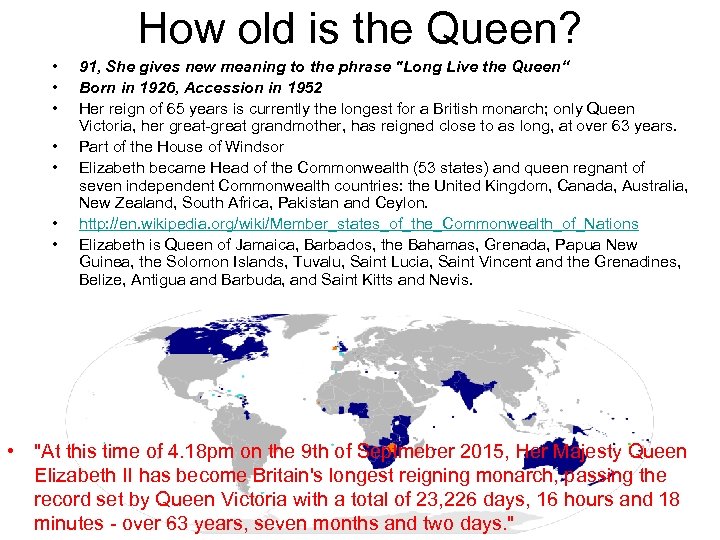
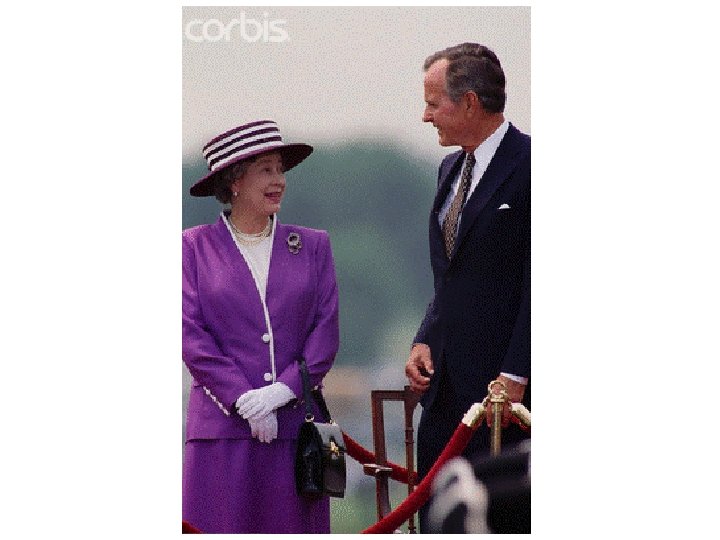
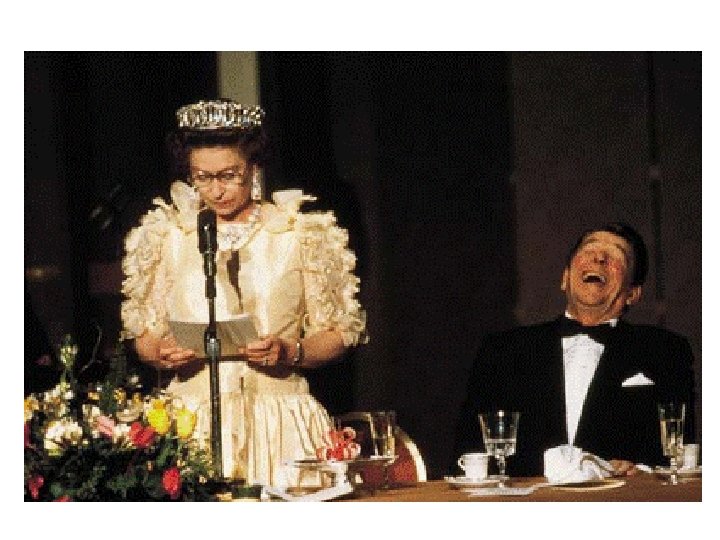
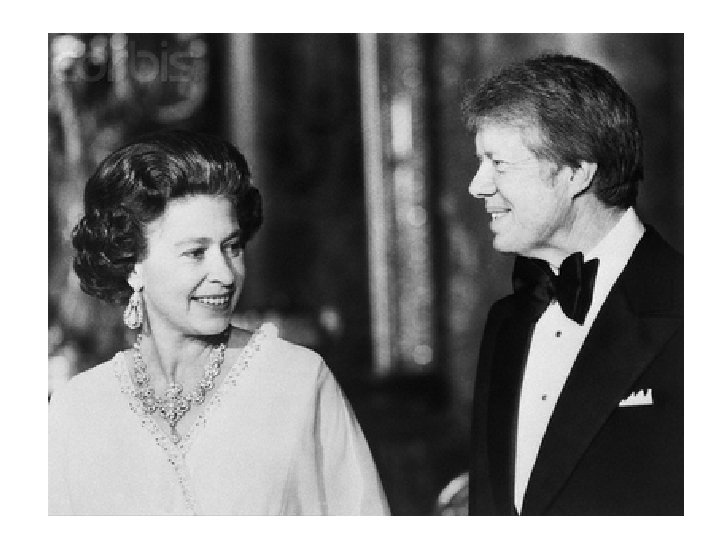
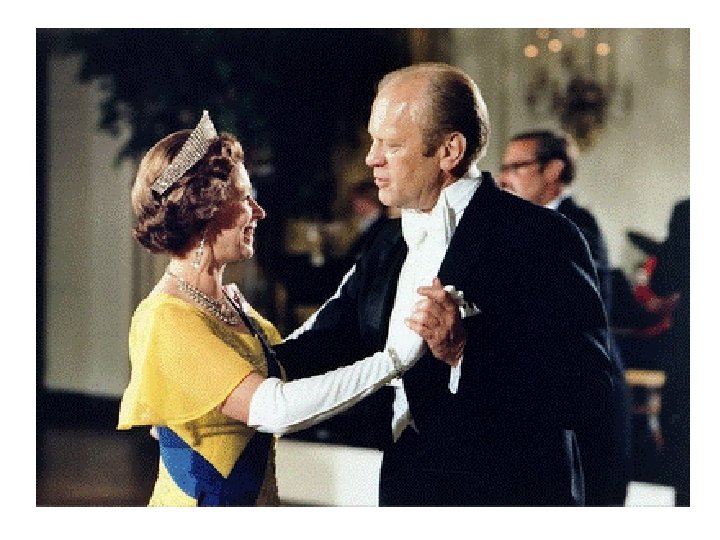
How old is the Queen? • • 91, She gives new meaning to the phrase "Long Live the Queen“ Born in 1926, Accession in 1952 Her reign of 65 years is currently the longest for a British monarch; only Queen Victoria, her great-great grandmother, has reigned close to as long, at over 63 years. Part of the House of Windsor Elizabeth became Head of the Commonwealth (53 states) and queen regnant of seven independent Commonwealth countries: the United Kingdom, Canada, Australia, New Zealand, South Africa, Pakistan and Ceylon. http: //en. wikipedia. org/wiki/Member_states_of_the_Commonwealth_of_Nations Elizabeth is Queen of Jamaica, Barbados, the Bahamas, Grenada, Papua New Guinea, the Solomon Islands, Tuvalu, Saint Lucia, Saint Vincent and the Grenadines, Belize, Antigua and Barbuda, and Saint Kitts and Nevis. • "At this time of 4. 18 pm on the 9 th of Septmeber 2015, Her Majesty Queen Elizabeth II has become Britain's longest reigning monarch, passing the record set by Queen Victoria with a total of 23, 226 days, 16 hours and 18 minutes - over 63 years, seven months and two days. "
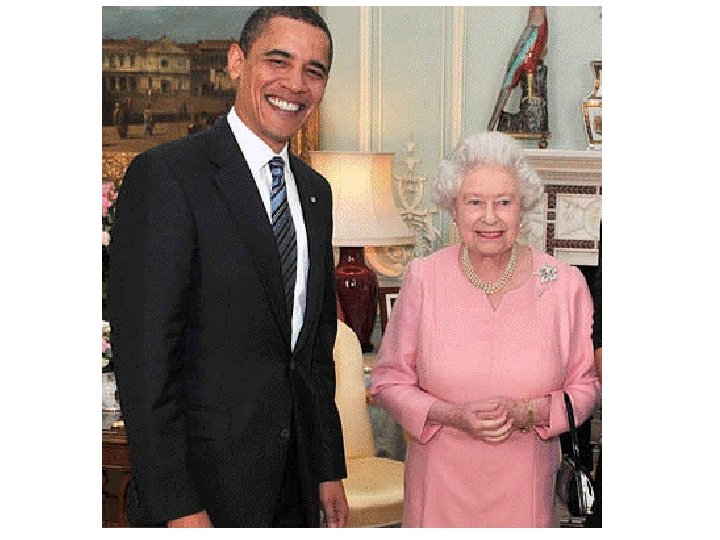
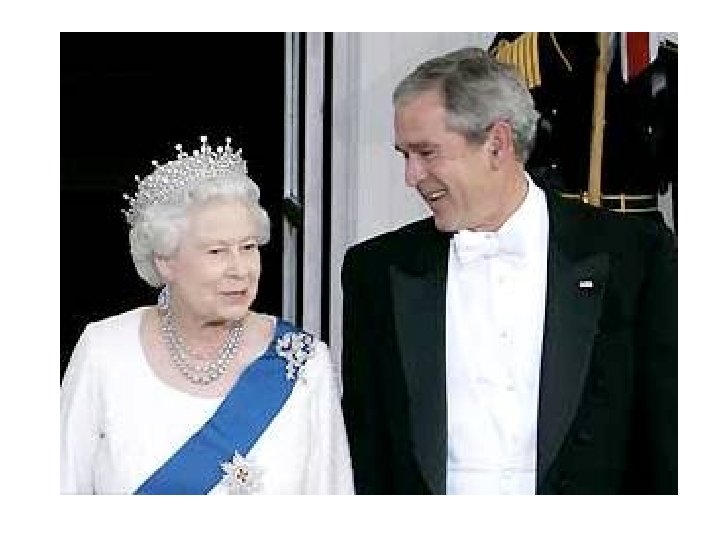
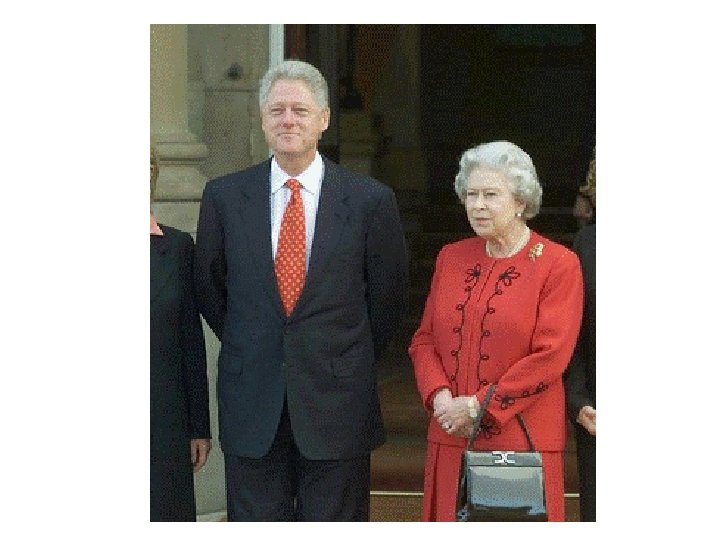
• Wow!
True cost of royals • http: //www. youtube. com/watch? v=bhy. Ygn hh. KFw&safe=active • How to become a royal? • http: //www. youtube. com/watch? v=BUY 6 H Gq. Ywe. Q&safe=active
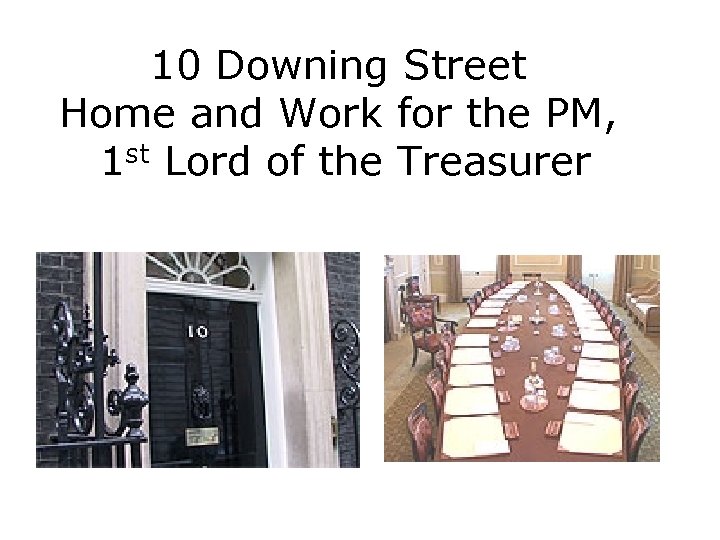
10 Downing Street Home and Work for the PM, 1 st Lord of the Treasurer
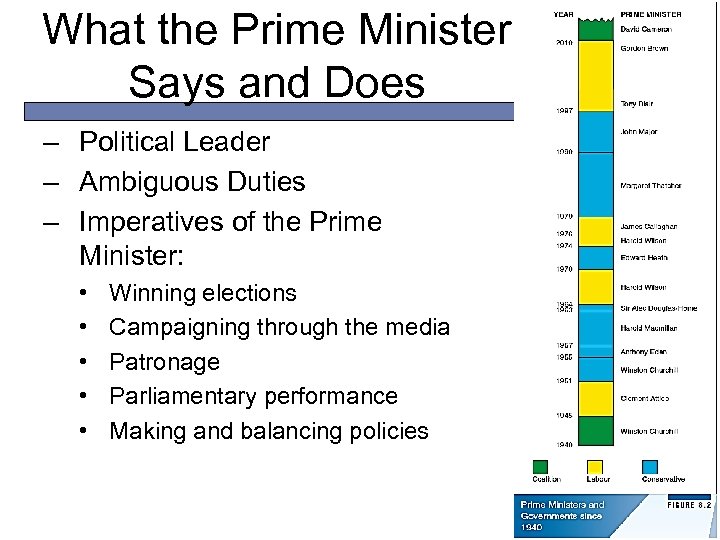
What the Prime Minister Says and Does – Political Leader – Ambiguous Duties – Imperatives of the Prime Minister: • • • Winning elections Campaigning through the media Patronage Parliamentary performance Making and balancing policies
Copyright © 2012, 2010, 2008 Pearson Education, Inc. All rights reserved.
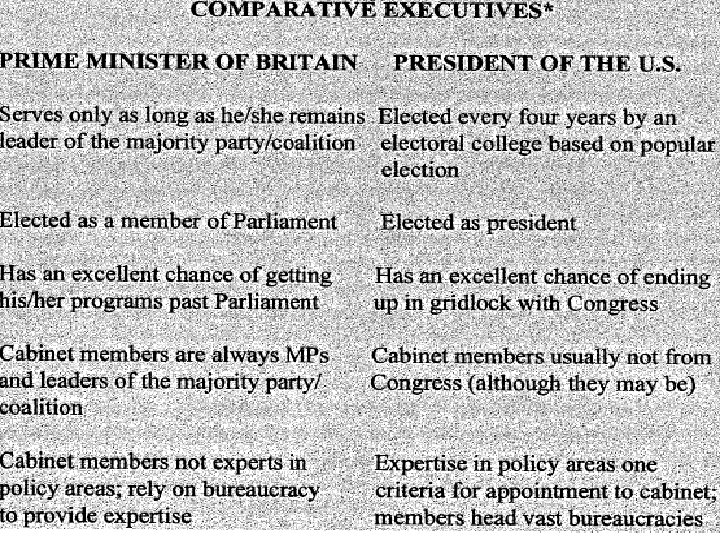
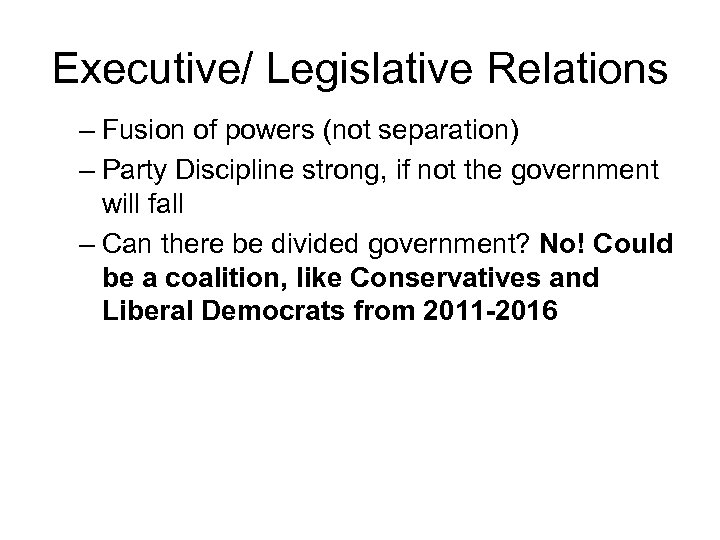
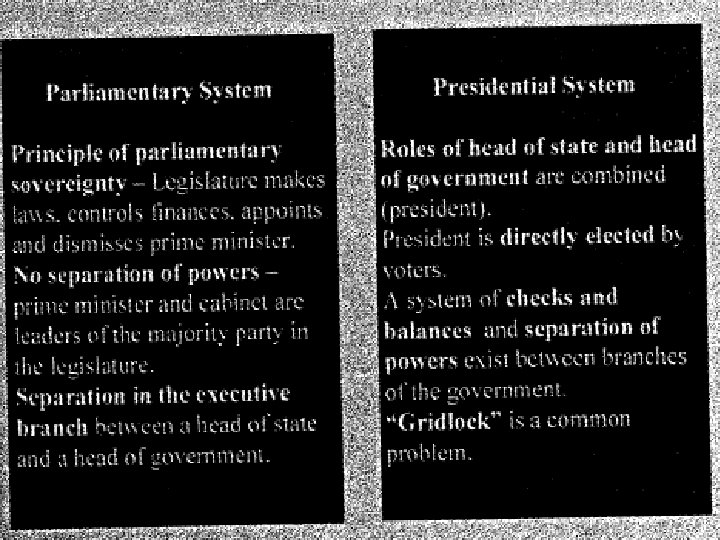
Executive/ Legislative Relations – Fusion of powers (not separation) – Party Discipline strong, if not the government will fall – Can there be divided government? No! Could be a coalition, like Conservatives and Liberal Democrats from 2011 -2016
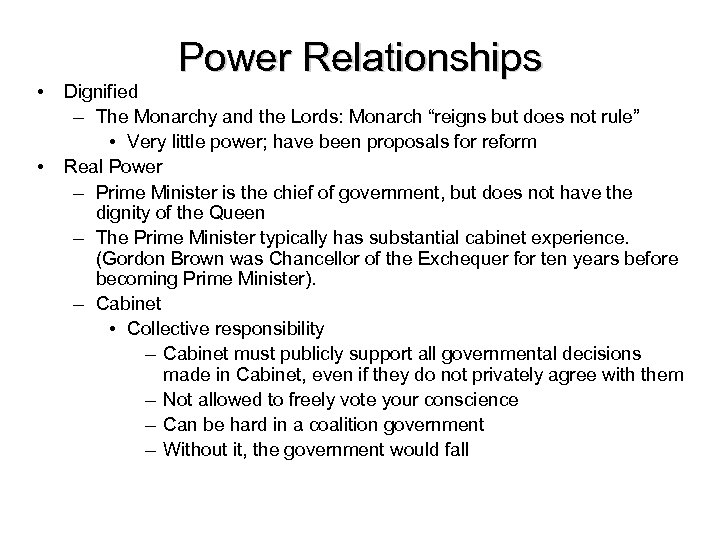
• • Power Relationships Dignified – The Monarchy and the Lords: Monarch “reigns but does not rule” • Very little power; have been proposals for reform Real Power – Prime Minister is the chief of government, but does not have the dignity of the Queen – The Prime Minister typically has substantial cabinet experience. (Gordon Brown was Chancellor of the Exchequer for ten years before becoming Prime Minister). – Cabinet • Collective responsibility – Cabinet must publicly support all governmental decisions made in Cabinet, even if they do not privately agree with them – Not allowed to freely vote your conscience – Can be hard in a coalition government – Without it, the government would fall
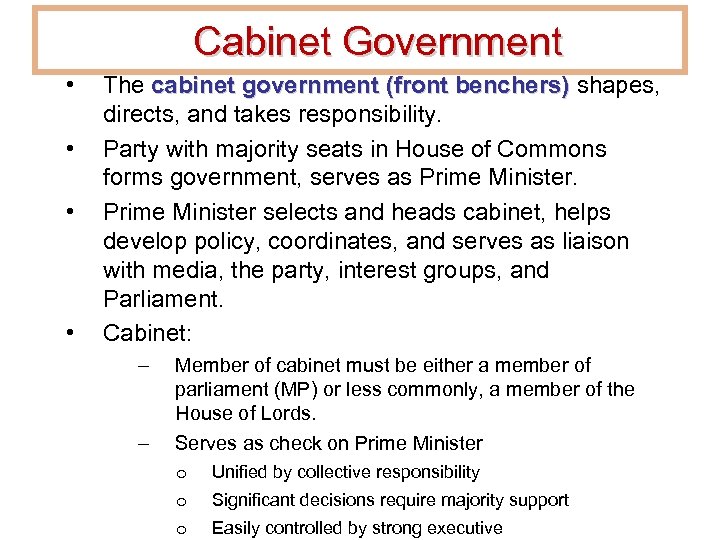
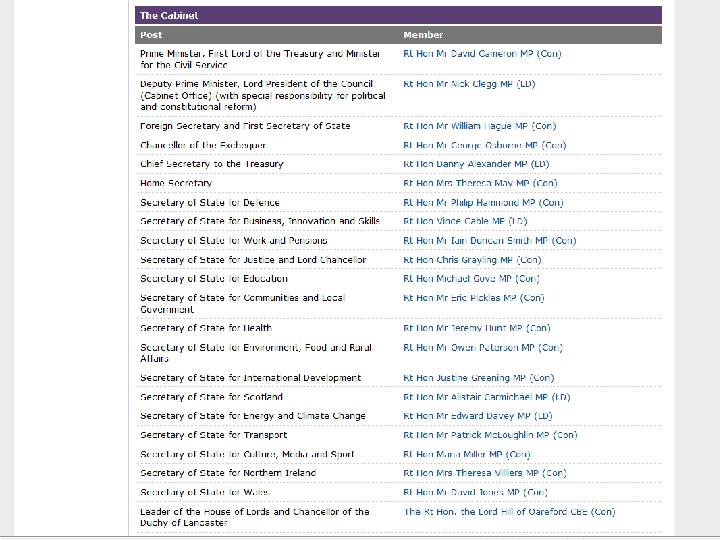
Cabinet Government • • The cabinet government (front benchers) shapes, cabinet government (front benchers) directs, and takes responsibility. Party with majority seats in House of Commons forms government, serves as Prime Minister selects and heads cabinet, helps develop policy, coordinates, and serves as liaison with media, the party, interest groups, and Parliament. Cabinet: – – Member of cabinet must be either a member of parliament (MP) or less commonly, a member of the House of Lords. Serves as check on Prime Minister o o o Unified by collective responsibility Significant decisions require majority support Easily controlled by strong executive
Political Institutions Review Cabinet Government (Cont’d) • Work of cabinet supported by – – – Cabinet committees (ministers) Official committees (civil servants) Treasury (through budget) Whips (legislation passage) Ministerial Responsibility (Collective Responsibility) Bureaucracy/ Whitehall
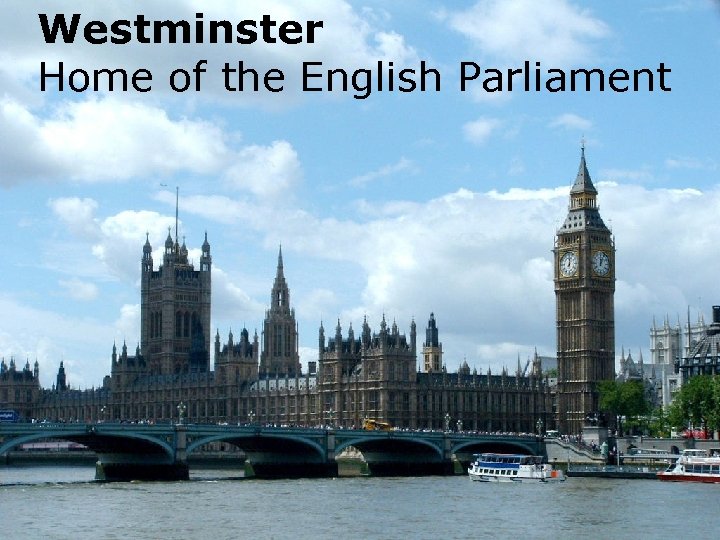
Westminster Home of the English Parliament
IV. Legislative Branch • Bicameral/ Asymmetric • House of Commons (650)/ House of Lords (roughly 788) – Front vs. Backbenchers • Selection Process – Lords, Commons • Electoral System- Parliamentary system – Single Member Districts – Plurality Elections – First Past the Post
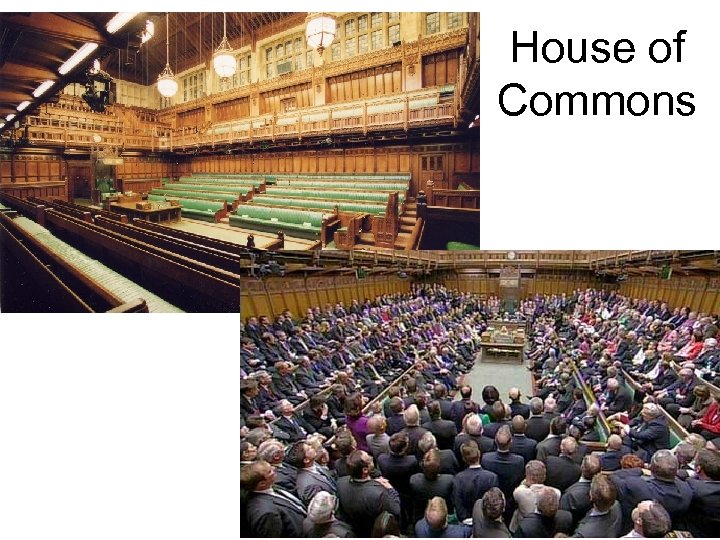
House of Commons
Parliamentary Sovereignty • Holds that the legislative body has absolute sovereignty, and is supreme over all other government institutions, including executive or judicial bodies. • The legislative body may change or repeal any previous legislation, and so that it is not bound by written law (in some cases, even a constitution) or by precedent. • Contrast with the doctrine of separation of powers, which limits the legislature's scope • Concept has been limited by the EU
House of Commons • • 650 Members, each representing about 65, 000 constituents Pass laws Authorize taxing and spending Review and scrutinize public administration and government policy • Visible arena for debate, i. e. PM Question Time – other ministers, too – Hour once a week where PM and cabinet must defend positions – Speaker of the House presides over, job to ensure order and all get to speak – Place for a MP (Member of Parliament) to gain attention – Important check and balance on the majority party • Committees today serve as watchdogs, scrutinizing the workings of each ministry
What are backbenchers? • Is a Member of Parliament (MP) or a legislator who does not hold governmental office and is not a Front Bench spokesperson in the Opposition, being instead a member of the "rank and file“ • A backbencher may be a new parliamentary member yet to receive high office, a senior figure dropped from government, or someone who for whatever reason is not chosen to sit either in the ministry or the opposition Shadow Ministry. • Not a reliable supporter of all of their party's goals and policies. • Do not have much power to influence government policy. • May play a role in providing services to their constituents and in relaying the opinions of their constituents. – Shadow Government • New Cabinet if the opposition party would win office
• • What is a 3 line whip? A single-line whip is a guide to what the party's policy would indicate, and notification of when the vote is expected to take place; this is non-binding for attendance or voting. A two-line whip, sometimes known as a double-line whip, is an instruction to attend and vote; partially binding for voting, attendance required unless prior permission given by the whip. A three-line whip is a strict instruction to attend and vote, breach of which would normally have serious consequences. Permission not to attend may be given by the whip, but a serious reason is needed. Breach of a three-line whip can lead to expulsion from the parliamentary political group in extreme circumstances and may lead to expulsion from the party. Consequently, three-line whips are generally only issued on key issues, such as votes of confidence and supply. The nature of three-line whips and the potential punishments for revolt vary dramatically among parties and legislatures. Disobeying a three-line whip is by definition a newsworthy event, indicating as it does a potential mutiny; an example was the decision on 10 July 2012 by 91 Conservative MPs to vote against Prime Minister David Cameron on the issue of reform of the House of Lords.

Daily Show, chatty bomb • http: //thedailyshow. cc. com/videos/f 7 fvxu/c hatty-chatty-bomb
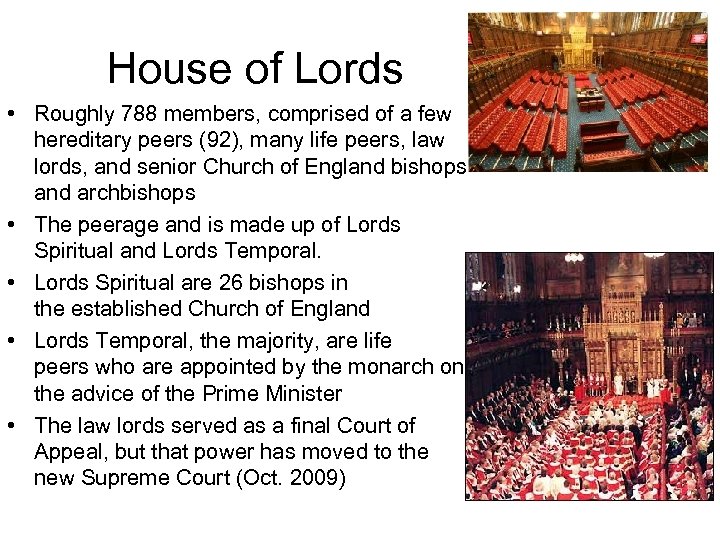
House of Lords • Roughly 788 members, comprised of a few hereditary peers (92), many life peers, law lords, and senior Church of England bishops and archbishops • The peerage and is made up of Lords Spiritual and Lords Temporal. • Lords Spiritual are 26 bishops in the established Church of England • Lords Temporal, the majority, are life peers who are appointed by the monarch on the advice of the Prime Minister • The law lords served as a final Court of Appeal, but that power has moved to the new Supreme Court (Oct. 2009)
Powers • The House of Lords scrutinizes bills that have been approved by the House of Commons. • Power to review and amends bills from the Commons, revising chamber. • It cannot veto bills, only delay bills and force the Commons to reconsider their decisions. • Government often introduces noncontroversial legislation in Lords if it deals with technical matters • Acts as a check on the House of Commons that is independent from the electoral process. • Bills can be introduced into either the House of Lords or the House of Commons
Gradualism • Prior to the 16 th century, the Lords was the stronger of the two houses of Parliament. • A process of gradual developments combined with such moments of crisis as the English Civil Wars transferred the political control of England, first from the Crown to the House of Lords and then to the House of Commons
Reform: House of Lords Act, 1999 • Act reformed the House of Lords, initiated by Labour and Tony Blair, democratization • For centuries, the House of Lords had included several hundred members who inherited their seats; the Act removed such a right • As a compromise, the Act did permit 92 hereditary peers to remain in the House on an interim basis. • When these peers die, they are replaced with By-elections to the House of Lords using the Alternative Vote system (AV) • AKA instant-runoff voting (IRV), transferable vote, ranked-choice voting (RCV), or preferential voting • Voters rank the candidates in order of preference. Ballots are initially counted for each elector's top choice. If a candidate secures more than half of these votes, that candidate wins. Otherwise, the candidate in last place is eliminated and removed from consideration and repeated until a majority is attained. • Other members are appointed by the monarch with advice from the PM • Considered totally abolishing the body or opening it up for elections.
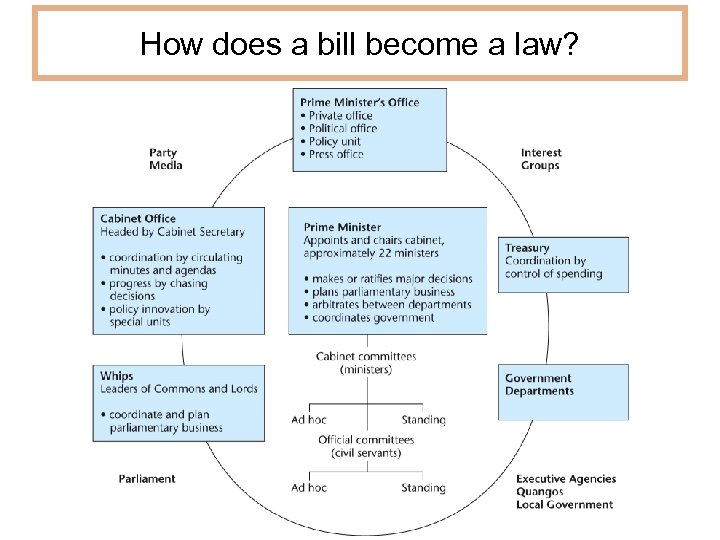
How does a bill become a law?
Government Policy-Making • Within Whitehall network, who are the core set of political figures that are important in determining policies? – Prime Minister – Cabinet Ministers – In coalition government major decisions cannot be made by a single politician – why?

V. Judicial Branch • The Judiciary – NO Judicial Review – The Courts and the EU – Britain must abide by decisions of the European Court of Justice (ECJ) – This led to: • Sex Discrimination Act of 1986 • Human Rights Act of 1998 • Types of Law – Common law (historical, legal precedent: UK, Nigeria, ) vs. Code Law (Rest of Europe: China, Mexico, Russia)
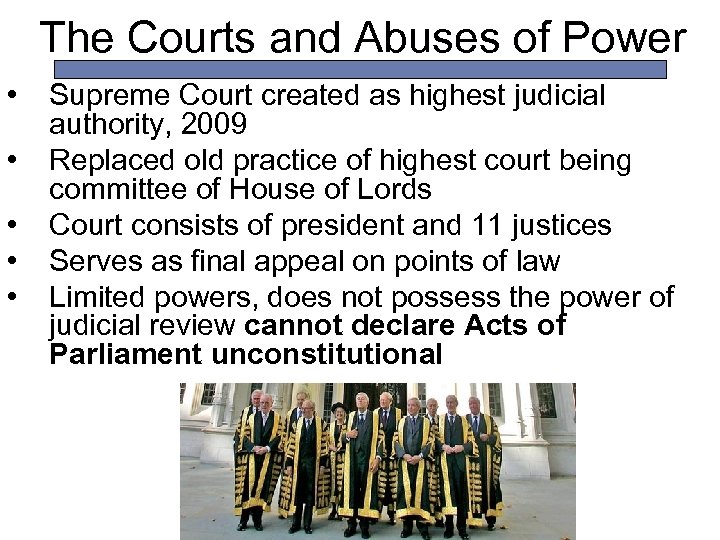
The Courts and Abuses of Power • • • Supreme Court created as highest judicial authority, 2009 Replaced old practice of highest court being committee of House of Lords Court consists of president and 11 justices Serves as final appeal on points of law Limited powers, does not possess the power of judicial review cannot declare Acts of Parliament unconstitutional Copyright © 2012, 2010, 2008 Pearson Education, Inc. All rights reserved.
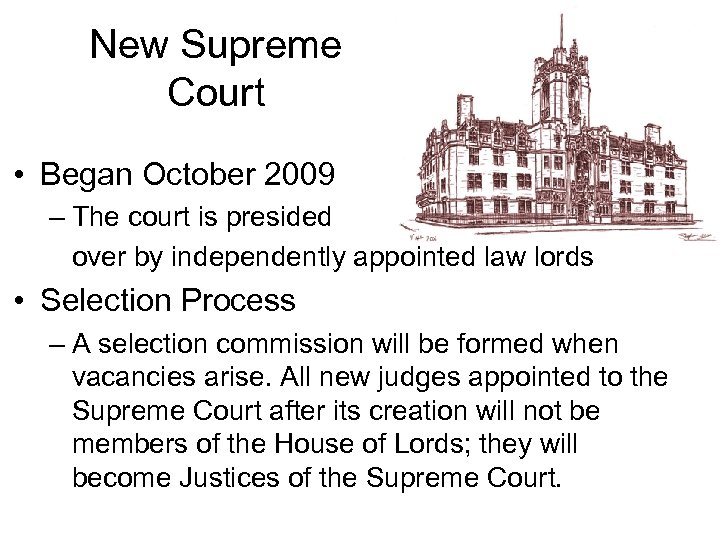
New Supreme Court • Began October 2009 – The court is presided over by independently appointed law lords • Selection Process – A selection commission will be formed when vacancies arise. All new judges appointed to the Supreme Court after its creation will not be members of the House of Lords; they will become Justices of the Supreme Court.
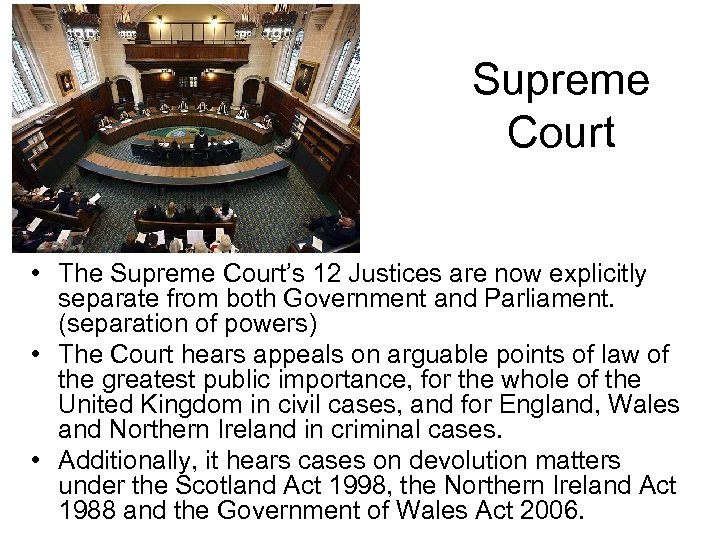
Supreme Court • The Supreme Court’s 12 Justices are now explicitly separate from both Government and Parliament. (separation of powers) • The Court hears appeals on arguable points of law of the greatest public importance, for the whole of the United Kingdom in civil cases, and for England, Wales and Northern Ireland in criminal cases. • Additionally, it hears cases on devolution matters under the Scotland Act 1998, the Northern Ireland Act 1988 and the Government of Wales Act 2006.
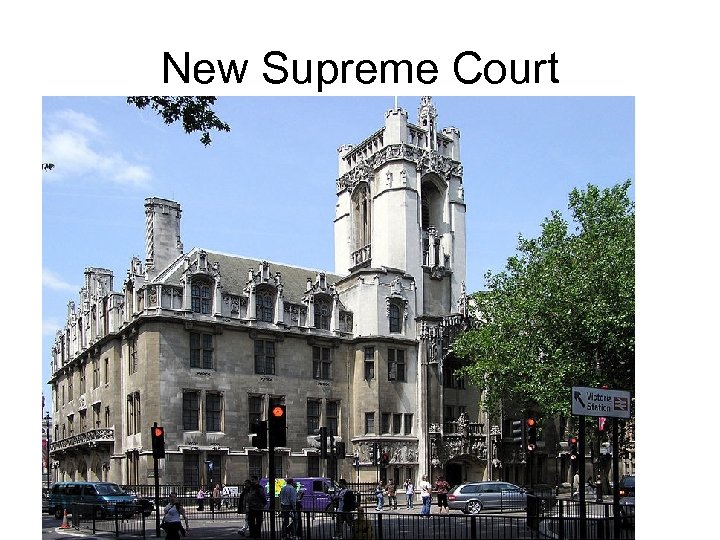
New Supreme Court
New Supreme Court • Under European law, member states’ courts should always make their rulings according to principles laid down in relevant decisions by the European Court of Justice (ECJ). • If The Supreme Court is considering a case where interpretation of an ECJ decision is unclear, the Justices can refer the question to the ECJ for clarification. They will then base their own decision on this answer. • How does this affect British sovereignty?
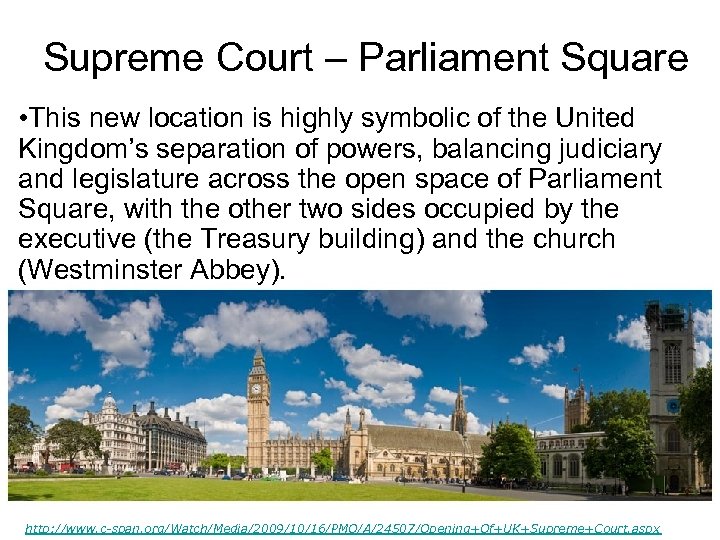
Supreme Court – Parliament Square • This new location is highly symbolic of the United Kingdom’s separation of powers, balancing judiciary and legislature across the open space of Parliament Square, with the other two sides occupied by the executive (the Treasury building) and the church (Westminster Abbey). http: //www. c-span. org/Watch/Media/2009/10/16/PMQ/A/24507/Opening+Of+UK+Supreme+Court. aspx
Linkage Institutions
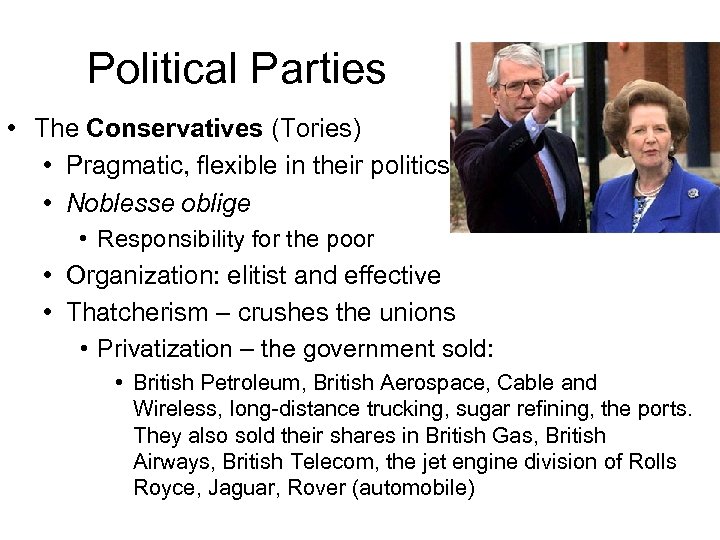
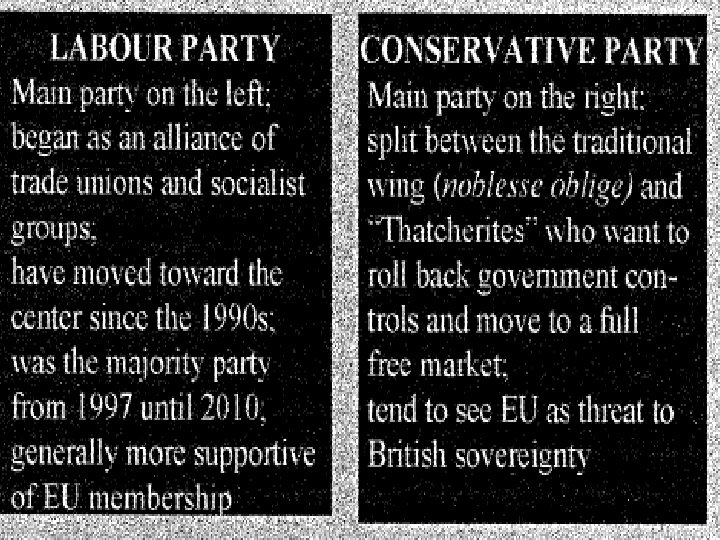
Political Parties • The Conservatives (Tories) • Pragmatic, flexible in their politics • Noblesse oblige • Responsibility for the poor • Organization: elitist and effective • Thatcherism – crushes the unions • Privatization – the government sold: • British Petroleum, British Aerospace, Cable and Wireless, long-distance trucking, sugar refining, the ports. They also sold their shares in British Gas, British Airways, British Telecom, the jet engine division of Rolls Royce, Jaguar, Rover (automobile)
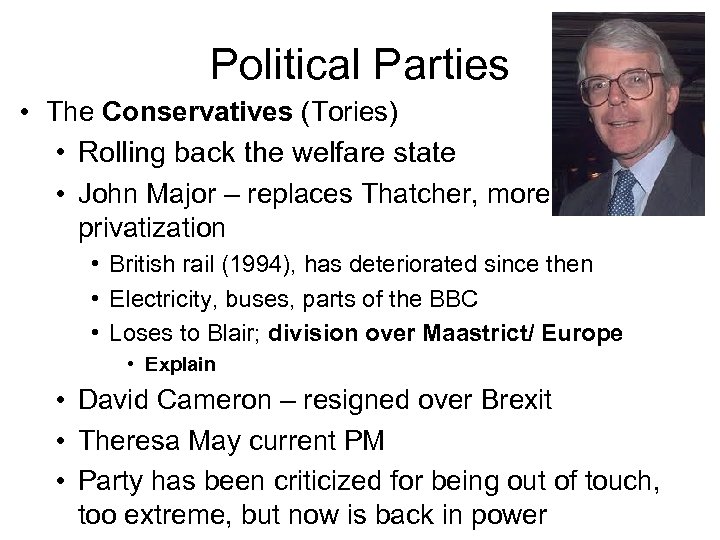
Political Parties • The Conservatives (Tories) • Rolling back the welfare state • John Major – replaces Thatcher, more privatization • British rail (1994), has deteriorated since then • Electricity, buses, parts of the BBC • Loses to Blair; division over Maastrict/ Europe • Explain • David Cameron – resigned over Brexit • Theresa May current PM • Party has been criticized for being out of touch, too extreme, but now is back in power
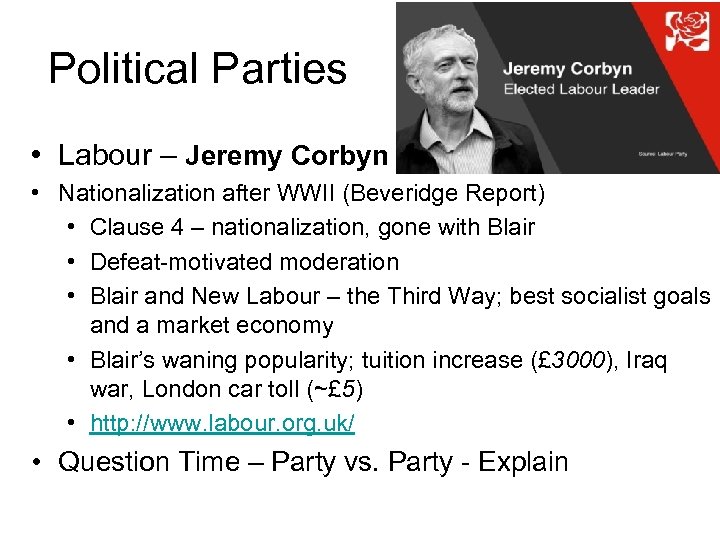
Political Parties • Labour – Jeremy Corbyn • Nationalization after WWII (Beveridge Report) • Clause 4 – nationalization, gone with Blair • Defeat-motivated moderation • Blair and New Labour – the Third Way; best socialist goals and a market economy • Blair’s waning popularity; tuition increase (£ 3000), Iraq war, London car toll (~£ 5) • http: //www. labour. org. uk/ • Question Time – Party vs. Party - Explain
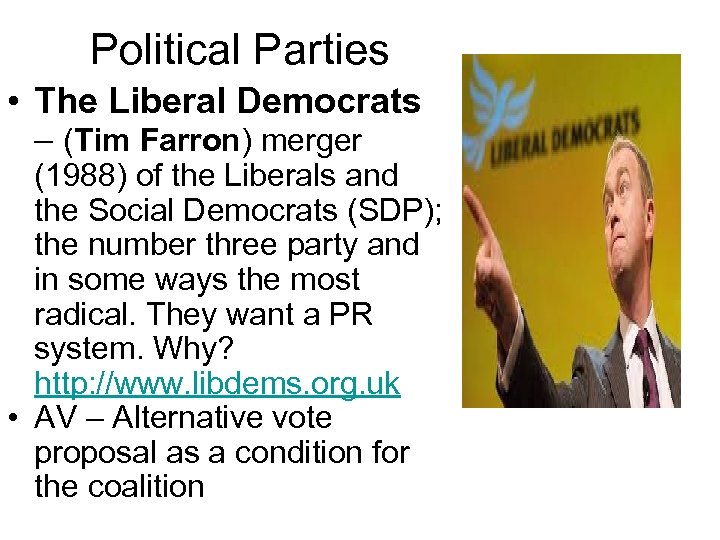
Political Parties • The Liberal Democrats – (Tim Farron) merger (1988) of the Liberals and the Social Democrats (SDP); the number three party and in some ways the most radical. They want a PR system. Why? http: //www. libdems. org. uk • AV – Alternative vote proposal as a condition for the coalition
Political Parties • Minor Parties – Scottish National Party (SNP), Wales (Plaid Cymru), and Northern Ireland (Sinn Fein is the political arm of the IRA while the Democratic Unionist Party represents Protestant clergymen). • Far right parties – British National Party (anti-semitic, anti-muslim) – UK Independence Party (anti-EU) • Others – many; one colorful example is: – Official Monster Raving Loony Party • http: //www. omrlp. com/ • Have fun with this site!
Party Images and Appeals • Terminology of left/right rejected by British voters – median voter tends to choose central position, a tenth on far left or far right – consensus among voters on variety of issues; economy, crime, health service major concerns – parties emphasize collectivist economic interests and consensual goals • Governing party has votes to enact parliamentary legislation, regardless of protests by opposition • New governments must also enforce the laws enacted by the previous governments
VII. Linkage Institution: Elections
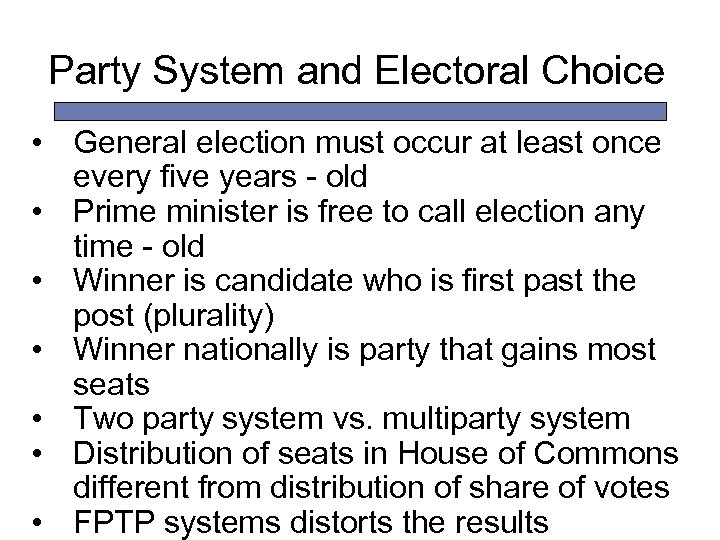
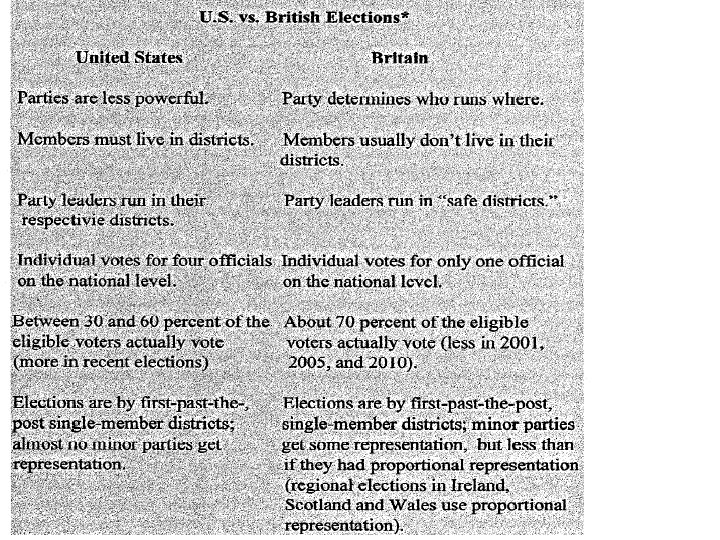
Party System and Electoral Choice • General election must occur at least once every five years - old • Prime minister is free to call election any time - old • Winner is candidate who is first past the post (plurality) • Winner nationally is party that gains most seats • Two party system vs. multiparty system • Distribution of seats in House of Commons different from distribution of share of votes • FPTP systems distorts the results
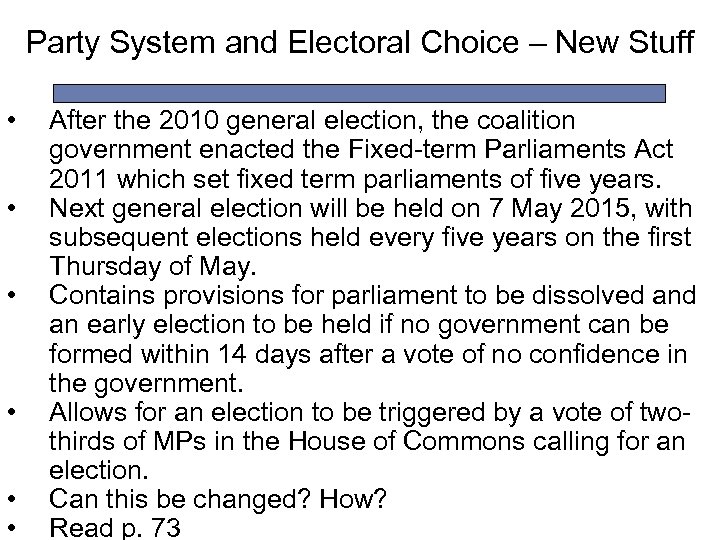
Party System and Electoral Choice – New Stuff • • • After the 2010 general election, the coalition government enacted the Fixed-term Parliaments Act 2011 which set fixed term parliaments of five years. Next general election will be held on 7 May 2015, with subsequent elections held every five years on the first Thursday of May. Contains provisions for parliament to be dissolved an early election to be held if no government can be formed within 14 days after a vote of no confidence in the government. Allows for an election to be triggered by a vote of twothirds of MPs in the House of Commons calling for an election. Can this be changed? How? Read p. 73
How to fix the problems of FPTP? • Liberal Democrats prefer the Alternative Vote System
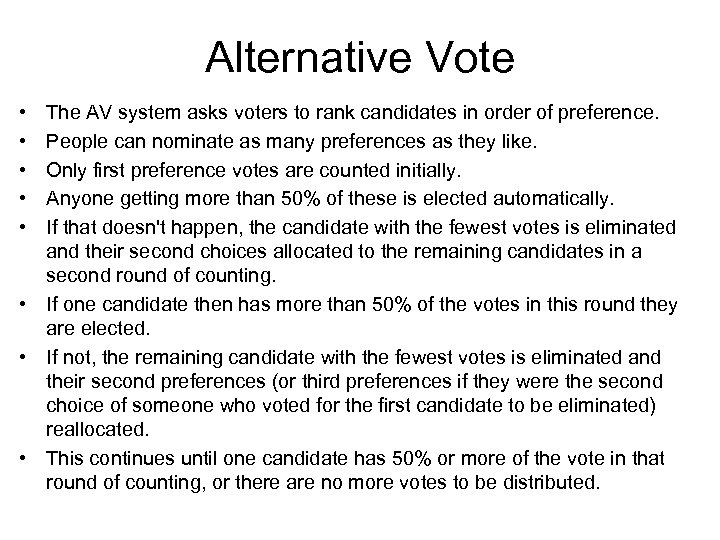
Alternative Vote • • • The AV system asks voters to rank candidates in order of preference. People can nominate as many preferences as they like. Only first preference votes are counted initially. Anyone getting more than 50% of these is elected automatically. If that doesn't happen, the candidate with the fewest votes is eliminated and their second choices allocated to the remaining candidates in a second round of counting. • If one candidate then has more than 50% of the votes in this round they are elected. • If not, the remaining candidate with the fewest votes is eliminated and their second preferences (or third preferences if they were the second choice of someone who voted for the first candidate to be eliminated) reallocated. • This continues until one candidate has 50% or more of the vote in that round of counting, or there are no more votes to be distributed.
The Alternative Vote Explained • http: //www. youtube. com/watch? v=3 Y 3 j. E 3 B 8 Hs. E&safe=active
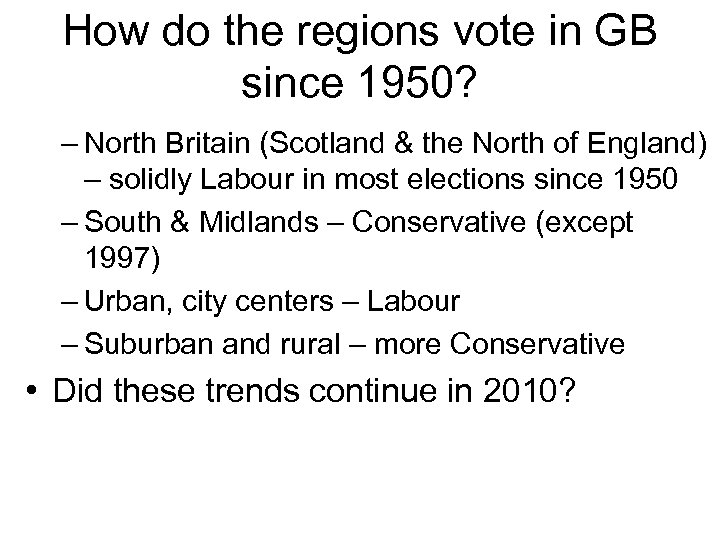
How do the regions vote in GB since 1950? – North Britain (Scotland & the North of England) – solidly Labour in most elections since 1950 – South & Midlands – Conservative (except 1997) – Urban, city centers – Labour – Suburban and rural – more Conservative • Did these trends continue in 2010?
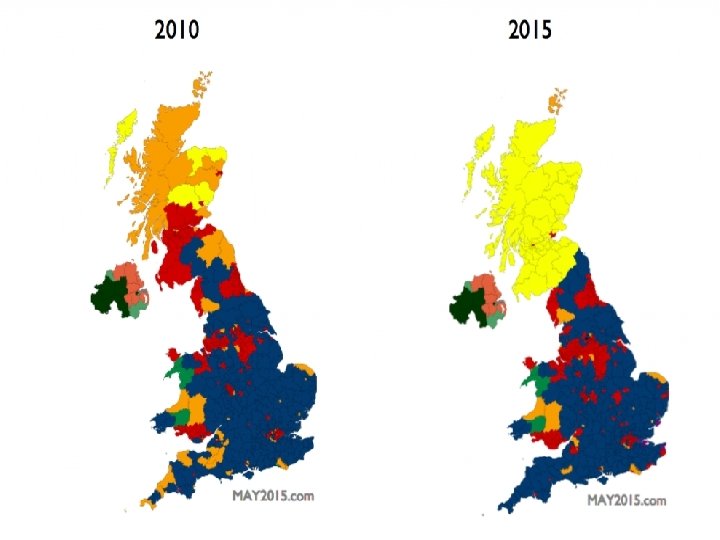
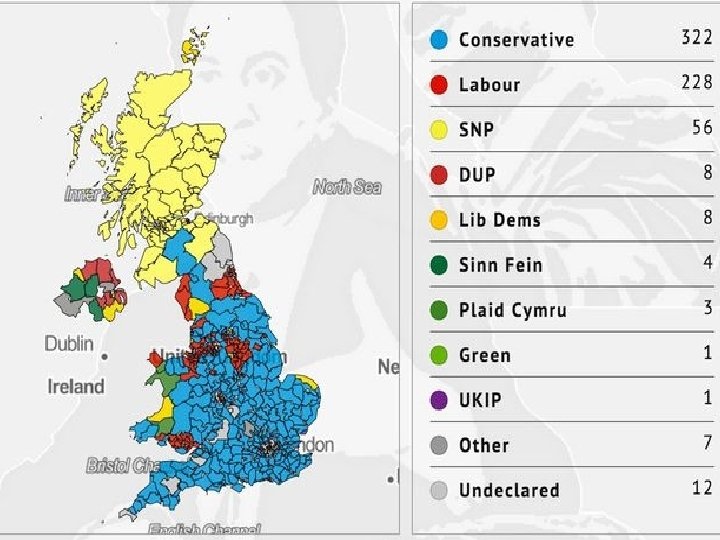

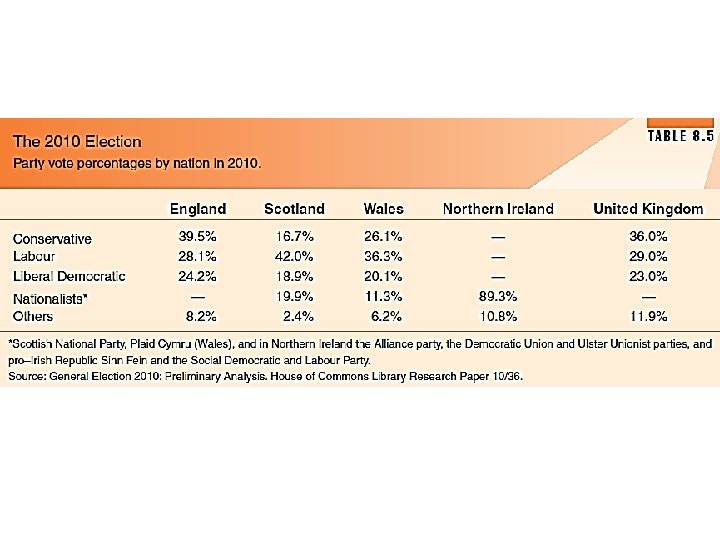
Recent Election Results
Election Results – Any Trends?
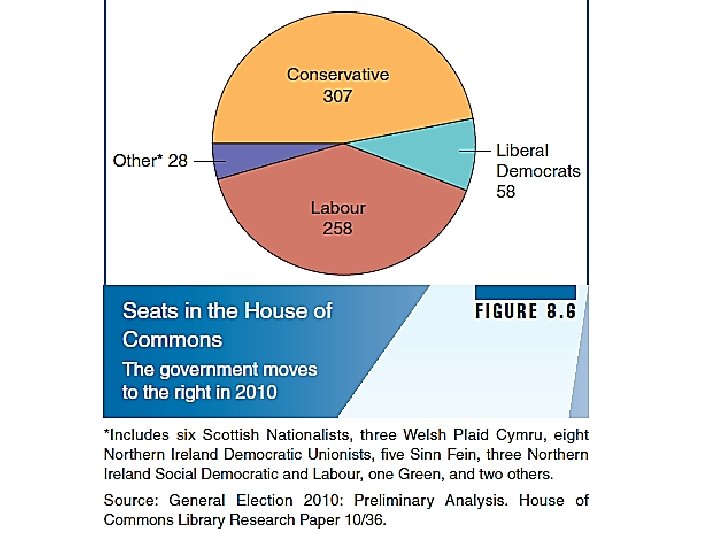
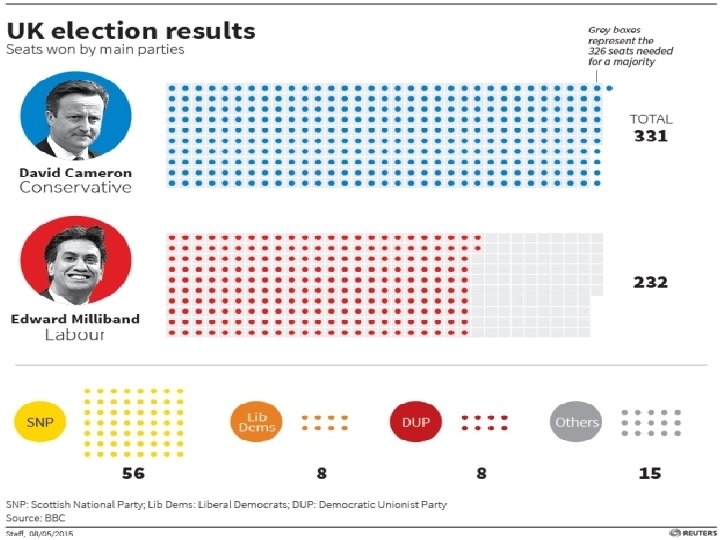
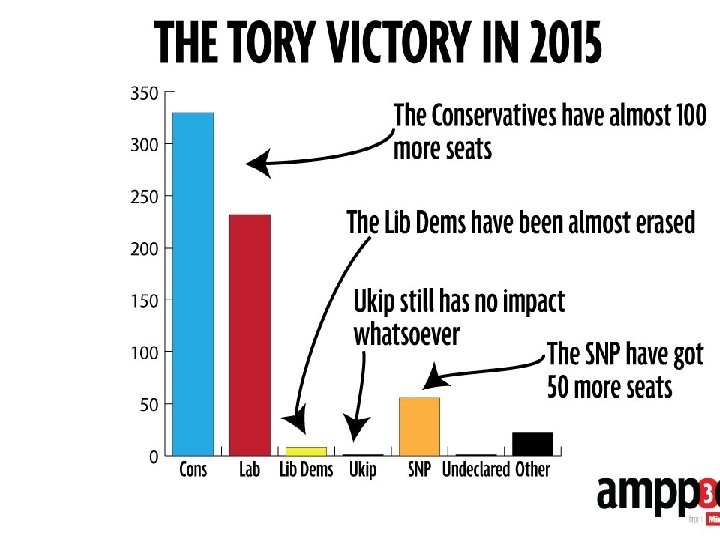
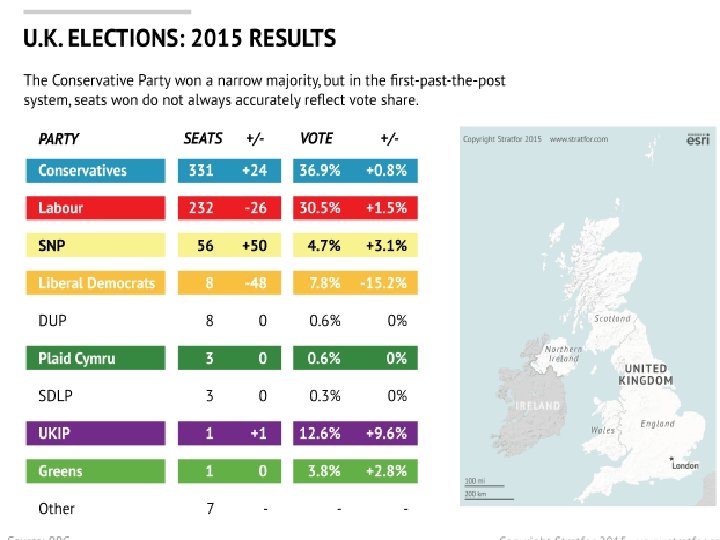
Why 2015 election results are the worse in UK history? • https: //www. youtube. com/watch? v=r 9 r. GX 9 1 rq 5 I
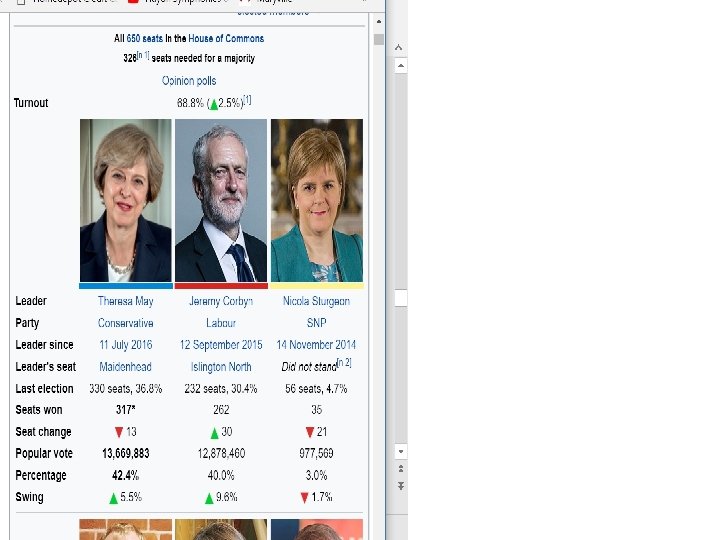
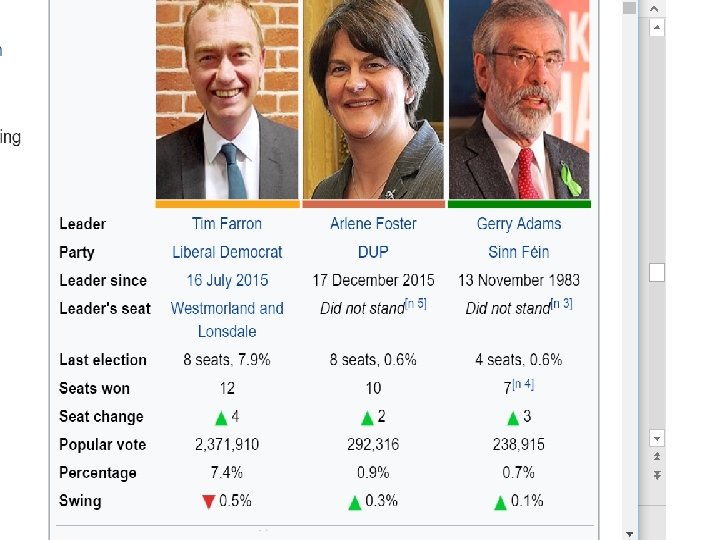
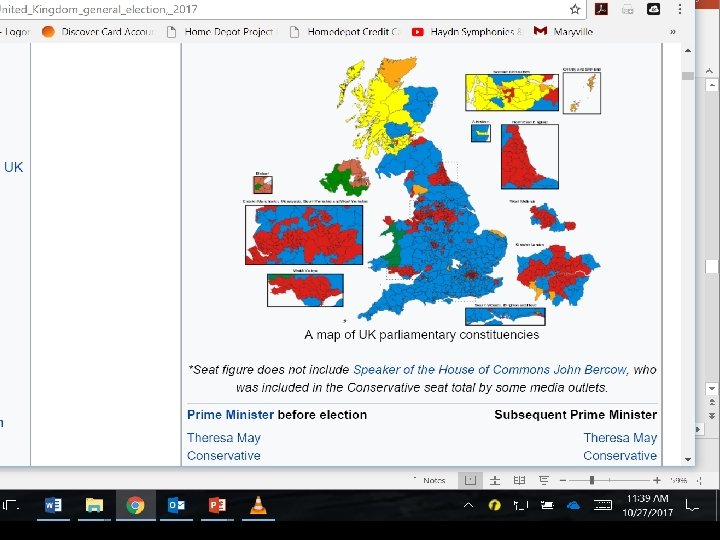
United Kingdom general election, 2017 • Under the Fixed-term Parliaments Act 2011 an election had not been due until May 2020, but a call by PM Theresa May for a snap election was ratified by the necessary supermajority in a 522– 13 vote in the House of Commons (Notice how unstable a parliamentary system is) • PM May wanted to firm up support to get ready for Brexit negotiations and to increase her majority in Parliament, polls told her she would • Conservatives were defending a working majority of 17 seats against the Labour Party • Coalition government formed, needed 326 for a majority, Conservatives won 317 seats • The Conservatives remained in power as a minority government, having secured a confidence and supply deal with the Democratic Unionist Party (DUP-Northern Ireland) • Agreement included additional funding of £ 1 billion for Northern Ireland, support for Brexit and commitment to the Good Friday Agreement
Linkage Institutions • Interest Groups – Little of the lobbying one finds in the U. S. – Interests groups focus their attention on decision makers: ministers, party leaders, and senior civil servants; try to influence the drafting of a bill, not how it is dealt with on the House floor. WHY?
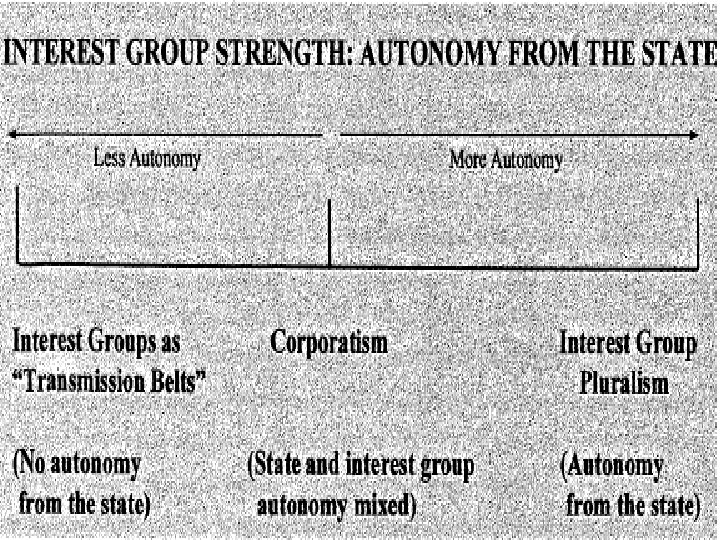
Political Institutions • Interest Groups – The TUC with Labour and the Confederation of British Industry (CBI) with Conservatives wield disproportionate influence – Corporatist arrangements (define!) during collectivist years; Thatcher government in 1980 s effectively froze the unions out of the decision making. – Trade Unions Congress – Labour – Confederation of British Industry – Conservative
Neo-Corporatism • Interest groups capture the state and control policy • QUANGOS: Quasi-Autonomous Non-Governmental Organizations. • When the government cedes policy making discretion to certain groups outside of government, but funded by taxpayers • Examples: Forestry Commission, Environment Agency, Regional Development Agencies, national galleries and museums • Been a victim of Conservative austerity cuts recently, 192 cut
IX. Linkage Institution: The Media • British media far more centralized than U. S. – London dominates • BBC • Broadsheets and tabloids • Scandal, News of the World, Hackgate • Very little local news on television; national news at different times of the day; networks tend to be impartial, but journalists are not necessarily so; interviewers “grill” politicians
X. Citizens, Society, and the State • British Political Culture • The civic culture and collectivist years • Widespread sense of legitimacy • Tolerance of diversity • Nationalism • British Civility • Heckling and PM Question Time
Will there always be a Britain? • How do the following affect the answer to the question above? • Polarization and catch-all parties • Devolution • Cultural and racial diversity • European Union
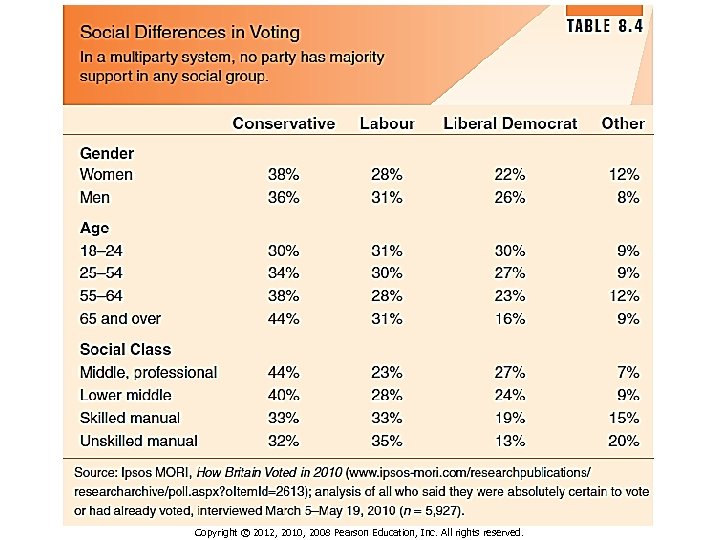
Political Socialization • Socialization influences the division between those who do and do not participate – Family and Gender: create youthful identification with party – Education: more educated not as likely to be conservative as once were – Class: Conservative = middle class, Labour = working class – Mass Media: only a few papers, TV is primary source of news Copyright © 2012, 2010, 2008 Pearson Education, Inc. All rights reserved.
Copyright © 2012, 2010, 2008 Pearson Education, Inc. All rights reserved.
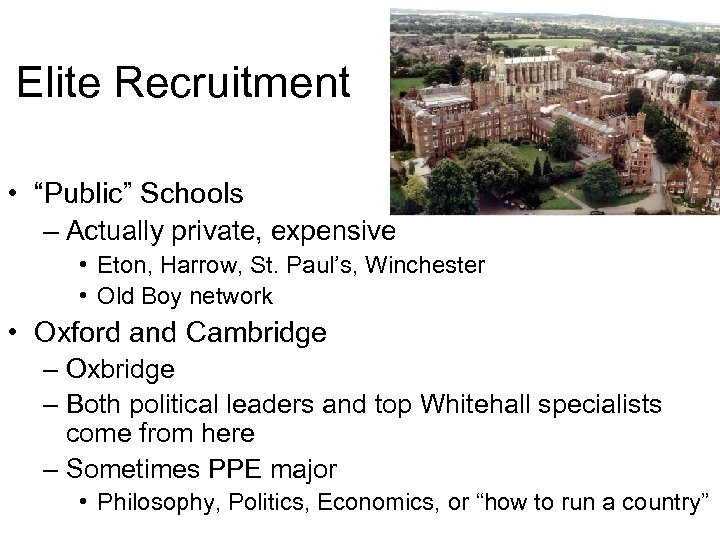
Elite Recruitment • “Public” Schools – Actually private, expensive • Eton, Harrow, St. Paul’s, Winchester • Old Boy network • Oxford and Cambridge – Oxbridge – Both political leaders and top Whitehall specialists come from here – Sometimes PPE major • Philosophy, Politics, Economics, or “how to run a country”
Major Social Cleavage • Biggest divide expressed in the political system- Conservatives (rich) v. Labour (poor) • Issues coincided in Northern Ireland, separatist centrifugal force • Unionists/loyalists, (Protestants, Ulster Scots, British nationalists) wanted to remain in the UK • Irish nationalists, (Irish Catholics) wanted to separate and join Ireland • History of terrorism and violence, especially in Belfast • IRA (Irish Republican Army) • The Troubles, "guerrilla war, “ 1960’s-1998 • Good Friday Agreement (1998) dramatically eased tensions • Devolution, created Northern Ireland’s Assembly
Political Participation • Consolidated Liberal democracy – People vote! • Participate through Political Parties and Interest Groups • Gender Gap – Women more likely to vote Labour • Except in the 2010 election – Men more likely to vote Conservative • Young Voters • Anti-war • Less likely to vote (Sound familiar? )
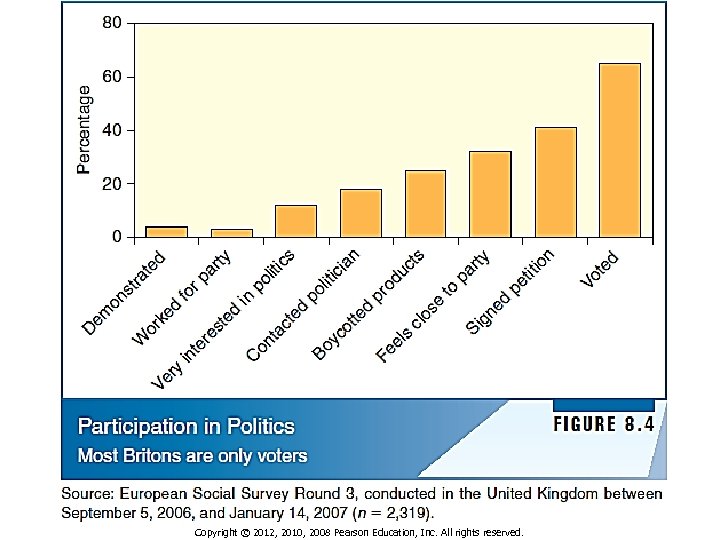
Copyright © 2012, 2010, 2008 Pearson Education, Inc. All rights reserved.
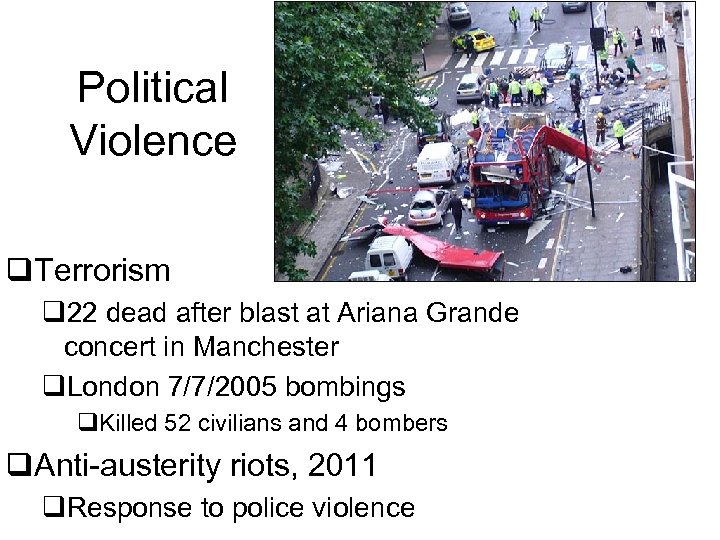
Political Violence q. Terrorism q 22 dead after blast at Ariana Grande concert in Manchester q. London 7/7/2005 bombings q. Killed 52 civilians and 4 bombers q. Anti-austerity riots, 2011 q. Response to police violence
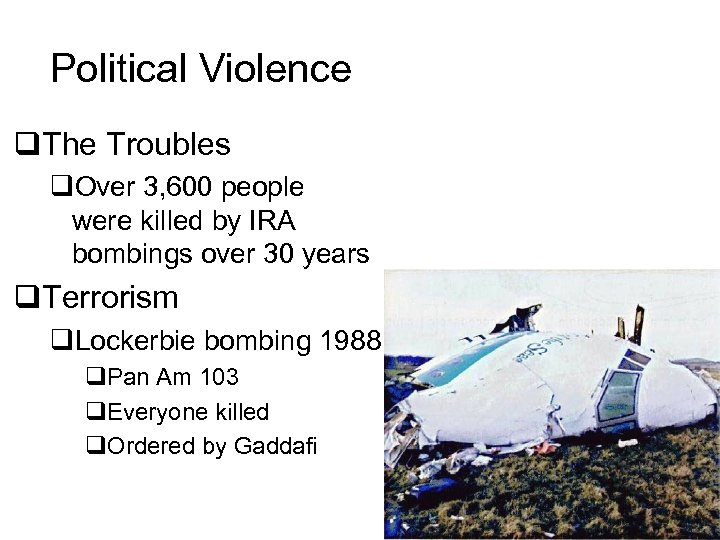
Political Violence q. The Troubles q. Over 3, 600 people were killed by IRA bombings over 30 years q. Terrorism q. Lockerbie bombing 1988 q. Pan Am 103 q. Everyone killed q. Ordered by Gaddafi
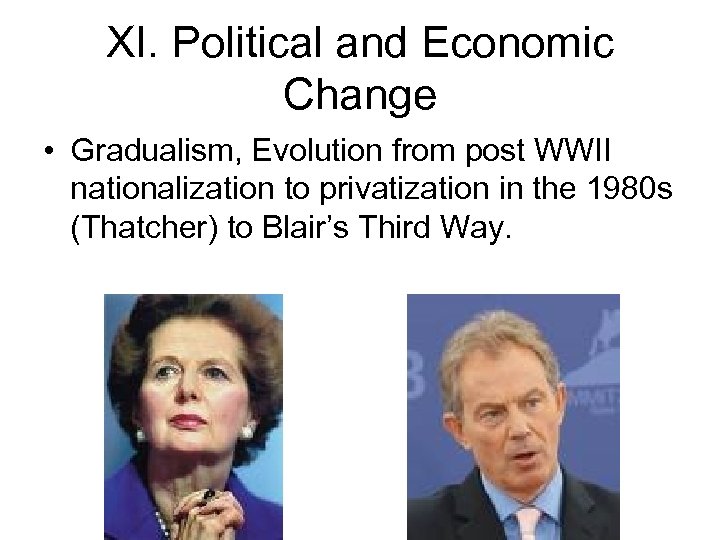
XI. Political and Economic Change • Gradualism, Evolution from post WWII nationalization to privatization in the 1980 s (Thatcher) to Blair’s Third Way.
The Thatcher and Blair Revolutions Reforms? • Break with the past in domestic policy – Thatcher’s “politics of conviction” brought dramatic change, especially to economic life. – Blair’s government has accepted privatization and the core of Thatcherism • Continuity in foreign policy
Domestic politics – Margaret Thatcher: • The retreat from the commanding heights: Nationalizing and privatizing • Rolling back the welfare state • Thatcher’s supporters say she saved the British economy by bring both inflation and unemployment under control and by creating a more dynamic private sector. • Thatcher’s detractors say she created new problems and exacerbated existing ones by widening the gap between rich and poor and by allowing public services to deteriorate.
The poorer • https: //www. youtube. com/watch? v=pd. R 7 WW 3 XR 9 c
Tony Blair: • Not rolling back Thatcher’s and Major’s reforms • Government spending as a percentage of GNP shrank • Welfare that gives recipients skills to find jobs rather than just benefits • Tuition increase • Tolling London drivers to reduce traffic congestion • Blair’s supporters say he has created the Third Way – combining the best aspects of the socialist goals commitment to equality with a market economy. • Blair’s detractors say he sold out the left and created “Thatcher lite. ”
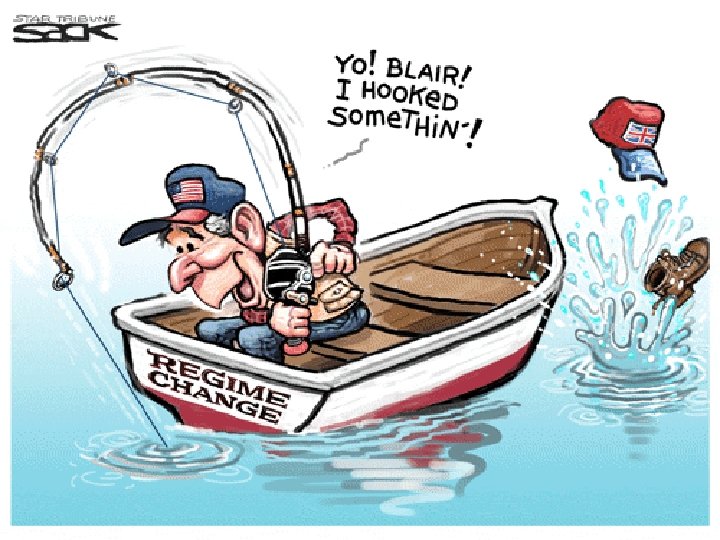
Foreign policy – Europe • European Monetary Union? – To Euro or Not To Euro, that is the question – Tories were Euroskeptics – Blair had promised a referendum, but it never came • Referendum on withdrawal from EU – Iraq • Political ramifications of backing George W. Bush on war with Iraq • Split within Labour, Conservatives support on principle
Happy Guy Fawkes Day! • Remember, remember the fifth of November, Gunpowder treason and plot. We see no reason Why gunpowder treason Should ever be forgot! Guy Fawkes, guy, t'was his intent To blow up king and parliament. Three score barrels were laid below To prove old England's overthrow. By god's mercy he was catch'd With a darkened lantern and burning match. So, holler boys, Let the bells ring. Holler boys, holler boys, God save the king. And what shall we do with him? Burn him!
XII. Public Policy • Supranational Influences – How do they affect Britain? Weakens their sovereignty – EU – UN – World Bank – GATT – WTO – NATO
Brexit (British Exit) • Term for the UK's planned withdrawal from the EU following an advisory referendum held in 2016 in which 52% of votes were cast for withdraw • Still must invoke Article 50 to start the two year clock • Lower voter turnout for the referendum • Fulfilled Conservative promise to hold the referendum • Led to the end of PM Cameron and rise of PM May • Reaction to loss of sovereignty in the EU, immigration, decline of the middle class, and globalization • Process of fragmentation (centrifugal force, tribalism)
Some Policy Issues – – – National Health Service Environment Adoption of the Euro? Constitutional Reform, including the Lords Immigration and Asylum • Race and Religion – – Terrorism/ War in Iraq Devolution/ Scottish Independence? Ireland Transparency in government
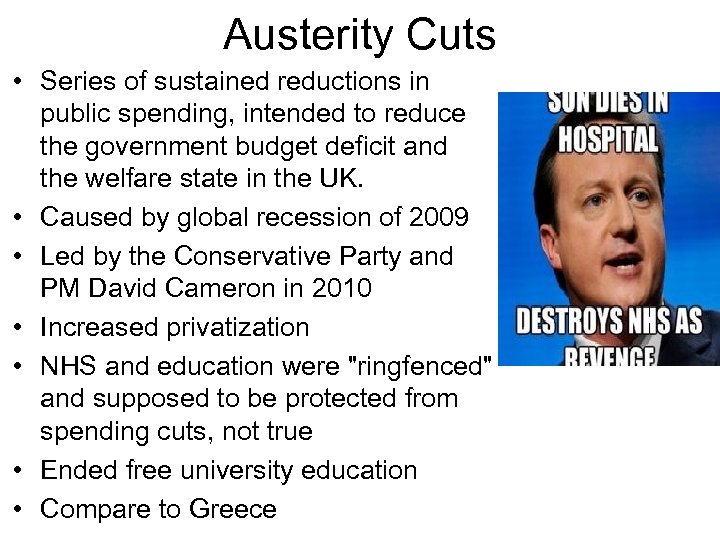
Austerity Cuts • Series of sustained reductions in public spending, intended to reduce the government budget deficit and the welfare state in the UK. • Caused by global recession of 2009 • Led by the Conservative Party and PM David Cameron in 2010 • Increased privatization • NHS and education were "ringfenced" and supposed to be protected from spending cuts, not true • Ended free university education • Compare to Greece
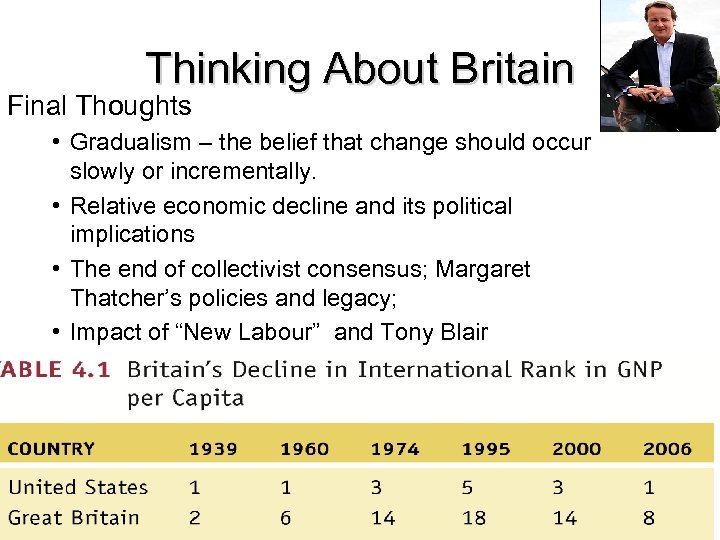
Thinking About Britain Final Thoughts • Gradualism – the belief that change should occur slowly or incrementally. • Relative economic decline and its political implications • The end of collectivist consensus; Margaret Thatcher’s policies and legacy; • Impact of “New Labour” and Tony Blair
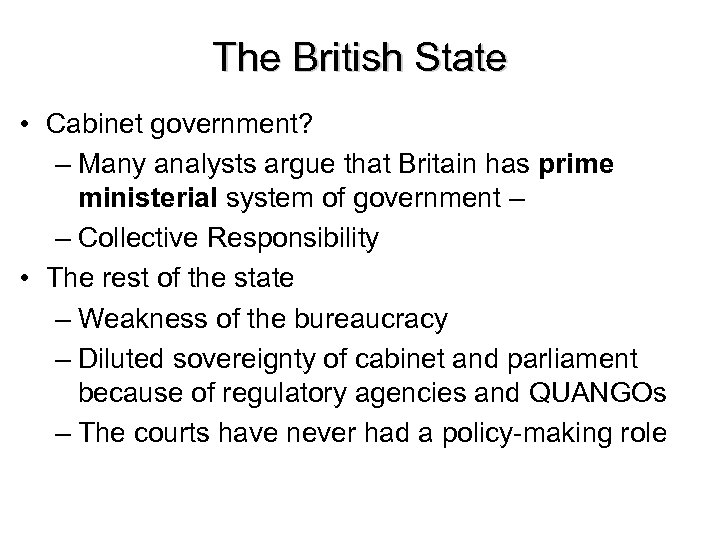
The British State • Cabinet government? – Many analysts argue that Britain has prime ministerial system of government – – Collective Responsibility • The rest of the state – Weakness of the bureaucracy – Diluted sovereignty of cabinet and parliament because of regulatory agencies and QUANGOs – The courts have never had a policy-making role

The European Union - http: //europa. eu/index_en. htm
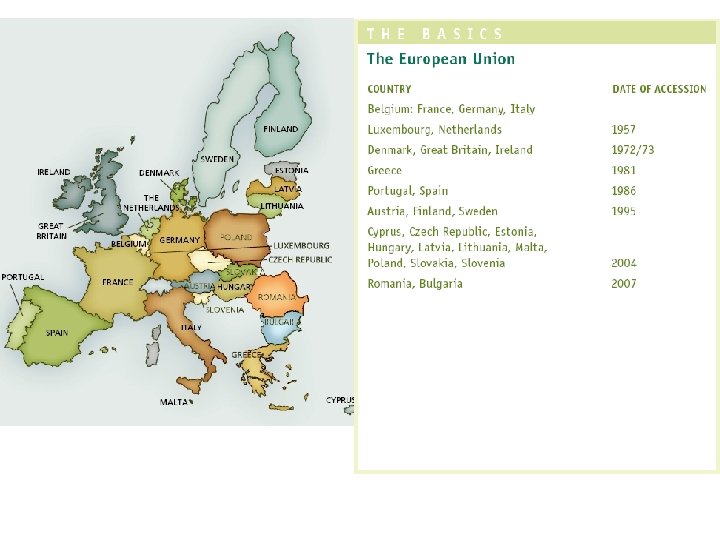
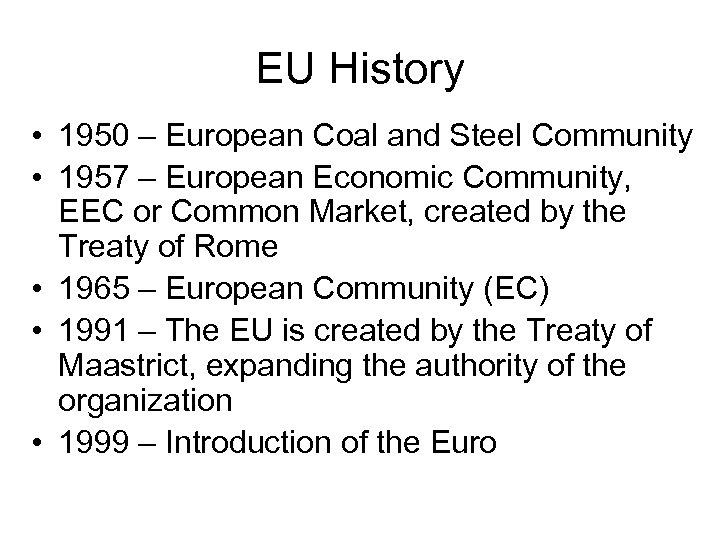
The European Union (EU) • Membership Requirements – Stable, functioning democratic regime – A market-oriented economy – Willingness to accept all EU laws and regulations • The European Union presently consists of 27 countries and has a total population of nearly 500 million citizens. • Motto of the EU – “United in Diversity”
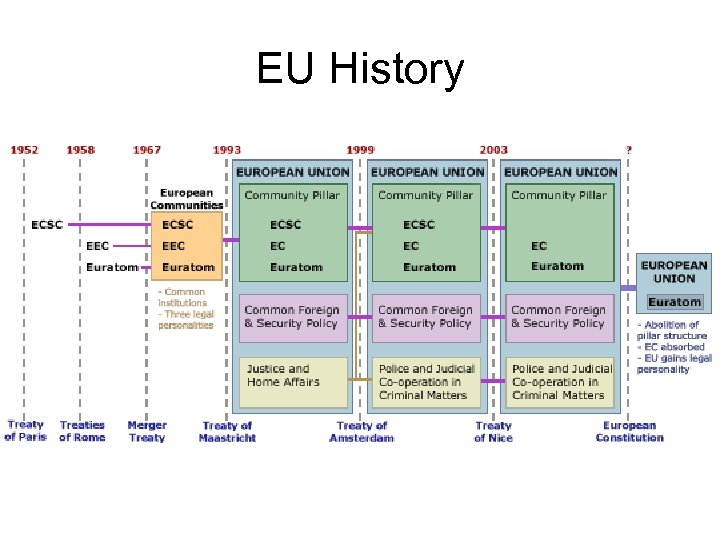
The EU’s Three Pillars (spheres of authority) • Trade and other economic areas – Single currency (the Euro) – Creation of the European Central Bank • Justice and Home Affairs – Asylum and Immigration (border crossing) – Judicial cooperation on crime and terrorism • Common Foreign and Security Policy – Common Defense Policy • Overall, the organization is classified as a supranational government and it severely undermines the sovereignty of its member states
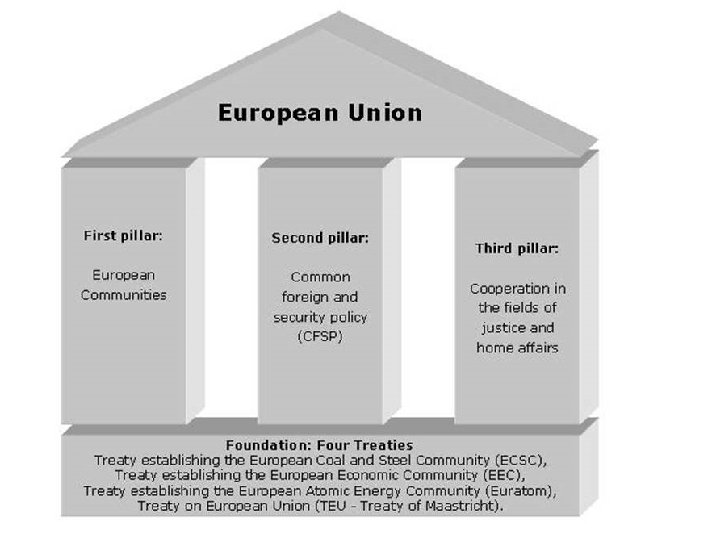
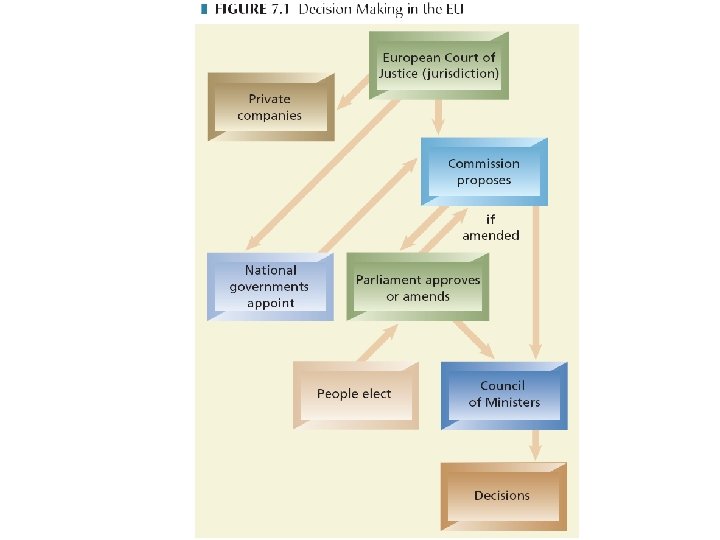
EU Institutions • • The Commission The Council of Ministers The European Parliament The European Court of Justice
The Commission • 27 Members, one from each member state • Supported by a bureaucracy of several thousand • Each commissioner is responsible for a particular area of policy • Headed by a president • Main purpose is to initiate and maintain new programs
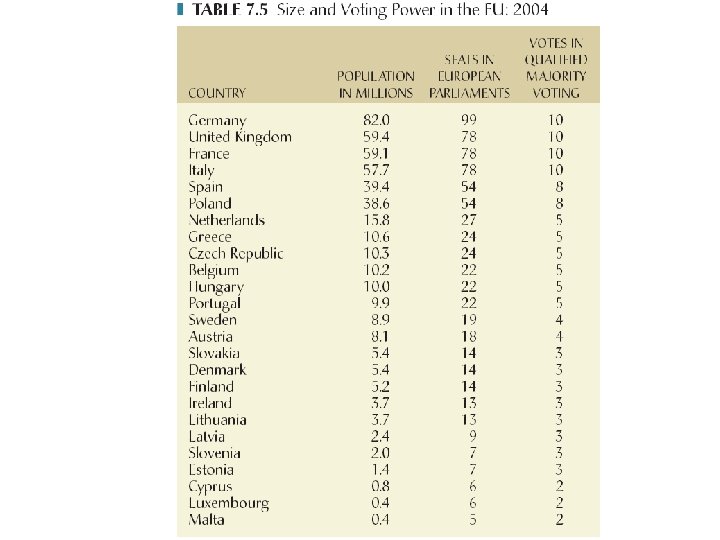
The Council of Ministers • Made up of the heads of government, the finance ministers, and the foreign ministers of the member states • The Commission may initiate legislation, but the must be passed by the Council to go into effect • Each country receives a number of votes based on population
The European Parliament • Not very powerful - The EU’s weakest institution • Directly elected by the people • Members sit by ideology, not by country • Power has grown since direct election of members • The right to approve all nominees to the Commission and can remove the entire Commission if a vote of censure passes by a two-thirds margin. • The right to approve the budget
European Court of Justice • • The supreme court of the EU Has the power of judicial review 27 judges, one from each member state Very powerful, its decisions may limit national sovereignty – what does that mean? • Decisions have frequently made major expansion of the EU’s authority possible • Actions have limited national sovereignty in favor of the EU’s institutions (very important!)
Policies of the EU • Single Internal Market • Common Monetary Policy – Euro adopted by 12 countries, but not Britain or Sweden – European Monetary Union sets interest rates and other fiscal policies • What are the benefits of these policies?

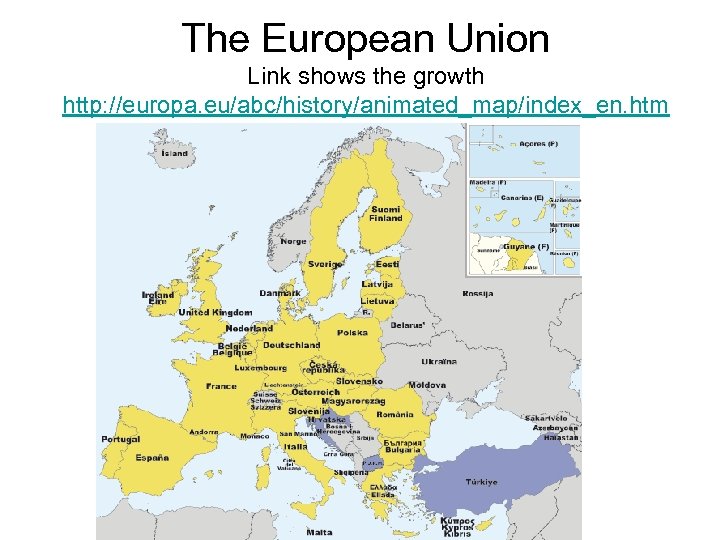
The European Union Link shows the growth http: //europa. eu/abc/history/animated_map/index_en. htm



Policies of the EU • Common Agricultural Policy – subsidies cost about ½ the EU budget – Who gets them? • Common Defense (but no EU army) • Justice/ Home Affairs – goal of free movement (immigration, asylum) of EU nationals, not required – What controversies has this caused? • Fighting Terrorism – Bombings in Spain and Britain
Public Policy in the EU • The Internal Market – The removal of tariffs and other barriers to trade • Tremendous impact on both European governments and their citizens – Monetary union • The euro • EMU gives the EU and its new central bank powerful levers they can exert over national governments
Public Policy in the EU • Common Agricultural Policy – Took steps to modernize inefficient farms to be more competitive in the European market – Established the EAFFF, giving farmers subsidies and guaranteeing the purchase of surplus goods at artificially high prices. – Demonstrates how pressure put on member states can lead to policies that tend to impede a free market and also make the EU resistant to change. – More recent reforms on the CAP have been forced on the EU by the GATT and the WTO.
European Constitution • A new constitution for the EU was passed in 2004 and is now being ratified by member states • But France and The Netherlands voted no • So….
The EU • What does the future hold for the EU? – Membership – How large should the EU be? – What about Russia? Turkey? – Which countries will dominate it in the future? – How does Britain keeping the Pound (£) affect its role in the EU? • Check it out – The EU at a glance – http: //europa. eu/abc/index_en. htm
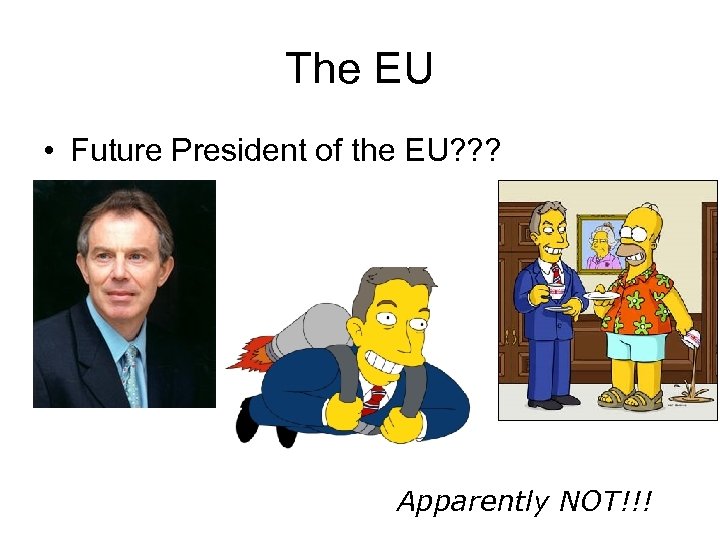
The EU • Future President of the EU? ? ? Apparently NOT!!!
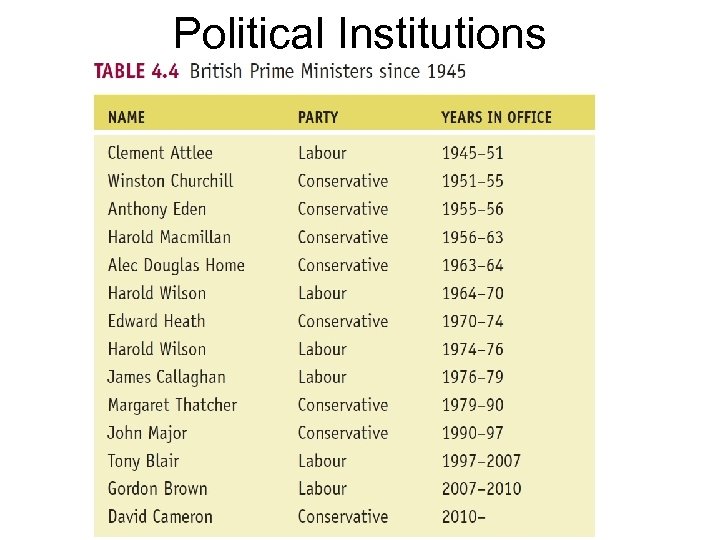
Political Institutions
The British State
Some Key Vocabulary Backbenchers Devolution Euroskeptic Shadow Cabinet Three-line whip Maastrict Treaty Beveridge Report Collective Responsibility Good Friday Agreement Third Way Parliamentary System Corporatism Nationalization First Past the Post CBI/ TUC Unitary system Fusion of Powers Quangos Whitehall
EU History • 1950 – European Coal and Steel Community • 1957 – European Economic Community, EEC or Common Market, created by the Treaty of Rome • 1965 – European Community (EC) • 1991 – The EU is created by the Treaty of Maastrict, expanding the authority of the organization • 1999 – Introduction of the Euro
EU History
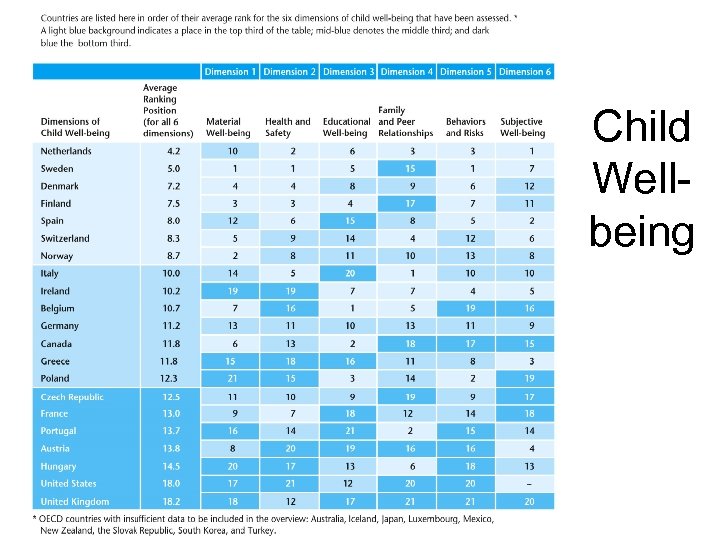
Child Wellbeing
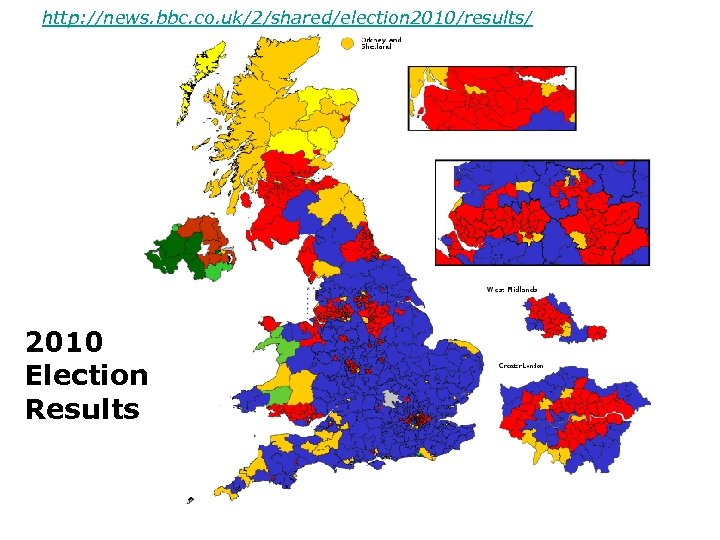
http: //news. bbc. co. uk/2/shared/election 2010/results/ 2010 Election Results
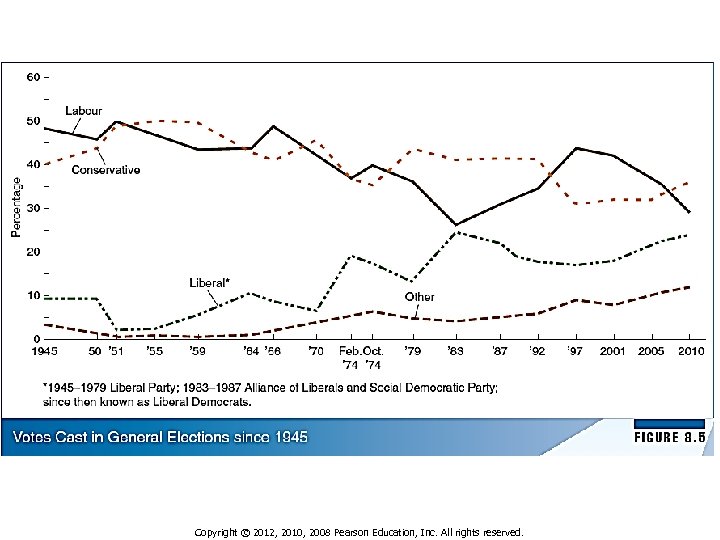
Copyright © 2012, 2010, 2008 Pearson Education, Inc. All rights reserved.
Скачать презентацию GREAT BRITAIN The Union Jack Flag The United
435e06f7d8a68a8802700726581ff2a0.ppt