 Скачать презентацию GREAT BRITAIN geographical position and economy BT 13
Great Br.pptx
- Количество слайдов: 11



GREAT BRITAIN: geographical position and economy BT 13 -11 AITZHANOVA DILYARA ALIMTAI NURGUL AITKALIEVA AINUR DAULETKANOVA SHYRYN KADIROVA SARA ABDIEVA SHYNARAI
Great Britain, also known as Britain /ˈbrɪ. tən/, is an island in the North Atlantic off the north-west coast of continental Europe. With an area of 229, 848 km 2 (88, 745 sq mi), it is the largest island of the British Isles, the largest island in Europe and the ninth-largest in the world. In 2011 the island had a population of about 61 million people, making it the third -most populous island in the world, after Java in Indonesia and Honshū in Japan. It is surrounded by over 1, 000 smaller islands. The island of Irelandlies to its west. The island is part of the United Kingdom of Great Britain and Northern Ireland, constituting most of its territory: most of England, Scotland, and Wales are on the island, with their respective capital cities, London, Edinburgh, and Cardiff. Politically, the term Great Britain usually extends to include surrounding islands that form part of England, Scotland, and Wales
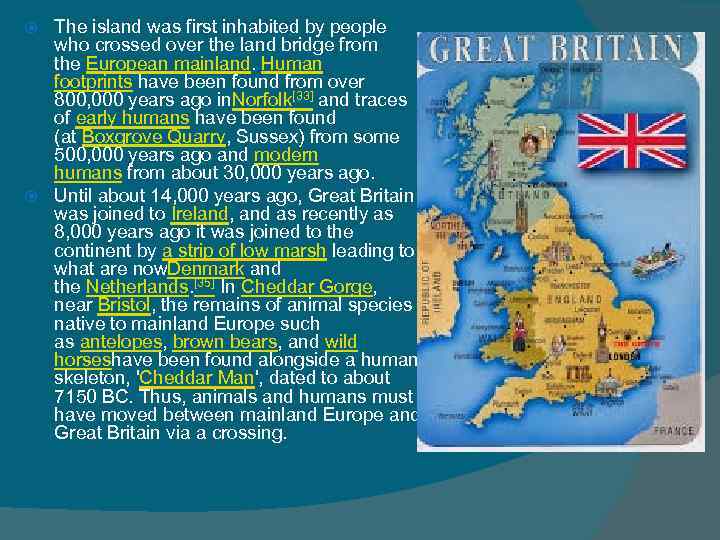
The island was first inhabited by people who crossed over the land bridge from the European mainland. Human footprints have been found from over 800, 000 years ago in. Norfolk[33] and traces of early humans have been found (at Boxgrove Quarry, Sussex) from some 500, 000 years ago and modern humans from about 30, 000 years ago. Until about 14, 000 years ago, Great Britain was joined to Ireland, and as recently as 8, 000 years ago it was joined to the continent by a strip of low marsh leading to what are now. Denmark and the Netherlands. [35] In Cheddar Gorge, near Bristol, the remains of animal species native to mainland Europe such as antelopes, brown bears, and wild horseshave been found alongside a human skeleton, 'Cheddar Man', dated to about 7150 BC. Thus, animals and humans must have moved between mainland Europe and Great Britain via a crossing.
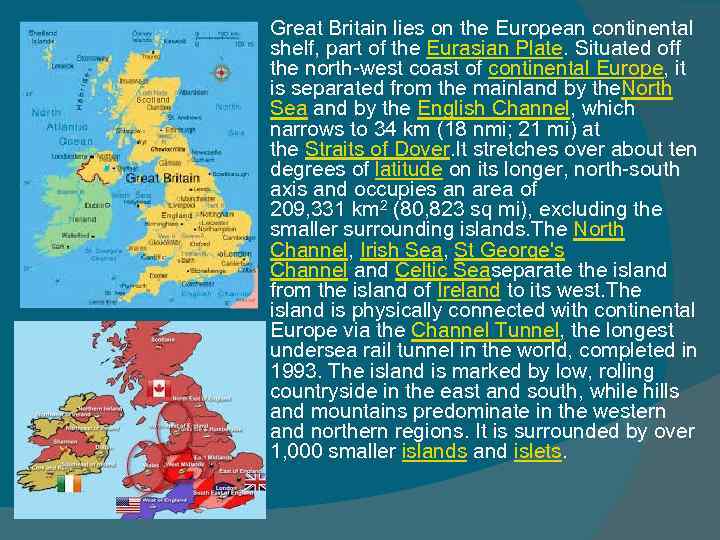
Great Britain lies on the European continental shelf, part of the Eurasian Plate. Situated off the north-west coast of continental Europe, it is separated from the mainland by the. North Sea and by the English Channel, which narrows to 34 km (18 nmi; 21 mi) at the Straits of Dover. It stretches over about ten degrees of latitude on its longer, north-south axis and occupies an area of 209, 331 km 2 (80, 823 sq mi), excluding the smaller surrounding islands. The North Channel, Irish Sea, St George's Channel and Celtic Seaseparate the island from the island of Ireland to its west. The island is physically connected with continental Europe via the Channel Tunnel, the longest undersea rail tunnel in the world, completed in 1993. The island is marked by low, rolling countryside in the east and south, while hills and mountains predominate in the western and northern regions. It is surrounded by over 1, 000 smaller islands and islets.
The English Channel is thought to have been created between 450, 000 and 180, 000 years ago by two catastrophic glacial lake outburst floods caused by the breaching of the. Weald -Artois Anticline, a ridge that held back a large proglacial lake, now submerged under the North Sea. Around 10, 000 years ago, during the Devensian glaciation with its lower sea level, Great Britain was not an island, but an upland region of continental northwestern Europe, lying partially underneath the Eurasian ice sheet. The sea level was about 120 metres (390 ft) lower than today, and the bed of the North Sea was dry and acted as a land bridge, now known as Doggerland, to the Continent. It is generally thought that as sea levels gradually rose after the end of the last glacial period of the current ice age, Doggerland became submerged beneath the North Sea, cutting off what was previously the British peninsula from the European mainland by around 6500 BC
There are two large islands and several smaller ones, which lie in the north-west coast of Europe. Collectively they are known as the British Isles. The largest island is called Great Britain. The smaller one is called Ireland. Great Britain is separated from the continent by the English Channel. The country is washed by the waters of the Atlantic Ocean. Great Britain is separated from Belgium and Holland by the North Sea, and from Ireland - by the Irish Sea.
The economic geography of the Great Britain reflects its high position in the current economic league tables, as well as reflecting its long history as a trading nation and as an imperial power. This in turn was built on exploitation of natural resources such as coal and iron ore. Much has changed since Bevan's speech (below) in 1945, with the coalfields largely deserted and the Empire relinquished. With its dominant position gone, the UK economic geography is increasingly shaped by the one constant: it is a trading nation.
Since the Enclosure Acts of the eighteenth century, the UK's uplands (including Wales and the Scottish Highlands) have largely been associated with animal husbandry andforestry. However, by the time of the Enclosure Acts, most of lowland Britain was already enclosed by processes such as assarting or illegal, but tolerated, piecemeal enclosure. However, evidence of the former open field system of agriculture can still be seen in some parts of the landscape, such as in the indentations remaining from boundary ditches of the former farming strips. Enclosure, in turn, led to intensification. Most UK agriculture is intensive and highly mechanised, with the use of chemical fertilisers and insecticides routine. By European standards it is very efficient, although that does not necessarily make it profitable.
The UK's primary industry sector was once dominated by the coal industry, heavily concentrated in south Wales, Midlands (north and south Staffordshire, Derbyshire and. Nottinghamshire etc. ), Yorkshire, North East England (Northumberland Durham) and southern Scotland (Fife and Midlothian). The number of pits and miners have been slashed, and output fell by more than 75% between 1981 and 2003. The remaining pits produced 17. 2 million tonnes of oil equivalent in 2003, making the UK the 15 th largest coal producing nation, compared with 4 th in 1981, according to the BP Statistical Review of World Energy 2004. The major primary industry is North Sea oil. Its activity is concentrated on the east coast of Scotland North East England. The waters in the North Sea off the east coast of Scotland contain nearly half of the UK's remaining oil reserves, and a quarter of reserves are located in the North Sea near the Shetland Islands. As of January 2004, the UK had proven crude oil reserves of 4. 7 billion barrels (750, 000 m³) including onshore reserves, according to the Oil and Gas Journal.
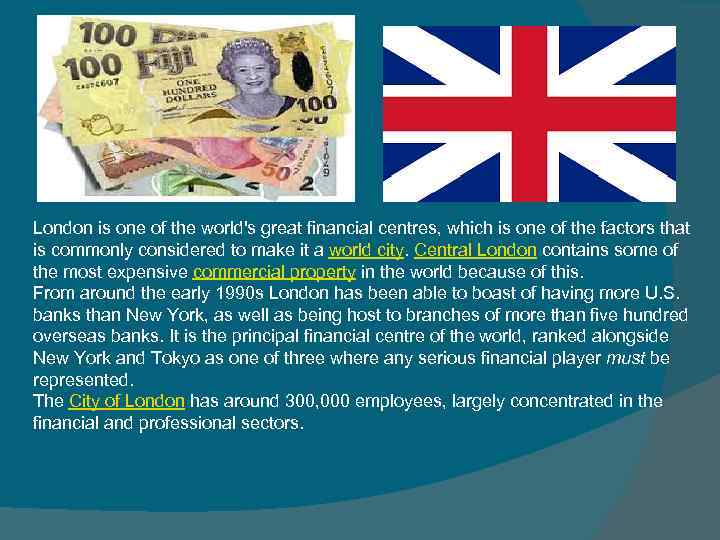
London is one of the world's great financial centres, which is one of the factors that is commonly considered to make it a world city. Central London contains some of the most expensive commercial property in the world because of this. From around the early 1990 s London has been able to boast of having more U. S. banks than New York, as well as being host to branches of more than five hundred overseas banks. It is the principal financial centre of the world, ranked alongside New York and Tokyo as one of three where any serious financial player must be represented. The City of London has around 300, 000 employees, largely concentrated in the financial and professional sectors.

Thank you for your attention
Скачать презентацию GREAT BRITAIN geographical position and economy BT 13
Great Br.pptx