


Great Auk By Evelina Rosiuk
" In June of 1840, three sailors hailing from the Scottish island of St. Klida landed on the craggy ledges of a nearby seastack, known as Stac-an-Armin. As they climbed up the rock, they spotted a peculiar bird that stood above the puffins and gulls and other seabirds. . . "
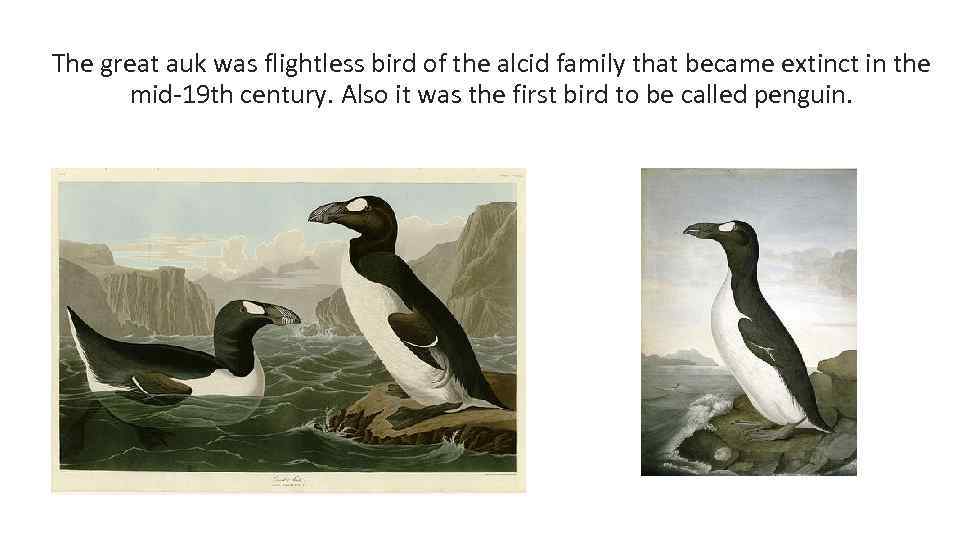
The great auk was flightless bird of the alcid family that became extinct in the mid-19 th century. Also it was the first bird to be called penguin.
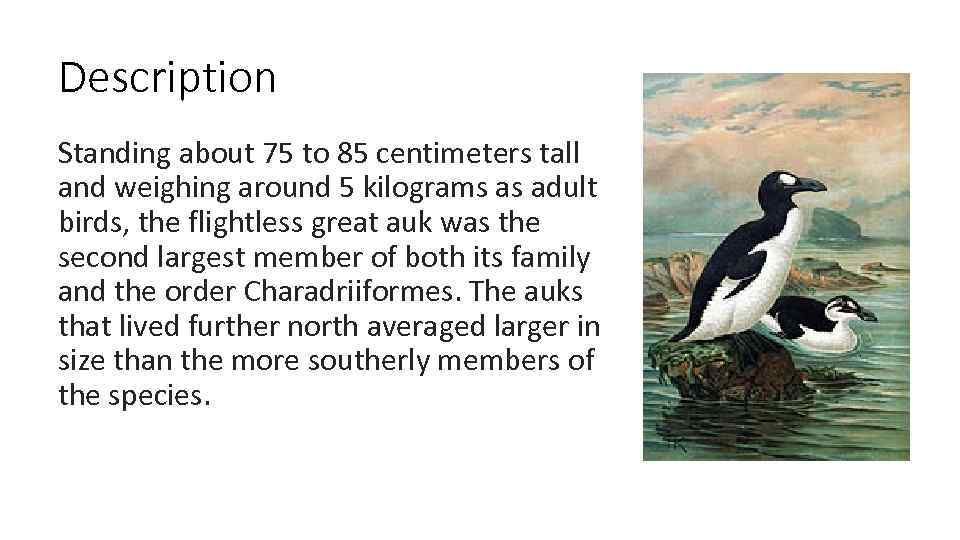
Description Standing about 75 to 85 centimeters tall and weighing around 5 kilograms as adult birds, the flightless great auk was the second largest member of both its family and the order Charadriiformes. The auks that lived further north averaged larger in size than the more southerly members of the species.
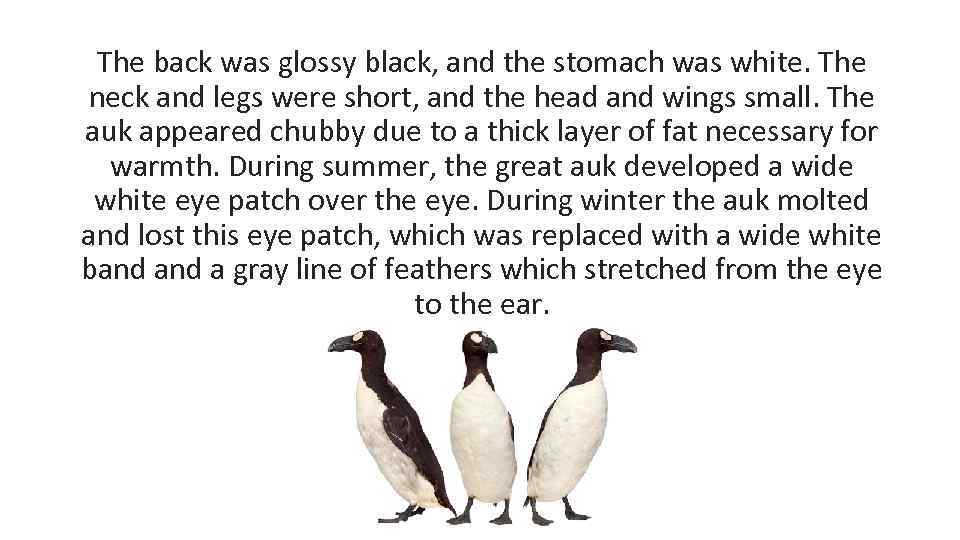
The back was glossy black, and the stomach was white. The neck and legs were short, and the head and wings small. The auk appeared chubby due to a thick layer of fat necessary for warmth. During summer, the great auk developed a wide white eye patch over the eye. During winter the auk molted and lost this eye patch, which was replaced with a wide white band a gray line of feathers which stretched from the eye to the ear.
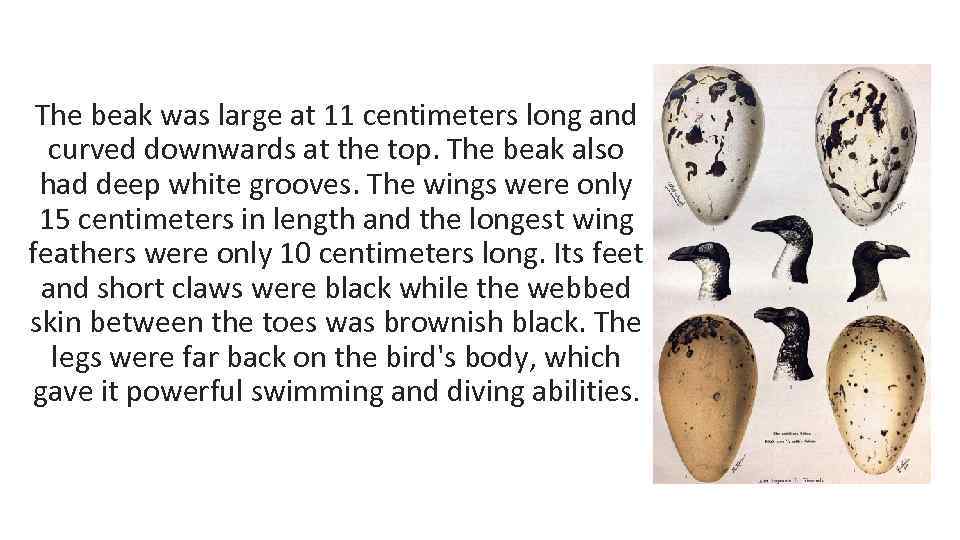
The beak was large at 11 centimeters long and curved downwards at the top. The beak also had deep white grooves. The wings were only 15 centimeters in length and the longest wing feathers were only 10 centimeters long. Its feet and short claws were black while the webbed skin between the toes was brownish black. The legs were far back on the bird's body, which gave it powerful swimming and diving abilities.
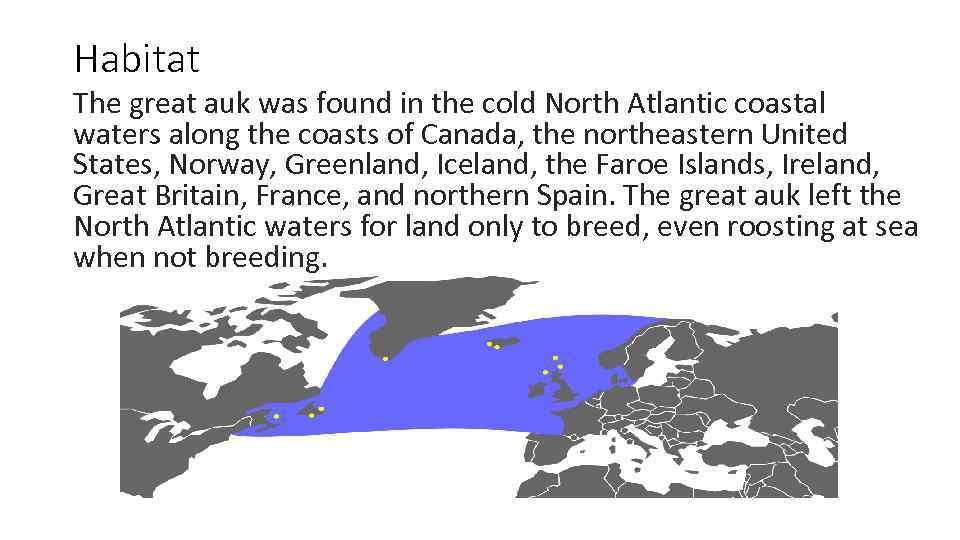
Habitat The great auk was found in the cold North Atlantic coastal waters along the coasts of Canada, the northeastern United States, Norway, Greenland, Iceland, the Faroe Islands, Ireland, Great Britain, France, and northern Spain. The great auk left the North Atlantic waters for land only to breed, even roosting at sea when not breeding.
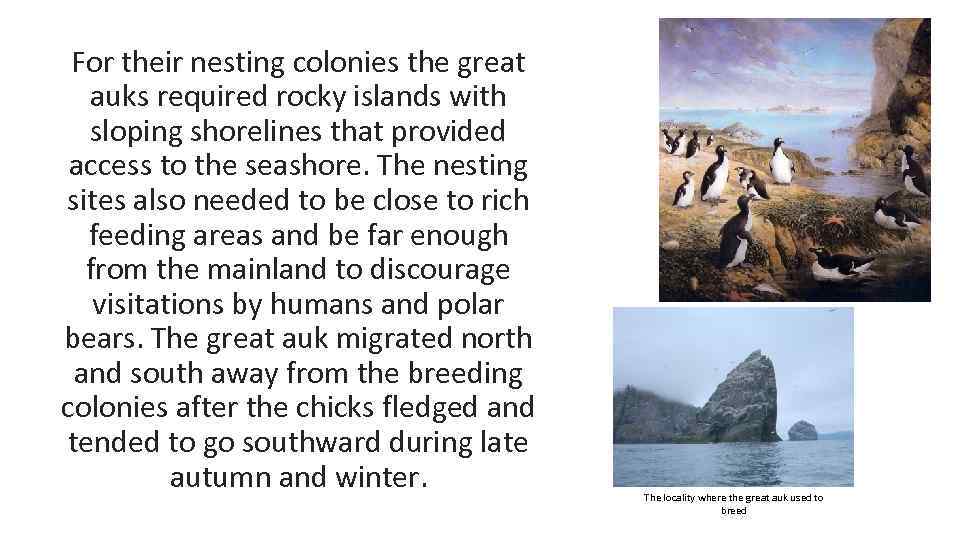
For their nesting colonies the great auks required rocky islands with sloping shorelines that provided access to the seashore. The nesting sites also needed to be close to rich feeding areas and be far enough from the mainland to discourage visitations by humans and polar bears. The great auk migrated north and south away from the breeding colonies after the chicks fledged and tended to go southward during late autumn and winter. The locality where the great auk used to breed
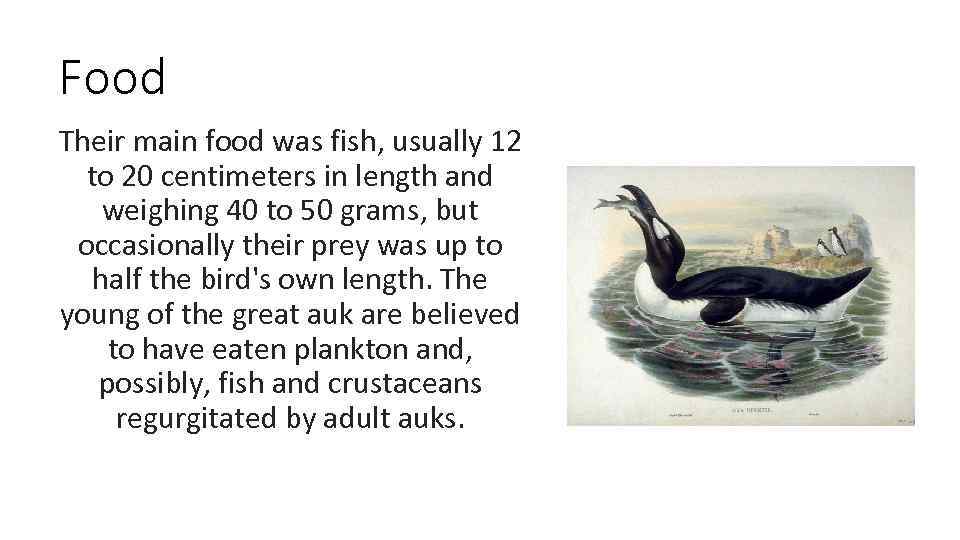
Food Their main food was fish, usually 12 to 20 centimeters in length and weighing 40 to 50 grams, but occasionally their prey was up to half the bird's own length. The young of the great auk are believed to have eaten plankton and, possibly, fish and crustaceans regurgitated by adult auks.
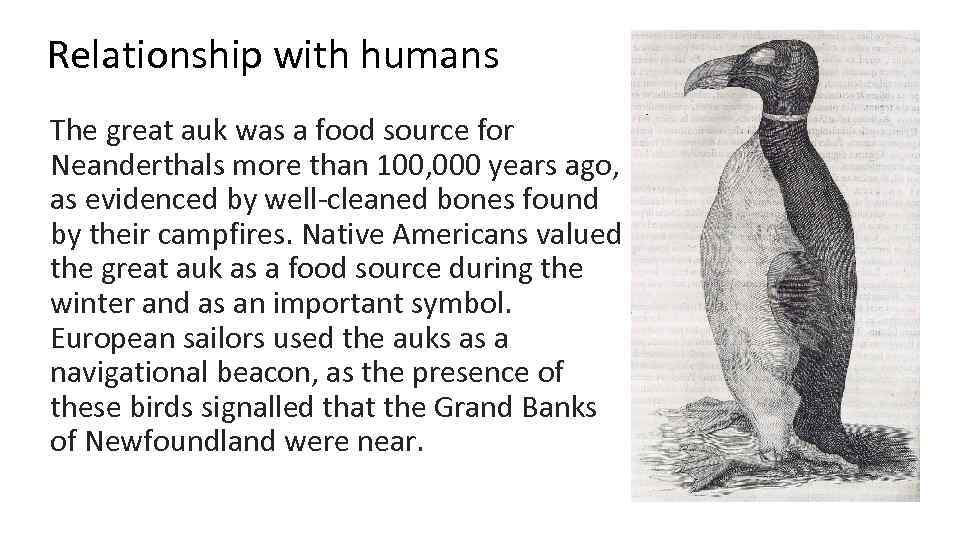
Relationship with humans The great auk was a food source for Neanderthals more than 100, 000 years ago, as evidenced by well-cleaned bones found by their campfires. Native Americans valued the great auk as a food source during the winter and as an important symbol. European sailors used the auks as a navigational beacon, as the presence of these birds signalled that the Grand Banks of Newfoundland were near.
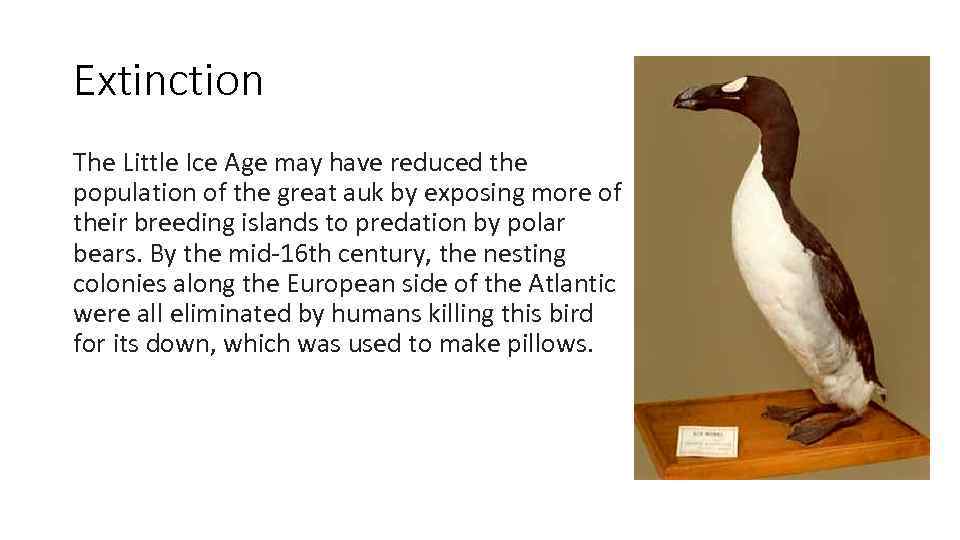
Extinction The Little Ice Age may have reduced the population of the great auk by exposing more of their breeding islands to predation by polar bears. By the mid-16 th century, the nesting colonies along the European side of the Atlantic were all eliminated by humans killing this bird for its down, which was used to make pillows.
The last colony of great auks lived on the Great Auk Rock off Iceland. This islet was a volcanic rock surrounded by cliffs which made it inaccessible to humans, but in 1830 the islet submerged after a volcanic eruption, and the birds moved to the nearby island of Eldey, which was accessible from a single side. The colony was initially discovered in 1835. Museums, desiring the skins of the auk for preservation and display, quickly began collecting birds from the colony.
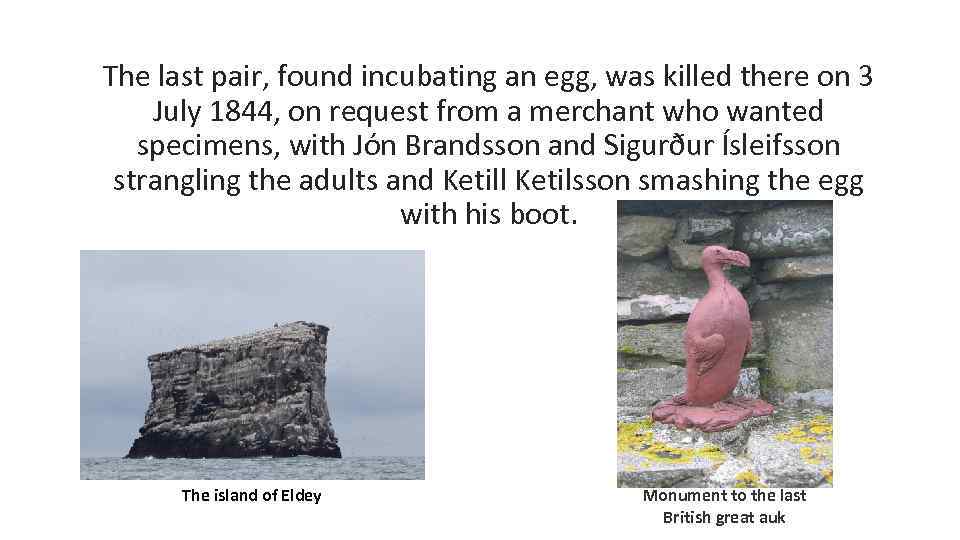
The last pair, found incubating an egg, was killed there on 3 July 1844, on request from a merchant who wanted specimens, with Jón Brandsson and Sigurður Ísleifsson strangling the adults and Ketill Ketilsson smashing the egg with his boot. The island of Eldey Monument to the last British great auk
