 Скачать презентацию Grapevine Genetics Genomics and Molecular Breeding for Disease
a745af6e0cb2d1737968898e193e03e3.ppt
- Количество слайдов: 1



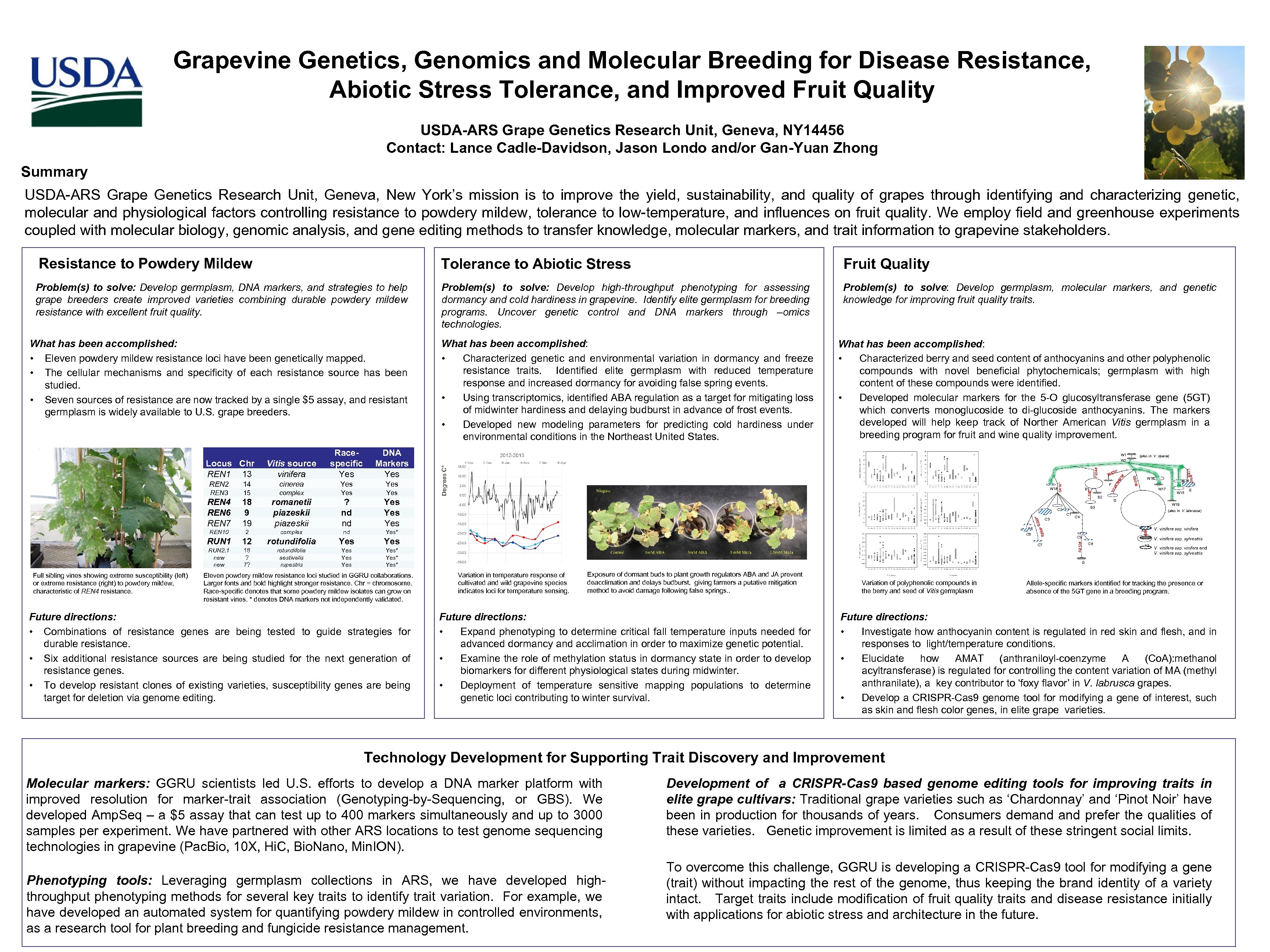
Grapevine Genetics, Genomics and Molecular Breeding for Disease Resistance, Abiotic Stress Tolerance, and Improved Fruit Quality USDA-ARS Grape Genetics Research Unit, Geneva, NY 14456 Contact: Lance Cadle-Davidson, Jason Londo and/or Gan-Yuan Zhong Summary USDA-ARS Grape Genetics Research Unit, Geneva, New York’s mission is to improve the yield, sustainability, and quality of grapes through identifying and characterizing genetic, molecular and physiological factors controlling resistance to powdery mildew, tolerance to low-temperature, and influences on fruit quality. We employ field and greenhouse experiments coupled with molecular biology, genomic analysis, and gene editing methods to transfer knowledge, molecular markers, and trait information to grapevine stakeholders. Resistance to Powdery Mildew Tolerance to Abiotic Stress Fruit Quality Problem(s) to solve: Develop germplasm, DNA markers, and strategies to help grape breeders create improved varieties combining durable powdery mildew resistance with excellent fruit quality. Problem(s) to solve: Develop high-throughput phenotyping for assessing dormancy and cold hardiness in grapevine. Identify elite germplasm for breeding programs. Uncover genetic control and DNA markers through –omics technologies. Problem(s) to solve: Develop germplasm, molecular markers, and genetic knowledge for improving fruit quality traits. What has been accomplished: • Eleven powdery mildew resistance loci have been genetically mapped. • The cellular mechanisms and specificity of each resistance source has been studied. • Seven sources of resistance are now tracked by a single $5 assay, and resistant germplasm is widely available to U. S. grape breeders. What has been accomplished: • Characterized genetic and environmental variation in dormancy and freeze resistance traits. Identified elite germplasm with reduced temperature response and increased dormancy for avoiding false spring events. • Using transcriptomics, identified ABA regulation as a target for mitigating loss of midwinter hardiness and delaying budburst in advance of frost events. • Developed new modeling parameters for predicting cold hardiness under environmental conditions in the Northeast United States. REN 10 2 complex nd Yes* RUN 1 12 rotundifolia Yes RUN 2. 1 new 18 ? 7? rotundifolia aestivalis rupestris Yes Yes* Eleven powdery mildew resistance loci studied in GGRU collaborations. Larger fonts and bold highlight stronger resistance. Chr = chromosome. Race-specific denotes that some powdery mildew isolates can grow on resistant vines. * denotes DNA markers not independently validated. Future directions: • Combinations of resistance genes are being tested to guide strategies for durable resistance. • Six additional resistance sources are being studied for the next generation of resistance genes. • To develop resistant clones of existing varieties, susceptibility genes are being target for deletion via genome editing. C 5 C 6 C 7 B 2 C 1 W 14 W 17 W 15 E D W 19 B 3 C 2 C 3 # P 234# Yes Yes 01 ? nd nd *N 4 romanetii piazeskii 39 18 9 19 B 1 W 16 Y 1 REN 4 REN 6 REN 7 W 18 L 136* Yes 35* W 4 F (also in V. labrusca) C 4 A 1 C 9 R 413# Yes C 414* complex 8* 15 Q 28 Yes * S 256 Yes Degrees C° cinerea REN 3 Full sibling vines showing extreme susceptibility (left) or extreme resistance (right) to powdery mildew, characteristic of REN 4 resistance. 14 (also in V. riparia) T 394# REN 2 W 1 W 2 W 392* L 190# Vitis source vinifera DNA Markers Yes # G 301 Locus Chr REN 1 13 Racespecific Yes What has been accomplished: • Characterized berry and seed content of anthocyanins and other polyphenolic compounds with novel beneficial phytochemicals; germplasm with high content of these compounds were identified. • Developed molecular markers for the 5 -O glucosyltransferase gene (5 GT) which converts monoglucoside to di-glucoside anthocyanins. The markers developed will help keep track of Norther American Vitis germplasm in a breeding program for fruit and wine quality improvement. C 8 A 2 V. vinifera ssp. vinifera V. vinifera ssp. sylvestris V. vinifera ssp. vinifera and V. vinifera ssp. sylvestris G Variation in temperature response of cultivated and wild grapevine species indicates loci for temperature sensing. Exposure of dormant buds to plant growth regulators ABA and JA prevent deacclimation and delays budburst, giving farmers a putative mitigation method to avoid damage following false springs. . Future directions: • Expand phenotyping to determine critical fall temperature inputs needed for advanced dormancy and acclimation in order to maximize genetic potential. • Examine the role of methylation status in dormancy state in order to develop biomarkers for different physiological states during midwinter. • Deployment of temperature sensitive mapping populations to determine genetic loci contributing to winter survival. Variation of polyphenolic compounds in the berry and seed of Vitis germplasm Allele-specific markers identified for tracking the presence or absence of the 5 GT gene in a breeding program. Future directions: • Investigate how anthocyanin content is regulated in red skin and flesh, and in responses to light/temperature conditions. • Elucidate how AMAT (anthraniloyl-coenzyme A (Co. A): methanol acyltransferase) is regulated for controlling the content variation of MA (methyl anthranilate), a key contributor to ‘foxy flavor’ in V. labrusca grapes. • Develop a CRISPR-Cas 9 genome tool for modifying a gene of interest, such as skin and flesh color genes, in elite grape varieties. Technology Development for Supporting Trait Discovery and Improvement Molecular markers: GGRU scientists led U. S. efforts to develop a DNA marker platform with improved resolution for marker-trait association (Genotyping-by-Sequencing, or GBS). We developed Amp. Seq – a $5 assay that can test up to 400 markers simultaneously and up to 3000 samples per experiment. We have partnered with other ARS locations to test genome sequencing technologies in grapevine (Pac. Bio, 10 X, Hi. C, Bio. Nano, Min. ION). Phenotyping tools: Leveraging germplasm collections in ARS, we have developed highthroughput phenotyping methods for several key traits to identify trait variation. For example, we have developed an automated system for quantifying powdery mildew in controlled environments, as a research tool for plant breeding and fungicide resistance management. Development of a CRISPR-Cas 9 based genome editing tools for improving traits in elite grape cultivars: Traditional grape varieties such as ‘Chardonnay’ and ‘Pinot Noir’ have been in production for thousands of years. Consumers demand prefer the qualities of these varieties. Genetic improvement is limited as a result of these stringent social limits. To overcome this challenge, GGRU is developing a CRISPR-Cas 9 tool for modifying a gene (trait) without impacting the rest of the genome, thus keeping the brand identity of a variety intact. Target traits include modification of fruit quality traits and disease resistance initially with applications for abiotic stress and architecture in the future.
Скачать презентацию Grapevine Genetics Genomics and Molecular Breeding for Disease
a745af6e0cb2d1737968898e193e03e3.ppt